
International Research Journal of Engineering and Technology (IRJET) e-ISSN: 2395-0056
Volume: 12 Issue: 12 | Dec 2025 www.irjet.net p-ISSN: 2395-0072
International Research Journal of Engineering and Technology (IRJET) e-ISSN: 2395-0056
Volume: 12 Issue: 12 | Dec 2025 www.irjet.net p-ISSN: 2395-0072
Mr. Dinesh H. Gore1 , Dr. Satyajit M. Deshmukh2
1,Student - Department of Chemical Engineering, School of Engineering and Applied Sciences, University of Mumbai (Kalyan Sub Centre), Maharashtra, India. Author Affiliation & Address 2,Second Professor - Department of Chemical Engineering, School of Engineering and Applied Sciences, University of Mumbai (Kalyan Sub Centre), Maharashtra, India.
Abstract - Process safety studies play a crucial role in the specialty chemicals, agrochemicals, pharmaceuticals, and petrochemicals industries, spanning from the development phase of new molecules to their commercial implementation. The process safety team conducted a literature review on explosive materials and processes during the initial stages of molecular development. Process safety personnel initially identify and comprehend potential hazards by analyzing historical incident data. This involves a systematic review of relevant literature,includingscientificpapersandprofessional articles, focusing onvarious types of hazards such aschemical process and reaction risks, health hazards, explosion risks, dust hazards, and the flammability of combustible gases and vapors, as well as environmental hazards.
This review paper outlines the initial identification of hazards conducted through a literature survey, data from Bretherick’s handbook, and an analysis of previous accident history. Outlined the hazards associated with toxicity and flammability, along with a risk assessment of these hazards. Assessed the toxicity risks of both single components and multicomponent mixtures utilizing the LD50, LC50, and TLV equations. Analyzed the flam ability risks of mixtures through the application of LFL and LOC equations. A process safety strategy during the R&D phase of reactions is essential for attaining operational excellence. This approach enables businesses in process industries to identify and mitigate risks throughout their production lifecycle, effectivelymanagingor eliminating hazards within their facilities while adhering to the highest safety standards.
Key Words: Process safety, Process Safety Incident, Literature review, Toxicity hazard, Flammability hazard etc
Number of products of the chemical, pharmaceutical, agrochemicals&petrochemicalsindustryisproducedusing potentially hazardous reactions. The toxic and flammable hazardous substance involved in the industry process. A flammablehazardreferstoamaterialorsubstancethatcan easily catch fire and burn when exposed to an ignition source, such as heat, sparks, or opens flames. These substancesaretypicallyvolatileandhavelowflashpoints,
meaningtheycanigniteatrelativelylowtemperatures.New materials, chemicals, and processes are often tested, and manyofthesemayinvolvesubstancesthatareflammableor poseothercombustion-relatedhazards.Toxicityhazardsare a significant concern in many industrial, scientific, and research environments. Early identification, a robust risk assessment process, and implementation of appropriate controlmeasuresareessentialtopreventingharmtopeople, animals,andtheenvironment.Theinitialstageofresearch anddevelopmentfor newproductsinvolvesassessing the potential hazards and evaluating the feasibility of these hazardsthroughexperimentalinvestigationsofallreactions occurringintheproductionprocesses,whichcanbequite costly. Early phase of research & development work, to identify reagents are acceptable to use in a scale process requires the practical assessment of specific hazardous properties.Energeticmaterialslikenitrocompound,diazo compound, propellants and pyrotechnic compositions are highexplosivehazards,resultingfromthehighquantitiesof heatandgasthatcanbereleaseduponrapiddecomposition. These can be identified in early phase and categories risk assessment to determining the likelihood or severity of unwantedhazards.[3]Initiatedtheprocesssafetystudyin early phase of the research & development work which helped to identify hazardous material properties like explosive, flammable, toxic etc. Eliminated the hazardous materials from the process, substituted the hazardous materialwithnon-hazardousmaterialsforthedesignofthe inherently safe process at R&D stage. Based on the hazardous materials risk like explosive, toxic, flammable used the appropriate PPEs, provided appropriate administrative controls and appropriate engineering controls for the inherently safe design process for commercialscale
Many process safety incidents occurred due to hazardous, explosive materials and reaction process in chemical, pharmaceutical,agrochemicals&petrochemicalsindustries andchemicaloperations,suchfires,explosionsandleaksetc. Most incidents were due to hazard awareness & identification, design, controls, safeguards, operating procedures and layers of protection, safety culture, and preventativemaintenance.Listoffewcontributingfactorsfor
International Research Journal of Engineering and Technology (IRJET) e-ISSN: 2395-0056
Volume: 12 Issue: 12 | Dec 2025 www.irjet.net p-ISSN: 2395-0072
theprocesssafetyincidentslikesafetyculturemissing,PHA datanotavailable,mechanicalintegrityetc.[3]
OnMarch13,2013,disastrousexplosionoccurredatAarti Drugs,Boisar,Maharashtra,India,whichledfivefatalitiesand 18 injuries. It was reported that the explosion happened during a nitration reaction, as brownish fumes were seen prior to the blast then some additional minor blasts continuedafterthefirestarted.Manufacturedmethylnitro imidazole, a chemical used in the production of pharmaceuticals.Theadministrativeofficewherethevictims wereseatedwastooclosetothe2000kgofchemicaltank whichexploded.Sevenpeoplewerechargedwithculpable homicidefornegligencerelatedtothisevent,includingsome seniorauthorities.
The unnoticed increase in temperature within the chemicaltankwasoneofthecontributingfactors.Thecauses forthisincidentincludeapoorsafetyculture,facilitysiting, hazardawarenessanddesignbasedonpressreportsofthe incident.[3]
OnJuly12,2018,aseriesofsevendisastrousexplosion occurredwithin10minutesatYibinHengdaTechnologyCo., Yibin,SichuanProvince,Chinawhichled19fatalitiesand12 injuries.Threebuildingswerereducedtosteelframesand windows of nearby buildings were shattered due to the explosions.Thecompanymanufactures300TPAofbenzoic acid,and2000TPAof5-nitroisophthalicacid,formedicines anddyes.Aftertheincidentoccurred,15people,including thelegalrepresentative,werearrested.
The workers lacked basic knowledge of safe operating practicesinthechemicalindustry.Adeputychiefreportedly hadonlystudiedforthreeyearsinanelementaryschool.The contributingcauseoftheaccidentwasaworkermisplacing unlabeledchemicalsintoadehydrationpool,causingafire and explosion. The causes of the incident include a poor safety culture, lack of personnel training and certification, hazardawareness,negligenceoflaw,illegalproductionand regulatoryoversight.[4]
OnMarch21,2019,acatastrophicexplosionoccurredat Tianjiayi Chemical Co., Ltd., Xiangshui county, China, that caused78deathsandinjuredmorethan617individuals,with apropertylossofasmuchasUS$100million.Anexplosion craterwithadiameterof98mwasgenerated.Accordingto an on-site survivor, a warehouse used for storing dinitrobenzene (DNB) and recovering off-spec or substandard nitro compounds was believed to be the explosionsite,whichcaughtfire.Basedontheresultsofthe consequenceanalysisperformedbythreemethodologies,it canbeconcludedthattheTianjiayiChemicalCo.warehouse
not only stored a substantially large quantity of dinitrobenzene but was also located too close to adjacent structureswithoutanadequateseparationdistance.Judging bytheeffectofexplosiveblastonpersonnel,afatalityradius wasdeterminedtobeabout400mfromtheexplosioncenter. [5]
Process safety extensive literature review has been carried out about process safety education. Process safety literature model preliminary identifies and understands potential hazards, chemical process and reaction hazards, health hazards, explosion hazards and dust hazards, and combustible gas and vapor flammability, environmental hazardsandpastincidentsdatathroughthesystematizethe literaturereviewandinvestigatedscientificpapersaswellas professionalarticlesandso-calledgreyliterature.
Thehazardousmaterialsinformationwasextractedfrom both scientific and professional literature. Google Scholar, Science Direct, and Web of Science (WOS) were used to searchon the internet forscientific literature.Bretherick’s handbookdata,conferencepapers,articlesandrecordsfrom reputedorganizationswereusedtosearchforprofessional literature. Few reputed professional process safety organizations such as Identification Board (CSB), the Loss Prevention and Safety Promotion Symposium series, the Center of Chemical Process Safety (CCPS), UK Health and SafetyExecutive (HSE), Dutch National Institute for Public HealthandtheEnvironment(RIVM)andAmericanInstitute ofChemicalEngineers(AICHE).[6]
Volume: 12 Issue: 12 | Dec 2025 www.irjet.net p-ISSN: 2395-0072
Safety performance and sustainability Willey, 1999. Knegtering and Pasman, 2009, Pfeil et al.,2013, Schonbucheretal.,2013
Risk analysis and Management LundinandJonsson,2002
Processsafetyeducation McKay et al., 2011, Schonbucher et al.,2013
Assetintegrityandreliability, Chemistry related courses, Design,Hazardidentification and risk analysis, Human factor,Incidentmanagement, Risk management, Safety culture, Process safety managementknowledge
Chemistry related courses, Design, Fire and explosion studies,Hazardidentification and risk analysis, Risk decision making, Security, Safetyperformanceindictor
Assetintegrityandreliability, Chemistry related courses, Design, Fire and explosion studies,Hazardidentification and risk analysis, Human factor,Incidentmanagement, Risk management, Safety culture,Safetymanagement
Mannan,2012, Amyotte, 2013, Pasmanetal.,2014
Mannan,etal.,2012
Pasmanetal.,2014
3.2 Process safety research found in scientific literature
Research in the literature on process safety is a crucial strategy for encouraging the advancement of cutting-edge technology and scientific understanding in the process industry. Process safety research contributes to the development of solutions for existing industrial problems, whichadvancestheprocessindustry.Thestudyofprocess safetyresearchincludesequipmentdesign,chemistry,human factors, hazard identification and risk analysis, and asset integrityandreliability.AccordingtoGibson(1999),Schmidt (2013), and Meyer (2015), these research areas foster processsafetycompetencies,whichareessentialforprevent major&minoraccidentsintheprocessindustry.[6]
Table 2 -Processsafetyresearchdomainfoundin scientificliterature
Mannanetal.,1999
Safetymanagement Nesheim and Gressgard, 2014, Krause,2016
Hazardidentificationandrisk analysis, Incident management Vechotetal.,2014
Design,Hazardidentification andriskanalysis
Deeetal.,2015,Meyer,2015
Bretherick's Handbook of Reactive Chemical Hazards (6th edition),whichcoversthefullspectrumofrelevantpublished literatureupto1999,isbynomeansareplacementforthis succinct synopsis. Bretherick’s Handbook is extensive and may be perceived as unwieldy, potentially deterring individualswhooughttobeacquaintedwithitssignificant material.Anoverviewofsometypicalorganicandinorganic explosiondangersisprovided,includingthoseinvolvingthe nitro, hydrazide, and azido groups, the perchlorate ion, peroxides,acetylides,andfulminates.[7]
Thepotentialrisksthatmaterialsorchemicalsmayposeto theenvironment,wildlife,orhumanhealthbecauseoftheir toxicqualitiesareknownastoxicityhazards.Theseriskscan
International Research Journal of Engineering and Technology (IRJET) e-ISSN: 2395-0056
Volume: 12 Issue: 12 | Dec 2025 www.irjet.net p-ISSN: 2395-0072
result from coming into touch with chemicals, biological agents, or physical agents that can have negative consequenceswhenconsumed,inhaled,orcomeintocontact with the skin, among other exposures. The material, concentration, exposure time, and the particular vulnerabilities of the organism impacted can all effect toxicity.
Commoncategoriesoftoxicityhazards:
1. ChemicalToxicity
2. PhysicalToxicity
3. BiologicalToxicity
4. EnvironmentalToxicity
RoutesofExposure:
Inhalation:Breathingintoxicgases,dust,fumes,or vapors can affect the respiratory system and the body’sabilitytofunction.
Ingestion:Swallowingtoxicsubstancescandamage the gastrointestinal tract or be absorbed into the bloodstream.
Dermal Contact: Skin contact with hazardous chemicalscanleadtoburns,rashes,orabsorptionof toxinsintothebloodstream.
Injection: Less common, but some hazardous substances can enter the body through puncture woundsorothermeans.
4.1 Toxicity Severity:
Toxicity severity calculation involves determining the potential harm a substance can cause based on its concentration,exposureroute,andthedurationofexposure. This process typically uses standardized measures and modelstoestimatetheseverityofatoxicsubstance’seffects onhealthortheenvironment.
Followingkeyfactorsintoxicityseverity:
1.Dose:Theamountofthetoxicsubstancethatanorganism isexposedto.
Thedoseunitsdependonthemethodofdelivery.Thedosage fordrugsthatareinjectedorconsumeddirectlyintothebody isexpressedinmilligramsoftheagentperkilogramofbody weight.Thismakesitpossibleforresearcherstoextrapolate findingsfromlittleanimals,likemice,whohavebodyweight fractionsofakilogramtopeople,whoweighroughly70kg for men and 60 kg for women. The dosage for gaseous airborne chemical is expressed in milligrams of agent per cubicmeterofair(mg/m3)orpartspermillion(ppm).
2 ExposureRoute:Thewaythesubstanceentersthebody throughinhalation,ingestion,injectionanddermal.
3. Exposure Duration: The length of time an organism is exposedtothetoxicsubstance.
Acuteexposure-Short-termexposure,typicallylessthan24 hours.
Chronicexposure-Long-term,oftenrepeatedexposureover monthsoryears.
Sub-chronicexposure:Intermediate-termexposure,typically 1to90days.
LDisknownasLethalDoseistheamountofsubstancethatis testedandcanresultinthedeathofatestanimal.Mostoften availableinsafetydatasheetsprovidedbychemicalsupplier. LD50isthesingledoseofamaterial whichonthebasisof laboratory tests is expected to kill 50% of a group of test animal.LD50isexpressedintermsofmgorgofmaterialper kgofanimalbodyweight(mg/kgorg/kg)
Table3–Packaginggroupandhazardassignmentsofliquid
Example- 1: Omkar is exposed to phenol when opening a flange and it splashed all over his body. A source model determinedthat0.5kgwasreleasedandassumedthatallofit splashedontheperson.CalculatetheLD50dosebasedonthe omkarweightof105kgs.
Solution:TheLD50valuereportedintheFisherscientificSDS is630mg/kg.
LD50=630mg/kg*105kg=66150mg=0.066kg
LD50valueis0.066kgandpersonnelwereexposedto0.5kg. i.ePhenolisahighlytoxicdermalhazard.
LCisknownasLethalConcentrationofagas,vapor,mistthat istestedandcanresultinthedeathofatestanimal.TheLC50 isexpressedaspartsofmaterialpermillionpartsofair,by volume (ppm) for gases and vapors or as micrograms of materialperliterofair(micro-g/L)ormilligramsofmaterial percubicmeterofair(mg/m3)fordustsandmistsaswellas forgasesandvapors.
International Research Journal of Engineering and Technology (IRJET) e-ISSN: 2395-0056
Volume: 12 Issue: 12 | Dec 2025 www.irjet.net p-ISSN: 2395-0072
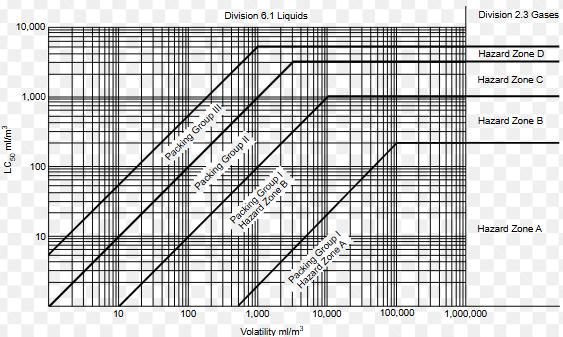
Inhalationtoxicityreferstothepotentialforasubstance to cause harm when inhaled, which can result in various acute or chronic health effects depending on the chemical properties, exposure levels, and the duration of exposure. Whenassessingtheriskofinhalationtoxicityforhazardous materials,packinggroupsandhazardouszonesareusedas part of classification systems to ensure proper handling, transportation,andsafetyprecautions.
Theminimumvalueontheresponseversusdosecurveis referredtoasthethresholddose.TheAmericanConference of Governmental Industrial Hygienists (ACGIH) has set thresholddosesknownasthresholdlimitvalues(TLVs)for numerous chemical substances. These TLVs represent airborne concentration levels that are considered safe, indicating that no significant adverse health effects are anticipatedoveraworker'slifetime.Thisexposureislimited tostandardworkinghours,specificallyeighthoursaday,five days a week. Previously, the TLV was referred to as the maximum allowable concentration (MAC). Occupational SafetyandHealthAdministration(OSHA)hasestablisheda specific threshold dose known as a permissible exposure level(PEL).Acommonlyreferencedquantityisthelevelthat posesanimmediatelydangeroustolifeandhealth(IDLH).It is essential to avoid any exposure to this level or higher underallcircumstances.
TherearethreedifferenttypesofTLV–
1
2
3
4
Table4–Packaginggroupandhazardassignmentsofliquid
Example-2:DeterminethetoxicityofMethylIsocyanate?
Solution:Toxicityisalsofunctionofvaporpressure
Vaporpressure@25°C=61.5kPa
Boilingpoint=39°C Volatility(ml/m3)(vol%)=(Pvap *106)/101.325 (01)
V=606,958ml/m3
Byreferringfigure1,
LC50 = 40 ppm (Hazard Zone A, based on the packaging groupandhazardassignment)
4.4.1 Threshold LimitValue– Timeweightedaverage(TLVTWA) - The time-weighted average for a standard 8-hour workdayora40-hourworkweekisdesignedtoensurethat mostworkerscanbeexposedtoitconsistently,dayafterday, without experiencing negative effects. Temporary exceedancesofthislimitarepermissibleaslongastheyare balancedbyperiodsofexposurebelowthelimit.
4.4.2 Threshold Limit Value - Short-term exposure limit (TLV-STEL)-Short-termexposurelimitreferstothehighest concentrationofasubstancethatworkersmaybeexposedto for a continuous duration of up to 15 minutes without experiencing severe irritation, long-term or irreversible damage to tissues, or a level of narcosis that significantly raises the risk of accidents, hinders self-rescue efforts, or substantially decreases work efficiency. It is important to notethatnomorethanfourexposureinstancesareallowed in a single day, with a minimum interval of 60 minutes betweeneachexposure,andthedailytime-weightedaverage (TLV-TWA)mustnotbesurpassed.
4.4.3 Threshold Limit Value-Ceiling - The concentration thatshouldnotbeexceeded,eveninstantaneously.
Thresholdlimitvaluedeterminedbyusingbelowequation, TLVsareexpressedforvaporsinppm(partspermillionby volume),mg/m3(milligramsofvaporpercubicmeterofair) and for dusts, mg/m3 or mppcf (millions of particles per cubicfootofair).
Concentrationinppm=Cppm=(22.4/M)(T/273)(1/P) (mg/m3) (02) =0.08205(T/PM)(mg/m3) (03)
Where,Tisthetemperatureindegreeskelvin,
International Research Journal of Engineering and Technology (IRJET) e-ISSN: 2395-0056
Volume: 12 Issue: 12 | Dec 2025 www.irjet.net p-ISSN: 2395-0072
Pistheabsolutepressureinatm, Misthemolecularweighting/mol
Table5–TLVsandPELSforafewofChemicalSubstances
4.4.4 Evaluating exposure to single toxicants substance by monitoring
A straightforward approach to assess worker exposures involvesthecontinuousmonitoringofairconcentrationsof toxic substances in the workplace. To calculate the timeweightedaverage(TWA)concentrationfromthecontinuous concentrationdataC(t),thefollowingequationisutilized.
=(1/8)
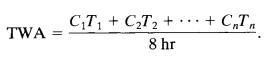
Where,Tistheexposuretimeinhour
Cistheconcentrationinppm
Example-3:Determinethe8-hrTWAworkerexposureifthe workerisexposedtobenzenevaporsasfollows:
4.4.5 Evaluating exposure to multiple toxicants substance by monitoring
In situations where multiple chemicals are present in the workplace,acommonapproachistoconsidertheeffectsof thesetoxicsubstancesascumulative.Theoverallexposure fromvarioustoxicants,eachwithdistinctTLV-TWAs,canbe calculatedusingafollowingequation.
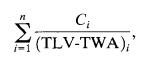
Where,nisthetotalnumberoftoxicants, Ciistheconcentrationofchemicaliwithrespecttotheother toxicants,
(TLV-TWA)istheTLV-TWAforchemicalspeciesi.
If the sum in equation 06 exceeds 1, then the workersare overexposed.
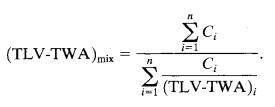
Where,nisthetotalnumberoftoxicants, Ciistheconcentrationofchemicaliwithrespecttotheother toxicants,
(TLV-TWA)istheTLV-TWAforchemicalspeciesi.
If the sum of the concentrations of the toxicants in the mixture exceeds this amount, then the workers are overexposed.
Example-4:Aircontains5ppmofbenzene(TLV-TWAof10 ppm),20ppmofdioxane(TLV-TWAof25ppm),and10ppm ofethylamine(TLV-TWAof5ppm).WhatisthemixtureTLVTWAandhasthislevelbeenexceeded?
Solution:Byusingequation06, (TLV-TWA)mix=(5/10)+(20/25)+(10/5) =3.3ppm
TWA=
BecausetheTLV-TWAforbenzeneis10ppm,theworkeris overexposed. Additional control measures need to be developed.
Because this quantity is greater than 1, The workers are overexposedunderthesecircumstances.
Byusingequation07, (TLV-TWA)mix=(5+20+10)/((5/10)+(20/25)+(10/5)) =10.6ppm
Thetotalmixtureconcentrationis5+20+10=35ppm.The workersareoverexposedunderthesecircumstances
International Research Journal of Engineering and Technology (IRJET) e-ISSN: 2395-0056
Volume: 12 Issue: 12 | Dec 2025 www.irjet.net p-ISSN: 2395-0072
4.4.6 Evaluating exposure to multiple toxic dust substance by monitoring
Toxicologicaltheoryindicatesthatthedustparticlesposing the highest risk to lung health typically fall within the respirable size range of 0.2 to 0.5 micrometers. Particles exceeding0.5micrometersgenerallydonotreachthelungs, whilethosesmallerthan0.2micrometerstendtosettletoo slowlyandarepredominantlyexhaled.
Dustevaluationcalculationsareconductedinthesameway asthoseforvolatilevapors.However,ratherthanemploying ppmastheunitofconcentration,itismorepracticaltouse mg/m3ormppcf(millionsofparticlespercubicfoot).
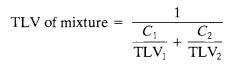
Where,Ciistheconcentrationofchemicaliwithrespectto theothertoxicants,
TLVistheforchemicalspeciesi.
Example-5:DeterminetheTLVforauniformmixtureofdusts containingthefollowingparticles?
Solution:Byusingequation08, (TLV-TWA)mix=1/((0.70/20)+(0.30/2.7)) =6.8mppcf
Special control measures will be required when the actual particlecountexceeds6.8mppcf.
4.5
Thefollowingacutetoxicscreeningcriteriaistypicallyused forsafetyscreening:
Emergency Response Planning Guidelines (ERPG) forallaircontaminants.
Immediately Dangerous to Life and Health levels (IDLH)establishedbyNIOSH
EmergencyExposureGuidanceLevels(EEGLs)and short-term public emergency guidance levels (SPEGLs) issued by the National Academy of Sciences/NationalResearchCouncil
Acute Exposure Guideline Level (AEGL) – a toxic endpointpromulgatedbytheUSEPAaspartofthe RiskManagementProcess(RMP)
Protective Action Criteria (PAC) – a database published by the US Department of Energy
containingERPG,AEGLandTemporaryEmergency Explosion Guideline (TEEL) values for hazardous chemicals.
Planning Guidelines (ERPG)
TheAmericanIndustrialHygieneAssociationlisted downasetofconcentrationvaluesforERPGthathas beenacceptedwithindustryandgovernment.
ERPG 1: This indicates the maximum airborne concentrationbelowwhichalltheindividualscanbe exposed up to 1 hour without experiencing any effectsotherthanmildhealtheffects.
ERPG 2: This indicates the maximum airborne concentrationbelowwhichalltheindividualscanbe exposed up to 1 hour without any serious health effectsthatcan reduce ordecreasetheirabilityto takeprotectiveaction.
ERPG 3: This indicates the maximum airborne concentrationbelowwhichalltheindividualscanbe exposedupto1hourwithoutdevelopinganylifethreateninghealtheffects.
DeterminetheERPGtoxicityvalueofthemixturebyusing belowequation,ERPGareexpressedforvaporsinppm(parts permillionbyvolume)
ERPGmixture= 1/ (yi/ERPGi) ____________(9)
Where, yi is the vapor fraction (Relative volatility) of individualcomponents
ERPGvaluesofindividualcomponents.
Example-6:CalculatetheequivalentERPG-3toxicityvalue for 50/50% ammonia (ERPG-3 = 1500 ppm) and chlorine (ERPG-3=20ppm)mixturestoredat25°C.
Solution:
Byusingequationno.09, ERPG-3mixture=1/((0.85/1500)+(0.15/20)) =124ppm
Chemicalindustryusednumberofflammablematerialswith large quantity of the flammable substance in the manufacturingprocess.Flammablematerialscaneasilyignite andcausefires.Theycanbesolids,liquids,orgases,andare commonly found in chemical process industry.Flammable materialscanbedangerous,ifnothandledproperly.Ignition, explosion, vapors cloud explosion, oxidizing hazards associated with flammable materials. Initially phase of research and development stage of any manufacturing
International Research Journal of Engineering and Technology (IRJET) e-ISSN: 2395-0056
Volume: 12 Issue: 12 | Dec 2025 www.irjet.net p-ISSN: 2395-0072
processidentifiestheflammablehazardsintheprocessand handletheprocesswithappropriatedesignsystem[14]
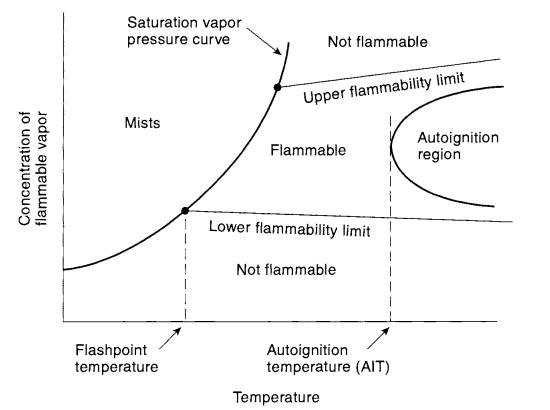
2 -Relationshipsbetweenvariousflammability properties
Autoignitiontemperature:Auto-ignitiontemperatureisthe lowest temperature at which the fuel will spontaneously igniteinanormalatmospherewithoutanexternalsourceof ignitionsuchasaflameorspark.
5.1 Flash point criteria for evaluating flammable risk –
The flash point temperatureisone of the major quantities usedtocharacterizethefireandexplosionhazardofliquids. Theflashpointofaliquidisthelowesttemperatureatwhich itgivesoffenoughvaportoformanignitablemixturewith air. The flash point generally increases with increasing pressure.Thetwomostcommonlyusedmethodsareopen cupandclosedcup,dependingonthephysicalconfiguration oftheexperimentalequipment.Earlyphaseofresearchand development work, experimental cost of flash point determinationishighforallflammablecomponentsandall mixturepresentintheprocess.
Firepoint:Thefirepointisthelowesttemperatureatwhicha vaporabovealiquidwillcontinuetoburnonceignited;the firepointtemperatureishigherthantheflashpoint.
Table 6 –Hazardclassificationbasedontheflashpointdata
3. I–C 73-100°F (2438°C) p-xylene
HAZARD CLASSIFICATION FOR COMBUSTIBLE LIQUIDS
II 101-140°F (39-60°C)
5. III-A 141-199°F (61-93°C)
6. III-B 200°F(93°C) orabove
Dieselfuel, motoroil, kerosene, cleaning solvents
Paints(oilbase), linseedoil, mineraloil
Paints(oilbase), neatsfootoil
Satyanarayana and Rao showed that the flash point temperatures for pure materials correlate well with the boilingpointoftheliquid.[15]
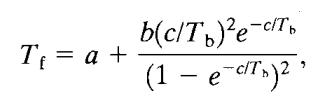
WhereTf,istheflashpointtemperature(K), a,b,andcareconstantsprovidedinTable-7(K) Tb,istheboilingpointtemperatureofthematerial(K).
Table 7 –Constantusedforthepredictingtheflashpoint
International Research Journal of Engineering and Technology (IRJET) e-ISSN: 2395-0056
Volume: 12 Issue: 12 | Dec 2025 www.irjet.net p-ISSN: 2395-0072
whenitisabovetheupperflammablelimit(UFL).Amixture isflammableonlywhenthecompositionisbetweentheLFL andtheUFL.Commonlyusedunitsarevolumepercentfuel.
Flashpointsofthemixtureisalsoimportantcomponentfor identifytheflammabilityhazardsintheprocess.Ifonlyoneof thecomponentsiscombustibleandflashpointisknownina twocomponentsmixturethenflashpointsofmixturescanbe approximated. Flash point of mixture temperature is calculated by determining the temperature at which the vaporpressureoftheflammablecomponentinthemixtureis equaltothepurecomponentvaporpressureatitsflashpoint. Ifmulticomponentmixtures withmorethanoneflammable component then recommended to determine the experimentallyflashpointofthemixture.[14]
Example-7–Methanolhasaflashpointof54°F,anditsvapor pressureatthistemperatureis62mmHg.Whatistheflash pointofasolutioncontaining75%methanoland25%water byweight?
Solution:
ByusingRaoult’sLaw,calculatevapourpressureofmethanol,
P=X*Pvap. ___________(11)
Pvap=X/P=62/0.63=98.4mmHg
Where,X=Molefractionofpurecomponents
P=Partialpressureofcomponent
Pvap=Partialvapourpressureofpurecomponent
Byusinggraphofvaporpressurevstemperatureshownflash pointofthesolutionis20.5°C.
5.3
Flammabilitylimitsarethemainpropertiesthatrepresent flammability characteristics of specific fuels. Vapor-air mixtureswilligniteandburnonlyoverawell-specifiedrange of compositions. The mixture will not burn when the compositionislowerthanthelowerflammablelimit(LFL); themixtureistooleanforcombustion.Themixtureisalso not combustible when the composition is too rich; that is,
20-Lsphericalapparatususedforexperimentallydetermine theflammabilitydatabyusingtheAmericanstandardASTM E-681testmethod.Earlyphaseofresearchanddevelopment work,experimentalflammabilitydatadeterminationcostis highaswellastimetakenactivity.Theoreticaldeterminethe flammabilitylimitofthechemicalstoidentifythepreliminary flammabilityhazards.
Flammabilitylimitofwell-knownsolventsandchemicals dataeasilyavailableinMSDSandliterature,butfewchemical datanotavailableinanyliterature.Theoreticaldeterminethe flammability limit of the chemicals to identify the flammabilityhazards.[21]
Following few methods for determine the theoretical flammabilitylimits-
Stoichiometricconcentration–
=0.55Cs
=3Cs
=3.5Cs
Where,Csisstoichiometricconcentration.
Example-8,Ethanol’sstoichiometricreactionsare: 1C2H5OH+ 3O2+11.28N2→2CO2+3H2O+11.28N2.
Forthisreaction,Cs=6.54%.UsingEq.(12)and(13),LFL= 3.59%andUFL=19.62%.
Alternative,


The stoichiometric concentration for most organic compounds is determined using the general combustion reaction (15)

CombustionenthalpyLFL=−4354/Hc _____________(17)
Where, Hciscombustionenthalpy(kJ/mol)
Example-9, ethanol has a combustion enthalpy of −1281 kJ/mol,LFLis3.39%.
International Research Journal of Engineering and Technology (IRJET) e-ISSN: 2395-0056
Alternative, ______________(18) (19)
Vaporpressure–
LFL=(Pf/P0)×100
Where,Pfisthefuelvaporpressureatflashpoint P0isstandardatmosphericpressure.
Example-10, The flash point of ethanol is 13°C. At this temperature,ithasavaporpressureof28mmHgwithP0= 760mmHg,LFL=3.68%.
Algebraicmethod-
LFL=100/(1+Na)
Where,Naisthenumberofmolesofairpermoleoffuelin themixtureatLFL.
Example-11,forethanol,thereactantsare 1C2H5OH+3O2+11.28N2.LFLobtainedis3.29%.
5.3.2 Flammability Limit Dependence on Temperature -
The flammability range increases with temperature. If the temperatureincreases,thelowerflammabilitylimitsshould decrease, while the upper flammability limits should increase.[18,19]


Thefollowingempiricallyderivedequationsareavailablefor vapors: (22) (23)
Where,/Hcisthenetheatofcombustion(kcal/mole)andT isthetemperature("C).
5.3.3 Flammability Limit Dependence on Pressure –
Pressure has little effect on the LFL except at very low pressures (< 50 mm Hg absolute), where flames do not propagate.[20]
TheUFLincreasessignificantlyasthepressureisincreased, broadeningtheflammabilityrange.Anempiricalexpression fortheUFLforvaporsasafunctionofpressureisavailable.
UFL,=UFL+20.6(logP+I), _____________(24)
Where,Pisthepressure(megapascalsabsolute)andUFLis the upper flammable limit (volume % of fuel plus air at 1 atm).
5.3.4 Flammability Limits of Mixture –
Flammabilityofthemixtureisalsoimportantcomponentfor identify the flammability hazards in the process. These mixturelimitsarecomputedusingtheLeChatelierequation [14] ______________(25)
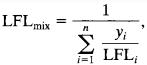
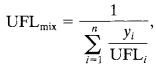
Where,LFLiisthelowerflammablelimitforcomponenti(in volume %) of component i in fuel and air, yi is the mole fractionofcomponentionacombustiblebasis,andnisthe numberofcombustiblespecies. (26)
Where,UFLiistheupperflammablelimitforcomponenti(in volume%)infuelandair, yiisthemolefractionofcomponentionacombustiblebasis, and nisthenumberofcombustiblespecies.
5.3.4 Limiting Oxygen Concentration (LOC) –
Oxygen is the key components and there is a minimum oxygenconcentrationrequiredtopropagateaflame.Thisis anespeciallyusefulresult,becauseexplosionsandfirescan be prevented by reducing the oxygen concentration regardlessoftheconcentrationofthefuel.

Example-12

MolesofO2=6.55, MolesofButane=1
LFL–1.9%byvolume
LOC=12.4vol%Oxygen
Volume: 12 Issue: 12 | Dec 2025 www.irjet.net p-ISSN: 2395-0072 © 2025, IRJET | Impact Factor value: 8.315 | ISO 9001:2008 Certified Journal | Page510
TheLOChasunitsof%ofmolesofoxygenintotalmoles.If experimental data are not available, the LOC is estimated usingthestoichiometryofthecombustionreactionandthe LFL.[14] (27)
International Research Journal of Engineering and Technology (IRJET) e-ISSN: 2395-0056
Volume: 12 Issue: 12 | Dec 2025 www.irjet.net p-ISSN: 2395-0072
LOCofthemixtureisalsoimportantcomponentforidentify theflammabilityhazardsintheprocess.[17]
Where,Riisstoichiometricmolarratioofoxygentofuelof componentiandXiismolefractionofcomponentiandLOCi islimitingoxygenconcentrationofcomponenti.
6. CONCLUSION:
Preliminarily identify the hazards of the substance and processbyconductingtheliteraturereviewandpastprocess safetyincidents.Evaluatingtherisk assessmentbasedonthe availabilityofprocesssafetyliteraturedataandlearningfrom thepastcatastrophicincidents.Thisreviewarticlehighlights the critical nature of nitro compounds and the nitration reactionintheincidentsinvolvingYibinHengdaexplosion, Aarti chemical plant explosion, and Tianjiayi Chemical explosion.Forliteratureonprocesssafety,consultarticles and conference papers from reputable professional organizations,aswellasdatafromBretherick’shandbook.In thisreviewarticle,weassessthetoxicityandflammability risks associated with both single-component and multicomponentmixtures.Thisevaluationinvolvesthetheoretical calculationofLC50,TLV,andERPGvaluestodeterminethe toxic hazards present. The objective is to ascertain the theoretical flammability parameters, including flash point, flammability limits, and LOC values, in order to recognize potentialflammabilityhazards.Basedonthistheoreticaldata, removedhazardousmaterialsfromtheprocessandreplaced them with non-hazardous alternatives during the design phase of the inherently safe process at the R&D stage. Consideringtherisksassociatedwithhazardousmaterials, such as explosiveness, toxicity, and flammability, suitable personalprotectiveequipment(PPE)wasutilized,alongwith effectiveadministrativeandengineeringcontrolstoensurea safedesignforcommercialimplementation.
7. REFERENCE:
1. Prediction of thermal hazards of chemical reactions, TheodorGrewer,,DavidJ.Frurip ,B.KeithHarrison,Journal ofLossPreventionintheProcessIndustries12(1999)391–398
2. Thermal Stability and Explosive Hazard Assessment of DiazoCompoundsandDiazoTransferReagentsSebastianP. Green,KatherineM.Wheelhouse,AndrewD.Payne,JasonP. Hallett,PhilipW.MillerandJamesA.Bull,Organic Process Research&Development2020,24,67-84.
3. Global process safety incidents in the pharmaceutical industry Maaz S. Maniar, Apoorv Kumar, Ray A. Mentzer, JournalofLossPreventionintheProcessIndustriesVolume 68,November2020,104279
4. Major explosion at Yibin Hengda Technology Company: Thecausesandlessonslearned,WangW,LiuY,ZhaoD,Chen J,WangY,DongH,ProcSafetyProg.2019;e12099
5. Case study on the catastrophic explosion of a chemical plantforproductionofm-phenylenediamine,XiaodongYang, YongzhaoLi,YangqingChen,YuqiLi,LiboDai,RenFeng,YihShing Duh, Journal of Loss Prevention in the Process IndustriesVolume67,September2020,104232
6. Process safety education: A literature review, Effiong Mkpat , Genserik Reniers, Valerio Cozzani, Journal of Loss PreventionintheProcessIndustries,Volume54,July2018, Pages18-27
7.ChemicalStructureandAccidentalExplosionRisk inthe ResearchLaboratory,DavidG.Churchill,Journalofchemical education,vol83No.12December2006.
8.AssessmentofChemicalReactivityHazardsforNitration ReactionsandDecompositionofNitro-Compounds,RobertW. TrebilcockandSeshuDharmavaram,Guggenheim;Chemistry, Process Design, and Safety for the Nitration Industry ACS SymposiumSeries;AmericanChemicalSociety:Washington, DC,2013.
9. Documentation of the Threshold Limit Values and Biological Exposure Indices, 5th ed. (Cincinnati: American ConferenceofGovernmentalIndustrialHygienists,1986).
10. Health Effects Assessment Summary Tables (HEASH), OERR 9200.6-303 (Cincinnati: Center for Environmental ResearchInformation,1991).
11. Integrated Risk Information System (IRIS) (Cincinnati: Center for Environmental Research Information, updated regularly).
12.TheOriginandBasisofThresholdLimitValues,JeffreyM. Paull,MS,AmericanJournalofIndustrialMedicine5:227-238 (1984)
13.ThresholdLimitValues,PermissibleExposureLimits,and Feasibility: The Bases for Exposure Limits in the United States,S.M.Rappaport,PhD,AmericanJournalofIndustrial Medicine23:683-694(1993)
14.ChemicalProcesssafetyfundamentalsandapplications, secondedition,DanielA.crowl/JosephF.Louvar.
15.Improved equation to estimate flash points of organic compounds, K. Satyanarayana and P.G. Rao, Journal of Hazardous Materials, 32 (1992) 81-85, Elsevier Science PublishersB.V.,Amsterdams.
International Research Journal of Engineering and Technology (IRJET) e-ISSN: 2395-0056
Volume: 12 Issue: 12 | Dec 2025 www.irjet.net p-ISSN: 2395-0072
16.Flammabilitylimits:Areviewwithemphasisonethanol for aeronautical applications and description of the experimental procedure, Christian J.R. Coronado, João A. CarvalhoJr.,JoséC.Andrade,ElyV.Cortez,FelipeS.Carvalho, José C. Santos, Andrés Z. Mendiburu, Journal of Hazardous Materials241–242(2012)32–54.
17.Thelimitingoxygenconcentrationandflammabilitylimits of gases and gas mixtures, Isaac A. Zlochower, Gregory M. Green,JournalofLossPreventionintheProcessIndustries22 (2009)499–505.
18.T. Suzuki, "Empirical Relationship Between Lower FlammabilityLimitsandStandardEnthalpiesofCombustion ofOrganicCompounds,"FireandMaterials(1994),18:333336.9
19.T. Suzuki and K. Koide, "Correlation between Upper Flammability Limits and Thermochemical Properties of OrganicCompounds,"FireandMaterials(1994),18:393-397.
20.M. G. Zabetakis, "Fire and Explosion Hazards at Temperature and Pressure Extremes," AICHE Inst. Chem. Engr.Symp.,ser.2.Chem.Engr.ExtremeCond.Proc.Symp. (1965),pp.99-104.
21.G. W. Jones, "Inflammation Limits and Their Practical ApplicationinHazardousIndustrialOperations,"Chem.Rev. (1938),22(1):1-26.