
International Research Journal of Engineering and Technology (IRJET) e-ISSN: 2395-0056
Volume: 13 Issue: 01 | Jan 2026 www.irjet.net p-ISSN: 2395-0072
PRELIMINARY PHYTOCHEMICAL SCREENING AND ANTIFUNGAL ACTIVITY OF ANISOMELES MALABARICA ROOT EXTRACT USING ETHANOL AS THE SOLVENT AGAINST CANDIDA ALBICANS
Dr. K.L. Senthil kumar1 , E. Rogini2, P. Roshini3, R. Sachin kumar4
1 , Principal, Sri Vijay Vidyalaya College of Pharmacy, Dharmapuri, Tamil Nadu (India) 2,3,4 , B.Pharm Students, Sri Vijay Vidyalaya College of Pharmacy, Dharmapuri, Tamil Nadu (india)
1. ABSTRACT:
AIM:
Theaimofstudyis(preliminaryphytochemicalscreeningandantifungalactivityof Anisomeles malabarica a root extractbyusingsolventasethanol.
OBJECTIVE:
PreliminaryphytochemicalstudiesofAnisomelesmalabaricaandantifungalactivityofrootextraction.
METHOD:
The root were collected dried and ground into fine powder. The powdered material was then subjected to solvent extractionusingethanol.Theobtainedethanolicextractwassubsequentlyusedfor preliminary phytochemical screening toidentifythepresenceofbioactivecompounds.Inaddition,theextractwasevaluatedforitsantifungalactivitytoassess itseffectivenessagainstfungalorganism.
CONCLUSION:
The present study reveals the preliminary phytochemical analysis and antifungal activity by using anisomeles malabaricaextract.
KEY WORDS:
Anisomelesmalabarica,Soxhletmethod,Ethanol,Phytochemicalscreening,Antifungalactivity.
2. INTRODUCTION
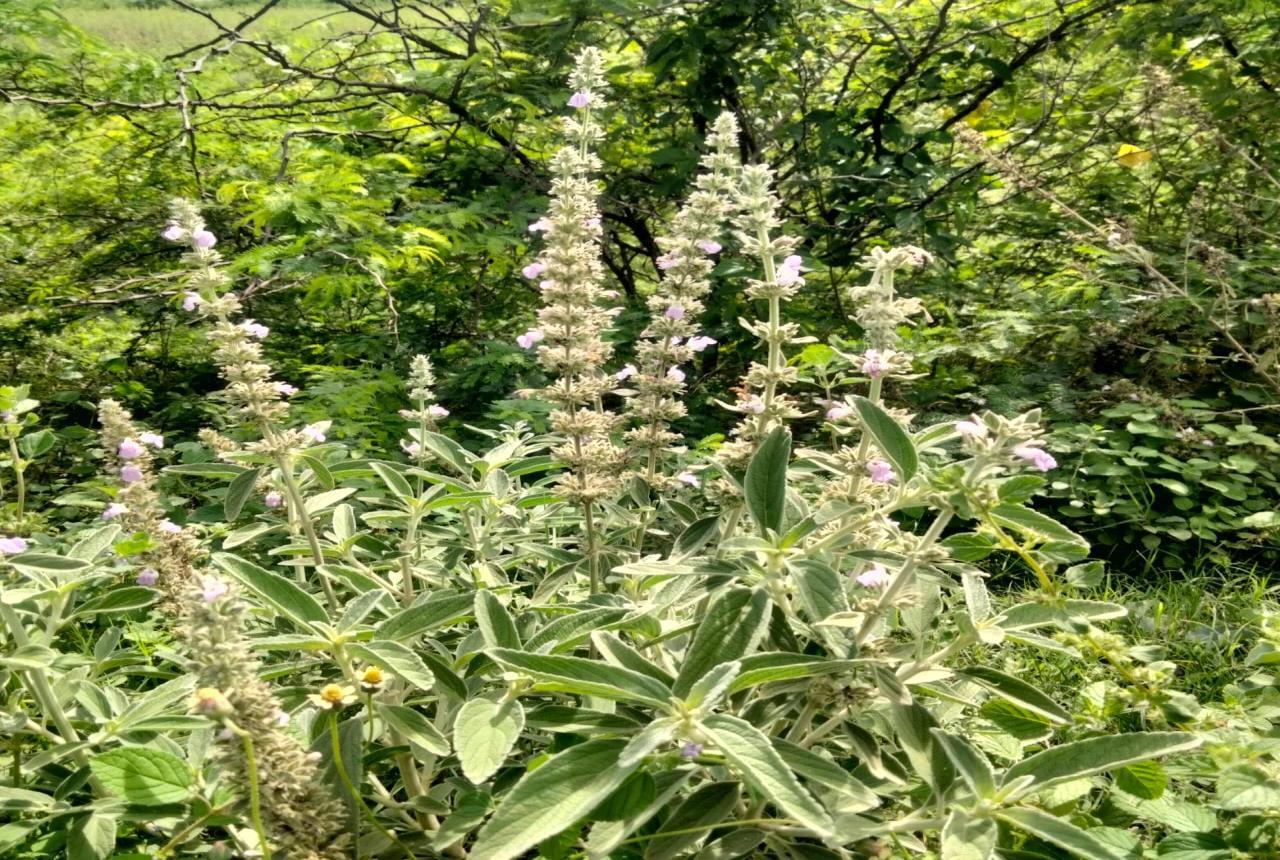
Anisomeles malabarica is a strongly aromatic ,perennial herb characterized by its dense pubescence.Belonging by the commonnameMalabarcatmint.
Thisherbisanaturallyfoundandwidelydistributedintropicalandsubtropicalregions,wheretheclimatesupports its vigorousgrowth.Ittypicallyflourishesinopenfieldsalongroadsidesandnear forestmargins.
Anisomeles malabarica is a herbaceous howering plant and typically reaches, 1-2meters in height. It bears opposite hairyleaves.Thatreleasestrongmintlikearoma.
Anisomeles malabarica has been used to treat digestive issues, fever, skin infection, and inflammatory disorders. The leaves are sometimes applied as poultices to treat wounds, insect bites and minor burns.Its bitter and pungent taste is believedtohelpstimulatedigestionandappetite.
CommonlyknownasMalabarcatmint,orMalabarvayana,thisplantbelongstothemintfamily,Lamiaceae.Itiswidely distributedinIndia,SriLanka,andotherpartsofsouthandsoutheastAsia.
2026, IRJET | Impact Factor value: 8.315 | ISO 9001:2008 Certified Journal | Page161
International Research Journal of Engineering and Technology (IRJET) e-ISSN: 2395-0056
3. TAXONOMICAL CLASSIFICATION:
KINGDOM : Plantae
SUB-KINGDOM : Viridiplantae
SUB-DIVISION : Angiospermae
DIVISION : Spermatophyta
CLASS : Magnoliopsida
SUB-CLASS : Asteridae
ORDER : Lamiales
FAMILY : Lamiaceae
GENUS : Anisomeles
SPECIES : Anisomelesmalabarica
4. VERNACULAR NAME:
ENGLISH : Malabarcatmint
HINDI : Gopoli,Codhara
MARATHI : Gojibha
TAMIL : Peyimarutti,Perumtumpa
MALAYALAM : Perumtumpa,Karintumpa
TELUGU : Mogan-biran,Mogabheri
Volume: 13 Issue: 01 | Jan 2026 www.irjet.net p-ISSN: 2395-0072 © 2026, IRJET | Impact Factor value: 8.315 | ISO 9001:2008 Certified
International Research Journal of Engineering and Technology (IRJET) e-ISSN: 2395-0056
KANNADA : Karitumbi,Gandubiranagida
SANSKRIT : Mahadronah,Vaikunthah
ORIYA : Vaikuntha
KONKANI : Kaktumbo
5. PHARMACOGNOSTICAL STUDIES:
STEM INFORMATION
Stemcolor :Greentopurplish
Stemodour :Aromatic
Stemcrosssection :Quadrangularshape
Stemsurface :Hairy
Stemform :Erect,branched
LEAVES INFORMATION
Leafcolor :Green
Leaftype :Simple
Leafarrangement :Opposite
Leafshape :Ovatetolanceolate
Leafmargin :Serrated
Hairspresent :Yes
Leaflength :3-8cm
Leafwidth :1.5-3cm
FLOWER INFORMATION
Flowercolor :Purple,PinkorWhite
Flowerinflorescence :Spikeorraceme
Flowerbloomtime :Summertoearlytall
Flowershape :Bilabiate(two-lipped)
Flowerpetals :5Fused
Flowersize :Small,Approximately1-2cmlong
FRUIT INFORMATION
Fruitcolor :Greenorbrown
Fruittype :Capsule(schizocarpformingnuttets)
Fruitlength :Approximately2-3mm
Fruitwidth :Approximately1-2mm
ROOT INFORMATION
Roottype :Taproot
Rootcolour :Lightbrowntodarkbrown
Rootsurface :Roughwithwrinkles
Rootodour :Aromatic
Roottaste :Slightlybitter
Roottexture :Hardandfibrous
Rootbranching :Fewlateralrootspresent
Rootsize :Moderatelylong
Rootnature :Dry
6. ANATOMY
1. LEAF ANATOMY
Epidermis: Theleaf hasadorsiventralstructure,withboththeupperandlowerepidermismadeupofasinglelayerof cells and covered by a thin cuticle. . Numerous glandular and non-glandular trichomes are present. Stomata are more abundantonthelowersurface.
Volume: 13 Issue: 01 | Jan 2026 www.irjet.net p-ISSN: 2395-0072 © 2026, IRJET | Impact Factor value: 8.315 | ISO 9001:2008
International Research Journal of Engineering and Technology (IRJET) e-ISSN: 2395-0056
Volume: 13 Issue: 01 | Jan 2026 www.irjet.net p-ISSN: 2395-0072
Vascular Bundle: Vascularbundlesarecollateralandclosed.Thexylemislocatedontheupperside,whilethephloem ispositionedonthelowerside,andabundlesheathsurroundsthe vasculartissue.
2. STEM ANATOMY
Epidermis: Single-layered epidermis with thick cuticle. Numerous multicellular trichomes are present. The stem is quadrangularinoutline.
Vascular system: Vascularbundlesarearrangedinaring.Bundlesareconjoint,collateral,andopen.Xylemisendarch. Phloemiswelldeveloped.Cambiumispresentbetweenxylemandphloem.
3. ROOT ANATOMY
Epidermis (Epiblema): Single-layered,thin-walledcellswithoutcuticle.Roothairsarepresent.
Cortex: Thecortexisbroadandcomposedofparenchymatouscellsthatfunctioninfoodstorage..
Endodermis : Welldevelopedwithcasparianstrips.Passagecellspresentoppositeprotoxylem.
Pericycle : Single-layered,giverisetolateralroots.
Vascular Tissue : Radialarrangement.Xylemandphloemoccuralternately.Xylemisdiarch.Protoxylemisexarch.
Pith : Smallorabsent.
7.MATERIALS AND METHODS
Root material: the roots of anisomeles malabarica were collected from the kolagathur village, Dharmapuri district. The collected roots was thoroughly with distilled water remove adhering soil, and left at root temperature at a dark environmentfortoweeks.Afterdrying,therootsweregroundintoacoarsepowderusingamechanicalgrinder.
MATERIALS
Soxhletapparatus
Extractionthimble
Solvent:Ethanol
RootpowderofAnisomelesMalabarica
Heatingmantle
Condenser
PREPARATION OF EXTRACTION BY SOXLET APPARATUS
The50gmofcoarsepowderedrootofAnisomelesMalabaricawastaken.
Thentheapparatuswhichallarerequiredlikesoxheltapparatuscondenserheatingmantleroundbottomflasktaken andassemble.
50gramofcoarsepowderedAnisomelesMalabaricatakeninthesoxhletapparatus.
Take500mlofethanolandaddittoaround-bottomflask.
Theextractionisallowedfor18hrsattemperatureof40
After18hrstheextractionliquidwhichissettledintheroundbottomflaskiscollected.
The after extraction all the crude extracts were filtered, and solvent was removed by distillation to obtain the concentratedextract.
International Research Journal of Engineering and Technology (IRJET) e-ISSN: 2395-0056
Volume: 13 Issue: 01 | Jan 2026 www.irjet.net p-ISSN: 2395-0072
The liquid extracts were concentrated separately under vaccum and the resulting dried extracts were preserved in desiccatoruntilfurtheruse.
Thedriedextractswereweighedandthepercentyieldwascalculated.
METHODS:
ANTIMICROBIAL ACTIVITY OF TEST MICROORGANISMS:
Totallyonefungalstrainwereusedthroughoutinvestigation.FungalcultureswereproducedthefromMicrobialType CultureCollectionatthe InstituteofMicrobial Technology, Chandigarh,India.Thefungus usedinthestudywas Candida albicans.
ANTIBACTERIAL ASSAY
I. PREPARATION OF INOCULUMS
Stock cultures were maintained at C on of nutrient agar slopes. For the experiment, Active bacterial cultures of experiment were prepared by transferring a loopful of cells from the stock cultures into test tubes containing MullerHinton broth (MHB). They were incubated without agitation for 24 hours at 37 C.. The cultures were then diluted with fresh Muller-Hinton broth to reach optical density corresponding to 2.0 X10⁶ colony forming units (CFU/ml) for bacteria (Smith&Doe2018).
II. PREPARATION OF STERILE SWABS
Cotton wool swabs on wooden or plastic applicators were prepared and sterilized. Wooden swabs were sterilized usingdryheat,whileothersweresterilizedbyautoclaving. Theswabswerepackedinculturetubes,papers,ortinsbefore sterilization.
III. STERILIZATION OF FORCEPS
Forcepscanbesterilizedbydippingtheminalcoholandthenpassingthemthroughaflametoburnoffthealcohol.
ANTIFUNGAL ACTIVITY: (WELL DIFFUSION METHOD)
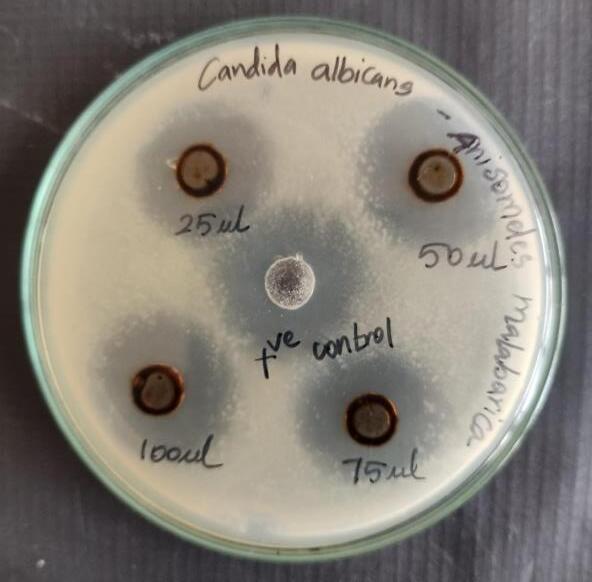
The antifungalactivitywasevaluated usingthewelldiffusionmethodonagarplates.Differentconcentrationofplant extract were dissolved in water. Sabouraud Dextrose Agar (20ml) was poured into 15cm petri dishes. Candida albicans weregrowninSabouraudDextroseBrothat27 Cfor48hours.and growthwasadjustedtoanopticaldensity(OD600nm) of0.1usingfreshbrothdilutionwith.Wellswerethen cut intotheagar,and theextractwasaddedatconcentrationsof 25, 50 and 75 of each sample(1mg /mL). Fluconazole (100 units) was used as a positive control. After inhibition at 27 Cfor48hours,thezonesofinhibitionweremeasuredtoassesantifungalactivity.
8.PHYTOCHEMICAL ANALYSIS OF ANISOMELES MALABARICA
1. TEST FOR ALKALOIDS:
Dragendroff’s Test:
About 1 ml of plant extract is taken and 1 ml of Dragendorff’s reagent is added. The appearance of an orange-red precipitateconfirmsthepresenceofalkaloids.
Mayer’s Test:
Totestforalkaloids,1mloftheextractismixedwith1mlofMayer’sreagent.Theappearanceofacreamorpaleyellow precipitateindicatesthepresenceofalkaloids.
2. TEST FOR GLYCOSIDES
Test solution: Itwaspreparedbydissolvingsampleinalcohol.
International Research Journal of Engineering and Technology (IRJET) e-ISSN: 2395-0056
Volume: 13 Issue: 01 | Jan 2026 www.irjet.net p-ISSN: 2395-0072
Keller-Killiani Test:
The sample is dissolved in alcohol. A few drops of ferric chloride solution are added, followed by concentrated sulphuricacidalongthesideofthetesttube.Formationoftwolayers,withareddish-brownlowerlayerandbluish-green upperlayer,confirmscardiacglycosides.
3. TEST FOR TRITERPENOIDS:
Test solution: Itwaspreparedbydissolvingtheextractinchloroform.
Salkowski test:
The extract is dissolved in chloroform and a few drops of concentrated sulphuric acid are added. Absence of yellow colorationinthelowerlayerindicatestriterpenoidsarenotpresent.
4.TEST FOR CARBOHYDRATES:
Molisch Test:
To 2-3 ml of extract, a few drops of molisch reagent are added. Concentrated sulphuric acid is carefully added along thesideofthetesttube.
Formationofavioletringatthejunctionconfirmscarbohydrates.
Fehling’s Test:
Equal volumes of Fehling’s solution A and B are mixed and added to the extrat, then heated. A brick-red precipitate indicatesreducingsugars.
5. TEST FOR PROTEINS:
Test solution: Itwaspreparedbydissolvingextractinwaterandmakingaqueousextract.
Biuret Test:
About3mlofextractistreatedwithsodiumhydroxidesolutionfollowedbyafewdropsofcoppersulphatesolution. Developmentofblueorvioletcolourconfirmsproteins.
6. TEST FOR ANTHRAQUINONES:
Borntrager’s Test:
Theextractisshakenwithbenzeneandfiltered.Ammoniasolutionisaddedtothefiltrate.Appearanceofpink,red,or violetcolourindicatesanthraquinones.
7. TEST FOR FLAVONOIDS:
Test solution: To small amount of extract equal amount of 2M HCL was added and heated for about 30-40 mins. The extractwascooleddownandagainextracted with ethyl acetatewhichwasfurther concentratedtodrynessandreadyto beusedastestsample.
Lead Acetate Test:
Asmallamountofextractistreatedwithleadacetatesolution.Formationofyellowprecipitateindicatesflavonoids.
8. TEST FOR QUINONES:
Concentrated Hcl Test:
Whenconcentratedhydrochloricacidisaddedtotheextract,developmentofgreencolourconfirmsQuinones.
9. TEST FOR TANNINS:
Test solution: Thetestsolutionwaspreparedbydissolvingtheextractinwaterandalcohol.
International Research Journal of Engineering and Technology (IRJET) e-ISSN: 2395-0056
Volume: 13 Issue: 01 | Jan 2026 www.irjet.net p-ISSN: 2395-0072
Ferric chloride test:
Ferricchloridesolutionisaddedtotheextract.Formationofdarkblueorgreenish-blackcolourindicatestannins.
Lead acetate Test:
Additionof leadacetatesolutionproduceawhiteprecipitate,confirmingtannins.
10. TEST FOR CHOLESTEROL:
The extractismixed with2ml chloroform and10dropsof aceticanhydride, followed by2-3 dropsofconcentrated sulphuricacid.Absenceofred-rosecolourindicatescholesterolisabsent.
11. TEST FOR DITERPIENES:
The extract is dissolved in distilled water and treated with 3-4 drops of copper acetate solution. Appearance of emeraldgreencolourconfirmsditerpienes.
12. TEST FOR TERPENOIDS:
Theextractismixedwith2mlofchloroformand3mlconcentratedsulphuricacid,thenheatedinawaterbath.Absence ofgreycolourindicatesterpenoidsarenotpresent.
13. TEST FOR SAPONINS:
Test solution: Itwaspreparedbydissolvingextractinwaterandmakingaqueousextract.
Foam Test:
Theaqueousextractisshakenvigorouslywithwater.Lackofpersistantfoamindicatesabsenceofsaponins.
14. TEST FOR FATS:
Solubility Test:
Theextractedistestedforsolubility.Insolubilityinwaterandethanolbutsolubilityinchloroform,benzene,orether confirmsfats.
15. TEST FOR STEROLS:
Libbermann- Burchard Test:
The sample is dissolved in chloroform and treated with acetic anhydride and glacial acetic acid, then cooled and concentratedsulphuricacidisadded.Absenceofbluish-greencolourindicatessterolsareabsent.
Table.No.1: Phytoconstituents Of Ethanol Of Dried Roots Of Anisomeles Malabarica.
1. Alakaloids + 2. Glycosides
3. Triterpenoids
4. Carbohydrates + 5. Proteins + 6. Anthraquinones
7. Flavonoids + 8. Quinone
9. Tannins
10. Cholesterol
11. Diterpenes
12. Terpenoids
13. Saponins
14. Fat
15. Sterols
International Research Journal of Engineering and Technology (IRJET) e-ISSN: 2395-0056
Volume: 13 Issue: 01 | Jan 2026 www.irjet.net p-ISSN: 2395-0072
REPORT
Table.No.2: Antifungal Activity Of Ethanol With 100 Concentrations.
(MM)
S.NO MICRO ORGANISMS
FUNGAL
International Research Journal of Engineering and Technology (IRJET) e-ISSN: 2395-0056
Volume: 13 Issue: 01 | Jan 2026 www.irjet.net p-ISSN: 2395-0072
RESULT:
The antimicrobial study revealed that the extract showed effective activity against Candida albicans, with inhibition zonesincreasingfrom11mmat25 to20mmat100 .ThestandarddrugFluconazoleproducedazoneof23 mm, indicating comparable efficacy of the extrat at higher concentrations. The results confirmed a concentrationdependent response,demonstrating thatantifungal potential riseswithincreasing extractdose. Thisactivity maybedue tobioactivephytochemicalssuchasflavonoidsandphenolicsthatdisruptfungalcellwalls.Thefindingsalignwithearlier reports on herbal antifungal agents. Thus, the extract possesses significant antifungal potential and can be explored for naturaltherapeuticuse.
CONCLUSION:
According to the current study, Anisomeles malabarica's ethanolic root extract contains a number of significant phytochemical elements, including tannins, glycosides, phenolic compounds, alkaloids, and flavonoids. The antifungal impactseeninthisstudymaybecausedbythesesecondarymetabolites,whicharerecognizedfortheirbiologicalactivity. Thepotentialoftheethanolicextracttopreventfungalgrowthwasdemonstratedbyitsnotableantifungalefficacyagainst Candidaalbicans.Accordingtothefindings,ethanolisausefulsolventforremovingbioactivesubstancesfromAnisomeles malabarica roots. Anisomeles malabarica may be a good substitute for traditional antifungal agents, according to the study'sfindings,especiallyfortreatinginfectionsbroughtonbyresistantmicrobes.
REFERENCES:
1. National Committee for Clinical Laboratory Standards (NCCLS). (1993). Methods for dilution antimicrobial susceptibility tests for bacteria that grow aerobically (3rded.).NCCLS.
2. ShindeUA,phadkeAS,NariAM,MungantiwarAA,DikshitVJ,SarafMN.Fitoterapia. 1999,70,251-257.
3. Joshi,S.G. Medicinal plants. Mohan primlonefor OxfordandIBH PublishingCo Pvt.Ltd. Newdelhi. India 2000: pp.222.
4. Adetuyi A O and Popoola AV. Extraction and Dye ability potentian studies of the colourant in Zanthoxylum zanthosxyloidesplantoncottonfabric.JSciEng.Tech, 2001;8(2):3291-3299
5. Singh, RS, Uvarani M and Raman S R. pharmacognostical and phytochemical studies on leaves of Anisomeles malabaricaR.br.AncSciLife, 2003;22(3);106-110.
6. Eckert,G.P.,T.Wegat,S.Schaffer,S.Theobald,andW.E.Muller.Pharm.Ztg, 2006,151(24),20-31.
7. D.prabu,S.Kirubanandam.OrientalpharmacyandExperimentalMedicine, 2008,8(4),423-429.
8. ThambirajJ,PaulsamyS.AsianPacificJournalofBiomedicine, 2012,732-736.
9. Kavitha TR. Nelson R, Thenmozhi and priya E. Antimicrobial activity and phytochemical analysis of Anisomeles malabarica(L)R.BR.JMicrobiolBiotechRes, 2012;2(1);1-5.
10. Smith, J. A., & Doe, R. B. (2018). Evaluation of the antimicrobial activity of herbal extracts against clinical pathogens. Journal of Microbial Research, 12(3),234-240.https://doi.org/10.1234/jmr.2018.012345