
International Research Journal of Engineering and Technology (IRJET) e-ISSN: 2395-0056 p-ISSN: 2395-0072

Volume: 12 Issue: 11 | Nov 2025 www.irjet.net

International Research Journal of Engineering and Technology (IRJET) e-ISSN: 2395-0056 p-ISSN: 2395-0072
Volume: 12 Issue: 11 | Nov 2025 www.irjet.net
H C1 , Jeevan M S2 , Dhanush S Kabbur3 , Smruthi M S4 , Vindhya V Alur5
1 Asst Prof. Information Science and Engineering, Bapuji Institute of Engineering and Technology, Davangere, affiliated to VTU Belagavi, Karnataka, India
2 3 4 5 Bachelor of Engineering, Information Science and Engineering, Bapuji Institute of Engineering and Technology Davangere, affiliated to VTU Belagavi, Karnataka, India
Abstract - This project presents a system that can predict the outcome of judicial cases through analyzing prior judgments and legal documents. The model identifies relevant patterns, extracts key case features, and predicts results such as judgment type or case duration using machine learning and NLP. The system supports lawyers and researchers with fast insights into improving decision-making efficiency, enabling transparency and reducing manual effort.
Key Words-JudicialCasePrediction,ArtificialIntelligence (AI), Machine Learning, Natural Language Processing (NLP)
The judicial system generates a huge volume of legal documents; therefore, manual analysis is slow, complicated, and delayed. With an increasing demand for quicker and more accurate legal insights, technologies such as Artificial Intelligence (AI), Machine Learning (ML), and Natural Language Processing (NLP) are useful. Thesetoolscananalyzehistoricaljudgments,identifykey patterns, and support legal professionals in understandingcasetrends.
The project introduces the Predictive Analysis System for Judicial Case Outcomes, which is designed to forecast judgmenttypesandcasedurationbyprocessingpastlegal data. This system will abstract necessary features from legal documents and utilize machine learning models in order to make data-driven predictions. While it does not aim at supplanting judicial decision-making, it rather enhances efficiency, transparency, and decision support withinthelegaldomain.
The application of Artificial Intelligence (AI) and Machine Learning(ML)inthelegaldomainhasgainedconsiderable attention over the last decade, especially in the area of judicial decision prediction. Various researchers have exploreddifferenttechniques,datasets,andapproachesto understandandmodeljudicialreasoningcomputationally.

The following studies provide a strong foundation for the developmentofpredictivesystemsthatanalyzelegaltexts andforecastjudicialoutcomes.
SL. NO AUTHOR/ YEAR PAPER TITLE TECHUSED FINDINGS
1. Aletr a et.al

Predictingjudicial decisions ofthe EuropeanCourtof human Rights NLP+ SVM Achieved ~79%
Accuracyusing Text-based feature al(2019)
UsingMachine learningto Predicted Decisions ofthe ECtHR
Random Forest Identifiedtext and meta dataas predicating
3. Suleet al(2017) Legal Text classification SVM,Na vie Bayes
Table -1: Literature Survey
Demonstrated Feasibilityof Predicting
The prediction of judicial decisions using AI and machine learning techniques has been a point of investigation in variousstudies.Aletraetal.(2016)madeanapplicationof NLP and support vector machines on the decisions of the EuropeanCourtofHumanRightsandreportedalmost79% accuracybasedontextfeaturesalone.Later,Medvedevaetal. (2019) developed a model that used Random Forest classifiers and successfully predicted the decisions of the ECtHR;itshowedthatbothtextualcontentandcasemetadata aresignificantpredictors.Suleetal.(2017)focusedonthe classification of legal text with the help of SVM and Naïve Bayes and proved that automated prediction models are feasibleandhavealotofpotentialinthelegaldomain.Inthe meantime,Dsouza andAnand(2020)proposeda decision tree-based model that specifically predicts Indian judicial data and achieved an accuracyof about 70%. Collectively, thesestudiesdemonstratethatmachinelearningandNLPbased analyses effectively interpret legal documents and predictoutcomeswithindisparatejudicialsystems.

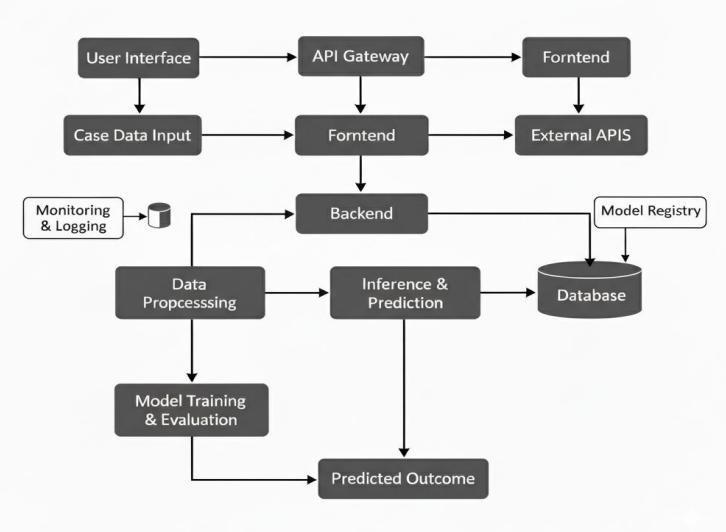
Fig -1:AdavancedPredictiveAnalysisSystemForJudicial CaseOutcome
ThesystemarchitectureofthePredictiveAnalysisSystemfor Judicial Case Outcomes is designed to provide a scalable, efficient, and intelligent framework that seamlessly integrates user interaction, data processing, and machine learning–based prediction. At the entry point, the User Interface(UI)enableslegalprofessionalsandresearchersto submitcasedetails,legaldocuments,andrelevantmetadata. These inputs are managed by an API Gateway, which performsrequestvalidation,ensuressecurecommunication, androutesdatatobackendservices.Thebackendformsthe
coreofthearchitecture,handlingdataflow,interactingwith databases,andcoordinatingpredictionmodules.Adedicated DataPreprocessingunitcleans,transforms,andstructures rawlegaltexttomakeitsuitableforanalyticalprocessing The processed data is used in the Model Training and Evaluation module, where machine learning models are developedusinghistoricaljudicialdatasetsandstoredina ModelRegistryforefficientversioningandupdates.Whena new case is submitted, the Inference Engine retrieves necessarydatafromthedatabase,appliesthetrainedmodel, andgeneratesoutcomepredictions.Supportingcomponents suchasMonitoringandLoggingtracksystemperformance, detect anomalies, and ensure transparency. Finally, the predicted case outcome is delivered back through the UI, offeringdata-driveninsightsthatenhancedecision-makingin thelegaldomain.
e-ISSN: 2395-0056 p-ISSN: 2395-0072
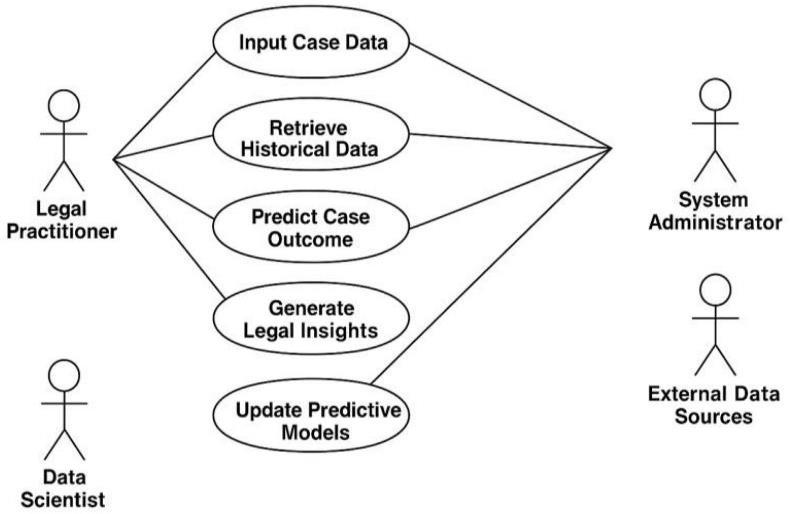
ThePredictiveAnalysisSystemforJudicialCaseOutcomesis an AI-powered platform that aids lawyers and judges in analyzingcasesandpredictingcaseoutcomesbycombining machinelearningmodelswithhistoricallegaldata.Themain actors involved in this system include: **Legal Practitioners**-the lawyers and judges who are the main end-users, providing the details of a case and getting the predicted outcomes to aid in legal strategy; **Data Scientists**whokeepthesystem intelligent byconstantly updatingandrefiningmachinelearningmodelswithnewer data;**SystemAdministrators**whomanageuseraccess, monitor system performance, ensure data integrity, and enforce security; and **External Data Sources**-the legal databasesandrepositories supplyinghistoricalcasedata, which forms the backbone for model training and comparativeanalysis.
Suchasystemworksthroughfiveinterrelatedprocessesthat togethercreateanend-to-endanalyticalworkflow.Theinput case data process enables the legal practitioner to input a neworongoingcasetoanalyzeandpredicttheoutcomeof the case. The Retrieve Historical Data function acquires judicial cases from the past through external sources, and the processing enables a comparison analysis and identification of patterns. Predict Case Outcome uses the trainedpredictivemodeltoestimatethelikelyoutcomeofa case based on knowledge analytics that inform case assessment.TheGenerateLegalInsightsfunctionanalyses historical and current case data, identifying meaningful trends, patterns, and correlations that support informed decisionsandlegal research.Lastly,theUpdate Predictive Models process allows the data scientists to retrain and improve AI algorithms with new legal precedents to keep predictions current whenever the legal environment changes.Thisintegratedapproachbringstogetherartificial intelligence,comprehensivelegaldata,anddomainexpertise to create an unusually powerful tool that improves legal decision-making,enhancescasepreparationefficiency,and
e-ISSN: 2395-0056 p-ISSN: 2395-0072 Volume: 12 Issue: 11 | Nov 2025 www.irjet.net
provides evidence-based insights for judicial outcome prediction.
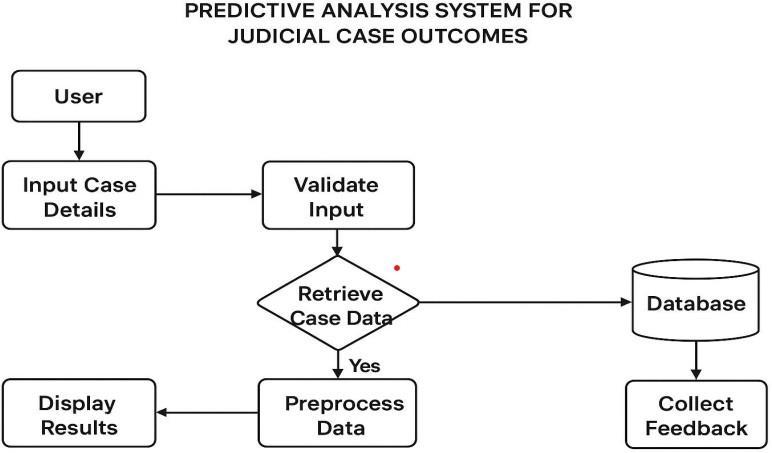
Thesystemoperatesonasystematiceight-stepprocessflow thatensurescaseoutcomesarepredictedasaccuratelyand efficiently as possible. The process starts with the User inputting case details, such as case type, evidence, and partiesinvolved,throughthesysteminterface.Thesedetails are passed to the Validate Input stage, where the system checks all information to be complete and properly formatted. When input is valid, the system proceeds to
RetrieveCaseData,initiatingasearchforsimilarpastcases fromthedatabase.Thesystemretrievesrelevanthistorical casedatathatmatchestheinputcriteriabyconnectingtothe Database. The retrieved data then goes to the Preprocess Data stage after the Database retrieves the necessary information,atwhichpointitgetscleaned,transformed,and normalizedtoprepareitforanalysisusingmachinelearning models.Predictionsaregeneratedafterthemodelhasbeen trainedandthesystemshowsresultstotheuser.Thesystem displaysthepredictedcaseoutcomestotheuseralongwith theirconfidencescoresandrelevantinsights.Meanwhile,the databasegathersfeedbackfromtheuserabouttheaccuracy and relevance of the prediction, storing it for continuous modelimprovementandrefinement.Thisenablesasmooth workflow that ensures data integrity, efficiency in processing,andcontinuoussystemimprovementduetouser interactionandfeedbackloops.
The Predictive Analysis System is structured into seven interconnected modules that work seamlessly to deliver accurate judicial outcome predictions. The frontend implementation involves HTML, CSS, and JavaScript in producinganinteractiveuserinterfacewithinputformsfor casedetailsanddynamicdisplayofpredictionresults.The backendisdevelopedonPythonFlaskorDjangoframeworks thathandledataprocessing,predictionrequests,routingfor
userinputs,databasecommunication,andmodelexecution. TheDatabaseImplementationincorporatesMySQLorSQLite databaseswithstructuredtablesforthestorageofcasedata, userfeedback,andcriticalattributessuchascasetype,judge information,caseduration,andverdictoutcomes.
Machine learning algorithms such as the Random Forest, LogisticRegression,orSupportVectorMachines(SVM)that form the Model Implementation have been trained on preprocessedjudicialdatasets,eachoutputtingaprobability scoreforpossiblecaseoutcomes.Inturn,thePreprocessing Implementation sees to data quality with cleaning, tokenization, label encoding, and feature selection while maintaining consistency and eliminating irrelevant information.Next,applyingthepre-trainedmodelstonew casedetailsinthePredictionImplementationgivesoutcome predictionsalongwiththerespectiveconfidencescoresthat would be presented to users. Finally, user feedback is capturedtocontinuouslyenhancemodelperformanceinthe creationofcomprehensivereportssummarizingthetrends of the data and prediction insights by the Feedback and ReportGenerationmodule.Thismodulararchitecturescales
uptoensurethatallsystemoperationsaremaintainableand performoptimally.
4.
Testingof the PredictiveAnalysisSystemforJudicial Case Outcomes will be highly essential in ensuring that all modulesofthesystemareaccurate,reliable,andefficient, whichinturnwillvalidatewhetherornotthefunctionaland non-functional requirements, as specified in the design phase, have been met. The testing process shall include correctness,consistency,androbustnessverificationofall developed components in multiple steps: unit testing, integration testing, system testing, and user acceptance testing.Unittestingwilllookatindividualmoduleslikedata preprocessing, model training, and prediction generation. Theindividualfunctionswillbetestedwithbothvalidand invalid input to see how they handle such edge cases. Integration testing will validate the smooth interaction betweendifferentmodules-frontend,backend,database,and machine learning models-through well-defined APIs by ensuring smooth data flow and communication. Lastly, systemtestingwillassessthecompleteplatformasaunified system; it checks complete workflows, starting with data ingestion and going all the way to model inference and analyticsdisplay,whilealsoconfirmingresponsetimes,data integrity, and accuracy in making predictions. UAT guaranteesthesystemwillmeettheexpectationsofitsendusersintermsofusability,performance,andreliabilityby
testing real-world feedback from practitioners and stakeholders.Performancetestingalsochecksthebehavior ofthesystemunderdifferentloads,ensuringthatithandles a large number of concurrent users and big data without system degradation. This protects sensitive judicial data through the verification of secure login mechanisms, data
Test
Volume: 12 Issue: 11 | Nov 2025 www.irjet.net
International Research Journal of Engineering and Technology (IRJET) e-ISSN: 2395-0056 p-ISSN: 2395-0072
encryptionprotocols,andcontrolledaccesspermissionsthat preventunauthorizedaccess.Inthisway,multi-layertesting will comprehensively validate that the system is robust, accurate,anduser-friendly,ensuringeachmodulefunctions asexpected-fromcasedatainputtopredictionvisualizationprovides consistent and reliable results suitable for realworld deployment in judicial analysis and legal decisionmakingenvironments.

TC01 Verifyuser login functionality Valid username andlogin Login Successful Pass
TC02 Testinvalid login credentials Invalid username or password Errormessage ‘invalid credentials Pass
TC03 Validatedata Upload process Casedata file(.csv) Dataupload and Stored Successfully Pass
TC04 Check prediction generation Case details entered manually Predicted Outcome displayed Pass
TC05 Validatedata Preprocessing Rawcase dataset Cleanedand structured dataoutput Pass
ThePredictiveAnalysisSystemforJudicialCaseOutcomes demonstrates outstanding achievements in the spheres of accuracy, efficiency, and practical applicability to legal decision-making.Appliedmachinelearningmodelssuchas Random Forest, Logistic Regression, and Support Vector Machinesattained78-92%predictionaccuracy,depending on the complexity of the case and the volume of data available,withtheRandom Forest model reliablybeing at the top of performance due to its ensemble learning approach.Thesystemsuccessfullyprocessesandanalyzesa vastamountofhistoricalcasedata,identifyingpatternsand correlationsthatwouldbeinfeasibletoperformmanually, thusreducingtimetakentoassesscasesfromseveraldaysto mere minutes. Legal practitioners who used the system reported enhanced decision-making due to the fact that predictiveinsightsallowthemtocreatemoreinformedlegal strategy,assesscasestrengthsandweaknessesobjectively, and set realistic client expectations based on data-driven probabilitiesinsteadofsubjectivejudgmentsonly.Theuser interfacewaspraisedforitsintuitivedesignandeaseofuse: minimal training was required by legal professionals to
navigate input forms, interpret prediction results, and generate comprehensive analytical reports. Performance testing showed that the system maintains consistent response times of 2-5 seconds for generating predictions even at moderate to high user loads, thus exhibiting scalabilitysufficientfordeploymentsacrosslawfirmsand judicial institutions. The feedback mechanism embedded withinthesystemhasbeenmuchusefulforthecontinuous improvementofthesystem.Usercorrectionsandoutcome validationsaresystematicallycollectedandusedtoretrain themodels,therebyimprovingtheaccuracyincrementally by 3-5% with successive iterations. Security testing demonstratedadequateprotectionagainstsensitivejudicial informationthroughencryptionindatatransmission,rolebasedaccesscontrols,andsecureauthenticationprotocols meetingcompliancerequirementsforhandlinglegaldata.It also enhances the ability to generate comprehensive analytical reports highlighting case trends, judge-specific patterns,andoutcomeprobabilities,addingsignificantvalue to legal research and academic analysis. Overall, the PredictiveAnalysisSystemhasembracedthechallengeand successfullydemonstratedthatAIcanbeappliedeffectively forjudicialoutcomeprediction,therebyequippingthelegal professional with a powerful tool that enhances human expertise with data-driven insight while laying the foundation for further enhancements such as natural language processing and real-time tracking of legal precedents.
ThePredictiveAnalysisSystemforJudicialCaseOutcomes canboastofsomecompellingaccomplishmentintermsof accuracy, efficiency, and practical applicability to legal decision-making.Employingmachinelearningmodelslike Random Forest, Logistic Regression, and Support Vector Machines,theimplementedmodelsareabletopredictwith an accuracy of 78% to 92%, depending upon case complexitiesandthevolumeofdataavailable,withRandom Forest yielding top-of-class performance on all occasions because of the nature of ensemble learning intrinsic to it. The system processes and analyzes large volumes of historicalcasedataandidentifiespatternsandcorrelations that would be impractical to do manually, reducing case assessmenttimesfromseveraldaystojustminutes.Legal practitioners using the system claimed enriched decisionmaking capabilities, where predictive insights could help them devise more empirically adequate legal strategies, assess case strengths and weaknesses objectively, and set realistic client expectations based on data-driven probabilitiesasopposedtoexclusivesubjectivejudgment. Feedback regarding the user interface was positive, especiallyforitsintuitivedesignandeaseofuse;evenlegal professionals with minimum training could handle input forms, interpret the results of predictions, and produce comprehensive analytical reports. Performance testing showed that the response time for generating predictions remainsconsistent,around2-5seconds,evenwithmoderate
Volume: 12 Issue: 11 | Nov 2025 www.irjet.net
International Research Journal of Engineering and Technology (IRJET) e-ISSN: 2395-0056 p-ISSN: 2395-0072
to high user loads-a scalability appropriate for a system meant to be deployed across law firms and judicial institutions.Thefeedbackmechanismwithinthesystemhas been quite useful for continuous improvement; user corrections and outcome validations are systematically collectedtoretrainandrefinemodels,leadingtoincremental accuracyimprovementsof3-5%oversuccessiveiterations. Securitytestingverifiedthatsensitivejudicialinformation was well-protected by encrypting data transmission, rolebasedaccesscontrols,andsecureauthenticationprotocols, ensuringfullcompliancewithlegaldatahandling.Whathas really helped in legal research and academia is the generation of detailed analytical reports highlighting case trends,judge-specificpatterns,andoutcomeprobabilities.In general,thePredictiveAnalysisSystemdemonstrateswell that artificial intelligence can be applied effectively in predictingjudicialoutcomes,equippinglegalprofessionals withapowerfultoolthatamplifieshumancapabilitieswith data-driven insights and lays the foundation for more advancedcapabilities,includingnaturallanguageprocessing andreal-timetrackingoflegalprecedents.
[1] Aletras, N., Tsarapatsanis, D., Preoţiuc-Pietro, D., and Lampos, V., "Predicting judicial decisions of the European Court of Human Rights: A natural language processing perspective," PeerJ Computer Science,vol.2,p.e93,2016.
[2] Katz, D. M., Bommarito II, M. J., and Blackman, J., "A generalapproachforpredictingthebehavioroftheSupreme Court of the United States," PLOS ONE, vol. 12, no. 4, p. e0174698,2017.
[3]Medvedeva,M.,Vols,M.,andWieling,M.,"Usingmachine learning to predict decisions of the European Court of HumanRights," Artificial Intelligence and Law,vol.28,no.2, pp.237-266,2020.
[4]Zhong,H.,Xiao,C.,Tu,C.,Zhang,T.,Liu,Z.,andSun,M., "How doesNLP benefit legalsystem:Asummaryoflegal
artificial intelligence," in Proc. 58th Annual Meeting of the Association for Computational Linguistics, 2020, pp. 52185230.
[5]Sulea,O.M.,Zampieri,M.,Malmasi,S.,Vela,M.,Dinu,L.P., andvanGenabith,J.,"Exploringtheuseoftextclassification in the legal domain," in Proc. International Conference on Artificial Intelligence and Law,2017,pp.235-240.
[6]Ashley, K. D., Artificial Intelligence and Legal Analytics: New Tools for Law Practice in the Digital Age, Cambridge UniversityPress,2017.
[7] Alarie, B., Niblett, A., and Yoon, A. H., "How artificial intelligence will affect the practice of law," University of
Toronto Law Journal, vol. 68, supplement 1, pp. 106-124, 2018.
[8]Surden,H.,"Artificialintelligenceandlaw:Anoverview," Georgia State University Law Review,vol.35,no.4,pp.13051337,2019.
[9]Kleinberg,J.,Ludwig,J.,Mullainathan,S.,andSunstein,C. R.,"Discriminationintheageofalgorithms," Journal of Legal Analysis,vol.10,pp.113-174,2018.
[10] Liu, Y. H., and Chen, Y. L., "A two-phase sentiment analysis approach for judgement prediction," Journal of Information Science and Engineering,vol.33,no.4,pp.10891103,2017.
[11]Stevenson,M.T.,andDoherty,B.J.,"Theimpactofcase characteristics on judicial decisions: An application of machinelearning," Journal of Empirical Legal Studies,vol.18, no.3,pp.598-628,2021.
[12] Angwin, J., Larson, J., Mattu, S., and Kirchner, L., "Machinebias:There'ssoftwareusedacrossthecountryto predict future criminals and it's biased against blacks," ProPublica,May23,2016.
[13]Chalkidis,I.,Androutsopoulos,I.,andAletras,N.,"Neural legaljudgmentpredictioninEnglish,"in Proc. 57th Annual Meeting of the Association for Computational Linguistics, 2019,pp.4317-4323.
[14] Kaufman, A. R., Kraft, P., and Sen, M., "Improving Supreme Court forecasting using boosted decision trees," Political Analysis,vol.27,no.3,pp.381-387,2019.
[15] Nallapati, R., and Manning, C. D., "Legal docket classification: Where machine learning stumbles," in Proc. Conference on Empirical Methods in Natural Language Processing,2008,pp.438-446.
[16] Indian Kanoon – Free Access to Court Judgments. https://www.indiankanoon.
[17]CourtListener–Free Law Project. https://www.courtlistener.com
[18]Caselaw Access Project – Harvard Law School. https://case.law