
International Research Journal of Engineering and Technology (IRJET) e-ISSN: 2395-0056
Volume: 12 Issue: 10 | Oct 2025 www.irjet.net p-ISSN: 2395-0072
International Research Journal of Engineering and Technology (IRJET) e-ISSN: 2395-0056
Volume: 12 Issue: 10 | Oct 2025 www.irjet.net p-ISSN: 2395-0072
1Mrs.A.Akileshwari Associate Professor2, Dept. of Computer Science Engineering, KLN college of Engineering, Tamil Nadu, INDIA
2Alageshwaran P, Dept. of Computer Science Engineering, KLN college of Engineering, Tamil Nadu, INDIA
3 Abishek G P, Dept. of Computer Science Engineering, KLN college of Engineering, Tamil Nadu, INDIA
⁴Sanjeevi K S, Dept. of Computer Science Engineering, KLN college of Engineering, Tamil Nadu, INDIA
Abstract - Industrial environments are inherently hazardous, with a high risk of accidents that can cause injuries, equipment damage, and operational downtime. Traditional accident reporting and monitoring methods are often manual, limited in coverage, and prone to delays, highlighting the need for intelligent real-time monitoring systems. This report presents a powered smart monitoring systemforautomateddetectionofindustrialaccidentsusing Convolutional Neural Networks (CNNs). The system combines vision-based sensors, such as CCTV or industrial cameras, with an edge computing unit running an optimized CNN model to continuously analyze live video streams. Video preprocessing techniques, including noise reduction, illumination normalization, and motion detection, are applied to improve the accuracy of frame selectionbeforeanalysisbytheCNN,whichhasbeentrained on a diverse set of annotated industrial accident scenarios, such as slips, falls, collisions, and machinery malfunctions. When an accident is detected with confidence above a predefined threshold, real-time alerts are instantly dispatched to supervisors and safety control systems, facilitating rapid emergency response and minimizing the impact of incidents. Experimental results demonstrate that the proposed system achieves high accuracy with low false positive rates and detects accidents with minimal latency, making it feasible for deployment in complex industrial environments. The study also addresses challenges such as varying lighting conditions, occlusions, multiple accident types, and the balance between detection speed and computational cost. Furthermore, recommendations are provided for enhancing system performance, including multi-camera data fusion, augmentation of the training datasetwithrareaccidentcases,andhardwareacceleration using GPUs or TPUs. By enabling continuous, automated, and real-time accident detection, the proposed system significantly improves industrial safety, reduces human dependency, and provides a scalable solution adaptable to various industrial settings, demonstrating the potential of deep learning-based monitoring systems to transform accidentpreventionstrategiesinhazardousworkplaces.
In modern industrial environments, ensuring worker safetyandpreventingaccidentsareofutmostimportance. Traditional monitoring systems often rely on manual supervision and conventional sensors, which can be slow or ineffective in detecting hazardous situations. With the rapid advancement of Artificial Intelligence (AI) and the Internet of Things (IoT), smart monitoring systems have become a powerful alternative. This project, Powered Smart Monitoring for Industrial Accident Detection Using Convolutional Neural Network (CNN), aims to automatically detect industrial accidents such as fires, falls, or unsafe behaviors in real time using video surveillancedata.Byleveragingdeeplearningtechniques, particularly CNNs, the system can analyze visual input, identify abnormal events, and alert authorities instantly This intelligent approach not only enhances workplace safety but also minimizes response time, reduces human error, and contributes to a safer and more efficient industrialecosystem.
The main objective of this project is to develop an intelligentmonitoringsystemthatcanautomaticallydetect industrial accidents using Convolutional Neural Networks (CNN). The system aims to ensure worker safety by continuously analyzing live video feeds from industrial areas to identify abnormal events such as fire, falls, or unsafe behaviors.Byintegrating deeplearningwithimage processing, thesystem can recognize hazardoussituations in real time and immediately send alerts to concerned authorities for quick action. The scope of this project includes designing and training a CNN model, implementing it for real-time monitoring, and creating an alert mechanism to enhance safety and reduce human dependency. This project can be further expanded with IoT-based sensors, cloud connectivity, and mobile notifications,makingita scalableandefficientsolutionfor improvingindustrialsafetymanagement.
International Research Journal of Engineering and Technology (IRJET) e-ISSN: 2395-0056
Volume: 12 Issue: 10 | Oct 2025 www.irjet.net p-ISSN: 2395-0072
Thisstageinvolvescapturingorimportingimagesfrom industrial environments and preparing them for analysis. Preprocessing steps such as resizing, normalization, and noise reduction are applied to enhance image quality. Feature extraction techniques like Local Binary Patterns (LBP) are used to highlight important visual details, improving model accuracy. Overall, this process ensures high-qualityinputdata,whichisessentialforeffectiveand reliable CNN performance in detecting industrial safety risks.
This module utilizes Convolutional Neural Network (CNN) layers to automatically extract deep features from input images. It applies filters, pooling operations, and activation functions to identify and enhance critical safety-related patterns, such as fire, falls, hazardous tools, and PPE compliance. The process also reduces data dimensionality while preserving essential visual information, ensuring efficient and accurate detectionofpotentialindustrialhazards
The Accident Detection and Classification system is designed to automatically analyze images and determinewhetherasceneissafeorinvolvesahazardous situation such as an accident. It leverages a Convolutional Neural Network (CNN) to accurately classify visual data, making it suitable for real-time safety monitoring applications. The model provides probability scores with each prediction to help reduce false alarms and increase reliability. Additionally, the system supports multi-class detection, allowing it to distinguish between different typesofaccidents(e.g.,collisions,fires,roadobstructions), thereby offering a more detailed understanding of hazardousevents.
The Alert and Notification system is designed to ensure immediate response during emergencies by triggering real-time alerts as soon as an accident is detected. It integrates seamlessly with platforms like Twilio for SMS, email services, and IoT-based alarm systems,allowinginstantcommunicationwithsupervisors orresponseteams.Toenhanceefficiencyandreducepanic, thesystemsupports customizable alert settings basedon the severity level of the incident, ensuring that appropriate actions are taken based on the nature and urgencyofthesituation.Thisrapidnotificationmechanism plays a crucial role in minimizing response time and improvingoverallsafetymanagement.
The Monitoring and Reporting Module provides a comprehensiveinterfaceforoverseeingaccidentdetection resultsthroughanintuitivedashboardbuiltwithStreamlit or Flask. It maintains detailed logs of all detected incidents, enabling systematic tracking and review. To support proactive safety management, the module generatesanalytical reportsthathighlightaccidenttrends and help identify potential preventive measures. Additionally, it includes data visualization tools that presentinformationinclear,interpretableformats,aiding supervisors and decision-makers in evaluating risks and improvingresponsestrategieseffectively.
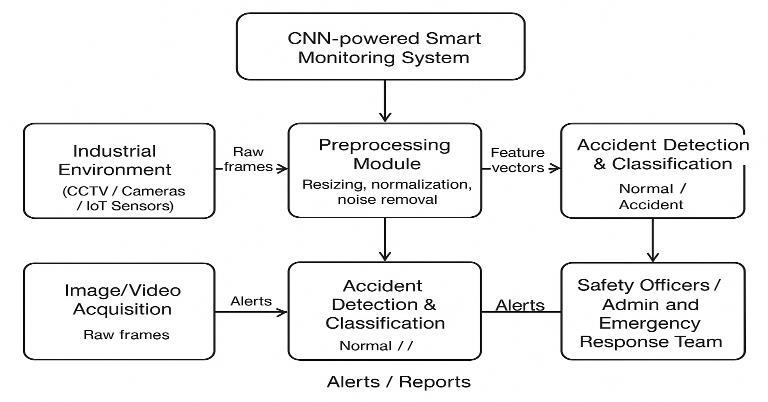
I. CNN-poweredSmartMonitoringSystemmonitors industrialenvironments.
II. RawframesarecollectedfromCCTVcamerasand IoTsensors.
III. Image/VideoAcquisitionmodulealsocollectsraw frames.
IV. Preprocessing module performs resizing, normalization,andnoiseremoval.
V. Preprocessed data is converted into feature vectors.
VI. Accident Detection & Classification module analyzesfeaturevectors.
VII. Events are classified as either “Normal” or “Accident.”
VIII. Alerts and reports are generated if an accident is detected.
IX. Alerts are sent to Safety Officers, Admin, and EmergencyResponseTeam.
X. A secondary Accident Detection module can also analyzerawframesdirectly.
XI. System ensures timely detection and reporting of industrialaccidents.
International Research Journal of Engineering and Technology (IRJET) e-ISSN: 2395-0056
Volume: 12 Issue: 10 | Oct 2025 www.irjet.net p-ISSN: 2395-0072
[1] [Zhang, Z., Zhang, C., Shen, W., Yao, C., & Bai, Y. (2018). Road Detection with Synthetic Data and Convolutional Neural Network. IEEE Access, 6, 3146731475.
In their research, Zhang et al. explored the application of Convolutional Neural Networks (CNNs) for roaddetectiontasks,utilizingsyntheticdataastheprimary training source. The study demonstrates that high-quality syntheticimages,whichareeasierandcheapertogenerate compared to real-world labeled data, can effectively train deep learning models to perform accurate road detection. This approach not only reduces the dependency on largescale real-world datasets but also provides a scalable methodfordevelopingrobustcomputervisionsystemsfor tasks such as autonomous driving and intelligent transportationfeature.
[2]. [Russakovsky, O., Deng, J., Su, H., Krause, J., Satheesh,S.,Ma,S.,...&Berg,A.C.(2015).ImageNetLarge ScaleVisualRecognitionChallenge.InternationalJournalof ComputerVision,115(3),211-252.Link.
Russakovsky and colleagues introduced and analyzed the ImageNet Large Scale Visual Recognition Challenge (ILSVRC), a benchmark competition that has driven major advancementsinimageclassification,objectdetection,and scene recognition. Their work outlines the dataset construction,evaluationmetrics,andtheevolutionofdeep learning architectures that emerged through the competition. ImageNet became a cornerstone in the development of CNNs, catalyzing the transition from traditional computer vision techniques to deep learningbased approaches due to its vast dataset and rigorous performanceevaluation..
[3] S. Hashimoto, Y. Ji, K. Kudo, T. Takahashi, and K. Umeda, "Anomaly detection based on deep learning using video for prevention of industrial accidents," arXiv, May 2020.
Hashimoto et al. proposed a video-based anomaly detection system using deep learning techniques aimed at preventing industrial accidents. Their system leverages surveillance video to automatically monitor work environmentsanddetectunusualorhazardouseventsthat mayprecedeaccidents.Thisapproachenhancesworkplace safety by enabling real-time detection and alerting, allowing for prompt intervention and reducing the potentialforinjuriesordamage.
[4] H. Ghahremannezhad, M. M. M. Hossain, and M. A. Hannan, "Real-time accident detection in traffic surveillanceusingdeeplearning," arXiv,Aug.2022.
Ghahremannezhad and co-authors developed a deep learning-based solution for real-time accident detection in
traffic surveillance videos. Their work focuses on enhancing road safety through early and accurate identification of accidents from video feeds, which can be crucial for quick emergency response and traffic management.Themodelisdesignedtooperateinreal-time environments, dealing with various challenges like occlusions,varyinglightingconditions,andcomplexurban trafficscenes.
[5] W. Sultani, C. Chen, and M. Shah, "Real-world anomaly detection in surveillance videos," IEEE Transactions on Pattern Analysis and Machine Intelligence, vol.41,no.3,pp.561–574,Mar.2019
Sultani et al. addressed the challenge of real-world anomaly detection in surveillance videos by introducing a deep learning framework capable of identifying abnormal eventsinunstructuredvideodata.Theirmethodisnotable foritsabilitytoworkwithweaklylabeleddata,whereonly video-level labels are available, rather than frame-level annotations. This significantly reduces the effort required for data labeling while still achieving high performance in detecting rare and unexpected events, making the system scalableandapplicableinvarioussurveillanceapplications.
The developed system successfully detects industrial accidents such as fire, worker falls, and unsafe movements using the trained Convolutional Neural Network (CNN) model. The model was tested with differentvideosamplesandreal-timecamerainputs,andit accurately identified abnormal activities with a high detection rate. When an accident or hazardous situation was recognized, the system generated an instant alert to notify supervisors through visual and audio signals. The CNN-based approach proved to be efficient in processing live video streams and making quick decisions without human intervention. The experimental results show that the system can operate reliably in various lighting and environmentalconditions,makingitsuitableforreal-world industrial applications. Overall, the proposed system demonstratesthatAI-poweredmonitoringcansignificantly enhance workplace safety and reduce response time duringemergencies.
The project Powered Smart Monitoring for Industrial Accident Detection Using Convolutional Neural Network effectively demonstrates how artificial intelligence can be applied to improve safety in industrial environments. The system is capable of detecting accidentssuchasfires,falls,andotherunsafesituationsin real time with high accuracy. By using CNN-based image and video analysis, it minimizes the need for manual supervision and provides quick alerts to ensure timely intervention. The project highlights the potential of deep
International Research Journal of Engineering and Technology (IRJET) e-ISSN: 2395-0056
Volume: 12 Issue: 10 | Oct 2025 www.irjet.net p-ISSN: 2395-0072
learning and automation in reducing human errors, preventing loss, and creating a safer workplace. Overall, thissmartmonitoringsystemprovestobeacost-effective andefficientsolutionforindustrialaccidentdetection,and itcanbefurtherenhancedwithIoTintegrationandcloudbasedmonitoringforlarge-scaledeploymentinthefuture.
This project can be enhanced by integrating Internet of Things (IoT) technology and cloud computing to enable remote monitoring and real-time data storage. The system can be connected to multiple cameras and sensorstocoverlargerindustrialareasanddetectawider range of hazards such as gas leaks, machinery malfunctions, or temperature fluctuations. Mobile applications or web dashboards can be developed to provide instant notifications and live video access to supervisors from anywhere. Additionally, the accuracy of theConvolutionalNeuralNetworkmodelcanbeimproved by training it with a larger and more diverse dataset to handle complex environments and lighting conditions. Implementing edge computing can also help in faster processing and decision-making at the device level. These enhancements would make the system more robust, scalable, and suitable for deployment in various types of industries,ensuringgreatersafetyandreliability.
[1] Zhang, Z., Zhang, C., Shen, W., Yao, C., & Bai, Y. (2018). Road Detection with Synthetic Data and Convolutional NeuralNetwork.IEEEAccess,6,31467-31475.
[2]Russakovsky,O.,Deng,J.,Su,H.,Krause,J.,Satheesh,S., Ma,S.,...&Berg,A.C.(2015).ImageNetLargeScaleVisual Recognition Challenge. International Journal of Computer Vision,115(3),211-252.Link.
[3] S. Hashimoto, Y. Ji, K. Kudo, T. Takahashi, and K. Umeda, "Anomaly detection based on deep learning using video for prevention of industrial accidents," arXiv, May 2020.
[4] H. Ghahremannezhad, M. M. M. Hossain, and M. A. Hannan, "Real-time accident detection in traffic surveillanceusingdeeplearning," arXiv,Aug.2022.
[5] W. Sultani, C. Chen, and M. Shah, "Real-world anomaly detection in surveillance videos," IEEE Transactions on PatternAnalysisandMachineIntelligence,vol.41,no.3,pp. 561–574,Mar.2019.