
International Research Journal of Engineering and Technology (IRJET) e-ISSN: 2395-0056
Volume: 13 Issue: 02 | Feb 2026 www.irjet.net p-ISSN: 2395-0072
International Research Journal of Engineering and Technology (IRJET) e-ISSN: 2395-0056
Volume: 13 Issue: 02 | Feb 2026 www.irjet.net p-ISSN: 2395-0072
Zainab Khan1 , Shifa Khan2 , Sanchita Nirmalkar3 , Afifa Momin4, Shaista Shaikh5
1Zainab Khan, Frontend Developer
2Shifa Khan, Backend Developer
3Sanchita Nirmalkar , Frontend Developer(Team Leader)
4Afifa Abdul Aziz Momin, Backend Developer
5Shaista Shaikh, Professor, Dept. of Computer Engineering, Abdul Razzak Kalsekar Polytechnic , Maharashtra, India (Team Mentor)
Abstract - In today’s digital era, individuals and small businesses frequently encounter complex legal documents such as contracts, rental agreements, employment letters, and policy statements. Understanding these documents often requires professional legal expertise, which may not always be accessible or affordable. This paper presents the design and development of Pocket Lawyer, an AI-enabled web application that assists users in analyzing and interpreting legal documents in simplified language. The system integrates Optical Character Recognition (OCR) for extracting text from scanned documents, a legal simplification engine for converting complex legal terminology into plain English, and a clause identification module that highlights critical elements such as penalties, liabilities, termination conditions, and payment terms. Additionally, the platform includes a risk indicator mechanism that categorizes documents as Safe, Risky, or Requires Lawyer Review based on predefined legal heuristics. A conversational chatbot interface further enhances usability by allowing users to query specific clauses and receive contextual explanations. The proposed architecture follows a modular design, ensuring scalability, multilingual support, and secure document storage. By combining AI-driven text processing with user-friendly interaction, Pocket Lawyer aims to improve legal awareness, reduce misinterpretation risks, and empower users to make informed decisions without compromising dataprivacy.
Key Words: Legal Document Analysis, Artificial Intelligence, Optical Character Recognition (OCR), Contract Simplification, Clause Detection, Risk Assessment System, AI Chatbot, Web-Based Application
The increasing use of digital legal documents such as rental agreements, employment contracts, and online policieshasmadelegalinterpretationacommonchallenge forindividualsandsmallbusinesses.Thesedocumentsare typically written in complex legal language, making them difficult for non-professionals to understand clearly. As a
result, users often accept legally binding terms without fully understanding their rights, liabilities, or potential risks.
Existing solutions either require professional legal consultation, which can be costly and time-consuming, or rely on generic AI tools that lack structured legal analysis and raise data privacy concerns. There is a growing need for a secure and intelligent system that can simplify legal language, identify important clauses, and provide risk awarenesswithoutcompromisinguserdata.
To address this issue, the proposed system, pocket Lawyer, introduces an AI-based web application that integrates Optical Character Recognition (OCR), Natural Language Processing (NLP), clause detection, and risk indication mechanisms to assist users in understanding legaldocumentsefficientlyandsecurely.
Modern legal documents are structured using formal terminology,conditionalclauses,andtechnicalexpressions thatareoftendifficultforindividualswithoutlegaltraining to interpret correctly. Important provisions related to penalties,liabilities,renewalconditions,terminationrights, and dispute resolution are typically embedded within lengthyparagraphs,makingthemhardtoidentifyquickly.
With the increasing shift toward digital contracts and onlineagreements,usersarefrequentlyrequiredtoreview and accept documents within limited timeframes. This situation increases the likelihood of oversight and misinterpretation. Furthermore, variations in document format such as scanned PDFs, images, and multilingual contracts add another layer of complexity in extracting andunderstandingrelevantinformation.
Existing methods for understanding legal documents primarilyrelyonprofessionallegalconsultationorgeneric document-reading tools. Legal consultation can be costly and time-consuming for routine agreements, while basic document viewers do not provide structured clause analysis or simplification. Some AI-based tools offer
Volume: 13 Issue: 02 | Feb 2026 www.irjet.net p-ISSN: 2395-0072
assistance but often require uploading sensitive documents to external servers, raising privacy and data securityconcerns.Theselimitationsindicatetheneedfora secureandintelligentsystemtailoredspecificallyforlegal documentanalysis.
The Pocket Lawyer system is designed as a web-based intelligent document analysis platform that processes legal documents through a structured and modular architecture. The system ensures efficient interaction between the user interface, processing modules, and secure storage components. The architecture emphasizes scalability, data privacy, and structured workflow management to provide reliable legal document interpretation.
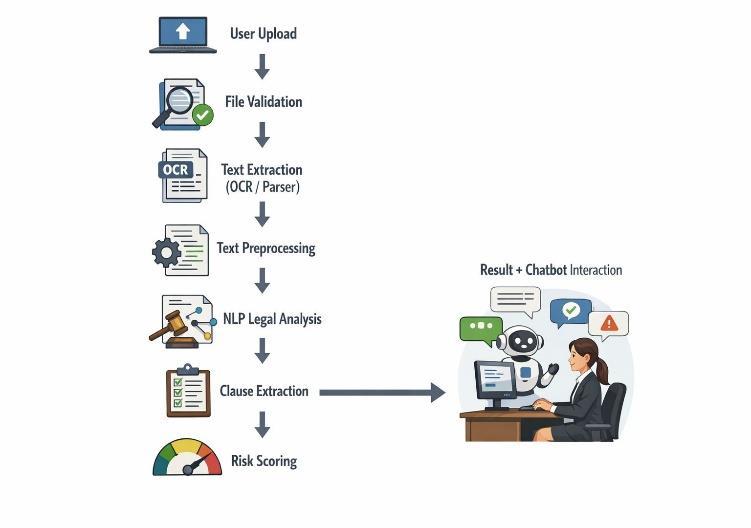
The overall workflow begins when a user uploads a legal documentinPDF,Word,orimageformatthroughtheweb interface. The uploaded file is then transmitted to the backend processing server, where it undergoes multiple stages of analysis including text extraction, clause detection, simplification, and risk evaluation. The processed results are returned to the frontend in a structuredformatforclearvisualizationandinteraction.
To maintain a clear separation between presentation and computation, the system follows a client–server interactionmodel.Theclientsiderepresentsthefrontend web interface through which users upload documents, access summaries, interact with the chatbot, and view highlightedclausesandriskindicators.
Thefrontendlayerisdesignedto beresponsiveanduserfriendly. It handles user authentication, document upload requests,andvisualizationofprocessedresults.Thislayer ensuresthatcomplexlegal analysisoutputsarepresented in a simplified and structured format, allowing users to easily understand critical clauses and overall document riskstatus.
The server side acts as the core processing environment.Whenadocumentisuploaded,itissecurely transmitted to the backend through defined API endpoints. The backend validates the file format and initiates structured analysis workflows. By isolating processing from the user interface, the system prevents heavy computational tasks from impacting the responsivenessofthefrontend.
This separation enhances system stability, improves performance, and ensures that future updates to either frontend or backend components can be implemented independently.
Thefrontendlayerisdesignedto beresponsiveanduserfriendly. It handles user authentication, document upload requests,andvisualizationofprocessedresults.Thislayer ensuresthatcomplexlegal analysisoutputsarepresented
in a simplified and structured format, allowing users to easily understand critical clauses and overall document riskstatus
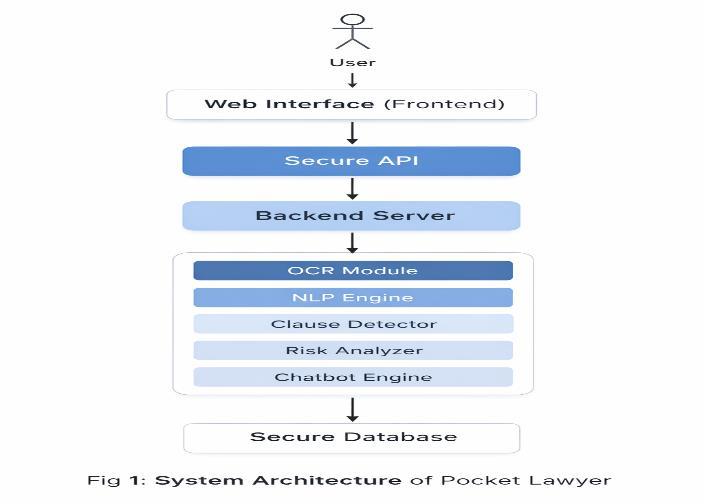
The intelligent processing layer forms the analytical core of the Pocket Lawyer system. It integrates multiple AIdriven modules to transform complex legal text into structured,simplified,andactionableinsights.
The first stage involves document parsing and text extraction. For scanned PDFs or image-based contracts, Optical Character Recognition (OCR) techniques are applied to convert visual text into machine-readable format. Once textual data is extracted, Natural Language Processing (NLP) techniques are used to identify legal terminology,clauseboundaries,andcontextualmeaning.
Following text analysis, the clause detection module highlights important contractual components such as penalties, payment terms, liabilities, and termination conditions. These clauses are presented separately to enhanceclarityandreduceuseroversight.
The system further incorporates a risk assessment mechanism that evaluates extracted clauses based on predefined analytical parameters. Based on this evaluation, the document is categorized as Safe, Risky, or RequiresLawyerReview.
Additionally, a contextual chatbot module interacts with processed document data, allowing users to ask queries related to specific clauses. This interactive component improves user engagement while ensuring responses remaindocument-specificandrelevant.
The modular integration of OCR, NLP, clause detection, risk evaluation, and chatbot interaction ensures that the system operates as a comprehensive legal assistance platformratherthanasimpledocumentviewer.
The Pocket Lawyer system is composed of multiple functional modules that work collaboratively to provide
International Research Journal of Engineering and Technology (IRJET) e-ISSN: 2395-0056
Volume: 13 Issue: 02 | Feb 2026 www.irjet.net p-ISSN: 2395-0072
intelligentlegaldocumentanalysis.Eachmoduleperforms a specific task within the overall processing pipeline, ensuringmodularity,maintainability,andefficiency
Thismodulehandlesuserdocumentsubmission.Itaccepts legal documents in formats such as PDF and DOCX. Upon upload, the system validates file type, size, and format compatibilitybeforeinitiatingprocessing.
Input validation ensures system security and prevents malicious file execution. Once verified, the document is securelytransferredtothebackendprocessinglayer.
For scanned or image-based legal documents, Optical Character Recognition (OCR) is applied to convert visual contentintomachine-readabletext.
Fordigitallycreateddocuments,structuredtextextraction techniques are used to retrieve raw textual content while preserving formatting hierarchy such as headings and clauses.
This module ensures that all documents, regardless of format,areconvertedintoanalysetext.
This module applies Natural Language Processing techniques to understand legal language structure. It identifies:
Keylegalterminology
Clauseboundaries
Contextualdependencies
Obligationandliabilityphrases
The system simplifies complex legal language into understandable summaries, making it accessible for nonlegalusers.
The AI Chatbot Interaction Module serves as the interactive layer between the user and the analysed legal document. Unlike conventional chatbots that generate generic responses, this module operates on documentspecific extracted data to provide contextual and relevant explanations.
After the completion of clause detection and risk assessment, the chatbot is integrated with the structured outputgeneratedbythebackendprocessinglayer.Whena user submits a query such as asking about termination conditions, penalty clauses, or liability statements the chatbot retrieves the corresponding extracted clause and provides a simplified explanation in user-friendly language.
The chatbot employs Natural Language Processing techniques to interpret user intent and map it to relevant
sections of the processed document. This ensures that responses are not random but directly linked to the uploaded legal content. Additionally, the module can highlighttheexactclausewithinthedocumenttoimprove clarityandtransparency.
To maintain accuracy and avoid misinformation, the chatbot restricts responses strictly to the analyzed document context rather than generating open-ended legal advice. This design ensures controlled assistance whilepreservingreliability.
By combining clause referencing, contextual simplification, and guided interaction, the AI Chatbot Interaction Module enhances overall system usability and transforms static document analysis into an interactive legalsupportexperience.
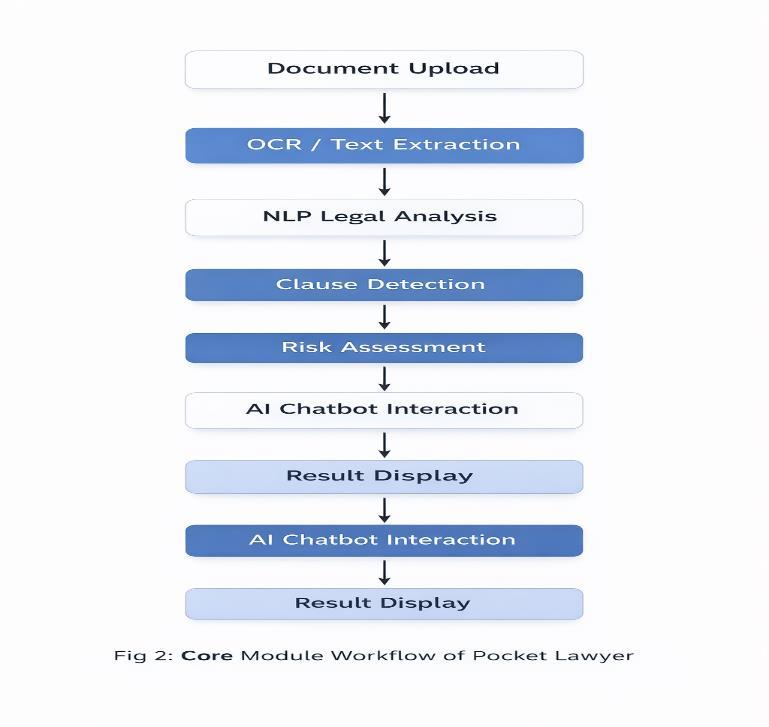
The methodology of the Pocket Lawyer system follows a structured multi-stage processing pipeline designed to transform complex legal documents into simplified and risk-aware outputs. The workflow ensures systematic document handling, intelligent analysis, and contextual userinteraction
The methodological workflow of the Pocket Lawyer systembeginswiththedocumentacquisitionstage.Inthis phase, the user uploads a legal document through the web-basedinterfaceprovidedbythesystem.Theinterface is designed to support commonly used legal document formats such as digitally generated PDF files and scanned image-basedcontracts.
Upon submission, the system performs an initial validation process to ensure file integrity and
International Research Journal of Engineering and Technology (IRJET) e-ISSN: 2395-0056
Volume: 13 Issue: 02 | Feb 2026 www.irjet.net p-ISSN: 2395-0072
compatibility. This includes verification of file type, file size limitations, and format consistency to prevent unsupported or potentially malicious files from entering the processing pipeline. Basic security checks are also implementedtosafeguardthebackendenvironmentfrom unauthorizedcontentexecution.
After successful validation, the document is securely transmitted to the backend server through encrypted API communication channels. The system assigns a unique processinginstancetotheuploadeddocumenttomaintain traceabilityandstructuredworkflowmanagement.
Thisacquisitionstageensuresthatonlyauthenticatedand properlyformatteddocumentsproceedtothesubsequent text extractionandanalytical phases,therebymaintaining systemreliabilityandoperationalsecurity.
Once the document is successfully acquired, the system proceeds to the text extraction and preprocessing stage. This phase ensures that the uploaded legal document is converted into a structured and machine-readable format suitableforintelligentanalysis.
If the document is scanned or image-based, Optical Character Recognition (OCR) techniques are applied to detect and extract textual content from visual data. The OCR engine identifies characters, words, and paragraph structures while preserving logical formatting as accurately as possible. In the case of digitally generated documents such as machine-created PDFs, direct parsing methods are employed to extract embedded textual data withouttheneedforimagerecognition.
After extraction, the raw text undergoes a series of preprocessing operations to enhance analytical accuracy. Thesepreprocessingstepsinclude:
Tokenization, where the text is divided into individualwordsandmeaningfulunits.
Stop-word removal, which eliminates commonly used words that do not contribute significant semanticvalue.
Sentence segmentation, used to break the text intologicallystructuredsentences.
Structural normalization, which standardizes formatting inconsistencies and removes unnecessarysymbolsornoise. These operations refine the textual dataset and convert unstructured legal content into a structured representation. By performing systematic preprocessing, the system improves the efficiency and precision of subsequent Natural Language Processing and clause detectionmechanisms
Followingtextextractionandpreprocessing,thesystem advances to the Legal Language Processing stage, which formsthecoreanalyticalcomponentofthePocketLawyer framework. In this phase, Natural Language Processing
(NLP) techniques are applied to interpret and structure complexlegaltext.
TheNLPengineexaminesthecontenttoidentifyclause boundaries, contractual sections, and syntactic relationshipsbetweenstatements.
It detects legal entities such as parties involved, monetary amounts, dates, obligations, and liabilities. By analysingsentencestructureandcontextualdependencies, the system distinguishes between mandatory obligations, conditionalstatements,andinformationalclauses.
In addition to structural parsing, pattern recognition mechanisms are employed to identify legally significant keywords and phrases related to penalties, indemnities, terminationconditions,confidentialityterms,andfinancial commitments. These keywords are mapped to predefined legalcategoriestoenablestructuredclassification.
The system further applies contextual analysis to reduce ambiguity, ensuring that similar terms used in different contexts are interpreted appropriately. This step enhances analytical precision and prevents misclassificationofclauses.
By transforming raw and unstructured legal text into organized, machine-understandable representations, this stage enables efficient clause extraction, risk evaluation, andinteractivequeryhandling.Itservesasthefoundation for subsequent modules responsible for risk assessment andintelligentchatbotinteraction.
file,highlightall ofthecontentsandimportyourprepared textfile.Youarenowreadytostyleyourpaper.
The extracted clauses are evaluated against predefined risk parameters. A rule-based and scoring-based mechanism assigns risk levels depending on the severity andfrequencyofcriticallegalterms.
Thedocumentiscategorizedinto:
Safe
ModerateRisk
HighRisk
Thisclassificationassistsusersinunderstandingpotential legalexposure.
The final stage of the methodology involves contextual queryhandlingthroughtheintegratedAIchatbotmodule. This component enables interactive communication between the user and the processed legal document, transforming static analysis into an intelligent assistance mechanism.
After clause extraction and risk evaluation arecompleted, thechatbotisdynamicallylinkedtothestructureddataset generated by the backend system. When a user submits a query such as asking about termination conditions,
International Research Journal of Engineering and Technology (IRJET) e-ISSN: 2395-0056
Volume: 13 Issue: 02 | Feb 2026 www.irjet.net p-ISSN: 2395-0072
financial penalties, renewal clauses, or liability limitations the system interprets the intent of the query usingNaturalLanguageProcessingtechniques.
The chatbot then retrieves the most relevant extracted clause from the analysed document and generates a simplified, context-aware explanation. Unlike generic conversational models, this module restricts responses strictly to the uploaded document content, ensuring accuracy and preventing unrelated or speculative legal advice.
Additionally, the system may highlight or reference the exact clause location to improve transparency and user understanding. This guided interaction allows users to clarify doubts, verify obligations, and better comprehend complex contractual terms without manually searching throughlengthydocuments.
Bycombiningintent recognition,contextual mapping,and structured response generation, the contextual query handling module enhances usability and provides a reliable,document-specificlegalassistanceexperience.
The Pocket Lawyer system was evaluated based on functional accuracy, response time, and usability. The objective was to assess how effectively the system processes legal documents and provides meaningful insightstousers.
Theexperimentalevaluationwasconductedusingvarious types of legal documents including rental agreements, servicecontracts,andemploymentpolicies.
The clause detection module was tested on multiple contractual documents containing liability, penalty, confidentiality, and termination clauses. The NLP-based detection mechanism successfully identified and categorized major legal components with high consistency.
Minor deviations were observed in highly complex or ambiguous legal phrasing; however, contextual mapping reduced classification errors. Overall, the system demonstrated reliable clause extraction performance suitableforpracticalapplications.
The risk scoringmechanism assignsstructured risk levels based on detected keywords, conditional obligations, and financial liabilities. The evaluation showed that high-risk clauses such as heavy penalties or strict termination conditions wereaccuratelyflagged.
Thescoringframeworkprovidesuserswithasummarized risk overview, enabling faster understanding without manually reviewing lengthy documents. This significantly improvesdecision-makingefficiency.
While the current implementation of Pocket Lawyer providesstructuredlegalanalysisandchatbotinteraction, several enhancements can further improve its scalability andintelligence.
Future enhancements of the Pocket Lawyer system may include the integration of multilingual Natural Language Processing (NLP) models to enable analysis of legal documents written in multiple regional and international languages. At present, the system primarily focuses on documents in a single language; however, legal contracts andagreementsarefrequentlydraftedindiverselinguistic formatsdependingonjurisdictionandregion.
By incorporating multilingual language models and translation-assisted preprocessing techniques, the system canexpanditsapplicabilityacrossbroaderlegaldomains.
This would allow users to upload documents written in languages such as Hindi, Marathi, or other regional dialects,aswellasinternationallyusedlanguages. Such an extension would significantly improve accessibility and inclusivity, especially for users who may not be comfortable interpreting complex legal text in a foreignlanguage.Additionally,multilingualsupportwould enhance the system’s potential for global deployment, making it adaptable to different regulatory environments andlegalframeworks.
Implementing this feature would require advanced language detection, semantic alignment across translations, and jurisdiction-aware clause classification mechanisms. Nevertheless, this enhancement would substantially strengthen the scalability and real-world usabilityofthesystem
International Research Journal of Engineering and Technology (IRJET) e-ISSN: 2395-0056
Volume: 13 Issue: 02 | Feb 2026 www.irjet.net p-ISSN: 2395-0072
ThefuturedevelopmentofthePocketLawyersystemmay involve the integration of advanced deep learning models to enhance contextual understanding of complex legal language. While the current implementation relies on structured keyword mapping and rule-based categorization, incorporating transformer-based architectures or fine-tuned legal language models could significantlyimprovesemanticinterpretationaccuracy.
Advanced AI-driven risk prediction mechanisms can analyse clause dependencies, conditional obligations, and cross-referenced statements within a contract. Instead of identifying isolated risk indicators, the system could evaluate the cumulative impact of multiple clauses to generateamorecomprehensiveriskprofile.
Predictive analytics techniques may also be introduced to estimate potential legal consequences based on extracted obligations, penalties, and termination conditions. For example,thesystemcouldidentifyhigh-liabilityscenarios, financial exposure risks, or restrictive compliance requirements by analysing patterns learned from historicallegaldatasets.
The system can be extended to a secure cloud-based architecture to handle large-scale document processing. Role-basedaccesscontrol and enterprise-level encryption can further enhance data security for organizational deployment.
Cloud integration would allow the platform to support simultaneous multi-user access and high-volume document analysis without performance degradation. Scalable infrastructure services can dynamically allocate computational resources based on processing demand, ensuringconsistentsystemresponsiveness.
The Pocket Lawyer system presents an intelligent and structured approach to simplifying the analysis of legal documents through the integration of Natural Language Processingandautomatedrisk assessmenttechniques.By combining OCR-based text extraction, clause detection mechanisms, contextual legal analysis, and AI-driven chatbot interaction, the system transforms complex contractual content into understandable and actionable insights.
The proposed framework successfully bridges the gap between technical legal documentation and user comprehension. Instead of manually reviewing lengthy contracts,userscanquicklyidentifyobligations,penalties, and risk-related clauses through structured summaries andinteractivequeryhandling.
Themodulararchitectureensuresscalability,security,and flexibility for future enhancements, including multilingual support and advanced predictive analytics. Experimental evaluation demonstrates that the system efficiently processes various types of legal documents while maintainingstructuredaccuracyandusability. Overall, Pocket Lawyer contributes toward accessible, AIpowered legal assistance, reducing cognitive burden and improving decision-making efficiency in contractual analysis. The system lays a strong foundation for further research and development in intelligent legal technology solutions.
[1] D. Jurafsky and J. H. Martin, Speech and Language Processing,3rded.,PearsonEducation,2023.
[2] C. D. Manning, P. Raghavan, and H. Schütze, Introduction to Information Retrieval, Cambridge UniversityPress,2008.
[3] R. Smith, “An Overview of the Tesseract OCR Engine,” Proceedings of the Ninth International Conference on DocumentAnalysisandRecognition(ICDAR),2007.
[4]J.Devlin,M.W.Chang,K.Lee,andK.Toutanova,“BERT: Pre-training of Deep Bidirectional Transformers for Language Understanding,” Proceedings of NAACL-HLT, 2019.
[5] D. Chalkidis, I. Androutsopoulos, and N. Aletras, “Neural Legal Judgment Prediction in English,” ProceedingsofACL,2019.