
International Research Journal of Engineering and Technology (IRJET) e-ISSN: 2395-0056
Volume: 12 Issue: 06 | Jun 2025 www.irjet.net p-ISSN: 2395-0072
International Research Journal of Engineering and Technology (IRJET) e-ISSN: 2395-0056
Volume: 12 Issue: 06 | Jun 2025 www.irjet.net p-ISSN: 2395-0072
Suyash Mane1 , Shreyash Chavare2 , Sarvesh Redekar3
1 B.E. Student, Dept. of Computer Science and Engineering (Artificial Intelligence and Machine Learning), S.S.P.M’s College of Engineering, Kankavli, Maharashtra, India
2 B.E. Student, Dept. of Computer Science and Engineering (Artificial Intelligence and Machine Learning), S.S.P.M’s College of Engineering, Kankavli, Maharashtra, India
3 B.E. Student, Dept. of Computer Science and Engineering (Artificial Intelligence and Machine Learning), S.S.P.M’s College of Engineering, Kankavli, Maharashtra, India
Abstract - This project uses deep learning to detect plant diseases from leaf images using a method called Convolutional Neural Networks (CNN). The goal is to build a smart and reliable system that can find and recognize different plant leaf diseases easily and accurately. Finding plant diseases early is very important for farmers because it helps protect crops and avoid big losses. The model is trained on a public dataset that contains many pictures of healthy and sick plant leaves. Before training, the images are processed by resizing and enhancing them to make the model work better. CNN automatically learns useful features from the images, so we don’t need to manually choose them. The model's performance is tested using measures like accuracy and precision. It gives very good results in detecting various diseases. This system can be helpful for farmers by giving quick and correct information about plant health. It can also be added to mobile or web apps, so it can be used anytime and anywhere. This project supports smart farming by giving a fast, low-cost, and easy solution to check crops and improve farming methods.
Key Words: Plant Disease Detection, Deep Learning, CNN, Leaf Image, Smart Farming, Image Processing, Crop Health, Agriculture
1.INTRODUCTION
Farming is very important for India and the whole world. One big problem farmers face is plant diseases. These diseases can damage crops and reduce the amount and qualityoffood.Ifthesediseasesarefoundearly,farmerscan savetheirplantsandavoidlosingmoney.Butcheckingfor diseasesbyhandtakestimeandneedsexperts,whichisnot alwayspossibleforfarmers,especiallyinvillages.
Now,withthehelpoftechnologylikeArtificialIntelligence (AI)andDeepLearning,wecancreatesmartsystemsthat find plant diseases by just looking at pictures of leaves. A specialmethodcalledConvolutionalNeuralNetworks(CNN) is very good at learning from images without any manual effort.
In this project, we made a CNN model that can detect different plant diseases from leaf images. We used a free dataset with images of healthy and diseased leaves. The
modellearnsfromtheseimagesandcancorrectlytellwhat diseaseaplanthas.Thissystemcanalsobeaddedtomobile or web apps, so farmers can use it anytime to check their crops.
Thisprojectgivesfarmersandagricultureworkersasmart and easy tool to check plant health. It also helps modern farming by using technology to grow better and healthier crops.
Manypeoplehavedoneresearchonfindingplantdiseasesby usingpicturesofleaves.Inthepast,expertshadtolookatthe leaveswiththeirowneyestofindoutwhatdiseasetheplant had. This method takes a lot of time and is not always possible, especially in villages where experts may not be available.
Later, computer methods like Support Vector Machines (SVM)andk-NearestNeighbours(k-NN)wereused.These neededpeopletochooseimportantpartsoftheleafimageby handbeforetrainingthemodel.Thiswasnotalwayseasyor accurate.
Now, deep learning methods like Convolutional Neural Networks (CNN) are used. CNN can learn directly from images and find patterns without any manual work. Many researchershaveusedCNNtodetectplantdiseasesandgot goodresults.Mostofthemusedthe Plant Village dataset, whichhasimagesofplantsliketomato,potato,andgrape.
But most of these projects focus only on a few common plants. Our project is different because wealso added leaf images of mango, coconut, and cashew plants. These are importantcropsinIndia,butnotmanyresearchpapershave used them. Finding diseases early in these plants can help farmersalot.
Byusing moretypes of plantsandleafimages,ourproject becomesmoreusefulandcanhelpmorefarmersinreallife.
International Research Journal of Engineering and Technology (IRJET) e-ISSN: 2395-0056
Volume: 12 Issue: 06 | Jun 2025 www.irjet.net p-ISSN: 2395-0072
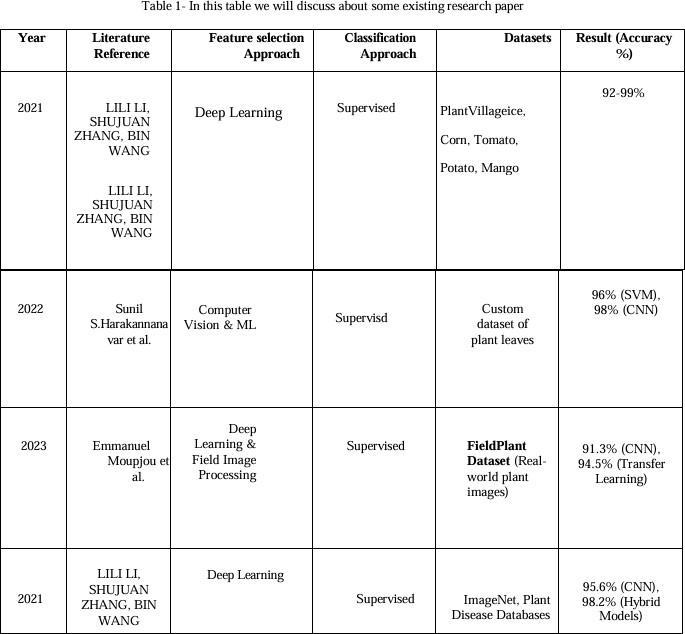
Althoughmanyresearchershaveworkedonplantdisease detectionusingdeeplearning,severalimportantgapsstill remain:
1. Limited crop coverage
Mostexistingresearchfocusesonlyonafewcrops liketomato,potato,andmaize.Rarebutimportant crops such as mango, coconut, and cashew are oftenignored.
2. Unbalanced Datasets:
Many datasets used in past research are imbalanced,meaningtheycontainmoreimagesof somediseasesandfewerofothers.Thisaffectsthe model’s ability to detect less common diseases accurately.
3. Lack of Disease Stage Detection:
Mostmodelsonlydetect if a disease is present or not, but they do not recognize the stage of the disease (early, moderate, severe), which is importantfortakingaction.
4. Low Accuracy on Similar-looking Diseases: Some diseases look very similar on leaves, which leads to misclassification. There is a need for better feature extraction and fine-grained classification.
5. Generalization Issues:
Manymodelsperformwellontrainingdatabutdo not work well when tested on new or unseen images,especiallyfromrealfarms.Thisshowsthat themodelsarenotgeneralized.
6. Environmental Variation Handling: Changesinlighting,background,leafangle,orimage quality affect model accuracy. Few models have beentestedundersuchreal-worldconditions.
7. Lack of Farmer-Friendly Interfaces:
While many models are developed, not all are converted into simple mobile or web apps that farmerscaneasilyuseintheirlocallanguage.
4.1 PROBLEM STATEMENT
Plant diseases are one of the major problems faced by farmers. These diseases can damage crops and reduce the amount of food produced. Many farmers are not able to detect diseases early because they don’t have expert knowledgeortools.Mostoftheexistingsystemsfocusonly oncommoncropsliketomatoorpotatoandignoreimportant cropslike mango, coconut,and cashew.Also,manymodels arenoteasyforfarmerstouseinreallife.
Thereisaneedforasmart,simple,andlow-costsystem thatcandetectdiseasesfrom leaf images ofdifferentplants, especiallytropicalcrops.Thesystemshouldbeaccurate,fast, andeasytouseonamobileorwebplatform.
4.2 OBJECTIVES
Themaingoalsofthisprojectare:
1. To build a system that can find plant diseases by lookingatpicturesofleaves.
2. To use a deep learning method called CNN (ConvolutionalNeuralNetwork)todetectandidentify differentdiseases.
3. To include more plants like mango, coconut, and cashew,whicharenotusedmuchinearlierprojects.
4. To improve the model by using image processing methodslikeresizingandimageflipping.
5. Tomakethesystemsimplesothatfarmerscanuseit easilythroughamobilephoneorwebsite.
6. Tohelpfarmersfinddiseasesearlyandprotecttheir crops, so they can grow better and more healthy plants.
5.PROPOSED SYSTEM
Thissystemisbuilttofindplantdiseasesusingleaf images. It uses a deep learning method called CNN (ConvolutionalNeuralNetwork).
International Research Journal of Engineering and Technology (IRJET) e-ISSN: 2395-0056
Volume: 12 Issue: 06 | Jun 2025 www.irjet.net p-ISSN: 2395-0072
Theuseruploadsaleafimage,andthesystemchecksifthe leafishealthyorhasadisease.Ifthereisadisease,itshows thenameofthediseaseandtheplanttype.
The model is trained on images from 12 types of plants, includingmango,coconut,andcashew,whicharenotused muchinearlierresearch.
Theresultisshowninsimpleform,andthesystemcanalso suggestbasicactions.Itcanbeusedthroughamobileappor website.
Thishelpsfarmerstodetectdiseasesearlyandprotecttheir cropsbetter.
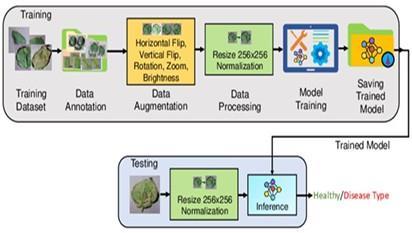
The methodology of this project explains how the system detectsplantdiseasesusingimagesofleaves.Theprocessis dividedintothefollowingsteps:
6.1 Dataset Collection:
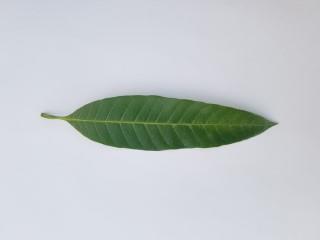
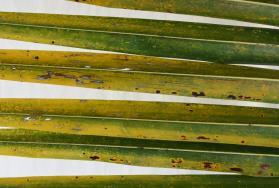
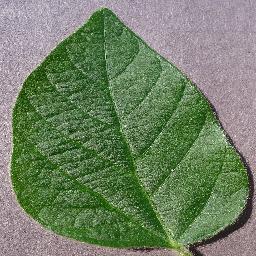
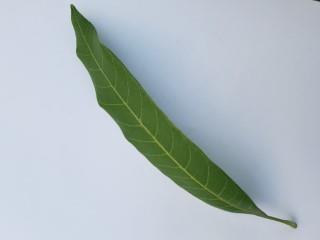
Thedatasetcontainsimagesofhealthyanddiseasedleaves from 12 different crops,suchas:
Apple(4diseases),Blueberry(1),Cherry(2),Corn (4),Grape(4),Mango(8),Potato(3),Soybean(1), Strawberry (1), Tomato (10), Coconut (4), and Cashew(3).
The images were collected from the following sources:
PubliclyavailabledatasetsonKaggle,includingthe popular Plant Village dataset.
Agriculture colleges and research institutions, whichprovidedlocalleafdiseasesamplesfromreal farmingconditions.
Fielddatacollection,whereplantleafimageswere captured directly from farms using smartphones anddigitalcameras.
Eachimageinthedatasetisproperlylabelledwith the crop name and disease type (or marked as healthy).Thiscombinationofonlineandreal-world sources has helped to build a more diverse, accurate,andpracticaldataset.Italsoensuresthat thesystemcandetectdiseasesinbothcommonand region-specific crops, making it more helpful to Indianfarmers.
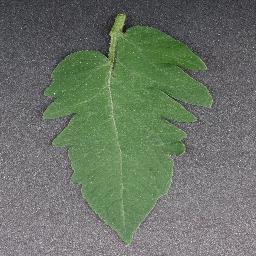
6.2 Image Preprocessing:
Before training the model, the images go through preprocessingstepstoimproveperformance:
Resizing: All images are resized to a fixed size (e.g.,224x224pixels).
Normalization:Pixelvaluesarescaledbetween 0and1.
Augmentation:Techniqueslikeimageflipping, rotation, and zoom are applied to increase varietyandavoidoverfitting.
6.3 CNN Model Architecture:
AConvolutionalNeuralNetwork(CNN) isusedto detectfeaturesfromleafimagesandclassifythe diseases.Themodelincludes:
International Research Journal of Engineering and Technology (IRJET) e-ISSN: 2395-0056
Volume: 12 Issue: 06 | Jun 2025 www.irjet.net p-ISSN: 2395-0072
Convolutional layers:Toextractfeaturesfromthe image.
ReLU activation:Toaddnon-linearity.
Pooling layers:Toreducethesizeoffeaturemaps.
Flatten layer: To convert features into a single vector.
Fully connected (Dense) layers: To make predictions.
SoftMax output layer:Toclassifytheimageintoone ofthediseasecategories.
6.4 Dataset Splitting:
The processed images are divided into three subsets:
– Training Set: Used to train the deep learning model.
–ValidationSet:Usedforhyperparametertuning andoptimization.
–Test Set: Used for evaluating the final modelperformance.
6.5 Training and Evaluation:
• Thedatasetisdividedintotrainingandtestingsets.
• TheCNNmodelistrainedforseveralepochsusinga categorical cross-entropy loss function and Adam optimizer.
After training, the model is evaluated using the test dataset. Performance metrics such as accuracy, precision, recallcomputedtodeterminethemodel’seffectiveness.This assessment ensures that the model generalizes well to unseenplantdiseasesamples.
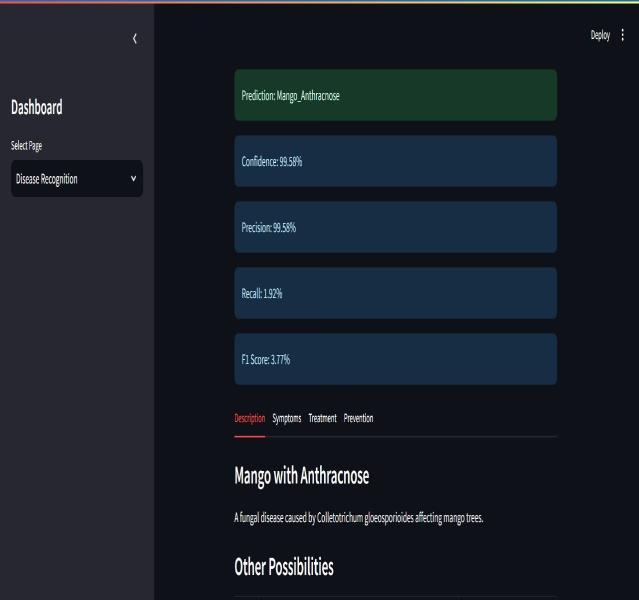
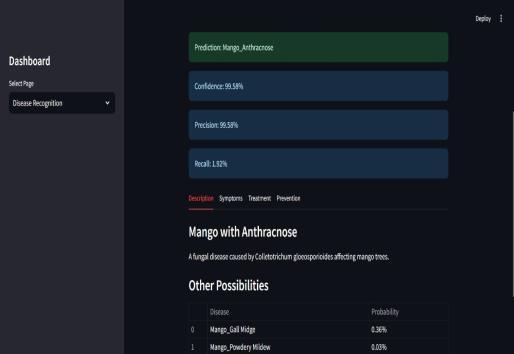
with confidence, precision, recall, and F1 score displayed, along with disease description and suggestions.
6.6 Plant Disease Classification:
Thefinalstageinvolvesclassifyingplantdiseases based on the trained model’s predictions. The systemoutputsthediseasecategoryoftheinput leaf image, enabling farmers and agricultural expertstotakenecessarypreventivemeasuresfor cropprotection.
Symptomsofvariousdisordershavealotin common. Diseases, dietary shortages, pests, phytotoxicity, extreme cold or heat, and a varietyofmechanicaldamageareallexamples. Inordertoresolvethischallengetheworking model needs to be re-train frequently with respecttothediseases.
So far, the techniques suggested have been restricted in reach and are reliant on ideal capture conditions tofunctionproperly. Thisisduetotheexistenceofcomplexcontexts
International Research Journal of Engineering and Technology (IRJET) e-ISSN: 2395-0056
Volume: 12 Issue: 06 | Jun 2025 www.irjet.net p-ISSN: 2395-0072
thatmakeitdifficulttodistinguish theareaof interest from the context (usually leaf and stem).ForExample:inacropadiseasenamed asteryellowsisdetected,nowifithasanother disease named bacterial wilt. Then our trained model won’t be abletoidentifyit.The solution of this challenge would be Transfer Learning.Inwhichtheexistingtrainedmodel canbeusedinsuchcases.
To help the growing global population and improvinglivingstandards,thereisagrowing demand for com- plete, healthy, and diverse foods. Nowadays, people are becoming more professionalintermsoftheirdieti.e.,whatthey eat.So,thefood(crops)shouldbefreefrom all thediseases.
Thisprojectpresentsaneffectiveandautomatedsolutionfor detectingplantleafdiseasesusingdeeplearning,specifically ConvolutionalNeuralNetworks(CNN).Themaingoalwasto createasystemthatcanhelpfarmersidentifyplantdiseases earlybysimplyuploadinganimageofaleaf.Themodelwas trained using a diverse dataset of 12 crops, including commonlygrownandregion-specificplantssuchasmango, coconut, cashew, and tomato. By applying image preprocessingtechniqueslikeresizing,normalization,and augmentation, the model performance was improved, resulting in high accuracy. The system is designed to be simple, fast, and user-friendly. It provides not only the predictionofthediseasebutalsoconfidencescores,making it suitable for real-time use in mobile or web-based applications.Thiscanbeveryhelpfulforfarmers,especially inruralareas,whereexpertadviceisnotalwaysavailable. By offering a low-cost, accurate, and easy-to-use solution, thisprojectcontributestosmartandprecisionagriculture.It canhelpreducecroploss,improveproductivity,andsupport sustainable farming practices using modern AI-based technology.
1) M.Sharif, M. A. Khan, Z. Iqbal, M. F.Azam, M. I. U. Lali and M. Y. Javed, ”Detection and classification ofcitrusdiseasesinagriculturebased on optimized weighted segmentation and feature selection,”Comput-ersandElectronicsAgriculture, vol.150,pp.220-234,2018.
2) S. Dimitriadis,C. Goumopoulos,”Applying Machine Learning to Extract New knowledge in Precision Agri-cultureApplications,”PanhellenicConference onInfor-matics,pp.100-104,2008.
3) A. Akhtar, A. Khanum, S. A. Khan and A. Shaukat, ”AutomatedPlantDiseaseAnalysis(APDA):Performance Comparison of Machine Learning Techniques,”InternationalConferenceonFrontiers ofInformationTechnology,pp.6065,2013.
4) K.P. Ferentinos,”Deep learning models for plant disease detection and diagnosis”Computers and Electronics in Agriculture, vol. 145, pp. 311 318, 2018.in”UsingDeepLearningforImage-BasedPlant DiseaseDetection,”Frontiersinplantscience,pp.110,2016.
5) S.Sladojevic,M.Arsenovic, A.Anderla,Neural NetworksBasedRecognitionofPlantDiseasesbyLeaf Im- age Classification,”Computational intelligence andneu-roscience,pp.1-12,2016.
6) K.R.GavhaleandU.Gawande,”AnOverviewof the Research on Plant Leaves Disease detection using Im- age Processing Techniques,” IOSR Journal of ComputerEngineering,vol.16,pp.10-16,2014.
7) J.Pujari,R.YakkundimathandA.Byadgi,”ImageProcessing Based Detection of Fungal Diseases in Plants,”InternationalConferenceonInformationand Com-municationTechnologies(ICICT),vol.46,pp. 1802-1808,2015.
8) S.Ramesh,R.Hebbar,P.BhatandP.V.Vinod,”Plant DiseaseDetectionUsingMachineLearning,”International Conference on Design Innovations for 3Cs Com-puteCommunicateControl,pp.41-45,2018.
9) A.M.A.Karol,D.GulhaneandT.Chandiwade,”Plant DiseaseDetectionusingCNN Remedy,”International Journal of Advanced Research of Electrical, Electronics and Instrumentation Engineering. D. Saxena,andA.K.Singh,”Aproactiveautoscalingand energy-efficient VM allocation framework using onlinemulti-resourceneuralnetworkforclouddata center”,Neurocomputing426(2021):248-264.
10) Kumar, Jitendra, DeepikaSaxena, Ashutosh Kumar Singh, and Anand Mohan.,”Biphase adaptive learning- based neural network model for cloud datacenterwork-loadforecasting.”SoftComputing (2020):1-18.
Saxena,Deepika,andAshutoshKumarSingh.”Autoadaptivelearning-basedworkloadforecastingindynamiccloudenvironment.”InternationalJournalof ComputersandApplications(2020):1-11.13.M.A. HusseinandA.H.Abbas,”PlantLeafDiseaseDetection Using Support Vector Machine,” AlMustansiriyahJournalofScience,vol.30,no.1,pp. 105-110,2019.
International Research Journal of Engineering and Technology (IRJET) e-ISSN: 2395-0056
Volume: 12 Issue: 06 | Jun 2025 www.irjet.net p-ISSN: 2395-0072
12) N.K.DurgaandG.Anuradha,”PlantDiseaseIdentificationUsingSVMandANNAlgorithm,”International Journal of Recent Technology and Engineering (IJRTE),vol.7,pp.471-473,2019.
|