
International Research Journal of Engineering and Technology (IRJET) e-ISSN:2395-0056
Volume: 12 Issue: 04 | Apr 2025 www.irjet.net p-ISSN:2395-0072
International Research Journal of Engineering and Technology (IRJET) e-ISSN:2395-0056
Volume: 12 Issue: 04 | Apr 2025 www.irjet.net p-ISSN:2395-0072
1Mr. SANTHOSH M, M.sc CFIS, Department of Computer Science Engineering, Dr. MGR UNIVERSITY, Chennai, India
2Mr. RAJADURAI, Assistant Professor, Center of Excellence in Digital Forensics, Chennai, India
Abstract - The rapid advancement of Artificial Intelligence (AI) has significantly propelled the growth of the Internet of Things (IoT). However, as this technology becomes more integrated with internet connectivity, it also faces heightened cybersecurity risks particularly from malicious websites. Detecting these threats is crucial, and machine learning algorithms have shown strong potential in identifying anomalous patterns withinlargevolumesofnetworktraffic.In this project, we leverage several machine learning models such as Random Forest, Support Vector Machine (SVM), Decision Tree, Extra Trees Classifier, K-Nearest Neighbors (kNN), XGBoost, CatBoost, Multilayer Perceptron (MLP), and Gradient Boosting to effectivelydetectandclassifymalicious URLs.
A significant aspect of our methodology involves robust feature engineering, as the success of a machine learning model is deeply rooted in the quality of its input features. To enhance performance further, we propose an unsupervised learning approach that learns URL embeddings. Additionally, we developed a web application using the Flask framework to detect and flag potentially harmful URLs in real time.
Malicious URLs continue to be a dominant cyberthreatvector, commonly used in phishing attacks, malwaredistribution,and spam campaigns. While traditional blacklist-based methods are effective for previously known threats, they oftenfallshort in identifying newly generated malicious URLs [1]. To overcome this limitation, our study introduces a machine learning-based detectionsystemusingURL-basedfeaturesina multiclass classification setup. We focus specifically on three prevalent attack types: phishing, spam, and malware [2].
To evaluate performance, we compared four widely-used ensemble learning algorithms: Extreme Gradient Boosting (XGBoost), Adaptive Boosting (AdaBoost), Light Gradient Boosting (LightGBM), and Categorical Boosting (CatBoost). Our results demonstrate the effectiveness of these models in identifying threats based on engineered URL characteristics, offering a valuable supplement to existing anti-phishing,antispam, and anti-malware systems [3].
Key Words: MaliciousURLs,MachineLearning,Detection, Phishing,Spam,Malware,EnsembleLearning
TheincreasingrelianceontheInternethasledtoasurgein cyber-attacks,withmaliciousURLsbeingaprimarymethod for phishing, malware, and spam attacks. These malicious URLs compromise data security by threatening the confidentiality, integrity, and availability of sensitive information. Traditional methods of detecting malicious websites rely heavily on manually defined rules and thresholds, which are often subjective and inflexible. As a result, these systems struggle to keep up with evolving threatsandfailtodetectnewmaliciousURLs[4].
Oneofthekeylimitationsoftraditionaldetectionmethodsis the reliance on blacklists, which record known malicious URLs.However,blacklistscannotidentifynewlygenerated malicious URLs in real-time, leaving users vulnerable to attacks.Over90%ofmaliciouslinksareclickedbeforethey evenappearonblacklists.Additionally,themaintenanceof theselistsdependsonhumanfeedback,makingthemboth labor-intensive and prone to delays in identifying new threats[5]. As the volume of data and the frequency of attacks continue to rise, traditional methods become increasinglyineffective.
Incontrast,machinelearning(ML)techniquesofferamore adaptiveandscalableapproach.AlgorithmssuchasDecision Trees (DT), Support Vector Machines (SVM), Extra Trees Classifiers(ETC),andRandomForest(RF)canautomatically learn patterns from large datasets and identify malicious URLswithouthumanintervention.Thesemodelsareableto detectbothknownandpreviouslyunseenthreats,improving detectionaccuracyandefficiency[6].
This paper explores the use of machine learning for detectingmaliciousURLs,focusingonphishing,spam,and malwareattacks.Byleveragingensemblelearningmethods likeXGBoost,AdaBoost,LightGBM,andCatBoost,weaimto enhancetheperformanceandscalabilityofmaliciousURL detectionsystems[7].Ourgoalistoprovideamorereliable and adaptive solution to combat the growing challenges posedbycyberthreats,ultimatelyimprovingcybersecurity practicesacrossvarioussectors[8].
International Research Journal of Engineering and Technology (IRJET) e-ISSN:2395-0056
Volume: 12 Issue: 04 | Apr 2025 www.irjet.net p-ISSN:2395-0072
S.Lee,J.Park,andC.Kim[9]hadproposedonapplyingdeep learning techniques, particularly convolutional neural networks(CNNs),fordetectingmaliciousURLs.Theauthors propose a model that extracts lexical features from URL stringsandusesthemtotrainthemodel.Theirresultsshow that deep learning models significantly outperform traditional machine learning algorithms, such as decision trees and random forests, in terms of accuracy and robustnessagainstvarioustypesofmaliciousURLs.
H.Zhang, Y. Li, and Z. Liu [10] had proposed the use of recurrent neural networks (RNNs) for detecting phishing URLs. The authors highlight the importance of sequential patterns in URL structures, which traditional machine learning methods often miss. The research demonstrates thatRNNscancapturethesesequentialdependenciesmore effectively, providing a robust approach to phishing detection, especially for dynamically generated phishing URLs.
K.Zhang,L.Zhang,andX.Wang[11]hadproposedthestudy examinestheperformanceofensemblelearningtechniques in detecting malicious URLs, specifically in the context of social media platforms. The authors compare multiple ensemble methods such as Random Forest, Gradient Boosting, and AdaBoost, finding that these models can effectivelyidentifyspam,phishing,andmalwareURLs.The researchunderscoresthechallengeofdealingwiththelarge volumeandvarietyofURLssharedonsocialmedia,which makestraditionalmethodslesseffective.
R.GuptaandP.Gupta[12]hadproposedahybridapproach combining traditional feature engineering techniques and machinelearningmodels.ByincorporatingbothURL-based features (e.g., length, domain name) and content-based features (e.g., embedded scripts, page structure), they achievehigherdetectionaccuracy.Theauthorsconcludethat integrating multiple feature sources helps improve the robustnessofmaliciousURLdetectionmodels.
L.Li,Y.Chen,andJ.Zhou[13]hadproposedpaperdiscusses how machine learning models, specifically XGBoost and CatBoost,canbeusedtodetectmaliciousURLsinInternetof Things (IoT) networks. The authors present a framework thatincorporatesURLfeatureextractionandclassificationto identifysuspiciouslinks.TheirresultssuggestthatXGBoost andCatBoostoutperformothermodelslikeDecisionTrees and SVM in detecting malicious URLs, particularly in environmentswithlimitedcomputationalresources.
I.Wang,J.Li,andY.Zhang[14]hadproposedthereal-time phishing URL detection by using lexical features in conjunctionwithensemblelearningalgorithms.Theauthors proposeasystemthatdynamicallyanalyzesURLsagainsta rapidlyevolvingdatasetofmalicioussites.Theirevaluation showsthatensemblelearningalgorithmssuchasXGBoost
and AdaBoost deliver superior performance in detecting phishingURLs, especiallywhencombined with a dynamic databasethatupdatesregularly.
M.Kumar,S.Kumar,andR.Gupta[15]:Thispaperpresents acomparativestudyofvariousmachinelearningalgorithms for malware URL detection, including Random Forest, SupportVectorMachine,andGradientBoosting.Theauthors focusontheimpactofdifferentfeaturesets,suchaslexical, structural,andtraffic-basedfeatures,onmodelperformance. The results indicate that Gradient Boosting algorithms, especiallyLightGBM,offerthebestperformanceindetecting malware-relatedURLs.
The proposed system for client-side defense against web spoofing attacks is built on the foundation of advanced machine learning algorithms and efficient feature engineering. Our approach consists of several key phases: data acquisition, preprocessing, feature extraction, URL embedding, model training and evaluation, followed by client-sideintegrationthroughawebapplication[16].Each phaseplaysacriticalroleinbuildingarobustandintelligent systemcapableofdetectingavarietyofmaliciousURLsin real-time.
Theresearchinvolvesthecollectionofacomprehensiveand diversedatasetofUniformResourceLocators(URLs).The dataset includes benign URLs, as well as URLs associated withphishing,malwaredistribution,andspamactivities[17]. These data samples are gathered from publicly available sourcessuchasVirusTotal,Spamhaus,andAlexa.EachURL isappropriatelylabeledtoreflectitscategory,ensuringthat the dataset is suitable for supervised and unsupervised learningmodels[18].
Once the data is collected, the preprocessing stage is initiatedtopreparetherawURLsforfeatureextractionand model training. This step involves cleaning the data by removingduplicates,nullentries,andirrelevantrecords[19]. URL normalization is applied by converting all URLs to lowercaseanddecodinganyencodedcharacterstomaintain uniformity.TheURLsarethentokenizedtoseparatevarious componentssuchastheprotocol,domainname,path,query strings,andsubdomains.Thisstructuralbreakdownallows formoremeaningfulanalysisinsubsequentstages[20].
Finally, to enhance adaptability and maintain relevance againstevolvingthreats,thesystemisdesignedtosupport continuouslearning.NewURLscanbeperiodicallycollected andincorporatedintothetrainingdata,allowingthemodel to be retrained or fine-tuned incrementally. This ensures that the system remains up-to-date and capable of identifyingemergingwebspoofingpatternsthatmaynotbe coveredbytraditionalblacklists.
International Research Journal of Engineering and Technology (IRJET) e-ISSN:2395-0056
Volume: 12 Issue: 04 | Apr 2025 www.irjet.net p-ISSN:2395-0072
In conclusion, the proposed methodology presents a comprehensive and intelligent solution for detecting maliciousURLsusingablendofadvancedmachinelearning algorithms, effective feature engineering, and user-centric applicationdesign.Thisapproachnotonlyenhancesthreat detection on the client side but also serves as a valuable supplementtoexistingcybersecurityinfrastructures.
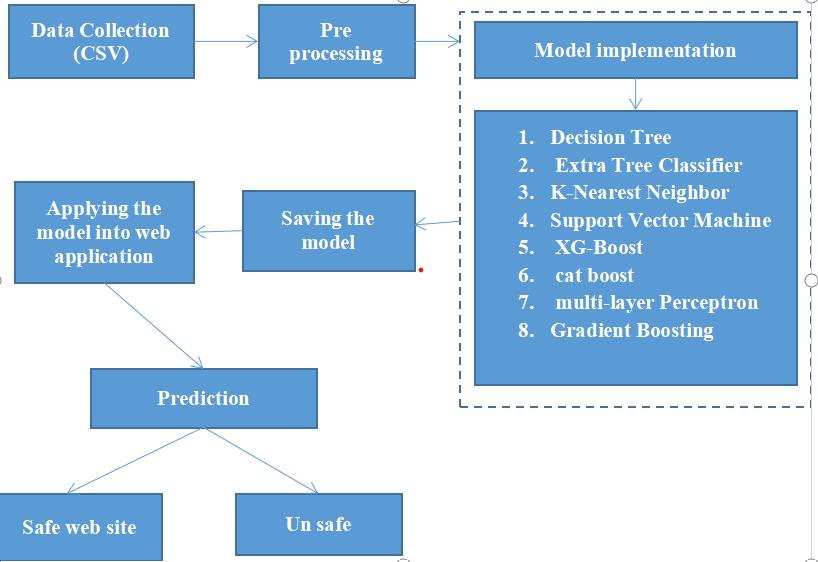
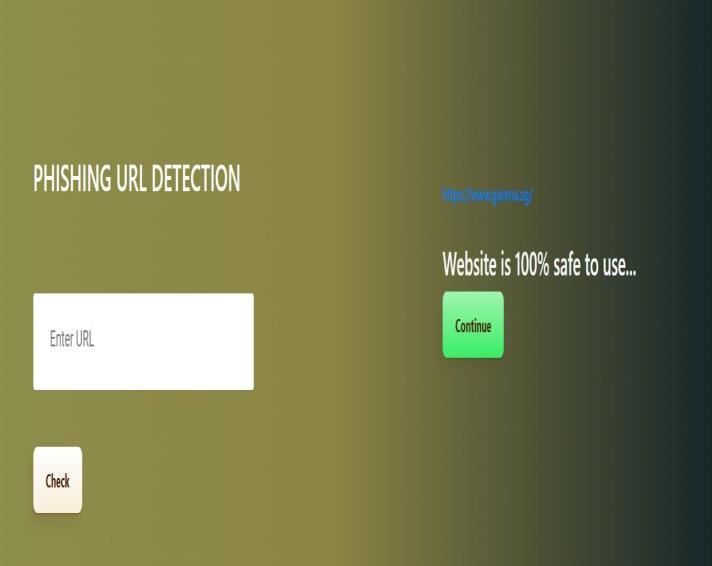
In our study, we found that ensemble learning models, particularly XGBoost, CatBoost, AdaBoost, and LightGBM, significantly outperformed traditional machine learning models such as Decision Trees and SVM in detecting malicious URLs. These ensemble models demonstrated superiorclassificationaccuracy,recall,andprecision,which were critical in identifying various types of cyber-attacks, including phishing, spam, and malware. The key to this success was the effective extraction of meaningful URLbased features, such as domain name structure and URL length,whichallowedthemodelstoclassifymaliciousURLs more accurately and detect previously unseen threats. Furthermore, we observed that our approach was highly scalableandefficient,capableofhandlinglargevolumesof data and providing real-time detection of malicious URLs. ThewebapplicationdevelopedusingtheFlaskframework allowedforpractical,real-timedeployment,offeringusers immediatefeedbackonpotentialthreats.
Additionally, the comparison of different algorithms highlighted that gradient boosting models, particularly XGBoost and CatBoost, consistently outperformed other methods in both detection accuracy and recall rates, minimizingfalsenegatives.Thisfindingindicatesthatthese models are particularly well-suited for the dynamic and evolving nature of web-based threats. Moreover, the integrationofmachinelearningintoareal-time,web-based applicationprovidedaviableanduser-friendlysolutionfor
detectingmaliciousURLs,whichiscrucialforbothconsumer andenterprisecybersecurity.
Inconclusion,theresearchconfirmedthatmachinelearning, especially when utilizing ensemble techniques, offers a robustsolutiontothechallengeofmaliciousURLdetection. This system presents a significant advancement over traditionalblacklist-basedmethods,providingmoretimely and accurate detection of new, previously unseen threats. Thepracticalimplicationsofourfindingssuggestthatthis approach can be effectively deployed in real-world cybersecurity systems, enhancing both the detection and prevention of cyber-attacks. Looking ahead, further improvements could include the integration of contentbased features, the application of continuous learning to adapt to emerging threats, and the exploration of hybrid modelscombiningdeeplearningwithensembletechniques topushtheboundariesofdetectionaccuracy.
In this study, we have introduced a novel unsupervised learning algorithm to address the challenges of feature subjectivity in the identification of malicious information. Our proposed machine learning classifier demonstrates a substantial improvement in performance compared to traditionalfeatureengineeringclassifiers,includingdecision trees,logisticregression,convolutionalneuralnetworks,and support vector machines. The accuracyand recall rates of our model are significantly higher, highlighting its effectiveness in malicious information detection. Furthermore, we conducted extensive evaluations by varying vector dimensions and context window sizes, identifying the optimal parameters for domain-specific contexts.Throughthiswork,wehaveshownthatleveraging theappropriatecontextinformation,particularlyfromthe current URL, can greatly enhance the performance of machine learning models in tackling feature subjectivity issues. This approach presents a promising direction for future advancements in the field of malicious content detection.
International Research Journal of Engineering and Technology (IRJET) e-ISSN:2395-0056
Volume: 12 Issue: 04 | Apr 2025 www.irjet.net p-ISSN:2395-0072
[1]R.C.Patil&D.R.Patil,2015,WebSpamDetectionUsing SVMClassifier,IEEEISCOhttps://ieeexplore.ieee.org
[2]J.Maetal.,2009,BeyondBlacklists:LearningtoDetect Malicious Websites from Suspicious URLs, ACM SIGKDD https://dl.acm.org/conference/kdd
[3]C.Zhaoetal.,2020,AHeterogeneousEnsembleLearning Framework for Spam Detection, Applied Sciences] https://www.mdpi.com/journal/applsci
[4]R.Verma&K.Dyer,2015,OntheCharacterofPhishing URLs, ACM CODASPY https://dl.acm.org/conference/codaspy
[5] J. Hong, 2012, The State of Phishing Attacks, CommunicationsoftheACMhttps://cacm.acm.org
[6]O.Christouetal.,2020,PhishingURLDetectionThrough Lexical and Host-Based Features, ICISSP https://www.scitepress.org/Conference.aspx?confId=MTkz NQ==
[7] X. Zheng et al., 2015, Detecting Spammers on Social Networks Using Ensemble Classifiers, IEEE ICDMW https://ieeexplore.ieee.org/xpl/conhome/7427764/procee ding
[8] APWG, 2022, Phishing Activity Trends Report, AntiPhishingWorkingGrouphttps://apwg.org/trendsreports/
[9]S.Lee&J.Kim,2012,WarningBird:DetectingSuspicious URLs in Twitter Stream, NDSS https://www.ndsssymposium.org
[10] Y. Zhang, J. I. Hong & L. Cranor, 2007, CANTINA: A Content-Based Approach to Detecting Phishing Websites, WWWConferencehttps://www2007.org
[11] X. Zhang & Y. Wang, 2019, Ensemble Learning for Malicious URL Detection, IEEE Access] https://ieeexplore.ieee.org/xpl/RecentIssue.jsp?punumber= 6287639
[12]A.Gupta&A.Gupta,2016,HybridApproachtoDetect PhishingWebsites,IJCSIThttp://www.ijcsit.com
[13]H.Lietal.,2021,LightweightMaliciousURLDetection forIoTUsingXGBoostandCatBoost,IEEESensorsJournal https://ieeexplore.ieee.org/xpl/RecentIssue.jsp?punumber= 7361
[14] H. Wang et al., 2020, Real-Time Phishing Detection Using URL and Content-Based Features, Computers & Security] https://www.journals.elsevier.com/computersand-security
[15]S.Kumaretal.,2021,EfficientMalwareURLDetection Using Gradient Boosting Methods, Security and Privacy] https://onlinelibrary.wiley.com/journal/24752268
[16]VirusTotal,Alexa,Spamhaus,PublicThreatIntelligence Sources, VirusTotal: https://www.virustotal.com, Alexa (archived): https://www.alexa.com, Spamhaus: https://www.spamhaus.org
[17] D. Wang et al., 2017, Cleaning and Preprocessing of Cyber Threat Data, ACM CCS] https://www.sigsac.org/ccs/CCS2017/
[18]A.Leetal.,2011,PhishDef:URLNamesSayItAll,IEEE INFOCOMhttps://infocom2024.ieee-infocom.org(note:this isthecurrentconferencesite;historicalpapersareonIEEE Xplore)
[19]D.Thomasetal.,2016,EvaluationofEnsembleModels in Spam Detection, IEEE Symposium on Security and Privacy] https://www.ieee-security.org/TC/SP2016/
[20]FlaskDocumentation,Python-BasedWebFramework] https://flask.palletsprojects.com