
International Research Journal of Engineering and Technology (IRJET) e-ISSN: 2395-0056
Volume: 12 Issue: 09 | Sep 2025 www.irjet.net p-ISSN: 2395-0072
International Research Journal of Engineering and Technology (IRJET) e-ISSN: 2395-0056
Volume: 12 Issue: 09 | Sep 2025 www.irjet.net p-ISSN: 2395-0072
Ayaan Chotani
1Suncity School, Gurgaon, India ***
Abstract - Rapidurbanizationreplacesnaturalsoilswith impervioussurfaces,increasingrunoffandfloodrisk.This studydesignsandtestsabench-scalepermeablepavement prototype tailored to Ludhiana, Punjab. We measure infiltrationthroughlayeredstonereservoirsandaprevious concrete surface, compare untreated vs. polyvinyl alcohol (PVA)–treatedsoils,andevaluateshort-termweatheringand pedestrian-level loads. The system infiltrated ~94% of a scaledstormwhiledischarging~6%viaanunderdrain.PVA treatmentincreasedsoilinfiltration~4×(2.4to9.6cm/h). After 30 days of exposure and three dry-storm cycles, infiltrationdeclined<4%.Thepavementwithstood~110kg withoutcracking.Resultssupportpermeablepavementasa viablelow-cost,pedestrian-usesolutiontoreducemonsoon waterlogging in Ludhiana, with recommendations for standardizedtesting,longer-termcloggingtrials,andcityscalepilots.
Key Words: permeable pavement, SUDS, infiltration, Ludhiana,stormwater,PVAsoiltreatment
1.INTRODUCTION
Urbanization has transformed cities by replacing natural, previouslandsurfaceswithimpermeablematerialssuchas asphalt,concrete,andpavingblocks.Thisshifthasdisrupted the natural hydrological cycle by limiting infiltration, increasing surface runoff, and exacerbating the risks of urban flooding and groundwater depletion. Ludhiana, Punjab, is one such rapidly developing city that faces recurring waterlogging and drainage issues, especially during the monsoon season. With rainfall concentrated betweenJulyandSeptember,thecityishighlyvulnerableto stormwater challenges that strain existing drainage infrastructure.
Permeablepavementshaveemergedasapromisingsolution totheseissues.Unlikeconventionalpavements,theyallow rainfall to percolate through their surface layers into underlying soils and stone reservoirs, thereby reducing runoff, improving groundwater recharge, and filtering pollutants. Their use is increasingly recognized as part of sustainable urban drainage systems (SUDS) aimed at creatingclimate-resilientcities.
Research conducted globally highlights the multifaceted benefitsofpermeablepavements.ScholzandGrabowiecki (2007) reviewed a range of permeable pavement systems
and concluded that they not only manage stormwater but also improve water quality through natural filtration processes. Ferguson (2005) emphasized their role in reducingurbanflooding,moderatingtheurbanheatisland effect,andenhancingecologicalbalance.Long-termstudies, suchasthosebyPratt etal. (2019),further demonstrated that permeable pavements can support pollutant biodegradation whilemaintainingstructural functionality. Case studies in cities like Chicago and Portland provide practical evidence, showing significant reductions in stormwater runoff and localized improvements in groundwaterrecharge.
In the Indian context, permeable pavements have only recently been introduced through pilot studies in metropolitan areas such as Delhi and Bangalore. These studies suggest promising outcomes in mitigating waterlogging and improving infiltration rates. However, limited research exists on their application in northern IndiancitiessuchasLudhiana,whererainfallisbothintense andhighlyseasonal.Thecombinationofhighprecipitation and rapid urban growth creates unique stormwater management challenges that demand locally validated solutions.
Thisstudyaimstoaddressthisresearchgapbyevaluating the feasibility of permeable pavements for Ludhiana’s climaticandsoilconditions.Byintegratingrainfalldata,soil infiltrationmeasurements,andprototypetesting,thestudy investigates whether optimized permeable pavement designs can mitigate flooding risks, reduce stormwater runoff, and enhance groundwater recharge. In doing so, it contributes to developing sustainable and resilient urban infrastructure strategies for Indian cities vulnerable to monsoonflooding.
2.1 Materials
Thepermeablepavementprototypewasconstructedusing transparent ceramic glass sheets to fabricate the experimentaltestbox,assembledandwaterproofedwithLcornerbrackets,adhesive,andsealingtape.Naturalsoilwas used to replicate subgrade conditions, while perforated double-wall corrugated PVC pipes simulated stormwater drainageconnections.Crushedstonesandgravelformedthe water storage reservoir and filtration medium. Permeable
International Research Journal of Engineering and Technology (IRJET) e-ISSN: 2395-0056
Volume: 12 Issue: 09 | Sep 2025 www.irjet.net p-ISSN: 2395-0072
concrete bricks were prepared using cement, coarse aggregate, and water with negligible sand content. Mechanicalstrengthwasevaluatedusingdumbbellweights (5,10,15kg)andhumanloadtests.Additionally,polyvinyl alcohol(PVA)treatmentwasappliedtosoilsamplestoassess improvementsininfiltrationcapacity.
2.2 Prototype Construction:
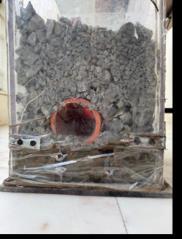
A transparent ceramic glass box was fabricated by cutting and assembling glass sheets using L-corner brackets and waterproof adhesive, allowing visual monitoring of water infiltrationandstorage.
2.2.1 Base Layer and Drainage: Asoillayerwasplacedat the bottom to simulate natural subgrade conditions. A perforatedPVCpipewasembeddedalongonesidetomimic stormwaterdrainage,withsealingtopreventleakage.
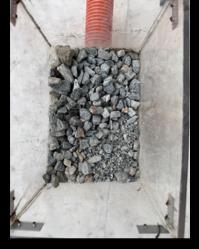
2.2.2 Reservoir Formation: Abovethesoil,acrushedstone andgravelreservoirwasconstructedusinguniformstonesto maintain stability while providing void space for water retentionandcontrolledinfiltration.
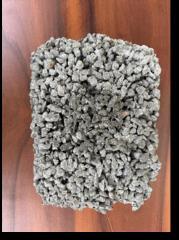
2.2.3 Pavement Layer Preparation: Permeable concrete brickswerecastusingcement,coarseaggregate,andminimal water,withnegligiblesand.Variousmixratiosweretestedto optimizethebalancebetweenpermeabilityandcompressive strength. The bricks formedthe toplayer ofthe pavement system.
2.2.4 Weathering Tests: The prototype was subjected to natural rainfall andsimulateddrystormsoveronemonth, assessing changes in permeability, structural stability, and maintenancerequirements.
2.2.5Load-BearingTests:Structuralintegritywasevaluated by incrementally applying loads (5–15 kg dumbbells) and humanweightupto110kg.Nocracksorstructuralfailures wereobserved.
Infiltration Measurement: Soil infiltration rates were measuredforuntreated(2.4cm/h)andPVA-treatedsoil(9.6 cm/h) to quantify the effect of chemical treatment on permeability.
Porouspavementblocksweredevelopedthroughiterative mixproportiontrialsusingcement,coarseaggregate,sand, and water. Five different combinations were prepared, varying cement content (12–25%), aggregate (65–83%), sand(5–10%),andwater–cementratios(0.30–0.35).Each blockwascastandsubjectedtotwokeyevaluations:
1. Permeability Test: Measured by adding a fixed watervolumetotheblocksurfaceandrecordingthe collectedoutflow.
2. Strength Assessment: Evaluated qualitatively basedonblockintegrityunderloadandresistance tocracking.
The initial mixes with higher cement content produced dense, impermeable blocks, while lower cement mixes yieldedfragilestructures.Throughsystematicadjustment, the optimum mix was identified as 20% cement, 75% aggregate, and 5% sand with a 0.34 water–cement ratio, which provided a balanced combination of strength and permeability.Thismixwasselectedforthefinalpavement blockdesign.
International Research Journal of Engineering and Technology (IRJET) e-ISSN: 2395-0056
Volume: 12 Issue: 09 | Sep 2025 www.irjet.net p-ISSN: 2395-0072
Overall,theprototypedemonstratesthedesiredbehaviour of permeable pavements efficient water infiltration with minimalsurfaceretentionhighlightingitspotentialforurban runoffmanagement.Futureworkmayinvestigatetheeffects ofsoiltype,compaction,andlong-termcloggingonhydraulic performance.
Table 2. Waterretentionperformanceofthepermeable pavement.
1
2
3
4
5
but impermea ble (too dense)
, but cracked under load
Very porous, but weak andfragile
Balanced permeabil ity and medium strength
and permeable (selected mix)
Thepermeablepavementprototypewasevaluatedforwater retention efficiency by applying varying volumes of water andmeasuringthecollected volumethroughthedrainage system (Table 1). The water loss ranged from 0.04 L to 0.15 L, corresponding to 5-7.5 % retention within the pavement.Thehighestretention(7.5 %)wasobservedat2 L ofappliedwater,whilethelowest(5.33 %)occurredat1.5 L.
These results indicate that the pavement effectively transmitsthemajorityofwaterthroughitsstructurewhile temporarily storing a small fraction. Slight variations in retention are likely due to interactions between the soil subgrade, crushed stone reservoir, and previous concrete layer, which together govern infiltration and storage dynamics.Higherwatervolumesslightlyincreaseretention, suggesting that void spaces within the stone layer can accommodatetemporarystorage.
The experimental evaluation of the permeable pavement prototypedemonstratedeffectivewaterinfiltration,with5–7.5 % of applied water retained within the structure. The results confirm that the pavement efficiently channels stormwater while temporarily storing a minor fraction, validatingitspotentialforurbanrunoffmanagement.Slight variationsinretention highlightthe influenceofsubgrade soil,crushedstonereservoir,andpreviousconcreteonthe hydraulicperform ance. Overall, the prototype exhibits the desired balance between permeability and minimalsurfaceretention.
This study was conducted under controlled laboratory conditionswithlimitedwatervolumesandasimplifiedsoil layer,whichmaynotfullyrepresentfieldscenarios.Future research could explore the effects of different soil types, compaction levels, long-term clogging, and larger-scale rainfall events. Additionally, incorporating vegetation or alternative aggregate materials could enhance water retention and sustainability, making the system more adaptabletoreal-worldurbanenvironments.
[1]Scholz,Miklas,andPiotrGrabowiecki.2007.“Reviewof permeablepavementsystems.” BuildingandEnvironment 42 (11): 3830–3836. https://doi.org/10.1016/j.buildenv.2006.11.016.
[2]Ferguson,BruceK.2005. Porous Pavements.BocaRaton, FL:CRCPress.https://doi.org/10.1201/9781420038439.
International Research Journal of Engineering and Technology (IRJET) e-ISSN: 2395-0056
[3]Pratt,C.J.,A.P.Newman,andP.C.Bond.1999.“Mineral oil bio-degradation within a permeable pavement: Longterm observations.” Water Science and Technology 39 (2): 103–109.https://doi.org/10.1016/S0273-1223(99)00013X.
[4] City of Chicago, Department of Transportation. 2010. Chicago Green Alley Handbook. Chicago: City of Chicago. Accessed September 12, 2025. https://www.chicago.gov/content/dam/city/depts/cdot/Gr een_Alley_Handbook_2010.pdf
[5]CityofPortland,BureauofEnvironmentalServices.2025. “About Green Streets.” Accessed September 12, 2025. https://www.portland.gov/bes/stormwater/about-greenstreets
[6] U.S. Environmental Protection Agency. 2021. NPDES: Stormwater Best Management Practice Permeable Pavements. EPA-832-F-21-031W, December. Accessed September 12, 2025. https://www.epa.gov/system/files/documents/202111/bmp-permeable-pavements.pdf
[7]ASTMInternational.2018. ASTMD3385-18:StandardTest Method for Infiltration Rate of SoilsinFieldUsingDouble-Ring Infiltrometer.WestConshohocken,PA:ASTMInternational. https://doi.org/10.1520/D3385-18.AccessedSeptember12, 2025.
[8] ASTM International. 2023. ASTM C1701/C1701M17a(2023): Standard Test Method for Infiltration Rate of InPlace Pervious Concrete. West Conshohocken, PA: ASTM International.https://doi.org/10.1520/C1701_C1701M-17A. AccessedSeptember12,2025.
[9] Federal Highway Administration (FHWA). 2023. Tech Brief: Use of Permeable Pavements. FHWA-HIF-23-076. Accessed September 12, 2025. https://www.fhwa.dot.gov/pavement/pubs/hif23076.pdf
[10] Federal Highway Administration (FHWA). 2019. Permeable Interlocking Concrete Pavement.FHWA-HIF-19021. Accessed September 12, 2025. https://www.fhwa.dot.gov/pavement/concrete/pubs/hif19 021.pdf
[11] India Meteorological Department (IMD), Chandigarh. 2024. Main Highlights: Punjab Southwest Monsoon 2024 Accessed September 12, 2025. https://mausam.imd.gov.in/chandigarh/mcdata/monsoon_p un.pdf
[12]HindustanTimes.2024.“LudhianarecordshighestAug rainfallsince2019.”(IncludesPAUobservatoryseries;notes 323.8 mm in July 2022.) Accessed September 12, 2025. https://www.hindustantimes.com/cities/chandigarh-
news/ludhiana-records-highest-aug-rainfall-since-2019101724519591265.html
Volume: 12 Issue: 09 | Sep 2025 www.irjet.net p-ISSN: 2395-0072 © 2025, IRJET | Impact Factor value: 8.315 |
| Page