
International Research Journal of Engineering and Technology (IRJET) e-ISSN: 2395-0056
Volume: 12 Issue: 05 | May 2025 www.irjet.net p-ISSN: 2395-0072
International Research Journal of Engineering and Technology (IRJET) e-ISSN: 2395-0056
Volume: 12 Issue: 05 | May 2025 www.irjet.net p-ISSN: 2395-0072
Navdeep Singh Phougat1 and Nitu2
Civil Engineering Department, Matu Ram Institute of Engineering & Management, Model Town, Rohtak, Haryana 124001
Abstract - This study investigates the sustainable development of M30 grade concrete by incorporating industrialandconstructionwastesaspartialreplacementsfor traditional constituents. Iron Ore Sludge (IOS) was used as a cement replacement in the range of 0–20%, Brick-Mortar Waste (BMW) replaced fine aggregates at 0–50%, and Ceramic Waste (CW) substituted coarse aggregates from 0–100%. A total of 25 concrete mixes were developed based on ResponseSurfaceMethodology(RSM)toanalyzeandoptimize theireffectsonkeypropertiessuchasworkability,compressive strength, flexural strength, and water absorption.
Experimental results demonstrated that moderate replacement levels led to significant performance improvements. The best mix, C5S12A0 (5% IOS, 12.5% BMW, 0% CW), exhibited a compressive strength of 40.25 MPa, flexuralstrengthof4.45MPa,slumpof109mm,andlowwater absorption of 2.8%. Mixes with higher CW content negatively impacted strength and durability due to increased porosity. RSM analysis confirmed the adequacy of predictive models with high R² values for all responses. The interaction of IOS with BMW and CW significantly influenced the concrete’s mechanical behavior, and the desirability function identified C5S12A0 as the optimal mix.
Thisstudyhighlightsthepotentialofwaste-basedmaterialsin concrete, promoting environmental conservation and costeffective construction. The use of RSM provided reliable optimization, offering valuable insights for practical applications in green construction
Key Words: Sustainableconcrete, Iron OreSludge,BrickMortarWaste,CeramicWaste,Optimization
The growing demand for infrastructure and urban development has led to an unsustainable rate of natural resource consumption and waste generation. Traditional concrete production consumes large quantities of virgin materials such as cement, sand, and aggregates, while simultaneouslycontributingtoenvironmentaldegradation throughminingandCO₂emissions.Inresponse,researchers and industry professionals are increasingly exploring the incorporation of industrial and construction waste in
concrete to promote sustainable construction. Iron Ore Sludge (IOS), a waste by-product of iron mining, BrickMortar Waste (BMW) from demolition activities, and Ceramic Waste (CW) derived from unused or broken tiles and ceramics are among the promising materials that can serveaspartialreplacementsinconcrete.
Recentliteratureunderscorestheincreasingroleofwaste materials and advanced modeling in sustainable concrete. AdamuandIbrahim(2024)highlightedtheenvironmental benefits of combining Date Palm Ash (DPA) and Eggshell Powder(ESP),optimizingthemixusingRSMtoreduceCO₂ emissions and improve concrete performance. Similarly, Adamuetal.(2021)demonstratedtheeffectiveuseofplastic wasteandgraphenenanoplatelets(GNPs)inhigh-volumefly ash concrete, showing how GNPs significantly improved mechanical strength and reduced water absorption. Their work, along with later findings by Adamu et al. (2024), revealed that optimal blends of DPA and ESP can boost compressive strength and reduce permeability, although excessivedosagescanimpactworkability.Aghajanzadehet al. (2024) optimized alkali-activated slag concrete incorporatingrecycledaggregatesandsilicafume,achieving high mechanical and durability properties with minimal environmental and economic drawbacks. Ahmed et al. (2022) used waste glass and condensed milk can fiber to address fine aggregate depletion, reporting optimal replacement values that maintained strength while emphasizingtheneedforfurtherworkabilityenhancements. Amiri et al. (2022) investigated coal waste as a partial cementreplacementandachievedsignificantimprovements in compressive strength and water absorption with optimizedproportions.StudieslikethosebyAwolusietal. (2019)andAzeezetal.(2023)emphasizedthemechanical benefitsofintegratingwastetyrefibers,steelslag,andwaste glass into concrete. Awolusi’s work validated the effectiveness of RSM in predicting concrete performance, while Azeez reported substantial strength gains with full steel slag replacement. Similarly, Chashm Khavari et al. (2023) showed that sulfur concrete reinforced with steel fibers demonstrated remarkable strength improvements, thoughrecyclabilityreducedperformanceslightly.
Nano-modified concrete has also received attention, with Dahish and Almutairi (2023) optimizing mixes containing
International Research Journal of Engineering and Technology (IRJET) e-ISSN: 2395-0056
Volume: 12 Issue: 05 | May 2025 www.irjet.net p-ISSN: 2395-0072
nano-silica and nano-clayfor high-temperature resilience. DivyaandPraveenkumar(2024)usedGNP,copperslag,and quarry dust in graphene-based mixes, identifying optimal combinations that boosted strength. Hafiz et al. (2023) explored GNPs in geopolymer concrete, enhancing both strength and durability even in the presence of crumb rubber.
Furthersupportingsustainablepractices,Haqueetal.(2024) optimized mixes with granite dust and scrapped copper wire, achieving optimal strength without compromising performance. Ja’e et al.(2024)emphasized the benefits of basalt fiber and silica fume in enhancing mechanical and impactresistance.Kaliyavaradhanetal.(2022)reportedCO₂ uptakeinwasteconcretepowder,reinforcingitspotentialas asupplementarymaterial.Kareemetal.(2025)validatedthe mechanicalandenvironmentalefficiencyofusingwastesteel andtyrerubberfibers.Lastly,MaazeandShrivastava(2023) optimized bricks from recycled concrete waste, achieving desirable strength and durability properties using RSM. Thesecollectiveeffortsshowcasethepowerofwaste-based materials and optimization techniques such as RSM in achievingsustainable,high-performanceconcretesolutions. Thecurrentstudybuildsuponthisfoundationbyassessing the combined effects of IOS, BMW, and CW on M30 grade concreteandidentifyingoptimalproportionsthroughRSM.
2. MATERIALS AND METHODS
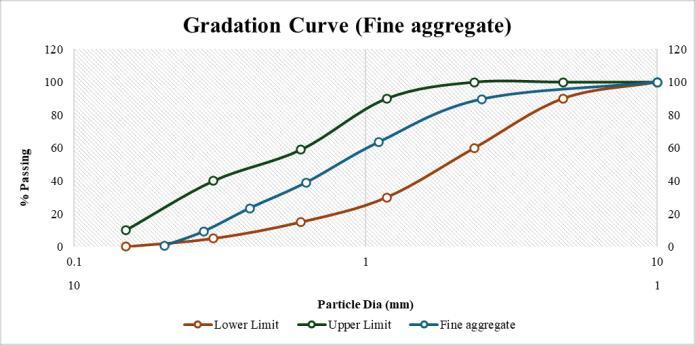
The materials used in this study were chosen for their relevancetosustainableconstructionandtheiravailability aswasteby-products.OrdinaryPortlandCement(OPC)of43 gradeconformingtoIS8112:2013wasusedastheprimary binder, with a specific gravity of 3.14. Natural river sand conforming to Zone II of IS 383:2016 served as the fine aggregate, with a specific gravity of 2.65. Crushed granite stones of 20 mm nominal size and specific gravity of 2.74 wereusedascoarseaggregates.
Iron Ore Sludge (IOS) was sourced from a local iron ore processing unit. The material was oven-dried and sieved througha75µmsievebeforeuseasacementreplacement. Brick-MortarWaste(BMW)wascollectedfromdemolition sites,crushed,andsievedtopassthrougha4.75mmsieve,
making it suitable for replacing fine aggregates. Ceramic Waste (CW) was obtained from discarded ceramic tiles, crushed into angular particles of 20 mm nominal size, to replacecoarseaggregates.
2.1 Mix design
The concrete mix was designed in accordance with IS 10262:2019andIS456:2000forM30gradeusingOrdinary PortlandCement(OPC)43grade.Thedesignincorporated theuseofSuperplasticizer(SP),waterreductiontechniques, and appropriate aggregate proportions to achieve the desired workability and strength. A water-cement (W/C) ratio of 0.43 was adopted, considering a 16% water reduction achieved through the addition of 1% superplasticizerbyweightofcement.
Table1:ReplacementLevelswithShortenedAbbreviations
International Research Journal of Engineering and Technology (IRJET) e-ISSN:
Volume: 12 Issue: 05 | May 2025 www.irjet.net
Cxx=%ofCementReplacedbyIOS
Sxx=%ofSandReplacedbyBMW
Axx=%ofAggregateReplacedbyCW
Example:M-C10S25A50=Mixwith10%IOS,25%BMW,and 50%CW
Table2:AllMixeswithReplacements
The specific gravities of the constituent materials were determined as follows: The coarse aggregate ratio was maintainedat61.4%,whichissuitablefor20mmnominal maximumsizeaggregatesasperISguidelines.Theassumed watercontent before reduction was196liters,whichwas adjustedto179.46litersaftertheuseofSP.Theminimum cement content required for M30 grade concrete is 280 kg/m³,asperTable5ofIS456:2000.However,theactual cementcontentusedwas417.34kg/m³,whichiswithinthe upperlimitof450kg/m³.
Concretepropertieswereevaluatedthroughstandardized test methods. Workability was measured using the slump conetestasperIS1199:1959.Compressivestrengthtests were conducted in accordance with IS 516:1959. Flexural strength was determined using the third-point loading method,andwaterabsorptionwasassessedbasedonASTM C642bymeasuringthedifferenceinmassbeforeandafter immersion.
Theexperimentalanalysisrevealedcriticalinsightsintothe behaviorofconcreteincorporatingIOS,BMW,andCW.The workabilityofthemixes,measuredbyslump,rangedfrom 93 mm to 110 mm. The control mix showed the highest slump of 110 mm, indicating superior flowability. As the
International Research Journal of Engineering and Technology (IRJET) e-ISSN: 2395-0056
Volume: 12 Issue: 05 | May 2025 www.irjet.net p-ISSN: 2395-0072
percentageofIOS,BMW,andCWincreased,theslumpvalues decreasedduetotheroughandporoustextureofthewaste materials, which absorbed more water. However, mix C5S12A0,with5%IOSand12.5%BMW,maintainedahigh slump of 109 mm, demonstrating the effectiveness of moderatereplacementlevelsinpreservingworkability.
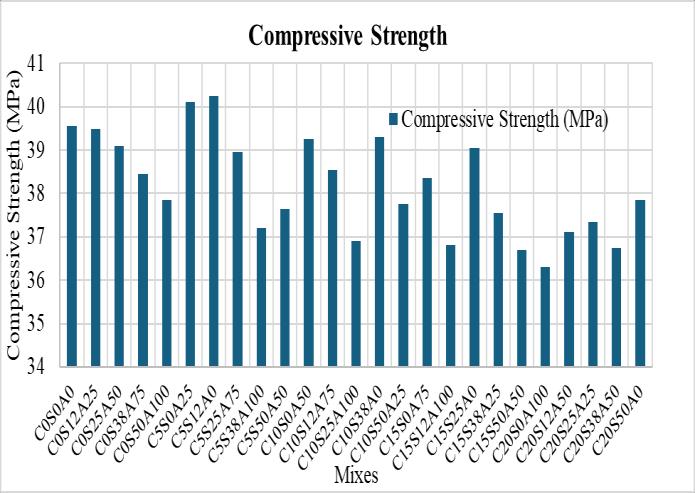
Compressive strength results varied across the 25 mixes. Thecontrolmixachieveda compressivestrengthof39.56 MPa after 28 days. Mix C5S12A0 recorded the highest strengthof40.25MPa,indicatingthatlowlevelsofIOSand BMW contributed positively through filler effects and possible pozzolanic activity. On the contrary, mix C20S0A100, with 20% IOS and 100% CW, exhibited the lowestcompressivestrengthof36.3MPa.Thedecreasein strength at high replacement levels was attributed to reducedcementitiouscontentandweakinterfacialbonding betweentheaggregatesandmatrix.
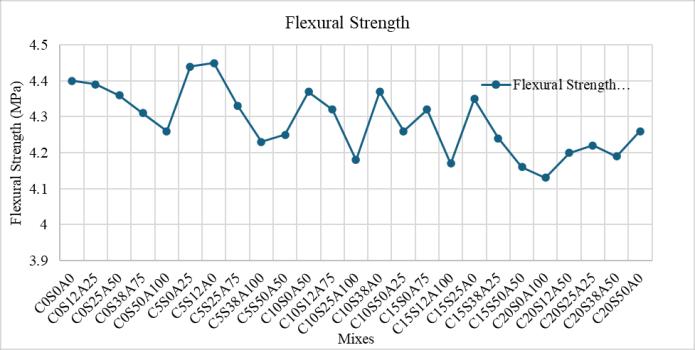
Flexuralstrengthfollowedasimilarpatterntocompressive strength.Themaximumflexuralstrengthof4.45MPawas observed in mix C5S12A0, while mix C20S0A100 had the lowestvalueof4.13MPa.HighcontentsofCWwerefoundto adverselyaffecttheflexuralbehaviorofconcreteduetopoor interfacial transition zones (ITZs) between the recycled coarseaggregatesandthesurroundingpaste.
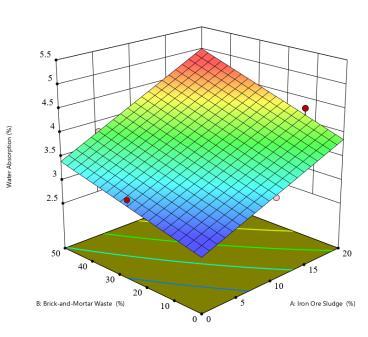
Waterabsorptionresultsrangedbetween2.80%and4.80%. MixC5S12A0hadthelowestabsorption,reflectingitsdense andimpermeablemicrostructure.Higherabsorptionvalues were recorded for mixes with increased CW content, confirming that the porous nature of ceramic particles contributestoelevatedwaterpermeability.
To better understand and optimize the performance of concretemixes,RSMwasemployedusingathree-factor,fivelevel design. For workability, the 2FI model provided the bestfitwithanAdjustedR²of0.9093.Allthreefactors IOS, BMW,andCW hadsignificantnegativecoefficientsinthe regressionequation,confirmingtheirdetrimentaleffecton slump. The interaction between IOS and CW (AC) was particularlysignificant,showinga compoundedimpacton reducingworkability.
In the case of compressive strength, the 2FI model also emergedasthemostsuitable,withanAdjustedR²of0.8270. The regression model revealed that IOS had the highest negative impact on strength, followed by CW and BMW. InteractiontermsAC(IOS×CW)andBC(BMW×CW)were statistically significant, suggesting that combinations of thesewastematerialsneedcarefulcontroltoavoidstrength reduction.The2FImodelforflexuralstrengthachievedan AdjustedR²of0.8145.Again,IOShadthemostsubstantial negative influence. The interaction between IOS and CW (AC)wasfoundtobeamajorcontributingfactorinreducing flexural performance, similar to compressive strength trends.
Forwaterabsorption,thequadraticmodelprovidedthebest fit with an Adjusted R² of 0.9019. All three factors contributed positively to water absorption, indicating increasedporositywithhigherwastecontent.Notably,IOS had the largest coefficient, making it the most influential variable.TheinteractiontermsACandBCweresignificant, reinforcing the need to control the combinations of IOS, BMW,andCWtolimitpermeability.
The lowest slump (93 mm) was recorded for mix C20S0A100,containing20%IOSand100%CW,indicating thecombinedeffectofahighcementreplacementandhighly absorbent aggregate replacement. On the other hand, C5S12A0 showed high workability (109 mm) close to the control,owingtothelowreplacementlevelsandnoceramic waste.
International Research Journal of Engineering and Technology (IRJET) e-ISSN: 2395-0056
Volume: 12 Issue: 05 | May 2025 www.irjet.net
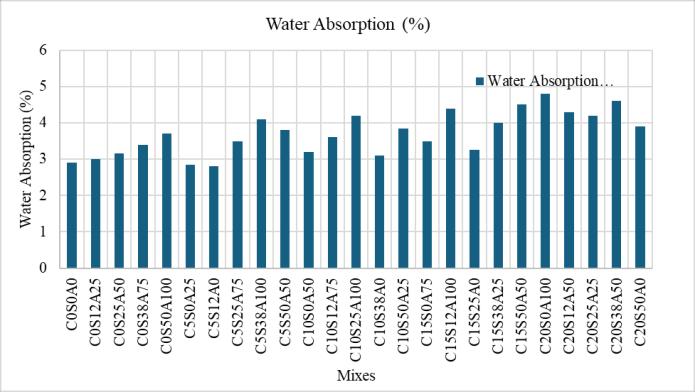
The best-performing mix in terms of workability was the control (C0S0A0), followed closely by C5S12A0 and C5S0A25,bothwithminimalreplacementlevels.Theleast workability was seen in high CW mixes like C20S0A100, C20S38A50,andC15S12A100,emphasizingtheimportance ofcontrollingCWcontentforachievingworkableconcrete.
Table3:SummaryofPerformance
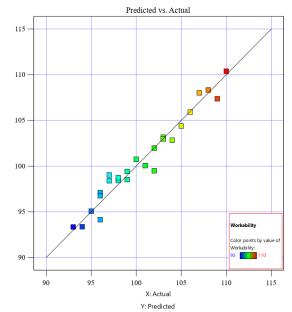
TheRSManalysisforworkabilitysuggestedthe2FImodelas thebestfit,withAdjustedR²=0.9093and PredictedR² = 0.9093, indicating excellent correlation between experimental and predicted values. The regression model showed that all three input variables negatively affected workability.IOShadthemostsignificantnegativecoefficient, followed by CW and BMW, confirming that higher replacementlevelsreduceslumpduetoincreasedsurface area andinternal waterdemand.Theinteraction between IOSandCW(AC)wasstatisticallysignificant(p=0.0021), indicating a compounded reduction in slump when both materialsareincreasedsimultaneously.
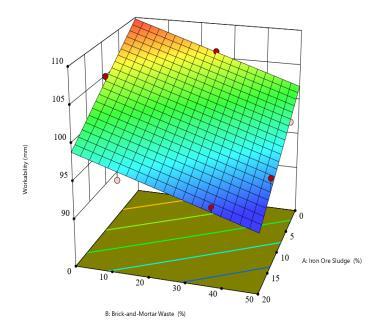
Theresponsesurfaceplotsclearlyillustratedadownward slopeinslumpvalueswithincreasinglevelsofIOSandBMW, reinforcing the regression outcomes. Thus, the model not onlyidentifiedkeycontributorstoworkabilitylossbutalso helpedvisualizeoptimalzonesformaterialusage.
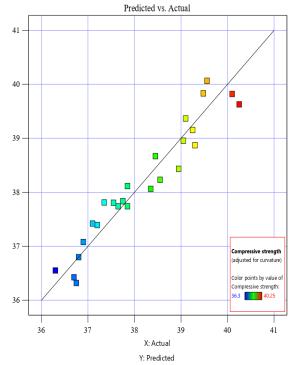
For compressive strength, the RSM analysis also recommendedthe2FImodelwithAdjustedR²=0.8270and a non-significant lack-of-fit, demonstrating strong model reliability. The regression equation revealed that all three materials negatively influenced strength, with IOS again showing the highest impact. Notably, the interaction between IOS and CW (AC) was significant (p = 0.0010), confirming that their combined usage at higher levels substantiallycompromisesstrength.
From the analysis, it is evident that C5S12A0 is the bestperforming mix overall, showing superior strength, durability,andworkability.Minimalreplacementlevels(5% IOS,12.5%BMW,0%CW)appeartoenhanceperformance due to improved packing density and limited interference with bonding mechanisms. On the contrary, C20S0A100, withmaximumIOSandCWcontent,consistentlyshowedthe lowest performance across all parameters due to higher porosity,reducedcementcontent,andweakaggregate-paste interfacial transition zones. The application of Response Surface Methodology (RSM) in this research provided a robust statistical framework for analyzing, modeling, and optimizingtheinfluenceofIronOreSludge(IOS),Brick-andMortar Waste (BMW), and Ceramic Waste (CW) on the performanceofM30gradeconcrete.TheRSMmodelswere developedforfourcriticalresponses:workability(slump), compressive strength, flexural strength, and water absorption.Theselectedmodelsshowedhighaccuracyand strongpredictivecapability,enablingadeepunderstanding ofhowindividualandinteractiveeffectsofthethreewaste materialsinfluenceconcretebehavior.
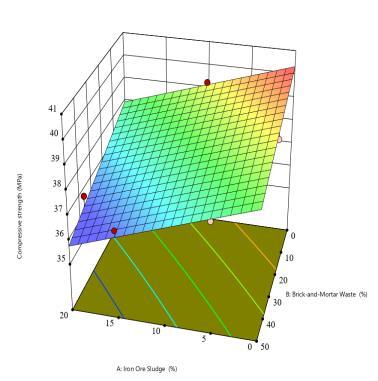
The response surface plots supported the regression findings by showing a gradual reduction in compressive strengthasIOSandBMWpercentagesincreased.Themodel successfullycapturedthepeakstrengthzonearound5–10% IOSand12.5%BMW,aidinginidentifyingthemostefficient mixproportionsforstructuralperformance.
The RSM model for flexural strength mirrored the trends observed in compressive strength. The 2FI model with AdjustedR²=0.8145wasvalidatedasthebestfit.Themodel equation demonstrated that IOS, BMW, and CW all had negative effects on flexural strength, with IOS having the mostpronouncedimpact.
InteractiontermAC(IOS×CW)wasstatisticallysignificant (p=0.0013),suggestingthathighcontentsofIOSandCW reduce concrete’s resistance to bending due to weak interfacialbondingandporosity.
2395-0056
Volume: 12 Issue: 05 | May 2025 www.irjet.net p-ISSN: 2395-0072
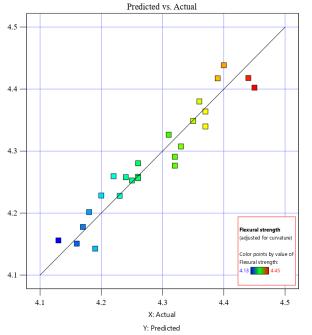
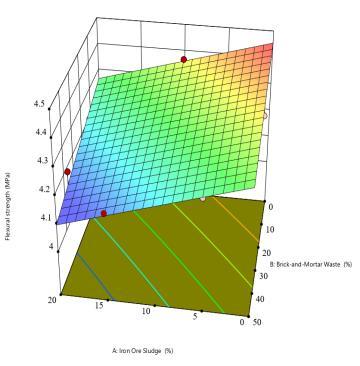
The predicted vs. actual plot and surface response graphs showedahighmatchwithexperimentaldata,illustratinga consistentdeclineinflexuralstrengthwithhigherlevelsof IOS and BMW. This affirmed that mix optimization is essentialforenhancingtensileresistance,especiallyinloadbearingmembers.
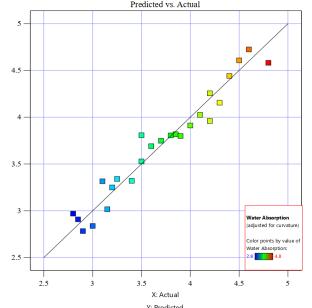
Forwaterabsorption,whichreflectsconcretedurability,the RSMrecommendedthequadraticmodelwithAdjustedR²= 0.9019andPredictedR²=0.9019,indicatingasuperiorfit. Theregressionequationshowedthatallthreevariables IOS, BMW, and CW significantly increased water absorption, with IOS contributing the most (+0.7116), followed by CW (+0.5274) and BMW (+0.4784). The interactiontermsAC(IOS×CW)andBC(BMW×CW)were alsosignificant,highlightingthatcombinationsofporousand angular waste particles increase void content and permeability. The surface response plot confirmed this trend,showingincreasedwaterabsorptionasbothIOSand BMWcontentsrose.TheRSMmodelthusprovidedcritical insightsintohowtolimitmaterialreplacementstoensure long-termconcretedurability.
The experimental and statistical evaluations showed that concreteperformanceissignificantlyinfluencedbythetype and amount of replacement materials. While high replacement levels generally reduced strength and workability and increased water absorption, low to moderate incorporation of IOS and BMW improved the concreteproperties.MixC5S12A0(5%IOS,12.5%BMW,0% CW) consistently outperformed all other mixes across all tested parameters. The RSM models validated the experimentalobservationsandprovidedaccurateprediction toolsforfuturemixoptimization.Amongthevariables,IOS hadthehighestimpactacrossallresponses,highlightingits dualroleasaperformanceenhancerandapotentialriskif overused.
This research demonstrates that Iron Ore Sludge, BrickMortar Waste, and Ceramic Waste can be effectively incorporated into M30 grade concrete to enhance sustainabilitywhilemaintainingdesirablemechanicaland durabilitycharacteristics.Experimentaltestingshowedthat concrete mixes with controlled levels of these materials achievedcomparableorbetterresultsthantheconventional mix.TheuseofRSMenabledthedevelopmentofaccurate regressionmodelsandprovidedinsightsintotheeffectsand interactionsofthereplacementmaterials.MixC5S12A0was identifiedastheoptimalblend,balancinghighstrength,low waterabsorption,andgoodworkability.Overall,thisstudy supports the use of industrial and construction waste in
International Research Journal of Engineering and Technology (IRJET) e-ISSN: 2395-0056
Volume: 12 Issue: 05 | May 2025 www.irjet.net p-ISSN: 2395-0072
concrete and promotes a greener, more resource-efficient approachtoconstructionpractices.
[1]. M. Adamu, and Y.E. Ibrahim, “Environmental sustainability and cost-benefit analysis of concrete containing date palm ash and eggshell powder: a response surface methodology approach,” Case Stud. Chem. Environ. Eng., 9 (December 2023) 100636 (2024).doi:10.1016/j.cscee.2024.100636.
[2]. M. Adamu, P. Trabanpruek, P. Jongvivatsakul, S. Likitlersuang, and M. Iwanami, “Mechanical performanceandoptimizationofhigh-volumeflyash concrete containing plastic wastes and graphene nanoplatelets using response surface methodology,” Constr. Build. Mater., 308 (May) 125085 (2021). doi:10.1016/j.conbuildmat.2021.125085.
[3]. M.Adamu,Y.E.Ibrahim,andH.Alanazi,“Optimizationof sustainableconcretepropertiesmodifiedwithblendsof date palm ash and eggshell powder using response surfacemethodology.,”Dev.BuiltEnviron.,17(January) 100359(2024).doi:10.1016/j.dibe.2024.100359.
[4]. Aghajanzadeh,A.M.Ramezanianpour,A.Amani,andA. Habibi, “Mixture optimization of alkali activated slag concretecontainingrecycledconcreteaggregatesand silica fume using response surface method,” Constr. Build. Mater., 425 (November 2023) 135928 (2024). doi:10.1016/j.conbuildmat.2024.135928.
[5]. T. Ahmed, S. Ray, M. Haque, T. Tasnim Nahin, and A. Ferdous Mita, “Optimization of properties of concrete prepared with waste glass aggregate and condensed milk can fiber using response surface methodology,” Clean.Eng.Technol.,8(August2021)100478(2022). doi:10.1016/j.clet.2022.100478.
[6]. H.Amiri,S.Azadi,M.Karimaei,H.Sadeghi,andFarshad Dabbaghi,“Multi-objectiveoptimizationofcoal waste recycling in concrete using response surface methodology,”J.Build.Eng.,45(October2021)103472 (2022).doi:10.1016/j.jobe.2021.103472.
[7]. T.F.Awolusi,O.L.Oke,O.O.Akinkurolere,andA.O.Sojobi, “Application of response surface methodology: predicting and optimizing the properties of concrete containing steel fibre extracted from wastetireswith limestonepowderasfiller,”CaseStud.Constr.Mater.,10 e00212(2019).doi:10.1016/j.cscm.2018.e00212.
[8]. A.T.Azeez,M.S.Hassan,andA.A.H.Attiyah,“Modelling the complementary role of inert slag aggregate and wasteglassonconcretemechanicalstrengthsusingthe responsesurfaceanddesign-of-experimentapproach,”
Constr.Build.Mater.,409(November)134199(2023). doi:10.1016/j.conbuildmat.2023.134199.
[9]. B.ChashmKhavari,M.Shekarriz,B.Aminnejad,A.Lork, andS.Vahdani,“Laboratoryevaluationandoptimization ofmechanicalpropertiesofsulfurconcretereinforced withmicroandmacrosteelfibersviaresponsesurface methodology,”Constr.Build.Mater.,384(March)131434 (2023).doi:10.1016/j.conbuildmat.2023.131434.
[10]. H.A.Dahish, and A.D. Almutairi, “Effect of elevated temperatures on the compressive strength of nanosilicaandnano-claymodifiedconcretesusingresponse surface methodology,” Case Stud. Constr. Mater., 18 (January) e02032 (2023). doi:10.1016/j.cscm.2023.e02032.
[11]. S. Divya, and S. Praveenkumar, “An integrated evaluation of graphene-based concrete mixture with copper slag and quarry dust using response surface methodology,” J. Build. Eng., 86 (December 2023) 108876(2024).doi:10.1016/j.jobe.2024.108876.
[12]. H.W. Iqbal, K. Hamcumpai, P. Nuaklong, P. Jongvivatsakul,S.Likitlersuang,C.Chintanapakdee,and A.C.Wijeyewickrema,“Effectofgraphenenanoplatelets onengineeringpropertiesofflyash-basedgeopolymer concretecontainingcrumbrubberanditsoptimization usingresponsesurfacemethodology,”J.Build.Eng.,75 (March) 107024 (2023). doi:10.1016/j.jobe.2023.107024.
[13]. M. Haque, S. Ray, A.F. Mita, A. Mozumder, T. Karmaker,andS.Akter,“Predictionandoptimizationof hardenedpropertiesofconcretepreparedwithgranite dustandscrappedcopperwireusingresponsesurface methodology,” Heliyon, 10 (2) e24705 (2024). doi:10.1016/j.heliyon.2024.e24705.
[14]. I.A.Ja’e,R.A.N.binRajaSazrin,A.Syamsir,N.Bheel, C.V.Amaechi,T.H.Min,andV.Anggraini,“Optimisation of mechanical properties and impact resistance of basaltfibrereinforcedconcretecontainingsilicafume: experimental and response surfaceassessment,”Dev. Built Environ., 17 (February) 100368 (2024). doi:10.1016/j.dibe.2024.100368.
[15]. S.K.Kaliyavaradhan,L.Li,andT.C.Ling,“Response surfacemethodologyfortheoptimizationofco2uptake usingwasteconcretepowder,”Constr.Build.Mater.,340 (May) 127758 (2022). doi:10.1016/j.conbuildmat.2022.127758.
[16]. M.A.Kareem,E.O.Ajadi,O.O.Fadipe,K.Ishola,O.A. Olawuyi,S.A.Ayanlere,O.J.Olatoyan,J.O.Adeosun,A.A. Adefajo, A.T. Oyewo, S.O.A. Olawale, and W.A. Lamidi, “Sustainability-drivenapplicationofwastesteelandtyre rubber fibres as reinforcement in concrete: an
International Research Journal of Engineering and Technology (IRJET) e-ISSN: 2395-0056
Volume: 12 Issue: 05 | May 2025 www.irjet.net p-ISSN: 2395-0072
optimization study using response surface methodology,” Next Mater., 7 (May 2024) 100345 (2025).doi:10.1016/j.nxmate.2024.100345.
[17]. M.R.Maaze,andS.Shrivastava,“Designoptimization ofarecycledconcretewaste-basedbrickthroughalkali activation using box- behnken design methodology,” J. Build. Eng., 75 (May) 106863 (2023). doi:10.1016/j.jobe.2023.106863.
© 2025, IRJET | Impact Factor value: 8.315 | ISO 9001:2008 Certified Journal | Page