
International Research Journal of Engineering and Technology (IRJET) e-ISSN: 2395-0056
Volume: 12 Issue: 08 | Aug 2025 www.irjet.net p-ISSN: 2395-0072
International Research Journal of Engineering and Technology (IRJET) e-ISSN: 2395-0056
Volume: 12 Issue: 08 | Aug 2025 www.irjet.net p-ISSN: 2395-0072
Rohan Shankar1, Shayan D’souza2 , Sridhar D R3
1UG student, Dept. of Mechanical Engineering Mangalore Institute of Technology & Engineering, Moodbidri, Karnataka, India
2 UG student, Dept. of Mechanical Engineering Mangalore Institute of Technology & Engineering, Moodbidri, Karnataka, India
3 Assistant Professor, Dept. of Mechanical Engineering Mangalore Institute of Technology & Engineering, Moodbidri, Karnataka, India
Abstract - The escalating demand for energy and the environmental impact of fossil fuels necessitate the exploration of alternative, sustainable energy sources. This study investigates the performance and emission characteristics of a single-cylinder, four-stroke compression ignition (CI) engine using novel biofuel blends. Honge oil, a non-edible vegetable oil, was subjected to a two-step transesterificationprocesstoproducebiodiesel.ThisHongeoil methylester(HOME)wasthenblendedwithdieselandfishoil in four different proportions: D80B10F10, D80B13F7, D80B15F5, and D80B17F3. The physical and chemical properties of these blends, including pH, calorific value, density, and flash point, were characterized. Engine performance was evaluated in terms of brake thermal efficiency and specific fuel consumption, while emission characteristics were assessed by measuring CO, CO₂, HC, and NOx levels. The results indicate that the D80B15F5 blend exhibits the most promising performance, with a brake thermalefficiency comparable to that ofconventional diesel, alongside a significant reduction in harmful emissions. This researchdemonstratesthepotentialofutilizingadual-biofuel blend as a viable alternative fuel for diesel engines, contributing to reduced fossil fuel dependency and a cleaner environment.
Key Words: Biofuel, Honge Oil, Fish Oil, Diesel Engine, Performance Evaluation, Emission Characteristics, Transesterification
Therapiddepletionoffossilfuelreservesandthegrowing concerns over environmental pollution have spurred intensive research into renewable and sustainable energy sources [1, 2]. Biofuels, derived from biomass such as vegetableoilsandanimalfats,haveemergedasapromising alternative to conventional petroleum-based fuels, particularlyforuseincompressionignition(CI)engines[3, 4]. Biodiesels, defined as mono-alkyl esters of fatty acids, offerseveraladvantages,includingbiodegradability,lower toxicity, and a significant reduction in harmful exhaust
emissions such as carbon monoxide (CO), hydrocarbons (HC),andparticulatematter[5,6].
Among the various potential sources for biodiesel production,non-edibleoilsaregainingincreasingattention astheydonotcompetewiththefoodsupplychain[7].Honge oil, derived from the seeds of the Honge tree (Pongamia pinnata),isanon-ediblevegetableoilthatiswidelyavailable in India and other parts of Asia [8]. Several studies have investigatedtheuseofHongeoilmethylester(HOME)asa dieselsubstitute,reportingcomparableengineperformance andreducedemissions[9,10].Similarly,fishoil,abyproduct of the fish processing industry, has been identified as a potential feedstock for biodiesel production [11]. Rich in omega-3fattyacids,fishoilcanbeconvertedintobiodiesel throughtransesterification,anditsblendswithdieselhave shownpromisingresultsintermsofengineperformanceand emissionreduction[12,13].
Whilemostresearchhasfocusedonblendingasingletypeof biofuel with diesel, the present study explores the novel conceptofadual-biofuelblend.BycombiningHongeoiland fishoilwithdiesel,thisresearchaimstoleveragetheunique propertiesofeachcomponenttocreateasuperiorfuelblend [14,15].Theprimaryobjectivesofthisstudyareto:
Reducetheoverallconsumptionofanddependence ondiesel.
EvaluatetheperformanceofaCIengineintermsof brake thermal efficiency and specific fuel consumptionusingthenovelblends.
Analyzetheemissioncharacteristicsoftheengine toassesstheenvironmentalimpactofthenewfuel combinations.
Identifyanoptimalblendratiothatoffersabalance between engine performance and reduced emissions.
International Research Journal of Engineering and Technology (IRJET) e-ISSN: 2395-0056
Volume: 12 Issue: 08 | Aug 2025 www.irjet.net p-ISSN: 2395-0072
2.1 Materials
TheprimarymaterialsusedinthisstudywereHongeoil,fish oil,andconventionaldieselfuel.TheHongeoilwasprocured locally, and the fish oil was purchased from a commercial supplier. All chemicals used for the transesterification process, including methanol, sodium hydroxide (NaOH), sulfuric acid (H₂SO₄), and phenolphthalein, were of analyticalgrade.
2.2
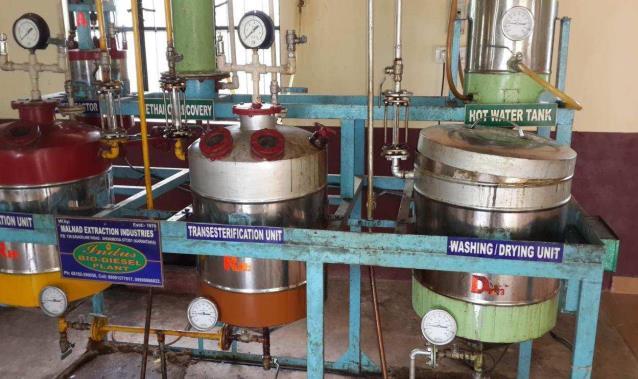
TheHongeoilwasextractedfromtheseedsusingascrew crusher (oil expeller). The raw oil was then filtered to remove impurities. A Free Fatty Acid (FFA) test was conductedonthecrudeHongeoilusingatitrationtechnique. AstheFFAvaluewasfoundtobegreaterthan3%,a twosteptransesterificationprocesswasemployedtoconvertthe oil into biodiesel (HOME). The transesterification unit is showninFig1.
1. Acid-Catalyzed Esterification: The first step aimed to reduce the FFA content to below 3%. The reaction was carried out in a reactor with Honge oil, methanol, and sulfuric acid as a catalyst. The mixture was heated and stirredforaspecifiedduration,afterwhichitwasallowedto settle.Thelowerlayercontaininggumming,methanol,and waterwasremoved.
2.Base-Catalyzed Transesterification: Thepretreatedoil was then subjected to base-catalyzed transesterification. Potassiumhydroxide(KOH)wasdissolvedinmethanoland added to the heated oil in the reactor. The mixture was stirred for a specific time and then allowed to settle. The upper layer, containing the Honge oil methyl ester (biodiesel),wascollectedandpurifiedbywashingwithhot watertoremoveanyremainingcatalystandglycerol.
Fourdifferentfuelblendswerepreparedbymixingdiesel, Honge oil biodiesel (B), and fish oil (F) in varying
proportions. The blends were designated as D80B10F10, D80B13F7,D80B15F5,andD80B17F3,wherethenumbers indicatethepercentagebyvolumeofeachcomponent.The physical and chemical properties of these blends were characterizedasfollows:
pH: MeasuredusingadigitalpHmeter.
Calorific Value: Determined using a bomb calorimeter.
Density: Measuredusingahydrometer.
Flash and Fire Points: DeterminedusingaPenskyMartensclosed-cupapparatus.
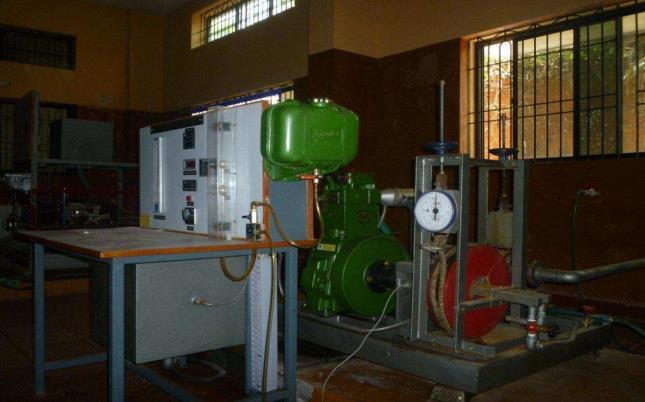
Theperformanceandemissiontestswereconductedon a single-cylinder,four-stroke,water-cooledCIenginewitha rated power of 3.67 kW at 1500 rpm. The engine was coupled to a mechanical dynamometer to apply varying loads.Theexperimentalsetupincludedinstrumentationto measureenginespeed,fuelconsumption,airflowrate,and exhaustgastemperature.TheCIEnginetestrigisshownin Fig.2.
Theexperimentalprocedureinvolvedthefollowingsteps:
1. The engine was started using conventional diesel and allowedtowarmuptoreachastableoperatingcondition.
2.Baselineperformanceandemissiondatawererecordedat differentloads.
3. The engine was then run on each of the four biofuel blends,andthesamesetofperformanceandemissiondata wascollectedforcomparison.
4.ThekeyperformanceparameterscalculatedwereSpecific Fuel Consumption (SFC), Brake Thermal Efficiency (BTE), BrakePower(BP),andVolumetricEfficiency.
Volume: 12 Issue: 08 | Aug 2025 www.irjet.net
3.1. Fuel Properties
Thepropertiesofthefourbiofuel blendsare presented in Table1.Thecalorificvaluesofallblendswereslightlylower than that of conventional diesel, which is a typical characteristicofbiofuels.Thedensitiesoftheblendswere slightly higher than that of diesel. The flash points of the blends were all above 50°C, ensuring safe handling and storage.
Table1:Enginetestdataforthefuelsused
International Research Journal of Engineering and Technology (IRJET) e-ISSN: 2395-0056
Volume: 12 Issue: 08 | Aug 2025 www.irjet.net p-ISSN: 2395-0072
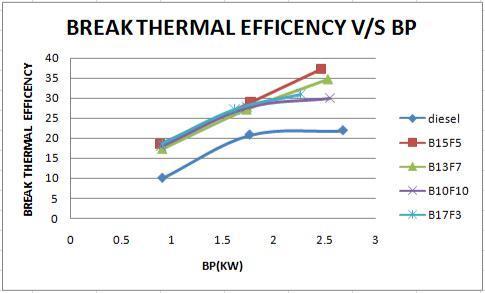
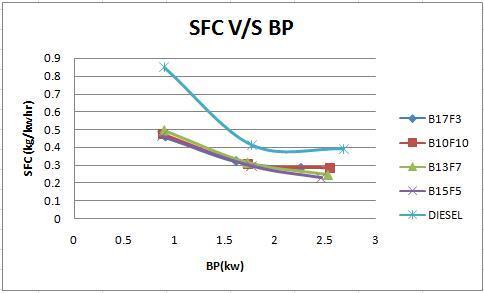
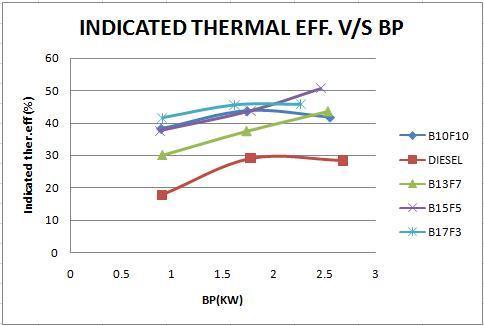
The performance of the engine was evaluated in terms of Brake Thermal Efficiency (BTE) and Specific Fuel Consumption(SFC).ThevariationofBTEwithloadforallthe fuel blends is shown in Figure 3. It was observed that the BTEofalltheblendswascomparabletothatofdiesel,with theD80B15F5blendexhibitingthehighestBTEamongthe blends. The SFC for the biofuel blends was slightly higher than that of diesel, which can be attributed to their lower calorific values. The SFC variation with load is shown in Figure4.
Theemissioncharacteristicsoftheenginewereanalyzedfor CO,CO₂,HC,andNOxemissions.Thebiofuelblendsshoweda significant reduction in CO, HC, and smoke emissions comparedtodiesel.Thisisduetothepresenceofoxygenin the biofuel molecules, which promotes more complete combustion. However, a slight increase in NOx emissions was observed for the biofuel blends, which is a common trend for biodiesels due to the higher combustion temperatures.
4.
This study successfully investigated the performance and emission characteristics of a CI engine fueled with novel blendsofdiesel,Hongeoilmethylester,andfishoil.Based ontheexperimentalresults,thefollowingconclusionscanbe drawn:
1. The two-step transesterification process was effective in converting high-FFA Honge oil into biodieselwithpropertiessuitableforengineuse.
International Research Journal of Engineering and Technology (IRJET) e-ISSN: 2395-0056
Volume: 12 Issue: 08 | Aug 2025 www.irjet.net p-ISSN: 2395-0072
2. Thebiofuelblendsexhibitedphysicalandchemical properties that are comparable to those of conventionaldiesel,makingthemsuitableforusein existing CI engines without any major modifications.
3. The engine performance with the biofuel blends was found to be very close to that of diesel. The D80B15F5 blend, in particular, showed a brake thermalefficiencythatwasalmostidenticaltothat ofdiesel,withonlyamarginalincreaseinspecific fuelconsumption.
4. The biofuel blends resulted in a significant reduction in harmful emissions,including CO, HC, and smoke. Although a slight increase in NOx emissionswasobserved,theoverallenvironmental impactoftheblendsisconsiderablylowerthanthat ofdiesel.
5. TheD80B15F5blendwasidentifiedastheoptimal blend, offering the best compromise between engineperformanceandemissionreduction.
Insummary,thisresearchdemonstratesthatadual-biofuel blend of Honge oil and fish oil with diesel is a viable and promising alternative fuel for CI engines. The use of such blendscancontributetoreducingthedependenceonfossil fuels, promoting the use of renewable resources, and mitigatingtheenvironmentalimpactofdieselengines.
[1]M.A.KalamandM.A.Masjuki,"Biodieselfrompalmoil an analysis of its properties and potential," Biomass and Bioenergy,vol.23,no.6,pp.471-479,2002.
[2] A. Demirbas, "Progress and recent trends in biofuels," ProgressinEnergyandCombustionScience,vol.33,no.1,pp. 1-18,2007.
[3]S.K.Hoekman,A.Broch,C.Robbins,E.Ceniceros,andM. Natarajan,"Reviewofbiodieselcomposition,properties,and specifications," Renewable and Sustainable Energy Reviews, vol.16,no.1,pp.143-169,2012.
[4] A. K. Agarwal, "Biofuels (alcohols and biodiesel) applications as fuels for internal combustion engines," ProgressinEnergyandCombustionScience,vol.33,no.3,pp. 233-271,2007.
[5] G. Knothe, "Biodiesel and renewable diesel: A comparison," ProgressinEnergyandCombustionScience,vol. 36,no.3,pp.364-373,2010.
[6] M. Lapuerta, O. Armas, and J. R. Fernández, "Effect of biodiesel fuels on diesel engine emissions," Progress in
Energy and Combustion Science,vol.34,no.2,pp.198-223, 2008.
[7]M.K.Lam,K.T.Lee,andA.R.Mohamed,"Homogeneous, heterogeneous and enzymatic catalysis for transesterificationofhighfreefattyacidoil(wastecooking oil)tobiodiesel:Areview," BiotechnologyAdvances,vol.28, no.4,pp.500-518,2010.
[8] S. K. Karmee and A. Chadha, "Preparation of biodiesel fromcrudeoilofPongamiapinnata," BioresourceTechnology, vol.96,no.13,pp.1425-1429,2005.
[9] H. Raheman and A. G. Phadatare, "Diesel engine emissionsandperformancefromblendsofKaranjamethyl esteranddiesel," Biomass and Bioenergy,vol.27,no.4,pp. 393-397,2004.
[10] N. R. Banapurmath, P. G. Tewari, and R. S. Hosmath, "Performance and emission characteristics of a DI compression ignition engine operated on Honge, Jatropha andsesameoilmethylesters," RenewableEnergy,vol.33,no. 9,pp.1982-1988,2008.
[11]F.MaandM.A.Hanna,"Biodieselproduction:areview," Bioresource Technology,vol.70,no.1,pp.1-15,1999.
[12]A.P.SinghandS.K.Singh,"Productionofbiodieselfrom waste fish oil," International Journal of Renewable Energy Research,vol.2,no.1,pp.136-140,2012.
[13] M. A. Bezerra, C. A. B. Garcia, and A. S. Araujo, "Performanceandemissionsofadieselenginefueledwith fishoilbiodiesel," Fuel,vol.90,no.11,pp.3433-3437,2011.
[14] A. E. Atabani et al., "A comprehensive review on biodiesel as an alternative energy resource and its characteristics," RenewableandSustainableEnergyReviews, vol.16,no.4,pp.2070-2093,2012.
[15]S.JaichandarandK.Annamalai,"Thestatusofbiodiesel as an alternative fuel for diesel engines," Journal of Sustainable Energy & Environment,vol.2, no. 2,pp.71-75, 2011.