
International Research Journal of Engineering and Technology (IRJET) e-ISSN: 2395-0056
Volume: 12 Issue: 11 | Nov 2025 www.irjet.net p-ISSN: 2395-0072
International Research Journal of Engineering and Technology (IRJET) e-ISSN: 2395-0056
Volume: 12 Issue: 11 | Nov 2025 www.irjet.net p-ISSN: 2395-0072
PAVAN KUMAR S1 , SRI C R SHARADA PRASAD 2
1M. Tech student, Power System Engineering, Dept. of Electrical and Electronics Engineering, University BDT College of Engineering, Davangere, Karnataka, India.
2 Associate Professor, Department of Electrical and Electronics Engineering, University BDT College of Engineering, Davangere, Karnataka, India.
Abstract - For Solar PV systems to achieve high-quality, efficient energy conversion, multilevel inverter integration has become more crucial. The main goal of this project is to model and simulate the operation of a solar PV array. Multilevel inverters attract a lot of attention due to their easy control and flexible design when connected in a solar PV array. These inverters operate exceptionally well since they generate an output voltage that closely a sine wave. A MATLAB Simulink model is simulated for a sine wave,3-level, and 5-level inverter, and the corresponding output is analyzed. FFT Analysis is also done to examine the total harmonic distortion (THD) in all three cases.
Key Words: Solar PV Array, Multilevel Inverter, THD, FFT Analysis, Boost Converter, MATLAB Simulink.
LifeonEarthissupportedbysolarenergy,itis alsoanendlessandsustainablesupplyofelectricity.Many studieshavebeencarriedouttoinvestigatedifferentdesign elementsandperformancetraitsofphotovoltaic(PV)cells overthelast50years.CreatingfullyintegratedPVmodules thatarecapableofeffectivelycompetingwithconventional energysourceshavebeentheultimategoal.Becausesolar energyisexpectedtoplayacrucialroleinfuturesmartgrids as a distributed renewable energy source, there is an increasing trendtowardsusingsolarcellsinbothindustrial and residential applications. A grid- connected solar photovoltaic system uses a DC/AC inverter and a DC-DC boostconvertertoprovideelectricitytotheutilitygrid.The PVcellmodelthatisusedinthissystemissimpleandThePV cellmodelusedinthissystemissimpleandaccuratesinceit takessolarradiationandambienttemperatureintoaccount. Recently,interestinadoptingrenewableenergyhassurged duetosustainableenergyalternatives.sources.Solarpower production, in particular, stands out due to its wide availability and eco-friendly features. This energy source helps reduce reliance on fossil fuels and lowers carbon emissions.Asaresult,morepeopleareusingsolarenergyin theirhomes.Theobjectiveistocreateadetailedmodeland simulationframeworkforasolarpowerproductionsystem connectedtotheelectricalgrid.Fossilfuels,primarilycoal, supply most of the world's energy. Yet, the traditional method of generating electricity poses challenges, as it
contributestogreenhousegasemissions.Inaddition,asthe populationgrows,fossilfuelsandallothernon-renewable resources used to produce electricity are running out and offeringpotentialalternativestotheseissuessincetheyare thoughttobelong-lastingandpuresources.Inordertosolve these issues, renewable resources such as solar photovoltaic,wind,tidal,wave,andbiomass arecurrently beingusedasalternativemethodsofproducingelectricity. Duetoitslowmaintenanceneeds,lownoiselevel,andlack ofpollutants,solarphotovoltaicenergyhasbecomeoneof the main renewable energy sources in recent decades. Together,solarPVpanelsandpowerconvertersefficiently supplyelectricity.Aphotovoltaicsystemisthusproduced. TherearenumerousconfigurationsforPVsystems.Among these, stand-alone and grid-connected are the two most importantsystemconfigurations.Renewableenergysources haveaccountedfor15–20%ofglobalenergyconsumptionin the 1ast ten years. The energy generated by photovoltaic (PV) arrays is one of the many renewable energy sources and is growing in importance every day. Solar energy is widelyusedbecauseitisinexpensive,readilyavailable,and abundant.Oneofthenumerousrenewableenergysourcesis the energy produced by photovoltaic (PV) arrays, is becoming increasingly significant every Day. Due to its abundance,easeofavailability,andlowcost,solarenergyis verypopular.worldwide.PVarraysgenerateDCelectricity directly, with no emissions or negative effects on the environment. DC/DC converters or inverters can then convertDCelectricitytoACenergyorraisetheDClevelof energy using a DC/DC converter. During the day, solar energycanbeusedtogenerateelectricity.Itisperfectfor energy at intermediate and high temperatures. use. However,erraticandabruptvariationsintheweatherorthe temperatureatwhichcellsoperatecanhaveanimpacton solarenergy.PVsystemstypicallyhaveafewcomponents, suchasaPVarray,energystoragedevices,andeitherDCor ACpower.loadandconverter.Forninemonthsoftheyear, experiences roughly ten hours of sunshine on average. Therefore,thefactthatthePVarraygenerateselectricityis advantageous.However,thiselectricityneedstobemodified for computing devices and electronics such as personal computers, lighting and heating controls, and uninterruptiblepowersupply,amongothers.Consequently, a low-cost, high-efficiency DC/DC converter with voltage
International Research Journal of Engineering and Technology (IRJET) e-ISSN: 2395-0056
Volume: 12 Issue: 11 | Nov 2025 www.irjet.net p-ISSN: 2395-0072
feedbackistypicallyconstructedforthesysteminorderto modifythepoweroutputofthePVarray.
1)To design and model a solar photovoltaic (PV) system integrated with a DC–DC boost converter and multilevel inverterusingMATLAB/Simulink.
2)To analyze the performance of different inverter topologies namely2-level(sinewave),3-level,and5-level inverters forsolarPVpowerconversion.
3) To evaluate the Total Harmonic Distortion (THD) of inverteroutputwaveformsandcompareharmonicreduction amongdifferentconfigurations.
4)Toinvestigatethe effectofincreasing inverterlevelson outputvoltagewaveformqualityandsystemefficiency.
5)Tovalidatethatmultilevelinvertertechnologyimproves power quality and minimizes the need for bulky filters in grid-connectedsolarPVsystems
The proposed system consistsofa PVarray,DC–DCboost converter,andamultilevelinverter.ThePVarrayconverts solar irradiation into DC voltage. The boost converter elevates the voltage to a stable DC level suitable for inversion.Threeinverterconfigurations sinewave,3-level, and 5-level are modeled in MATLAB/Simulink. The multilevel inverter employs cascaded H-bridge topology with Pulse Width Modulation (PWM) control to generate near-sinusoidaloutputvoltage.FFTanalysisisperformedto assessharmonicdistortionineachcase.

Solar power generation involvescapturing sunlight and converting it into usable electricity, primarily through photovoltaic(PV)cells.PVsystemsuseofsolarpanels,which directly transform sunlight into direct current (DC) electricity. This DC is then boosted by a DC-DC Boost Converter.ThisBoostedDCisthenconvertedtoalternating current (5 level) by an inverter, the converted AC is connectedtotheGrid,fromthegrid,electricityisusedfor homeappliances.MinimizationofTHDbya5Levelinverter.
1) Solar Panel (PV Array)
a)Thephotovoltaic(PV)panelabsorbssolarradiationand convertsitdirectlyintodirectcurrent(DC)electricity.
b) Solar irradiation, temperature, and load conditions all affecttheoutputvoltageandcurrent.Itisnecessarytodo additionalprocessingbecausethisoutputistypicallypoor andunregulated.
2)Boost Converter (DC–DC Stage)
a)TheboostconverterraisesthelowDCvoltagefromthePV paneltoahigher,stableDClevelsuitablefortheinverter.
b)Example:APVmodulegiving40Vcanbesteppedupto around350–400VDC.
a)Theinverterconvertsthe regulatedDCintoalternating current(AC).
b)AsinusoidalACvoltageisproducedbytheinverterusing methodssuchasPulseWidthModulation(PWM).
c)Inordertoachievecorrectsynchronization,theinverter alsomakessurethatitsoutputvoltage,frequency,andphase matchthoseofthegrid.
4) Grid Connection
a)TheACoutputoftheinverterisfedintotheutilitygrid.
b) When the PV system generates more than the local demand,surplusenergyisexportedtothegrid.Ontheother hand,thegridprovidestheloadwiththenecessaryenergy whensolarpowerisinsufficient.
1.3 SOLAR PV ARRAY MODULE DATA:
International Research Journal of Engineering and Technology (IRJET) e-ISSN: 2395-0056
Volume: 12 Issue: 11 | Nov 2025 www.irjet.net p-ISSN: 2395-0072
2.1 MODELLING OF BOOST CONVERTER CONNECTED TO PV ARRAY USING MATLAB/SIMULINK.
FromsolarPVarrayblockparameters1Soltech1STH-230-P
Themoduleisselectedthatisavailableinthemodulesection ofthePVarrayblockinMATLAB/Simulink.
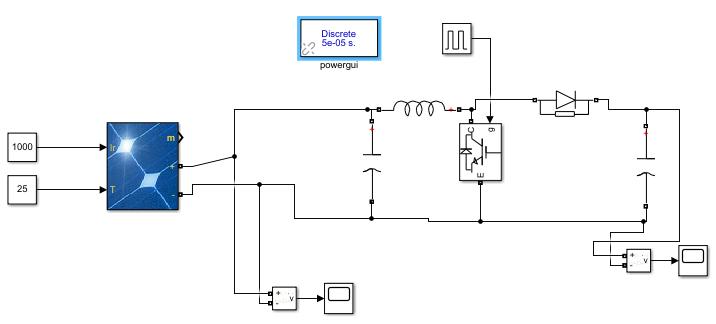
Fig 2: PVarraymodelinMATLAB/Simulink
Solarphotovoltaic(PV)systemsgeneratedirectcurrent(DC) powerwhenexposedtosunlight.However,therawvoltage outputfromPVmodulesisusuallylowandnotconsistent enoughforreal-worlduses.Tomakeitsuitableforfurther use,suchasfeedinganinverterorconnectingtothegrid,a boostconverterisemployed.Theboostconverterincreases the PV voltage to the desired level while regulating the output.
ThesimulationdemonstratestheeffectiveoperationofaPV system with a boost converter. Here, the PV array is connected to a DC-DC Boost Converter in this simulation. Solarirradianceof1000w/m2 andtemperature25°Cgives 113Vofvoltage,whichisboostedto423VbyusingaDC-DC Boost converter. When the switch is ON, current flows throughtheinductor,and energyisstored inits magnetic field.WhentheswitchisOFF,theinductorreleasesstored energy,whichaddstothePVvoltage,resultinginahigher output voltage. The output of the boost converter in this modelisapproximately423VDC.
CALCULATIONS:
1)DutyCycle D = 1- Vin =1–113=0.50 Vout 228
2)InductorL
ChooserippleΔIL=0.3Iin
Inductance L= (Vin*D) =1.34mH (Fs * ΔIL)
3)Capacitor
Forboost,withsmallrippleapproximation:
Capacitor C = Iout max *D =2.95μF.
( Fs x Vout)
2.2 MODELLING OF PV Array Connected boost converter and sine wave inverter using MATLAB/SIMULINK.
Here,thePVarrayisconnectedtoaDC-DCBoostConverter andasinewaveinverter(2-level)inthissimulation.Solar irradianceof1000w/m2andtemperature25°Cgives113V ofvoltage,whichisboostedto228VbyusingaDC-DCBoost converter.Fig.4.2showstheboostedoutputwaveform.we canseetheboostconverteroutputusinga
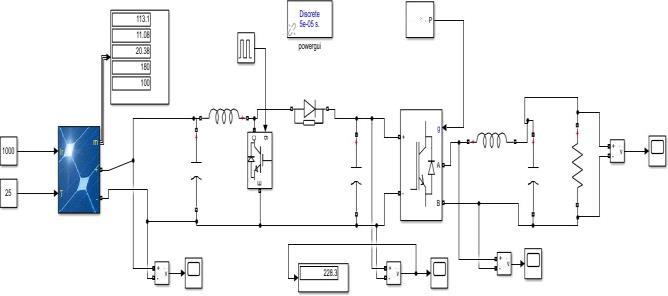
Fig 3:PVarrayconnectedtoaBoostconverterandsine waveinverter.
2.3 PV Array Connected boost converter and 3-level inverter Simulink model.
The 3-levelinverterproducesanoutputthatstepsthrough positive,zero,andnegativevoltages,makingthewaveform smootherandclosertoa sine wavecomparedtoa 2-level inverter.
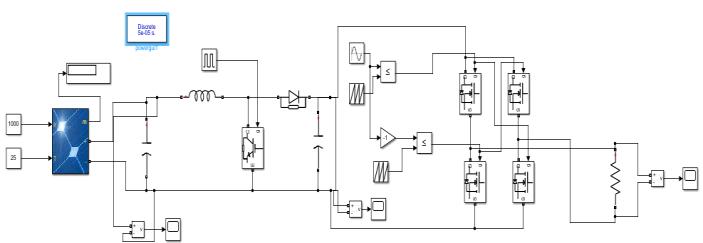
Fig 3:PVarrayconnectedtoaBoostconverterand3-level inverter.
International Research Journal of Engineering and Technology (IRJET) e-ISSN: 2395-0056
Volume: 12 Issue: 11 | Nov 2025 www.irjet.net p-ISSN: 2395-0072
2.4 PV Array Connected boost converter and 5-level inverter Simulink model.
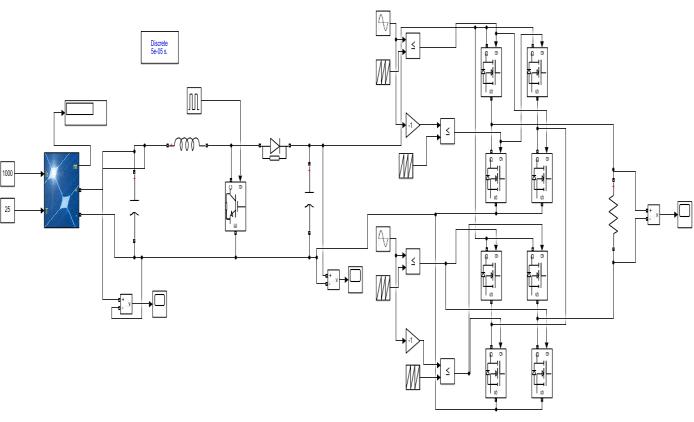
Fig 4:PVarrayconnectedtoaBoostconverteranda5level inverter.
Anabove5-levelinvertercreatesastaircasewaveformwith fivevoltagestepsineachhalfcycle.Thehighernumberof stepsmakestheoutputmuchclosertoasinewave,reduces distortion,andimprovesoverallpowerqualitycomparedto a2-levelor3-levelinverter.
3.1 Simulation Result:
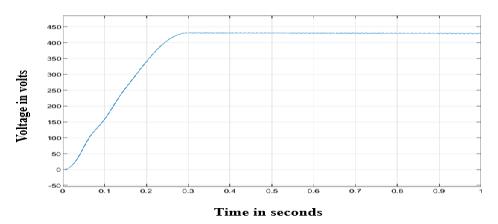
5 :outputwaveformofboostconverterconnectedto PVarray.
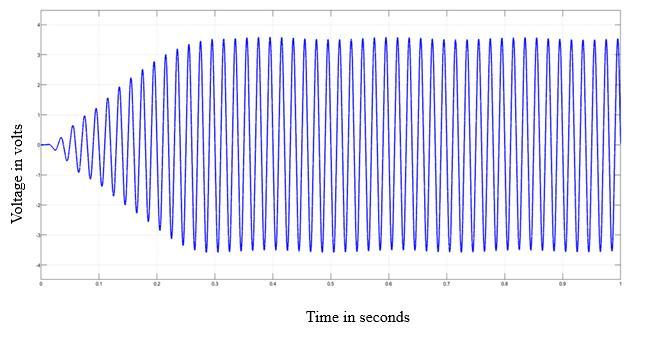
6: outputwaveformofPVarrayconnectedtoaBoost converterandsinewaveinverter.
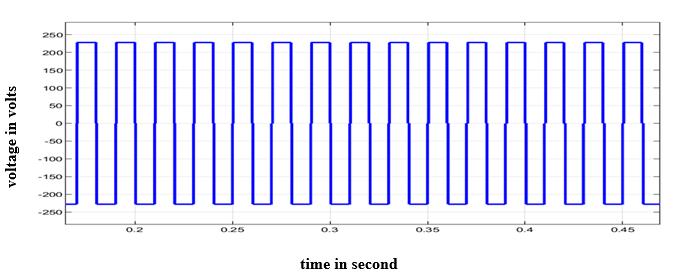
Fig 7: outputwaveformofPVarrayconnectedtoaBoost converterand3-level inverter.
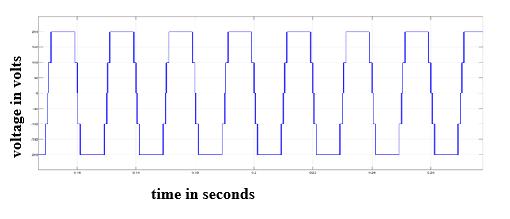
Fig 8 : outputwaveformofPVArrayConnectedboost converterand5-levelinverterSimulinkmodel.
A 3-level inverter produces an output that steps through positive,zero,andnegativevoltages, makingthewaveform smootherandclosertoa sine wavecomparedtoa 2-level inverter.the5-levelinvertercreatesastaircasewaveform withfivevoltagestepsineachhalfcycle.Thehighernumber of steps makes the output much closer to a sine wave, reduces distortion, and improves overall power quality comparedtoa2-levelor3-levelinverter.
3.2 FFT Analysis to calculate THD of various inverters:
Atime-domainvoltageorcurrentwaveformisbrokendown into its frequency components using FFT (Fast Fourier Transform) analysis. For power-electronics outputs (inverter/boostconverter),FFTisusedto:
1) Identify the fundamental frequency and harmonic content.
2)CalculateTHD(TotalHarmonicDistortion).
3)Evaluatefilteringormodulationeffectiveness.
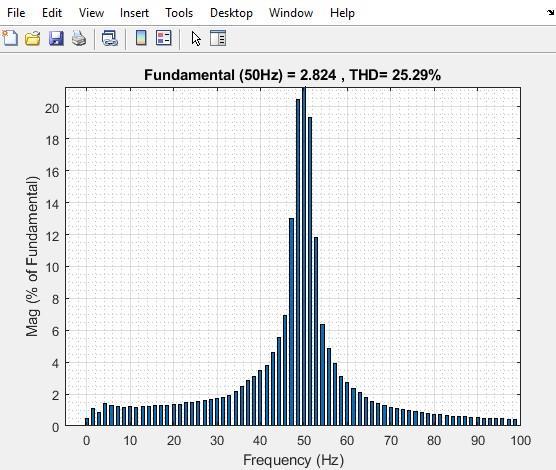
9 : FFTAnalysisofsinewave Inverter.
International Research Journal of Engineering and Technology (IRJET) e-ISSN: 2395-0056
Volume: 12 Issue: 11 | Nov 2025 www.irjet.net p-ISSN: 2395-0072
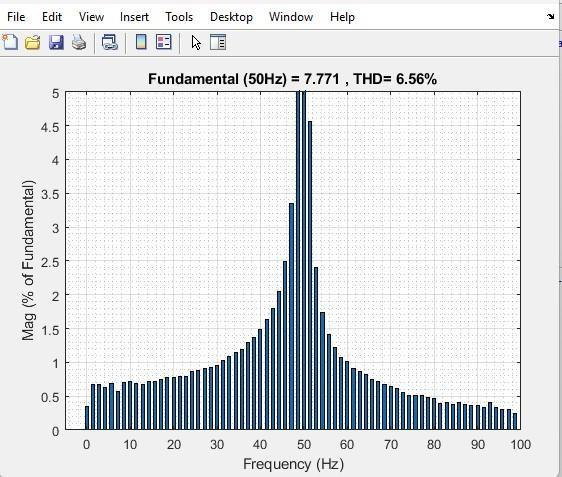
TheFFTanalysisofthe5-levelinvertershowsafundamental frequency at 50 Hz with a magnitude of 7.77and a THD of 6.85%, which is good. The waveform contains very few harmonics,indicatingitisveryclosetoapuresinewave. To further improve, you need better filtering or advanced inverter modulation techniques (like SPWM or multilevel inverterdesign).Figure4.10showstheFFTAnalysisofa5levelinverter.AccordingtoIEEEStandards,THDofVoltage andCurrentshouldbebeloworEqualto5%and4%.
4.1 RESULT:
SineWave
(2level)
waveform,far frompuresine
% Highharmonic distortionneeds abulkyfilter
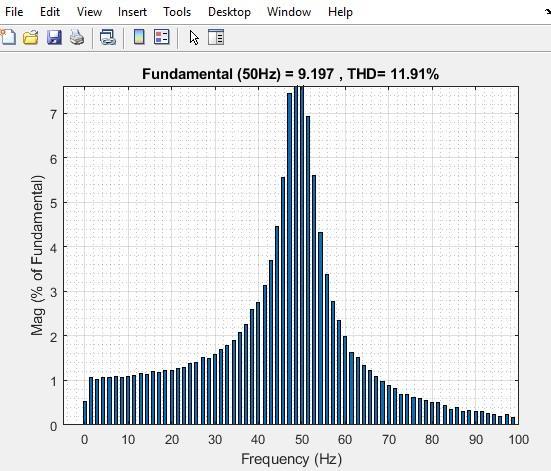
3-LevelInverter Closertosinewave, smallervoltagesteps 11.91 % ModerateTHD, reducedfilter size
5-LevelInverter Veryclosetopuresine wave,smoothersteps 6.56% LowTHD,better efficiency
Amultilevelinverter'soutputwaveformapproaches a pure sine wave as the number of levels rises, and THD sharply falls. Therefore, in terms of power quality and harmonicreduction,5-levelinvertersperformbetterthan3level and traditional sine wave (2-level) inverters. In this paper,MATLABSimulinkisusedtosimulateasolarPVarray consisting of sinewave,3-level, and 5-level inverters. Total Harmonic Distortion (THD) is calculated in each case the valueofTHDdecreasesastheleveloftheinverterincreases.
[1] Narmatha Deenadayalan, Arul Raj Kumarave, PrabhakaranNarayanan,SridharAntoniraj,“Simulink-Based Modelling and Simulation of Solar Power Generation with Grid Interconnection System Using Matlab for Home Appliances”,2022.
[2] Sunita Kumari and Sudhir Y Kumar, “DESIGN AND CONTROL OF MULTILEVEL INVERTER TOPOLOGIES FOR INDUSTRIAL APPLICATIONS “, IAEME Publication,VOL 8, JUN2017.
[3]Mr.S.SheikMohammed,Dr.D.Devaraj,“Simulationand Analysis of Stand-alone Photovoltaic System with Boost ConverterusingMATLAB/Simulink”,2018.
[4] L Siva Chaitanya Kumar, K Padma, “Matlab/Simulink Based Modelling and Simulation of Residential Grid ConnectedSolarPhotovoltaicSystem”,2014.
[5]LakshmanRaoS. P,Dr. CijiPearl Kurian,Dr.B.K.singh, KumarAbhinav,GauravNandy,“Designand Simulation of Grid Connected Hybrid Solar-WECS Using SIMULINK/MATLAB”,2014.
[6] Oleg V. Leshtayev, Natalia A. Stushkina, Vladimir I. Zaginailov,NataliaA.Sergeev,“Solarpowerstationmodelin MatlabSimulinkprogram”,2020.
[7] Sandeep Neupane, Ajay Kumar, “Modeling and SimulationofPVarrayinMatlab/Simulinkforcomparisonof perturbandobserve&incrementalconductancealgorithms usingbuckconverter”,2017.
[8] Sunita Kumari, Sudhir Y Kumar, “Design of Cascaded Multilevel Inverter for Harmonic Distortion Elimination”, IJEETE,Vol.04,Issue02,Pg.102-108,Mar-Apr2017.
[9] Dayaneshwar D. Khairnar, V. M. Deshmukh, “Review Study on Topologies of Multilevel Inverters”, IJIRD ISSN: 2278-0211,Vol.3,Issue5,May2014.
[10] Md. Samiul Islam Sadek, Md. Anamul Haque Joy,etal “DESIGNANDANALYSISOFAROOFTOPHYBRIDSOLARPV SYSTEM USING HOMER PRO AND MATLAB SIMULINK”, SEUJEEE,VOL2,Jan2022.