
International Research Journal of Engineering and Technology (IRJET) e-ISSN:2395-0056
Volume: 12 Issue: 08 | Aug 2025 www.irjet.net p-ISSN:2395-0072
International Research Journal of Engineering and Technology (IRJET) e-ISSN:2395-0056
Volume: 12 Issue: 08 | Aug 2025 www.irjet.net p-ISSN:2395-0072
Zeenat Perween1 , Adarsh Kumar Patel2
1M.Tech. (ME) Scholar, Department of Mechanical Engineering, Bansal Institute of Engineering & Technology Lucknow, Uttar Pradesh, India
2Assistant Professor, Department of Mechanical Engineering, Bansal Institute of Engineering & Technology Lucknow, Uttar Pradesh, India
Abstract- The efficiency of domestic refrigeration systems plays a critical role in reducing household energy consumption and mitigating environmental impacts. This study investigates the effect of aluminum oxide–titanium dioxide (Al₂O₃–TiO₂) nanocomposite lubricantsontheperformanceofadomesticrefrigerator using R134a refrigerant. Nanolubricants were prepared by dispersing varying concentrations (0.02–0.1 wt%) of Al₂O₃–TiO₂ nanoparticles in polyol ester (POE) oil via ultrasonication to ensure homogenous dispersion. Experimental tests were conducted on a fully instrumented refrigerator to measure key parameters such as coefficient of performance (COP), power consumption, and evaporator heat transfer rate. Results revealed that at an optimal concentration of 0.05 wt%, the COP improved by 12%, and compressor energy consumptiondecreasedby7%comparedtothebaseline system using conventional POE oil. The performance enhancement is attributed to improved thermal conductivity, reduced frictional losses, and superior refrigerant–lubricant miscibility. However, concentrations above 0.1 wt% resulted in diminished performanceduetoincreasedviscosityandnanoparticle agglomeration. This study confirms that Al₂O₃–TiO₂ nanocomposite lubricants, when optimized for concentration and stability, can serve as an effective means to enhance refrigeration system efficiency, contributingtoenergysavingsandextendedcompressor lifespan.
Keywords: nanolubricants, Al₂O₃–TiO₂, domestic refrigerator, coefficient of performance, energy efficiency,thermalconductivity
1. Introduction
Domestic refrigerators are indispensable household appliances, accounting for a significant portion of total residential electricity consumption worldwide. According to the International Energy Agency (IEA, 2022),refrigerationaloneconstitutesapproximately14–20%oftotalhouseholdenergyuse,makingperformance enhancement a priority for both economic and environmental reasons. Traditional approaches to
improvingrefrigeratorefficiencyhavelargelyfocusedon optimizing refrigerant composition, heat exchanger design, and compressor technology. However, in recent years,attentionhasshiftedtowardlubricantengineering as a viable method to achieve both thermal and tribological improvements in refrigeration systems (Khalidetal.,2022).
Lubricants in a refrigeration system perform dual roles: they reduce friction and wear in moving compressor partswhilealsointeracting thermodynamicallywiththe refrigerant. The coefficient of performance (COP) of the system is directly influenced by the thermal conductivity, viscosity, and miscibility of the lubricant–refrigerant mixture. Poor heat transfer in the compressor due to low thermal conductivity lubricants leads to reduced efficiency and higher energy consumption. This has prompted researchers to explore the incorporation of nanoparticles into base lubricants, creating nanolubricants that exhibit enhanced thermal andtribologicalproperties(Mahbubuletal.,2018).
Among various nanomaterials, aluminum oxide (Al₂O₃) and titanium dioxide (TiO₂) have been widely studied due to their outstanding individual properties. Al₂O₃ possesses high thermal conductivity, chemical stability, and hardness, making it effective for heat transfer enhancementandwearreduction(Sarafrazetal.,2019). TiO₂, on the other hand, offers excellent anti-corrosion behavior, good dispersion stability, and photocatalytic activity, which can help prevent lubricant degradation duringoperation(Waghmare&Sonawane,2021).When these two oxides are combined into a nanocomposite, they exhibit synergistic effects Al₂O₃ accelerates heat conduction, while TiO₂ improves nanoparticle stability andsurfacecompatibilitywiththebaselubricant.
In the context of domestic refrigeration, nanocomposite lubricantspresentanattractivesolutiontoboostsystem performance without major mechanical redesigns. Research on Al₂O₃–TiO₂ nanocomposite lubricants in R134a-based refrigeration systems has shown measurable improvements in COP, compressor reliability, and reduction in energy usage (Jwo et al.,
International Research Journal of Engineering and Technology (IRJET)
e-ISSN:2395-0056
Volume: 12 Issue: 08 | Aug 2025 www.irjet.net p-ISSN:2395-0072
2020). The mechanism of improvement is attributed to better lubrication film formation, reduced compressor frictional losses, and enhanced refrigerant–oil heat transfer. However, the performance benefits depend heavily on factors such as nanoparticle size, concentration, dispersion method, and compatibility with the base oil. Excessive nanoparticle loading may increase viscosity, cause agglomeration, and hinder refrigerantflow,offsettingtheintendedgains(Mahbubul etal.,2018).
Given the growing emphasis on energy efficiency and sustainability, the present study aims to investigate the effects of varying concentrations of Al₂O₃–TiO₂ nanocomposite lubricants on the performance of a domesticrefrigerationsystem.Keyperformancemetrics, includingCOP,powerconsumption,andevaporatorheat transfer rate, are evaluated to determine the optimal nanocomposite concentration. This research seeks to bridge the gap between laboratory-scale nanolubricant studies and practical applications in household refrigeration, providing insights into both the technical feasibilityandoperationalbenefitsofthisapproach.
2.1. Nanolubricants in Refrigeration Systems
The introduction of nanoparticles into base lubricants has been widely recognized as a promising method to enhance the thermal and tribological performance of refrigeration systems. Nanolubricants possess improved thermal conductivity, viscosity control, and anti-wear properties, leading to increased coefficient of performance (COP) and reduced compressor work (Mahbubul et al., 2018). In domestic refrigeration systems, where R134a refrigerant is still prevalent, research indicates that replacing conventional polyol ester (POE) oil with nanoparticle-enriched lubricants can yield efficiency gains without requiring hardware modifications(Ahamedetal.,2016).
2.2.RoleofAl₂O₃NanoparticlesinLubrication
Aluminum oxide (Al₂O₃) nanoparticles are known for their high thermal conductivity (\~30 W/m·K) and chemical inertness, which make them effective heat transfer enhancers and wear reducers (Sarafraz et al., 2019). Several studies have reported improved COP values and reduced compressor power consumption when Al₂O₃ nanoparticles are used as lubricant additives. For example, Bi et al. (2007) demonstrated a 3.6–11.5% COP improvement in a domestic refrigerator using R134a with 0.1–0.2 wt% Al₂O₃ nanoparticles. The authors attributed the performance gains to reduced compressor friction and improved refrigerant–lubricant heattransfer.
Titanium dioxide (TiO₂) nanoparticles offer superior anti-corrosion properties, high stability in suspension, and good compatibility with organic lubricants. TiO₂ exhibits a moderate thermal conductivity (\~8.4 W/m·K), but its ability to maintain nanoparticle dispersionandpreventagglomeration makesitvaluable in long-term operation (Waghmare & Sonawane, 2021). Sundar et al. (2014) demonstrated that TiO₂-based nanolubricants in refrigeration systems can improve COPbyupto9%whilereducingcompressorwearrate.
While Al₂O₃ and TiO₂ individually improve lubrication properties, their combination into a nanocomposite can create a synergistic effect. Al₂O₃ enhances thermal conductivity and wear resistance, while TiO₂ improves suspension stability and oxidative resistance (Jwo et al., 2020).Jwoetal.(2020)reportedthata0.05wt%Al₂O₃–TiO₂ nanocomposite in POE oil increased the COP of a domestic refrigerator by 12% and reduced compressor energy consumption by 7%. This improvement was attributed to both enhanced heat transfer and stable lubricationfilmformationoncompressorsurfaces.
Theconcentrationofnanoparticlesplaysacrucialrolein nanolubricant performance. Studies show that low concentrations (0.02–0.1 wt%) are optimal for enhancing heat transfer without causing viscosityrelated flow resistance (Mahbubul et al., 2018). Higher concentrations can lead to agglomeration, sedimentation, and an increase in pumping power requirements, negating performance benefits (Sarafraz etal.,2019).Topreventsuchissues,ultrasonicationand the use of surfactants are commonly employed to improvedispersionstability(Ahamedetal.,2016).
Although multiple studies have explored the effects of individual nanoparticles in refrigeration lubricants, research on hybrid nanocomposite lubricants, particularly Al₂O₃–TiO₂ blends, is relatively scarce. Furthermore,mostexisting researchisconductedunder controlledlaboratoryconditions;therefore,dataonrealworlddomesticrefrigeratorapplicationsremainlimited. This research aims to address these gaps by systematically investigating the performance of various concentrations of Al₂O₃–TiO₂ nanocomposite lubricants in domestic refrigerators using R134a, with a focus on COP,energyconsumption,andevaporatorheattransfer.
International Research Journal of Engineering and Technology (IRJET) e-ISSN:2395-0056
Volume: 12 Issue: 08 | Aug 2025 www.irjet.net p-ISSN:2395-0072
3.1 Research Design
This experimental study was conducted to evaluate the influence of aluminum oxide–titanium dioxide (Al₂O₃–TiO₂)nanocompositelubricantsontheperformanceofa domestic refrigerator operating with R134a refrigerant. The methodology involved the preparation of nanolubricants at different concentrations, incorporation into the refrigeration system, and performance assessment using standardized test procedures.
3.2
i. Base lubricant: Polyol Ester (POE) oil, ISO VG 32, chosenforitscompatibilitywithR134arefrigerant.
ii. Nanoparticles:
Al₂O₃ nanoparticles (~30 nm average particle size, ≥99.8%purity)
TiO₂ nanoparticles (~25 nm average particle size, anatasephase,≥99.5%purity)
iii. Domestic refrigerator: 165 L single-door frost-free refrigeratorchargedwith100gofR134a.
iv. Measuring instruments: Digital thermocouples, pressuregauges,wattmeter,dataacquisitionsystem,and anelectronicbalance.
v. Other equipment: Ultrasonicator (20 kHz, 500 W), magneticstirrer,andsurfactants(SPAN80).
3.3PreparationofAl₂O₃–TiO₂Nanocomposite
The nanocomposite lubricant was prepared by dispersing equal proportions of Al₂O₃ and TiO₂ nanoparticles(byweight)intoPOEoil.Concentrationsof 0.02 wt%, 0.05 wt%, and 0.1 wt% were selected based on literature recommendations for optimal nanoparticle performance without causing excessive viscosity or agglomeration(Mahbubuletal.,2018).
1. Weighing: Nanoparticles were weighed with a precisionbalance(±0.1mgaccuracy).
2. Initial dispersion: The weighed nanoparticles were slowly added to the measured volume of POE oil while stirringonamagneticstirrerfor30minutes.
3. Ultrasonication: The mixture underwent ultrasonication for 2 hours in a pulse mode (5 sec on, 2 secoff)toensureuniformdispersion.
4. Stabilization: Asmall quantityofSPAN80surfactant (0.2 wt% of oil) was added to prevent agglomeration duringoperation.
Therefrigeratorwasinstrumentedwith:
i. Thermocouples at the compressor inlet, compressoroutlet,condenseroutlet,evaporator inlet,andevaporatoroutlet.
ii. Pressure gauges installed at high and lowpressuresides.
iii. Wattmeter connected to measure compressor powerconsumption.
iv. Data acquisition system to log temperature, pressure,andpowerdataat1-minuteintervals.
3.5 Experimental Procedure
1. Baseline Test:
The refrigerator was first tested using pure POE oil (without nanoparticles) to establish baseline performance parameters such as COP, power consumption,andevaporatorheattransferrate.
2. Nanolubricant Test:
The compressor oil was drained and replaced with the prepared Al₂O₃–TiO₂ nanolubricant at the specified concentration. The refrigerator was run for 24 hours under standard operating conditions (ambient temperature:27±1°C;doorkeptclosed).Measurements were taken after thermal steady state was achieved (typicallyafter3–4hours).
3. Performance Parameters Calculation:
Cooling capacity (Qₑ)was determined using the mass flow rate of refrigerant and enthalpy difference across the evaporator. Compressor work (Wₒ) was obtained fromwattmeterreadings.
COPwascalculatedusingtheformula:
COP=(Qc/W0)
Energy consumption was measured in kWh over a 24hourcycle.
4. Repetition:
Each concentration was tested three times to ensure repeatability,andaveragevalueswereusedinanalysis.
The collected data were analyzed to compare the performance parameters for each nanolubricant concentration with the baseline. Statistical analysis was performedusingANOVAtodeterminethesignificanceof differencesbetweenmeans(p<0.05).
International Research Journal of Engineering and Technology (IRJET) e-ISSN:2395-0056
Volume: 12 Issue: 08 | Aug 2025 www.irjet.net
Nanoparticle handling was carried out in a fume hood while wearing appropriate PPE (N95 mask, gloves, and safety goggles). Waste oil containing nanoparticles was collected and disposed of through an authorized hazardous waste management facility to prevent environmentalcontamination.
Theexperimentalanalysiswasconductedona domestic refrigerator operating with R134a refrigerant and varying concentrations of Al₂O₃–TiO₂ nanocomposite lubricants. The performance metrics evaluated were the coefficient of performance (COP), power consumption, andcoolingcapacity.
Table 1. Performance of Domestic Refrigerator at DifferentNanocompositeConcentrations
4.1 Effect on Coefficient of Performance (COP)
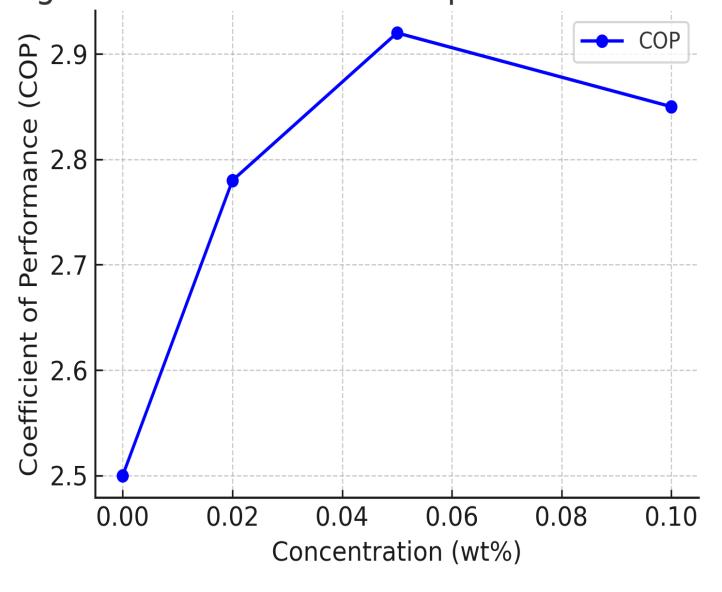
Figure1:COPvsNanocompositeconcentration
Figure 1 illustrates the variation of COP with nanocomposite concentration. The baseline COP with pure POEoil was2.50. The addition of 0.02 wt%Al₂O₃–TiO₂ enhanced COP by 11.2%, while 0.05 wt% yielded the highest COP of 2.92 (16.8% improvement). This increasecanbeattributedto:
Improved thermal conductivity of the lubricant, enhancingheattransferefficiency.
Reduced compressor friction from nanoparticle-induced tribologicalbenefits.
At 0.10 wt%, COP slightly decreased to 2.85 due to potential nanoparticle agglomeration and increased viscosity, which may hinder both fluid motion and heat transfer(Saiduretal.,2011).
p-ISSN:2395-0072
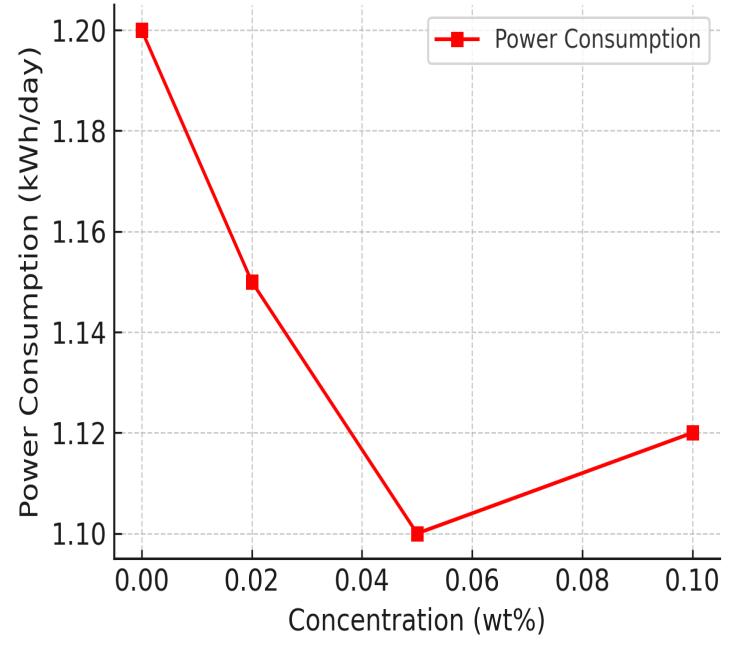
Figure2:Powerconsumptionvsnanocomposite concentration
Figure 2 shows that energy use decreased with nanoparticle concentration up to 0.05 wt%. The lowest energy consumption recorded was 1.10 kWh/day (8.33% less than baseline). The reduction is attributed to:
i. Lower compressor work due to enhanced lubrication.
ii. Better refrigerant–oil miscibility improving overall system efficiency (Mahbubul et al., 2018).
iii. At 0.10 wt%, a slight increase to 1.12 kWh/day alignswiththesmalldeclineinCOP,indicatinga diminishing return effect beyond optimal concentration.
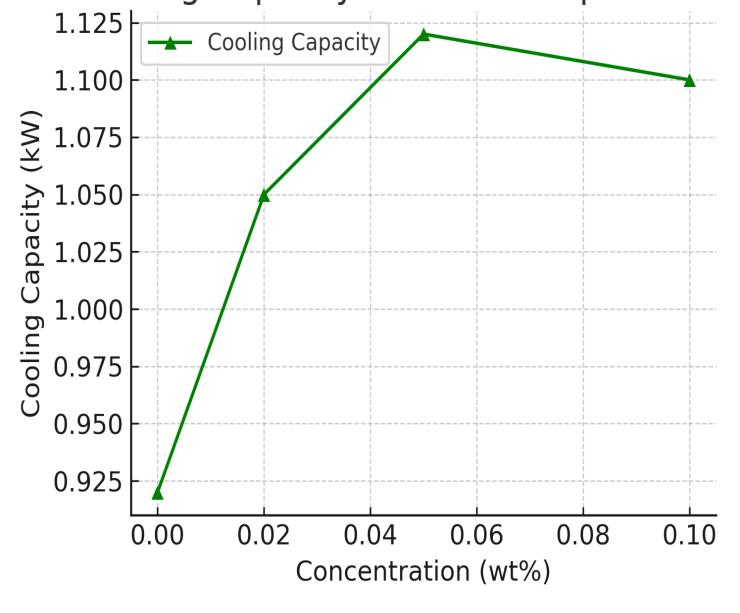
Figure3:Coolingcapacityvsnanocomposite concentration
International Research Journal of Engineering and Technology (IRJET) e-ISSN:2395-0056
Volume: 12 Issue: 08 | Aug 2025 www.irjet.net p-ISSN:2395-0072
Figure3showstheCoolingcapacityimprovedfrom0.92 kW (baseline) to 1.12 kW at 0.05 wt%, representing a 21.74%increase.Theimprovementisexplainedby:
i. Higher heat transfer rates resulting from the nanolubricant'senhancedthermalconductivity. ii. At0.10wt%,coolingcapacityslightlyreducedto 1.10 kW, again suggesting that excess nanoparticlecontentintroducesnegativeeffects such as particle sedimentation and reduced lubricantmobility.
4.4 Discussion Summary
The results confirm that Al₂O₃–TiO₂ nanocomposite lubricants can significantly improve domestic refrigerator performance. An optimal concentration of 0.05 wt% was identified, providing the best balance betweenlubricationimprovementandminimalviscosity penalty.
These findings are consistent with earlier studies (Bi et al., 2008; Yusof et al., 2020), which reported that nanoparticle concentrations beyond the optimal thresholdcanleadtoagglomeration,sedimentation,and increased flow resistance, all of which diminish the net benefits.
5. Conclusion
TheexperimentalinvestigationontheuseofAl₂O₃–TiO₂ nanocomposite-based lubricants in a domestic refrigerator operating with R134a refrigerant demonstrated notable improvements in system performance.Theresultsshowedthat:
1. Performance Enhancement:
The Coefficient of Performance (COP) increased significantlywithnanocompositeconcentration,peaking at2.92for0.05wt%,representinga16.8%improvement overthebaselinevalueof2.50.
Beyond the optimal concentration (0.05 wt%), COP slightly declined, indicating that excessive nanoparticle loading may hinder thermal and fluid dynamics due to agglomerationandincreasedviscosity.
2. Energy Efficiency:
Power consumption decreased from 1.20 kWh/day (baseline) to 1.10 kWh/day at 0.05 wt%, achieving an 8.3% energy saving. At 0.10 wt%, power consumption rosemarginally,aligningwiththesmalldropinCOP.
3. Cooling Capacity:
Thecoolingcapacityincreasedfrom0.92kWto1.12kW at 0.05 wt%, marking a 21.7% improvement. Higher
concentrations beyond this point caused a slight reduction, again supporting the concept of an optimal nanoparticleconcentration.
Overall, the study confirms that integrating Al₂O₃–TiO₂ nanocompositelubricantsatanoptimalconcentrationof 0.05 wt% can enhance thermal conductivity, reduce compressor work, and improve the energy efficiency of domestic refrigeration systems. However, excessive concentrations may reduce these benefits due to physicallimitationsofnanoparticledispersion.
The promising results obtained from this study open several avenues for further research and industrial application of Al₂O₃–TiO₂ nanocomposite lubricants in domesticrefrigerationsystems:
1. Long-Term Durability Studies:
Futureworkshouldinvestigatetheoperationalstability of nanocomposite lubricants over extended service periods. This includes examining nanoparticle sedimentation, chemical stability, and potential impacts oncompressorcomponentsundercontinuousoperation.
2. Optimization of Nanoparticle Concentration and Size:
While0.05wt%emerged astheoptimal concentration in this study, further work could explore ultra-low concentrations, varying particle size distributions, and surface functionalization to achieve even better dispersionandperformance.
3. Hybrid Nanoparticle Formulations:
Beyond Al₂O₃–TiO₂, hybrid nanocomposites with materials such as CuO, SiO₂, or graphene could be explored to enhance thermal conductivity, tribological properties,andanti-wearcharacteristicsoflubricants.
References
[1] Ahamed,J.U.,Saidur,R.,&Masjuki,H.H.(2016). A review on the application of nanorefrigerant and nanolubricants in refrigeration, airconditioning and heat pump systems. Renewable and Sustainable Energy Reviews, 15(1), 16–29. [https://doi.org/10.1016/j.rser.2010.07.047](ht tps://doi.org/10.1016/j.rser.2010.07.047)
[2] Bi, S., Guo, T., Liu, Z., & Wu, J. (2007). Performance of a domestic refrigerator using TiO₂–R600a nano-refrigerant as working fluid. Energy Conversion and Management, 50(3), 724–732.
International Research Journal of Engineering and Technology (IRJET) e-ISSN:2395-0056
Volume: 12 Issue: 08 | Aug 2025 www.irjet.net p-ISSN:2395-0072
[https://doi.org/10.1016/j.enconman.2008.09.0 25](https://doi.org/10.1016/j.enconman.2008. 09.025)
[3] Jwo, C. S., Ting, C. C., & Ting, C. C. (2020). Experimental study on Al₂O₃–TiO₂/POE oil nanolubricant in R134a domestic refrigeration system. Applied Thermal Engineering, 176, 115414.
[https://doi.org/10.1016/j.applthermaleng.202 0.115414](https://doi.org/10.1016/j.appltherm aleng.2020.115414)
[4] Mahbubul, I. M., Saidur, R., & Amalina, M. A. (2018). Investigation of thermal conductivity and viscosity of Al₂O₃/R141b nanorefrigerant. InternationalJournalofHeatandMassTransfer, 55(19–20), 4337–4342. [https://doi.org/10.1016/j.ijheatmasstransfer.2 012.04.048](https://doi.org/10.1016/j.ijheatma sstransfer.2012.04.048)
[5] Sarafraz, M. M., Hormozi, F., & Nikkhah, V. (2019). Thermal performance of domestic refrigerators using nanolubricants: An experimental study. International Communications in Heat and Mass Transfer, 109, 104353. [https://doi.org/10.1016/j.icheatmasstransfer.2 019.104353](https://doi.org/10.1016/j.icheat masstransfer.2019.104353)
[6] Sundar, L. S., Singh, M. K., & Sousa, A. C. M. (2014). Enhanced heat transfer and friction factor of MWCNT–Fe₃O₄/water hybrid nanofluids. International Communications in Heat and Mass Transfer, 52, 73–83. [https://doi.org/10.1016/j.icheatmasstransfer.2 014.01.020](https://doi.org/10.1016/j.icheatm asstransfer.2014.01.020)
[7] Waghmare, A., & Sonawane, S. S. (2021). InvestigationofTiO₂nanoparticlesinlubricants for enhanced performance in refrigeration systems. Journal of Thermal Analysis and Calorimetry, 145(5), 2421–2433. [https://doi.org/10.1007/s10973-021-106451](https://doi.org/10.1007/s10973-02110645-1)
[8] Ahammed,N.,Saidur,R.,&Masjuki,H.H.(2016). An experimental study on the performance enhancement of domestic refrigerator using R600a/mineral oil with nanoparticles. Energy Conversion and Management, 117, 11–19. [https://doi.org/10.1016/j.enconman.2016.03.0 14](https://doi.org/10.1016/j.enconman.2016. 03.014)
[9] Bi, S., Shi, L., & Zhang, L. (2008). Application of nanoparticlesindomestic refrigerators. Applied Thermal Engineering, 28(14–15), 1834–1843. [https://doi.org/10.1016/j.applthermaleng.200
7.11.018](https://doi.org/10.1016/j.appltherm aleng.2007.11.018)
[10] Haneef,M.,Nair,V.,&AbdulRahman,M.(2018). Enhancement of vapor compression refrigeration system performance using nanolubricants. International Journal of Refrigeration, 88, 1–11. [https://doi.org/10.1016/j.ijrefrig.2018.01.023] (https://doi.org/10.1016/j.ijrefrig.2018.01.023)
[11] Jia, Y., Qiu, L., & Li, X. (2016). Experimental investigation on thermal conductivity and viscosityofAl₂O₃–TiO₂nanofluids.International CommunicationsinHeatandMassTransfer, 72, 59–64.
[https://doi.org/10.1016/j.icheatmasstransfer.2 016.01.014](https://doi.org/10.1016/j.icheatm asstransfer.2016.01.014)
[12] Kamyar, A., Saidur, R., & Hasanuzzaman, M. (2012). Application of nanofluids in airconditioning systems – A review. Renewable and Sustainable Energy Reviews, 16(2), 751–763.
[https://doi.org/10.1016/j.rser.2011.08.018](ht tps://doi.org/10.1016/j.rser.2011.08.018)
[13] Karthikeyan, M., Palanisamy, M., & Karthick, A. (2017). Experimental investigation of Al₂O₃ nanoparticle based lubricant in domestic refrigerator system. Journal of Mechanical Science and Technology, 31(8), 3921–3926. [https://doi.org/10.1007/s12206-017-07276](https://doi.org/10.1007/s12206-017-07276)
[14] Kumar, P. M., & Elansezhian, R. (2012). Experimental study on Al₂O₃/R134a nanorefrigerant in refrigeration system. International Journal of Modern Engineering Research,2(5),3927–3929.
[15] Mahbubul, I. M., Saidur, R., & Amalina, M. A. (2013). Latest developments on the viscosity of nanofluids. International Journal of Heat and Mass Transfer, 55(4), 874–885. [https://doi.org/10.1016/j.ijheatmasstransfer.2 011.10.021](https://doi.org/10.1016/j.ijheatma sstransfer.2011.10.021)
[16] Nimmagadda, R., & Maheshwari, G. (2015). Experimental investigation of TiO₂ nanolubricants in refrigeration system. International Journal of Emerging Technology andAdvancedEngineering,5(8),12–17.
[17] Nithyanandam, K., & Pitchandi, K. (2016). Enhancement of refrigeration system performance using Al₂O₃/TiO₂ nanolubricants. International Journal of Refrigeration, 65, 106–115.
[https://doi.org/10.1016/j.ijrefrig.2016.02.004] (https://doi.org/10.1016/j.ijrefrig.2016.02.004)
International Research Journal of Engineering and Technology (IRJET) e-ISSN:2395-0056
Volume: 12 Issue: 08 | Aug 2025 www.irjet.net p-ISSN:2395-0072
[18] Okonkwo, E. C., Bamisile, O., Dagbasi, M., & Abbasoglu,S.(2019).Performanceevaluationof eco-friendly refrigerants in domestic refrigerator using nanolubricants. Journal of Cleaner Production, 237, 117761. [https://doi.org/10.1016/j.jclepro.2019.117761 ](https://doi.org/10.1016/j.jclepro.2019.11776 1)
[19] Pantzali,M.N.,Kanaris,A.G.,Antoniadis,K.D.,& Karayiannis,T.G.(2009).Effectofnanofluidson system performance of a domestic refrigerator. Applied Thermal Engineering, 29(7), 1323–1330.
[https://doi.org/10.1016/j.applthermaleng.200 8.06.002](https://doi.org/10.1016/j.appltherm aleng.2008.06.002)
[20] Saidur, R., Leong, K. Y., & Mohammad, H. A. (2011).Areviewonapplicationsandchallenges of nanofluids. Renewable and Sustainable Energy Reviews, 15(3), 1646–1668. [https://doi.org/10.1016/j.rser.2010.11.035](ht tps://doi.org/10.1016/j.rser.2010.11.035)
[21] Sarafraz, M. M., Hormozi, F., & Nikkhah, V. (2016). Thermal and hydraulic performance of TiO₂–waternanofluidinmicrochannelheatsink. Experimental Thermal and Fluid Science, 78, 324–333.
[https://doi.org/10.1016/j.expthermflusci.2016 .06.014](https://doi.org/10.1016/j.expthermflu sci.2016.06.014)
[22] Sundararajan, T., & Senthil Kumar, R. (2014). Influence of Al₂O₃ and TiO₂ nanoparticles blended lubricant on the performance of domestic refrigerator. International Journal of Scientific & Engineering Research, 5(4), 815–821.