
International Research Journal of Engineering and Technology (IRJET) e-ISSN: 2395-0056
Volume: 12 Issue: 10 | Oct 2025 www.irjet.net p-ISSN: 2395-0072
International Research Journal of Engineering and Technology (IRJET) e-ISSN: 2395-0056
Volume: 12 Issue: 10 | Oct 2025 www.irjet.net p-ISSN: 2395-0072
N.V. Narasimha Rao1, N. Alagappan2, CH V K N S N Moorthy3, Markndeyulu Vuggirala4
1,2Department of Mechanical Engineering, Annamalai University, 608002, Tamil Nadu, India
3Department of Mechanical Engineering Vasavi College of Engineering, Ibrahim Bagh 500031, Telangana, India.
5Department of Mechanical Engineering, St. Ann’s College of Engineering and Technology, Chirala, 523187, Andhra Pradesh, India ***
Abstract – The present study investigates the performance enhancement of a solar water heater integrated with a beeswax-based Phase Change Material (PCM) at tilt angles of 15° and 30°. Experiments were carried out at three different flow rates 60 kg/hr, 90 kg/hr, and 120 kg/hr to evaluate both hourly and overall thermal efficiencies. The system incorporating PCM (WPCM) demonstrated superiorefficiency compared to the system without PCM (WOPCM) under all test conditions. The maximum efficiencies achieved for the WPCM system were approximately 20.56%, 25.11%, and 29.90% at flow rates of 60 kg/hr, 90 kg/hr, and 120 kg/hr, respectively, while the corresponding values for the WOPCM system were around 17.67%, 22.32%, and 26.17%. The observed enhancement in efficiency is attributed to the PCM’s capacity to absorb excess thermal energy during peak solar radiation periods and release it gradually during the evening, thereby maintaining stable thermal performance. These findings confirm that integrating beeswax-based PCM significantly improves overall energy utilization and extends the effective operating duration of the solar water heater.
Key Words: Solar water heater, WBPCM, WOBPCM, Bees wax,Coppertubes,Absorberplate,Thermocouples.
In line with the rapid pace of development and changing lifestyle patterns, energy consumption in Indonesia has continuedtorise.Thisgrowthhasoccurredacrossnearlyall sectors, including industry, transportation, commerce, households, power generation, and others. Between 2003 and2013,thecountry’stotalnationalenergyconsumption increasedatanaverageannualrateof4.1%,risingfrom117 million TOE in 2003 to 174 million TOE in 2013 [1]. The commercial sector includes trade, hotels, restaurants, finance, government institutions, schools, hospitals, communicationservices,andother relatedactivities.Data from 2004 to 2011 indicate that this sector grew at an averagerateof8%peryear.However,thisgrowthdidnot directlycorrespondtotheincreaseinenergyconsumption, whichroseatasloweraveragerateof4%peryearduring thesameperiod.In2014,thecommercialsectorconsumed approximately5.22millionTOE,accountingforabout3%of thetotalfinalenergyconsumption.AccordingtotheNational
EnergyConservationMasterPlan,thissectorhasanenergysavingpotentialrangingfrom10%to30%.Reducingenergy consumption and its associated impacts can be achieved through several strategies, such as using low-carbon buildingmaterials,enhancinginsulation,installingenergyefficient lighting, integrating renewable technologies, employing intelligent control systems, and utilizing lowcarbon fuels. The integration of renewable energy within building components should be designed to ensure both reliable performance and cost-effective energy savings. BuildingIntegratedPhotovoltaic(BIPV)systemsrepresent one such approach, where photovoltaic modules are incorporatedintothebuildingenvelopesuchastheroofor façade. By functioning simultaneously as a structural elementandapowergenerator,BIPVsystemshelpreduce materialandelectricitycosts,lowerfossilfueldependence andgreenhousegasemissions,andenhancethearchitectural aestheticsofthebuilding[2].However,BIPVsystemsfacea significantchallengerelatedtotemperaturerise,whichleads to reduced electrical efficiency and overheating. This efficiencylossprimarilyoccursduetothedeclineinopencircuit voltage (Voc), which possesses a negative temperaturecoefficient.Atpresent,onlyabout15–20%of the solar energy incident on a photovoltaic (PV) panel is converted into electricity, while the remaining energy is converted into heat. This accumulated heat can raise the operatingtemperatureofthePVmoduletoashighas80°C, resulting in a decrease in conversion efficiency of approximately 0.4–0.65% for each degree of temperature increase[3].Consequently,manyresearchersareexploring waystominimizetheadverseeffectsofhightemperatures onPVconversion efficiencybyeffectivelydissipatingheat fromthemodulesurfaces.Thegoal istomaintain optimal performance and ensure the system meets expected efficiencylevels.Mostofthesestudieshaveconcentratedon variouscoolingapproaches,includingnaturalorforcedair circulation,heatpipesystems,andhydraulicorrefrigerantbasedcoolingmethods[4-7].
Emphasizes on the thermal properties of PCMs, techniquesofheattransferaugmentation,andapplications insolarwaterheatingsystems,allofwhichcontributetohot water requirements [8]. Studied the TES employing solid liquidphasetransitionwasconducted,focusingonpossible
International Research Journal of Engineering and Technology (IRJET) e-ISSN: 2395-0056
Volume: 12 Issue: 10 | Oct 2025 www.irjet.net p-ISSN: 2395-0072
materials,thermophysicalcharacteristics,heattransfer,and applications.CommercialPCMswerealsofeatured.Different methodsfordeterminingthermalpropertiesarecovered,as well as issues with long-term material stability and encapsulation[9].Inorganicphasechangematerials(PCMs) haveathermalconductivityof0.3-1W/mkandsignificant latentheatacrossaspecifiedtemperaturerange.However, organicPCMs,despitebeingthepreferredchoiceforthermal energystorage(TES)duetotheirlowvaporpressure,high energy storagecapacity,chemical stability,self-nucleating behaviour, and commercial availability, have significant drawbacks such as significant supercooling and corrosive properties [10,11]. Biological PCMs are the carbon-based fuel variant, with price disparities and sociopolitical implications.Becauseofthesefactors,motivationmustbe transferred from commercial biological PCMs to auxiliary bio-basedPCM(BPCM)[12].BiologicalPCMsaresuitedfor TESduetotheirsmallvapourpressure,substantialenergy storage capacity, chemical durability, tendency to selfnucleate,andeconomicalaffordability.BiologicalPCMs,on the other hand, are derivatives of fossil fuels with price differencesandgeopoliticalimplications.Becauseofthese factors, there is an urgent need to shift motivation away fromcommercialorganicPCMsandtoward(BPCMs).Asa promising material forTES, BPCMscompositeshave been concerned with energy storage since BPCMs have certain unique qualities such as less polluting, excellent energy storage,highlystable,littlevolumechange,andeco-friendly [13-16].Phasechangematerials(PCMs)arematerialshaving thecapacityforlatentheatthermalenergystorage(LHTES). TheycanbeemployedascreativewaystoTESandsatisfying theworld'senergyneeds[17]. Solarthermalenergysystems
absorb sunlight and convert it into heat, which is then transferredtoafluidforusage.ManySolarthermalenergy systems additionally have a heat storage system, which mightbesensibleorlatentheat[18].comparedtheduration intervalsbetweenPCMandstandardsamplesatspecifictime increments. The approach known as the "heat latency technique" provides accurate, temperature-dependent thermal data unique to PCMs. This method delivers comprehensive information needed to construct an enthalpy–temperature curve, essential for PCM characterization [19]. Studied the phase change materials andtheirapplicationsinsolarthermalenergystorage[20].
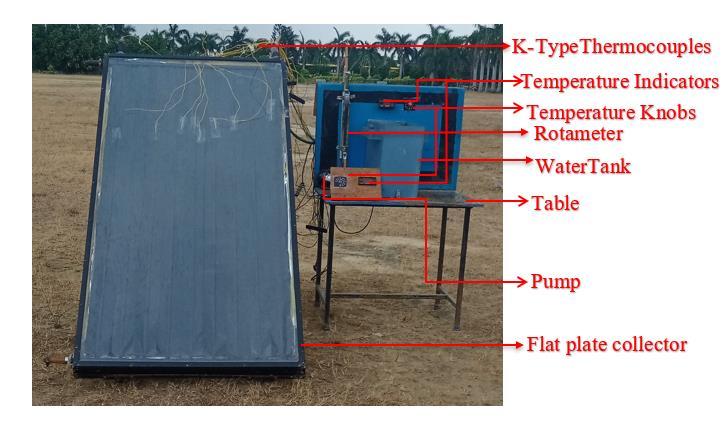
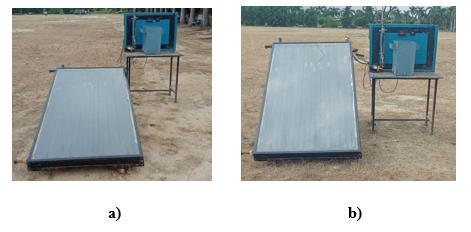
Theexperimentisdesigned totesta flatplatesolarwater heaterthatincorporatesbeeswaxasaphasechangematerial (PCM) and nano-enhanced components to improve heat storageandtransfer.Thesetupincludesawatertank,pump, and rotameter, which together control and measure the waterflow throughthe system.Byadjusting the flow rate (60,90,and120kg/hr)andthetiltangleofthecollector(150 and 300), the experiment can study how these variables affecttheheater’sperformance.Coppertubeswithfinsare usedasthemainchannelsforwaterflow.Thefinsandthe blackpaintincreaseheatabsorptionfromtheabsorberplate. Heatfromthesunwarmsthewaterasitflowsthroughthe tubes.BeeswaxPCM isinstalledundertheabsorberplate. Temperature measurements are taken at multiple points usingthermocouples:atthewaterinletandoutlet,alongthe coppertubes,theabsorberplate,theglasscover,theairgap, thePCM,andambientair.
International Research Journal of Engineering and Technology (IRJET) e-ISSN: 2395-0056
Volume: 12 Issue: 10 | Oct 2025 www.irjet.net p-ISSN: 2395-0072
3.1 Efficiency Evaluation of Solar WaterHeaters with out and with Beeswax-Based Phase Change Materialat 150Tilt Angle:
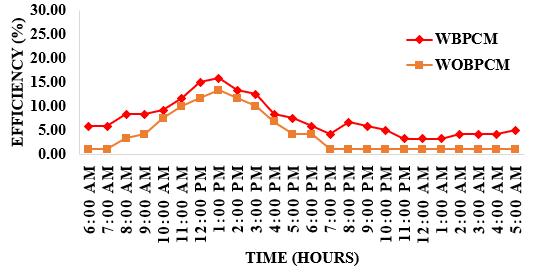
Chart-1: EfficiencyCurveata150 TiltAnglewithaFlowRate60 kg/hr
ThegraphChart-1 illustratesthethevariationinefficiency (%)withrespecttotimefor60Kg/hrataninclinationangle of 450 of a solar water heating system, comparing two conditionsWithBeeswaxPhaseChangematerial(WOB)and Without Bees wax Phase Change Material (WOPCM). The readingsaretakenfrom6:00AMto5:00AMthenextday, representing a full 24-hour performance cycle. Morning (6:00 AM–11:00 AM): WBPCM shows slightly higher efficiencythanWOBPCMbecausePCMstartsabsorbingheat early. Noon (12:00–1:00 PM): Both systems reach peak efficiency;WBPCMisslightlyhigher.Afternoon&Evening (2:00PM–8:00PM):Efficiencydropsforbothsystems,but WBPCMmaintainsabetterlevelduetoPCMheatretention. Night(9:00PM–5:00AM):WBPCMmaintainsefficiency(~4–
5%), while WOBPCM drops to almost 1%, showing the energy storage advantage of PCM. With Bees wax Phase changematerial(WBPCM)efficiencystartsaround5–6%at 6:00 AM, increases sharply during the morning as solar radiationincreases,peakingaround12:00–1:00PM(~15%). Efficiency then gradually decreases in the afternoon but remainshigherthantheWOBPCMsystemintheeveningand night due to the latent heat storage effect of the PCM. Maintainssomeefficiencyevenaftersunset(e.g.,1:00–5:00 AM),becausethePCMreleasesstoredheat.WithoutBees waxPhasechangematerial(WOBPCM)Efficiencyriseswith sunlight, peaking around 12:00–1:00 PM (~13%). After sunset,efficiencydropssharplyandstaysalmostnegligible (~1%)duringthenight.NoPCMmeansnothermalenergy
International Research Journal of Engineering and Technology (IRJET) e-ISSN: 2395-0056
Volume: 12 Issue: 10 | Oct 2025 www.irjet.net p-ISSN: 2395-0072
storage,sothesystemcannotcontinuereleasingheatafter solarinputends.BeesWaxPCMtoaflatplatesolarcollector enhancesthermalefficiency,especiallyduringlateafternoon
andnighttime,bystoringsolarenergyduringthedayand releasingitgradually.
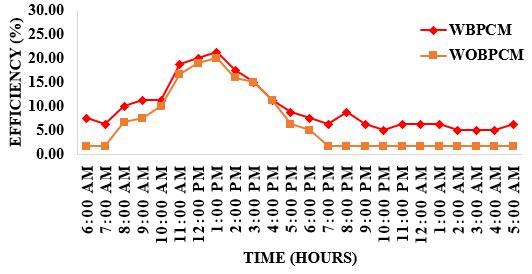
Chart-2: EfficiencyCurveata150 TiltAnglewithaFlowRate90 kg/hr
ThegraphChart-2 showsthevariationofefficiency(%)with time(hours)foraFlatPlateSolarCollector(FPSC)system testedwithBeesWaxPhaseChangeMaterial(WBPCM)and withoutBeesWaxPhaseChangeMaterial(WOBPCM).Early Morning(6:00AM–8:00AM):TheWBPCMsystemexhibits a slightly higher efficiency, as the beeswax PCM begins absorbingandstoringheatevenatlowertemperatures.MidMorningtoNoon(9:00AM–12:00PM):TheWBPCMsystem consistently outperforms the WOBPCM one due to the additionalthermalstoragecapabilityofbeeswaxPCM,which capturesexcessheat.Afternoon(12:00PM–2:00PM):The maximumefficiencyisobservedaround12:00PM–1:00PM, withWBPCMreachingaround21%,whileWOBPCMpeaks
near18%.Thisindicatesenhancedheatretentionandbetter energyutilizationwithPCM.Evening(3:00PM–6:00PM): Efficiencystartstodeclineassolarradiationdecreases.The WBPCM system maintains higher efficiency for a longer duration because the PCM releases stored heat gradually, extending useful operation time. Night to Early Morning (7:00PM–5:00AM):EfficiencyofWOBPCMdropsnearlyto zero.WBPCMmaintainsasmallresidualefficiencyduetothe releaseofstoredheatfromthePCM,showingitsadvantage in heat retention. This improvement is due to the PCM’s abilitytostoreheatduringpeaksunlightandreleaseitwhen solarradiationdecreases,resultinginstableandextended performanceofthesolarcollector.
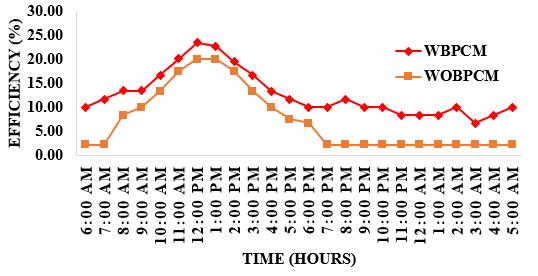
Chart-3: EfficiencyCurveata150 TiltAnglewithaFlowRate120 kg/hr
International Research Journal of Engineering and Technology (IRJET) e-ISSN: 2395-0056
Volume: 12 Issue: 10 | Oct 2025 www.irjet.net p-ISSN: 2395-0072
ThegraphChart-3 illustratesthevariationofefficiency(%) with time (hours) for a Flat Plate Solar Collector (FPSC) system tested with Bees Wax Phase Change Material (WBPCM) and without Bees Wax Phase Change Material (WOBPCM). Early Morning (6:00 AM – 8:00 AM): The WBPCM system shows slightly higher efficiency, as the beeswaxPCMbeginstoabsorbandstoresolarenergyeven atlowertemperatures.MorningtoNoon(9:00AM–12:00 PM): Solar intensity increases, leading to a rapid rise in efficiency for both systems. The WBPCM system reaches higher efficiency levels compared to WOBPCM, due to enhancedheatabsorptionandthermalstorageinthePCM. NoontoEarlyAfternoon(12:00PM–2:00PM):TheWBPCM systempeaksataround22%efficiency,whiletheWOBPCM systemreachesaround18%.ThebeeswaxPCMeffectively
storesexcessheat,preventingoverheatingandmaintaining stableperformance.LateAfternoon(3:00PM–6:00PM):As solarradiationdecreases,efficiencyforbothsystemsdecline. TheWBPCMsystemmaintainshigherefficiencyforalonger period since the PCM releases stored heat gradually, extending the useful heating duration. Evening to Early Morning (7:00 PM – 5:00 AM): The WOBPCM system efficiency drops nearly to zero after sunset, as it lacks thermalstoragecapability.TheWBPCMsystemcontinuesto showasmallbutconsistentefficiencylevel,attributedtothe releaseofstoredheatfromthephasechangematerialduring discharge.ThePCMenhancesthecollector’sperformanceby storing heat during peak sunlight hours and releasing it during low solar radiation periods, ensuring extended operationandimprovedenergyutilization.
3.2 Efficiency Evaluation of Solar WaterHeaters with out and with Beeswax-Based Phase Change Materialat 300Tilt Angle:
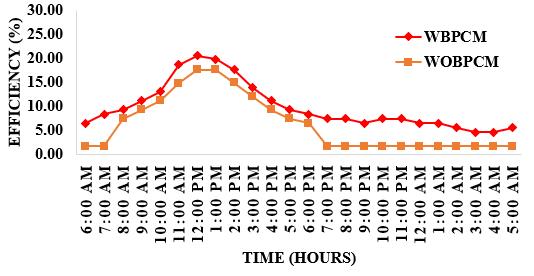
Chart-4: EfficiencyCurveata300 TiltAnglewithaFlowRate60 kg/hr
ThegraphChart-4 representsthevariationofefficiency(%) with time (hours) for a Flat Plate Solar Collector (FPSC) system tested with Bees Wax Phase Change Material (WBPCM) and without Bees Wax Phase Change Material (WOBPCM).EarlyMorning(6:00AM–8:00AM):Atsunrise, both systems show low efficiency due to minimal solar radiation.TheWBPCMsystembeginsabsorbingheatearlier andexhibitsslightlyhigherefficiencybecausethebeeswax PCMstoresheatevenatlowtemperatures.MorningtoNoon (9:00 AM – 12:00 PM): Solar intensity increases steadily, resultinginasharpriseinefficiencyforbothsystems.The WBPCMsystemachieveshigherefficiencythantheWOBPCM system,asthePCMabsorbsandstorespartoftheincoming
solarenergy,preventingheatloss.NoontoAfternoon(12:00 PM – 2:00 PM): Both systems reach their maximum efficiencyaround12:00PM–1:00PM.TheWBPCMsystem peaksnear20–21%efficiency,whiletheWOBPCMsystem reachesaround16–17%.ThestoredheatinthePCMhelps maintain stable operation during peak sunlight. Evening (3:00 PM – 6:00 PM): The WBPCM system retains higher efficiency because it releases stored heat gradually, sustaining useful output after solar intensity drops. The WOBPCM system efficiency falls more rapidly due to the absenceofheatstorage. NighttoEarlyMorning(7:00PM–5:00AM):TheWOBPCMsystemefficiencyapproacheszero aftersunset.
International Research Journal of Engineering and Technology (IRJET) e-ISSN: 2395-0056
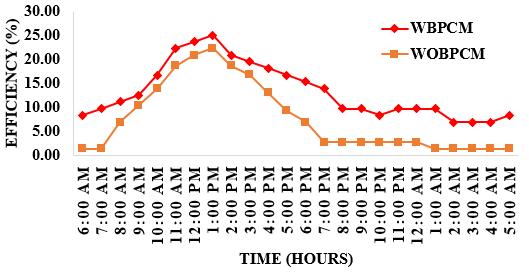
Chart-5: EfficiencyCurveata300 TiltAnglewithaFlowRate90 kg/hr
The graph Chart-5 shows how efficiency (%) varies with time (hours) for two different systems WBPCM and WOBPCMovera24-hourperiod.Morning(6:00AM–9:00 AM): Both systems start with low efficiency. WBPCM efficiency rises earlier and faster than WOBPCM. Midday (10:00 AM – 1:00 PM): Efficiency peaks for both systems around 12:00 PM. WBPCM reaches around 25%, while WOBPCMpeaksaround20–22%.ThisindicatesthatWBPCM performs better during peak solar hours. Afternoon (2:00 PM – 6:00 PM): Efficiency declines gradually for both.
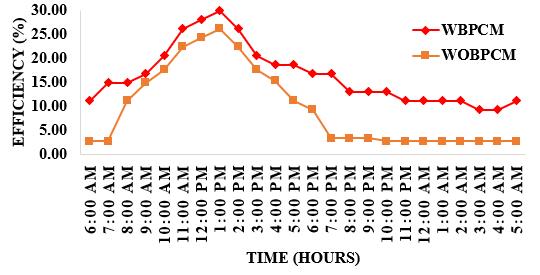
Chart-6: EfficiencyCurveata300 TiltAnglewithaFlowRate60 kg/hr
ThegraphChart-6illustratesthevariationofefficiency(%) with time (hours) for two systems WBPCM (With Phase Change Material) and WOBPCM (Without Phase Change Material)overa24-hourperiod.EarlyMorning(6:00 AM8:00 AM) Both systems start at low efficiency. WBPCM beginsaround12%,whileWOBPCMstartsnear3%.Morning toNoon(8:00AM-12:00PM)Efficiencyincreasesrapidlyfor
WBPCMmaintainshigherefficiencycomparedtoWOBPCM. EveningtoEarlyMorning(7:00PM –5:00AM):Efficiency dropssignificantly.WBPCMremainsslightlymoreefficient even during night hours, while WOBPCM efficiency nears zero. WBPCM (With Phase Change Material) shows consistentlyhigherefficiencythroughouttheday.PCMhelps storethermalenergyduringpeakhoursandreleaseitlater, maintainingefficiencylonger.WOBPCM(WithoutPCM)loses efficiency quickly once solar input decreases. No thermal storagecapability.
both. WBPCM peaks around 28% at 12:00 PM. WOBPCM peaksaround22%atthesametime.Afternoon(1:00PMto 6:00PM) WBPCM maintains higher values (between 15–20%) compared to WOBPCM (5–15%). Evening to early morning (7:00 PM-5:00 AM) WBPCM sustains a small efficiencylevel(~10–12%) duetothermalenergystorage whileWOBPCMefficiencyremainsnearlyconstantatavery
Volume: 12 Issue: 10 | Oct 2025 www.irjet.net p-ISSN: 2395-0072 © 2025, IRJET | Impact Factor value: 8.315 | ISO 9001:2008
International Research Journal of Engineering and Technology (IRJET) e-ISSN: 2395-0056
Volume: 12 Issue: 10 | Oct 2025 www.irjet.net p-ISSN: 2395-0072
low level (~3–4%). WBPCM having higher efficiency throughoutthedayandmaintainsusefulperformanceafter sunset.ThisindicatesthatPCMabsorbsheatduringtheday andreleasesitlater,improvingoverallthermal regulation andperformancestability.WOBPCM Showslowerandmore fluctuating efficiency, dropping quickly once sunlight diminishes,asitlacksthermalstoragecapability
3.
Thethermalperformanceofahybrid-coatedsolarflat-plate water heater was evaluated from 6:00 a.m. to 5:00 a.m., comparing systems with and without beeswax as a phase changematerial(PCM).ThePCMwaspositionedbeneaththe absorberplatetooptimizethermalenergystorage. Beeswax PCMsignificantlyenhancedthermalefficiencycomparedto thenon-PCMsystem.Coppertubesoutperformedsteeltubes duetotheirsuperiorthermalconductivity.A30°tiltangle yielded the highest efficiencies for the beeswax PCM (WBPCM) system compared to 15° and 30° angles. The maximumefficienciesrecordedata300 tiltanglewere:120 kg/hr flow rate: WBPCM: 29.90%, Without Beeswax PCM (WOBPCM):26.17%,90kg/hrflowrate:WBPCM:25.11%, WOBPCM: 22.32% ,60 kg/hr flow rate: WBPCM: 20.56%, WOBPCM: 17.67% Efficiency. peaked around midday and declinedintheafternoonduetoreducedsolarradiation. A sharper efficiency drops after 1:00 p.m. suggested either increasedheatlossordiminishedsolargain.Systemswith beeswaxPCMmaintainedmarginallyhigherefficiencythan non-PCM setups, demonstrating the material’s ability to storeandgraduallyreleasethermalenergy.
[1]DewanEnergiNasional2014OutlookEnergiIndonesia 2014.
[2]SharmaS,TahirA,ReddyKS,andMallickTK2016Solar EnergyMaterials&SolarCellsPerformanceenhancementof a Building-Integrated Concentrating Photovoltaic system usingphasechangematerialSol.EnergyMater.Sol.Cells149 pp29–39.
[3]HasanA,McCormackSJ,HuangMJ,andNortonB2010 Evaluationofphasechangematerialsforthermalregulation enhancement of building integrated photovoltaics Sol. Energy84:9pp1601–1612
[4] S. Dubey S, G. S. Sandhu, and G. N. Tiwari, “Analytical expressionfortheelectricalefficiencyofPV/Thybridair collector,”Appl.Energy,vol.86,no.5,pp.697–705,2009.
[5]ChauhanDandAgarwalS2014DifferentCasesofHybrid PV/TAirCollector:AComparativeStudy1:3pp29–34.
[6] Tonui J K and Tripanagnostopoulos Y 2007 Air-cooled PV/T solar collectors with low-cost performance improvementsSol.Energy81:4pp498–511
[7] K. A. Moharram 2013 Enhancing the performance of photovoltaicpanelsbywatercoolingAinShamsEng.J.4:4 pp869–877
[8] M. Kenisarin, K. Mahkamov, ‘Actual problems in using phase change materials to store solar energy.’ Paper presented at the NATO Advanced Study Institute Summer School on thermal energy storage for sustainable energy consumption (TESSEC), C¸esme, Izmir, Turkey, 6–17 June (2005).
[9]A.Sharma,S.D.Sharma,D.Buddhi,Acceleratedthermal cycle test of acetamide, stearic acid and paraffin wax for solar thermal latent heat storage applications. Energy Convers.Manage.43,1923–1930(2002).
[10]C.Chen,H.Zhang,X.Gao,T.Xu,Y.Fang,andZ.Zhang, “Numericalandexperimentalinvestigationonlatentthermal energy storage system with spiral coil tube and paraffin/expanded graphite composite PCM,” Energy ConversionandManagement,vol.126,pp.889–897,2016.
[11] J.-N. Shi, M-D. Ger, Y-M. Liu, Y-C. Fan, N-T. Wen, et al. “Improvingthethermalconductivityandshape-stabilization of phase change materials using nano graphite additives,” carbon,vol.51,pp.365–372,2013.
[12]A.Abhat,“Lowtemperaturelatentheatthermalenergy storage:Heatstoragematerials,”SolarEnergy,vol.30,no.4, pp.313332,1983.
[13]Z.Jiang,A.Palacios,B.Zou,Y.Zhao,W.Deng,etal.,“A reviewonthefabricationmethodsforstructurallystabilized compositephasechangematerialsandtheirimpactsonthe propertiesofmaterials,”RenewableandSustainableEnergy Reviews,vol.159,p.112134,2022.
[14] S. Xiao, X. Hu, X. Jiang, and Q. Li, “Enhanced thermal performance of phase change materials supported by hierarchical porous carbon modified with polydopamine/nano-Agforthermalenergystorage,”Journal ofEnergyStorage,vol.49,p.104129,2022.
[15] S. Xiao, X. Hu, X. Jiang, and Q. Li, “Enhanced thermal performance of phase change materials supported by
hierarchical porous carbon modified with polydopamine/nano-Agforthermalenergystorage,”Journal ofEnergyStorage,vol.49,p.104129,2022.
[16] R. Wu, W. Gao, Y. Zhou, Z. Wang, and Q. Lin, “A novel three-dimensionalnetwork-basedstearicacid/graphitized carbon foam composite as high-performance shapestabilized phase change material for thermal energy storage,” Composites Part B: Engineering, vol. 225, p. 109318,2021.
International Research Journal of Engineering and Technology (IRJET) e-ISSN: 2395-0056
Volume: 12 Issue: 10 | Oct 2025 www.irjet.net p-ISSN: 2395-0072
[17]Subramanian,M.,Hoang,A.T.,Kalidasan,B.,Nižetić,S., Solomon, J.M., Balasubramanian, D., Subramaniyan, C., Thenmozhi,G.,Metghalchi,H.,Nguyen,X.P.,2021.Atechnical reviewoncompositephasechangematerialbasedsecondary assisted battery thermal management system for electric vehicles.J.Clean.Prod.322,129079.
[18]Sakhaei,S.,&Valipour,M.(2021).Thermalbehaviorofa flatplatesolarcollectorwithsimultaneoususeofhelically heat collecting tubes and phase change materials. SustainableEnergyTechnologiesandAssessmentsVolume 46,August2021,101279.
[19] Kravvaritis E D, Antonopoulos K A and Tzivanidis C 2011Experimental determination oftheeffective thermal capacityfunctionandotherthermalpropertiesforvarious phase change materials using the thermal delay method AppliedEnergy,88(12),4459–4469.
[20]N.V.N.Rao,N.Alagappan,CH.V.K.S.N.Moorthy(2024) Comprehension study of Phase change materials for solar thermal energy storage Recent advances in mechanical engineering volume 2 pp 273-281 https://doi.org/10.1007/978-981-97-2249-5.