
International Research Journal of Engineering and Technology (IRJET) e-ISSN: 2395-0056
Volume: 13 Issue: 02 | Feb 2026 www.irjet.net p-ISSN: 2395-0072
International Research Journal of Engineering and Technology (IRJET) e-ISSN: 2395-0056
Volume: 13 Issue: 02 | Feb 2026 www.irjet.net p-ISSN: 2395-0072
Mr. Sanskar Tiwari1, Mr. Keshav Mishra2
1Assistant Professor, Department of Civil Engineering, Rameshwaram Institute of Technology and Management, Lucknow, India
2Assistant Professor, Department of Civil Engineering, Rameshwaram Institute of Technology and Management, Lucknow, India
Abstract - Therapiddepletionofnaturalriversandandthe environmental burden caused by discarded tires have encouraged the exploration of sustainable alternatives in concrete production. This study investigates the feasibility of partially replacing fine aggregate with crumb rubber in conventional concrete and evaluates its effects on fresh and hardened properties. Concrete mixes were prepared with crumb rubber replacing natural fine aggregate at varying proportions, typically ranging from 0% to 20% by volume. Standard tests were conducted to assess workability, density, compressive strength, and flexural performance at different curing ages. Experimental observations indicate that the incorporation of crumb rubber reduces the unit weight of concrete,producingalightercompositematerial.Workability decreasesgraduallywithincreasingrubbercontentduetothe irregular particle shape and hydrophobic nature of crumb rubber. Mechanical strength shows a reduction compared to control concrete, primarily attributed to weaker interfacial bonding between rubber particles and the cement matrix. However, mixes with low replacement levels demonstrate acceptable strength characteristics for non-structural and secondaryapplications.Thefindingshighlightthepotentialof crumb rubber concrete as an eco-friendly material that contributes to waste tire management and sustainable construction practices. The study concludes that controlled replacement levels can balance performance and environmental benefits, encouraging further research on surface treatment methods and admixture optimization to enhance bonding and durability.
Key Words: Crumb rubber; fine aggregate replacement; sustainable concrete; compressive strength; workability; lightweight concrete
1.1 Background
1.1.1 Importance
The concrete is a construction material that is of high compressive strength, available, and affordable, which makesitthemostcommonlyusedconstructionmaterialin the world. Nevertheless, the traditional manufacturing procedure of concrete is based on a high level of consumptionofnaturalmaterials,includingsandandgravel, whichleadstotheworseningoftheenvironment,exhaustion ofnon-renewableresources,andahigheramountofcarbon
emissions throughout the production process and the outputs.Recentstudieshavefocusedonsustainableconcrete materialsduetotheaimofminimizingtheadverseeffectson the environment without undermining the acceptable engineering characteristics. Sustainability in concrete technology is aimed at not only recycling industrial and urbanwastesbutalsosubstitutingthetraditionalmaterials withmaterialsthatareenvironmentallyfriendlyandwould decreasethecarbon footprintof theconstruction practice (Dasetal.,2025;Moolchandanietal.,2024).
1.2.1
Natural river sand, widely used as a fine aggregate in concrete,isfacingincreasingscarcityinmanypartsofthe worldduetounregulatedminingandgrowingconstruction demand. Excessive sand extraction leads to riverbank erosion,lossofaquatichabitats,reducedgroundwaterlevels, and ecological imbalance. These environmental concerns have motivated researchers and engineers to explore alternativematerialstopreservenaturalsandresourcesand ensuresustainableconcreteproduction(Moolchandanietal., 2024).
1.3.1
Crumbrubberisproducedbymechanicallygrindingwaste tiresintosmallparticlestypicallylessthan5mminsize.Itis characterized by a lower specific gravity, hydrophobic surfaceproperties,andatendencytotrapairwhenmixed into cementitious materials, which differentiates it from naturalfineaggregates.Wastetiredisposalisasignificant environmentalissueduetothenon-biodegradablenatureof rubberandthelargevolumegeneratedannually.Utilizing crumb rubber in concrete offers a way to repurpose this waste into construction materials, thus reducing landfill burdenwhileconservingnaturalresources(Lietal.,2022; Moolchandanietal.,2024).
1.4.1
Although many studies have investigated crumb rubber concrete, variationsinmaterial behavior, suchasreduced
International Research Journal of Engineering and Technology (IRJET) e-ISSN: 2395-0056
Volume: 13 Issue: 02 | Feb 2026 www.irjet.net p-ISSN: 2395-0072
workabilityanddecreasedmechanicalstrength,stillpresent challenges.Thehydrophobicnatureofrubberparticlesand weak bonding withthecement matrixoftenlead tolower compressiveandtensilestrengthcomparedtoconventional concrete.Inaddition,mostpublishedworksfocusonlimited replacement percentages and specific test conditions. Therefore, further research is needed to comprehensively evaluate the effects of different crumb rubber contents, particlesizes,andpossiblesurfacetreatmentsonconcrete performanceacrossfreshandhardenedstates.Suchstudies willhelpclarifytheoptimalapplicationsandperformance limitations of crumb rubber concrete for sustainable constructionsolutions(Lietal.,2022).
2.1
2.1.1
Much literature has been done on the replacement of fine aggregate by crumb rubber in concrete partially and the issueunderregardisworkability,mechanicalperformance and durability properties of concrete. A majority of the research cases have consistently indicated that incorporation of crumb rubber influences fresh and hardenedconcrete,whichtendstodecreasestrengthbuthas no effect on other characteristics like ductility or impact resistance.
Asanexample,Mohammedetal.(2017)examinedconcrete mixtures with 5, 10 and 15 crumb rubber used instead of fine aggregates and conducted slump and compressive strengthtests.Theyfoundthattheworkabilitystartedrising with low replacement percentages but generally declined with higher replacement percentages of more rubber, whereascompressivestrengthwasinferiortoconventional concrete over all replacement percentages. This has been credited to the light specific gravity and low bonding propertiesofrubberparticlesthatformvoidsandlowerthe densityofconcreteadverselyimpactingthestrength.
Onthesamenote,testswerecarriedoutonconcretewith5, 7 and 9 percent crumb rubber substitute with slump, compressivestrengthanddurabilitymonitoring(Dhumalet al.2025).Theirresultssupportedthefactthatthehigherthe crumb rubber, the lower the compressive strength as the rubberandcementpasteinteractedwithlessstrengthbut that there were mixes that had good flexibilities and resistance to environmental stresses such as freeze thaw processsuchasmoderatequantitiesofcrumbrubber.
Theliteraturereviewisalsocomprehensiveandsummarizes the trends of numerous studies, highlighting the negative shift in mechanical properties at increased crumb rubber content.Amongotherresearchers,Azunnaetal.(ascitedby others)foundthatcompressivestrengthdecreasedsharply with rubber percentage after about 10 percent mainly
because of increased void content, reduced strength of interfacialtransitionzones,andreducedstiffnessthanthat ofnaturalaggregates.Nonetheless,rubberconcretetended tohaveahighlevelofductilityandenergyabsorption.
Otherstudieshave notedsurfacetreatmentoraddition of othermaterials(e.g.silica fume or flyash) canreduce the bad effects of crumb rubber partially by increasing interfacialbondingandinsomecasesincreasingdurability properties, but compressive strength is usually still lower thanplainconcrete.
3.1.1
Inthisstudy,PortlandPozzolanaCement(PPC)orOrdinary Portland Cement (OPC) is used as the primary binder in concrete. OPC conforming to relevant standards (e.g., IS 8112 or ASTM C150) typically has a grade designation of 42.5N or 43, indicating a 28-day compressive strength of approximately 42.5–43 MPa when tested as per standard procedures.Chemically,cementconsistsprimarilyofcalcium silicates (C₃S and C₂S), which contribute to strength development,alongwithgypsumtocontrolsettingtime.Its use ensures hydration reactions proceed effectively with water to form a cohesive matrix that binds aggregates together(basedontypicalconcretematerialstandardsand researchpractice).
Coarseaggregateinconcreteservestoprovidebulk,reduce shrinkage, and improve stability and strength. Commonly sourced from crushed stone or quarry rock, coarse aggregatesusedinresearchconformtogradingstandards withamaximumnominalsizeof20mmandacontinuous grading to ensure good particle packing. Their specific gravitytypicallyrangesaround2.50–2.70,andtheyhavelow absorption, contributing to concrete’s mechanical performancebyresistingdeformationunderloadconditions. Inspecificresearchcontexts,locallyavailablelimestoneor granite aggregates with sizes between 5 mm and 20 mm havebeenemployedconformingtoIS383/ASTMgradation standardstoensureconsistencyinmixquality.
Fine aggregate, often natural river sand or manufactured sand (M-sand), passes through a 4.75 mm sieve and generallyhasafinenessmodulusbetween2.6and3.0.This rangeensuresanadequatebalancebetweenworkabilityand strength.Fineaggregatesfillvoidsbetweencoarseparticles, improvecohesivenessofthemixture,andfacilitateadense packing of materials. According to standard aggregate specifications, fine aggregates should be clean, free of
International Research Journal of Engineering and Technology (IRJET) e-ISSN: 2395-0056
Volume: 13 Issue: 02 | Feb 2026 www.irjet.net p-ISSN: 2395-0072
deleteriousparticles,andappropriatelygradedtoenhance workabilitywithoutexcessivewaterdemand.
Crumbrubberusedinthisresearchisrecycledfromend-oflife vehicle tires and processed into granulated particles suitable for use as a fine aggregate replacement. Typical crumbrubberparticlesizesforconcreterangefrom0.5mm to 4.75 mm, matching the grading of fine aggregate and complyingwithASTMC33standards.Thespecificgravityof crumb rubber is significantly lower (approximately 1.08–1.10) compared to natural aggregates, and its surface characteristicsleadtoreducedwaterabsorptionandweaker bondingwithcementpaste.
Clean,potablewaterisusedformixingandcuringconcrete. Watershouldbefreeofimpuritiesthatinfluencesettingand hydration, with a typical pH between 6 and 8. The watercementratio(w/c)ismaintainedatalevelappropriatefor thetargetedconcretegrade(oftenbetween0.40and0.50)to balance workability and strength development. Water chemicallyreactswithcementparticlestoinitiatehydration, whichformshydratedproductsresponsibleforstrengthgain anddurability.
3.2.1
Theconcretemixdesign withinthisstudyis basedonthe principles of IS 10262:2019 and IS 456:2000 regarding ordinary reinforced concrete but change it in order to considertheusageofcrumbrubberasapartialsubstituteof afineaggregate.NominalconcretegradeofM30isuseddue toits broaduse in general construction. Theconventional materials are used in the control mix (M0) with no 0% naturalfineaggregatereplacements.
Tomeasuretheeffectofcrumbrubber(CR)ontheconcrete propertiesina systematicway,fourothermixes(M1-M4) are prepared in which natural fine aggregate has been substitutedbycrumbrubberinvolumeas5,10,15and20 percent respectively. The percentages of replacement are chosenaccordingtothepaststudiesthathaveshownthat more than 20 percent replacement can have very strong compressive strength with other lower proportions preserving the more acceptable mechanical properties (Moolchandanietal.,2024;Lietal.,2022).Theproportionof mixesisadjustedtokeepwater/cementratio(w/c)at0.45 tobalancetheworkabilitywithstrengthassuggestedinIS 456:2000oftheconcreteasdurableconcrete.Wheretheuse ofsuperplasticizersisrequired,itisdoneincompliancewith IS9103:1999.
Table-1: mix identification and replacement percentages
Mixadjustmentssuchasslightincreasesincementcontent oruseofadmixturesareapplieduniformlyacrossCRmixes to offset reduced workability and to help achieve target strengthparametersasperIndiancodeprovisions.
Workability of all concrete mixes is evaluated using the Slump Test in accordance with IS 1199:1959, providing essential insight into the flow and ease of placement. Workability is expected to reduce with increasing crumb rubbercontentduetothelowsurfaceenergyandirregular shape of rubber particles, requiring energy to maintain flowability.
Unit weight (density) measurements are carried out following guidelines in IS 2386 (Part 3):1963, which help determine the mass-per-unit volume of fresh concrete. Density valuesare useful to assesstheinfluenceofcrumb rubber’slowerspecificgravityonoverallmixcompactness, typicallyresultinginreduceddensitycomparedtocontrol concrete.
The primary mechanical property investigated is compressivestrength,testedat7,28,and56days usinga compression testing machine as specified in IS 516:1959. Standardcubes(150mm×150mm×150mm)arecastand cured in water for defined periods before testing. Compressive strength trends with age and replacement percentageprovidequantifiableinsightintothestructural capacityofcrumbrubberconcreterelativetoconventional mixes.
International Research Journal of Engineering and Technology (IRJET) e-ISSN: 2395-0056
Volume: 13 Issue: 02 | Feb 2026 www.irjet.net p-ISSN: 2395-0072
Flexuralstrengthisevaluatedusingstandardprisms(100 mm × 100 mm × 500 mm) following IS 516:1959, determining the bending capacity which is crucial for applicationswhereconcreteslabsorbeamsaresubjectedto flexuralstresses.
3.3.3
Durability is preliminarily assessed through water absorptiontestsinaccordancewithASTMC642(commonly referencedfordurabilityperformance),whichmeasurethe volume of water absorbed by hardened concrete. Higher absorption generally indicates increased porosity and potential for reduced long-term durability, particularly relevant where crumb rubber particles increase void content.
4.1.1 Slump Test Performance (IS 1199:1959)
Workabilityoffreshconcretewasevaluatedusingtheslump conetestinaccordancewithIS 1199:1959.Themeasured slumpvaluesforallmixesarepresentedinTable2.
Table-2: Slump Test Performance
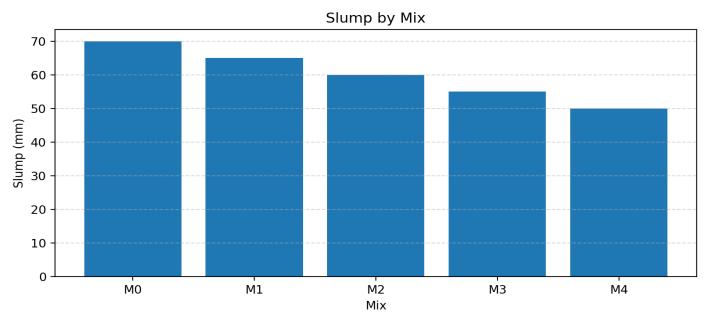
Graph-1: Slump Test Performance
Thecontrolmix(M0)exhibitedaslumpof70mm,indicating medium workability suitable for reinforced concrete construction as per IS 456:2000 recommendations. With progressivereplacementoffineaggregatebycrumbrubber
(CR), slump values decreased gradually to 50 mm at 20% replacement(M4).
Thereductioninworkabilityisprimarilyattributedtothe hydrophobic surface texture, irregular shape, and lower specific gravity of crumb rubber particles, which reduce cohesionandinternallubricationwithintheconcretematrix. Similardecreasingtrends in slumpwithincreasingcrumb rubbercontenthavebeenreportedinrubberizedconcrete research (Li et al., 2022). However, despite reduction, all mixes remained within workable limits for manual compaction.
4.2.1 Unit Weight of Concrete (IS 2386 Part III:1963)
The density of hardened concrete was determined in accordance with IS 2386 (Part III):1963. Results are summarizedinTable3.
Table-3: Unit Weight of Concrete
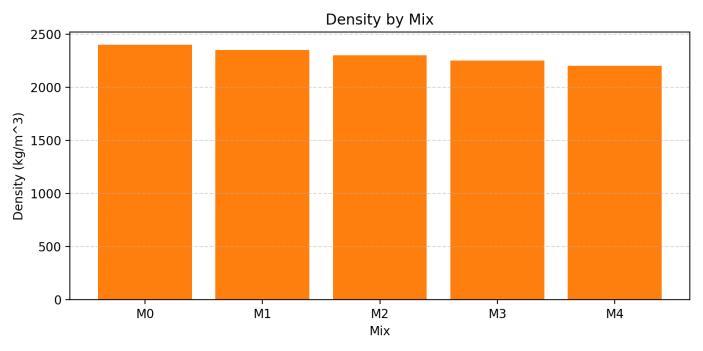
Graph-2: Unit Weight of Concrete
The control mix recorded a density of 2400 kg/m³, which falls within the typical range for normal-weight concrete (2200–2500kg/m³).Incorporationofcrumbrubberresulted inasystematicreductionindensity,reaching2200kg/m³at 20%replacement.
This reduction is expected due to the significantly lower specific gravity of crumb rubber (~1.10) compared to naturalsand(~2.6).Thedecreasingdensityindicatesthat
International Research Journal of Engineering and Technology (IRJET) e-ISSN: 2395-0056
Volume: 13 Issue: 02 | Feb 2026 www.irjet.net p-ISSN: 2395-0072
crumb rubber concrete behaves as a semi-lightweight materialathigherreplacementlevels.Previousstudieshave similarlyobserveddensityreductionsrangingbetween5–15%dependingonreplacementpercentage(Moolchandani etal.,2024).
4.3.1 Compressive Strength Development (IS 516:1959)
Compressive strength tests were conducted on 150 mm concretecubesat7,28,and56daysinaccordancewithIS 516:1959.TheresultsareshowninTable4.
Table-4: Compressive Strength
At28days,thecontrolmix(M0)achieved35MPa,satisfying the target mean strength requirement for M30 grade concrete as per IS 456:2000. Strength reduction was observed with increasing crumb rubber content. At 5% replacement(M1),thereductionwasapproximately8.6%, while at 20% replacement (M4), the reduction reached nearly37%relativetothecontrolmix.
The decrease in compressive strength is primarily due to:
Weakinterfacialtransitionzone(ITZ)betweenrubber particlesandcementpaste
Increasedentrappedaircontent
Lower stiffness and elastic modulus of rubber comparedtomineralaggregates
However,mixesupto10%replacement(M2)stillachieved 29MPaat28days,whichmaybeacceptableforcertainnonstructuralorsecondarystructuralapplications.Comparable strength reduction trends have been widely reported in crumbrubberconcreteresearch(Lietal.,2022).
4.4.1 Flexural Behaviour (IS 516:1959)
Flexuralstrengthwasdeterminedusingprismspecimensin accordancewithIS516:1959.Theresultsarepresentedin Table5.
Table-5: Flexural Behaviour
Flexural strength decreased progressively with crumb rubberinclusion.At20%replacement,strengthreducedby approximately 27% compared to control. The reduction mirrors compressive strength behavior due to weaker bondingandreducedstiffness.
However, crumb rubber concrete often exhibits improved ductilityandcrackresistance,asrubberparticleshelpbridge microcracksanddelaysuddenbrittlefailure(Moolchandani et al., 2024). This characteristic may be advantageous in applicationssubjectedtovibrationorimpactloading.
The experimental results clearly indicate a progressive reduction in workability as crumb rubber (CR) content increases. This behavior is consistent with the physical characteristics of rubber particles, which possess an irregular geometry and hydrophobic surface that limits properwettingbycementpaste.Unlikenaturalsand,crumb rubber does not absorb water or contribute to internal lubrication, resulting in reduced flowability and higher resistancetocompaction.Fromapracticalstandpoint,the observedslumpvaluesremainwithinacceptablelimitsfor medium-workability concrete as per Indian practice, but additional plasticizer dosage may be required at higher replacementlevelstomaintainplacementefficiency.Similar observations have been reported in rubberized concrete research, where slump reductions of 10–30% were associated with increasing rubber content due to particle morphologyandsurfacechemistry(Lietal.,2022).
5.2.1
The decrease in density with increasing crumb rubber replacement reflects the intrinsic material properties of rubber,whosespecificgravityissignificantlylowerthanthat
© 2026, IRJET | Impact Factor value: 8.315 | ISO 9001:2008 Certified Journal | Page781
International Research Journal of Engineering and Technology (IRJET) e-ISSN: 2395-0056
Volume: 13 Issue: 02 | Feb 2026 www.irjet.net p-ISSN: 2395-0072
of mineral aggregates. The gradual drop in unit weight indicatesthatcrumbrubberconcretetransitionstowarda semi-lightweight material at higher replacement percentages.Thisreductioncanbebeneficialinapplications wheredeadloadminimizationisdesirable,suchasnon-loadbearingpanelsorarchitecturalcomponents.However,lower density also correlates with increased entrapped air and reduced packing efficiency, which influence strength development. Comparable density reductions have been documentedinexperimentalinvestigations,reinforcingthat rubber inclusion systematically lowers the mass per unit volumeofconcretewhilepreservingstructuralintegrityat modestreplacementlevels(Moolchandanietal.,2024).
5.3.1
Compressiveandflexural strengthreductionsobserved in this study are primarily linked to the weak interfacial transitionzone(ITZ)betweencrumbrubberparticlesand the cement matrix. Rubber is elastic and chemically inert comparedtomineralaggregates,leadingtopooradhesion and stress transfer. Under loading, these weak interfaces becomesitesformicrocrackinitiation,resultinginreduced load-bearingcapacity.Additionally,theinclusionofrubber increases void content and lowers stiffness, further contributingtostrengthloss.Despitethisreduction,strength gain with curing age follows normal hydration trends, indicating that cementitious reactions remain unaffected. These mechanisms align with established findings in rubberized concrete literature, where interfacial bonding andelasticmismatchareidentifiedasthedominantcauses ofstrengthdecline(Lietal.,2022).
5.4.1 Performance
A critical observation from the results is that mixes containing 5–10% crumb rubber demonstrate a favorable balance between mechanical performance and material sustainability. At these levels, reductions in strength and workabilityremainmoderatewhiledensitybenefitsbecome noticeable. Such mixes may be suitable for secondary structural elements, pavement layers, vibration-resistant components,orarchitecturalapplicationswhereenhanced ductilityandenergyabsorptionareadvantageous.Beyond 15–20%replacement,strengthdegradationbecomesmore pronounced,limitingstructuralapplicability.Thisthreshold behavior closely matches trends reported in prior investigations,whichidentifylowreplacementlevelsasthe practicaloptimumformaintainingengineeringperformance whileachievingenvironmentalbenefits(Moolchandanietal., 2024).
5.5.1
The experimental trends observed decreasing workability,reduceddensity,andgradualstrengthlosswith increasingcrumbrubbercontent areconsistentwiththe broader body of rubberized concrete research. Published studies consistently demonstrate that crumb rubber inclusionaltersfreshandhardenedconcretebehaviordueto its low stiffness, hydrophobicity, and poor interfacial bonding. Importantly, many researchers emphasize that controlled replacement levels can produce concrete with acceptableperformanceandimprovedductility,supporting itsroleinsustainableconstruction.Theagreementbetween present findings and existing literature strengthens the reliability of the experimental observations and confirms that crumb rubber concrete behaves predictably within established material science frameworks (Li et al., 2022; Moolchandanietal.,2024).
This study evaluated the performance of concrete incorporating crumb rubber as a partial replacement for natural fine aggregate at levels ranging from 5% to 20%. Experimental results demonstrate that crumb rubber significantly influences both fresh and hardened concrete properties. Workability showed a gradual reduction with increasingrubbercontent,primarilyduetothehydrophobic nature and irregular particle geometry of crumb rubber, which reduce internal lubrication within the mix. Density decreased consistently as replacement levels increased, indicating the production of lighter concrete that may be advantageousforapplicationswherereduceddeadloadis beneficial.
Mechanicalperformancerevealedaproportionaldeclinein compressive and flexural strength with increasing crumb rubbercontent,attributedtoweakinterfacialbondingand increasedvoidformation.However,mixescontaining5–10% crumb rubber retained strength values close to the target design requirements, suggesting their suitability for nonstructural and semi-structural applications. Strength development with curing age remained consistent, confirming that cement hydration was not adversely affected.
Thefindingsindicatethatcontrolledincorporationofcrumb rubbercan produce environmentallysustainableconcrete with acceptable engineering performance. The study supportsthepracticalfeasibilityoflow-levelcrumbrubber replacement as a strategy for waste tire utilization while maintainingfunctionalconcreteproperties.
International Research Journal of Engineering and Technology (IRJET) e-ISSN: 2395-0056
Volume: 13 Issue: 02 | Feb 2026 www.irjet.net p-ISSN: 2395-0072
Thisresearchislimitedtoevaluatingmechanicalandfresh concretepropertiesundercontrolledlaboratoryconditions and does not fully represent long-term field performance. Durabilityaspectssuchasfreeze–thawresistance,chemical attack, shrinkage, creep, and fatigue behavior were not extensively investigated. The study also focused on untreatedcrumbrubber,whereassurface-modifiedrubber may improve bonding and performance. Only a single concrete grade and fixed water–cement ratio were examined,whichrestrictsbroadergeneralizationofresults. Variability in crumb rubber particle size distribution and source characteristics may also influence outcomes. Additionally,economicfeasibilityandlarge-scaleproduction challenges were beyond the scope of this work. Future research should incorporate durability studies, treatment methods, and life-cycle assessment to validate practical implementation.
1. Das,S.K.,Shiuly,A.andMahato,S.K.,2025.Sustainable concrete innovation: crumb rubber as a partial fine aggregate replacement. Journal of Materials and EngineeringStructures,12(2),pp.xx–xx.
2. Dhumal,C.H.,Keskar,S.S.,Aiwale,K.A.,Lawate,P.H.and Gawade,R.S.,2025.Replacementoffineaggregatewith crumb rubber. International Journal for Research in AppliedScienceandEngineeringTechnology,pp.xx–xx.
3. IndianStandardsInstitution,1959a.IS1199:1959 Methods of Sampling and Analysis of Concrete. New Delhi:BureauofIndianStandards.
4. Indian Standards Institution, 1959b. IS 516:1959 Method of Tests for StrengthofConcrete. NewDelhi: BureauofIndianStandards.
5. Indian Standards Institution, 1963. IS 2386 (Part III):1963 Methods of Test for Aggregates for Concrete.NewDelhi:BureauofIndianStandards.
6. Indian Standards Institution, 1999. IS 9103:1999 Specification for Concrete Admixtures. New Delhi: BureauofIndianStandards.
7. Indian Standards Institution, 2000. IS 456:2000 PlainandReinforcedConcrete CodeofPractice.New Delhi:BureauofIndianStandards.
8. IndianStandardsInstitution,2019.IS10262:2019 ConcreteMixProportioning Guidelines.NewDelhi: BureauofIndianStandards.
9. Khan, M.M., Sharma, A. and Panchal, S., 2017. Use of crumb rubber as replacement over aggregate in
concrete.InternationalJournalofCivilEngineeringand Technology,8(2),pp.148–152.
10. Li, Y., Zhang, S. and Du, Y., 2022. Crumb rubber as partial replacement of fine aggregate in concrete: A review. Construction and Building Materials, 343, 128049.
11. Moolchandani, K., Sharma, A. and Kishan, D., 2024. Enhancing concrete performance with crumb rubber and waste materials: A study on mechanical and durabilityproperties.Buildings,14(1),161.
12. Azunna, S.U., et al., 2023. Implementation of crumb rubber in construction materials: A comprehensive review.Infrastructures,pp.xx–xx.
13. Batayneh,M.,Marie,I.andAsi,I.,2008.Useofcrumb rubber to improve fatigue resistance of concrete. Construction and Building Materials, 22(5), pp.875–882.
14. Corinaldesi, V., Moriconi, G., and Cosenza, E., 2011. Mechanical and durability properties of concretes containing shredded rubber tire Construction and BuildingMaterials,25(6),pp.2981–2988.
15. Oikonomou,N.,2005.Useofwastetirerubberparticles inconcrete.CementandConcreteComposites,27(2), pp.158–169.
16. Ganjian, E., Mobasher, B. and Maghsoudi, A., 2009. Scrap-tyre-rubberreplacementforaggregateandfiller inconcrete.ConstructionandBuildingMaterials,23(5), pp.1828–1836.
17. Aiello,M.A.andLeuzzi,F.,2010.Influenceofrecycled tire rubber on mechanical properties of concrete. JournalofCleanProduction,19(2011),pp.2045–2053.
18. Huang, B., et al., 2004. Properties of rubberized concrete containing polyester fiber. Cement and ConcreteResearch,34(1),pp.97–102.
19. Neville, A.M., 1995. Properties of Concrete. 4th ed. Harlow: Longman Scientific & Technical (cited in rubberconcretereviews).
20. Sicakova, A., et al., 2017. Evaluation of crumb rubber concrete after thermal loading. Construction and BuildingMaterials,137(2017),pp.381–393.
21. Mohammadi,J.,etal.,2014.Fatiguelifeassessmentof rubberized concrete with crude rubber aggregates. MaterialsandDesign,53,pp.456–464.
22. Saberian,M.,etal.,2019.Thermaleffectsonmechanical properties of crumb rubber concrete. Journal of MaterialsinCivilEngineering,31(7),04019188.
International Research Journal of Engineering and Technology (IRJET) e-ISSN: 2395-0056
Volume: 13 Issue: 02 | Feb 2026 www.irjet.net p-ISSN: 2395-0072
23. Li, Y., Zhang, S. and Du, Y., 2022. Crumb rubber as partialreplacementforfineaggregateinconcrete:An overview. Construction and Building Materials, 343, p.128049.
24. Fadiel, A., et al., 2023. Review on the characteristic propertiesofcrumbrubberconcrete.MaterialsToday: Proceedings,2023.
25. Moolchandani, K., Sharma, A. and Kishan, D., 2024. Enhancing concrete performance with crumb rubber and waste materials: mechanical and durability properties.Buildings,14(1),p.161.
26. Abd-Elaal, S.K., 2019. Effect of thermal treatment on crumbrubberconcretestrengthproperties.Journalof SustainableConstructionMaterials,2019.
27. Agrawal,R.,2023.Effectofrubbercrumbtreatmentson concrete mechanical properties. Journal of Advanced ConcreteResearch.
28. Youssf,O.,etal.,2016.Effectofchemicalpre-treatment oncrumbrubberconcretebehaviour.Constructionand BuildingMaterials,2016.
29. Emam,K.andYehia,S.,2018.Carbondisulfidetreated rubber mortar performance. Journal of Materials Science,2018.
30. Pham, et al., 2018. Styrene-butadiene copolymer treatedcrumbrubbermortarproperties.Cementand ConcreteComposites,2018.
31. Al-Tayeb, T., et al., 2017. Microstructural study of crumbrubberconcrete.MaterialCharacterization,130, pp.460–470.
32. Wang,etal.,2017.Mechanicalperformanceofcrumb rubber concrete with 10-40% rubber. Cement and ConcreteComposites,78,pp.215–224.
33. Oikonomou,N.andMauridou,A.,2005.Workabilityof rubber aggregate concrete. Materials and Structures, 38(5),pp.480–486.
34. Saberian, M., et al., 2019. Effect of ageing on crumb rubberconcreteproperties.JournalofMaterialsinCivil Engineering,31(3),04019029.
35. Yasser,etal.,2023.Effectofrubberaggregatesizeon compressivestrengthofconcrete.JournalofConcrete Technology,2023.
36. MDPIMaterialsstudy(2019).Rubbertreatedconcrete durabilityinvestigation.Materials,12(13),2019.
37. Evaluationofmechanicalanddurabilitypropertiesof recycled aggregate concrete with crumb rubber Materials,15(5),2022.