
International Research Journal of Engineering and Technology (IRJET) e-ISSN:2395-0056
Volume: 12 Issue: 04 | Apr 2025 www.irjet.net p-ISSN:2395-0072
International Research Journal of Engineering and Technology (IRJET) e-ISSN:2395-0056
Volume: 12 Issue: 04 | Apr 2025 www.irjet.net p-ISSN:2395-0072
Sushant Pawar1 , Yashpalsinh Rathod2 , Yogesh Ambule3 , Prajwal Chandanshive4 , Onkar Ghule5 , Mr. A.M. Dyade6
1,2,3,4,5UG Students, Department of Computer Science and Engineering, SVERI’s College of Engineering Pandharpur, Maharashtra, India
6Assistant Professor, Department of Computer Science and Engineering, SVERI’s College of Engineering Pandharpur, Maharashtra, India.
ABSTRACT:
This paper explores a blockchain-based ap- proach to ensuring traceability and trans- parency in the organic food supply chain. By leveraging blockchain’s decentralizedandimmutablenature,theproposedsystem ad- dresses challenges such as fraud, inefficien- cies, and lack of trust among stakeholders. Using smart contracts and real-time tracking mechanisms, the model enhances trust and compliance with organic standards while improvingsupplychainefficiency. Thisresearch contributes tothedevelopmentofa scalablesolutionfororganicfood traceability, crucial for meeting increasing consumer demandsandmaintainingauthenticityintheorganicfood market.
Keywords: Blockchain, Organic Food Supply Chain, Traceability,SmartContracts,DecentralizedSystems.
Thedemandfororganicfoodhassurgedinrecentyearsas consumers grow increasingly conscious of health, sustainability, and ethical food production practices. However, ensuring the authenticity and safety of organic products remains a significant challenge. The complexity of modern supply chains, coupled with the potential for fraudulent practices, has heightened the need for robust traceability mechanisms. Consumers and regulators alike seek transparent systems that can verify the origins, handling,andqualityoforganicfoodproducts.
Blockchain technology has emerged as a trans- formative tool in addressing supply chain inefficiencies, providing unparalleled transparency and security. By leveraging a decentralized and immutable ledger, blockchain enables all stakeholders in the supply chain farmers, distributors,retailers,andconsumers toaccessaccurate, real-time data. This technology not only enhances trust but also ensures compliance with organic certification standards, thereby mitigating the risk of fraud and contamination.
In this research paper, we explore the integration of blockchaintechnologyintheorganicfoodsupply chain to establishanefficientandtrustworthytraceabilitysystem.
We discuss its potential to revolutionize the industry by enhancing transparency, reducing inefficiencies, and fostering consumer confi- dence. Through case studies and technical analysis, this study aims to demonstrate how blockchaincanserve asa reliablesolutionto thepersistent challengesinorganicfoodsup-plychainmanagement.
The organic food industry has witnessed sig- nificant growth in recent years, driven by in- creased consumer awareness about food safety, environmental sustainability, andethicalpro-ductionpractices.However,ensuringtransparency and traceability in the organic food supply chain remainsacriticalchallenge.:
1. ChallengesinCurrentOrganicFoodSupplyChains: LackofTransparency[5]:
Oneoftheprimary issues inorganicfoodsup- ply chains is the lack of transparency, which often leads to fraud and mislabeling. Con- sumers frequently encounter products falsely labeled as organic, eroding trust in the indus- try. Blockchain addresses this challenge by providing an immutablerecordofeverytrans-actioninthesupplychain, ensuring that all information, from production to distribution,isaccurateandtamper-proof.
Inefficient Manual Record-Keeping[8]: Many organic food supplychainsstillrelyonout-datedmanualrecord-keeping systems. These processes are prone to errors, inconsistencies, and delays, which can disrupt the traceability of organic products. Blockchain technology replaces manual systems with automated dig- ital ledgers that provide real-time updates and reduce human error, therebystreamliningop-erationsandimprovingefficiency.
Verification of Organic Certification[7]: Verifying the authenticity of organic certifica- tions is a major challenge forbothconsumersand regulatory authorities. Current systems often lack the means to validate certifica- tions effectively,leadingtomisrepresentation.
Blockchainsolvesthisbyintegratingcertifica- tiondatainto a decentralized ledger, making it accessible to all
International Research Journal of Engineering and Technology (IRJET) e-ISSN:2395-0056
stakeholders. This ensures that only certified organic products enter the supply chain, enhancing trust and compliancewithregulations.
TraceabilityandRecallMechanisms[4]:
In the event of food safety issues, the lack of traceability mechanismsoftendelaysrecalls,increasingriskstopublic health. Blockchain technology enables end-to-end traceability,al-lowingstakeholderstoquicklyidentifythe source of contamination and remove affected products from the market. This reduces the time and cost associatedwithrecallswhileprotectingconsumersafety.
PricingTransparency[6]:
The absence of clear and transparent pricing models in organic food supply chains often leads to unfair pricing and consumer dissatisfaction. Blockchain provides a solution by recording all cost components, including production,processing,transportation,anddistribution
CommunicationGapsAmongStakeholders[2]:
Communication issues between growers, processors, distributors, and retailers are common in organic food supply chains, leading to de- lays and inefficiencies. Blockchain incorporates smart contract functionality, automating agreements and ensuring seamless communicationamongallparticipants
InconsistentQualityControl[10]:
Maintaining consistent quality standards is a persistent challenge in organic food supply chains. Variability in farming practices, pro- cessing methods, and storage conditionsoftenleadstounevenproductquality.
Vernekar et al. (2020) presents an exploration of blockchaintechnologyfordevelopingasecure,transparent, and cost-efficient e-voting system, addressing technical, legal,andsecurityimplementation[12].
2. How Blockchain Technology Addresses These Challenges
EnhancedTraceabilityandTransparency[1]:Blockchain creates a tamper-proof digitalledgerthatrecordsevery stepoftheorganicfoodsupplychain.
Thisensurescompletetraceability,allowingconsumersto verify the origin and journey of their food products, therebyincreasingtrustandconfidenceinorganiclabels.
IntegrationwithIoTandReal-TimeDataCol-lection:
By integrating with IoT devices, blockchain allows realtimedatacollectiononfactorsliketemperature,humidity, and storage conditions. This ensures that organic food
Volume: 12 Issue: 04 | Apr 2025 www.irjet.net p-ISSN:2395-0072 © 2025, IRJET | Impact Factor value: 8.315 | ISO 9001:2008
maintains its quality throughout the supply chain and providesverifiabledatatoallstakeholders.
AutomatedSmartContracts:
Smart contracts automate agreements and transactions amongstakeholders.Forinstance,paymenttoasuppliercan be automatically triggered once the delivery of organic produce is confirmed, ensuring timely and transparent transactions.
The objective of ”Organic Food Supply Chain Traceability Using Blockchain Technology” is to establish a transparent and reliable system that tracks the journey of organic food products from growers to consumers. It aims to enhance traceability, prevent fraud and mislabeling, and build consumertrustbyprovidingverifiableproductauthenticity. The system ensures streamlined supply chain operations, quality control, and pricing transparency while facilitating certification validation. By lever- aging blockchain’s decentralized ledger and smart contracts, it improves communicationamongstakeholders,supportssustainability by reducing food waste, and promotes ethical practices, creating an innovative and efficient ecosystem for organic foodsupplychains[12].
Theorganicfoodsupplychainfacessignificantchallengesin ensuring transparency, trace- ability, and trust among stakeholders. Traditional systems rely heavily on manual record- keeping and centralized databases, which are prone to inefficiencies, fraud, and data manipulation. Mislabeling of organic products and the inability to verify their authenticity under- mine consumer trust and damagemarketintegrity.Furthermore,alackofreal-time communication and coordination among growers, suppliers, and retailers leads to inefficiencies and increased costs. These issues necessitate a robust, decentralized solution that can enhance traceability, ensure product authenticity, and streamline operations acrosstheorganicfoodsupplychain.
1.Data Entry: Farmers upload details about organic practices,certifications,andharvestinformation.
2.Transport Tracking: IoT sensors monitor conditions during transportation, ensuring compliance with organic standards.
3.Retail Verification: Retailers use blockchain to verify productauthenticitybeforesellingtoconsumers.
4.Consumer Access: QR codes on products allow consumerstotracetheentirejourneyoftheproduce.
International Research Journal of Engineering and Technology (IRJET) e-ISSN:2395-0056
Volume: 12 Issue: 04 | Apr 2025 www.irjet.net p-ISSN:2395-0072
Thesystemistestedusingasimulatedorganicfoodsupply chaindataset:
• Training Phase: Blockchain is trained to handle high transaction volumes and identify anomalies in the supply chain.
• Testing Phase: Performance metrics such as transaction speed,dataaccuracy,andscalabil-ityareevaluated.
The Organic Food Supply Chain Traceabil- ity Using BlockchainTechnology operatesby first enabling farmers to record crucial details such as organic certifications, cultivationprac-tices,andharvestinginformationdirectly onto the blockchain, ensuring the authenticity and transparencyoftheproduce.
Next,transportersuseIoTdevicestomonitorandlogrealtime conditions during the trans- portationprocess, such astemperatureandhu- midity,whichareuploadedtothe blockchain to verify compliance with organic standards. Retailers then access the blockchain to validate the product’s origin, certification,and transport conditions before making it available for sale, ensuring that only authenticorganicproductsreachconsumers.
Finally, consumers can scan a QR code on the product packaging to retrieve the entire history of the item, from farm to table, thereby fos- tering trust and confidence in the quality and authenticity of the organic produce. This end-to-endblockchainsystemminimizesfraud,en-hances transparency, and improves operational efficiency across thesupplychain.
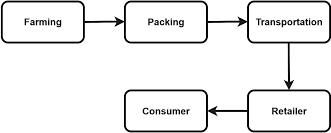
Intheorganicfoodsupplychain,blockchain canbeusedto trace each stage, from sourcing raw materials to delivering products to con- sumers. The cycle starts with suppliers obtain- ing certified organic materials, which are then processed by man ufacturers, distributed to retailers, andfinally purchased by consumers. Blockchain ensures that every transaction and logistics step is securely recorded,providingtransparencyandaccountability
Growers represent the farmers or producers who cultivate the raw materials used in food production. Their contribution marks the first step in the supply chain, and their activities are recorded on the blockchain for traceability.
After harvesting, raw materials are processed into usable forms by entities such as food pro- cessing plants. Blockchain technology tracks this transition, ensuring no tamperingorloss ofinformationabout the product’sorigin andquality.
Suppliers are responsible for the transporta- tion and distribution of processed goods. Blockchain ensures transparency in logistics, recording critical data such as shipment routes, times, and conditions, reducing fraud or de-lays.
Manufacturers convert processed materials into finished products. Blockchain technology helps track compliance with safety and quality standards, ensuring that the goods meetregu-latoryandconsumerexpectations.
Retailers represent the final commercial step where finished goods are sold to consumers. Blockchain helps retailers provide verified in- formation about the product’s originandjour-ney,fosteringtrustamongbuyers.
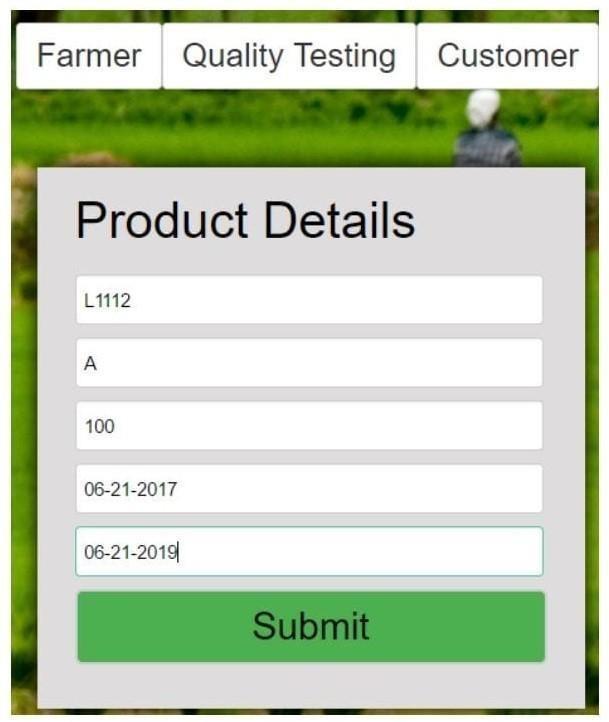
Fig. 2.ProductDetails
This interface demonstrates the ”Product De- tails” form intheblockchain-basedorganicfoodsupplychainsystem. It allows farmers or supply chain participants to input critical productinformation, suchasproductID,category,
International Research Journal of Engineering and Technology (IRJET) e-ISSN:2395-0056
Volume: 12 Issue: 04 | Apr 2025 www.irjet.net p-ISSN:2395-0072
quantity, production date, and expiry date. Once submitted, the data is securely recorded on the blockchain, ensuring transparency and traceability throughoutthesupplychain.
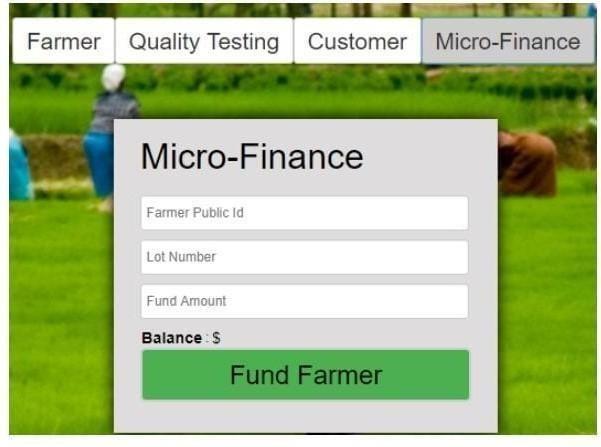
This image depicts a web page interface for a microfinance platform. The page features a green background with fields for enteringafarmer’spublicID, lot number, and fund amount. A ”Fund Farmer” button is promi- nently displayed. The overall design sug- gests a user-friendlyandaccessibleplatformforfarmerstoaccess microfinanceservices.
Themethodology forimplementing ”Or- ganic Food Supply Chain Traceability Using Blockchain Technology” begins with identi- fying key stakeholders, such as farmers, suppliers,processors,retailers,andconsumers,toanalyzetheir specific requirements for trans- parencyandtraceability.A suitable blockchain platform, such as Ethereum or Hyperledger, is selected based on scalability, security, and cost-effectiveness.Thesystemincorporatessmartcontracts to automate critical processes like verifying certifications, updatingsupplychainevents,andensuringcompliancewith or- ganic standards. IoT devices are integrated to monitor essentialparameters,suchastempera-tureandhumidity,to maintainproductqualitythroughoutthesupplychain.Data collection ateverystageisdigitizedandsecurelystoredon theblockchain,ensuringimmutabilityandtransparency.
Toenhancetraceability,eachproductisas- signedaunique identifier, such as QR codes or RFID tags, that links to its blockchain record. A consumer-facing application, either web or mobile-based, is developed to allow users to access detailed product information, including its origin, certifications, and quality assurance. Security and privacy measures, like encryption and access control, are implemented to protect sensitive data. The system undergoes rigorous testing and validation to ensure functionality, data integrity, and real-time updates. Once
deployed, the blockchain-based solution is maintained and scaled as needed, creating a reliable, transparent, and efficientorganicfoodsupplychainecosystem.
The proposed blockchain-based traceability system for organic food supply chains ensures transparency, authenticity, and efficiency. By addressing challenges such as fraud and in- efficiency, the system fosters trust among stakeholders and meets consumer demands for traceable organicproducts.
The implementation of the Organic Food Supply Chain Traceability System using Blockchain Technology ensures transparency,accountability,andtrustamongallstakeholders,includingfarmers,suppliers,consumers,andregulators. By leverag ing blockchain’s immutability, decentralized nature, and smart contracts, the system addresses key challenges such as fraud, inefficiencies, and lack of visibilityintraditionalsupplychains.
This blockchain-based system not only streamlines operations but also builds con- sumer trust by providing verifiable proof of product authenticity. It empowers stakeholderswithtransparentrecordsandpromotessustainable practices, setting a benchmark for modern traceability solutionsinthefoodindustry.
The ”Organic Food Supply Chain Traceability Using Blockchain Technology” has a promising future as it addresses critical challenges in the organic food industry and aligns with growing consumer demand for transparency and authenticity. This technology can expand to include integration with advanced IoT devices and sensors for real-time monitoring of additional parameters such as soil health, carbon emissions, and water usage, promoting sustainable farming practices. It can also facilitate global interoperability by connecting withother blockchainnetworks,enablingseamlesscrossbordertraceabilityfororganicfoodproducts.
Furthermore, the system can evolve to include predictive analytics powered by artificial intelligence (AI) and machine learning (ML) to optimize supply chain processes, reduce food waste, and forecast consumer demand. It could also support regulatory compliance by automatingauditsandcertificationsfororganicstandards. As blockchain technology gains wider acceptance, it has the potential to extend its application to other sectors, such as pharmaceuticals or luxury goods, that require robust traceability. With increasing awareness of food safety andsustainability, thissystemis well-positionedto becomeacornerstoneinthe future of global organic food supplychains.
International Research Journal of Engineering and Technology (IRJET) e-ISSN:2395-0056
Volume: 12 Issue: 04 | Apr 2025 www.irjet.net p-ISSN:2395-0072
References:
1.F. Tian, ”A supply chain traceability system for food safety based on HACCP, blockchain Internet of Things,” 2017 International Con- ference on Service Sys tems and Service Man- agement (ICSSSM), Dalian, China, 2017, pp. 1-6.doi:10.1109/ICSSSM.2017.7996119.
2.N. Kshetri, ”Blockchain’s roles in meeting key supply chain management ob jectives,” International Journal of Information Man- agement, vol. 39, pp. 80-89, 2018. doi: 10.1016/j.ijinfomgt.2017.12.005.
3.S. Saberi, M. Kouhizadeh, J. Sarkis, and L. Shen,” Blockchain technology and its re- lationships to sustainable supply chain man- agement,” International Journal of Production Research, vol. 57, no. 7, pp. 21172135,2019.doi:10.1080/00207543.2018.1533261.
4.A.Kamilaris,A.Fonts,andF.X.Prenafeta-Boldu,”Therise of blockchain tech nology in agriculture and food supply chains,”Trendsin FoodScienceTech nol- ogy,vol.91,pp. 640-652,2019.doi:10.1016/j.tifs.2019.07.034.
5.IEEE, ”AgriBlockIoT: IoT-enabled blockchain architecture,” IEEE Internet of Things Journal, accessed Oct.2024.Avail-able:https://ieeexplore.ieee.org
6.D.TapscottandA.Tapscott,BlockchainRevolution:How the Technology Behind Bit- coin Is Changing Money, Business,andtheWorld.NewYork:Portfolio,2016.
7.Zhang,Y.,Zhao,L.(2020).”Blockchain-BasedTraceability Systems for Agricultural Supply Chains: A Systematic Review.”Jour-nalofCleanerProduction,273,123-145.
Casino, F., Dasaklis, T. K., Patsakis, C. (2019). ”A Systematic Literature Review of Blockchain-Based Applications: Current Sta tus, Classification, and Open Issues.” TelecommunicationsPolicy,43(10),101-115.
8.Jabbar, S., et al. (2021). ”Blockchain Tech- nology for SustainableSupplyChains:ALit-eratureReviewandFuture Research Agenda.” Journal of Industrial Information Integration,22,100-123.
9.Chang, S. E., Chen, Y. C., Lu, M. F. (2019). ”Supply Chain Re-Engineering Us- ing Blockchain Technology: A Case of Smart ContractBasedTrackingProcess.”TechnologicalForecastingandSocialChange,144,1-11.
10. Tan, B., Yan, Z., Lin, Z. (2020). ”Us-ing Blockchain Technology to Enhance Trans- parency in OrganicFoodSupplyChains.”Sus-tainability,12(4),1654.
11. Vernekar, A. G., Phutane, M., Godase, R., Waghmode, V., & Shinde, S. M. (2020). Blockchain based E-Voting System. International Research Journal of Engineering and Technology(IRJET),7(12),1786.
© 2025, IRJET | Impact Factor value: 8.315 |