
International Research Journal of Engineering and Technology (IRJET) e-ISSN: 2395-0056
Volume: 13 Issue: 03 | Mar 2026 www.irjet.net p-ISSN: 2395-0072
International Research Journal of Engineering and Technology (IRJET) e-ISSN: 2395-0056
Volume: 13 Issue: 03 | Mar 2026 www.irjet.net p-ISSN: 2395-0072
Bhavy Kothari1, Prof. Rinni Shah2
1 Bhavy Kothari ME Student, Dept. Infrastructure Eng. LDRP, Gandhinagar, Gujarat India
2 Professor Rinni Shah, Dept. of Infrastructure Engineering. LDRP, Gandhinagar, Gujarat, India
Abstract - For urban areas to maintain public health and environmental sustainability, waste management must be done effectively. To optimize landfill site selection in City, this study suggests a novel approach integrating remote sensing, Geographic Information System (GIS), and Multi-Criteria Decision Analysis (MCDA) techniques. The purpose of this study was to locate a suitable landfillsite.Ninethematiclayers including elevation, slope, land value, distance from water bodies, roads, built-up areas, airport, railway, and land use and land cover (LULC) were assessed as important criteria. Weights were assigned using the Analytical Hierarchical Process (AHP) method analysis. For every parameter, the relative relevance was determinedbyapplyingSaaty'spriority scale of 1 to 9. Each parameter's weighting was verified using the consistency ratio, permitting the effectiveness of the selected parameters to be justified
Key Words: Landfill Site Selection, GIS, Remote Sensing, AHP, MCDA, Solid Waste.
Solid waste management is a critical global issue with significant environmental and health implications. Rapid urbanizationandpopulationgrowthhaveincreasedwaste generation,overwhelmingexistinginfrastructure.
In many cities, improper disposal practices like open dumping and burning pollute the environment and pose healthrisks.Cityfacessimilarchallenges,withthedumpsite operating for many years and causing methane emissions andleachateproblems.
This necessitates scientific landfill site selection using moderntechniques.GISandRemoteSensingprovidespatial data on waste generation patterns, while Multi-Criteria DecisionAnalysishelpsevaluatemultipleconflictingfactors systematically.
Several studies have employed GIS-MCDA for landfill selection:
Roy et al. (2022) used AHP in Siliguri, identifying suitable waste disposal locations. Sk et al. (2020) applied eleven criteriainDurgapurCity.MajidandMir(2021)integratedGIS with MCE in Srinagar. Ali et al. (2021) combined AHP in
MemariMunicipality.HazarikaandSaikia(2020)provided alternatives for Guwahati's non-compliant Boragaon site. These studies consistently validate the effectiveness of integratedGIS-MCDAapproaches.
Through a variety of applications, geographic information system (GIS) and remote sensing (RS) techniques are essential to improving solid waste management practices. Firstofall,byprovidingcomprehensivespatialdataonthe productionofsolidwaste,collectionlocations,anddisposal sites,theyaidinthecreationofwastemapsandinventories. These maps help waste management agencies and urban planners locate high-waste-generation areas, improve collection routes, and choose the best sites for waste treatmentfacilities.
GIS tools also contribute to Landfill Site Selection and Management. For the best landfill siting, they aid in evaluating the topography, environmental sensitivity, and proximitytopopulatedareas.Additionally,bytrackingwaste deposition, monitoring capacity, and evaluating potential risks like groundwater contamination, GIS-based decision supportsystemshelpwitheffectivelandfillmanagement.
TheintegrationofremotesensingandGIStechniques into waste management systems offers valuable spatial data analysis, decision support, and stakeholder engagement capabilities, leading to improved efficiency, effectiveness, andsustainabilityofsolidwastemanagementpractices.
1.3
SampleAnalyzelandcharacteristicsusingRSdata
Evaluateenvironmentalsuitabilityforlandfillsites
2.
2.1
AhmedabadisacityinGujarat,India,atlatitude23°01'17.83" North,longitude72°34'46.96"East.Itisthefifth-largestcity andsixth-largestmetropolitanareainIndia.Accordingtothe 2011census,thepopulationofAhmedabadMetropolitanwas
International Research Journal of Engineering and Technology (IRJET) e-ISSN: 2395-0056
Volume: 13 Issue: 03 | Mar 2026 www.irjet.net p-ISSN: 2395-0072
6,352,254.Ahmedabadwasfoundedin1411ADasawalled city on the eastern bank of the river Sabarmati. It is now India'sseventh-largestmetropolisandthestate'slargest
2.2 Selection Criteria
Table -1: CriteriaandRemarks
Criteria Remarks
Slope Lowslopedesirable
Elevation Lowelevationdesirable
LULC Barrenlanddesirable
DistancefromWaterBodies Highdistancedesirable
DistancefromRoads Lowdistancedesirable
DistancefromAirport Highdistancedesirable
DistancefromRailways Highdistancedesirable
DistancefromBuilt-up Highdistancedesirable
LandValue Lowvaluedesirable
2.3 Data Sources
NASAEarthData (10m resolutionDEM),ESRILandCover, propertywebsites,DIVAGIS,andOpenStreetMap
2.4 Analytic Hierarchy Process (AHP)
Thomas L. Saaty created the Analytic Hierarchy Process (AHP)inthe1970sasastructuredmethodforclassifyingand evaluatingcomplicateddecisions.Bybreakingdowndifficult decisions into a series of pairwise comparisons and then synthesizingthefindings,itassistsdecision-makersinsetting prioritiesandarrivingatthebestchoice.
3. RESULTS AND DISCUSSION
3.1 Thematic Layers
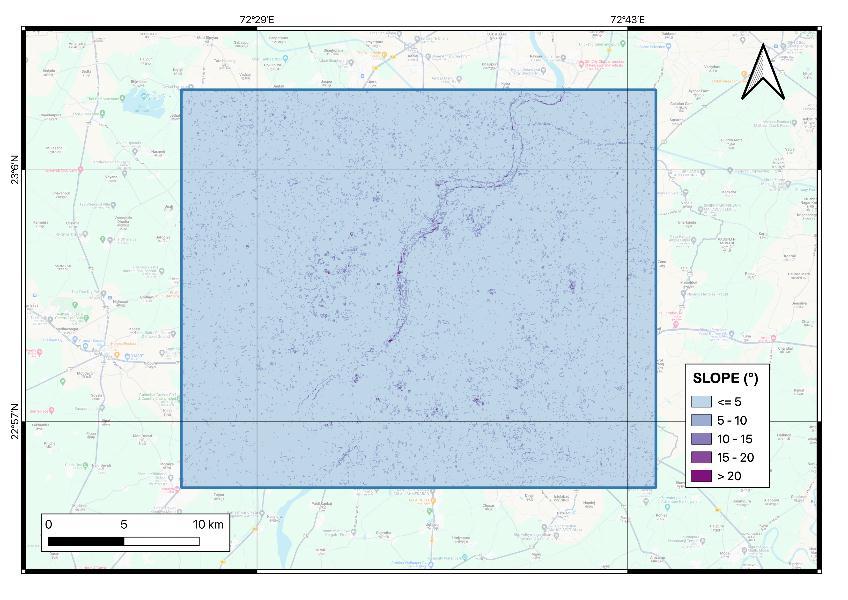
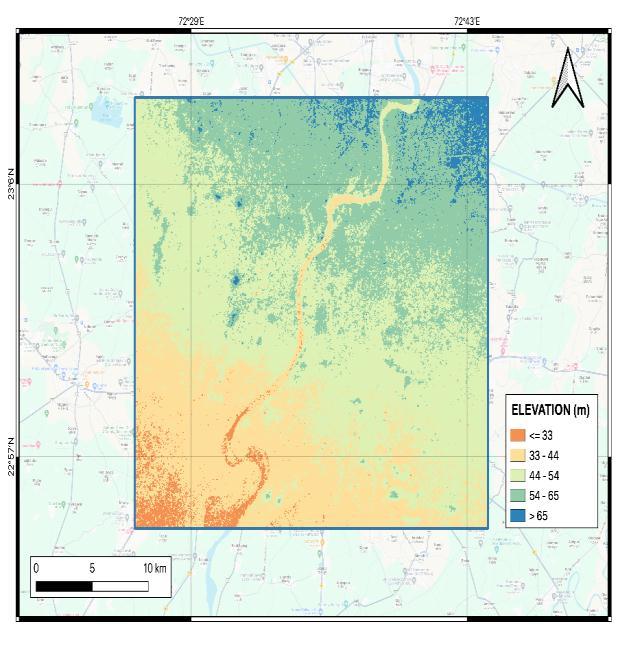
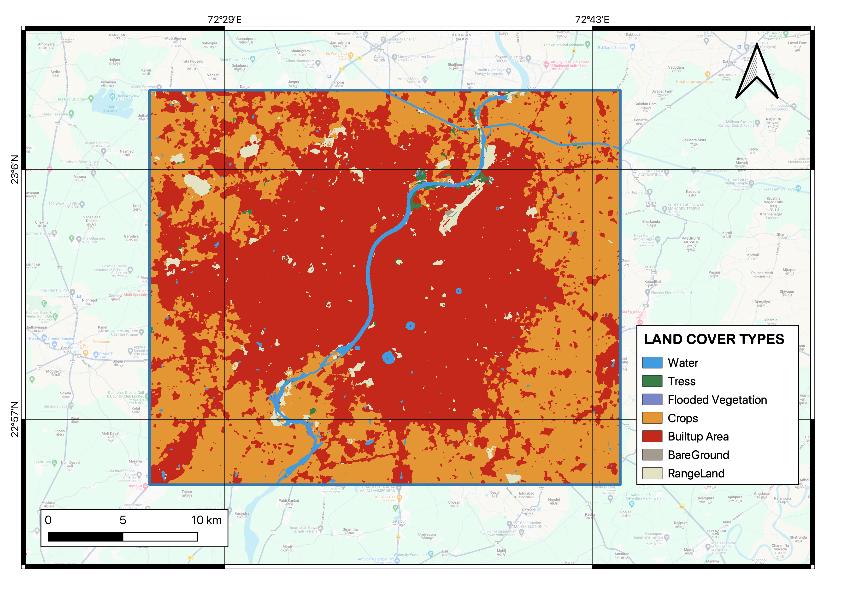
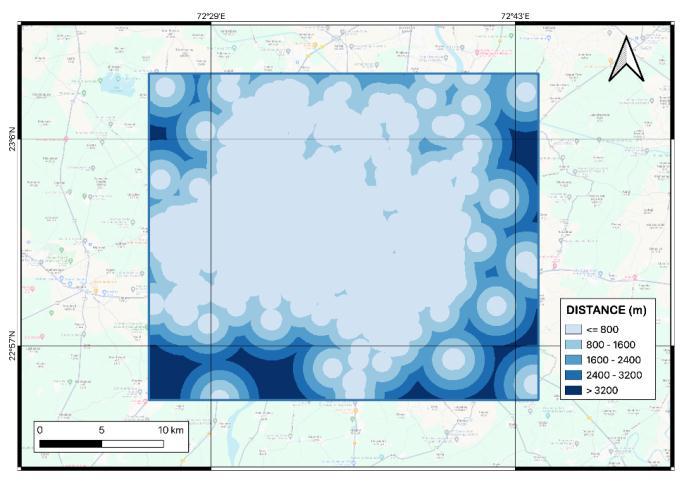
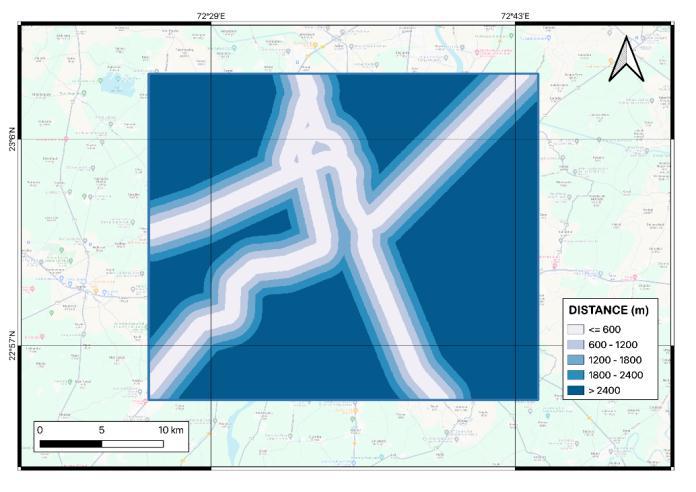
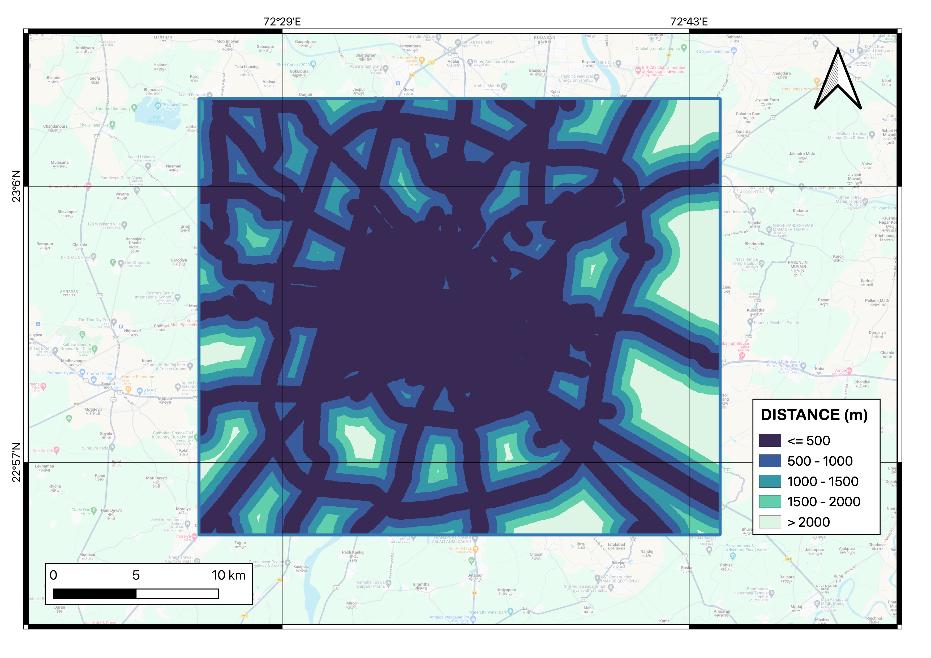
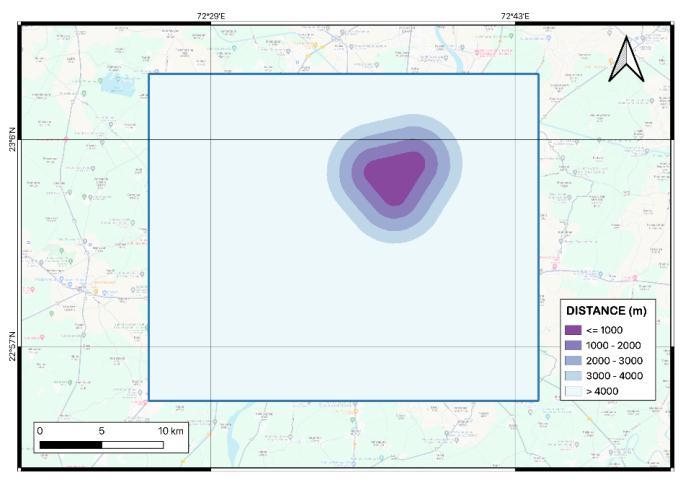
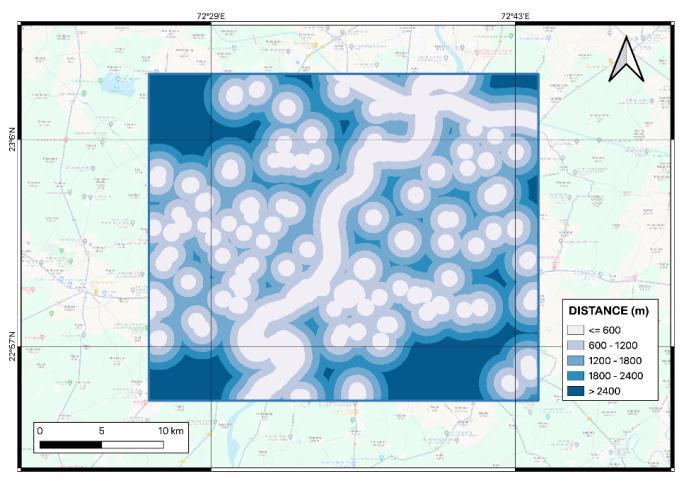
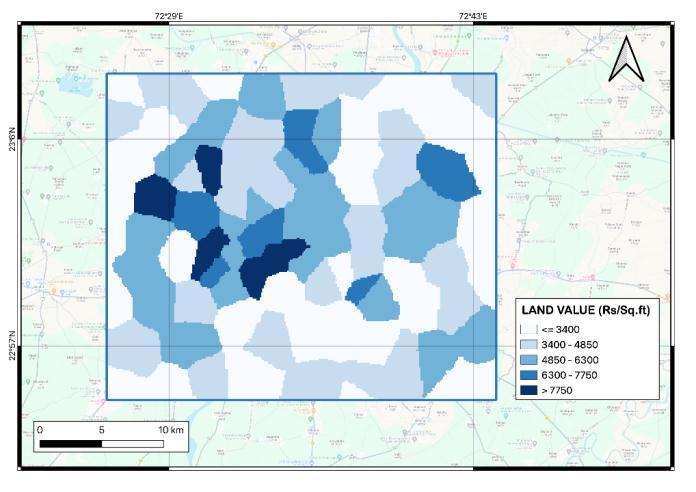
AllninefactorsweremappedwithdifferentcriteriausingGIS softwere.Thefiguresareshowbellow.
International Research Journal of Engineering and Technology (IRJET) e-ISSN: 2395-0056
Volume: 13 Issue: 03 | Mar 2026 www.irjet.net p-ISSN: 2395-0072
Volume: 13 Issue: 03 | Mar 2026 www.irjet.net
Table -2: AHPCriteriaWeightsandConsistency
Dis.From Roads
Thetopfivecriteria LULC(0.206),DistancefromBuilt-up (0.148),DistancefromWater-bodies(0.125),Distancefrom Roads(0.125),andDistancefromRailway(0.107) emerged as the most influential for landfill site selection. The ConsistencyRatiovalueof0.008,wellbelowthepermissible cutoffof0.10,confirmedtheconsistencyofthefindings.
The top five criteria LULC at 0.206, Dis. From built-up at 0.148,Dis.FromWater-bodiesat0.125,Dis.Fromroadsat 0.125,andDis.FromRailwayat0.107emergedasthemost influentialforlandfillsiteselection.Conversely,LandValueat 0.083,Dis.FromAirportat0.086,Slopeat0.065,Elevationat 0.055 exhibited relatively lower impact on the selection process.TheLandfillSuitabilityIndex(LSI)iscomputedfor theentirestudyareausingreclassifiedrasterlayersandtheir respectivecriteriaweightsasperequation.
4. CONCLUSIONS
The selection of new landfill sites requires scientific methods due to the urgent need to overhaul the current urbanlandfillsinAhmedabadcity.Thisstudy successfully demonstratedanintegratedGeographicInformationSystem (GIS)andRemoteSensingapproachcombinedwithMultiCriteria Decision Analysis (MCDA) for identifying optimal landfilllocations.
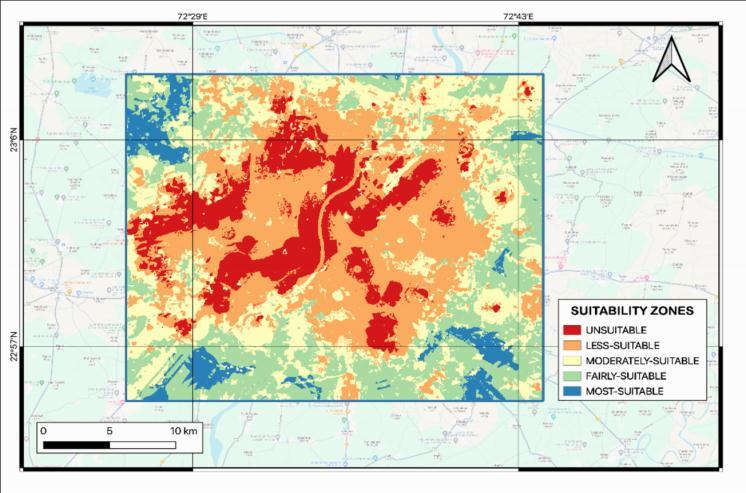
Nine evaluation criteria were considered including land value, water body proximity, built-up proximity, ground elevation, ground slope, road proximity, rail proximity, airportproximity,andlanduselandcover(LULC).Thematic raster layers for these criteria were generated and reclassified on a 1-5 suitability scale. The Analytical HierarchyProcess(AHP),informedbyexpertopinionsand literature,determinedtherelativeinfluenceofeachcriterion Weightedoverlayanalysiswasperformedbycombiningall reclassified thematic layers with their respective AHPderived weights to generate the Landfill Suitability Index (LSI) map (Figure 10). This map clearly delineates areas across Ahmedabad city into five suitability zones: Most Suitable,FairlySuitable,ModeratelySuitable,LessSuitable, and Unsuitable. The most suitable lands for landfill constructionappearinspecificperipheralareasofthecity, particularly in the western and southern parts, where conditionsareoptimalwithbarrenlandcover,appropriate distances from sensitive features, favorable slopes, and lowerlandvalues.
The findings provide valuable scientific evidence for policymakers and urban planners to transition from conventional to systematic approaches in waste managementinfrastructureplanning.
International Research Journal of Engineering and Technology (IRJET) e-ISSN: 2395-0056
Volume: 13 Issue: 03 | Mar 2026 www.irjet.net p-ISSN: 2395-0072
[1] Roy,D.,etal.(2022).Anassessmentofsuitablelandfill siteselection...ComputationalUrbanScience,2(1).
[2] Ali,S.A.,etal.(2021).Sanitarylandfillsiteselectionby integratingAHPandFTOPSISwithGIS.Environmental ScienceandPollutionResearch,28(6),7528-7550.
[3] Majid,M.,&Mir,B.A.(2021).Landfillsiteselectionusing GIS based multi criteria evaluation technique. EnvironmentalChallenges,3.
[4] Hazarika,R.,&Saikia,A.(2020).Landfillsitesuitability analysis using AHP... Arabian Journal of Geosciences, 13(21).
[5] Sk, M., et al. (2020). Optimal Sanitary Landfill Site Selection... using GIS and Multi-criteria Evaluation Technique.