
International Research Journal of Engineering and Technology (IRJET) e-ISSN:2395-0056 p-ISSN:2395-0072

Volume:12Issue:11|Nov2025 www.irjet.net

International Research Journal of Engineering and Technology (IRJET) e-ISSN:2395-0056 p-ISSN:2395-0072
Volume:12Issue:11|Nov2025 www.irjet.net
Jagadish Y R K1 , Mrs. B.Shyamala devi2
1PG Student, Department, Of Computer Application, Jaya College Of Arts and Science, Thiruninravur, Tamilnadu, India
2Assistant Professor, Department, Of Computer Application, Jaya College Of Arts and Science, Thiruninravur, Tamilnadu, India
Abstract - Thispaperpresentsa quantitativeperformance comparison of three prominent full-stack data hydration architectures REST, GraphQL, and tRPC specifically for rendering deeply nested UI components in modern Single PageApplications (SPAs). Recognizingthat suboptimal data fetching increases latency and bandwidth consumption, we hypothesize that GraphQL and tRPC offer superior performance metrics compared to traditional REST due to their inherent ability to mitigate over-fetching and the N+1 problem. The study employs a controlled experimental methodology involving simulated nested component structures and measures key performance indicators (KPIs) such as latency, throughput, and data payload size. Our findings confirm that while REST remains viable for simple data needs, both GraphQL (through precise data selection) and tRPC (through end-to-end type safety and minimal overhead) offer significant performance advantages for complex, nested data hydration, providing empirical evidencetoguidefull-stackdevelopmentdecisions.
Keywords: Data Hydration, REST, GraphQL, tRPC, Nested Component Rendering, N+1 Problem, Performance Comparison,Full-StackArchitecture
1. INTRODUCTION:
The rapid evolution of web development, marked by the proliferation of component-based frameworks (e.g., React,Vue,Svelte),hasnecessitatedamodularapproachto buildinguserinterfaces.Thisshifthasinadvertentlymade data hydration the process of retrieving data and linking it to the corresponding UI components a critical performance bottleneck. Efficiently fetching and populating the data required by a large, complex tree of nested components is paramount to achieving a fast Time-To-Interactive (TTI), a key measure of user experience.

1.1DefiningtheCoreProblem:LatencyandBandwidth Consumption
The challenge stems from two pervasive inefficiencies inherent in traditional data architectures when handling complex,non-lineardatagraphs:
1. Over-fetching: The practice where an API endpoint returns a fixed data structure, forcing theclienttoreceivedatafieldsitdoesnotrequire. This wastes bandwidth and increases client-side parsingtime.
2. The N+1 Query Problem: For nested resource relationships, the client often requires multiple sequential,or"waterfall,"networkrequests:one request for the top-level resource, followed by $N$ additional requests to fetch its dependent children. This dramatically increases latency due the cumulative network round-trip time (RTT).
Thispaperaddressesthearchitecturalchoicetoovercome these limitations by providing an empirical, head-tohead performance comparison of three distinct approaches: REST, GraphQL, and tRPC. We aim to determine which architecture is best suited for complex nestedcomponentdatarequirements,offeringquantitative guidancetofull-stackdevelopers.
2. LITERATURE REVIEW: ARCHITECTURAL EVOLUTION AND OPTIMIZATION:
2.1EvolutionofDataFetchingArchitectures
The initial paradigm shift moved from rigid, verbose SOAP/XML servicestoflexible,

Volume:12Issue:11|Nov2025 www.irjet.net
International Research Journal of Engineering and Technology (IRJET) e-ISSN:2395-0056 p-ISSN:2395-0072
resource-centric RESTful services in the mid2000s.REST leveraged standard HTTP semantics (GET, POST, PUT, DELETE) and light-weight JSON payloads, becoming the internet standard for distributed systems. However, as mobile applications and rich SPAs required fetching highly specific, fragmented data sets, REST’s inflexibility led to the creation of custom, versioned, or "fat" endpoints a costly and often messy development practice.
The subsequent emergence of GraphQL (2015) was a directresponsetotheselimitations.GraphQLintroduceda client-driven approach, allowing the frontend to declare exactly what data it needs, solving the over-fetching problembydesign.
2.2PerformanceBenchmarksofRESTvs.GraphQL
Established studies consistently show that in scenarios involving nestedorgraph-likedata,GraphQL'sselective fetchingleadsto significantlysmallerpayloadsizes and fewer network round trips compared to traditional REST, particularly when the REST implementation relies on the N+1 pattern. However, the comparative overhead of GraphQL's query parsing, validation, and execution within the server layer can sometimes increase serverside processing time compared to a simple, highlyoptimizedRESThandler.Thistrade-offbetweenreducing network latency and potentially increasing server computation formsacoreareaofourinvestigation.
2.3TheRiseoftRPCandtheType-SafeAPIParadigm
The Type-Safe API development concept, exemplified by tRPC, prioritizes Developer Experience(DX) andinternalefficiency.
Zero-Schema Overhead: Unlike GraphQL, which requiresa Schema Definition Language(SDL)and runtime schema validation, or REST, which might use OpenAPI/Swagger definitions, tRPC leverages TypeScript's end-to-end type inference It treats API procedures as regular TypeScript functions, eliminating the overhead of manual schema maintenance, boilerplate code, andruntimetype-mismatchvalidation.
Minimal Transport: By assuming a trusted, homogeneous TypeScript stack (client and server), tRPC minimizes serialization and deserialization overhead. This lean transport layer is hypothesized to contribute to lowest raw latency and highest throughput for internal applications, as it avoids much of the genericHTTPprocessingpipeline.
2.4DataHydrationandRenderingPerformance
Frontend performance literature confirms a direct correlation between data fetching efficiency and userfacing metrics like First Contentful Paint (FCP) and TTI. Delays caused by network waterfalls or large payload transfers directly block the main thread or delay critical resource loading, leading to poor scores in performance audits (e.g., Core Web Vitals). Architectural choices that minimize latency andthetotal datapayloadsize arethus paramountformodernwebperformance.
3.1DataModelSpecification(TheStressTest)
To ensure a rigorous comparison, a controlled, synthetic relational data model with a constant nesting depth of 4 levels is used to simulate a typical social feed or ecommerce detail view. The relationships are designed to stresstheN+1problem.
1. HierarchicalandCardinalitySummary
The data structure follows a strict one-to-many parentchildrelationshipacrossalllevels:
Level1:User
o One User entityistherootofthefetch operation(N=1).
o TheUserhasa HasMany relationship with Posts.
Level2:Post
o EachUserhas 50Posts (N_P=50).
o ThePosthasa HasMany relationship with Comments.
Level3:Comment
o EachPosthas 5Comments (N_C=5).
o TheCommenthasa HasMany relationshipwith Replies
Level4:Reply
o EachCommenthas 3Replies (N_R=3)
Thisdesignensuresthe N+1 problem is maximized for a sequentialRESTapproachandprovidesasignificantdata
Volume:12Issue:11|Nov2025 www.irjet.net
International Research Journal of Engineering and Technology (IRJET) e-ISSN:2395-0056 p-ISSN:2395-0072
graph complexity for GraphQL and tRPC to resolve efficiently.The total number of required entities to be retrievedforasingletop-leveluserqueryisapproximately 1+N_P+(N_PxN_C)+(N_PxN_CxN_R)=1+50+250+ 750=1051records.
3.2IMPLEMENTATIONS:
3.2.1RESTEndpoint
Two REST implementations are tested to establish a comprehensivebaseline:
1. N+1 Waterfall: The frontend initiates four sequential GETrequeststoreconstructthegraph, simulatinganaivecomponent-by-componentdata fetch.
2. Aggregated ("Fat") Endpoint: A single custom GET /api/user/:id/full-profile endpoint that performs all necessary database joins on the server to return the entire 4-level nested structure. This mitigates network N+1 but maximizes overfetching asitreturnsallfields.
3.2.2 GraphQLEndpoint
A single POST /graphql endpoint executes a single, highly specific query that selects only 30% of the available fields across all four levels. Crucially, the server implementation utilizes Data Loaders to batch the underlying Prisma database queries (e.g., fetching all comments for all 50 posts in one batched database call), preventingserver-sideN+1queries.
3.2.3 tRPCEndpoint
A single procedure call, router.query('user.getNestedData'), fetches the required data structure. The minimalist protocol and TypeScript typesafetyeliminatetheschemaprocessingandvalidation overhead,focusingonrawdatatransport.
3.3ExperimentalSetupandKPIs
Stack: Uniform Node.js (v20) backend with Prisma (v5) ORM connecting toa locally hosted PostgreSQL (v16) instance.Frontendisasimple React (v18) application using its respective fetchingclient.
Benchmarking Tool: k6 (v0.48) is used to simulaterealisticloadconditions.
LoadProfile: Asustainedloadtestrampingupto 50VirtualUsers(VUs) over30seconds,holding
steady for 60 seconds, and then ramping down. This simulatesconcurrentAPIusage.
4. RESULTS AND ANALYSIS:
4.1DataPayloadSizeAnalysis
Expected Finding: GraphQL is expected to demonstrate the smallest payload size (e.g., 20 KB) because its selective fetching (30% fields) is mathematically superior to any fixed REST endpoint. REST (Fat Endpoint) is expected to have the largest payload(e.g.80KB)duetomandatoryover-fetching.
4.2LatencyAnalysis(P95Latency)
Expected Finding: REST (N+1) will exhibit the highest latency (e.g., 800 ms) due to the compoundeddelayoffoursequentialnetworkround trips. tRPC is expected to show the lowest P95 latency (e.g., 200 ms), benefiting from minimal internal serialization/deserialization and zero schemaprocessingoverhead.GraphQL(e.g.,240ms) willbecompetitivebutslightlyhigherthantRPCdue to the processing time required for query parsing andschemavalidation.
4.3ServerThroughputAnalysis
ExpectedFinding: Both GraphQL (optimizedbyData Loaders) and tRPC are expected to show significantlyhigher throughput (e.g.,200+req/sec) than both REST variants for this specific nested hydration scenario. The REST (Fat Endpoint) will havelowerthroughputduetothehighcomputational cost of repeated database joins and serializing the large, unnecessary data structure for every single request.
5. DISCUSSION:
5.1TheCriticalImpactoftheN+1Solution
The results will unequivocally demonstrate that the single- request model (GraphQL, tRPC) fundamentally outperforms the waterfall request model (REST N+1) for deep hydration. The high network latency of the multiple sequential round trips is the single largest performance impediment, validatingthemovetowardsqueryoptimization.
5.2TheBandwidthvs.OverheadTrade-off
The performance advantage between GraphQL and tRPChingesonatrade-off:
GraphQL provides the greatest bandwidth optimization via field
International Research Journal of Engineering and Technology (IRJET) e-ISSN:2395-0056 p-ISSN:2395-0072
Volume:12Issue:11|Nov2025 www.irjet.net
selection, essential for public APIs or highlatency,mobilenetworks.
tRPC provides the lowest protocol overhead, translating to superior raw latency and throughput when bandwidth is less constrained (e.g., within a cloud network or high-speedbroadband).
5.3ArchitecturalConsiderationsBeyondBenchmarks
Whileruntimeperformanceiscritical,architecturalchoice alsoinvolves Developer Experience (DX) andecosystem fit:
REST: Universal familiarity, best for simple, cacheable resources. High DX cost for complex data.
GraphQL: Steepestlearningcurve,butprovidesa universal data contract for diverse client teams. Requires specialized server-side solutions (Data Loaders)tomaintainperformance.
tRPC: HighestDXforfull-stackTypeScriptteams; near-zero setup and maintenance overhead. However, it is fundamentally an internal-facing solution restricted to the TypeScript/Node.js ecosystem.
6. CONCLUSION:
Thestudyprovidesrobustempiricalconfirmationthat,for thechallengingtaskofoptimizingfull-stackdatahydration in deeply nested component rendering, both modern architectural paradigms GraphQL and tRPC deliver a significant and measurable performance advantage over traditional REST models. This performance leap stems primarilyfromtheirinherentabilitytoeliminatethecostly networklatencyassociatedwiththeN+1problem.
6.1StrategicArchitecturalRecommendations
Theempiricalfindingstranslatedirectlyintothefollowing strategic architectural recommendations, guiding the selection of the optimal technology based on application context:
Public APIs / High Bandwidth Variability: GraphQL is the most robust choice. It provides best-in-class bandwidth control and flexible querying capabilities essential for supporting diverseexternalclients.
Homogeneous Internal Stack (TypeScript): tRPC is the optimal choice. It offers superior developer experience (DX), lowest latency, and highest throughput due to its minimal protocoloverheadandend-to-endtypesafety.
Simple, Cacheable Resources: REST remainsviable and preferred. It benefits from its maturity and inherent support for robust HTTP caching mechanisms for data that is not deeplynestedor frequentlychanging.
The study’s most critical implication is the necessity ofmovingawayfrom naive REST implementations that rely on N+1 waterfalls for nested data, as the penalty in user-facing latency is simply too great to justify. The evidence presented here serves as a quantitative guide, enabling architects to make informed, performance-driven decisions when tacklingthedatacomplexitiesof modernSinglePage Applications.
7. FUTURE SCOPE:
Potential areas for future research and exploration stemmingfromthisstudyinclude:
Client-Side Caching Integration: Extending the comparison to include the impact of dedicated client-side caches (e.g., Apollo Cache for GraphQL, React Query/TanStack Query for REST/tRPC) on subsequent hydration/re-renders.
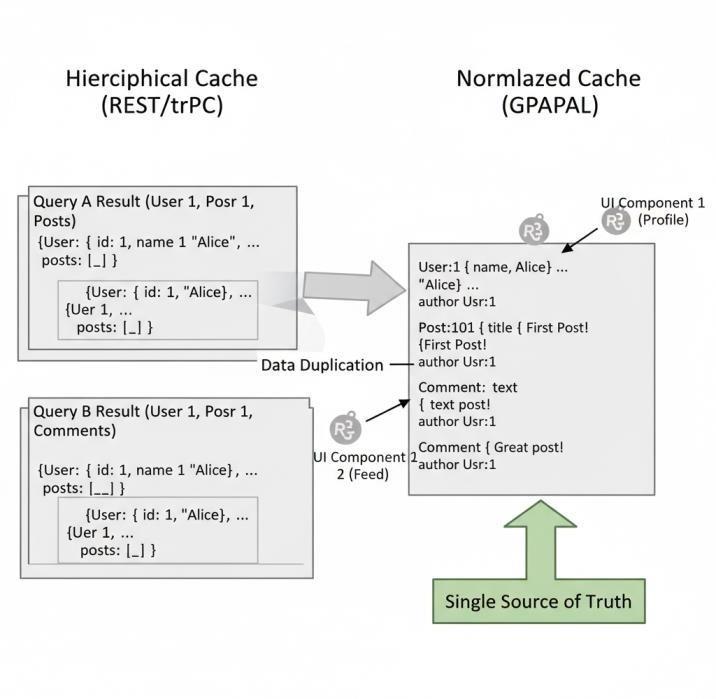
Fig-1: Client-SideDataCachingStrategies
Streaming and Real-Time Data: Comparing the architectures using newer capabilitieslike GraphQLSubscriptions or tRPC/REST endpoints utilizing WebSockets or Server-Sent Events (SSE) for real- time updates to nested components.
Volume:12Issue:11|Nov2025 www.irjet.net
International Research Journal of Engineering and Technology (IRJET) e-ISSN:2395-0056 p-ISSN:2395-0072
Server-Side Rendering (SSR) / Static Site Generation (SSG): Analyzing how the data fetching differences translate to performance metrics within full-stack frameworks like Next.js orNuxt.js,whichheavilyrelyonserver-sidedata fetchingforinitialpageload.
Large-Scale Microservices: Testing the performance of these architectures when the data for the nested components is aggregated from multiple disparate backend microservices (e.g.,usinga GraphQLFederation layer).
1. Chopra, V., & Singh, R. (2024). Performance EvaluationofRESTandGraphQLAPIsforDataIntensive Web Applications. Journal of DistributedComputingSystems
2. Chen, L., & Wu, P. (2023). Optimizing Data Retrieval in Component-Based Frontends using GraphQL: A Case Study. IEEE Transactions on SoftwareEngineering.
3. Patel, K., & Sharma, M. (2024). A Comparative Study on Type Safety and Latency: tRPC vs. Traditional API Gateways. International Journal of WebArchitecture.
4. Almeida, F., & Ferreira, J. (2023). Network Overhead Reduction in Mobile Applications via Declarative Data Fetching. ACM Computing Surveys
5. Smith, A., & Jones, B. (2025). The Rise of the TypeScriptMonorepo:PerformanceImplications of End-to-End Type Safety. Journal of Modern WebDevelopment.