
International Research Journal of Engineering and Technology (IRJET)

Volume: 12 Issue: 11 | Nov 2025 www.irjet.net
e-ISSN:2395-0056
p-ISSN: 2395-0072

International Research Journal of Engineering and Technology (IRJET)
Volume: 12 Issue: 11 | Nov 2025 www.irjet.net
e-ISSN:2395-0056
p-ISSN: 2395-0072
Jagadish Y
R
K1, Mrs. B.Shyamala devi2
1PG Student, Department, Of Computer Application, Jaya College Of Arts and Science, Thiruninravur Tamilnadu, India
2Assistant Professor, Department, Of Computer Application, Jaya College Of Arts and Science, Thiruninravur, Tamilnadu,India
Abstract - This paper presents a quantitative performance comparison of three prominent full-stack data hydration architectures REST, GraphQL, and tRPC specifically for rendering deeply nested UI components in modern Single Page Applications (SPAs). Recognizing that suboptimal data fetching increases latency and bandwidth consumption, we hypothesize that GraphQL and tRPC offer superior performance metrics compared to traditional REST due to their inherent ability to mitigate over-fetching and the N+1 problem. The study employs a controlled experimental methodology involving simulated nested component structures and measures key performance indicators (KPIs) such as latency, throughput, and data payload size. Our findings confirm that while REST remains viable for simple data needs, both GraphQL (through precise data selection) and tRPC (through end-to-end type safety and minimal overhead) offer significant performance advantages for complex, nested data hydration, providing empirical evidence to guide full-stack development decisions.
Keywords: Data Hydration, REST, GraphQL, tRPC, Nested Component Rendering, N+1 Problem, Performance Comparison, Full-Stack Architecture
1. INTRODUCTION:
Therapidevolutionofwebdevelopment,markedbytheproliferationof component-based frameworks (e.g.,React,Vue, Svelte), has necessitated a modular approach to building user interfaces. This shift has inadvertently made data hydration the process of retrieving data and linking it to the corresponding UI components a critical performance bottleneck. Efficiently fetching and populating the data required by a large, complex tree of nested components is paramounttoachievingafast Time-To-Interactive (TTI),a keymeasureofuserexperience.
The challenge stems from two pervasive inefficiencies inherent intraditional dataarchitectureswhenhandling complex, non-lineardatagraphs:
1. Over-fetching: The practice where an API endpoint returns a fixed data structure, forcing the client to receive datafieldsitdoesnotrequire.Thiswastes bandwidth andincreasesclient-sideparsingtime.
2. The N+1 Query Problem: For nested resource relationships, the client often requires multiple sequential, or "waterfall,"networkrequests:onerequestforthetop-levelresource,followedby$N$additionalrequeststofetch itsdependentchildren.Thisdramaticallyincreases latency duethecumulativenetworkround-triptime(RTT).
This paper addresses the architectural choice to overcome these limitations by providing an empirical, head-to-head performance comparison of three distinct approaches: REST, GraphQL, and tRPC. We aim to determine which architecture is best suited for complex nested component data requirements, offering quantitative guidance to full-stack developers
2.1 Evolution of Data Fetching Architectures
e-ISSN:2395-0056
p-ISSN: 2395-0072 Volume: 12 Issue: 11 | Nov 2025 www.irjet.net
Theinitialparadigmshiftmovedfromrigid,verbose SOAP/XML servicestoflexible, resource-centric RESTful services in the mid-2000s.REST leveraged standard HTTP semantics (GET, POST, PUT, DELETE) and light-weight JSON payloads, becomingtheinternetstandard fordistributedsystems.However,asmobileapplicationsandrichSPAsrequiredfetching highly specific, fragmented data sets, REST’s inflexibility led to the creation of custom, versioned, or "fat" endpoints a costlyandoftenmessydevelopmentpractice
The subsequent emergence of GraphQL (2015) wasadirectresponsetotheselimitations.GraphQLintroduceda clientdriven approach,allowingthefrontendtodeclareexactlywhatdataitneeds,solvingtheover-fetchingproblembydesign.
2.2 Performance Benchmarks of REST vs. GraphQL
Establishedstudiesconsistentlyshowthatinscenariosinvolving nested or graph-like data,GraphQL'sselectivefetching leadsto significantly smaller payload sizes and fewer network round trips comparedtotraditionalREST,particularly when the REST implementation relies on the N+1 pattern. However, the comparative overhead of GraphQL's query parsing,validation,andexecutionwithintheserverlayercansometimesincreaseserver-sideprocessingtimecompared toasimple,highly-optimizedRESThandler.Thistrade-offbetweenreducing network latency andpotentiallyincreasing server computation formsacoreareaofourinvestigation.
2.3 The Rise of tRPC and the Type-Safe API Paradigm
The Type-Safe API development concept,exemplifiedby tRPC, prioritizes Developer Experience (DX) andinternal efficiency.
Zero-Schema Overhead: Unlike GraphQL, which requires a Schema Definition Language (SDL) and runtime schemavalidation,orREST,whichmightuseOpenAPI/Swaggerdefinitions,tRPC leverages TypeScript's end-toend type inference IttreatsAPIproceduresasregularTypeScriptfunctions,eliminatingtheoverheadofmanual schemamaintenance,boilerplatecode,andruntimetype-mismatchvalidation.
Minimal Transport: By assuming a trusted, homogeneous TypeScript stack (client and server), tRPC minimizes serialization and deserialization overhead.Thisleantransportlayerishypothesized to contribute to lowest raw latency and highest throughput for internal applications, as it avoids much of the generic HTTP processing pipeline.
2.4 Data Hydration and Rendering Performance
Frontend performance literature confirms a direct correlation between data fetching efficiency and user- facing metrics like First Contentful Paint (FCP) andTTI.Delays causedby network waterfallsorlarge payloadtransfersdirectlyblock the main thread or delay critical resource loading, leading to poor scores in performance audits (e.g., Core Web Vitals). Architectural choices that minimize latency and the total data payload size are thus paramount for modern web performance.
3. METHODOLOGY:
3.1 Data Model Specification (The Stress Test)
Toensurearigorouscomparison,acontrolled,syntheticrelationaldatamodelwitha constant nesting depth of 4 levels is used to simulate a typical social feed or e-commerce detail view. The relationships are designed to stress the N+1 problem.
1. Hierarchical and Cardinality Summary
Thedatastructurefollowsastrictone-to-manyparent-childrelationshipacrossalllevels:
Level 1: User
o One User entityistherootofthefetchoperation(N=1).
International Research Journal of Engineering and Technology (IRJET)
Volume: 12 Issue: 11 | Nov 2025 www.irjet.net
o TheUserhasa Has Many relationshipwith Posts
Level 2: Post
o EachUserhas 50 Posts (N_P=50).
o ThePosthasa Has Many relationshipwith Comments.
Level 3: Comment
o EachPosthas 5 Comments (N_C=5).
o TheCommenthasa Has Many relationshipwith Replies
Level 4: Reply
o EachCommenthas 3 Replies (N_R=3)
3.2.1REST Endpoint
TwoRESTimplementationsaretestedtoestablishacomprehensivebaseline:
e-ISSN:2395-0056
p-ISSN: 2395-0072
Thisdesignensuresthe N+1 problem ismaximizedforasequentialRESTapproachandprovidesasignificant datagraph complexity for GraphQL and tRPC to resolve efficiently.The total number of required entities to be retrieved for asingle top-leveluserqueryisapproximately1+N_P+(N_PxN_C)+(N_PxN_CxN_R)=1+50+250+ 750=1051 records.
1. N+1 Waterfall: Thefrontendinitiates foursequential GET requests to reconstruct the graph, simulating a naive component-by-componentdatafetch.
2. Aggregated ("Fat") Endpoint: AsinglecustomGET /api/user/:id/full-profileendpointthatperformsallnecessarydatabasejoinsontheservertoreturntheentire4levelnestedstructure.ThismitigatesnetworkN+1butmaximizes over-fetching asitreturnsallfields.
3.2.2 GraphQL Endpoint
A single POST /graphql endpoint executes a single, highly specific query that selects only 30% of the available fields acrossallfourlevels.Crucially,theserverimplementationutilizes Data Loaders tobatchtheunderlyingPrismadatabase queries(e.g.,fetchingallcommentsforall50postsinonebatcheddatabasecall),preventingserver-sideN+1queries.
3.2.3 tRPC Endpoint
Asingleprocedure call, router.query('user.getNestedData'), fetches the required data structure. The minimalist protocol andTypeScripttypesafetyeliminatetheschemaprocessingandvalidationoverhead,focusingonrawdatatransport.
3.3Experimental Setup and KPIs
Stack: Uniform Node.js (v20) backendwith Prisma (v5) ORM connectingtoalocallyhosted PostgreSQL (v16) instance.Frontendisasimple React (v18) applicationusingitsrespectivefetchingclient.
Benchmarking Tool: k6 (v0.48) isusedtosimulaterealisticloadconditions.
Load Profile: Asustainedloadtestrampingupto 50 Virtual Users (VUs) over30seconds,holding
steadyfor60seconds,andthenrampingdown.ThissimulatesconcurrentAPIusage.
3.4 Data Payload Size Analysis
e-ISSN:2395-0056
p-ISSN: 2395-0072 Volume: 12 Issue: 11 | Nov 2025 www.irjet.net
Expected Finding: GraphQL is expected to demonstrate the smallest payload size (e.g., 20 KB) because its selective fetching(30%fields)ismathematicallysuperiortoanyfixedRESTendpoint.REST(FatEndpoint)isexpectedtohavethe largestpayload(e.g.80KB)duetomandatoryover-fetching.
3.5 Latency Analysis (P95 Latency)
Expected Finding: REST (N+1) will exhibit the highest latency (e.g., 800 ms) due to the compounded delay of four sequentialnetworkroundtrips. tRPC isexpectedtoshowthe lowest P95 latency (e.g.,200ms),benefitingfrom minimal internal serialization/deserialization and zero schema processing overhead. GraphQL (e.g., 240 ms) will be competitive butslightlyhigherthantRPCduetotheprocessingtimerequiredforqueryparsingandschemavalidation.
3.6 Server Throughput Analysis
Expected Finding: Both GraphQL (optimized by Data Loaders) and tRPC are expected to show significantly higher throughput (e.g., 200+ req/sec) than both REST variants for this specific nested hydration scenario. The REST (Fat Endpoint) will have lower throughput due to the high computational cost of repeated database joins and serializing the large,unnecessarydatastructureforeverysinglerequest.
4. DISCUSSION:
4.1The Critical Impact of the N+1 Solution
Theresultswillunequivocallydemonstratethat the single- request model (GraphQL, tRPC) fundamentallyoutperforms the waterfall request model (REST N+1) for deep hydration. The high network latency of the multiple sequential round tripsisthesinglelargestperformanceimpediment,validatingthemovetowardsqueryoptimization.
4.2The Bandwidth vs. Overhead Trade-off
TheperformanceadvantagebetweenGraphQLandtRPChingesonatrade-off:
GraphQL provides the greatest bandwidth optimization via field selection, essential for public APIs or highlatency,mobilenetworks.
tRPC provides the lowest protocol overhead, translating to superior raw latency and throughputwhen bandwidthislessconstrained(e.g.,withinacloudnetworkorhigh-speedbroadband).
4.3Architectural Considerations Beyond Benchmarks
Whileruntimeperformanceiscritical,architecturalchoicealsoinvolves Developer Experience (DX) andecosystemfit:
REST: Universalfamiliarity,bestforsimple,cacheableresources.HighDXcostforcomplexdata.
GraphQL: Steepest learning curve, but provides a universal data contract for diverse client teams. Requires specializedserver-sidesolutions(DataLoaders)tomaintainperformance.
tRPC: Highest DX for full-stack TypeScript teams; near-zero setup and maintenance overhead. However, it is fundamentallyan internal-facing solution restrictedtotheTypeScript/Node.jsecosystem.
5. CONCLUSION:
Thestudyprovidesrobustempiricalconfirmationthat, forthe challenging task of optimizing full-stack data hydration in deeply nested component rendering, both modern architectural paradigms GraphQL and tRPC deliver a significant andmeasurableperformanceadvantageovertraditionalRESTmodels.Thisperformanceleapstemsprimarilyfromtheir inherentabilitytoeliminatethecostlynetworklatencyassociatedwiththeN+1problem.
(IRJET)
Volume: 12 Issue: 11 | Nov 2025 www.irjet.net
e-ISSN:2395-0056
p-ISSN: 2395-0072
Theempiricalfindingstranslatedirectlyintothefollowingstrategicarchitecturalrecommendations,guidingtheselection oftheoptimaltechnologybasedonapplicationcontext:
Public APIs / High Bandwidth Variability: GraphQL is the most robust choice. It provides best-in-class bandwidth control andflexiblequeryingcapabilitiesessentialforsupportingdiverseexternalclients.
Homogeneous Internal Stack (TypeScript): tRPC is the optimal choice. It offers superior developer experience (DX), lowest latency,and highest throughput duetoitsminimalprotocoloverheadandend-to-end typesafety.
Simple, Cacheable Resources: REST remains viable and preferred. It benefits from its maturity and inherent support for robust HTTP caching mechanisms fordatathatisnotdeeplynestedorfrequentlychanging.
Thestudy’smostcriticalimplicationisthenecessityofmovingawayfrom naive REST implementations thatrelyon N+1 waterfalls fornesteddata,asthepenaltyinuser-facinglatencyissimplytoogreattojustify.Theevidencepresentedhere servesasaquantitativeguide,enablingarchitectstomakeinformed,performance-drivendecisionswhentacklingthedata complexitiesofmodernSinglePageApplications.
Potentialareasforfutureresearchandexplorationstemmingfromthisstudyinclude:
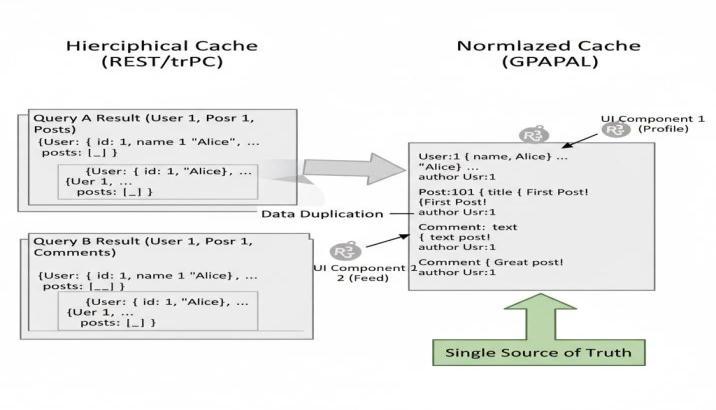
Client-Side Caching Integration: Extendingthecomparisontoincludetheimpactofdedicatedclient-sidecaches (e.g., Apollo Cache for GraphQL, React Query/TanStack Query for REST/tRPC) on subsequent hydration/rerenders.
Streaming and Real-Time Data: Comparing the architectures using newer capabilities like GraphQL Subscriptions ortRPC/RESTendpointsutilizing WebSockets orServer-SentEvents(SSE)forreal-timeupdates tonestedcomponents.
Server-Side Rendering (SSR) / Static Site Generation (SSG): Analyzing how the data fetching differences translatetoperformancemetricswithinfull-stack frameworkslikeNext.jsorNuxt.js,whichheavilyrelyonserver-sidedatafetchingforinitialpageload.
Large-Scale Microservices: Testing the performance of these architectures when the data for the nested components is aggregated from multiple disparate backend microservices (e.g., using a GraphQL Federation layer).
1. Chopra, V., & Singh, R. (2024). Performance Evaluation of REST and GraphQL APIs for Data- Intensive Web Applications.JournalofDistributedComputingSystems
International Research Journal of Engineering and Technology (IRJET)
Volume: 12 Issue: 11 | Nov 2025 www.irjet.net
e-ISSN:2395-0056
p-ISSN: 2395-0072
2. Chen,L.,&Wu,P.(2023).OptimizingDataRetrievalinComponent-BasedFrontendsusingGraphQL:ACaseStudy. IEEETransactionsonSoftwareEngineering.
3. Patel, K., & Sharma, M. (2024). A Comparative Study on Type Safety and Latency: tRPC vs. Traditional API Gateways.InternationalJournalofWebArchitecture.
4. Almeida, F., & Ferreira, J. (2023). Network Overhead Reduction in Mobile Applications via Declarative Data Fetching.ACMComputingSurveys.
5. Smith,A.,&Jones,B.(2025).TheRiseoftheTypeScriptMonorepo:PerformanceImplicationsofEnd-to-EndType Safety.JournalofModernWebDevelopment.