
International Research Journal of Engineering and Technology (IRJET) e-ISSN: 2395-0056
Volume: 12 Issue: 10 | Oct 2025 www.irjet.net p-ISSN: 2395-0072
International Research Journal of Engineering and Technology (IRJET) e-ISSN: 2395-0056
Volume: 12 Issue: 10 | Oct 2025 www.irjet.net p-ISSN: 2395-0072
Mr. Shubham M. Mare1 , Dr. Anita Nag 2
1 Student M tech (2nd year), Construction Engineering and Management, Department of Civil Engineering, G H Raisoni University Amravati
2 Associate Professor, Department of Civil Engineering, G H Raisoni University Amravati.
Abstract - Inthis study, the development and use of on-site andprecast constructiontechniques vary significantly across differentcountries.Traditionally,cast-in-situconstructionhas been the primary method for building structures. However, prefabricated systems have emerged as an advancing technology that facilitates rapid construction and helps minimize project delays. This approach enhances product quality, as structural components are produced under controlled conditions in manufacturing plants where highperformancematerialscanbeused. Moreover,prefabrication contributestoimprovedworkplacesafetybyreducingon-site activities, especially those performedat height or near traffic zones, during high-rise construction. Prefabricated construction methods are applicable not only to newprojects but also to the rehabilitation of existing buildings. Their use results in faster project completion and minimized interruptionsthroughouttheconstructionprocess.Fast-track construction techniques often incorporate prefabricated components to expedite the erection of structures. For instance,intraditionalhouseconstruction,rawmaterialssuch as bricks, timber, cement, sand, steel, and aggregates are transportedto the site, andthe buildingis assembledentirely on-site. In contrast, prefabricated construction involves castingonlythefoundationon-site,whilestructuralelements suchascolumns,beams,staircases,lintels,chajjas,floors,and roofs are manufactured in a factory, transported to the location, and assembled using cranes
Key Words: Precast Construction, Prefabrication, Cost Optimization, Time Efficiency, Modular Components, SustainableBuilding,etc.
Thedevelopmentanduseofon-siteandprecastconstruction techniques differ considerably across countries. Traditionally, cast-in-place construction has been the dominant method for building structures. In recent years, prefabricated systems have emerged as a modern technology that facilitates faster construction and helps minimize project delays. This method also enhances the overallqualityofconstruction,asstructuralcomponentsare producedundercontrolledfactoryconditionswherehighperformance materials can be used during casting. Additionally,prefabricationimprovessafetyonconstruction sites by reducing the amount of on-site work required,
particularlyathighelevationsorinareaswithheavytraffic, such as during high-rise construction. Prefabricated construction techniques are applicable to both new developments and the rehabilitation of existing buildings. Theiradoptionleadstofasterprojectcompletionandfewer interruptions throughout the construction process. Fasttrack construction methods often rely on prefabricated componentstoacceleratestructuralassembly.Forexample, intraditionalhouseconstruction,materialssuchasbricks, timber,cement,sand,steel,andaggregatesaredeliveredto thesite,andtheentirestructureisbuiltthere.Incontrast, prefabricated construction involves casting only the foundationon-site,whileelementssuchascolumns,beams, staircases,lintels,chajjas,floors,androofsaremanufactured in a factory, transported to the site, and assembled using cranes
The aim of this project is to compare the cost and construction time of prefabricated buildings with conventional methods to evaluate the efficiency and economicbenefitsofprefabrication
1)To study the conventional & prefabricated building construction.
2)To Analyze the time and cost required for various buildingcomponents.
3)Tocomparetheconventionalandprefabricatedbuilding constructionwithrespecttotimeandcost.
4)To optimize blend of conventional and prefabrication techniques in construction. Above objectives will be achievedbytakingacasestudy
Haron et al. (2005) [1] stated that conventional constructionpracticesdependlargelyonon-siteoperations such as the installation of timber or plywood formwork, placementofsteelreinforcement,andcastingofconcreteat the site. These methods commonly employ reinforced concreteframesusingtraditionalwoodenformwork.Their studyrevealedthatsuchpracticesleadtoincreasedproject costs due to higher labour demands, excessive material consumption,andtransportationrequirements,alongwith
International Research Journal of Engineering and Technology (IRJET) e-ISSN: 2395-0056
Volume: 12 Issue: 10 | Oct 2025 www.irjet.net p-ISSN: 2395-0072
slowerconstructionprogress.Theresearchfurtherindicated thattraditionalconstructionapproachesarelessefficientand moreresource-intensivecomparedtomodernprefabrication methods, ultimately reducing productivity and costeffectivenessinconstructionprojects
Haron et al. (2005) [2] stated that prefabricated construction methods involve manufacturing structural componentssuchasfloorslabs,staircases,columns,beams, lintels,andchajjasoff-site,whicharelaterassembledatthe constructionlocation.Thistechniqueconsiderablyreduces thedependenceonon-sitelabourandenhancestheoverall productivity of the construction industry. Their study highlighted that the adoption of precast building systems resultsinshorterprojectdurationsduetohigherefficiency andprecisioninexecution.Furthermore,theintegrationof advancedmachinery,equipment,andmodernconstruction technologies in prefabricated systems improves both the qualityofconstructionandthespeedofprojectcompletion, makingitaneffectivealternativetoovercomethedrawbacks ofconventionalconstructionmethods.
Dr.N.B. ChaphalkarandMs.SayaliS.Sandbhor[3] stated thattheirstudyfocusesonthedevelopmentofacalculation modelforcurrentconstructionproducts,analyzingbuilding materialsincludedintheproductbasket,fluctuationsintheir wholesale prices,and the resultingimpact on promotional success. The authors provided an overview of the Indian financial system and discussed the role of institutions contributing to it. They emphasized that inventories and productsmarketedinthefinancialsectorareinfluencedby various government-established indicators, which affect markettrends,sales,andproductioncosts.Accordingtotheir findings, the Indian market relies on the Stock Market Index compiledatthenationallevel asakeymeasureof retail price variations. The study also highlighted that developmentremainsoneofthemostsignificantanddebated aspects within the construction industry, and that Indian business regulations permit the use of stock market capitalizationforcalculatingcapitalgainsonmaterialsand supplies.
Azman et al. (2012) [4] statedthattheglobalconstruction industryisundergoingasignificanttransformationwiththe increasing adoption of prefabrication techniques as a strategicshiftfromconventionalconstructionmethods.Their study examined the challenges involved in integrating prefabricated systems with traditional practices and providedacomparativeanalysisofimplementationstrategies in the United Kingdom, Australia, and Malaysia. In the Malaysiancontext,theIndustrializedBuildingSystem(IBS) was identified as a major initiative wherein structural componentsareprefabricatedeitheron-siteoroff-siteand then assembled with minimal labour requirements. In the United Kingdom, such practices are categorized under Modern Methods of Construction (MMC), representing various innovative approaches to building development. Similarly,boththeUKandAustralianconstructionindustries
frequently use the term Offsite Manufacturing (OSM) to describetheseprocesses.Theresearchalsohighlightedthe increasinguseofprecastconcretesystemsacrossallthree regions and emphasized the crucial role of government bodies and academic institutions in enhancing awareness, providing training, and fostering the modernization, efficiency,andsustainabilityoftheconstructionindustry
Baldwin et al. (2009) [5] statedthattheirstudycompared the cost and productivity aspects of conventional construction methods with those of prefabrication techniques. The analysis considered several cost factors, includingmaterialprocurement,manufacturing,off-siteand on-site inspections, and the installation of prefabricated elements.Thefindingsrevealedthatalthoughtheinitialcost ofprefabricationisapproximately25%to35%higherthan that of traditional construction, it delivers significant productivity improvements. Prefabrication enhances productionefficiencybyabout30%,mainlyduetoreduced on-sitelabourrequirementsandmaterialsavingsresulting from limited formwork usage. Furthermore, the study reportedthatprefabricatedfloorslabsprovidearound28% costsavings,whileprecastpre-stressedconcretecomponents achieveupto60%savings,therebyillustratingthelong-term economic and operational benefits of implementing prefabricationintheconstructionindustry.
Dabhade et al. (2009) [6] statedthattheirstudyexamined the time and cost feasibility of different construction techniques within the framework of India’s urban development, where vertical expansion is increasingly adopted due to limited horizontal space in metropolitan areas.Theresearchersemphasizedthatinarapidlygrowing economy where rising costs pose major challenges reducing construction time can play a crucial role in minimizing overall expenses. A case study of a 10-storey multilevelcarparkingstructurewasundertaken,featuring post-tensionedcompositesteelbeamsspanning16meters. Usingidenticalplandimensions,floor-to-floorheights,and loading conditions, the building was analyzed under two alternative systems: (1) a precast concrete frame with a precastconcretefloor,and(2)asteelframewithaprecast concrete floor. For the precast concrete frame system, an additional interior column was introduced to satisfy structural requirements over the 16-meter span. Time schedulingforeachmethodwasconductedusingMicrosoft Project2003,focusingonmaterialandconstructioncostsof structuralcomponents.Thefindingsindicatedthatthesteel framewithacompositedeckfloordemonstratedthegreatest time efficiency, reducing construction duration by 55.3% compared to the precast concrete frame and by 14.3% relativetothesteelframewithaprecastfloor.However,this system incurred 23.10% higher direct costs and 12.99% higher net costs than the precast frame system, with only minorvariationsof0.52%(directcost)and-2.34%(netcost) comparedtothesteelframewithaprecastfloor.Thestudy concludedthatalthoughadvancedcompositesteelstructures offer substantial time savings, they involve a moderate
International Research Journal of Engineering and Technology (IRJET) e-ISSN: 2395-0056
Volume: 12 Issue: 10 | Oct 2025 www.irjet.net p-ISSN: 2395-0072
increase in initial costs, reflecting a key trade-off between efficiencyandexpenditure.
Haasetal.(2000)[7] statedthattheirresearchanalyzedthe trendsandimpactsofprefabricationandpreassemblywithin theconstructionindustry,withparticularemphasisontheir influence on the workforce. The study reported that from 1984 to 1999, the adoption of prefabrication and preassembly techniques increased by nearly 86%, demonstratingasubstantialtransformationinconstruction practicesoverthat15-yearspan.Surveydatacollectedduring the study indicated that these methods contribute to enhanced productivity and improved safety conditions at construction sites, while the required worker skill levels remain relatively consistent with those of traditional methods.Furthermore,thestudyobservedthatwagelevels are generally lower in projects utilizing prefabrication approaches. The researchers also identified both the advantages andlimitationsof these systems,underscoring theiroverallimpactonprojectefficiency,labourstructure, andevolvingindustrystandards
GirmscheidandKrocher(2007)[8] statedthattheirstudy investigatedtheapplicationofprefabricationmethodsand theirinfluenceonconstructionefficiency,cost,andmarket potential. The research highlighted that prefabrication reduceson-siteconstructiontimebyenablingsimultaneous activitiesatdifferentlocations,incontrasttothesequential workflow typical of conventional methods. Their findings indicated a 5% increase in construction speed and a 10% reductionintotalprojectcostsduetotimesavingson-site. The study also analyzed the market for prefabricated concreteelementsinSwitzerland,identifyingkeychallenges faced by companies in the precast industry. Through comparativeanalysiswithotherconstructionsegmentsand international benchmarks, the research identified growth opportunitieswithinthismarket.Basedonpriorstudiesand empirical observations,theauthorsproposedstrategiesto increasetheadoptionofprefabricatedcomponents,including the creation of an industry-wide knowledge platform to centralize and disseminate technical and commercial informationtoarchitectsandengineers.Thisplatformwas designed to address barriers to market adoption while promotingfactorsthatfacilitatetheuseofprecastelements, drawing on best practices from other constructionsectors andincorporatingtheinterestsofrelevantstakeholdersto supportwiderimplementationofprefabricationinSwitzer.
Haron et al. (2005) [9] statedthattheirstudyanalyzedthe transitionalphaseoftheMalaysianconstructionindustryasit moved from conventional building methods to a more systematic and mechanized approach, known as the Industrialized Building System (IBS). The research emphasizedthatIBSimprovesproductivityandconstruction qualitythroughtheuseofadvancedmachinery,equipment, high-quality materials, and detailed pre-project planning. Notingtheabsenceoforganizeddata oncostcomparisons
between conventional construction and IBS methods in Malaysia,thestudyspecificallyexaminedthedifferencesin buildingcostsbetweentraditionalsystemsandtheformwork system within the IBS framework. Data were collected through questionnaire surveys and case studies of institutionalbuildings,andstatisticalanalysisusingthet-test wasemployedtodeterminesignificantcostvariations.The findings revealed a notable cost difference favoring the conventional systemovertheformwork system,providing usefulinsightsforstakeholdersassessingcost-effectiveness inMalaysia’sevolvingconstructionsector.
Huanga et al. (2004) [10] stated that their study investigated the reduction of erection time for reinforced concrete(RCC)formwork,showingthatmodularformwork systemscandecreaseoverallprojectconstructiontimebyup to 15% compared to conventional methods. The research highlighted that cost optimization is achieved through the reuseofformworkwithinthesameprojectoracrossmultiple projects, thereby minimizing material waste. Recognizing that traditional concrete formwork is labor-intensive and time-consuming, the study analyzed various modular formworksystemsaimedatenhancingproductivityandcosteffectiveness.Effectiveimplementationwasshowntorequire carefulplanningduringbothdesignandconstructionphases, includingresourceallocationformodularformsets,cranes, and labor. Using computer process simulation techniques, fivedistinctformreuseschemeswereidentifiedandmodeled withtheCYCLONEmethodology.Micro-CYCLONEsimulations andsensitivityanalyseswereconducted,varyingthenumber offormsets,cranes,andlaborcrewswithinareal-worldcase study. The findings provided valuable insights into the productivity and cost implications of different form reuse strategies,enablingmoreefficientplanningandfacilitating gang-formconstructioninbuildingprojectsthroughmodular formworksystems
Yadav and Shah (2013) [11] stated that their study examined precast technology as an initial step toward promoting sustainable development in construction. The researchemphasizedthaterectingprecastunitsisacomplex mechanized process involving continuous assembly and installation of prefabricated components. Precast constructionprovidesadvantagesoverconventionalmethods by fabricating structural members such as panels, walls, beams, and columns at predetermined sizes in a factory before transporting them to the construction site for final installation.Theauthorshighlightedthatthisapproachnot onlyacceleratesconstructionbutalsoensureshigherquality, makingitaneffectivemethodtomeetthegrowingdemand forsustainablehousing,particularlyindevelopingcountries. Thestudyalsodiscussedvarioustypesofprecastsystems, detailingtheirkeycharacteristics,theequipmentrequiredfor assembly, and the installation procedures for different components.
International Research Journal of Engineering and Technology (IRJET) e-ISSN: 2395-0056
Volume: 12 Issue: 10 | Oct 2025 www.irjet.net p-ISSN: 2395-0072
3.1 General
Thischapteroutlinestheresearchmethodologyemployed forthestudytitled “Optimization of Precast Components in Building Construction.” Themethodologyisstructured to achieve the study’s objective of comparing precast and conventional construction methods in terms of cost and time,withthegoalofoptimizingtheapplicationofprecast techniquesinbuildingprojects.Acombinationofqualitative and quantitative data, field observations, and case studies has been used to provide a thorough and well-rounded analysis.Traditionalconstructionmethods,includingloadbearingwallsandRCC-framedstructureswithmasonryinfill, often encounter challenges such as inconsistent quality, weather-relateddelays,andhighlabordemands,whichcan significantly impact large-scale or time-sensitive projects. Conversely, precast construction offers benefits such as consistent quality, reduced labor requirements, faster constructiontimelines,enhanceddurability,andproduction that is less affected by weather conditions. This study evaluates both construction approaches to determine the mosteffectiveuseofprecastcomponentsforachievingcost andtimeefficiencies
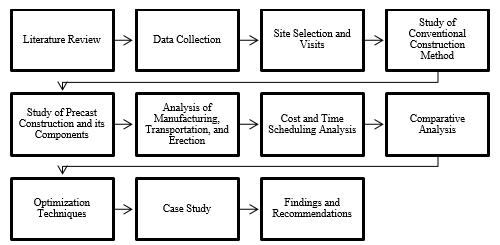
3.2 Research Flow:
3.3 Site adaptation
Followingstepsinvolvedinsiteadaptationforprefabricated constructionmethod.
Selection of site
Maharashtra state police housing and welfare corp. ltd. constructed site of 7512Sq.M. area which was required to completeasearlyaspossibletobuiltupspeedyconstruction B.G. Shirke Construction Technology Private Limited i.e. contractor adopted precast construction method. The site consistingof132,2-BHKflatswhichhastocompletein12 months of short period. Considering this short period the contractor along with footing work they installed another team for molding, casting and placing various precast membersonsite.Adoptingthismethodtilltheplinthlevel
completedtheallcomponentsofbuildingarereadytouse andplace.
Site visits
Along that the precast data will available from site by interviewingsiteengineerandvarioustimessitevisit;After that it will be possible to do respective site as if it will be constructed by conventional method to estimate for comparison with precast method. All design drawings are collected form site also observation work during construction work. Rent for particular transporting each componenttheerectioncostiscalculated.Theerectioncost consisting the cost required for each components for one cyclewheretopickupcomponents,toplaceorerectitand comebacktopickupanotherprecastmember.Considering thiseachprecastmemberserectioncostisestimatedduring site visit by analyzing cycle time of rented Cranes and Trailers.
B.G.Shirke(Contractor)havingabove500Workers onsitewhereheavyequipmentsandmachineryused.Also site contains the heavy Precast column, Beam, Lintel, slab PanelsandChajja whicharetransportingandplacingwork isthere;Sotheuseof15Kgbearing helmetandsafetyshoes is compulsory. If the transportation of component work executed in that section the all work will be on hold only placingworkwilldoneandonlyrespectiveworkersallowed inthatsection.
Optimizing Conventional and prefabricated techniques
Optimizing Conventional and prefabricated techniques in casestudyfollowingpointstakenintoconsideration.
Identification of problem
In the past decade construction is done with the help of traditional method. Traditional method means the useofformworkandrequiremorelabouretc.Today’sthe need of fast-track construction. So the most of companies will go for the readymade components and construct the building within a stipulated timing. Using this fast-track constructionsavesthedurationofprojectandautomatically saves the cost. Thus the need is to be study of various precastbuildingcomponentswhichrequiredlesstimefor construction and get final results and to optimize the buildingcomponentstoconventionalconstructionsothatin conventionalmethodwewillreducetheprojecttimeaswell asprojectduration.
Literature review
Oncetheproblemisidentified,surveywascarriedout withthehelpofvariousjournals,books,takingcasestudies tohavea deepknowledgeabouttheproblem, understand
International Research Journal of Engineering and Technology (IRJET) e-ISSN: 2395-0056
Volume: 12 Issue: 10 | Oct 2025 www.irjet.net p-ISSN: 2395-0072
theconceptsofproblem.Withthehelpofdatagettheideato examinethesitesituation,howtheoptimizationtobedone usingestimatingthecostofdifferentcomponentsofbuilding inprecastandconventionaltypes.
The primary data was collected from the internet sources from which we know that the what is mean be precastconstruction,howtheyconstructandgivesthedeep knowledge about that construction, how to prepare a planning. Also I have taken a one case study for detailed study on Karad site and collecting all data required for project work. Such as precast column, beam, lintel, chajja, slab panels types which are to be used for construction. Collected data contains the cost and the time requires placingthecomponentsbyusingsuchequipments.
Themainexecutionpartistoanalysisdatausingcasestudy whichincludescalculatingestimatingcostandanalyzetime. Estimated cost involves the type of estimate and basic considerationforevaluatingtheproblem.
Estimating Cost
Foranalyzingthedataforprefabricationmethodcompared to conventional method by using Divisional schedule rate 2015-2016.
Theconcretequantityestimatedby,
Q = L*B*H*N (Unit-M3)
Where,
L=Length
B=Breadth
H=Height
N=Numbersofcolumncomponents
Aftercalculatingthequantityofconcrete,thesteelquantity isestimatedaftertakingthe helpofbarbendingschedule. ThebarbendingscheduleconsistingthenumbersoftorSteel barswiththeirsizeandlength.
SteelQuantityEstimatedby,
Q = N*(L*D*D)*162 (Unit-Kg)
L=LengthofBar
D=DiameterofBar
N=NumberofSteelBars
a) Estimatingcolumnbyusingcollecteddata requiresteel, concrete quantity calculated, using them the cost analyzedbycomparingitthecostofcolumncastedby connectionalmethodandprefabricatedmethod.
b) Estimatingbeambyusingcollecteddata requiresteel, concrete quantity calculated, using them the cost analyzed by comparing it the cost of beam casted by connectionalmethodandprefabricatedmethod.
c) EstimatingLintel-chajjabyusingcollecteddata require steel,concretequantitycalculated,usingthemthecost analyzedbycomparingitthecostofLintel-chajjacasted byconnectionalmethodandprefabricatedmethod.
d) Estimating Slab by using collected data require steel, concrete quantity calculated, using them the cost analyzed by comparing it the cost of slab casted by connectionalmethodandprefabricatedmethod.
The rate taken from DSR 2015-2016 with following specificationsarethere;
M-20 Concrete Columns (3Abi/5 BDF5)Providing&castinginsitucementconcreteM-20of trap / granite /quartzite/ gneiss metal for R.C.C. Column as per detailed designs & drawings or as directed including centering, formwork, cover blocks compaction & roughening the surface if specialfinishistobeprovided&curingcomplete. (Excluding reinforcement) With fully automatic microprocessor based PLC with SCADA enabled reversibledrumtypeconcretemixerwithnatural sand.(Spec.No.:Bd.F.5PageNo.300andB.7,Page No.38)
M-20 Concrete Beam and Lintel(3Abi/5BDF6) -Providing&castinginsitucementconcreteM-20 oftrap/granite/quartzite/gneissmetalforR.C.C. beamandLintelasperdetaileddesigns&drawings orasdirectedincludingcentering,formwork,cover blocks compaction & roughening the surface if specialfinishistobeprovided&curingcomplete. (Excluding reinforcement) With fully automatic microprocessor-based PLC with SCADA enabled reversibledrumtypeconcretemixerwithnatural sand.(Spec.No.:Bd.F.6PageNo.300andB.7,Page No.38)
M-25 Concrete Slab (4A a i / 5 BDF 8) -Providing andcastinginsitucementconcreteM-25oftrap/ granite/quartzite/gneissmetalforR.C.C.slabsand landings canopy, waist slab with steps as per detaileddesignsanddrawingsincludingcentering, formwork,coverblockscompactingandroughening the surface if special finish is to be provided and curing complete. (Excluding reinforcement).With fully automatic microprocessor-based PLC with SCADA enabled reversible drum type concrete mixerwithnaturalsand.(Spec.No.:Bd.F.8PageNo. 302andB.7,Page.No.38)
International Research Journal of Engineering and Technology (IRJET) e-ISSN: 2395-0056
Volume: 12 Issue: 10 | Oct 2025 www.irjet.net p-ISSN: 2395-0072
M-20 Concrete Chajja (5A a i / 5 BDF 8)Providing&castinginsitucementconcreteM-20of trap/ granite/ quartzite/ gneiss metal for R.C.C. chajjaasperdetaileddesign&drawingsincluding centering, formwork, cover blocks compacting & roughening the surface if special finish is to be provided & curing complete. (Excluding reinforcement).With fully automatic microprocessor-based PLC with SCADA enabled reversibledrumtypeconcretemixerwithnatural sand. (Spec. No.: Bd.F.9 Page No. 303 and B.7, Page.No.38)
Tor Steel (32 / 24 BR 35A) - Providing, cutting, bending,hooking,tieinginpositionandlayingTMT FE500steelbarforreinforcementasperdetailed drawingsforallR.C.C.works.(Spec.No.:BR.35Page No.134)
Thecostincludestransportation,erectionandlaborcostfor castingandplacing.
Estimating Time
During casting, erecting and placing each component of precastmemberthetimeiscalculatedforprecastandalso cycle time calculated if building is constructed by conventional method excluding foundation work. Considering the fact that plinth level is completed before cycletimeiscalculatedforeachcomponent.
The following site activities are considered for precast constructionmethod-
Transportation - Transportation of precast components done by using heavy trailers having double-Triple axel with 50MT Weighing capacity. Generallysuchvehiclehavingspeedof5-10Km/Hr in working area and on Highway it is restricted upto 60Km/Hr. The rent for such vehicles about Rs.5000-8000 Per day excluding diesel and diver allowanceon8Hrsworkingbasis.
Erection- ForthisactivitytheheavyCranesareto beusedwhichareavailableonhourlybasisofRent Rs.1200-1500perHourincludingdieselanddriver allowance.Thecapacityofsuchcranesis20MTto 70MT.Theywillbeusedaspersitecondition.
Level Work-whereeachcomponentistobeplaced; itshouldbelevel byusinglevel tubewithgreater accuracyandforthatworkmoretimerequired,soit shouldbecalculatedduringestimatingtime.
ThesoftwarethatisMicrosoftproject2007forplanningof both precast and conventional construction is used to calculateactualperiod
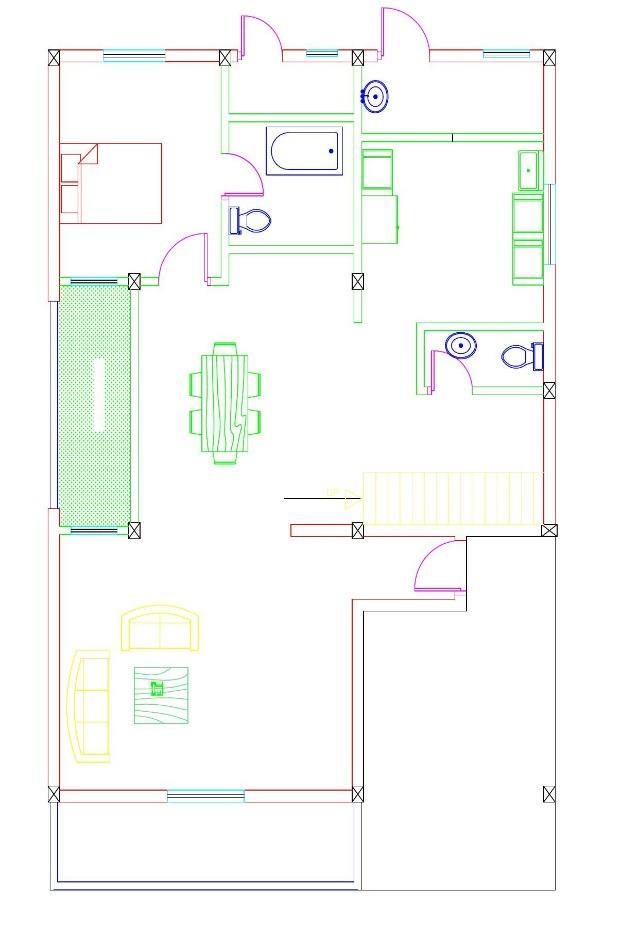
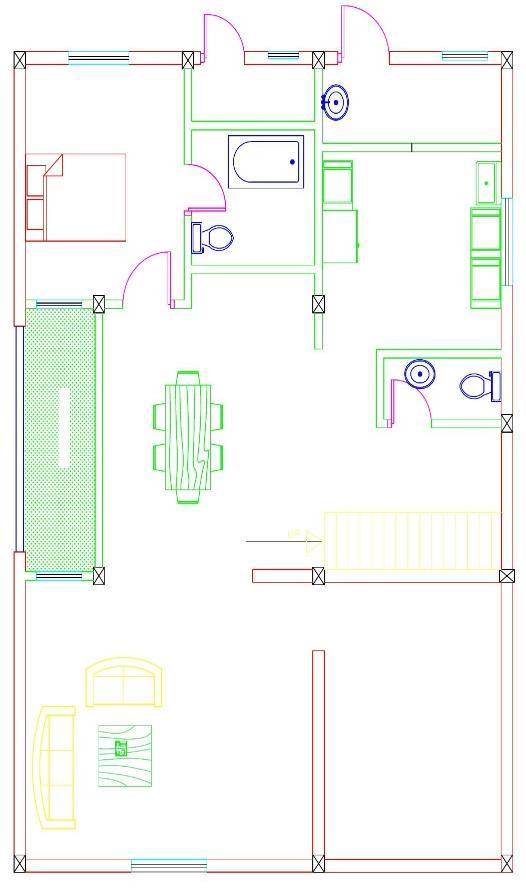
3.5 plan consider analysis:
International Research Journal of Engineering and Technology (IRJET) e-ISSN: 2395-0056
Volume: 12 Issue: 10 | Oct 2025 www.irjet.net p-ISSN: 2395-0072
x16'9"
x15'7"
x12'4"
x14'0"
x9'3"
x2'9"
x3'6"
x4'8"
x5'0"
x17'7"
5'3"x15'4"
Table No. 3.1 Schedules of Ground Floor
x11'10"
x13'1"
x5'7"
x12'4"
4'8"x5'3"
2 11'1"x17'7" W.I.R 5'4"x7'3"
1 7'3"x5'0" Toilet2 5'10"x8'7" Balcony1 5'10"x8'7" Balcony2 9'7"x18'0"
x11'10"
Table No. 3.3 Schedules of First Floor 4.
4.1 General:
The prefabricated construction is significantly more costeffective and time-efficient compared to conventional
methods. Major savings are observed in structural works, internal finishes, and building services due to factory production,reducedlabor,andminimizedmaterial waste. While groundwork and minor finishes show minimal differences, the overall project cost is notably lower with prefabrication. In terms of time, prefabricated methods drastically shorten construction durations especially in plastering,painting,andstructuralcomponents thanksto faster assembly and parallel workflows. Overall, prefabrication offers faster project delivery and reduced costs, making it a highly efficient alternative for modern constructionprojects
4.2 Cost Comparison: Conventional vs Prefabricated Construction – Detailed Observations
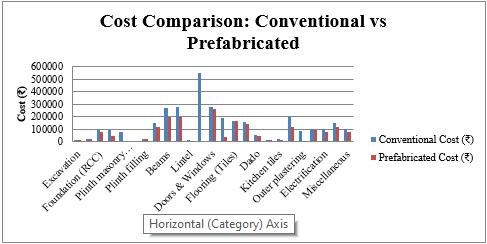
Graph No. 1- Cost Comparison: Conventional vs Prefabricated
[1] Overall Cost Efficiency of Prefabricated Construction
Analysis of project costs shows that prefabricated constructionisgenerallymoreeconomicalthanconventional methods. This advantage stems from the industrialized production process, lower labor requirements, reduced materialwastage,andshorterconstructiontimelines.
A notable cost reduction is observed in the Brick Bat Masonry (BBM) of the superstructure. Conventional constructionforthisactivityoftenexceeds₹5.5lakhs,while prefabricated construction achieves considerably lower costs. Prefabrication reduces labor-intensive expenses by utilizingfactory-madecomponentsthatareeasierandfaster toassembleon-site.
Internal plastering, flooring, and painting demonstrate substantialcostsavingsinprefabricatedconstruction.Prefinishedpanelsrequireminimalon-sitefinishing,andtasks canbestandardizedinafactoryenvironment.Forexample, paintingcostsarealmosthalvedcomparedtoconventional construction,reflectingsignificanttimeandlaborefficiency.
International Research Journal of Engineering and Technology (IRJET) e-ISSN: 2395-0056
Volume: 12 Issue: 10 | Oct 2025 www.irjet.net p-ISSN: 2395-0072
[4] Cost-Effective Installation of Doors and Windows
Installing doors and windows is less expensive in prefabricated construction because frames are often integratedduringthemanufacturingstage.Thisreducesthe need for on-site adjustments, enhances precision, and minimizeserrors,contributingtooverallcostsavings.
[5] Structural Components Benefit from Modular Design
Prefabricated columns, beams, and slabs show clear cost reductions.Producedinstandardsizesandshapesoff-site, theseelementsallowforefficientmaterialuseandquicker assembly. This approach also reduces site congestion, equipment requirements, and labor effort, lowering both directandindirectcosts.
[6] Minimal Differences in Preliminary Site Activities
Early-stage site activities, such as excavation, PCC below foundation, and plinth filling, show negligible cost differences between prefabricated and conventional methods.Thesetaskslargelydependonon-siteconditions and require similar treatment regardless of construction type.
[7] Limited Cost Variation in Minor Finishing Items
Activities such as DPC (Damp Proof Course), kitchen tiles, kitchenotta,andskirtinghavenearlyidenticalcostsinboth methods.Thesesmallertasksareperformedon-siteandthus donotsignificantlybenefitfromprefabrication.
[8] Moderate Savings in Building Services
Services like plumbing, electrification, and terrace waterproofing show moderate cost reductions in prefabricatedconstruction.Earlyintegrationofconduitsand plumbing lines into prefabricated units simplifies on-site installationandminimizesrework,reducingbothlaborand materialexpenses.
[9] Painting Offers Clear Cost Advantage
Painting, a labor-intensive finishing process, is more costefficientinprefabricatedbuildings.Factory-finishedpanels providesmoothsurfacesthatrequirelesspreparationand fewercoats,savingbothtimeandpaint.
Consistent
When the cumulative cost of all activities is considered, prefabricatedconstructionconsistentlyshowsareductionin overall project expenditure. This not only benefits the client’s budget but also enables better time management, reduced labor dependence, and greater predictability in execution.
Prefabrication improves material efficiency and reduces waste. Conventional construction often encounters higher material loss due to breakage, over-ordering, and inefficiencies,whichareminimizedina controlledfactory environment.
[12] Conclusion on Cost Trends
Overall, while certain construction activities remain costneutral between the two methods, most structural and finishing tasks exhibit significant cost advantages when prefabricatedmethodsareused.Thissupportsthegrowing preferenceforprefabricationinresidentialandcommercial projects where cost efficiency, speed, and quality are key considerations.
4.3 Activity and duration Comparison: Conventional vs Prefabricated Construction – Detailed Observations:
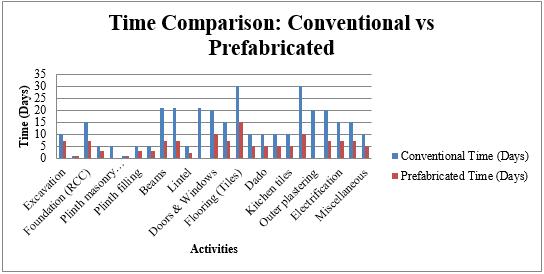
Graph No. 2- Time Comparison: Conventional vs Prefabricated
1] General Trend: Faster Construction with Prefabrication:
The graph clearly shows that prefabricated construction methods consistently require less time than conventional methods across almost all construction activities. This validatesthe claimthat prefabrication not onlysaves cost butalsosignificantlyshortenstheprojecttimeline,whichis crucialfortime-sensitivedevelopments.
2] Substantial Time Savings in Finishing Works:
The most noticeable time difference is seen in internal plastering,painting,andflooring(tiles).Intheconventional method, these activities take up to 30 days, whereas the prefabricatedapproachreducesthemtonearlyhalforeven less.Thisisduetothesmoothersurfacesandmoreuniform finishes provided by factory-made components, which requireminimalon-sitetouch-ups.
International Research Journal of Engineering and Technology (IRJET) e-ISSN: 2395-0056
Volume: 12 Issue: 10 | Oct 2025 www.irjet.net p-ISSN: 2395-0072
3] Shorter Duration for Structural Elements:
Activitieslike columns, beams,and slabs showasignificant reduction in time using prefabrication. In conventional construction, each of these takes around 21 days, while prefabricated components reduce this to roughly 7 to 10 days. This can be attributed to the fact that prefabricated structural members are manufactured off-site and simply need to be assembled, eliminating the time-consuming formwork,curing,andscaffoldingprocesses.
4] BBM (Superstructure) Time Efficiency:
TheBrickBatMasonry(BBM)superstructure,whichistimeintensiveinconventionalconstruction(about21days),takes muchlesstimeinprefabricatedconstruction(approximately 6–7 days). This showcases how modular walls or panels reducenotjustlaborbutalsodryingandsettingperiods.
5] Time Reduction in Doors & Windows Installation:
Installing doors and windows takes around 20 days in traditionalmethods,whereasprefabricationreducesthisto nearly 8 days. This is possible because prefabricated elements often include pre-cut openings and frames, simplifyingtheinstallationprocesssignificantly.
6] Early-stage Activities Show Modest Gains:
Activities such as excavation, PCC below foundation, and foundation(RCC)showsmalleryetnotabletimereductions. Since these are groundwork activities that happen on-site regardless of the building method, the time advantage of prefabricationislessdramatic,thoughstillbeneficial(e.g., 15daysdownto8daysinPCC).
7] Finishing Items Like Skirting,Dado,andKitchen Tiles:
These minor works also exhibit reduced durations in the prefabricatedmethod.Whiletheytypicallytake10–15days conventionally, prefabrication shortens them to 5–7 days, indicating better preplanning and reduced manual intervention.
8] Faster Execution of Building Services:
Service-relatedactivitiessuchaselectrification,plumbing, andterracewaterproofingalsoshowmoderatetimesavings. Forexample, electrification dropsfrom15days to 7days, largely due to the integration of service conduits within prefabricated panels, eliminating the need for chases and hackingduringinstallation.
9] Reduction in Overall Project Duration:
When evaluating the cumulative time across all activities, prefabricationconsistentlyresultsinsignificanttotal time
savings. The reduction in construction time can lead to earlier project handovers, lower interest on project financing,andfasterrevenuegenerationincommercialor residentialdevelopments.
10] Less Downtime Between Activities:
Inprefabricatedconstruction,tasksaremoresequentially alignedduetoprecisecoordinationandminimaldependency on curing or drying periods. This results in less idle time betweenconstructionphases,unlikeconventionalmethods where delays are common due to overlapping labor schedulesandmaterialdependencies.
11] Enhanced ProjectSchedulingandPredictability:
Due to the controlled nature of prefabrication, timeline predictabilityissignificantlyhigher.Prefabricatedelements can be manufactured while site preparation is ongoing, therebyoverlappingactivitiesthatwouldotherwiseoccurin sequenceinconventionalconstruction.
12] Conclusion: Time Efficiency Validated:
Thetimecomparisonvalidatesthatprefabricationisatimesaving construction technique, especially beneficial in projects where early completion is a priority. These time savings not only improve productivity but also reduce overheadcostsrelatedtolabor,equipmentrental,andsite maintenance
International Research Journal of Engineering and Technology (IRJET) e-ISSN: 2395-0056
Volume: 12 Issue: 10 | Oct 2025 www.irjet.net p-ISSN: 2395-0072
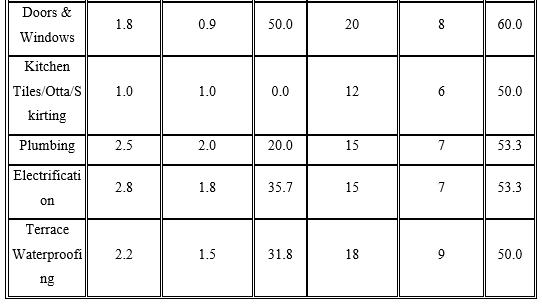
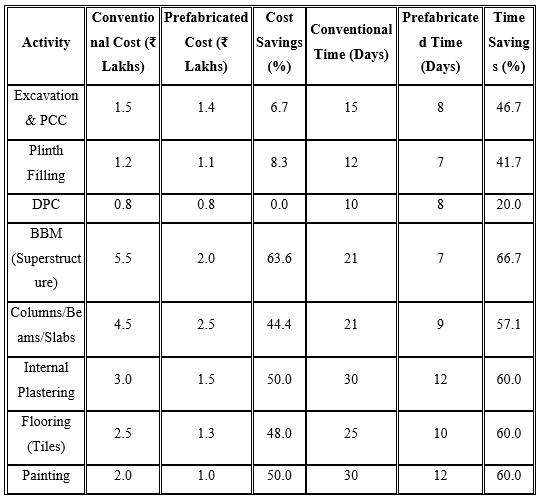
No. 4.1 - Cost and Time Comparison between Conventional and Prefabricated Construction
4.4 Combined Summary: Cost and Time Comparison –Conventional vs Prefabricated:
Thecomparativeanalysisofconventionalandprefabricated constructionmethodsdemonstratesaclearandconsistent advantageforprefabricationinbothcostandtimeefficiency. Economically, prefabricated construction substantially lowersexpensesincriticalstructuralandfinishingactivities, including BBM (superstructure), internal plastering, painting,anddoors/windowsinstallation.Thesesavingsare primarilydrivenbyoptimizedmaterialutilization,factorycontrolledproductionprocesses,andreducedon-sitelabor requirements. Although some groundwork and minor finishingtasksshowcomparablecostsacrossbothmethods, theoverallfinancialbenefitofprefabricationissignificant. From a time perspective, prefabricated construction considerably shortens project timelines for nearly all activities. Notable reductions occur in structural works, plastering,painting,flooring,andbuildingservicessuchas electrificationandplumbing.Onaverage,tasksthatwould typically take 15–30 days with conventional methods are completedinlessthanhalfthetimethroughprefabrication. This improvement is largely due to parallel processing manufacturing components off-site while site preparation proceeds shorter curing periods, and minimal delays between consecutive tasks. In summary, prefabricated constructionprovidesthedualadvantageofreducedcosts and faster execution, making it an attractive solution for modern construction projects where efficiency, budget control, and timely delivery are essential. Its adoption enhances project planning, optimizes resource allocation, and improves return on investment, particularly in largescaleorrepetitivedevelopments
Theanalysisclearlyindicatesthatprefabricatedconstruction outperforms conventional methods in both cost and time efficiency. Significant cost reductions are achieved in structuralworkssuchasBBM,columns,beams,andslabs,as well as in internal finishes like plastering, flooring, and
painting, and building services including plumbing and electrification. These savings result from industrialized, factory-controlledproduction,whichoptimizesmaterialuse, minimizeson-sitelabor,andensuresconsistentquality.
Intermsoftime,prefabricationallowssimultaneousoff-site componentmanufacturingandon-sitepreparation,reducing durationsforstructuralassembly,finishing,andinstallation tasks to less than half of conventional timelines. Reduced formwork, curing time, and improved task sequencing furtheraccelerateprojectdelivery.Minorgroundworkand finishing activities show modest benefits, but the overall timelineissubstantiallyshortened.
Thecombinedeffectofreducedcostandfasterconstruction results in earlier project handovers, lower overheads, improved resource utilization, and enhanced project predictability. Prefabrication is therefore particularly advantageous for large-scale, repetitive, or time-sensitive projects, offering an effective solution for modern constructionchallengeswhereefficiency,quality,andcost controlarecritical
[1] Haron, M., Ismail, F., & Abang Ali, A. (2005), “ConventionalConstructionPracticesandTheirImpact on Cost and Productivity,” Journal of Construction Research,Malaysia,haron@construction.edu.my.
[2] Haron, M., Ismail, F., & Abang Ali, A. (2005), “Prefabricated Construction Methods and Their Advantages in Building Projects,” Journal of Industrialized Building Systems, Malaysia, haron@construction.edu.my.
[3] Chaphalkar,N.B.,&Sandbhor,S.S.(2013),“Analysisof ConstructionProductCosts andMarketInfluencesin India,” International Journal of Civil Engineering and Construction,Pune,India,n.chaphalkar@civilpune.edu, s.sandbhor@civilpune.edu.
[4] Azman, N., Mohamed, A., & Abdullah, M. (2012), “Integration of Prefabricated Systems in Global Construction: Comparative Analysis of UK, Australia, and Malaysia,” Journal of Modern Construction Methods, Kuala Lumpur, Malaysia, azman@construction.my.
[5] Baldwin,A.,Smith,R.,&Johnson,P.(2009),“Costand Productivity Analysis of Prefabrication versus Conventional Construction,” International Journal of ProjectManagement,USA,baldwin@project.edu.
[6] Dabhade,S.,Kulkarni,R.,&Patil,M.(2009),“Timeand CostFeasibility ofConstruction TechniquesinUrban India,” Journal of Structural Engineering Research, Pune,India,dabhade@civilpune.edu.
International Research Journal of Engineering and Technology (IRJET) e-ISSN: 2395-0056
Volume: 12 Issue: 10 | Oct 2025 www.irjet.net p-ISSN: 2395-0072
[7] Haas,C.,Dormer,R.,&Brown,K.(2000),“Workforce Impacts and Productivity of Prefabrication and Preassembly in Construction,” Construction Management and Economics, USA, haas@constructionresearch.edu.
[8] Girmscheid, G., & Krocher, K. (2007), “Prefabrication Methods: Efficiency, Cost, and Market Potential in Switzerland,” Journal of Advanced Construction Technology, Switzerland, girmscheid@ethz.ch, krocher@ethz.ch.
[9] Haron, M., Ismail, F., & Abang Ali, A. (2005), “IndustrializedBuildingSystem(IBS)inMalaysia:Cost and Productivity Assessment,” Malaysian Journal of Civil Engineering, Malaysia, haron@construction.edu.my.
[10] Huanga, Y., Li, Z., & Chen, W. (2004), “Erection Time Reduction Using Modular RCC Formwork Systems,” JournalofConstructionEngineeringandManagement, China,huanga@construction.cn.
[11] Yadav,S.,&Shah,P.(2013),“PrecastTechnologyasa StepTowardSustainableConstruction,”International JournalofCivilandEnvironmentalEngineering,India, yadav@civilpune.edu,shah@civilpune.edu.