
International Research Journal of Engineering and Technology (IRJET) e-ISSN: 2395-0056
Volume: 13 Issue: 02 | Feb 2026 www.irjet.net p-ISSN: 2395-0072
International Research Journal of Engineering and Technology (IRJET) e-ISSN: 2395-0056
Volume: 13 Issue: 02 | Feb 2026 www.irjet.net p-ISSN: 2395-0072
RADHIKA YADAV1 , VAISHNAVI POTDUKHE2 , DIPALI ATHAWALE3 , SHRUTIKA BANKAR4
PROF.KALYANI KAHANDAL5 , PROF.ANIL NAIK6
1,2,3,4 (Students, Department Of Computer Engineering), S.Y.P Shreeyash College Of Engineering And Technology (Polytechnic), Chh.Sambhajinagar , India
5(Professer, Dept. Of Computer Engineering), S.Y.P Shreeyash College Of Engineeringand Technology (Polytechnic), Chh.Sambhajinagar , India
6(Hod, Dept. Of Computer Engineering), S.Y.P Shreeyash College Of Engineeringand Technology (Polytechnic), Chh.Sambhajinagar , India
Abstract - In a world where we can order a pizza or book a flight in seconds, the process of reporting a crime remains surprisingly outdated. Many people still have to visit a police station in person, deal with mountains of paperwork, and then wait weeks for an update they might never get. This paper introduces an Online Crime Reporting System designed to bring law enforcement into the digital age.
The goal of this project is simple: make it easier for victims to speak up and easier for the police to act. The system allows users to file reports from their phones or laptops, attach photos or videos as evidence, and most importantly track the status of their case in real-time. On the back end, it gives the police a clean, organized dashboard to manage cases, assign officers, and see exactly where crime "hotspots" are developing.
By removing the physical and bureaucratic barriers to reporting, this system encourages more people to report incidents while helping the police work faster and more transparently. It’s not just about building a website; it’s about using technology to make communities feel safer and more connected to the people sworn to protect them.
Keywords: Online Crime Reporting System, E-FIR, Digital Policing, Case Management, Data Encryption, RBAC, Crime Analytics, Centralized Database.
Foralongtime,reportingacrimehasbeenanintimidatingandexhaustingprocess.Ifsomeonegetstheirphonestolenor witnesses a break-in, their first hurdle isn't just the crime itself it’s the bureaucracy that follows. Between finding the rightpolicestation,waitinginline,andfillingoutmanualformsthatmightgetlostinafilingcabinet,manypeoplesimply decidethatreportingtheincidentisn'tworththehassle
This "reporting gap" is a massive problem for society. When crimes go unreported, the police can’t see the full picture, resources are sent to the wrong places, and criminalsremainfreetostrikeagain.Inanerawherewe handleour banking, healthcare,andeducationonline,it no longer makes sense for public safety to be stuck in a paper-basedpast. thesystem ensuresthatonlyauthorizeduserscanviewormodifysensitivedata,
Themotivationbehindthisprojectstemsfromthedesiretoempowervictimsofcrimebyprovidingadigitalplatformthat offers a direct, immediate, and private way to take action. Furthermore, the system is driven by the potential for datadriven policing, where high-quality data can be leveraged by law enforcement to prevent future incidents. To address current systemic gaps, the platform provides 24/7 availability, allowing reports to be filed instantly at any time without waitingforstationhours.Byeliminatingthe"papertrail"delaysandmanualrecord-keepingtypicaloftraditionalsystems, it significantly reduces bureaucracy. Additionally, the system enhances evidence collection by allowing the immediate uploadofdigitalfiles,suchashigh-resolutionphotosandvideoclips.
International Research Journal of Engineering and Technology (IRJET) e-ISSN: 2395-0056
Volume: 13 Issue: 02 | Feb 2026 www.irjet.net p-ISSN: 2395-0072
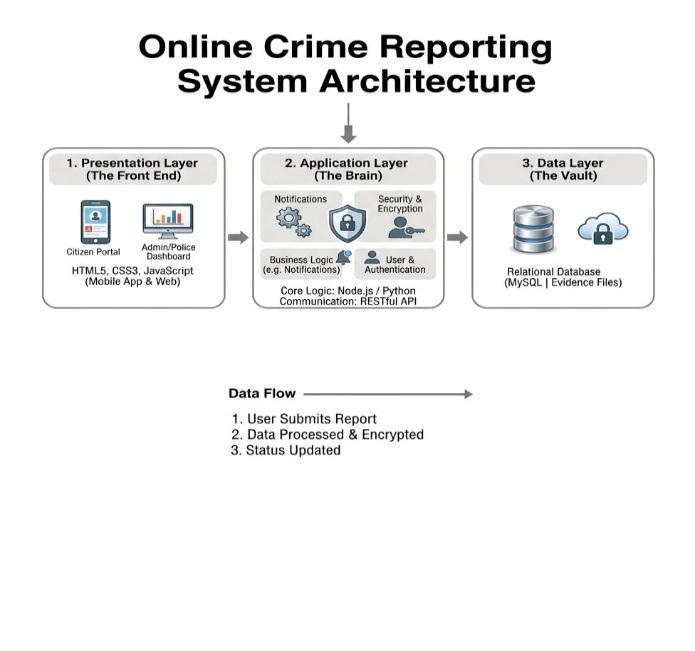
1.Presentation Layer
This is the user interface. Citizens use a web portal or mobile app to submit reports, while police officers use a separatedashboardtoreviewcasesandupdatestatuses.
2.Application Layer
This server-side layer handles the "work." It verifies user identities, encrypts sensitive information, and routes the reportstothecorrectpolicedepartment.
3.Database Layer
Thisisthesecuredatabasewhereallrecords userprofiles,crimedetails,anduploadedevidence(photos/videos) arestoredandretrieved..
Thislayeredapproachenhancesscalability,maintainability,andsystemsecurity.
This study adopts the Structured System Analysis and Design Methodology (SSADM) combined with the Waterfall Model.Thisensuresalogical,step-by-stepprogressionwhereeachphasemustbeverifiedbeforemovingtothenext.
1. Requirement Engineering (The "What")
The first phase involved identifying the specific needs of three primary stakeholders: Citizens, Police Officers, and Administrators.
Fact-Finding Techniques: We used Questionnaires and Document Analysis (reviewing current paper-based FIR forms)toensurethedigitalversioncapturesalllegallyrequiredfieldslikeDate,Time, NatureofOffense,andSuspect Description.
Feasibility Study: * Technical: Canthesystemhandlehigh-resolutionimageuploads?
Economic: Isitcost-effectivetohostthisoncloudserversversuslocalhardware?
Legal: Doesthedigitalsignature/timestampmeetthestandardsforlegalevidence?
2. System Analysis & Modeling (The "Logic")
Beforebuilding,wemodeledhowdatamovesthroughthesystem. Use Case Diagrams: Todefinewhateachusercando(e.g.,Citizenscan file butnot delete areport;Admincan assign officers).
International Research Journal of Engineering and Technology (IRJET) e-ISSN: 2395-0056
Volume: 13 Issue: 02 | Feb 2026 www.irjet.net p-ISSN: 2395-0072
Data Flow Diagrams (DFD): Wemappedthejourney of a report from the user’s device, through the authentication "checkpoint,"intothedatabase,andfinallytotheofficer'snotificationcenter.
Entity-Relationship Diagram (ERD): Definedthe"Vault"structure linkinguserstotheirspecificcrimes,andcrimes tospecificofficers,ensuringnodatais"orphaned."
3. Design & Implementation (The "Build")
Thisphaseinvolvedtranslatingmodelsintocode.
Tech Stack Selection: * Front-end: HTML5/Bootstrap foramobile-first,responsivedesign.
Back-end: PHP forsecureserver-sidelogic.
Database: MySQL forstructured,searchablerecord-keeping.
Security Integration: We implemented Hashed Passwords (using BCrypt) and SSL Encryption to protect data duringtransit.Wealsoused Unique Reference IDs foreverycasetopreventdatacollisions.
4. Comprehensive Testing (The "Check")
Toensurethesystemmeets"police-grade"standards,itunderwentfourrigorouslevelsoftesting.Duringunittesting, individualformsliketheFIRuploadwerecheckedforinputvalidationtopreventincompletesubmissions.Integration testing was then conducted to verify that the evidence upload functionality correctly connected to the database storage. For broader assessment, black-box testing focused on the overall user experience and error messaging without internal code examination. Finally, stress testing was performed by simulating multiple concurrent users to ensureserverstabilityunderhigh-trafficconditions.
5. Deployment & Evaluation (The "Launch")
Thefinalstepwashostingtheapplicationandevaluatingitsperformance.
Speed Metrics: Wecomparedthetimetakentofileadigitalreport(approx.5minutes)versusamanualone(approx. 2-3hoursincludingtravel).
Data Integrity: Weverifiedthatalluploadedevidencewasretrievedexactlyasitwassent,withnocorruption.
Theprimary challengefacingmodernlaw enforcement is thepersistent"reportinggap"causedbyanantiquated,manual system of crime documentation. Currently, the requirement for victims to physically visit a police station to file a report creates a significant barrier tojustice,often resulting in minor orsensitiveincidentsgoingentirelyunreportedduetothe associatedtime,travel,andsocialintimidation.
Furthermore, the reliance on paper-based record-keeping leads to systemic inefficiency, where data is difficult to search, prone to human error, and nearly impossible to share across different jurisdictions in real-time. This lack of a digital frameworkalsoleavescitizensinastateofuncertainty;withoutatransparenttrackingmechanism,victimsareleftwithout updatesontheircaseprogress,whichdeeplyerodespublictrustinthelegalsystem.Consequently,thereisanurgentneed for a secure, centralized digital platform that simplifies the reporting process, ensures data integrity, and fosters a more transparentandresponsiverelationshipbetweenthecommunityandthepolice.
The Proposed System is a secure, web-based platform designed to transform the traditional, paper-dependent crime reporting process into a streamlined digital experience. By providing a centralized portal for both citizens and law enforcement, the system eliminates the need for physical travel to police stations, allowing victims to file reports and upload digital evidence such as photos or videos directly from their devices. Once a report is submitted, the system automaticallygeneratesauniquetrackingID,enabling citizenstomonitorthereal-timeprogressoftheircaseandreceive automatedstatusupdatesviaemailorSMS.Forlawenforcement,theplatformprovidesarobustadministrativedashboard thatorganizesincomingreportsbypriorityandlocation,facilitateseasiercasemanagement,andoffersdataanalyticstools to identify local crime trends. By integrating advanced security protocols to protect sensitive whistleblower data and ensuringauser-friendlyinterface,thissystemnotonlyincreasestheefficiencyofpoliceoperationsbutalsofostersamore transparentandtrustingrelationshipbetweenthecommunityandthejusticesystem.
International Research Journal of Engineering and Technology (IRJET) e-ISSN: 2395-0056
Volume: 13 Issue: 02 | Feb 2026 www.irjet.net p-ISSN: 2395-0072
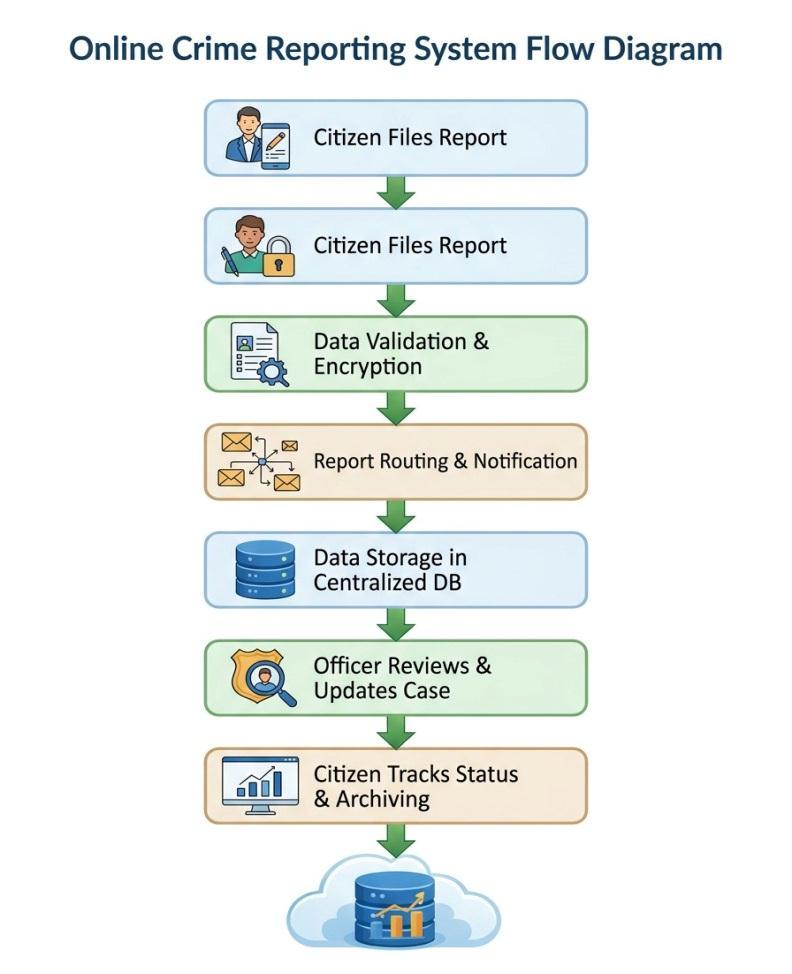
Thepresentationlayer,applicationlayer,anddatabaselayer.
1.Presentation Layer
Thisistheuserinterface.Citizensuseawebportalormobileapptosubmitreports, whilepoliceofficersusea separate dashboardtoreviewcasesandupdatestatuses.
2.Application Layer
This server-side layer handles the "work." It verifies user identities, encrypts sensitive information, and routes the reportstothecorrectpolicedepartment.
3.Database Layer
Thisisthesecuredatabasewhereallrecords userprofiles,crimedetails,anduploadedevidence(photos/videos) are storedandretrieved
1.Citizen Module (The Reporter)
Thisisthepublic-facingsideoftheapplication.Itisdesignedforeaseofuseandmaximumaccessibility.
User Registration: Securesignupusingemailorphone verification.
Report Management: Astep-by-stepformtofilenewcomplaints,includinglocation,time,andtypeofcrime.
Evidence Portal: Asecureuploadinterfaceforattachingdigitalevidence(images,audio,orvideofiles).
Personal Dashboard: A private area where users can track the real-time status of their submitted reports and communicatewithassignedofficers.
2. Police/Investigator Module (The Responder)
Thismoduleisreservedforauthorizedlawenforcementpersonnelandfocusesoncasemanagement.
Case Inbox: Aprioritizedlistofallreportsassignedtotheirspecificprecinctordepartment.
Verification Tools: Toolstoreviewsubmittedevidenceandcross-referencedetails.
Status Management: Acontrolpaneltoupdatethecaselifecycle(e.g., Under Investigation, Court Hearing, Resolved). Communication: Asecurechanneltorequestadditionalinformationorevidencefromthecitizenreporter.
International Research Journal of Engineering and Technology (IRJET) e-ISSN: 2395-0056
Volume: 13 Issue: 02 | Feb 2026 www.irjet.net p-ISSN: 2395-0072
TheAdminmoduleservesasthesystem’sbackbone,managingtheoverallframeworkandsecurity.
User & Station Management: Creating and managing police officer accounts and assigning them to specific stations/precincts.
System Auditing: Accesstologsthatshowwhoviewedoreditedacase,ensuringaccountability.
Analytics & Reporting: A high-level dashboard that generates heatmaps and statistical reports on crime trends for policy-making.
Database Maintenance: Managingbackupsandensuringthe"DataVault"remainsencryptedandfunctional.
The Security and Access Control module employs a multi- layered defense strategy to ensure the confidentiality and integrityofsensitivecriminaldata.ByimplementingRole-BasedAccessControl(RBAC),thesystemensuresthatcitizens, officers,andadministrators onlyaccess informationrelevanttotheirauthorized functions,effectivelypreventinginternal data leaks. To defend against external threats, all communications areprotected via SSL/TLS encryption, while sensitive database records are secured using AES-256 standards and BCrypt hashing for passwords. Furthermore, a permanent, timestamped Audit Trail logs every action taken within the system, ensuring high levels of officer accountability and maintainingalegallysoundchainofcustodyforalldigitalevidence.
1. Real-Time Transparency: Theautomated Tracking ID allowsvictimstomonitortheircasestatusinstantlythrougha personaldashboard,eliminatingtheinformationgapandbuildingpublictrust.
2. Error-Free Data Management: Digital entry reduces human errors common in paper records and ensures that data is storedsecurelyforlongperiodswitheasyretrievalandmanipulation.
3. Enhanced Evidence Integrity: The system provides a secure portal for uploading digital evidence (photos/videos), whicharetimestampedtoensureareliable"ChainofCustody"forlegalproceedings.
4. Operational Efficiency: Automatedcaseassignmentanddigitaldashboardsallowpolicetoprioritizeurgentincidents, reducingadministrativeworkloadandspeedingupinvestigationtimes.
5. Actionable Crime Analytics: Unlike paper files, digital data can be used to generate crime statistics and heatmaps, helpinglawenforcementidentifyhotspotsandallocateresourcesmoreeffectively.
1.Citizen Registration & Profile Module
The Citizen Module serves as the primary public-facing interface, focusing on ease of use and accessibility . It facilitates secure user registration through email or phone verification and provides a step-by-step management form for filing complaintswithspecificdetailsliketime,location,andcrimetype.ThismodulealsofeaturesasecureEvidenceVaultfor uploading digital media, such as photos and audio files, which are immediately encrypted to prevent tampering. Once a reportissubmitted,thesystemgeneratesauniqueCaseTrackingID,allowingthecitizentomonitorreal-timeprogressvia aprivatedashboardwhileensuringlegalaccountability.
2.Crime Reporting & Evidence Module
The Police and Investigator Module is reserved for authorized law enforcement personnel to manage the case lifecycle. Withinthismodule,officersaccessaprioritizedcaseinboxspecifictotheirprecinctandutilizeverificationtoolstoreview submitted digital evidence . The system allows for status management, where officers update cases from "Under Investigation" to "Resolved," triggering automated notifications to the citizen reporter . This centralized framework promotestransparencyandfacilitatescross-precinctdatasharing,whichsignificantlyimprovesorganizationalworkflow.
3. Case Management & Status Module
designedtoenablepoliceofficerstoefficientlyprocessreportsandmaintaincommunicationwithvictims.Keyfeaturesof this module include the ability for officers to view assigned cases and review all submitted evidence directly through the platform. Officers can update the case status such as "Pending," "Under Investigation," or "Resolved" which triggers automatednotificationstocitizenstokeeptheminformedofanyprogress.Thisstreamlinedapproachbenefitsthejustice process by increasing transparency for the public and significantly improving the organizational workflow for law enforcementagencies
International Research Journal of Engineering and Technology (IRJET) e-ISSN: 2395-0056
Volume: 13 Issue: 02 | Feb 2026 www.irjet.net p-ISSN: 2395-0072
The Administrator Module acts as the system's backbone by managing user credentials, station assignments, and overall system security . It provides high-level analytics, such as crime heatmaps and statistical reports, to help officials identify recurring patterns for proactive policing . Security is maintained through the Security and Access Control Module, which implementsRole-BasedAccessControl(RBAC)andMulti-FactorAuthentication(MFA)toprotectsensitivewitnessdetails. Finally, the Centralized Crime Database Module ensures the secure storage, backup, and high-speed retrieval of all historicalcriminalrecords.
Thesecurityframeworkemploysamulti-layereddefensestrategytomaintaintheconfidentialityandintegrityofsensitive criminal data. Through Role-Based Access Control (RBAC), the system ensures that citizens, officers, and administrators only access information relevant to their authorized roles, preventing internal leaks. External threats are mitigated using SSL/TLS encryption for all communications, while database records are secured with AES-256 standards and BCrypt hashingforpasswords.Apermanent,timestampedaudittraillogseverysystemactionto ensureofficeraccountabilityand alegallysoundchainofcustody.
Stages:
The operational lifecycle of the Online Crime Reporting System is divided into six distinct stages to ensure a secure and logicalflowofinformation.Theprocessbeginswiththe UserSubmissionandAuthenticationStage,wherecitizensinitiate areportviaasecureloginthatutilizesMulti-FactorAuthentication(MFA)toverifytheiridentity.Duringthisphase,users completeadigitalFIRformbyprovidingthetime,location,andcategoryoftheincident,whilethesystemperformsinitial validation to filter out duplicate or prank reports . Once authenticated, the system moves to the Evidence Capture and Encryption Stage, where supporting documentation such as images, videos, or audio clips are uploaded. To maintain a legally sound chain of custody, the platform automatically applies digital timestamping, GPS tagging, and AES-256 encryptiontothesefiles,preventinganyunauthorizedtampering.
ThethirdphaseistheAutomatedRoutingandAssignmentStage,whichuseslogic-basedroutingtodirectthereporttothe nearest police station based on the incident's geographic data . At this point, the duty officer receives a dashboard notification, and the reporter is issued a unique Case Tracking ID . This leads into the Investigation and Status Update Stage, where law enforcement officers actively process the report, record findings, and update the case status such as "EvidenceVerified"or"ChargeSheetFiled" keepingthecitizeninformedinreal-time.
As data accumulates, the Data Analysis and Hotspot Mapping Stage aggregates this information to generate weekly or monthly statistical reports and visual crime heatmaps . This enables higher officials to identify recurring patterns and transition from reactive to proactive policing . Finally, the process concludes with the Resolution and Archiving Stage, wherea final closurereport isuploadedandall casedata ismoved toa centralized database.Accesstothesearchivesis restrictedtoread-onlystatus,ensuringapermanentandsearchablerecordforfuturelegalreferencesorcourtappeals.
TheOnlineCrimeReportingSystemrepresentsavitalshifttowardamoretransparentandefficientjudicialframework.By digitizing the reporting process, the system eliminates physical barriers for citizens, ensures the integrity of evidence throughencryption,andprovideslawenforcementwithactionabledataanalytics.Ultimately,thisplatformbridgesthegap betweenthepublicandthepolice,creatinganaccountableenvironmentwherejusticeisdeliveredfasterandmorereliably.
[1] GlobalCrimeInformatics,Concepts,Methodologies,Tools,andApplications,IGIGlobal,2023.
[2] R. K. Sharma, "Digital Transformation of Law Enforcement: A Review on E-FIR Implementation and Challenges," InternationalJournalofLawandInformationTechnology,vol.28,no.1,pp.30–55,2021.
[3] S. Mehta and P. Verma, "Design and Development of a Web-Based Crime Reporting and Management System," InternationalJournalofComputerApplications,vol.182,no.14,pp.25–32,2020.
[4] National Crime Records Bureau (NCRB), Digitalization of Police Records and Evidence Management Guidelines, NewDelhi,2022.
International Research Journal of Engineering and Technology (IRJET) e-ISSN: 2395-0056
Volume: 13 Issue: 02 | Feb 2026 www.irjet.net p-ISSN: 2395-0072
[5] K.Gupta,"ElectronicCaseManagement: Secure Digital FIR Systems," Journal of Forensic and Legal Medicine, vol. 45,no.10,pp.115–128,2019.
[6] A. Roberts, J. Miller, and S. Khan, "Implementing E-Government Portals in Public Safety: A Systematic Literature Review,"JournalofPublicAdministrationandTechnology,vol.16,article410,2018.
[7] L.ChenandB.Wright,"OnlineCrimeReportingSystems ScopeandFunctionalities: LiteratureReviewandFuture Directions,"JournalofCyberSecurityandLaw,vol.22,no.8,e412,2021.
[8] N.Hassanetal.,"Processing ofElectronicPolice RecordsforData-DrivenPolicing inUrbanCenters: Methods and Validation,"InformaticsforPublicSafety,vol.7,no.3,e11244,2022.
[9] A.HossainandM.Rahman, "NaturalLanguageProcessinginCrimeReportsforAutomatedCaseCategorization:A SystematicReview,"arXiv,2024.
[10] A. Naidu Chitikela, "Secure and Transparent Crime Record Management System Using Python and Blockchain Technology,"InternationalJournalofInnovativeResearchinTechnology,vol.11,no.4,pp.88–95,2024.
BIOGRAPHIES
MS.RADHIKA YADAV
PursuingPoly(Co)
S.Y.PSHREEYASHCOLLEGEOFENGINEERING ANDTECHNOLOGY (POLYTECHNIC)
MS.VAISHNAVIPOTDUKHE
PursuingPoly(Co)
S.Y.PSHREEYASHCOLLEGEOFENGINEERING ANDTECHNOLOGY (POLYTECHNIC)
MS.DIPALI ATHAWALE
PursuingPoly(Co)
S.Y.PSHREEYASHCOLLEGEOFENGINEERING ANDTECHNOLOGY (POLYTECHNIC)
MS.SHRUTIKABANKAR
PursuingPoly(Co)
S.Y.PSHREEYASHCOLLEGEOFENGINEERING ANDTECHNOLOGY (POLYTECHNIC)
PROF. KALYANI KAHANDAL
PROFESSER,Dept.ofComputerEngineering
S.Y.PSHREEYASHCOLLEGEOFENGINEERINGAND TECHNOLOGY(POLYTECHNIC)