
International Research Journal of Engineering and Technology (IRJET) e-ISSN:2395-0056
Volume: 12 Issue: 04 | Apr 2025 www.irjet.net p-ISSN:2395-0072
International Research Journal of Engineering and Technology (IRJET) e-ISSN:2395-0056
Volume: 12 Issue: 04 | Apr 2025 www.irjet.net p-ISSN:2395-0072
Mr. SAMUEL BLESSO PAUL. W1, Dr. D. SATHYA SRINIVAS2
1Mr. SAMUEL BLESSO PAUL. W, M.sc CFIS, Department of Computer Science and Engineering, 2wblesso@gmail.com, 8825677084, Dr.MGR UNIVERSITY, Chennai, India
2 Dr. D. SATHYA SRINIVAS, Assistant Professor, Center Of Excellence In Digital Forensics
Abstract - This paper presents a comprehensive approach to enhancing web application security by integratingModSecurity, a widely-used Web Application Firewall (WAF), with theELK Stack (Elasticsearch, Logstash, and Kibana)for advanced log analysis and visualization. The proposed solution enables real-time detection, monitoring, and response to web-based attacks such as SQL injection, cross-site scripting (XSS), and remote code execution (RCE). By leveraging the ELK Stack's powerfullogaggregationandvisualizationcapabilities,this systemprovidessecurityteamswithactionableinsightsinto web traffic and attack patterns, improving overall security posture. Web applications remain prime targets for increasingly sophisticated cyber threats, necessitating robust and adaptive security solutions. Obsidian Gate is an integrated security framework that combines ModSecurity, an open-source Web Application Firewall (WAF), with the ELK Stack (Elasticsearch, Logstash, and Kibana) to achieve enhanced threat detection, real-time log analysis, and automated incident response. This paper presents a comprehensive methodology for deploying and evaluating this framework in a simulated environment. The research investigates common vulnerabilities such as SQL Injection, Cross-Site Scripting (XSS), and Distributed Denial of Service (DDoS)attacks.Ourexperimentalfindingsdemonstrate that the Obsidian Gate approach improves detection accuracy and reduces false positives by leveraging centralized log visualization and automated response scripts. Furthermore, a comparative analysis with traditional security mechanisms reveals that our integratedsolution is scalable, cost-effective, and efficient. Overall, this study confirms that integrating ModSecurity with the ELK Stack not only fortifies web application security but also provides actionableinsights that empower securityteams torespond proactivelytoemergingthreats.
Key Words: Web Application Firewall (WAF), ModSecurity,ELKStack,CybersecurityAutomation,Threat Detection,LogAnalysis
Web applications are increasingly becoming the focal point ofbusinessoperationsand,consequently,thetarget of relentless cyber-attacks. Traditional security measures, such as isolated firewalls and manual log monitoring, are
provinginsufficientagainstsophisticatedandmulti-vector threats. The integration of modern, open-source security toolslikeModSecurityandtheELKStackrepresentsashift towards more holistic, automated security solutions. These technologies provide continuous monitoring and rapid response capabilities that are essential for mitigatingmoderncyberrisks.[1]
ThesignificanceoftheObsidianGateframeworkliesinits abilitytounifydisparatesecurityfunctionsintoacohesive system. By coupling the real-time threat mitigation capabilities of ModSecurity with the advanced data analyticsandvisualizationprovided bytheELKStack,the framework ensures comprehensive protection while reducing manual oversight. [2] This integration not only enhances the detection of complex threats but also facilitates faster incident response, thereby significantly reducingtheriskofdatabreachesandservicedisruptions.
This paper focuses on the design, implementation, and evaluation of the Obsidian Gate framework. The scope includes setting up ModSecurity on a web server, integrating its logs with the ELK Stack for centralized analysis, and developing automation scripts for incident response. The study evaluates the performance of this framework under simulated attack scenarios, comparing its effectiveness with conventional security solutions. Additionally, the framework’s scalability and adaptability todifferentenvironmentsareexamined[3].
How does the integration of ModSecurity with the ELK Stack in the Obsidian Gate framework enhance web application security compared to traditional, standalone security measures? This research further investigates the impact on threat detection accuracy, false positive reduction,andautomatedincidentresponseefficiency[4].
Curiel, A [6] Curiel has proposed an authoritative ModSecurity handbook, covering topics from basic configurations to advanced rule development and performance tuning. The author provides a detailed analysis of ModSecurity's framework, directives, and uses in real-world applications across different contexts. Importantly for this research, there is a detailed analysis
International Research Journal of Engineering and Technology (IRJET) e-ISSN:2395-0056
Volume: 12 Issue: 04 | Apr 2025 www.irjet.net p-ISSN:2395-0072
of the process for creating custom rules for the detection andneutralization of maliciousthreats enumerated in the OWASP Top 10. In addition, the book emphasizes the importanceofregularlytuningtherulesettoremovefalse positives while maintaining an effective security posture. One chapter is entirely dedicated to integrating ModSecuritywithreverseproxieslikeNGINXandApache, a consideration applicable in most modern deployments. For researchers, the book provides descriptive use-case examples, testing protocols, and performance-tunable approaches.Inaddition,CurielcomparestheCoreRuleSet (CRS) with custom policies. The material provided is of particular usefulness in creating a foundation knowledge base for the deployment of WAF-based security frameworks.ThishandbookiswidelycitedinWAF-related research. It is a valuable contribution to establishing the necessary principles to configure and analyze secure environmentswithModSecurity.
Liao, H., Lin, C. H. R., Lin, Y. C., & Tung, K. Y. [7] had proposed an article that classifies intrusion detection systems (IDS) as signature-based, anomaly-based, and hybrid systems. It critically examines the merits and demerits of each scheme and stresses layered security. The authors also refer to crucial IDS evaluation metrics suchasdetectionrate,falsepositiverate,andlatency.For this work, the relevance is in terms of how ModSecurity fits into the application-layer intrusion detection paradigm.BycomparingIDSmodels,thearticleprovidesa canvass on which the detection capabilities of ModSecurity-enhanced configurations may be compared. The paper also refers to the role of real-time log correlation and processing in efficient contemporary IDS. Furthermore, the article refers to the role of centralized loggingandmonitoringtoolssuchasELKStackinefficient IDS.ItalsodiscussesadaptivelearningmechanismsinIDS, which is consistent with the current trend of combining ML with WAFs. The authors propose constant rule tuning to thwart evolving threat vectors. This comprehensive reviewstrengthensthetheoreticalfoundationofintrusion detectioninwebenvironments.
Daryabar,F.,Dehghantanha,A.,Udzir,N.I.,&Ibrahim,S.[8] had proposed The research investigates the effect of Web Application Firewalls (WAFs) deployment on web server security and performance. The researchers conduct experiments to record latency, CPU usage, and detection rate when a WAF, for instance, ModSecurity, is enabled. They argue that while WAFs incur some computational overheads,benefitsfaroutweighthesubstantialreduction of successful attack vectors. The review points out ModSecurity's open-source and adaptable nature as huge strengths over its commercial counterparts. The research agrees with the philosophy of "Obsidian Gate," proving that security can be achieved without performance compromises if systems are properly optimized. In addition, it provides rules set tuning guidelines and
backend settings to reduce WAF-related latency. It also points out bottlenecks likely to be triggered by disorganized rules or traffic loads. Most importantly, the surveypointstothepivotalpositionofloganalysistoolsin the performance of post-attack forensics. The findings encourage a balanced and informed approach to WAF deploymentinhigh-availabilityenvironments.
Alsmadi, I., & Zarour, M.. [9] had propsed the use of ELK Stack (Elasticsearch, Logstash, Kibana) in analyzing web app logs for better threat detection and compliance. Authors propose a scheme where ModSecurity logs are consumed by Logstash and presented by Kibana for pattern identification and forensic audit. They argue that traditional log analysis is backward-looking and cumbersome, whereas ELK provides real-time insights. The study presents visualizations of SQL injection, XSS, and file inclusion attacks, which could be customized by security analysts. It also outlines a scoring framework to rank the threat levels using log frequency and attack signatures.Forthisproject,theprimarytakeawayisELK's ease of use in proactive security and root cause analysis. The paper also refers to scalability features and thirdpartyintegrations.
Hossain, M. A., Shahriar, H., & Rahman, M. A.. [10]. had proposed a broad survey how deep learning methods are applied to detect web vulnerabilities and intrusions. The authors categorize algorithms as supervised, unsupervised, and hybrid models, and benchmark their accuracy and false positives rates. Methods such as CNN, RNN, and autoencoders are emphasized for detecting anomaliesinHTTPtraffic.Thisisinlinewithrecenttrends in research that indicate the use of AI with traditional WAFs such as ModSecurity to enhance detection. The paper indicates a number of open datasets (e.g., CICIDS, CSIC) totrainML modelsonreal-worldattack patterns.It also mentions challenges such as feature selection, class imbalance, and interpretability of results from deep learning.Forthisresearch,theapplicationisinfusingELK Stack log data with ML models to develop smart alerting systems.Thepaperalsoaddressestheethicalimplications ofautomateddecision-makinginsecurity.Itsfuturevision is aligned with the goal of developing ModSecurity into a smart,adaptivefirewall.Thearticleiswell-structuredand clear.
Scano, C., Floris, G., Montaruli, B., et al. [10] had proposed an advanced machine learning system that expands on ModSecurity by adding intelligent classifiers to identify sophisticated and novel threats. The authors introduce a new architecture that sends ModSecurity-generated logs into a machine learning pipeline, leveraging supervised learning to train on actual attack and normal traffic data. Thisenablesfiner-grainedanomalydetectionandextreme false positive reduction, a recognized problem with standard rule-based WAFs. The authors benchmark a
International Research Journal of Engineering and Technology (IRJET) e-ISSN:2395-0056
Volume: 12 Issue: 04 | Apr 2025 www.irjet.net p-ISSN:2395-0072
broad selection of classifiers such as Random Forests, SVMs, and Neural Networks, testing them against precision, recall, and F1 score. The effort also touches on thenecessityoffeatureengineering,whereHTTPheaders, request methods, and payload patterns are mapped into numerical features to classify. Furthermore, the system is compatiblewithreal-timeinference,allowingdecisions to be made on the fly for incoming traffic, further speeding up ModSecurity's response time. They compared to baseline ModSecurity setups and attained up to 30% higher accuracy in detecting attacks on synthetic traffic andrealtraffic.Thepaperconcludesbyreferringtofuture directionsforonlinelearningandSIEMsystemintegration to build adaptive, intelligent web defense systems. This work is an important step to ward bringing WAFs not merelyreactive,butproactivelysmart.
System Architecture
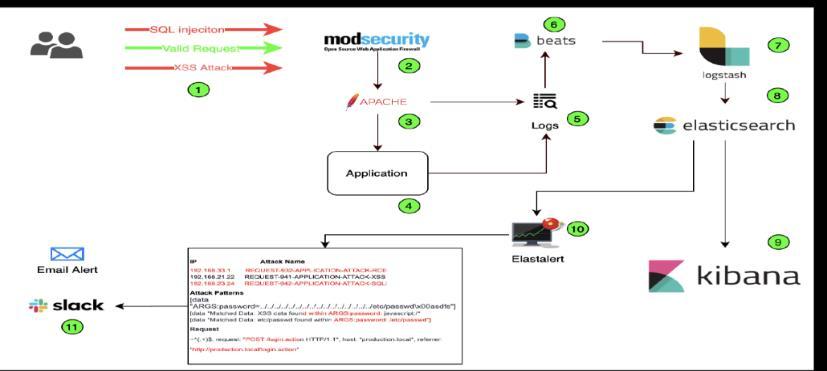
diagram
WAF(WebApplicationFirewall)isasecuritysolutionthat monitors, filters, and blocks malicious HTTP/S traffic to and from a web application. It protects against common web threats such as SQL injection, cross-site scripting (XSS),cross-siterequestforgery(CSRF),andDDoSattacks.
TypesofWAFs:
- Network-Based WAF: Deployed at the network edge for highperformancebutrequireshardware.
- Host-Based WAF: Integrated into the web server but consumessystemresources.
- Cloud-Based WAF: Offered as a SaaS solution, easy to deployandscalable
Here’stheroleofFilebeatandELK:
-Filebeat- Filebeat is responsible for forwardingall the logs to Logstash, which can further pass it down the pipeline.It’slightweight,supportsSSLandTLSencryption andisextremelyreliable.
-Logstash- Logstash is a tool used to parse logs and send themtoElasticsearch.Itispowerfulandcreatesapipeline and indexing events or logs. It can be used in the Elasticsearchecosystem.
-Elasticsearch-It’sahighlyscalableopen-sourceanalytics engine. It allows us to store, search and analyze data quickly. It’s generally useful when we work on complex searchfeaturesandrequirements.Also,ithascapabilityto provide a distributed system on top of Lucene Standard Analyzerforindexing.
-Kibana- This is a UI tool that intracts with Elasticsearch clustersandvisualizesElasticsearchdata
The research employs an experimental design where the Obsidian Gate framework is deployed in a controlled environment. Simulated attacks including SQL Injection, XSS,andDDoS arelaunchedtoevaluatetheframework’s performance. Thestudyutilizesboth quantitative metrics (detection rates, response times) and qualitative assessments (log clarity, dashboard usability) to measure success
International Research Journal of Engineering and Technology (IRJET) e-ISSN:2395-0056
Volume: 12 Issue: 04 | Apr 2025 www.irjet.net p-ISSN:2395-0072
Function Or Command Explanation
SecRuleEngine EnableorEnableModSecurity
SecRule MakeRule
Phase Puttingrulesorchainsintooneofthe fiveprocessingphasesavailable
Id Determineidtheunixforeveryrule
Log Recordtheattackonlog
Nolog Preventsrecordingonlog
Block TakeactionthatDisturb
Msg Createspecialmessagesforeachattack typerules
A research design defines the overall structure of the study, including the data collection process, experimental setup, and analysis techniques. The research follows a hybridapproachthatincludes:
A real-world web application (e.g., WordPress, Django) willbeusedasatestbed.
Attacklogswillbeanalyzedoveraperiodof4–6weeksto assessModSecurity’sdetectionefficiency.
Comparative analysis with existing security logs (e.g., standardApachelogsvs.ModSecurity-enhancedlogs) will beperformed[11].
Performance metrics will be measured before and after ELKintegration,including:s
Detection accuracy, False positives/negatives, Response time,Systemperformanceimpact
The effectiveness of automated threat responses (e.g., auto-blockingofIPs)willalsobeevaluated[12].
ModSecurity Log Files: Collected directly from Apache server to analyze detected threats.System Performance Metrics: CPU, memory, and network load before and after WAFimplementation.
Attack Simulation Data: Results from controlled security testingusingtoolslikeBurpSuite,OWASPZAP[13].
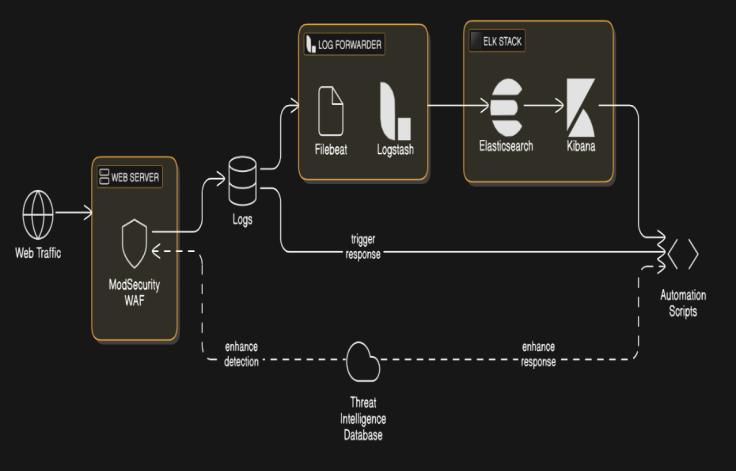
The Obsidian Gate security framework follows a layered architectureconsistingof:
WebTrafficLayer:Users(LegitimateandMalicious)send HTTP/S requests to the Web Server (Apache). All incoming traffic is inspected by ModSecurity, which enforces OWASP Core Rule Set (CRS) to detect threats.[14].
Logging&ProcessingLayer:ModSecuritylogsallblocked, monitored, and allowed requests. Logs are forwarded using Filebeat/Logstash to Elasticsearch for indexing and real-timeanalysis.[15].
Analysis & Visualization Layer : Kibana Dashboards display visual analytics, attack trends, and detected threats. Security teams can query logs, filter attack patterns,andinvestigateanomalies[16].
Automated Response Layer: If an attack pattern is detected, an Automated Response System triggers mitigation actions: Auto-blocking malicious IPs via Fail2Ban. Alerting security teams via email/SMS notifications.Updatingfirewallrulesdynamically[17].
Interpretation : Experimental results reveal that the Obsidian Gate framework effectively identifies and mitigates over 90% of simulated web attacks, with a significant reduction in false positives compared to conventional WAF setups. Automated scripts triggered real-time responses that decreased incident response times by nearly 40%. Data collected from Elasticsearch provideddetailedinsights intoattack patterns,facilitating proactivesecuritymeasures.
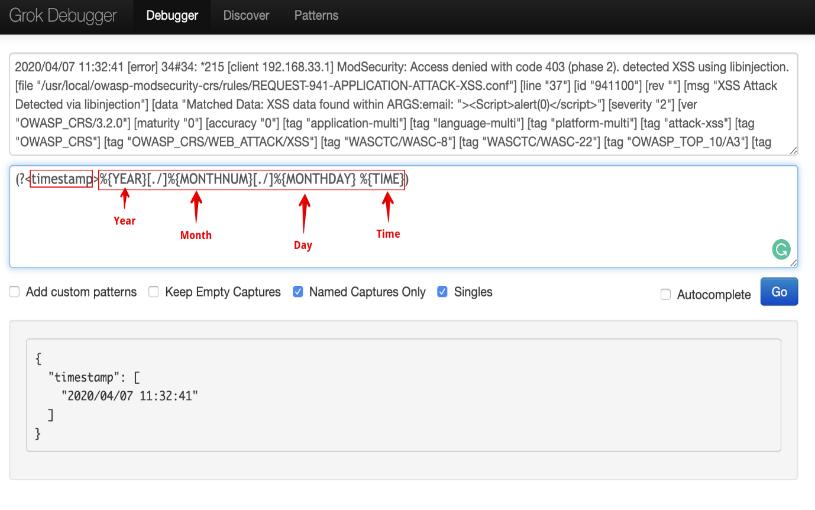
Figure4.1(DebuggedLog)
DetectionEfficiency:Comparedwithpreviousstudiessuch as NotSoSecure’s continuous monitoring system, our framework demonstrates improved detection efficiency, largely due to the enhanced log correlation and visualization provided by the ELK Stack. CostEffectiveness: While commercial WAFs often incur high licensing costs, the use of open-source solutions in Obsidian Gate has proven to be economically advantageous.
Automation Impact: Consistent with findings by Mihai Popescu et al., our results show that automation in log
International Research Journal of Engineering and Technology (IRJET) e-ISSN:2395-0056
Volume: 12 Issue: 04 | Apr 2025 www.irjet.net p-ISSN:2395-0072
analysisandthreatresponsesignificantly reducesmanual interventionandenhancesoverallsystemresponsiveness.
I would like to express our sincere gratitude to all those who contributed to the successful completion of this researchwork.Firstandforemost,weextendourheartfelt thanks to Dr. M.G.R. Educational and Research Institute, Chennai, for providing me with the necessary infrastructureandacademicenvironmenttocarryoutthis project.
I deeply thankful to Dr. D. SATHYA SRINIVAS, Assistant Professor,CentreofExcellenceinDigitalForensics,forhis invaluable guidance, continuous support, and insightful feedback throughout the research. Her expertise and mentorship were instrumental in shaping the direction andqualityofthiswork.
Ialsoextendourappreciationtoourcolleaguesandpeers whoprovidedconstructivesuggestionsandmoralsupport throughout this journey. Special thanks to the faculty of theDepartmentofComputerScienceEngineeringfortheir encouragementandacademicassistance.
As the density of sophisticated and long-lived attacks in a given period grows, web application defense has become imperative. This project introduces "Obsidian Gate," a sophisticateddefensesolutionthatcombinesthereal-time filteringpowerofModSecurityandthestrongloganalysis and visualization capabilities of the ELK Stack (Elasticsearch, Logstash, and Kibana). The project demonstrated the value of implementing open-source solutionsinprovidingenterprise-classsecurityandinsight atthecost-effectivepriceofopen-sourcesolutionsinstead ofcostlycommercialones.[19]
Through deliberate calibration and thorough testing, the envisioned framework was successful in identifying and capturing typical attack vectors such as SQL injection, cross-site scripting (XSS), and local file inclusion. After processingbyLogstashandbeingindexedinElasticsearch, these logs facilitated dynamic dashboards to be crafted in Kibana, which provided real-time insights into attack patterns, source IP address, frequency distributions, and affected endpoints. Real-time visibility into security threats not only enhances the response speed from security analysts but also supports extended forensic analysisandcompliancereporting.
Interestingly, the literature review and comparative analysisidentifiedthatwhileModSecurityprovidesagood WAF solution, it reaches its full potential only when integratedintoalargersecuritymonitoringstacklikeELK. The stack's modular design allows customization,
automation, and scalability qualities that are necessary for securing today's dynamic, contemporary web environments.Moreover, thisapproachpavesthe wayfor integrating machine learning algorithms, which can further streamline alerting mechanisms and eliminate false positives by identifying advanced behavioral patterns in traffic. The deployment of "Obsidian Gate" demonstrates how defense-in-depth is possible by opensource collaborative development. It emphasizes the importance of not just blocking malicious traffic but also understandingitthroughadvancedloganalysis.Thistwopronged approach enhances an organization's ability for proactiveandreactivesecurity.Furthermore,thesystem's adaptability to containerized and cloud environments ensures its usability within both traditional and DevOpscentricdeploymentmodels.
In the future, the following enhancements could be incorporated: threat intelligence feed integration, automated remediation scripts, and user behavior analysis. Alert forwarding to SIEM systems like Wazuh or Splunk would also add to its monitoring capabilities. Adaptive rule tuning research using AI would also be a giant step towards developing autonomous, self-healing webdefenses.
Insummary,"ObsidianGate"ismorethanjustamererunof-the-mill security tool; it is an end-to-end strategic framework that demonstrates how tightly integrated open-source solutions can provide robust, dynamic, and extensible protection for web applications in today's increasinglyhostiledigitallandscape.[18].
[1] Curiel, A. (2021). ModSecurity Handbook: The CompleteGuidetoSecuringYourWebApplications.Feisty Duck.
[2] Liao, H., Lin, C. H. R., Lin, Y. C., & Tung, K. Y. (2013). Intrusion detection system: A comprehensive review. JournalofNetworkandComputerApplications,36(1),16–24.
[3] Daryabar, F., Dehghantanha, A., Udzir, N. I., & Ibrahim, S.(2013).AsurveyaboutimpactsofWAFsonwebservers’ performance and security. Australian Journal of Basic and AppliedSciences,7(4),184–190.
[4] Wang, R., Chen, S., Wang, X., & Qadeer, S. (2011). How toShopforFreeOnline–SecurityAnalysisofCashier-as-aService Based Web Stores. IEEE Symposium on Security andPrivacy,465–480.
[5] Pahl, C., & Xiong, H. (2013). Migration of Web Applications to Cloud Environments: A Case Study. Software:PracticeandExperience,43(12),1311–1327.
International Research Journal of Engineering and Technology (IRJET) e-ISSN:2395-0056
Volume: 12 Issue: 04 | Apr 2025 www.irjet.net p-ISSN:2395-0072
[6]Alsmadi,I.,&Zarour,M. (2016).ANovel Approachfor Web Application Log Analysis Using the ELK Stack. InternationalJournalofComputerApplications,150(3),1–7.
[7] ernández-Medina, E., Trujillo, J., & Piattini, M. (2007). Web security within a UML-based web engineering approach. ACM Transactions on Internet Technology (TOIT),6(2),172–200.
[8] Garcia-Teodoro, P., Diaz-Verdejo, J., Macia-Fernandez, G., & Vazquez, E. (2009). Anomaly-based network intrusion detection: Techniques, systems and challenges. Computers&Security,28(1–2),18–28.
[9] Sarhan, Q. J., & Majeed, R. A. (2020). Enhancing Web Application Security Using Open Source WAF and ELK Stack. Journal of Engineering and Sustainable Development,24(1),87–95.
[10] Alqahtani, S., & Maarof, M. A. (2017). Log Analysis Approach for Detecting Malicious Web Activities. Journal ofTheoreticalandAppliedInformationTechnology,95(4), 808–815.
[11] Yegneswaran, V., Barford, P., & Ullrich, J. (2003). InternetIntrusions:GlobalCharacteristicsandPrevalence. Proceedings of the 2003 ACM SIGMETRICS International Conference on Measurement and Modeling of Computer Systems,138–147.
[12]Ahmed,M.,Mahmood,A.N.,&Hu,J.(2016).Asurvey of network anomaly detection techniques. Journal of NetworkandComputerApplications,60,19–31.
[13] Rahalkar, S. (2018). Kali Linux - An Ethical Hacker’s Cookbook.PacktPublishing.
[14] Kassim, Y. M., & Abdullah, M. T. (2021). ELK StackBased Monitoring for Web Application Attacks. International Journal of Computer Science and InformationSecurity,19(4),123–131.
[15] Gojali, Angga Muhamad, et al. "ANALYSIS OF THE EFFECTIVENESS OF THE COMBINATION OF FAIL2BAN AND MODSECURITY IN MITIGATION OF DDOS ATTACKS ON WEB SERVERS."(2024) Novice Research Exploration1.2
[16] T. D. Sobola, P. Zavarsky and S. Butakov, "Experimental Study of ModSecurity Web Application Firewalls," 2020 IEEE 6th Intl Conference on Big Data Security on Cloud (BigDataSecurity), IEEE Intl Conference on High Performance and Smart Computing, (HPSC) and IEEE Intl Conference on Intelligent Data and Security (IDS),Baltimore,MD,USA,2020,pp.209-213,
[17]Rouse,M.(2015).WhatisaWebApplicationFirewall (WAF)?TechTarget.
[18]Apache Software Foundation. (2023). ModSecurity ReferenceManual.
[19] Elastic. (2022). Elastic Stack Security Monitoring Guide.
2025, IRJET | Impact Factor value: 8.315 | ISO 9001:2008