
International Research Journal of Engineering and Technology (IRJET) e-ISSN:2395-0056
Volume: 12 Issue: 04 | Apr 2025 www.irjet.net p-ISSN:2395-0072
International Research Journal of Engineering and Technology (IRJET) e-ISSN:2395-0056
Volume: 12 Issue: 04 | Apr 2025 www.irjet.net p-ISSN:2395-0072
Ankita Falldessai1 , Prof. Amogh Sanzgiri2
1Student, Department of Information Technology and Engineering, Goa College of Engineering, Farmagudi, Goa, India
2AssistantProfessor, Department of Information Technology and Engineering, Goa College of Engineering, Farmagudi, Goa, India ***
Abstract - Object detection and change detection in satellite imagery play a key role in environmental monitoring, urban planning, and disaster response. This projectusesdeeplearningtechniquestoenhanceaccuracy in identifying changes over time. Initially, K-means clusteringandkernel-basedmethodswereusedforimage segmentation.Later,aSiameseNeuralNetwork(SNN)was implemented to compare satellite image pairs and detect structuraldifferenceseffectively.
To improve detection, a Siamese Attention U-Net (SNNAUNet)wasintroduced,whichusesattentionmechanisms to capture fine spatial and contextual details. This approach handles challenges like noise, scale variation, and complex structures, providing accurate insights into land cover and infrastructure modifications. The system supports better decision-making across domains like agriculture, urban development, and disaster management
Key Words: Satellite Imagery, Change Detection, Siamese Neural Network, Attention Mechanism, Deep Learning
1.INTRODUCTION
Satellite image analysis stands as a vital component in understanding Earth’s dynamic surface, offering deep insights into land cover changes, infrastructure growth, and environmental transformations. The use of satellite imagery has proven indispensable in domains such as urban planning, agriculture, and disaster response, enabling timely decisions through large-scale visual data. Thisprojectaimstoexplorethepotentialofdeeplearning for object detection in satellite images, focusing on identifyingmeaningfulchangesovertime.
Thetraditionalmethodsusedforimagesegmentationand featureextraction,suchasK-meansclusteringandkernelbased techniques, offer foundational insight but often fall short when addressing scale variation, image noise, and structural complexity. To overcome these limitations, the system integrates an advanced Siamese Attention U-Net (SNN-AUnet),leveragingattentionmechanismstocapture fine-grainedspatialfeaturesandcontext.Acustomdataset comprising 1,000 image pairs from Google Earth Engine
was curated, ensuring variety across urban, agricultural, andinfrastructurallandscapes.
By adopting this approach, the system not only enhances accuracy but also contributes to scalable, automated change detection. The attention-driven model ensures improvedinterpretabilityandadaptabilityacrossdifferent geospatial contexts, positioning this project as a meaningful contribution to sustainable development and real-timeenvironmentalmonitoring.
Theprimaryaimofthisprojectistodevelopanintelligent system capable of automatically detecting changes in satellite images using deep learning techniques. This systemisdesignedtocomparesatelliteimagescapturedat different time intervals and accurately identify regions where significant transformations have occurred. These changes may include urban development, environmental alterations,ordamageresultingfromnatural disasters.To fulfill this goal, the project employs advanced neural network models specifically, Siamese Neural Networks (SNN) and Siamese Attention U-Net that are well-suited for analyzing paired satellite images. These models are structuredtoextractandcomparedeepfeaturesfromtwo inputimages,enablingthedetectionofsubtleandcomplex changes with high precision. The integration of attention mechanisms enhances the system’s ability to focus on relevant spatial features while minimizing noise and irrelevantdata.
The core objectives of the project include designing a robust framework that applies deep learning to detect visualdifferencesbetweenmulti-temporalsatelliteimages, enhancing the model's accuracy through attention-based feature refinement, reducing false detections via deep contextual analysis, and building a scalable solution that operates efficiently on large datasets without manual intervention. By automating the change detection process, this project contributes to critical applications in areas such as urban planning, environmental monitoring, and disaster management. Ultimately, the system aims to provide decision-makers with timely, accurate, and actionableinsightsderivedfromsatelliteimagery,enabling more informed and effective responses to dynamic realworldchanges
International Research Journal of Engineering and Technology (IRJET) e-ISSN:2395-0056
Volume: 12 Issue: 04 | Apr 2025 www.irjet.net p-ISSN:2395-0072
This project utilizes a deep learning-based framework to automatically detect and analyze changes in satellite imagery captured at different time intervals. The core methodology involves comparing two temporally distinct satellite images to identify areas where significant transformationshaveoccurred.Thesechangesmayinclude urban expansion, deforestation, environmental shifts, or damage caused by natural disasters. To achieve this, a comprehensive pipeline is implemented, combining SiameseNeuralNetworks(SNN)andSiameseAttentionUNet architectures both designed to process paired satellite images and detect fine-grained pixel-level differences
The process begins with data collection and preprocessing, where a set of satellite image pairs is gathered and spatially aligned to ensure consistency. Preprocessing techniques such as resizing, normalization, image augmentation (e.g., flipping or rotation), and patch generation are applied to prepare the dataset for training. The methodology involves deploying two distinct deep learningarchitecturesforcomparison:thefirstisaSiamese Neural Network comprising two identicalconvolutional branches that independently process the image pair while sharing weights, allowing feature comparison; the second is Siamese Attention U-Net, which builds upon the basic Siamese framework by incorporating an encoder-decoder structureenhancedwithattentionmechanismstofocuson the most relevant spatial features, thereby improving detectionaccuracy.
Once the data is preprocessed and the models are selected, the training phase begins. Both models are trained using labeled imagepairs and theircorresponding binarychangemaps,whichindicateregionsofchangeand no change. Loss functions such as Binary Cross Entropy and Dice Loss are used to reduce prediction errors, while optimizationisachievedthroughtechniquesliketheAdam optimizer andlearning rateschedulers.Duringthe change detection stage, the aligned satellite images are input into the trained model, where feature maps are extracted and comparedtogenerateeitherbinaryorprobabilisticchange mapshighlighting modifiedregions.Model performanceis then evaluated using metrics such as accuracy, precision, recall, F1-score, and Intersection over Union (IoU) to assess the correctness and completeness of the detected changes.
Finally,theresultsarevisualizedusingbinarymasksor color overlays on the original images to clearly represent theareasofchange.Thesevisualoutputscanbeappliedin practical scenarios such as environmental monitoring, infrastructure planning, or disaster damage assessment, making the system valuable for real-world decisionmakingandgeospatialanalysis
The dataset used in this projectcompriseshigh-resolution satellite images captured across different years, allowing for effective detection of temporal changes in selected regions of Goa. The images offer excellent spatial resolution, enabling detailed observation of both natural and man-made transformations in the landscape. To further enhance the analysis, multi-spectral data including Red, Green, Blue (RGB), and Near-Infrared (NIR) bands were utilized. These spectral bands are crucial in identifying and highlighting changes related to urban development,vegetationcover,andwaterbodies.
The region of interest primarily focuses on areas in Goa that are undergoing significant infrastructure and environmental changes. Notable locations include the Manohar Parrikar Atal Setu (bridge over the Mandovi River), the New Zuari Bridge, and the Mopa International Airport (Manohar International Airport). The dataset also covers the South Goa District Hospital redevelopment (Hospicio),theGMCCancerBlockatGoaMedicalCollegein Bambolim,variousroadexpansionsites,newlyconstructed temples and religious structures, as well as regions experiencing deforestation and the transformation of agricultural land. These carefully selected areas offer a diverseandrelevantsamplesetfortrainingandevaluating thedeeplearningmodelsforchangedetection.
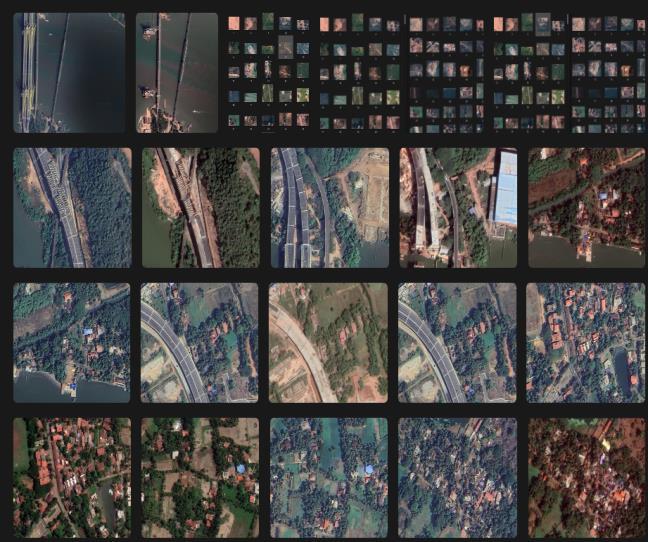
Fig -1: DatasetGenerated
Table -1: KeyChallengesingeneratingdataset
Challenge Resolution
ManualSnapshotting Imagescapturedmanuallyfrom GEEforspecificsectorsnot availableaspre-packaged datasets
CloudandShadowNoise HandledusingGEE’scloud maskingbeforeexportand morphologicalfiltersafter modelprediction.
International Research Journal of Engineering and Technology (IRJET) e-ISSN:2395-0056
Volume: 12 Issue: 04 | Apr 2025 www.irjet.net p-ISSN:2395-0072
ImageAlignment
DataImbalance
Spatialconsistencyensuredin GEEbeforecapturingpaired images.
Augmentationtechniqueslike flippingandrotationappliedon minoritysamples
ComputationalLoad PCAandpatchingstrategyused toreducememoryandtime complexity.
TheproposedsystemforSatelliteImageChangeDetection usingSiameseAttentionU-Net(SNN AUNet) was evaluated using a custom-created dataset consistingof1,000imagepairs,collected via Google Earth Engine. Each pair consists of a "before" and"after"imageofthesamegeographic region capturing sectors such as agriculture, infrastructure,andurbandevelopment.
The objective of this phase was to evaluate the model’s capabilitytodetectmeaningfulchanges betweensatelliteimagepairsandrepresentthemthrough clearlyvisualizedoutputs.
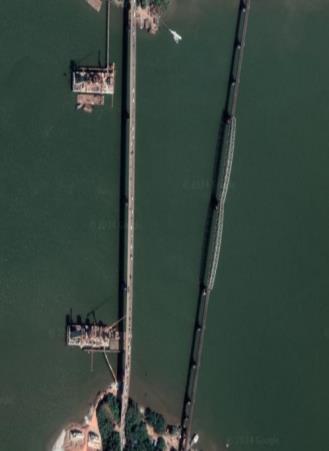
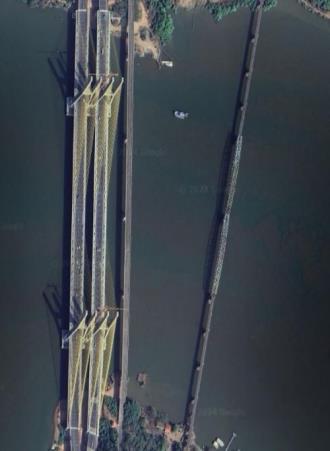
This model provides a scalable and efficient solution for geospatial change monitoring. When applied to diverse domains such as urban planning, agriculture, disaster management, or deforestation tracking, the insights generatedcanserveascriticaldecision-makingtools.
Unliketraditionalimagecomparisonmethods,theSiamese Attention U-Net enhances context-aware learning by comparing deep feature embeddings, making it robust
against minor variations like brightness, shadows, or seasonalcolorchanges.
The performance of various change detection methods was evaluated based on model type, accuracy, and visual results. Among the classical unsupervised techniques, KMeans Clustering offered a fast and straightforward approach for identifying major changes but lacked the precision needed for finer analysis. The combination of PCA and Morphological Operations helped emphasize large-scale transformations but failed to capture subtle changeseffectively.
On the other hand, Siamese Neural Network (SNN), a supervised deep learning model, showed a significant improvement in accuracy (~80%) for binary change detection tasks. However, it was limited by its inability to providedetailedpixel-leveloutputs.
Themostadvancedmodel,SiameseAttentionU-Net(SNNAUNet),demonstratedthehighestvisualaccuracyandwas capable of generating precise change maps with finegrainedspatialdetail.Itsattentionmechanismallowedthe network to focus on critical regions, making it the most reliable choice for satellite image change detection in this study.
Table -2: ComparisonofChangeDetectionMethods
Method ModelType Accuracy/ Performance Remarks
K-Means Clustering Unsupervised (Classical) Moderate (VisualOnly) Simpleand fast,but lacksfine precision
PCA+ MorphOps Unsupervised (Classical) Lowto Moderate Highlights patterns butmisses small changes
SNN Supervised (Deep Learning) ~80%ontest data Goodbinary detection, lackspixel detail
SNN-AUNet Supervised (Deep Learning) High accuracy (visually precise) Best performanc e;accurate pixel-level output
The proposed Satellite Image Change Detection system using Siamese Attention U-Net (SNN-AUNet) has demonstrated a high level of accuracy and reliability in identifyingmeaningfuldifferencesbetweensatelliteimage
International Research Journal of Engineering and Technology (IRJET) e-ISSN:2395-0056
Volume: 12 Issue: 04 | Apr 2025 www.irjet.net p-ISSN:2395-0072
pairs. The system effectively processed and analyzed 1,000 image pairs across various sectors, including agriculture,infrastructure,andurbandevelopment.
By leveraging the power of deep learning, specifically Siamese architecture and feature similarity analysis, the modelwasabletodetectevensubtlechangesinlandcover andstructures.Theintegrationofimagepreprocessing,L2 distance-based similarity calculation, and postprocessing using morphological techniques helped enhance the accuracyandclarityofthedetectedchanges.
The generated Difference Maps, Change Maps, and Morphological Output Maps have been visually consistent with actual observable differences, indicating that the system is well-suited for practical applications in areas suchas:
Disaster management (e.g., flood or landslide impact analysis)
Urban planning (e.g., monitoring of construction or landusetransformation)
Agriculturalsurveillance(e.g.,cropmonitoring,landusage changes)
The system also produced a quantitative similarity score, offering a numerical interpretation of image similarity, which can be valuable for automated reporting and integrationintolargergeospatialsystems
[1] Anusha,C.,Rupa,C.andSamhitha,G.,2022,February. Region based detection of ships from remote sensing satellite imagery using deep learning. In 2022 2nd International Conference on Innovative Practices in Technology and Management (ICIPTM) (Vol. 2, pp. 118-122).IEEE.
[2] Mansour, A., Hussein, W.M. and Said, E., 2019, December. Small objects detection in satellite images using deep learning. In 2019 Ninth International Conference on Intelligent Computing and Information Systems (ICICIS) (pp. 86-91). IEEE.Ma, J., Zhao, J., Shi, X., & Li, Y. (2019). Deep learning in remote sensing applications: A meta-analysis and review. ISPRS Journal ofPhotogrammetry andRemote Sensing,152, 166-177.
[3] Gupta, D., Kushwaha, V., Gupta, A. and Singh, P.K., 2021, June. Deep learning based detection of water bodies using satellite images. In 2021 International Conference on Intelligent Technologies (CONIT) (pp. 1-4).IEEE.
[4] Laban,N.,Abdellatif,B.,Ebeid,H.M.,Shedeed,H.A.and Tolba, M.F., 2019, December. Convolutional neural
network with dilated anchors for object detection in very high resolution satellite images. In 2019 14th International Conference on Computer Engineering andSystems(ICCES)(pp.34-39).IEEE
[5] Hafiz, A., & Bhat, G. M. (2020). A survey on deep learning methods for semantic segmentation of remote sensing imagery. Expert Systems with Applications,151,113387.
[6] Chen,L.C.,Papandreou,G., Kokkinos,I.,Murphy,K.,& Yuille, A. L. (2018). DeepLab: Semantic image segmentation with deep convolutional nets, atrous convolution, and fully connected CRFs. IEEE Transactions on Pattern Analysis and Machine Intelligence,40(4),834–848.
[7] Koch, G. (2015). Siamese Neural Networks for Oneshot Image Recognition. ProceedingsoftheICMLDeep LearningWorkshop
[8] Google Earth Engine Team. (2021). Google Earth Engine:Aplanetary-scalegeospatialanalysisplatform.
[9] Singh, A. (1989). Digital change detection techniques using remotely-sensed data. International Journal of RemoteSensing,10(6),989–1003.
[10] Zhang, Y., & Wang, C. (2020). An improved Siamese network for building change detection in highresolution remote sensing images. Remote Sensing Letters,11(7),678–687