
International Research Journal of Engineering and Technology (IRJET) e-ISSN: 2395-0056
Volume: 12 Issue: 10 | Oct 2025 www.irjet.net p-ISSN: 2395-0072
International Research Journal of Engineering and Technology (IRJET) e-ISSN: 2395-0056
Volume: 12 Issue: 10 | Oct 2025 www.irjet.net p-ISSN: 2395-0072
K. Prakhyaati1 and Dr. K. Ramu2
1 Master in Technology, Department of Civil Engineering, University College of Engineering(A), JNTUK, Kakinada, Andhra Pradesh, India
2 Professor, Department of Civil Engineering, University College of Engineering(A), JNTUK, Kakinada, Andhra Pradesh, India ***
Abstract - A common ground improvement method for supporting heavy loads over soft soils is the use of stone columns. In order to improve drainage, decrease settlement, and increase the soil's load-bearing capacity, they include forming vertical columns of compacted stone or gravel. The performance of stone columns on soft soils is examined in this research. To evaluate the accuracy of the software’s performance, both experimental and numerical analyses were carried out. For experimental analysis, a small-scale laboratory model was used, and numerical analysis verification was done for the same model using PLAXIS 3D, a finite element program. In the computational study, stone columns with diameters of 1.0, 1.25, and 1.5 meters and lengths of 10, 20, and 30 meters were modelled, and a spacing of 3m was considered between the columns.
Key Words: PLAXIS 3D, Stone columns, Ground improvement,softsoil,BearingCapacity.
High compressibility and low shear strength are characteristics of soft soils, which are commonly defined as silty-clays, clayey silts, and peats. These soils are frequently found in places with a lot of water, such as floodplains and coastal regions. Soft soils have characteristics that make them difficult to work with during construction and necessitate special ground preparation. In order to make soft soils suitable for construction, a variety of procedures are used to increase their carrying capacity, decrease settlement, and improve overall stability. These methods include vertical drains, preloading, stone columns, deep soil mixing, dynamic compaction,geosynthetics,andmore.Thetypeofsoil,the softlayer'sdepth,andtheproject'sneedsallinfluencethe precisetechniquethatisused.
Stonecolumnsarea methodofgroundimprovementused to increase the load-bearing capacity of weak soils and reduce excessive settlements. It is made up of differentsized crushed coarse particles. Typically, 15–35% of the soil volume is replaced with stone while building stone columns. By functioning as vertical drains and quickly
dissipating excess pore water pressure, it promotes radial drainage and speeds up post-construction settlements. Stone columns are built using the Vibro-Replacement technique. This technique increases the soil's overall stiffness by incorporating a stiffer substance (stone) into thesoil.
Itcanbedoneby
1.DryBottom-Feedmethod
2.WetTop-Feedmethod
1) To model and analyse the behaviour of soft soil, reinforcedwithstonecolumns,usingPLAXIS3D.
2) To study the effect of varying stone column diameters (1.0m,1.25m&1.5m)onthebearingcapacityofsoftsoils.
3) To evaluate the influence of stone column length (10m, 20m &30m) onload-bearing performanceunder constant spacingconditions.
4)Toverifytheperformanceofthesoftwarebycomparing the results of a laboratory experimental model with a similarnumericalmodelinthePLAXIS3Dsoftware.
[1] Abdelsatar et.al. (2024) had done their study on the effect of granular piles on the behaviour of weak soils using PLAXIS 3D. In this study, stone columns with an averagedepthof10m,adiameterof1m,andaspacingof 2m with sand blankets of thickness 0.75m and 1.2m are considered.Thestudyrevealedthattherewasanincrease in the bearing capacity of the improved soil by approximately89%to95%whencomparedtonaturalsoil and a significant decrease in soil settlement when using granularpiles [2] .
[2] Bahi Selma and Houhou Mohamed Nabil (2024) had done their study on advanced 3D modeling of geosynthetic-encased stone columns in soft clay beneath embankment using PLAXIS 3D software. The study revealedthattheincreaseinthefrictionangleofthestone
International Research Journal of Engineering and Technology (IRJET) e-ISSN: 2395-0056
Volume: 12 Issue: 10 | Oct 2025 www.irjet.net p-ISSN: 2395-0072
column material leads to a decrease in settlement over time. The settlements for friction angles of 30°, 39°, and 45° were observed to be 0.25 m, 0.24 m, and 0.23 m, respectively. These results suggest that increasing the frictionangleby9°resultsinareductionofsettlement by approximately0.01m [6]
[3] WassieandDemir(2023)haddonetheirstudyon the behaviour of an embankment on stone columnreinforced soft soil using PLAXIS 2D. The study revealed thatthebearingcapacitywasimprovedandthesettlement was reduced when the length of the stone column increased. The maximum settlement dropped from 150 mm to 57 mm when the length of the column was increased from 0.5 Hs to Hs, where Hs is the thickness of softclay [4] .
[4] M. Abbas, Gendy et.al. (2023) had done their study on settlement mitigation of cylindrical tanks foundedonweaksoilusingPLAXIS3D.Inthisstudy,three different diameters of stone columns, 1m, 1.25m & 1.5m, with heights of 12.5m, 25m, 37.5m, and 50m are considered. The study revealed that the settlement at the center of the tank base for 1m diameter columns decreasedby17.11%,34.18%,39.79%&42.79%whereas for 1.25m diameter, settlement decreased by 21.30%, 41.52%, 49.31% & 55.16% and for 1.5m diameter columns, the settlement decreased by 22.45%, 42.27%, 54.87% & 65.23% for column heights of 12.5m, 25m, 37.5m& 50m. Theresultsindicate thatthesoilresistance to deformation increased, resulting in decreased soil settlement with an increase in both stone column height anddiameter.
[5] Elsiragy, M. N. (2021) conducted their study on the utilisation of a stone column for improving seismic response of foundation on soft clay using PLAXIS 2D. In this study, the column diameter was varied from 0.5m to 1m, and the column height was 10m. The study revealed thatthesettlementwas90.5atD=0.5manddecreasedto 61.3 with a reduction ratio of 66% when increasing column diameter from 0.5m to 1m. This confirmed that stone columns with larger diameters have a greater bearingcapacityandsmallersettlement duetoincreasing thecolumnsizeandstrength.
[6] Mohammad Javad, Seyed Hasan et.al. (2021) had done their study on 3D analysis of improved soft ground with a group of floating stone columns laid on the appropriate bed. In this study, the height of the columns was 6m & 10m, and the diameter was 0.8 m. The study revealedthatthesettlementdecreasesby17%&63%for columndepthsof6m&10m [3] .
[7] Mahmoud Ali (2019) had done his study on the behaviour of ordinary and encased stone columns endbearingandfloatinginsoftclayusingPLAXIS3Dsoftware. The study revealed that the settlement was reduced by
36% when using end-bearing stone columns and by 33% at floating columns with a column length/clay thickness (L/H) ratio of 0.8 and by 28% at floating columns with a (L/H)ratioof0.6.Themaximumsettlementof 0.32mwas observed at the center of the tank, and the settlement reducedwhenthedistancefromthetankcenterincreased [5]
A comparison between the experimental study's results and the numerical results for the same study was undertaken in order to confirm the software's performance.
The experimental studywas conductedona soil bedwith a diameter of 150 mm and a height of 125 mm. A stone column was installed at the centre of the soil bed with a diameterof25mmandaheightof125mm.
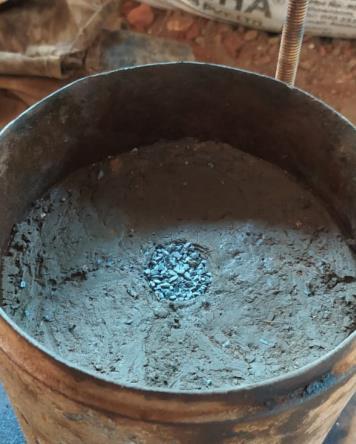
Aplungerwithadiameterof50mmisusedtoapplyaload atthecentreofthesoilbed.
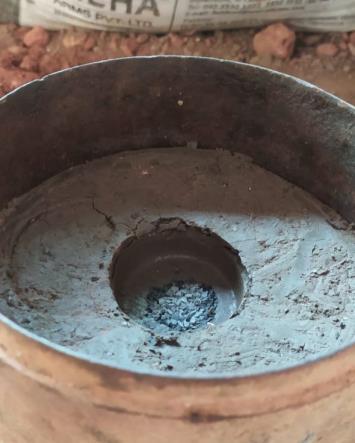
Fig -2:After12mmpenetration
A numerical analysis was conducted using PLAXIS 3D software.
International Research Journal of Engineering and Technology (IRJET) e-ISSN: 2395-0056
Volume: 12 Issue: 10 | Oct 2025 www.irjet.net p-ISSN: 2395-0072
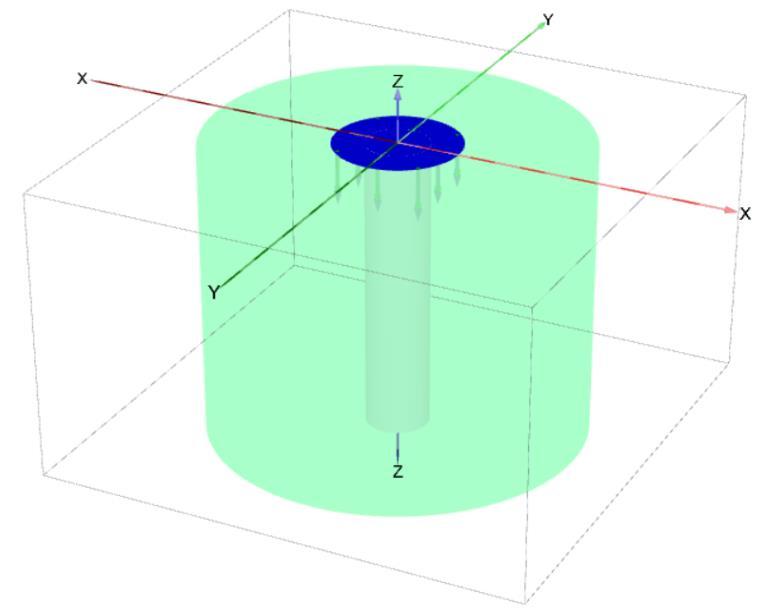
Fig -3:AnexperimentalmodelsimulatedinPLAXIS3D
Theload-settlementcurveforthenumericalanalysisand experimentalresults.
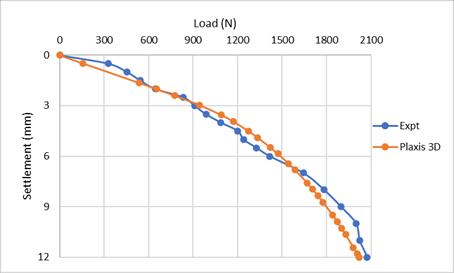
Chart -1:Load-settlementcurveforverification
Theresultsobtainedfromtheexperimentalandnumerical studies are well matched, which proves that the software canbeusedtosimulatesoilimprovedwithstonecolumns.
5. MODELLING
ThePLAXIS3Dfiniteelementsoftwarewasusedtomodel the soft soil with stone columns. Figure 4 illustrates an exampleofasimulatedground.
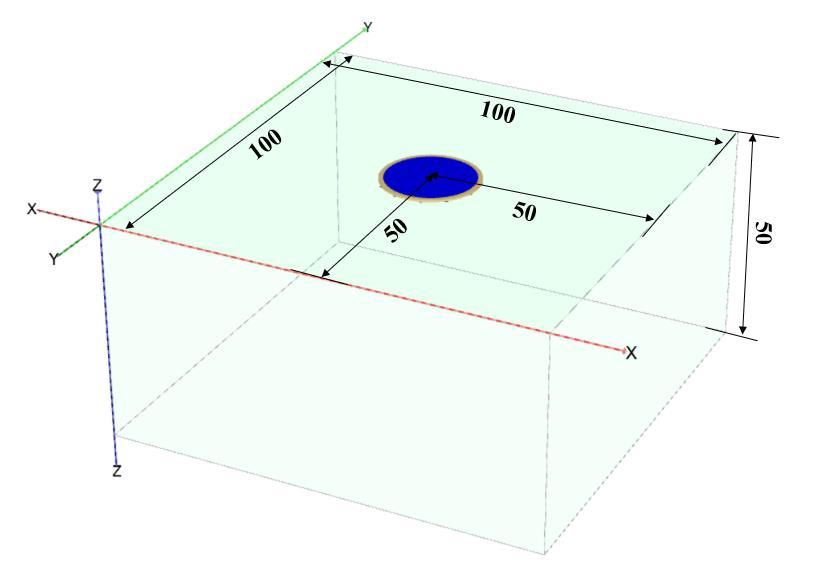
Fig -4:Modelofsoilwithoutstonecolumns (Alldimensionsareinm)
A quarter of the geometry has been modelled due to the symmetryofthemodel.Thedimensionsofthesoilprofile taken–50mx50mx50m.
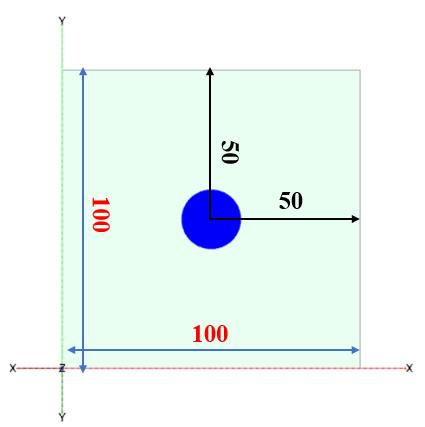
Fig -5:Topviewofthemodel (Alldimensionsareinm)
In order to simulate the soil behaviour, an appropriate model and parameters must be assigned to the structure, proportional to the materials. The soil bed contains soft soil with a thickness of 50m. The width of the model is considered by the sensitivity analysis conducted in previous studies to reduce the boundary effects with the amountof2.5Dfromthecentreofthetank base, where D isthediameterofthebaseofthestoragetank,i.e.,20m.An elastic-plastic model with the Mohr-Coulomb failure criterionwasusedtomodelsoftsoilswithstonecolumns.
International Research Journal of Engineering and Technology (IRJET) e-ISSN: 2395-0056
Volume: 12 Issue: 10 | Oct 2025 www.irjet.net p-ISSN: 2395-0072
Table -1: Propertiesof
Property
Unitweight,γ (kN/m3) 17 19 18
Young’smodulus,E (kN/m2) 2000 55000 20000
Poisson’sratio,ν 0.35 0.3 0.3
Shearstrength,τ (kN/m2) 20-
Cohesion,c (kN/m2) - 0 0.1
Angleofinternalfriction,Φ(°) - 43 30
The dimensions of the stone columns and the distance between these columns are selected based on practical considerations. The height of the stone columns is 10m, 20m&30m,andthediametersare1.0m,1.25m& 1.5m.A constant spacing of 3m is considered between the stone columns.Theloadistransferredtothegroundthroughthe concretebaseofthestoragetank.Inthisstudy,thebaseof thestoragetankisconsideredasarigidbasewithuniform settlement, and hence, a prescribed displacement of 200mmintheZ-directionisconsidered.
As mentioned in the previous sections, three different lengths of stone columns (10m, 20m & 30m) were used with diameters of 1m, 1.25m & 1.5m. The results of the numericalanalysisarepresentedbelowwithaprescribed displacementof200mm.
6.1 The Effect of 1.0m Diameter Stone Columns on the Bearing Capacity of Soft Soil
Theeffectofthevaryingstonecolumnlengths(10m,20m &30m)with1.0mdiameteronthebearingcapacityunder improved and unimproved conditions has been shown in chart-2.
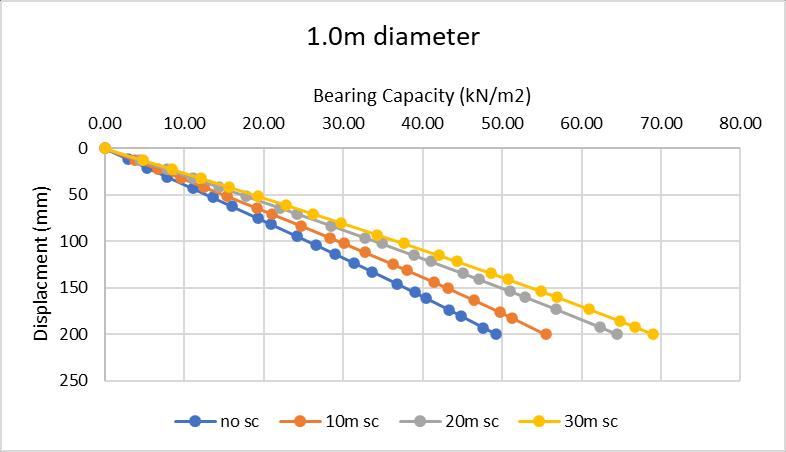
Ascanbeseen,withtheincreaseinthelengthofthestone columns, the bearing capacity increased for 200mm displacement. When the length of the stone column is 10m, the bearing capacity increased to 55.48 kN/m2 comparedto theuntreated soil.Asthelength of the stone column increased to 20m, the bearing capacity of the soft soilincreasedto64.51kN/m2 whencomparedtosoilwith no stone columns. On further increasing the length of the stone columns to 30m, the bearing capacity increased to 69.04kN/m2 whencomparedtotheuntreatedsoil.
6.2 The Effect of 1.25m Diameter Stone Columns on the Bearing Capacity of Soft Soil
Theeffectofthevaryingstonecolumnlengths(10m,20m & 30m) with 1.25m diameter on the bearing capacity under improved and unimproved conditions has been showninchart-3
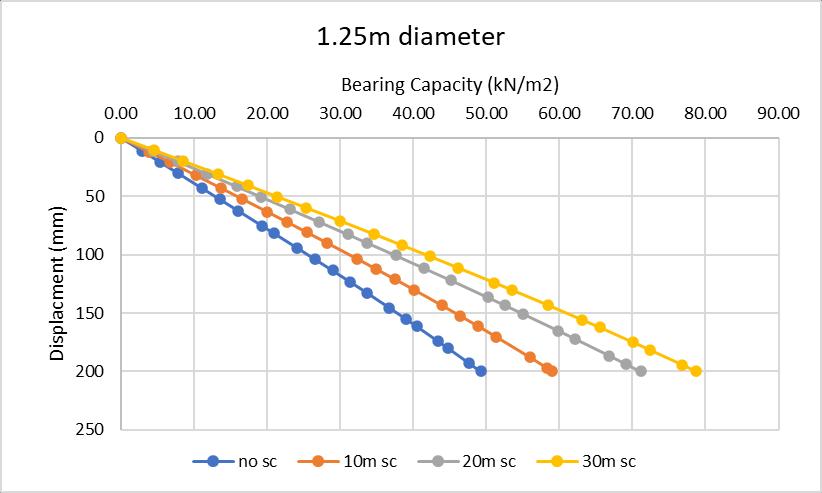
Ascanbeseen,withtheincreaseinthelengthofthestone columns, the bearing capacity increased for 200mm displacement. When the length of the stone column is 10m, the bearing capacity increases to 59.04 kN/m2 comparedto theuntreated soil.Asthelength of the stone column increased to 20m, the bearing capacity of the soft soilincreasedto71.15kN/m2whencomparedtosoilwith no stone columns. On further increasing the length of the stone columns to 30m, the bearing capacity increased to 78.71kN/m2whencomparedtotheuntreatedsoil.
6.3 The Effect of 1.5m Diameter Stone Columns on the Bearing Capacity of Soft Soil
Theeffectofthevaryingstonecolumnlengths(10m,20m &30m)with1.5mdiameteronthebearingcapacityunder improved and unimproved conditions has been shown in chart-4.
International Research Journal of Engineering and Technology (IRJET) e-ISSN: 2395-0056
Volume: 12 Issue: 10 | Oct 2025 www.irjet.net p-ISSN: 2395-0072
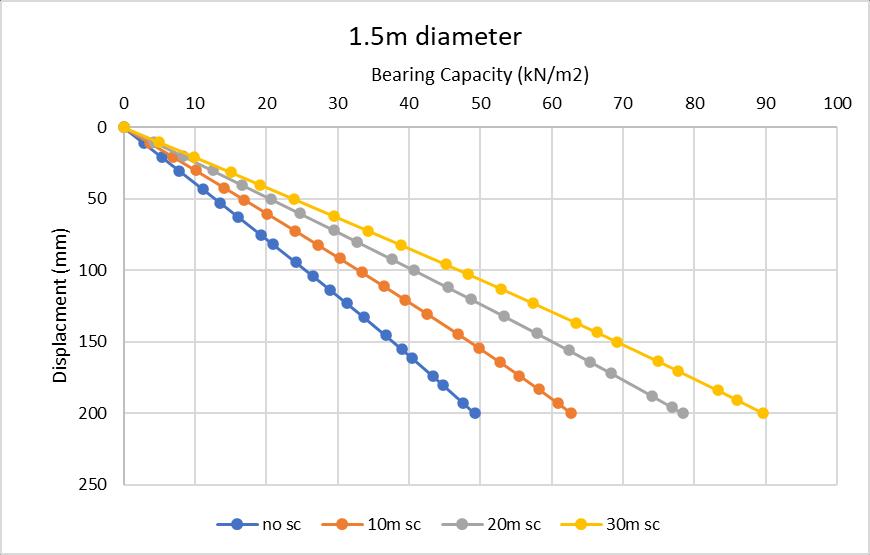
Chart -4:Curvefor1.5mdiameterstonecolumns
Ascanbeseen,withtheincreaseinthelengthofthestone columns, the bearing capacity increased for 200mm displacement. When the length of the stone column is 10m, the bearing capacity increases to 62.73 kN/m2 comparedto theuntreated soil.Asthelength of the stone column increased to 20m, the bearing capacity of the soft soilincreasedto78.39kN/m2 whencomparedtosoilwith no stone columns. On further increasing the length of the stone columns to 30m, the bearing capacity increased to 89.66kN/m2 whencomparedtotheuntreatedsoil.
6.4 The Effect of Stone Column Length on Bearing Capacity of Soft Soil
The increase in the length of the stone columns significantlyincreasesthebearingcapacityofthesoil.
The graph below shows the bearing capacity of the soft soilfor200mmdisplacementwithincreasinglengthofthe stone columns (10m, 20m & 30m) with 1.0m, 1.25m, and 1.5mdiameters.
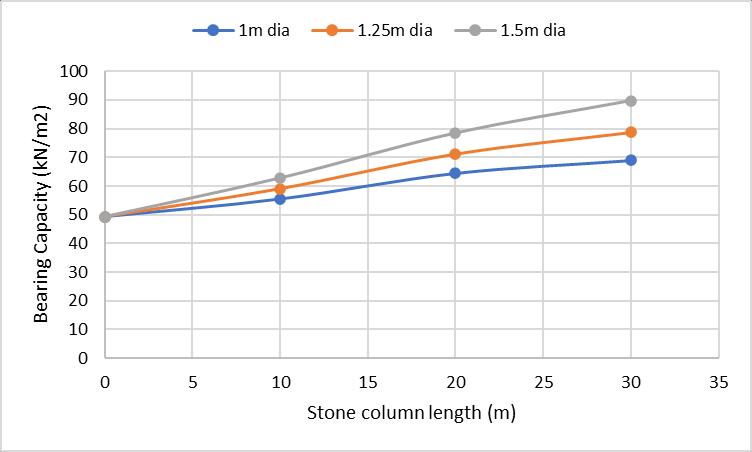
Chart -5:StonecolumnlengthvsBearingcapacityat 200mmsettlement
The numerical analysis of the soft soil improvement by stone columns was carried out by PLAXIS 3D. Improvement depth was examined using the 10m, 20m & 30m stone columns with 1.0m, 1.25m & 1.5m diameters. The most important conclusions of this study are as follows:
1. For 1.0m diameter stone columns, when 10m columns are used, the bearing capacity increased by 12.65% respectively, whereas when 20m stone columns are used, thebearingcapacityincreasedby30.98%respectively,but when the length of the stone columns was 30m, the bearing capacity increased by 40.18% respectively when comparedtotheuntreatedsoftsoil.
2.For1.25mdiameterstonecolumns,when10mcolumns are used, the bearing capacity increased by 19.88% respectively, whereas when 20m stone columns are used, thebearingcapacityincreasedby44.47%respectively,but when the length of the stone columns was 30m, the bearing capacity increased by 59.82% respectively when comparedtotheuntreatedsoftsoil.
3. For 1.5m diameter stone columns, when 10m columns are used, the bearing capacity increased by 27.37% respectively, whereas when 20m stone columns are used, thebearingcapacityincreasedby59.17%respectively,but when the length of the stone columns was 30m, the bearing capacity increased by 82.05% respectively when comparedtotheuntreatedsoftsoil.
[1] IS 15284 (Part 1): 2003 Design and construction forgroundimprovement–Guidelines.
[2] A. R. Abdelsatar, A. R. Tawfik, and M. F. Abdelmajed, "Investigating the Effect of Granular Piles on the Behaviour of Weak Soils", Journal of Al-Azhar University Engineering Sector, vol. 19, pp.889-904,2024.
DOI:10.21608/auej.2024.292163.1668.
[3] MohammadJavad,SeyedHasanet.al.,(2021),“3D AnalysisofImprovedSoftGroundwithaGroupof Floating Stone Columns laid on the Appropriate Bed”, Journal of Structural Engineering and Geotechnics, 11(1), 57-70, Winter and Spring 2021.
[4] Wassie and Demir (2023), “Behaviour of an Embankment on Stone Column-reinforced Soft Soil”, Slovak Journal of Civil Engineering, Vol. 31, 2023,No.4,9–15,DOI:10.2478/sjce-2023-0022.
International Research Journal of Engineering and Technology (IRJET) e-ISSN: 2395-0056
Volume: 12 Issue: 10 | Oct 2025 www.irjet.net p-ISSN: 2395-0072
[5] MahmoudAli(2019),“BehaviourofOrdinaryand EncasedStoneColumnsEnd-BearingandFloating in Soft Clay using PLAXIS 3D software”, Springer Nature Switzerland AG 2019, H. Shehata and H. Poulos (Eds.): GeoMEast 2018, SUCI, pp. 26–38, 2019.
DOI:10.1007/978-3-030-01917-4_2.
[6] Bahi Selma and Houhou Mohamed Nabil (2024), “Advanced 3D modelling of geosynthetic-encased stonecolumnsinsoftclaybeneathembankment”, Studies in Engineering and Exact Sciences, Curitiba,v.5,n.2,p.01-27,2024.
DOI:10.54021/seesv5n2-434.
[7] Krishna Kotiyal, Manendra Singh et.al., (2023), “Behaviour of Horizontally Reinforced Stone Column in a Layered Soil”, Journal of Mining and Environment(JME),Vol.15,No.2,2024,537-555.
DOI:10.22044/jme.2023.13807.2565.
[8] Mohamed, Mona (2022) "Behaviour of Encased Stone Columns in Soft Clay," Journal of Engineering,Research:Vol.6:Iss.3,Article25.
https://digitalcommons.aaru.edu.jo/erjeng/vol6/ iss3/25