
International Research Journal of Engineering and Technology (IRJET) e-ISSN: 2395-0056
Volume: 12 Issue: 05 | May 2025 www.irjet.net p-ISSN: 2395-0072
International Research Journal of Engineering and Technology (IRJET) e-ISSN: 2395-0056
Volume: 12 Issue: 05 | May 2025 www.irjet.net p-ISSN: 2395-0072
Mrs. Sumaiya1, Ms. Gagana H P2, Ms. S Bhoomika3, Ms. Srushti Harish4, Mr. Suhas H K5
1Assistant Professor, Dept. of Computer Science and Engineering, Maharaja Institute of Technology Thandavapura
2345Students, Dept of Computer Science and Engineering, Maharaja Institute of Technology Thandavapura
Abstract - Early and accurate detection of brain tumors is critical for improving patient outcomes. This paper presents a dual-module approach for optimized brain tumor detection and classification, integrated with a novelestimationoftumor depth using 3D reconstruction. The system combines the power of deep neural networks (DNNs) for classification with medical image processing using SimpleITK and VTK for depth value estimation through 3D reconstruction. The proposed architecture addresses the critical gap in tumor localization and depth analysis, enhancing surgical planning and clinical diagnostics. The pipeline has been evaluated on MRI datasets with promising results in accuracy, visual quality of reconstructions, and computational efficiency.
Key Words: Brain tumor detection, classification, 3D reconstruction, VTK, SimpleITK, Deep Neural Networks, tumor depth estimation, medical imaging.
1.INTRODUCTION
Brain tumors pose a significant risk to human life due to their invasive nature and the complexity of surgical intervention. The medical community heavily relies on Magnetic Resonance Imaging (MRI) for the diagnosis and treatmentplanningofbraintumors.However,traditional2D slice-basedanalysisoftenlacksdepthperception,makingit difficult to assess the tumor’s full extent.This paper introducesanoptimizedframeworkthatnotonlyautomates tumordetectionandclassificationusingdeeplearningbut alsoestimatesthedepthvaluebyreconstructingthetumor in3DusingSimpleITKandVTKlibraries.Thisdual-module system aims to bridge the gap between classification and spatial quantification, offering a more holistic view for radiologistsandneurosurgeons
1.1
To develop a dual-module system that Detects and classifies brain tumors using a DNN classifier Estimates tumordepththrough3DreconstructionusingSimpleITKand VTK Enhances diagnostic decision-making by integrating classificationresultswith3Dspatialinformation
1.2
DeepNeuralNetworks(DNNs),particularlyConvolutional NeuralNetworks(CNNs),havebecomefoundationalinthe
advancementofartificialintelligence,especiallyinmedical imaging. Their hierarchical architecture enables the automatic extraction of complex features from highdimensional data such as MRI scans. CNNs have demonstratedsuperiorperformanceinimageclassification, segmentation, and detection tasks, making them highly suitable for brain tumor diagnosis. In the context of this research,themotivationliesnotonlyinaccuratelydetecting and classifying brain tumors but also in addressing the critical need for spatial depth analysis an aspect often overlookedin2Dimagingapproaches.ByintegratingDNNbasedclassificationwith3Dreconstructionusingtoolslike VTK and SimpleITK, this work aims to bridge the gap between precise tumor identification and spatial understanding,ultimatelycontributingtoimprovedclinical decision-making
Artificialintelligence(AI)hasemergedasapivotalforce intechnologicaladvancement,withapplicationsextending into nearly every field including medicine. Within this landscape, Deep Neural Networks (DNNs) have demonstratedexceptionalcapabilityinpatternrecognition and classification tasks, particularly in medical imaging. Despitetheirpromise,severalchallengesmustbeaddressed toeffectivelyintegrateDNNsintobraintumordiagnostics. Onekeyissueisthelimitedavailabilityofannotatedmedical datasetsnecessaryfortrainingrobustmodels.Additionally, conventional 2D MRI-based analysis often lacks spatial context, making it difficult to estimate tumor depth a crucial factor for surgical planning. This project seeks to overcome these challenges by combining DNN-based classificationwith3DreconstructiontechniquesusingVTK andSimpleITK,therebyofferingamorecomprehensiveand interpretablediagnostictoolforbraintumordetection.
ConvolutionalNeuralNetworks(CNNs)areaspecialized classofdeeplearningmodelsdesignedtoprocessgrid-like data such as medical images. They utilize multiple layers, including convolutional, pooling, normalization, and fully connected layers, to automatically extract and learn hierarchicalfeaturesfrominputdatawithminimalmanual preprocessing.CNNsareoftenreferredtoasshift-invariant
International Research Journal of Engineering and Technology (IRJET) e-ISSN: 2395-0056
Volume: 12 Issue: 05 | May 2025 www.irjet.net p-ISSN: 2395-0072
artificial neural networks (SIANNs) due to their ability to recognize patterns regardless of spatial translation, a property that mirrors the biological organization of the visual cortex in animals. In these networks, individual neuronsrespondonlytostimuliwithinalocalizedregionof theinput,mimickingthereceptivefieldsfoundinthebrain's visualprocessingareas.
ThisarchitecturemakesCNNshighlyeffectiveforanalyzing visual data,suchasMRIscans,where detecting structural abnormalities is critical. In the context of brain tumor detectionandclassification,CNNscanidentifytumorsbased on spatial variations in intensity, shape, and texture. Traditional diagnostic approaches often rely on manual interpretationbyradiologists,whichcanbetime-consuming and subject to variability. However, advances in deep learning particularly the use of 3D CNNs have significantly improved the automation and accuracy of tumor detection. These models process volumetric data directly,enablingthenetworktolearnspatialrelationships across MRI slices, thereby enhancing the detection and characterizationofbraintumors
Significantadvancementshavebeenmadeinthefieldof braintumordetectionandclassification,withseveralstudies contributingtothedevelopmentofimprovedmethodologies.
One notable study by [1] demonstrated an average Dice SimilarityIndex(DSI)of0.82,showingpromisingresultsin tumorsegmentation.Thisapproachoutperformedprevious techniques by offering better overlap between the segmentedtumorregionsandthosemanuallydelineatedby radiologists, which suggests higher precision in tumor identification.
PradeepSinghYadavetal.[2]proposedamethodbasedon X-ray imaging, highlighting that cancer-affected regions exhibit high-intensity pixels, while normal tissues correspondtolow-intensitypixels.Thisprincipleunderlies thresholding, a simple but effective technique for segmentation.Thresholdingcategorizestumorregionsbased onintensitylevels,andwhilethismethodisbasic,itprovides afoundationformoreadvancedtumordetectiontechniques. Additionally,morphologicaloperations,suchas"imerode" and"imdilate,"wereusedtoextracttumorsfromtheX-ray images. In the proposed technique, these operations, combined with the identification of regions of interest (ROIs),allowfortheextractionofrelevanttumorfeatures, improvingtumorrecognition.
Nishant Verma et al. [3] emphasized region-growing techniques for image segmentation, proposing a method wherepixelswithsimilarintensityvaluesaregroupedintoa single region. This process relies on 4-connected or 8connectedpixelareastodetermineifadjacentpixelsbelong tothesameregion.Theregion-basedsegmentationmethod is noted for its resilience to noise in X-ray images, which
contributestomorerobusttumorsegmentationcomparedto othermethods.
DeepthiMurthyT.S.etal.[4]focusedonthresholdingand morphological operations for efficient brain tumor segmentation. However, the thresholding value in their methodwasfixed,makingitsemi-automatedandrequiring human intervention for optimal results. This limitation pointstotheneedformoreadaptivetechniquestohandle variationsinbrainscandata.
L. Ramya et al. [5] explored region-growing segmentation techniquesandappliedthemtoidentifytumorsinbrainMRI images.Theirmethodincorporatesskullremoval,combined with morphological operators, to enhance the accuracy of brain tumor detection. This approach highlights the importanceofpreprocessingstepslikeskullremoval,which significantlyimprovetheaccuracyoftumoridentification
Brain tumor detection plays a crucial role in the early diagnosisandtreatmentplanningofpatients.Deeplearning techniques, particularly Convolutional Neural Networks (CNNs),havedemonstratedpromisingresultsinautomating thisprocess.AmongthevariousCNNarchitectures,ResNet50 standsoutduetoitsdepthandtheuseofskipconnections, whichaddressthevanishinggradientproblemandfacilitate moreefficientfeaturelearning.
Despite the promising results achieved, there are several limitationsthatneedtobeaddressed.Ongoingresearchand developmentareessentialtoovercomethesechallengesand facilitate the integration of these deep learning-based systems into routine clinical practice. The future direction should focus on improving model generalization, handling diverse and noisy medical images, and optimizing system performance to meet the clinical needs of healthcare professionals.
The proposed system aims to optimize brain tumor detectionandclassificationbyintegratingtwokeymodules: thetumordetectionandclassificationmoduleandthetumor depthvalueestimationmodule.Thisdualapproachleverages the power of Deep Neural Networks (DNNs) for efficient detectionandclassificationofbraintumors,whileutilizing 3D reconstruction techniques with VTK (Visualization Toolkit)andSimpleITKtoestimatetumordepthandprovide spatial information critical for precise diagnosis and treatmentplanning
Thefirstmodulefocusesonautomatingtheprocessofbrain tumordetectionandclassification.Thisisachievedusinga Convolutional Neural Network (CNN) architecture,
International Research Journal of Engineering and Technology (IRJET) e-ISSN: 2395-0056
Volume: 12 Issue: 05 | May 2025 www.irjet.net p-ISSN: 2395-0072
specificallydesignedformedicalimageanalysis.TheCNNis trained to differentiate between tumor and non-tumor regions in MRI scans, classifying the detected tumors into benignormalignantcategories.Themodelutilizestransfer learning from pre-trained networks such as ResNet50 to extracthigh-level featuresfrom the input medical images. Thesefeaturesarecrucialfordistinguishingvarioustumor typesandforaccurateclassification.
The second module addresses the critical aspect of tumor depthestimation,whichisessentialfordeterminingtumor growthpatternsandplanningtreatmentstrategies.Thisis achievedbyreconstructingthe3Dvolumeofthetumorusing VTK and SimpleITK. The system first segments the tumor from the MRI scan, creating a 3D model of the affected region. Using thedepth estimation algorithms, thesystem calculates the depth value of the tumor, providing more accurate information about its location within the brain, whichcanbevitalforsurgicalplanningorradiationtherapy.
The tumor’s depth value is determined by calculating the distancefromthesurfaceofthebraintissuetothedeepest point of the segmented tumor region. This information is thenintegratedwiththetumor’sclassificationtoprovidea comprehensiveassessmentofthetumor’sseverity,size,and location.
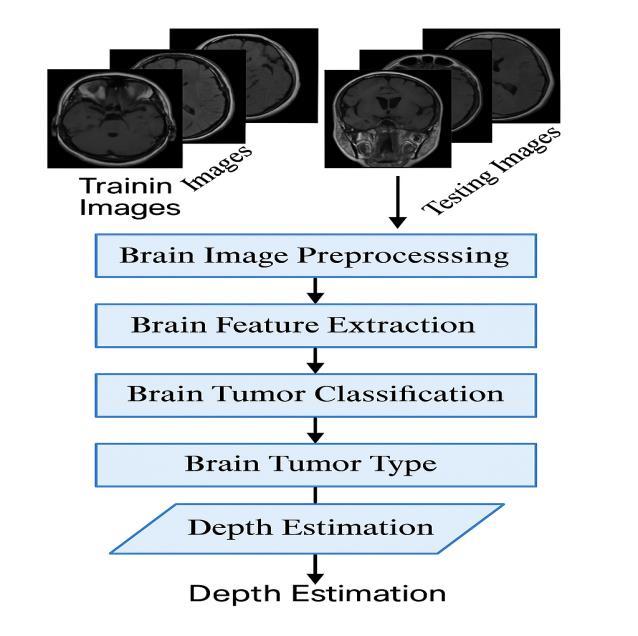
Theproposedsystemarchitectureconsistsoftwointegrated modulesdesignedtoenhancethediagnosisofbraintumors. Thefirstmoduleusesadeeplearningmodel,specificallya DNN algorithm, to classify MRI brain images into four categories: glioma, meningioma, pituitary tumor, or no
tumor. It extracts features from the images and uses a Softmax layer to predict the tumor type accurately. Once classified, the second module takes over to estimate the tumor'sdepthbyreconstructinga3Dmodelfrom2DMRI slices.UsingsegmentationtechniquesfromSimpleITK,the tumor region is isolated and passed to VTK for 3D visualization. These slices are then stacked to build a volumetricimageofthetumor.Thesystemcalculatesdepth by measuring the distance from the brain surface to the tumor's deepest point. This helps provide spatial context, supportingbettersurgicalplanning.
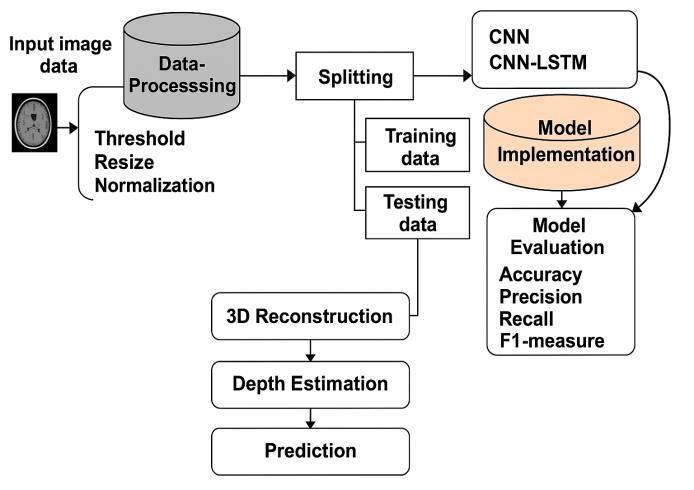
1.A dataset is a structured compilation of data, often organizedtoservespecifictaskssuchasmachinelearning, analysis, or research. In this context, it provides the foundationfortrainingandevaluatingbraintumordetection andclassificationmodels.
2.Once the dataset is collected, it typically undergoes preprocessingstepssuchasimagenormalization,resizing, noise reduction, and data augmentation. These processes helpensurethedataisclean,consistent,andsuitableforuse indeeplearningframeworks.
3.Thedatasetusedinthisstudycomprises7,017MRIimages of the human brain, categorized into four distinct classes: glioma,meningioma,pituitarytumor,andnotumor.These categories are essential for training a multi-class classificationmodel.
4.Glioma:300images,Meningioma:305images,NoTumor: 404images,PituitaryTumor:300images Theseimagesare usedfortesting.
5.Glioma: 1,320 images, Meningioma: 1,338 images, No Tumor:1,594images,PituitaryTumor:1,456images.These imagesareusedfortraining.
International Research Journal of Engineering and Technology (IRJET) e-ISSN: 2395-0056
Volume: 12 Issue: 05 | May 2025 www.irjet.net p-ISSN: 2395-0072
The proposed system is implemented using a supervised DeepNeuralNetwork(DNN),designedtoeffectivelyclassify brain tumors based on MRI images. The DNN processes image data to learn complex patterns that distinguish betweenvarioustumortypesandnormalbrainconditions. Forimagepreprocessingandenhancement,theframework incorporates OpenCV, which optimizes image clarity and speedsupprocessing.Inadditiontoclassification,thesystem utilizesVTKandSimpleITKlibrariesfor3Dreconstructionof the tumor, enabling accurate depth value estimation by generating a volumetric model from 2D slices. This integrationallowsthesystemnotonlytodetectthepresence of a tumor but also to provide insights into its spatial dimensions within the brain. The model was trained on a comprehensive dataset and achieved a confidence level of 99.8% in correctly classifying tumor types. This high accuracy,combinedwithprecisedepthanalysis,makesthe dual-module system a robust tool for both diagnostic and surgicalplanningpurposes.
Datasets Glioma Meningioma Notumor Pituitary
Training 1320 1338 1594 1456 Testing 300 305
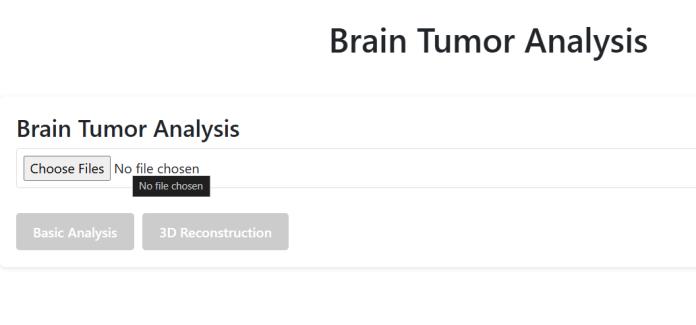
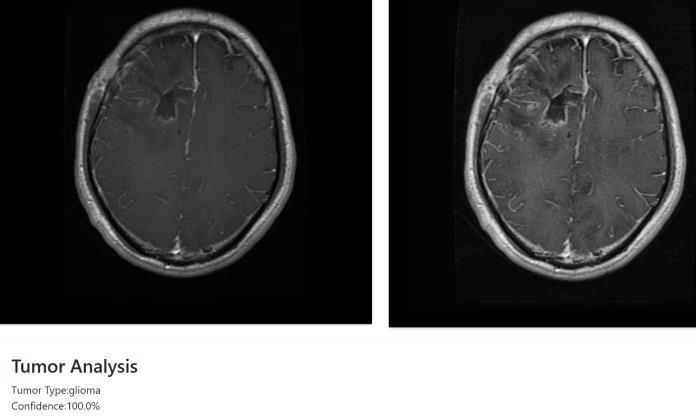
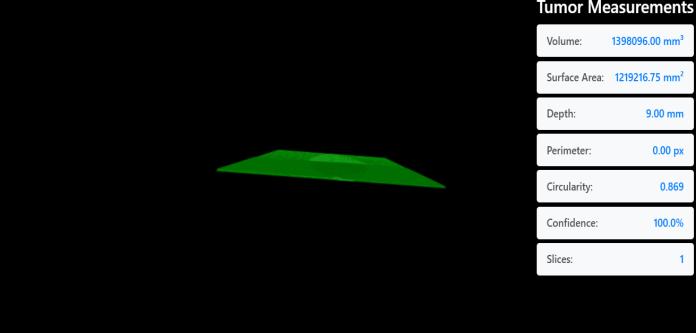
Thisstudypresentsadual-modulesystemthateffectively combinesdeeplearningwithmedicalimagereconstruction toimprovebraintumordetectionandanalysis.UsingaDeep Neural Network (DNN), the system accurately classifies brainMRIimagesintovarioustumortypes,achievingahigh confidence level of 99.8%. Alongside classification, the integrationofVTKandSimpleITKenablesthegenerationof 3Dtumormodels,whichhelpin estimatingthedepthand spatial position of the tumor within the brain. This depth analysis is valuable for understanding tumor severity and guidingtreatmentdecisions.Byworkingwithactualmedical imagedata,thesystemoffersbothdiagnosticaccuracyand clinicalrelevance.Itsimplifiestheworkflowforradiologists byprovidingbothatumortypepredictionandavisual3D referenceinonesystem.Althoughtheresultsarepromising, further improvements could make the model more adaptable to a wider range of cases and patient data. The projectdemonstrateshowcombiningmachinelearningwith 3Dimagingtoolscanbringrealvaluetomedicaldiagnostics. Withmoredataandcontinuedrefinement,thisapproachcan support doctors in early diagnosis, better treatment planning, and improved patient outcomes in brain tumor care.
We wish to express our deepest appreciation to our esteemed Project Guide, Prof. Sumaiya, whose invaluable guidanceandsuggestionshavepropelledourprojectbeyond ourexpectations.Weextendourheartfeltgratitudetoour Project Coordinator, Prof. Bharath Bharadwaj B S, for his unwaveringsupportanddedicationinhelpinguscomplete thisprojectwithinatighttimeframe.Wewouldalsoliketo acknowledge our Head of Department, Dr. Ranjit KN, for fostering an environment that encourages innovation and practicalapplicationofouracademiccurriculum.Finally,we extendoursincerestthankstoourPrincipal,Dr.YTKrishne Gowda,forprovidinguswithagoldenopportunitytocarry outprojectonthetopicof'BrainTumorDetectionusing3D CNN', and for his unwavering support in our research learningendeavors
International Research Journal of Engineering and Technology (IRJET) e-ISSN: 2395-0056
Volume: 12 Issue: 05 | May 2025 www.irjet.net p-ISSN: 2395-0072
[1] P.S. Yadav,D.Singh,andA. Goyal,“Detection of brain tumorusingMRIimagesandthresholdsegmentation,” International Journal of Engineering and Advanced Technology(IJEAT),vol.8,no.6S3,pp.145–148,2019.
[2] N.VermaandA.Mishra,“Anefficientapproachforbrain tumordetectionusingregiongrowingsegmentationand SVMclassification,”InternationalJournalofComputer Applications,vol.180,no.30,pp.17–21,2018.
[3] T. S. Deepthi Murthy, V. K. Kale, and R. C. Jaiswal, “Automatedbraintumorsegmentationandclassification fromMRIimages,”ProcediaComputerScience,vol.167, pp.689–696,2020,doi:10.1016/j.procs.2020.03.372.
[4] L.RamyaandK.V.Sujatha,“BrainTumorDetectionand Segmentation Using Region Growing Method,” International Journal of Engineering Research & Technology(IJERT),vol.7,no.4,pp.136–140,2018.
[5] O. Ronneberger, P. Fischer, and T. Brox, “U-Net: Convolutional Networks for Biomedical Image Segmentation,”inProc.MedicalImageComputingand Computer-Assisted Intervention (MICCAI), 2015, pp. 234–241.
[6] K. Simonyan and A. Zisserman, “Very Deep Convolutional Networks for Large-Scale Image Recognition,”arXivpreprintarXiv:1409.1556,2014.
[7] J.C.McInerneyandD.Terzopoulos,“Deformablemodels in medical image analysis: a survey,” Medical Image Analysis,vol.1,no.2,pp.91–108,1996.
[8] J. A. Sethian, “Level Set Methods and Fast Marching Methods,” Cambridge Monographs on Applied and ComputationalMathematics,1999.
[9] L. Ibanez, W. Schroeder, L. Ng, and J. Cates, The ITK SoftwareGuide,KitwareInc.,2005.
[10] W. Schroeder, K. Martin, and B. Lorensen, The Visualization Toolkit (VTK): An Object-Oriented Approachto3DGraphics,4thed.,KitwareInc.,2006.M. Young, The Technical Writer’s Handbook. Mill Valley, CA:UniversityScience,1989.