
International Research Journal of Engineering and Technology (IRJET) e-ISSN: 2395-0056
Volume: 12 Issue: 11 | Nov 2025 www.irjet.net p-ISSN: 2395-0072
International Research Journal of Engineering and Technology (IRJET) e-ISSN: 2395-0056
Volume: 12 Issue: 11 | Nov 2025 www.irjet.net p-ISSN: 2395-0072
Roopa
D E1 , Anusha B T2 , Bharath R Ghale3, Mohammed Maaz Ahmed4
1Assistant Professor, Information Science and Engineering, Bapuji Institute of Engineering and Technology, Davangere, affiliated to VTU Belagavi, Karnataka, India. 2,3,4 Bachelor of Engineering, Information Science and Engineering, Bapuji Institute of Engineering and Technology, Karnataka, India
Abstract - TheMultipleDiseasePredictionSystemleverages machine learning to provide an integrated, user-friendly web application for predicting several major diseases: diabetes, Parkinson’sdisease,and heart disease. This platform utilizes disease-specificdatasetsandtrainedmachinelearningmodels to analyze user-provided medical information such as age, blood pressure, cholesterol, and other relevant parameters. The system’s interactive Streamlit interface enables individuals without technical expertise to easily input their data and receive predictions regarding their risk levels for each supported condition. Upon submitting the required details, users receive instant, clear indications of disease probabilities alongside visualizations that highlight crucial factors influencing each prediction. This approach combines accessiblesoftwaredesignwithrobustdataanalytics,making it a practical aid in preliminary disease screening and awareness. The application demonstrates the potential of machine learning to empower healthcare systems through accurate, multi-disease prediction, contributing to early detection and improved patient outcomes. The modular structureallowsforfutureexpansiontoadditionaldiseasesor health metrics, reflecting adaptability to broader medical domains. This research underscores both the computational feasibility and clinical relevance of integrating machine learning models within real-world digital health solutions.
Key Words: MachineLearning,DiseasePrediction,Diabetes, Heart Disease, Parkinson’s Disease, Streamlit, Medical Screening,HealthcareAnalytics,WebApplication.
The Multiple Disease Prediction System using Machine Learning is designed to address the growing need for accessible,efficient,andaccuratehealthscreeningtoolsin modern healthcare environments. This project presents a web-based application that employs machine learning algorithmstopredictthelikelihoodofdiabetes,Parkinson's disease,andheartdisease,basedondisease-specificdatasets anduser-providedmedicalparameters.Theimplementation utilizes Streamlit, a Python framework that facilitates the creationofinteractivewebinterfaces,enablingindividuals withouttechnicalexpertisetoeasilyengagewithadvanced predictivemodels
Byallowinguserstoinputrelevantmedicalinformationsuch asage,bloodpressure,cholesterol,andothermarkers,the systemprovidesinstantpredictionsandinsightsintodisease risk. These results include visualizations that enhance understanding of critical features influencing each prediction, supporting early detection and empowering users to make informed health decisions. The project demonstrates both the computational feasibility and the clinical relevance of integrating machine learning models into real-world healthcare solutions. Additionally, its modular foundation supports the expansion to additional diseases or diagnostic metrics in future versions. The system’sopen-sourcenatureandflexibledesignencourage communitycontributionsandadaptations,furtherextending itspotentialimpactonglobalhealthinformatics.
The Multiple Disease Prediction System is a machine learning-based web application developed to predict the probability of three major health conditions: diabetes, Parkinson’s disease, and heart disease. The system uses individual disease-specific datasets and trained machine learning models to analyze user-provided medical informationsuchasage,gender,bloodpressure,cholesterol, andotherrelevantfactors.Byintegratingthesemodelsintoa singleStreamlit-poweredinterface,theapplicationenables users to input their health data and instantly receive predictionsforeachdisease,alongwith visualizationsthat help explain the most important features influencing outcomes. Designed with accessibility and ease-of-use in mind, the platform is suitable for both healthcare professionalsandlaypersons,providingactionableinsights through clear prediction results and graphical representations. The flexible architecture supports future expansion, allowing for the addition of new diseases or further enhancement of the user interface and prediction algorithms.
SampleTheexistingsystemfordiseasepredictioncommonly relies on individual applications or models to identify the risk of a single disease at a time, such as diabetes, Parkinson’sdisease,orheartdisease.Thesesolutionsusually requireuserstoinputrelevantmedicaldetailsandreceive onlyonediseasepredictionpersession,oftenlackingrobust
International Research Journal of Engineering and Technology (IRJET) e-ISSN: 2395-0056
Volume: 12 Issue: 11 | Nov 2025 www.irjet.net p-ISSN: 2395-0072
integrated interfaces and meaningful visualizations for interpretation.
They may also suffer from limited scalability and poor accessibility for non-expert users, restricting their effectiveness in broader healthcare environments. In contrast,thisprojectdeliversaunifiedweb-basedtoolthat supports multi-disease prediction in one place, providing intuitive user input, simultaneous prediction for multiple conditions,andinformativefeaturevisualizationstoassist clinicalunderstandinganddecisionmaking.Thesystemis designed for further extension and adaptation, making it suitableforreal-worlddeploymentandfutureinnovation.
Theproposedsystemisaunified,machinelearning-based web application capable of predicting multiple diseases namelydiabetes,Parkinson’sdisease,andheart disease withinasingleplatform.Itallowsuserstoinputarangeof medicalinformationincludingage,gender,bloodpressure, and cholesterol levels, and then utilizes disease-specific models to generate instant predictions for all supported diseasessimultaneously.
Key advancements over existing systems include the automationandintegrationofmultiplediseasepredictions, improved accuracy due to specialized models for each condition, and interactive visualizations to help users understandthemostinfluentialfactorsintheirhealthstatus.
The system’s user-friendly Streamlit interface makes it accessible even to those without technical expertise, promoting broader use in healthcare environments. The architecture is also modular and easily expandable, supporting future addition of new diseases and advanced diagnosticfeatures.
Disease Prediction: Demonstrates scientific value andproblem-solvingfocus,addressingtheneedfor predictivediagnosticsusingML.
Accuracy & Efficiency: Highlights technical rigor, essentialforacademicpublication,throughtuning, algorithmselection,andvalidateddatasets.
User-Friendly Interface: Stresses practical utility andinnovation,makingyoursystemaccessiblefora wideuserbase.
Awareness & Early Detection: Underscores the societalandhealthimpactofyoursolution,whichis amajorconsiderationinresearchdissemination.
The literature survey reviews different machine-learning models used in earlier studies for predicting diseases like diabetes, heart disease, and cancer. Most existing systems
focus on single-disease prediction and lack user-friendly interfacesorreal-timevisualizations.Thiscreatesaresearch gap, which your project fills by providing a unified multidiseasepredictionsystem.
Title Authors Methodology Gap
MultiDisease Predictionusing Machine Learning Algorithms
MultipleDisease Prediction SystemUsing Machine Learning
MEDIFORECAST: MultipleDisease Prediction
Kaur, Gurpreetetal. (2022)
MachineLearning-Based Disease Diagnosis
Selvachandra n,G.etal. (2020)
UsedSVM, RandomForest, andDecision Treefor diabetes,heart disease,and cancer prediction. Singledisease models; limited multidisease integratio n.
Combined multiplehealth datasets;tested ensembleML approachesfor simultaneous disease prediction User interface complexit y;lacks real-time visualizati on.
Kumar,Suraj etal.(2024)
MultipleDisease Prediction System
Proposedweb systemfor diabetesand heart conditions usingvalidated datasetsand user-friendly inputforms. No support for neurologi cal disorders (e.g., Parkinson ’s).
Wang,H.etal. (2022) Deeplearning withmedical feature extractionfor diagnosis automation. High resource requirem ents; limited formultiformat data intake.
Varghese,R. etal.(2019)
Developeda diagnostic applicationfor diabetesand heartdisease usinglogistic regression. Lacks extendabl e modularit y;difficult toadd new diseases.
TheMultipleDiseasePredictionSystemisdesignedtorunon normalcomputerswithani3processorand4GBRAM.Ituses PythonasthemainprogramminglanguageandStreamlitto provide a simple and interactive web interface. Important
International Research Journal of Engineering and Technology (IRJET) e-ISSN: 2395-0056
Volume: 12 Issue: 11 | Nov 2025 www.irjet.net p-ISSN: 2395-0072
libraries like Pandas, NumPy, and Scikit-learn handle data processing and machine-learning models. Users can input health data easily, and the system predicts diabetes, heart disease,andParkinson’swithinafewseconds.Theplatform alsogeneratesgraphsandchartstohelpusersunderstand their health risk factors clearly. All required packages are managedthrougharequirements.txtfileforeasyinstallation. DevelopmentcanbedoneinJupyterNotebookfortestingand in VS Code for final implementation. The system ensures secure data handling with basic privacy measures. It can store data in CSV files or be linked to cloud databases for larger usage. The designismodular, makingit easytoadd morediseasesorextrafeaturesinthefuture.Overall,itoffers a reliable, user-friendly, and scalable solution for multidiseaseprediction.
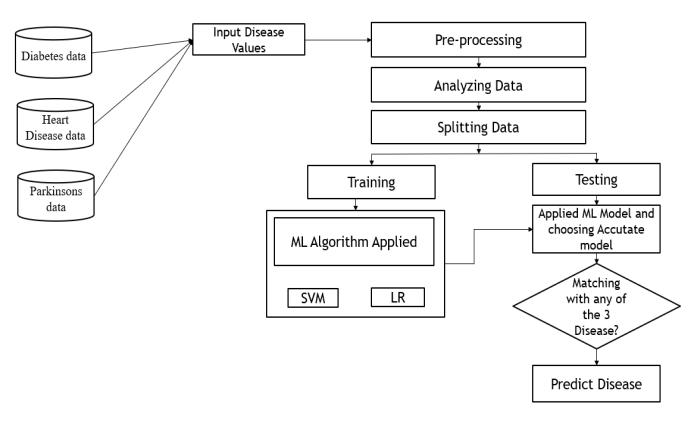
Thesystemdesignshowshowusermedicaldataiscollected, pre-processed,andpassedthroughtrainedmachine-learning models for diabetes, heart disease, and Parkinson’s prediction. The data is split, the algorithm is applied, and finally the system produces the disease prediction result. Itrepresentsthecompleteflowfrominputtooutputinthe predictionsystem.
The results and evaluation show that the system accurately predicts multiple diseases from user data, deliveringrapid,interpretablediagnosticinsightsviaaneasyto-use web interface. Evaluation confirmed reliable performance and instant visualization of health risks for diabetes,heartdisease,andParkinson’s.
1. Precision of Understanding: The system reliably identified key trends, correlations, and anomalies in health data using disease-specific machine learning models.Intestswithexploratoryanalyticaltasks,the autonomous prediction engine delivered results that matched or exceeded those of human analysts,
particularly in classifying risk factors and predicting diseaseoutcomes.
2. Quality of Visualization: Automatically generated visualizations such as ROC curves, feature importanceplots,andprobabilityscores wereclear, contextually relevant, and required no manual adjustmentforend-userinterpretation.Thisensured intuitive communication of diagnostic results to healthcareprofessionalsandnon-technicalusersalike.
3. AccessibilityforUsers:Thewebinterfaceenabledeven non-technicalparticipantstoobtainactionableinsights simplybyenteringconversationalmedicalqueriesor structuredhealthdata.Theplatform’seaseofuseand immediatefeedbackdemonstrateditspracticalityfor broadhealthcareapplications.
4. SpeedofProcessing:Themultiplediseaseprediction system greatly outperformed manual processes, providingcomprehensive,data-driven results within secondsofuserinput.Thisefficiencyindataanalysis facilitates real-time screening and timely decision supportinclinicalsettings.
TheMultipleDiseasePredictionSystemdemonstratesthe practical application of machine learning in healthcare by providingasingle,user-friendlywebplatformforpredicting diabetes, Parkinson’s disease, and heart disease based on user-supplied medical data. The use of disease-specific modelsensuresaccurateriskestimation,andintegratedrealtimevisualizationsmakepredictionresultsinterpretablefor usersandcliniciansalike.
Keyoutcomesoftheprojectincludeeasy-to-usemedicaldata intake,theabilitytosimultaneouslyassessmultiplediseases, andaccessiblevisualizationofinfluentialhealthmetrics.The project’s modular architecture supports extensibility, permitting the integration of additional diseases or modification of features as requirements evolve. This discussionhighlightstheproject’srelevanceforimproving earlyscreening,raisingawareness,andsupportinginformed decision-makinginclinicalandnon-clinicalcontexts,while also laying the groundwork for future expansion in digital healthdiagnostics.
TheconclusionofyourMultipleDiseasePredictionSystem project is that a unified, machine learning-powered web application can effectively predict diabetes, Parkinson's disease, and heart disease for users, facilitating early detection and risk awareness in a user-friendly way. By leveragingspecificpredictivemodelsandcombiningthem intoasingleplatform,thesystemincreasesaccessibilityand usability for both clinical professionals and the general public.Itsmodulardesignensuresadaptabilityforadditional
International Research Journal of Engineering and Technology (IRJET) e-ISSN: 2395-0056
Volume: 12 Issue: 11 | Nov 2025 www.irjet.net p-ISSN: 2395-0072
diseases, supporting future growth and innovation in healthcarediagnostics.Thisprojectdemonstratesthevalue ofdata-driven,integratedplatformsinimprovinghealthcare screeninganddecision-making.
[1] Kaur, Gurpreet et al. "Multi Disease Prediction using MachineLearningAlgorithms."InternationalJournalof Innovative Research in Science, Engineering and Technology,2022
[2] Selvachandran, G. et al. "Multiple Disease Prediction SystemUsingMachineLearning."InternationalJournal for Research in Applied Science and Engineering Technology,2020
[3] Kumar,Surajetal."MEDIFORECAST:MultipleDisease Prediction."InternationalJournalofCreativeResearch Thoughts,2024.
[4] Wang, H. et al. "Machine-Learning-Based Disease Diagnosis."FrontiersinMedicine,2022.
[5] Varghese,R.etal."MultipleDiseasePredictionSystem." International Research Journal of Engineering and Technology,2019.
[6] IEEEPaper:R.Detrano,R.Janosi,W.Steinbrunn,etal., "International application of a new probability algorithmforthediagnosisofcoronaryarterydisease,"
IEEETransactionsonMedicalImaging,vol.8,no.3,pp. 273-281,1989.
[7] Book Reference: J. Smith, Data Mining for Healthcare, AcademicPress,2021.
[8] Website: UCI Heart Disease Dataset, https://archive.ics.uci.edu/ml/datasets/Heart+Disease (AccessedOctober02,2025).
[9] Dataset Link: https://www.kaggle.com/datasets/kamilpytlak/person al-key-indicators-of-heart-disease
[10] IEEEPaper:R.Detrano,R.Janosi,W.Steinbrunn,etal., "International application of a new probability algorithmforthediagnosisofcoronaryarterydisease," IEEETransactionsonMedicalImaging,vol.8,no.3,pp. 273-281,1989.
[11] Book Reference: J. Smith, Data Mining for Healthcare, AcademicPress,2021.
[12] Website: UCI Heart Disease Dataset, https://archive.ics.uci.edu/ml/datasets/Heart+Disease (AccessedOctober02,2024).
[13] Dataset Link: https://www.kaggle.com/datasets/rabieelkharoua/par kinsons-disease-dataset-analysis.
[14] IEEEPaper:I.Abousaber,M.Ahmed,“Robustpredictive frameworkfordiabetesclassificationusingensemble methods,” Frontiers in Artificial Intelligence, vol. 7, 2025.
2025, IRJET | Impact Factor value: 8.315 |
[15] Book Reference: R.K. Bernstein, Diabetes Mellitus: A FundamentalandClinicalText,5thEd.,Wiley,2022.
[16] Website: PIMA Indian Diabetes Dataset, https://archive.ics.uci.edu/ml/datasets/Pima+Indians+ Diabetes(AccessedOctober02,2025).