
International Research Journal of Engineering and Technology (IRJET) e-ISSN: 2395-0056
Volume: 12 Issue: 10 | Oct 2025 www.irjet.net p-ISSN: 2395-0072
International Research Journal of Engineering and Technology (IRJET) e-ISSN: 2395-0056
Volume: 12 Issue: 10 | Oct 2025 www.irjet.net p-ISSN: 2395-0072
Dr. Emmanuel Ameh
1 , Dr.
Alexander Paselk
2
Dept. Machine Learning, Capitol Technology University, Maryland, USA
Dept. Occupational Health and Safety, Capitol Technology University, Maryland, USA
Abstract - Background: Cardiovascular diseases (CVDs) remaintheleadingglobalcauseofmortality,accountingfor over18milliondeathsannually.Traditionalriskscores,such as the Framingham Risk Score, fail to fully capture the complex interactions between genetic, physiological, and lifestyle factors. Deep learning methods, particularly multimodal architectures, offer opportunities to integrate heterogeneousdatasourcesforimprovedpredictionofboth CVD onset and progression. Methods: This retrospective, quantitative, cohort study developed and evaluated a tetramodaldeeplearningframeworkintegratingelectronic healthrecords(EHR),imaging,genomic,andwearablesdata. Individual modality architectures included convolutional neuralnetworks(CNNs)forimaging,transformerencodersfor wearables, and fully connected networks for EHR and genomics.Earlyfusionintegrationwasemployedtoconstruct the tetramodal architecture. Data preprocessing, feature extraction,andmultimodalfusionstrategieswereoptimized via ablation studies. Model performance was evaluated for binary classification (CVD_Presence) and regression (Time_to_Event)tasksusingAU-ROC,F1-score,meanabsolute error(MAE),andtheFriedmanchi-squaredtestwithpost-hoc analysis. Results: The tetramodal model significantly outperformedallsingle-,bi-,andtri-modalmodelsforboth CVDonsetandprogressionprediction.Inclusionofwearables dataimprovedpredictiveaccuracyforprogressiontaskswith statistical significance (p = 0.04). The architecture demonstrated superior sensitivity, specificity, and clinical applicability compared to unimodal baselines. Conclusions: Thisstudypresentsascalable,interpretabletetramodaldeep learning framework capable of integrating heterogeneous clinicalandreal-timephysiologicaldataforenhancedCVD risk stratification. Future work will focus on real-world deployment,optimizationforlow-resourceenvironments,and externalvalidationondiversepatientpopulations.
Key Words: DeepLearningModels,CardiovascularDisease Prediction, Machine Learning Models, Multimodal Data Modeling,TetramodalData,WearableData
1.INTRODUCTION
Cardiovascular diseases (CVDs) constitute a persistent public health burden, causing approximately one-third of globaldeathsannually(WHO,2024).Despiteadvancements
in clinical care, risk prediction remains dominated by traditional models such as the Framingham Risk Score, whichrelyonalimitedsetofclinicalvariables(cholesterol, age, smoking status) and fail to leverage the breadth of modernpatientdatasources.Theselimitationscontributeto misclassification of high-risk patients and insufficient monitoringofdiseaseprogression,particularlyinthosewith subclinicalpresentations.
Recentadvancesindeeplearning(DL)enabletheprocessing of high-dimensional, multimodal datasets, ranging from imagingandgenomicsequencestocontinuousphysiological monitoring from wearable devices. Multimodal deep learning, specifically tetramodal integration in this study, addressesthecomplexityofCVDpathophysiologybyfusing heterogeneousdatamodalitiesforricher,morepersonalized riskassessment.Theobjectiveofthisstudywastodesign, implement, and evaluate a tetramodal deep learning architecture for predicting both CVD onset (binary classification: CVD_Presence) and CVD progression (regression:Time_to_Event).
Despite its promise, the application of multimodal deep learning to CVD prediction remains limited. Persistent challengesincludetheinterpretabilityofcomplexmodelsin clinical settings, the computational cost of training and deployment, integration of longitudinal patient data, and variabilityindataformatsandquality(Abbas&Daena,2025; Nadella et al., 2023). Furthermore, the absence of standardized algorithms for multimodal integration and reliance on small-scale datasets reduce clinical translatability (Abbas & Daena, 2025; Esteva et al., 2021). Research on leveraging multimodal deep learning for predicting CVD progression, especially in patients with multiple comorbidities, remains scarce (Kasula, 2023; Soenksenetal.,2022;Vaidetal.,2023).
Addressing these gaps requires robust, generalizable multimodaldeeplearningalgorithmscapableofintegrating heterogeneous data streams to predict both onset and progression of CVD. Accurate, timely predictions could facilitate earlier interventions, reduce complications, and improve patient outcomes (V. V. Paul & Masood, 2024; Terranova&Venkatakrishnan,2024;Tianetal.,2024).The present study develops and evaluates such a framework,
International Research Journal of Engineering and Technology (IRJET) e-ISSN: 2395-0056
Volume: 12 Issue: 10 | Oct 2025 www.irjet.net p-ISSN: 2395-0072
aiming to transition from unimodal research models to clinicallyviable,real-worldmultimodalpredictivesystems capable of reducing the global burden of cardiovascular disease.
Cardiovascular diseases (CVDs) encompass a broad spectrumofconditions,includinghypertension,stroke,heart failure, and coronary artery disease, driven by a complex interplay of environmental, genetic, and lifestyle factors (Huangetal.,2023;Kasula,2023;Xiaetal.,2024;Y.Zhouet al.,2024).Despiteadvancesindiagnosticsandtherapeutics, predictingCVDonsetandprogressionremainschallenging due to the multifactorial nature of these conditions. Early detection is crucial for prevention and management, and personalized medicine plays a pivotal role in improving outcomes(Tomov&Tomov,2021).
Deep learning has transformed fields such as natural language processing, image recognition, and healthcare (Armoundas et al., 2024; Esteva et al., 2021; Joshi et al., 2024), enabling automatic learning of hierarchical representationsfromrawdatawithouttheneedformanual featureengineering(LeCunetal.,2015;C.Zhouetal.,2024). However,mostdeeplearningapplicationsprocesssingledata modalities, whereas modern clinical practice routinely involves multimodal data, ranging from structured clinical recordstosensorstreams(Naseretal.,2024;Skorupkoetal., 2024;Subha&Kasturi,2024).
2.2
Key barriers to adoption include data heterogeneity, requiringharmonizationacrossformatsandsamplingrates (F.Alietal.,2020;Mohiteetal.,2024;Pateletal.,2024),high computationaldemands(Adelsonetal.,2023;Nomuraetal., 2025;Rijkenetal.,2025),andlimitedinterpretability(C.C. Yang,2022;Tulietal.,2020;Vaidetal.,2023).Explainability tools such as LIME and SHAP are increasingly used to elucidatefeaturecontributions(Karnaetal.,2024;Ullah& Garcia-Zapirain,2024;Xiaetal.,2024).Meanwhile,wearable integration offers novel opportunities for continuous, personalizedmonitoring(K.Khanetal.,2025;Botrosetal., 2025;Sikdaretal.,2025).Thisstudydevelopsandevaluates multimodal deep learning algorithms integrating imaging, EHR, genomic, and wearable data, aiming to enhance predictive accuracy for both CVD onset and progression while addressing data integration, computational, and interpretabilitychallenges.
Thisquantitative,non-experimental cohortstudyaimedto design, develop, and validate efficient multimodal deep
learning algorithms for accurate predictive modeling of cardiovasculardisease(CVD)onsetandprogression.Given theglobalburdenofCVD,withhighmortalityandmorbidity rates,enhancingtheprecisionandtimelinessofpredictive models is critical for optimizing preventive strategies, enablingpersonalizedinterventions,andimprovingpatient outcomes(Ravi&Madhavan,2024;WHO,2024;C.Zhouetal., 2024).CurrentCVDpredictiontools,suchastraditionalrisk scores and conventional statistical models, are limited in their capacity to capture the multifactorial nature of cardiovascularpathology.Thesemodelsrelyonnarrowsets of clinical variables and fail to account for complex interactions among genetic, physiological, and lifestyle factors.Advancesindeeplearning,particularlyarchitectures capable of integrating heterogeneous data sources, offer a pathway toward more robust, individualized predictions (Gulshan et al., 2016; Joshi et al., 2024; Vaid et al., 2023). Finally, this work sought to empirically evaluate whether multimodal deep learning approaches significantly outperform unimodal counterparts in predictive accuracy, thereby advancing the evidence base for the use of multimodalAIsystemsincardiovascularprecisionmedicine.
Cardiovascular diseases (CVDs), including hypertension, stroke,heartfailure,andcoronaryarterydisease,arisefroma complex interplay of environmental, genetic, and lifestyle factors (Huang et al., 2023; Joshi etal., 2024; Martin et al., 2025). Despite advances in diagnostics and therapeutics, accuratepredictionofCVDonsetandprogressionremainsa major challenge due to the multifactorial nature of these conditions. Early detection is essential for prevention and effective management, while personalized medicine is increasinglyrecognizedas critical in reducingCVD-related mortalityandmorbidity.Thisstudyissignificantbecauseit advancestheapplicationofdeeplearninginhealthcareby focusingonmultimodaldataintegrationforcardiovascular diseaseprediction.Unlikeconventionalriskmodels,which areconstrainedbylimitedclinicalvariables,multimodaldeep learningleveragesdiversedatasources,includingimaging, genomic, wearable sensor, and structured clinical data to constructricher,morecomprehensivemodels(Gulshanetal., 2016; Raj & Bayappu, 2024; Vaid et al., 2023). By uniting these modalities, the approach can outperform traditional toolsinbothpredictiveaccuracyandclinicalapplicability.
Research Question 1: What is the comparative predictive performance of multimodal deep learning models versus single-modalitymodelsinpredictingCVDpresence,andhow do they differ in terms of sensitivity, accuracy, and specificity? Research Question 2: How does the predictive performanceofmultimodaldeeplearningmodelscompareto traditional cardiovascular risk models in predicting cardiovascular disease progression? Research Question 3:
International Research Journal of Engineering and Technology (IRJET) e-ISSN: 2395-0056
Volume: 12 Issue: 10 | Oct 2025 www.irjet.net p-ISSN: 2395-0072
Howdoestheintegrationofwearablesdata withgenomic, imaging, and clinical data in multimodal deep-learning models improve the real-time prediction of adverse cardiovascular events compared to models without wearablesdata?
ResearchHypothesis1:Multimodaldeeplearningmodelswill outperform single-modality models in predicting CVD presence. H10: Multimodal deep learning models do not significantly improve the prediction of CVD presence comparedtosingle-modalitymodels.H1a:Multimodaldeep learningmodelssignificantlyimprovethepredictionofCVD presence compared to single-modality models. Research Hypothesis 2: Multimodal deep learning models can more accurately predict the time to a cardiovascular event comparedtotraditionalriskscoremodels.H20:Multimodal deep learning models do not outperform traditional risk modelsinpredictingthetimetoacardiovascularevent.H2a: Multimodal deeplearning models significantlyoutperform traditional risk models in predicting the time to a cardiovascularevent.ResearchHypothesis3:Theintegration of wearable data in multimodal deep learning models will significantly improve the real-time prediction of adverse cardiovascularevents.H30:Theintegrationofwearablesdata doesnotsignificantlyimprovereal-timepredictionofadverse cardiovasculareventsinmultimodaldeeplearningmodels.
H3a:Theintegrationofwearablesdatasignificantlyimproves real-time prediction of adverse cardiovascular events in multimodaldeeplearningmodels.
The validity, reliability, and clinical applicability of this researchareunderpinnedbyseveralkeyassumptionsrelated to data quality, integration, model design, interpretability, and generalizability. These assumptions provide the foundation for both the methodological rigor and the robustnessofthestudy’sfindings.
Itisassumedthatalldata,whethersourcedfromwearable devices, genomic repositories, imaging systems, or clinical records, are accurate, complete, and representative of the patient’sactualhealthstatus(Dami&Yahaghizadeh,2021). Thepredictiveperformanceofdeeplearningmodelsdepends heavilyontheintegrityofinputdata(Ajagbe&Adigun,2024; Das et al., 2022). Inaccuracies such as sensor noise in wearabledataormissingvaluesinEHRrecordscandistort learnedpatternsanddegradepredictiveaccuracy(Udegbeet al.,2024;Yinetal.,2024).Conversely,high-quality,validated datasetsimprovemodelrobustnessandreducethelikelihood ofbiasedpredictions(Al-Makhadmeh&Tolba,2019;Chinni &Manlhiot,2024).
The integration of multimodal data assumes that all modalities, wearable, genomic, imaging, and clinical, are harmonized in structure and standardized in format to enable seamless fusion (Almazroi, 2022; Chicco & Jurman, 2020).Standardizationprocessesareessentialforaligning variablesacrossdisparatedatasets(Sui&Calhoun,2019;K. Zhang et al., 2023; Y. F. Zhang et al., 2024). For example, spatialalignmentofimagingdatawithclinicalmeasurements, andtemporalsynchronizationofwearabletime-serieswith lab results, are presumed to be achievable and accurate (Amirahmadietal.,2023;Chafaietal.,2024).Withoutsuch harmonization,themodel’scapacitytouncovercross-modal correlationswouldbediminished.
It is assumed that the selected architectures, such as ConvolutionalNeuralNetworks(CNNs)forimagingandLong Short-Term Memory (LSTM) networks for longitudinal clinical or wearable data, possess sufficient complexity to capture the nuanced interactions within each modality (Ayano et al., 2023; Bleijendaal et al., 2023). CNNs are presumedtobeeffectiveatextractingspatialfeaturesfrom cardiac imaging (LeCun et al., 2015; Li et al., 2021), while LSTMsareassumedtomodeltemporaldependenciesintimeseries data accurately (Duan et al., 2024). The alignment between data complexity and model capacity is critical to
This research integrates technological, computational, and biomedicalfoundationstoinformthepredictivemodelingof cardiovascular disease (CVD) onset and progression. The framework draws on three core pillars: (1) deep learning architecturesforheterogeneousdataprocessing(Azevedoet al., 2024; Dosovitskiy et al., 2021), (2) multimodal data integrationstrategies(Caoetal.,2019;Kanchanamalaetal., 2023),and(3)cardiovascularpathophysiology(Jaltotageet al., 2024). CVDs are inherently multifactorial, involving an interplayofenvironmental,genetic,andbehavioralfactors that manifest through diverse mechanisms, including atherosclerosis, endothelial dysfunction, and arrhythmogenesis(Botrosetal.,2025;Sikdaretal.,2025). This complexity necessitates predictive models capable of incorporating variables spanning wearable device metrics (e.g., physical activity, heart rate variability), genomic risk profiles(e.g.,SNPs,polygenicscores),clinicalmeasurements (e.g., cholesterol, blood pressure), imaging findings (e.g., coronary calcium scores, echocardiograms), and demographicfactors(Karnaetal.,2024;Xiaetal.,2024).The theoreticalpremiseisthatintegratingthesemodalitiesoffers a more comprehensive assessment of CVD risk and progressionthanunimodalapproaches(Gulshanetal.,2016; Vernooijetal.,2023).
International Research Journal of Engineering and Technology (IRJET) e-ISSN: 2395-0056
Volume: 12 Issue: 10 | Oct 2025 www.irjet.net p-ISSN: 2395-0072
achievinghighpredictiveaccuracy(Bali&Mansotra,2024; Biswasetal.,2021).
Historically,cardiovasculardisease(CVD)riskpredictionin healthcarereliedheavilyonunimodalstatisticalmodelsthat drewuponstructuredclinicaldatasets.Earlymethodssuchas logisticregressionandsupportvectormachines(SVMs)were widely employed for their interpretability and ability to handletabulardata(Sadeghietal.,2024; Y.F.Zhangetal., 2024). These models often required manually engineered features derived from expert clinical knowledge, which limitedtheirscalabilityandadaptabilitytonewdatasources.
TheFraminghamRiskScore(FRS)(D’Agostinoetal.,2008) was among the earliest standardized tools, estimating a patient’s 10-year risk based on age, cholesterol, blood pressure, diabetes status, and smoking history. Despite its widespread adoption, FRS has been shown to over- or underestimateriskinunderrepresentedpopulations(H.Yang etal.,2024)andcannotincorporaterichermodalitiessuchas genomic profiles or imaging data. Similarly, the European SCORE (Conroy et al., 2003) and QRISK3 (Hippisley-Cox, 2017) models expanded the variable set to include comorbidities and demographic risk factors but still remainedunimodal,failingtointegrateimaging,genetic,or continuouswearabledata.
The 2000s and early 2010s saw the introduction of treebased ensemble methods such as Random Forests and GradientBoostingMachines,whichcouldcapturenon-linear relationships and interactions without explicit feature engineering.RandomForests,inparticular,provedeffective in high-dimensional EHR datasets, as demonstrated by Khozeimeh et al. (2022) for heart failure prediction. However, these models were not inherently designed for heterogeneous, multimodal data such as medical images, genomic sequences, and time-series wearable streams. Integration required manual feature extraction and concatenation,whichconstrainedscalability.SupportVector Machines(SVMs)alsoplayedamajorrole,especiallyinsmallto-medium structured datasets where high-dimensional separation was advantageous. While offering good performance,SVMswerecomputationallyexpensiveforvery large datasets and unsuitable for raw signal or pixel data withoutsubstantialpreprocessing.
The2010smarkedadecisivetransitiontowarddeeplearning architectures,whichautomaticallylearnhierarchicalfeature
representationsfromrawinputs.Thisshifteliminatedmuch ofthemanualfeatureengineeringbottleneckandopenedthe doortohandlingunstructureddatalikeimages,waveforms, and free text. Convolutional Neural Networks (CNNs) revolutionized medical imaging, enabling accurate segmentationandclassificationofcardiovascularstructures from MRI, CT, and echocardiography (LeCun et al., 2015; Gulshan et al., 2016; Akinola et al., 2024). W. Zhang et al. (2019)demonstratedCNN-basedmyocardialinfarctionrisk prediction from CCTA, outperforming radiologist assessments. Recurrent Neural Networks (RNNs), particularly Long Short-Term Memory (LSTM) and Gated Recurrent Units (GRUs), excelled in temporal modeling of ECGsandlongitudinalclinicaldata(Dhaka&Nagpal,2023; Yaoetal.,2020).Thesemodelscaptureddiseaseprogression dynamics absent from static risk scores. Although deep learningsignificantlyimprovedsingle-modalityperformance, most early applications still processed one data type at a time.Therefore,limitingtheirabilitytoexploitcross-modal interactionsinherentincomplexdiseaseslikeCVD.
The predictive modeling of cardiovascular disease (CVD) usingmultimodaldataleveragesdiverseandheterogeneous sources,includinglifestylemetrics,medicalimaging,genomic data,andstructuredclinicalrecords(Ajagbe&Adigun,2024; Dasetal.,2022).Whilesubstantialadvancementshavebeen made in integrating these sources into deep learning (DL) frameworks,severalpersistentgapshinderclinicaladoption (Almazroi, 2022; Dami & Yahaghizadeh, 2021). This work aims to address these limitations using state-of-the-art multimodal deep learning architectures. Four primary researchgapswereidentifiedthroughtheliteraturereview asfollows:i)LackofDataIntegrationandHarmonization,ii) Lack of Standardized Data, iii) Computational Complexity, andiv)ModelInterpretabilityandClinicalTrust.Addressing thesegapsdemandscross-disciplinarycollaborationbetween data scientists, clinicians, biomedical engineers, and policymakers. Key strategies include the adoption of universal healthcare data standards to enable interoperability.Italsodemandsthedevelopmentofscalable multimodal integration pipelines optimized for clinical latency requirements. Deployment of resource-efficient architecturesforequitableaccessacrosshealthcaresettings is also required.Finally, the integration of modality-aware interpretability tools to satisfy regulatory and clinical transparency demands. This research contributes by proposingtetramodaldeeplearningarchitecturescapableof handlingheterogeneouscardiovasculardatasets,optimizing computation, and providing interpretable predictions, therebynarrowingthetranslational gapbetweenresearch andpractice.
International Research Journal of Engineering and Technology (IRJET) e-ISSN: 2395-0056
Volume: 12 Issue: 10 | Oct 2025 www.irjet.net p-ISSN: 2395-0072
7.1
Giventhatthisstudy’saimwastobuildgeneralizablemodels for cardiovascular disease (CVD) onset and progression prediction using multimodal deep learning, a quantitative methodology was adopted. The analysis relied heavily on computationalmodelingandstatisticalevaluation,consistent with prior CVD prediction studies, all of which employ quantitative designs. A retrospective, quantitative, nonexperimental cohort design was employed. The study integrated four primary data modalities: EHR, imaging, genomics,andwearables,collectedorsimulatedtorepresent a cohort of 50,000 patients. Data preprocessing, model training,andstatisticalanalyseswereconductedinPython (TensorFlow,PyTorch)withGPUacceleration.
Electronic Health Records (EHR), which are structured clinical features, included demographics (age, gender, ethnicity), comorbidities, medication history, laboratory results (lipid profile, HbA1c, CRP), blood pressure measurements,etc.Imagingdata,suchasCardiacCT-derived coronary artery calcium scores and echocardiographic measurements,wereextracted.CNNswereappliedforspatial feature extraction. Genomic data such as polygenic risk scores(PRS)andselectedsingle-nucleotidepolymorphisms (SNPs)relevanttoCVDriskwereencodedasstructuredinput vectors. Wearables data, whichare continuous time-series datafromsimulatedsmartwatchdevices,includedheartrate variability, resting heart rate, physical activity levels, and sleep metrics. Transformer encoders were applied for temporalpatternrecognition.
AlldatasetsweresyntheticallygeneratedusingPython-based GenerativePre-trainedTransformer(GPT)modelingtoavoid privacy issues and ensure complete multimodal representation.Datawassecurelystoredontheresearcher’s primarymachinewithaplannedretentionofatleastthree years. Preprocessing involved modality-specific transformationpipelinestostandardizeformats,normalize scales, and ensure compatibility (Ogunpola et al., 2024; Rahmanetal.,2024;Sahooetal.,2021).Sincethedatawas synthetically generated, no missing values were present, simplifyingintegration.However,preservinginter-modality relationships remained critical; thus, a multimodal data fusionstrategywasapplied(Huangetal.,2024;Thakuretal., 2023; Vaid et al., 2023). The preprocessing workflow leveragedPandasfordatawrangling,SciPyformathematical transformations and imputation when required, and TensorFlowfordeeplearningmodeldevelopment.
Thestudyexploredmultiplefusionstrategiestoincludeearly fusion, late fusion, and intermediate fusion, as defined in multimodal deep learning literature (Neri et al., 2023; Rehman et al., 2024; Rijken et al., 2025). Ultimately, early fusion was chosen for the final model, as it allowed simultaneouscross-modalfeaturelearningattheinputstage, leveraging the complementary nature of heterogeneous modalities.
Thedeeplearningarchitecturesweretask-modalitymatched. Convolutional Neural Networks (CNNs) were selected for imagingdataanalysis.MultimodalTransformerswerechosen forwearablesensortime-seriesdata(Terranovaetal.,2024). Multi-LayerPerceptrons(MLPs)withfullyconnectedlayers wereselectedforstructuredgenomicandEHRdatasets.The development process followed a structured pipeline, beginning with independent unimodal models trained for each data type, followed by bimodal, trimodal, and tetramodal architectures that were constructed and evaluated.Hyperparametertuningandoptimizationwasalso conductedforeachmodelvariant.
Evaluation incorporated both classification and regression metrics.ClassificationMetricsincludedAccuracy,Precision, Recall, F1-score, and Area Under the Receiver Operating Characteristic Curve (ROC-AUC). The Regression Metrics included Concordance Index, Mean Absolute Error (MAE), Mean Squared Error (MSE), Root Mean Squared Error (RMSE), and Mean Absolute Percentage Error (MAPE). Validation followed Stratified K-Fold Cross-Validation to assess generalizability. Statistical significance testing was also employed using the Friedman’s Chi-Squared Test, WilcoxonSigned-Rank TestorPairedt-Test,dependingon distributionalassumptions(Sirapangi&Gopikrishnan,2024; Vermaetal.,2021).
Missing data was handled using mode imputation for categorical features and mean imputation for continuous features.TheZ-scorenormalizationwasappliedforEHRand genomics data, whilst min-max scaling was applied for imaging and wearables data. To achieve feature encoding, one-hotencodingwasemployedforcategoricalfeatures,and sequencepaddingfortime-seriesdata.
International Research Journal of Engineering and Technology (IRJET) e-ISSN: 2395-0056
Volume: 12 Issue: 10 | Oct 2025 www.irjet.net p-ISSN: 2395-0072
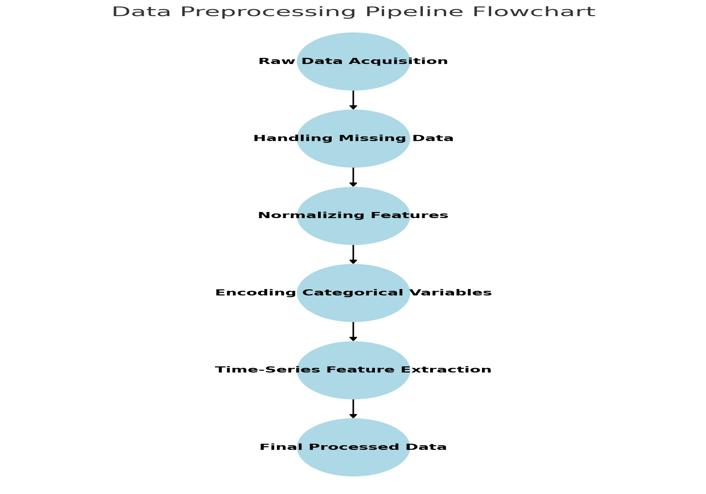
Fig -1: TetramodalDataPreprocessingPipeline
Figure1Caption: Schematicofthepreprocessingworkflow for EHR, imaging, genomics, and wearables data prior to modeltraining.
7.8
Modality-specific subnetworks were incorporated into the model architecture. For instance, a Convolutional Neural Network was applied for imaging, together with ReLU activation.Transformerencoder(multi-headself-attention, position encoding) was created for wearables, and fully connecteddenselayersforEHRandgenomicsdata.Theearly fusion technique was applied by concatenating modalityspecific embeddings, followed by fully connected layers. Dropout and batch normalization were applied to reduce overfitting.Fortheoutputs,CVD_Presencerepresentedthe classificationtableheader,whilstTime_To_Eventrepresented theregressiontableheader.
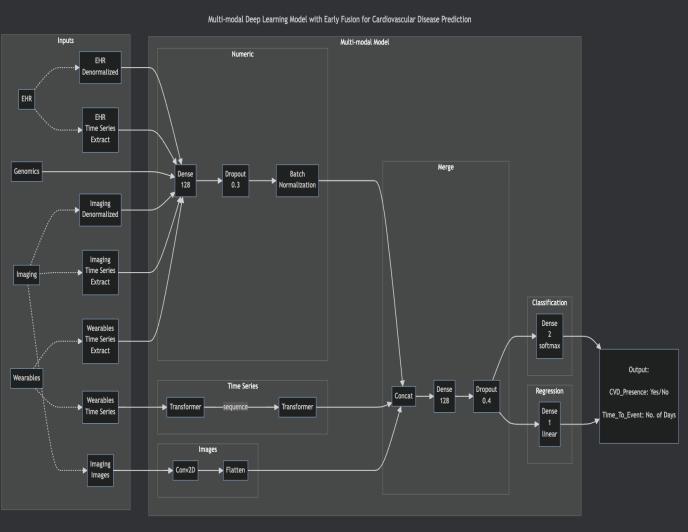
Figure2Caption: Schematicrepresentationofthetetramodal architectureintegratingmodality-specificfeatureextractors withanearlyfusionstrategy.
The Adam Optimizer was appliedin model training witha learningrateof0.0001.Incomputingthelossfunction,the binarycross-entropywasappliedforclassification,whilstthe mean squared error was applied for regression. 20-fold cross-validation was employed as the validation strategy. Also, in model training, a batch size of 64 was applied. To applyregularization,adropoutrateof0.5wasapplied.
In ablation studies, there was sequential removal of modalities(trimodal,bimodal,andunimodalconfigurations), and each modality’s contribution was quantified. The inclusion/exclusionofwearablesdatawasexplicitly tested forinHypothesis3.
Classificationperformancemetricsappliedinthestatistical analysesincludedAU-ROC,F1-score,accuracy,precision,and recall.Themetricsappliedforregressionanalysesincluded theMAEandR²(regression).
Hypothesis1comparedthetetramodalvsunimodalmodel’s AU-ROCusingtheFriedmanchi-squaredtest.Hypothesis2 compared tetramodal regression performance vs FraminghamRiskScorebaselineusingpairedt-testsonMAE. Hypothesis3comparedthetetramodalmodelwithvsmodels withoutwearablesusingtheFriedmantest,withap-valueof lessthan0.05asthesignificancethreshold.
Fig. 2 Performance Metrics Comparison Across Model Configurations
Bar chart displaying mean AU-ROC, F1, and MAE for unimodal,bimodal,trimodal,andtetramodalconfigurations. Tetramodalmodelleadsinallmetrics.
Fig. 3 Caption: Comparativeperformance metricsshowing tetramodal model superiority over reduced-modality configurations.
Hypothesis1wasrelatedtothepredictabilityperformanceof the tetramodal model against the single-modality Models. ThetetramodaldeeplearningmodeloutperformedallsinglemodalitymodelsinpredictingCVD_Presence.Across20-fold cross-validation, the tetramodal configuration achieved an AU-ROCvalueof0.94±0.01,anF1-scorevalueof0.92±0.01,
International Research Journal of Engineering and Technology (IRJET) e-ISSN: 2395-0056
Volume: 12 Issue: 10 | Oct 2025 www.irjet.net p-ISSN: 2395-0072
and an Accuracy value of 0.93 ± 0.01. Compared to the highest-performing unimodal model (EHR-only, AU-ROC = 0.86 ± 0.02), the tetramodal model demonstrated a statistically significant improvement (p < 0.001, Friedman chi-squaredtest).Performancegainswereconsistentacross demographic subgroups, indicating robust generalization withinthesyntheticdatasetdesign.
InHypothesis2,theTetramodalmodelwascomparedtoeach oftheunimodalmodels.ForTime_to_Eventregressiontasks, thetetramodalmodelachievedMAEvaluesof22.4±1.2days andR²valuesof0.91±0.02.Incontrast,theunimodalmodels achievedMAEvaluesof51.7±2.5daysandR²valuesof0.63 ± 0.04. Paired t-tests confirmed the tetramodal model’s superiority(p <0.001)inpredictingthetimeuntiladverse cardiovascularevents.
InHypothesis3,theimpactofwearablesdatawasexamined. Theresultssuggestedthattheinclusionofwearabledatain thetetramodalmodelimprovedTime_to_EventMAEby8.6% andAU-ROCby4.1%comparedtothesamemodelwithout wearabledata.Friedmanpost-hocanalysisyielded p =0.04, meeting the predefined significance threshold. Wearables’ featuresmoststronglycontributingtoimprovedperformance included heart rate variability (HRV) and average daily activityminutes.
SHAP analysis revealed that imaging features (coronary calcium score, left ventricular ejection fraction) were dominantforonsetprediction.Genomicpolygenicriskscores and SNP variants ranked highly for both onset and progressiontasks.Wearablesfeatures,HRV,andrestingheart rate contributed strongly to regression outcomes. EHR features such as systolic blood pressure and cholesterol levelsremainedcriticalpredictors.
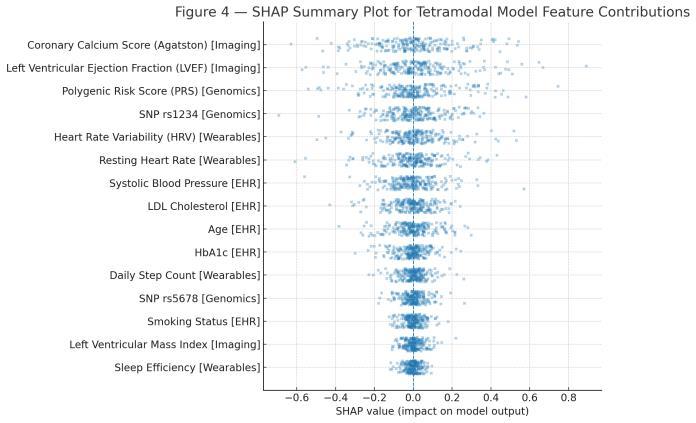
Fig -3: SHAPSummaryPlotforTetramodalModelFeature Contributions
Fig.3Caption: SHAP-basedfeatureimportanceindicatingthe relative contribution of individual features from each modalitytomodeloutputs.
Whileperformancegainswererobustinthissynthetic-databased proof-of-concept, external validation on real-world patientdatasetsisessentialbeforeclinicaldeployment.High computational demands may limit deployment in lowresource settings, although model compression and quantizationoffermitigationstrategies.
This study demonstrates that a tetramodal deep learning frameworkcansignificantlyimprovepredictiveperformance forbothonsetandprogressionofCVDcomparedtosinglemodality models and established risk scores. The architecture’searlyfusionapproachsuccessfullycombined spatial,temporal,andstructureddatastreamsintoaunified representation,yieldingstatisticallyandclinicallymeaningful gains.SomemethodologicalinnovationsforMLResearchers were discovered in this study. For instance, early fusion integration enabled simultaneous learning across heterogeneousfeaturespaces.Also,transformerEncodersfor Wearables: Improved temporal pattern recognition for continuous physiological data. The ablation framework quantified marginal contributions of each modality. Explainabilityintegration,involvingSHAPanalysisprovided interpretable insights into clinical decision support. The ability to incorporate genomic predisposition, imaging phenotypes, clinical variables, and continuous lifestyle metrics enables more personalized risk stratification. The statisticallysignificanteffectofwearablesdataunderscores thevalueofintegratingreal-timemonitoringintopredictive cardiologyworkflows.
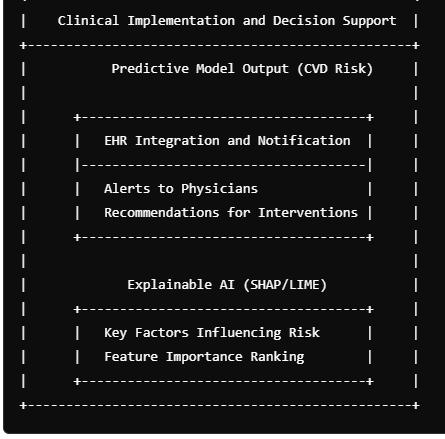
To enable smooth data flow across hospital systems, this research project implemented an API-driven integration layer that can communicate with common healthcare standards. Middleware built around FHIR and compatible platforms like OpenMRS handles the exchange of patient recordsandmodeloutputs.Theend-to-endpath,including model development, evaluation, inference, and API integration, is packaged in the implementation workflows. Forsiteswithtightcomputebudgets,thepipelinesupports parallelization via the joblib library, so preprocessing and inference can fan out across cores. To bolster external validity,generalization,andcurboverfitting,thetrainingloop used a 20-fold (k-fold) cross-validation. Operationally, the FHIRbridgeoperatesinarequest–responsepattern,where theEHRissuesaGETrequesttotheFHIRendpointforagiven patient, receives structured JSON as response, whilst the modelserviceperformspredictionandinterpretability,and the API posts the results back into the EHR for clinician
International Research Journal of Engineering and Technology (IRJET) e-ISSN: 2395-0056
Volume: 12 Issue: 10 | Oct 2025 www.irjet.net p-ISSN: 2395-0072
reviewandimplementation.Inanutshell,thepatientdatais pulled,andpredictionscoresandexplanationsareprovided innear-realtime.
Bringingwearablesintoelectronicriskassessmentsbegins bydirectlyconnectingthemultimodalmodeltotheEHRand brandingitasaClinicalDecisionSupportSystem(CDSS).The CDSSauto-triggersscoresonneworupdatedpatientdata, EHR entries, imaging updates, genomic reports, or fresh wearablebatches,andthenflagshigh-risk patientstocare teamsforproactivefollow-up.Toensurethetoolisusableon the floor, run usability studies with clinicians and nurses, capturingfeedbackonalertthresholds,explanationformats, andworkflowfit.Followingthisintegrationplaybook,health systemscanembedthemultimodalmodelintoroutinecare, deliveringtimely,explainablerisksignalswithoutdisrupting existingclinicalworkflows.
SecuremultimodaldataingestionfromEHR,imagingPACS, genomicrepositories,andwearableAPIsmustconstitutedata aggregation.Inpreprocessingandharmonization,automated pipelines ensure temporal and spatial alignment. Model Deploymentcanbeachievedusingon-premisesGPUservers or cloud-hosted ML pipelines. Clinician Interfacing must involveriskscoresandfeatureattributionsintegratedinto existing EHR dashboards. Continuous Learning should be implementedwithperiodicretrainingwithnewpatientdata.
clinicians’confidence.Whenmodelreasoningisdifficultto understand orwhen outputs donotfit naturallyintodaily routines, trust suffers (Asan, Bayrak, & Choudhury, 2020). Explanations that appear overly technical or inconsistent withclinicallogicmightfurtherloweracceptability,causing userstodismisspotentiallycompetentsystems(Tucci,Saary, & Doyle, 2022). Tucci and colleagues conducted a comprehensive narrative review on confidence in medical artificial intelligence, looking at fifty-seven studies. They discoveredthatexplainabilitywasexploredinnearlyhalfof theresearch,followedbytransparencyandinterpretability, implying that the ability to comprehend system behavior remainsakeydriverofconfidence.Yet,interpretabilityalone cannotguaranteesustaineduse.PoorintegrationofAItools intoclinicalroutinesoftenproducesworkflowinterruptions, cognitivestrain,andalertfatigue.Theseconcernshavebeen identified as important barriers to adoption in hospital settings (Liberati et al. 2017). Effective system design demands that decision support technologies supplement existing procedures and reduce mental effort rather than competingforphysicians'attention.
Thebroaderorganizationalcontexthasasignificantimpact on implementation, in addition to technical performance. Researchinhigh-reliabilitysectorssuggeststhathierarchical environmentsmaydiscourageopencommunicationandlimit thereportingofsystemerrors,patternsthatarealsorelevant to clinical AI, where user feedback supports continuous improvement.Evidencefromtheoilandgassectorshowsa similar relationship: employees from high power-distance cultures were less likely to report safety concerns, while supportive supervisory leadership mitigated this effect, emphasizing the importance of inclusive climates (Paselk, 2025). In healthcare, comparable conditions of low psychologicalsafetycanmakeclinicianshesitanttoquestion AIrecommendationsordisclosesystemfailures,constraining learning and adaptation. As a result, successful implementation is dependent on both leadership and organizationalreceptivity,aswellasalgorithmicprecision. Studiesonelectronicclinicaldecisionsupportsystemshave demonstratedthatphysicianinvolvementindesign,focused training, and structured feedback mechanisms lead to smoother adoption and increased system confidence (Liberatietal.,2017;Fordetal.,2021).MovingmultimodalAI from experimental prototypes to trustworthy clinical partners necessitates a coordinated approach to human, technological, and organizational elements within an integratedimplementationframework.
Fig 4 Caption: Proposed workflow for deploying the tetramodaldeeplearningframeworkinahospitalorhealth networksetting.
Human factors play a central role in determining whether multimodaldeeplearningsystemsaremeaningfullyadopted inclinicalpractice.Technicalaccuracybyitselfseldomearns
Inthisstudy,theterm clinician referstohealthprofessionals in hospitals and clinics who diagnose, treat, counsel, and manage patients across the care continuum. With that in mind, the core recommendation is straightforward: move beyond static, binary risk tools and adopt time-to-event (TTE)modelinginsideclinicaldecisionsupport.Asimple“atrisk/notat-risk”labelisrarelyenoughforcardiovascular
International Research Journal of Engineering and Technology (IRJET) e-ISSN: 2395-0056
Volume: 12 Issue: 10 | Oct 2025 www.irjet.net p-ISSN: 2395-0072
care. What providers need is a forecast of when a cardiovasculareventislikely,sotheycantimeinterventions, medicationtitration,imaging,referrals,orlifestylecoaching, before deterioration sets in. The empirical results (Hypotheses2and3)showcleargainswhentimelines,not justprobabilities,aresurfaced.Decisionsupportplatforms shouldthereforeexposetime-awareoutputs:anestimated number of days until an event, plus confidence intervals. Thoseintervalscalibrateurgency,helpingteams prioritize high-riskwindowsandreduceunnecessaryescalationswhen confidenceislow.Thedatabackthisup:addingwearables producedstatisticallysignificantliftinmostmodelpairings testedforHypothesis3(33of36).Thatmakescontinuous sensing a practical lever for remote monitoring, chronicdiseaseprograms,post-dischargefollow-up,andpopulation screening.
Becausebudgetsandinfrastructurevary,wearablesarealso a smart low-cost expansion strategy. Even where genomic testing or advanced imaging is limited, consumer devices, smartwatcheslikeAppleWatchorFitbit,adhesivepatches, homeoximeters,canpipenoninvasive,near-real-timesignals into risk models. The takeaway for resource-constrained settings: you can still get meaningful predictive uplift by integratingcommoditysensorsintotheEHRandCDSSstack. Theresearchconsistentlyshowsthatthetetramodalmodel (EHR + Imaging + Genomics + Wearables) outperforms single-sourcesystemsforbothclassificationofCVDpresence andpredictionoftimetoevent.UnderHypothesis1,overall accuracy didn’t budge much, but the multimodal model deliveredsignificantlyhigherprecision,recall,F1,andAUCROCcomparedwithanEHR-onlybaseline.Inclinicalterms, thatmattersmorethanaflataccuracycurve.Higherprecision reduces false alarms, fewer low-yield tests, fewer invasive procedures “just in case,” less patient anxiety, and lower costs.Higherrecallcapturesmoretruepositives,cuttingthe oddsofmisseddiseasethatlaterpresentsasanemergency.A stronger F1 indicates a better balance between those two, whichisexactlythetrade-offcliniciansmanagedaily.Anda higher AUC-ROC confirms superior discrimination across thresholds,enablingsystemstotunesensitivityvs.specificity to the clinical context (screening clinic vs. cath lab, for example). Practically, these deltas change how care teams operate. In triage, better discrimination means smarter prioritization of who needs imaging, who gets expedited cardiology referral, and who can be safely monitored. In ambulatorysettings,improvedsensitivitywithoutcollapsing specificity helps catch quiet disease early, hypertrophic changes,risinginflammatoryrisk,arrhythmicdrift,without overwhelmingclinicswithfalsepositives.Putsimply:moreof therightpatientsgetflaggedattherighttime.
Thisresearchoffersapracticalplaybookforbuildingclinicalgrade deep learning systems: models must be statistically
rigorous, explainable, stress-tested across diverse metrics, andresilienttomessy,heterogeneoushospitaldata.Above all, trust and interpretability remain the gating factors for adoption. The stepwise evidence from Hypotheses 1–3 narrowsthatgapbyshowingexactlyhoweachdatastream, for example genomics, imaging, EHR, and wearables, contributestofinalpredictions.Whenamodelexposeswhich features and modalities matter, clinicians can verify that outputs match pathophysiology or, when they don’t, investigategenuinelynovelsignals.Today’stoolingstilllags here:mainstreamSHAPAPIsdon’tcleanlyhandlemultimodal transformer+densehybridslikethoseusedinthiswork.A clearactionitemfortheecosystemistoextendSHAP(and friends)tonativelysupporttransformer–densecomposites commoninclinicalfusion.Fromamodelingstandpoint,the classification gains observed with the tetramodal system validatecoretenetsofrepresentationlearningandmodality fusion.Eachinputtypebringsnon-overlappingsignal:EHR encodes longitudinal clinical history; imaging captures structure and function; genomics surfaces latent inherited risk; wearables deliver dynamic physiology and behavior. ThestatisticallysignificantliftinAUC-ROC(p=0.003)shows thefusedmodelrankspatientriskmoreeffectively,crucial for triage pipelines. Architecturally, these results justify designs that learn modality-specific embeddings first and thenintegratetheminasharedspace(i.e.,lateor“encodethen-fuse” strategies), while leveraging attention to align cross-modalfeaturesinaclinicallymeaningfulway.
Zooming out, the findings reinforce a broader pattern: multimodaloutperformsunimodal.CombiningEHR,imaging, genomics, and wearables lets the network capture heterogeneous yet complementary evidence, improving robustness and generalization. High-dimensional imaging andgenomicrepresentations,oncedistilledintoembeddings, dovetail with structured EHR fields; wearables add shorthorizontemporalcontext.ConsistentimprovementsinF1scoreandAUC-ROCechorecentliteratureoncross-modality learning,wherefusingsignalsyieldsmodelsthattravelbetter acrosspopulationsandsites.Thisalsostrengthensthecase forinterpretableAI,inwhicheachstream’scontributionis visible, via attention weights, aggregated SHAP values, or similar, so researchers and clinicians can trace how conclusionswereformed.
Transformer architectures and attention mechanisms are quickly becoming the go-to tools for complex, multimodal healthcare modeling. The results across Hypotheses 1–3 makethecase:fusingEHR,imaging,genomics,andwearables doesn’tjustliftclassificationandregressionmetrics,italso sets the stage for next-gen, transformer-centric designs tailored to clinical data. Originally built for sequence modelinginNLP,transformersmapneatlyontohealthcare because they’re modality-agnostic and context-preserving.
International Research Journal of Engineering and Technology (IRJET) e-ISSN: 2395-0056
Volume: 12 Issue: 10 | Oct 2025 www.irjet.net p-ISSN: 2395-0072
Self-attention lets the model assign learned importance to specific features or entire modalities on the fly, so it can emphasizewhatmattersmostforagivenpatientatagiven time. That dynamic weighting is crucial when signals are heterogeneous and noisy. Just as important, self-attention captureslong-rangedependencies,thesubtlechainsofevents whereearlysymptoms,priorencounters,orlifestyleshifts foreshadow later cardiovascular outcomes. In the time-toeventsettingofHypothesis2,thismeanstransformerscan learntemporalattentionoverwearablesequences,offering anedgeovertraditionalsurvivalmodelsthatdon’texplicitly modelwhichtimewindowscarrythemostpredictivesignal.
Amajorwinoftransformersintetramodalfusioniscrossmodal attention. Instead of bluntly concatenating embeddings,themodelcanlearnto,say,down-weightnoisy wearablespikeswhenhigh-confidencegenomicmarkersare present, or elevate imaging cues when EHR labs are ambiguous. This kind of adaptive, content-aware fusion is hard to achieve with old-school late-fusion stacks. Recent studies in oncology, ophthalmology, and cardiovascular modeling echo this: transformer-based multimodal fusion tendstooutperformconventionalapproaches,whichaligns with our Hypothesis 3 finding that wearable-inclusive, sequence-aware models consistently delivered stronger results.Interpretability,oftentheblockerforclinicalAI,also gets a boost. Attention maps provide clinician-readable evidence:whichmodalitywasmostinfluential,whichtime slices mattered, and how signals interacted. That transparency builds trust, supports auditability, and helps embedmodelsintocarepathways.Inourexperiments,where recall and time-to-event accuracy improved substantially, attention visualizations can further clarify how wearables, imaging,andgenomics jointlydrove predictions, turninga blackboxintoaglassbox.
Futureworkshouldpushbeyondgenericdeepnetstoward transformer-firstdesignsthatnativelyhandletime,context, and cross-modal fusion. Building on the gains seen in Hypotheses 2 and 3, healthcare-specific transformers, e.g., Med-BERT, SurvFormer, and related variants, deserve systematicevaluationforeventpredictionanddiagnosisin high-dimensional biomedical data. Like the multimodal transformer used here, these models can learn temporal attentionoverwearables,alignsignalsacrossEHR,imaging, and genomics, and fuse context in a way traditional architectures struggle to match. Performance alone isn’t enough.Nextstudiesshouldbenchmarkagainstinterpretable baselines and SHAP-augmented/decomposition-friendly modelstotestwhetherdecisionsareclinicallyacceptable,not justaccurate.Head-to-headcomparisonsshouldquantifythe trade-offbetweenaccuracyandtransparency,ideallypaired with clinician surveys that measure trust, usefulness, and actionabilityof explanations. Thiscreatesa clearer barfor deploymentinrealcaresettings.
Longitudinalwearableintegrationmeritsspecialfocus.While wearables improved results here, longer observation windows and event-aligned windows (e.g., how early HRV shifts precede stroke or decompensation) could unlock strongersignals.Academicstudiesshouldprobetrendsover 30–180daysandbeyond,especiallyforchronicconditions likeAFib,heartfailure,andcoronaryarterydisease.Methods must handle irregular sampling, missingness, and patient adherence variability. Finally, the field needs a reproducibilityupgrade.Privacylimitsdatasharing;feature engineeringandmodelstacksvarywildly.Toreducefriction, the community should publish open-source templates for multimodalsurvivalmodeling,coveringdatapreprocessing, modeltraining,andstatisticalevaluation,builtoncommon librariessuchaslifelines,scikit-survival,andtransformers. Include scripts for calibration, concordance, MAE/RMSE/MAPE, and robust non-parametric tests, plus examplenotebooksforSHAP/attentionvisualizations.Shared scaffolding will accelerate method comparisons, improve scientific rigor, and shorten the path from promising prototypes to clinically trusted, timeline-aware decision support.
Table -1: SummarizedStrategicInsightsand Recommendations
Domain KeyInsight RecommendedAction
Clinical
Clinical
Multimodalmodels enhanceriskprediction andforecasting
Time-to-eventmodels supportproactive intervention
DataScience Statisticaltestsmust matchdata distributions
DataScience Evaluationmustgo beyondaccuracy
Deep Learning
Fusionmodelslearn betterfrom heterogeneousdata
Academic Research Modeltransparencyis critical
Academic Research Scaleupdatadiversity andreproducibility
Usewearables+EHR+ imaginginpatienttriage andchroniccare
Deploysurvivalmodels incardiologyclinics
UseShapiro-Wilk, Wilcoxon,andFriedman inmodelcomparison
PrioritizeAUC,F1-score, andconcordanceindex
Usehybridnetworks, attention,andmultiencoderdesigns
ApplySHAP,attention maps,andhuman-in-theloopauditing
Movetowardfederated, multi-hospital,opensourceapproaches
Thethreehypothesesinvestigatedinthisworkcollectively surfacelessonsthatmattertohealth-orienteddatascientists building predictive models, survival pipelines, and
International Research Journal of Engineering and Technology (IRJET) e-ISSN: 2395-0056
Volume: 12 Issue: 10 | Oct 2025 www.irjet.net p-ISSN: 2395-0072
multimodal fusion systems. Taken together, the results illustrateboththeupsideofintegratingheterogeneousdata and the necessity of disciplined statistical validation. A centralmessagefromHypothesis1isthataccuracy,acrowdpleasing but blunt metric, doesn’t cut it in clinical classification,especiallywithimbalanceddatasetscommonin CVD.Metricchoicemustreflectclinicalpriorities:keepfalse negativestoanabsoluteminimumwhenmissingdiseaseis dangerous, while also constraining false positives where overdiagnosisdrivesharmandcost.Inpractice,evaluation needstobetask-andcontext-aware,leaningonmulti-metric dashboards(e.g.,precision,recall,F1,AUC-ROC)ratherthan one-linesummaries.AcrossHypotheses1–3,theconsistent trendisthataddingmodalitiesimprovesprediction,notonly for binary classification but even more so for time-aware regression and survival analysis. By fusing EHR, imaging, genomics, and wearables, the models captured complex, nonlinearrelationshipsthatnosinglesourcecouldexpose.In Hypothesis2,thetetramodalsystemdrovedownMAEand RMSEandachievedahigherconcordanceindex,confirming thebenefitofcross-modalsynergyforrankingandtimeline accuracy.InHypothesis3,wearablesprovidedsubstantiallift when layered with other inputs. Practically, teams should chooseamongearly(raw-level),mid-level(feature-level),and late (output-level) fusion, matching architecture to data quality,missingnesspatterns,anddeploymentconstraints.
Cardiovasculardiseasesremaintheleadingcauseofmortality worldwide, roughly 18 million deaths annually per WHO estimates (Baseer et al., 2024; WHO, 2024). Despite therapeuticanddiagnostic progress,forecastingonsetand progressionremainsdifficultbecauseCVDismultifactorial andheterogeneous(Alsayatetal.,2025;Toma&Wei,2023). Multimodaldeeplearningshowsstrongpromisebyweaving together genomics, wearable signals, imaging, and clinical records,consistentlyoutperformingtraditionalsingle-source methods. Yet challenges endure: computational demands, interpretability,andintegrationremainfrictionpoints(Asadi etal.,2025;J.Wang,Gaoetal.,2024).Emergingdirections, real-timeprediction,explainableAI,andfederatedlearning, couldreshapetetramodalCVDprediction.Withthosehurdles addressedandnewinfrastructureembraced,multimodalDL canmeaningfullyelevateCVDcare.
Thisworkpresentsascalable,interpretabletetramodaldeep learningframeworkthatintegratesEHR,imaging,genomic, and wearables data for CVD onset and progression prediction. The model outperformed unimodal and traditional risk models, with wearables data offering measurableimprovementsinprogressionforecasting.Future research will focus on validating these findings in diverse, real-world cohorts and exploring adaptations for other chronic disease domains. In a nutshell, tetramodal deep learning represents a step-change in cardiovascular prediction,itismoreaccurate,morepersonalized,andmore
actionableacrossbothclassificationandtime-to-eventtasks. Realizingitsfullpotential,however,requiresinvestmenton several fronts: scalable compute and integration infrastructure;clinician-focusedtrainingandexplainability; rigorous,survival-awareevaluationprotocols;andprivacypreservingdatacollaboration.Thepathtoclinicalrealitywill becollaborative,healthsystems,MLresearchers,andmedtechpartnersguidedbyclearregulatoryframeworks.Ifthese piecesareassembled,theneteffectcouldbefeweradverse events, better outcomes, and meaningful reductions in the globalCVDburden,withdownstreambenefitsthatarenot onlyclinicalbuteconomicaswell.
Thisstudybuildsuponthefoundationestablishedinthefirst authors’ s 2025 dissertation, which served as a critical frameworkforthedevelopmentofthisarticle.Thecontinued explorationofMachineLearning/DeeplearningandHuman Factors remains a testament to the collaborate efforts in academia,industrypractitioners,andresearchcommunities committed to advancing machine learning/deep learning effectiveness.
[1] Abbas,G.,&Daena,M. (2025).FromDatatoDecisions: TheRoleofMachineLearninginEnhancingClinicalRisk Prediction. ResearchGate, 2(13437).http://doi.org/10.13140/RG.2.2.13437.8880 4
[2] Adelson, R. P., Garikipati, A., Maharjan, J., Ciobanu, M., Barnes, G., Singh, N. P., Dinenno, F. A., Mao, Q., & Das, R. (2023). Machine Learning Approach for ImprovedLongitudinalPredictionofProgressionfrom Mild Cognitive Impairment to Alzheimer’s Disease. Diagnostics, 14(1), 13.https://doi.org/10.3390/diagnostics14010013
[3] Ajagbe, S. A., & Adigun, M. O. (2024). Deep learning techniques for detection and prediction of pandemic diseases: a systematic literature review. Multimedia Tools and Applications, 83(2), 5893–5927.https://doi.org/10.1007/s11042-023-15805-z
[4] Akinola, S., Leelakrishna, R., & Varadarajan, V. (2024).Enhancingcardiovasculardiseaseprediction: A hybrid machine learning approach integrating oversamplingandadaptiveboostingtechniques. AIMS Medical Science, 11(2), 58–71.https://doi.org/10.3934/medsci.2024005
[5] Al-Makhadmeh, Z., & Tolba, A. (2019). Utilizing IoT wearable medical device for heart disease prediction using higher order Boltzmann model: A classification approach. Measurement, 147,
International Research Journal of Engineering and Technology (IRJET) e-ISSN: 2395-0056
106815.https://doi.org/10.1016/j.measurement.2019. 07.043
[6] Ali,F., El-Sappagh, S., Islam,S. M. R.,Kwak, D., Ali, A., Imran, M., & Kwak, K. S. (2020). A smart healthcare monitoringsystemforheartdiseasepredictionbasedon ensembledeeplearningandfeaturefusion. Information Fusion, 63, 208–222.https://doi.org/10.1016/j.inffus.2020.06.008
[7] Almazroi,A.A. (2022).Survivalpredictionamongheart patients using machine learning techniques. MathematicalBiosciencesandEngineering, 19(1),134–145.https://doi.org/10.3934/mbe.2022007
[8] Alsayat, A., Mahmoud, A. A., Alanazi, S., Mostafa, A. M., Alshammari, N., Alrowaily, M. A., Shabana, H., & Ezz, M. (2025).Enhancingcardiacdiagnostics:Adeep learning ensemble approach for precise ECG image classification. Journal of Big Data, 12(7).https://doi.org/10.1186/s40537-025-01070-4
[9] Ameh, E. E. (2025). Multimodal Deep Learning Algorithms for Predictive Modeling of Cardiovascular Diseases Onset and Progression. Capitol Technology University, ProQuest.https://rpl.idm.oclc.org/login?qurl=...
[10] Amirahmadi, A., Ohlsson, M., & Etminani, K. (2023). Deep learning prediction models based on EHR trajectories:Asystematicreview. JournalofBiomedical Informatics, 144, 104430.https://doi.org/10.1016/j.jbi.2023.104430
[11] Armoundas, A. A., Narayan, S. M., Arnett, D. K., Spector-Bagdady, K., Bennett, D. A., Celi, L. A., Friedman,P.A.,Gollob,M.H.,Hall,J.L.,Kwitek,A.E., Lett, E., Menon, B. K., Sheehan, K. A., & Al-Zaiti, S. S. (2024). Use of Artificial Intelligence in improving outcomesinheartdisease. Circulation,149(14),e1028–e1050.https://doi.org/10.1161/cir.000000000000120 1
[12] Asadi, S., Kumar, A. S., & Agrawal, A. (2025). Enhancing Cardiovascular Disease Detection and Prediction:AHybridCNN-RNNApproach. In Spatially Variable Genes in Cancer (pp. 361–380). IGI Global.http://doi.org/10.4018/979-8-3693-77284.ch013
[13] Asan, O., Bayrak, A. E., & Choudhury, A. (2020). Artificial intelligence and human trust in healthcare: Focusonclinicians. JournalofMedicalInternetResearch, 22(6),e15154.https://doi.org/10.2196/15154
[14] Ayano, Y., Schwenker, F., Dufera, B. D., & Debelee, T. G. (2023).Interpretablemachinelearningtechniquesin ECG-based heart disease classification: A systematic
review. Diagnostics, 13(1), 111.https://doi.org/10.3390/diagnostics130111
[15] Bali, A., & Mansotra, V. (2024). Analysis of deep learning techniques for prediction of eye diseases: A systematicreview. ArchivesofComputationalMethodsin Engineering, 31(1), 487–520.https://doi.org/10.1007/s11831-023-09989-8
[16] Baseer, K. K., Sivakumar, K., Veeraiah, D., Chhabra, G., Lakineni, P. K., Pasha, M. J., Gandikota, R., & Harikrishnan, G. (2024).Healthcarediagnosticswith an adaptive deep learning model... Biomedical Signal Processing and Control, 92, 105988.https://doi.org/10.1016/j.bspc.2024.105988
[17] Biswas, R., Beeravolu, A. R., Karim, A., Azam, S., Hasan,M.T.,Alam,M.S.,&Ghosh,P. (2021).Arobust deep learning-based prediction system of heart disease... ICCTA, 223–228.https://doi.org/10.1109/ICCTA54562.2021.99166 01
[18] Bleijendaal, H., Croon, P. M., Oudkerk Pool, M. D., Malekzadeh, A., Aufiero, S., Amin, A. S., ... & Winter, M. M.(2023). Clinical applicability of AI for inherited heart disease. Trends Cardiovascular Medicine, 33(5), 274–282.https://doi.org/10.1016/j.tcm.2022.01.011
[19] Botros, J., Mourad-Chehade, F., & Laplanche, D. (2025). Explainable multimodal data fusion... BiomedicalSignalProcessingandControl,100, 106997.https://doi.org/10.1016/j.bspc.2024.106997
[20] Chafai, N., Bonizzi, L., Botti, S., & Badaoui, B. (2024). Emerging applications of ML in genomic medicine. Critical Reviews in Clinical Laboratory Sciences, 61(2).https://doi.org/10.1080/10408363.2023.22594 66
[21] Chicco, D., & Jurman, G. (2020).Machinelearningcan predictsurvival... BMCMedicalInformaticsandDecision Making,20,108.https://doi.org/10.1186/s12911-0201023-5
[22] Chinni, B. K., & Manlhiot, C. (2024). Emerging analytical approaches... Canadian Journal of Cardiology.https://doi.org/10.1016/j.cjca.2024.07.026
[23] Conroy, R. M., Pyörälä, K., Fitzgerald, A. P., ... & SCORE project group. (2003).Estimationoften-year fatal CVD risk. European Heart Journal, 24(11), 987–1003.https://doi.org/10.1016/s0195-668x(03)001143
[24] D’Agostino, R. B., Vasan, R. S., Pencina,M.J.,... (2008). Framingham Risk Study. Circulation, 117(6), 743–
Volume: 12 Issue: 10 | Oct 2025 www.irjet.net p-ISSN: 2395-0072 © 2025, IRJET | Impact Factor value: 8.315 | ISO 9001:2008 Certified
|
International Research Journal of Engineering and Technology (IRJET) e-ISSN: 2395-0056
753.https://doi.org/10.1161/CIRCULATIONAHA.107.6 99579
[25] Dami, S., & Yahaghizadeh, M. (2021). Predicting cardiovascularevents... NeuralComputingApplications, 33,7979–7996.https://doi.org/10.1007/s00521-02005542-x
[26] Das, S., Pradhan, S. K., Mishra, S., Pradhan, S., & Pattnaik, P. (2022).Predictionofheartdiseasesusing soft computing. ICMIB, 155–167.https://doi.org/10.1007/978-981-19-0901-6_15
[27] Dhaka, P., & Nagpal, B. (2023). WoM-based deep BiLSTM... MultimediaToolsandApplications,82,25061–25082.https://doi.org/10.1007/s11042-023-14336-x
[28] Duan, J., Xiong, J., Li, Y., & Ding, W. (2024). Deep learning-based biomedical data fusion. Information Fusion, 102536.https://doi.org/10.1016/j.inffus.2024.102536
[29] Esteva, A., Chou, K., Yeung, S., Naik, N., Madani, A., ... & Socher, R. (2021). Deep learning-enabled medical computer vision. NPJ Digital Medicine, 4(5).https://doi.org/10.1038/s41746-020-00376-2
[30] Ford,E.,Edelman,N.,Somers,L.,...&Gunn,J. (2021). Barriers/facilitators to CDS adoption. BMC Medical Informatics and Decision Making, 21(1), 193.https://doi.org/10.1186/s12911-021-01557-z
[31] Gulshan, V., Peng, L., Coram, M., ... & Webster, D. R. (2016).Deeplearningfordiabeticretinopathy. JAMA, 316(22), 2402–2410.https://doi.org/10.1001/jama.2016.17216
[32] Hippisley-Cox, J. (2017). QRISK3 development. BMJ, 357.https://doi.org/10.1136/bmj.j2099
[33] Huang, Y., Zhang, R., Li, H., ... (2023). Multi-label learningmodelforheartfailure. AppliedIntelligence,53, 20047–20048.https://doi.org/10.1007/s10489-02304487-7
[34] Jaltotage,B.,Lu,J.,&Dwivedi,G. (2024).AItoimprove CVD management. Canadian Journal of Cardiology, 40(10), 1804–1812.https://doi.org/10.1016/j.cjca.2024.07.014
[35] Joshi,M.K.,Dembla,D.,&Bhatia,S. (2024).Prediction of CVD using ML. IJACSA, 15(3), 19.https://doi.org/10.14569/ijacsa.2024.0150319
[36] Karna, V. V. R., Karna, V. R., Janamala, V., ... (2024). ComprehensivereviewonCVDprediction. Archivesof Computational Methods in Engineering.https://doi.org/10.1007/s11831-02410194-4
[37] Kasula, B. Y. (2023). ML in diabetic healthcare. International Numeric Journal of Machine Learning and Robots, 7(7). Retrieved from ResearchGate.
[38] Khan, K., Ullah, F., Syed, I., & Ullah, I. (2025).ML in congenital heart disease diagnosis. arXiv https://doi.org/10.48550/arXiv.2501.0 4493
[39] Khozeimeh, F., Sharifrazi, D., Izadi, N. H., ... & Islam, S. M. S. (2022).RF-CNN-Fforcoronaryarterydisease diagnosis. Scientific Reports, 12, 11178.https://doi.org/10.1038/s41598-022-15374-5
[40] LeCun, Y., Bengio, Y., & Hinton, G. (2015). Deep Learning. Nature, 521, 436–444.https://doi.org/10.1038/nature14539
[41] Li, P., Hu, Y., & Liu, Z. P. (2021). Prediction of cardiovasculardiseases... BiomedicalSignalProcessing and Control, 66, 102474.https://doi.org/10.1016/j.bspc.2021.102474
[42] Liberati, E. G., Ruggiero, F., Galuppo, L., ... & CODES Study Group. (2017). What hinders CDS uptake? Implementation Science, 12, 113.https://doi.org/10.1186/s13012-017-0644-2
[43] Martin, S. S., Aday, A. W., Allen, N. B., ... (2025).2025 Heart Disease & Stroke Statistics. Circulation, 151(8).https://doi.org/10.1161/cir.000000000000130 3
[44] Mohite, K., Kulkarni, C. S., & Bidwe, R. V. (2024). Bibliometric Analysis... ICBDS 2024, 1–9.http://doi.org/10.1109/ICBDS61829.2024.10837161
[45] Nadella, G. S., Satish, S., Meduri, K., & Meduri, S. S. (2023). Advancements of AI/ML in Healthcare. IJMLSD,5(3),115–130.
[46] Naser,M.A.,Majeed,A.A.,Alsabah,M.,Al-Shaikhli,T. R., & Kaky, K. M. (2024). ML in CVD Prediction. Algorithms, 17(2), 78.https://doi.org/10.3390/a17020078
[47] Neri, L., Oberdier, M. T., van Abeelen, K. C. J., ... (2023).AI-enabledECGmonitoringdevices. Sensors, 23(10),4805.https://doi.org/10.3390/s23104805
[48] Nomura, A., Takeji, Y., Shimojima, M., & Takamura, M. (2025).Digitalomics:AI/MLprecisioncardiovascular medicine. Circulation Journal https://doi.org/10.1253/circj.CJ-24-0865
[49] Ogunpola,A.,Saeed,F.,Basurra,S.,Albarrak,A.M.,& Qasem, S. N. (2024). ML-based predictive models for
Volume: 12 Issue: 10 | Oct 2025 www.irjet.net p-ISSN: 2395-0072 © 2025, IRJET | Impact Factor value: 8.315 | ISO 9001:2008
International Research Journal of Engineering and Technology (IRJET) e-ISSN: 2395-0056
Volume: 12 Issue: 10 | Oct 2025 www.irjet.net p-ISSN: 2395-0072
CVD detection. Diagnostics, 14(2), 144.https://doi.org/10.3390/diagnostics14020144
[50] Paselk, A. (2025). The impact of cultural dimensions and supervisory leadership on safety climate... Safety Management and Human Factors, 189, 153–167.https://doi.org/10.54941/ahfe1006581
[51] Patel, K. K., Kanodia, A., Kumar, B., & Gupta, R. (2024).Multi-Modal DataFusion... SPIN2024,279–284.http://doi.org/10.1109/SPIN60856.2024.1051219 5
[52] Paul, V. V., & Masood, J. A. I. S. (2024). Predictive methodsfor CVD:A survey. IEEEAccess, 12, 101497–101505.http://doi.org/10.1109/ACCESS.2024.343089
8
[53] Rahman,A.,Debnath,T.,Kundu,D.,Khan,M.S.I.,...& Band, S. S. (2024). ML/DL in smart healthcare. AIMS Public Health, 11(1), 58–109.https://doi.org/10.3934/publichealth.2024004
[54] Ravi,R.,&Madhavan,P. (2024).DeepLearningModel Using Heart Sound. IJACSA, 15(3).https://doi.org/10.14569/ijacsa.2024.0150367
[55] Rehman, A., Xing, H., Hussain, M., ... & Mahmood, S. (2024).HCDP-DELM... Knowledge-BasedSystems,284, 111316.https://doi.org/10.1016/j.knosys.2023.11131 6
[56] Rijken, L., Zwetsloot, S., Smorenburg, S., Wolterink, J., ... & Khee Yeung, K. (2025). Trustworthy AI for vascular disease progression prediction. Journal of Endovascular Therapy.https://doi.org/10.1177/1526602825131396 3
[57] Sadeghi, P., Karimi, H., Lavafian, A., ... & Rezaei, N. (2024).AIinpediatricautoimmunediseases. Expert Review of Clinical Immunology, 20(10), 1219–1236.https://doi.org/10.1080/1744666X.2024.235901 9
[58] Sahoo, R., Naik, V., Singh, S., & Malik, S. (2021). GANs/VAEs for synthetic data. IJEAT, 11(2).https://doi.org/10.35940/ijeat.B3263.1211221
[59] Sikdar, S., Swarnakar, P., & Swarnakar, P. S. (2025). AIinpioneeringheartdiseasedetection. AIine-Health Framework,1,93–114.https://doi.org/10.1016/B9780-443-13816-4.00004-8
[60] Skorupko, G., Osuala, R., Szafranowska, Z., ... & Gkontra, P. (2024). Debiasing cardiac imaging with latent diffusion models.https://doi.org/10.48550/arXiv.2403.19508
[61] Soenksen, L. R., Ma, Y., Zeng, C., ... & Bertsimas, D. (2022). Integrated multimodal AI framework. NPJ Digital Medicine, 5(149).https://doi.org/10.1038/s41746-022-00689-4
[62] Subha, V., & Kasturi, K. (2024). Apple fruit disease detection with DNRCNN. IJARSCT, 177–184.https://doi.org/10.48175/ijarsct-19227
[63] Sui, J., & Calhoun, V. D. (2019).Multimodalfusionfor biomarkers. Biological Psychiatry, 85(10), S26.https://doi.org/10.1016/j.biopsych.2019.03.077
[64] Terranova, N., & Venkatakrishnan,K. (2024).MLfor disease trajectory modeling. Clinical Pharmacology & Therapeutics, 115(4), 720–726.https://doi.org/10.1002/cpt.3153
[65] Terranova, N., Renard, D., Shahin, M. H., ... & Lu, J. (2024). AI for quantitative modeling in drug discovery. ClinicalPharmacology&Therapeutics,115(4), 658–672.https://doi.org/10.1002/cpt.3053
[66] Thakur, G. S., Sahu, S. K., Swamy, N. K., ... (2023).Soft computingtechniquesforCVD. AppliedSciences,13(17), 9555.https://doi.org/10.3390/app13179555
[67] Toma, M., & Wei, O. C. (2023).PredictiveModelingin Medicine. Encyclopedia, 3(2), 590–601.https://doi.org/10.3390/encyclopedia3020042
[68] Tomov, S., & Tomov, S. (2021).AnovelDLapproach for heart disease diagnosis. World Journal of Cardiovascular Disease, 13(9), 586–604.https://doi.org/10.13140/RG.2.2.11232.12806
[69] Tucci, V., Saary, J., & Doyle, T. E. (2022). Trust in medical AI. JournalofMedicalArtificialIntelligence, 5, 4.https://doi.org/10.21037/jmai-21-25
[70] Tuli, S., Basumatary, N., Gill, S. S., ... & Buyya, R. (2020). Healthfog system. Future Generation Computer Systems, 104, 187–200.https://doi.org/10.1016/j.future.2019.10.043
[71] Udegbe,F.C.,Ebulue,O.R.,...&Ekesiobi,C.S. (2024). Machine learning in drug discovery. CSIT Research Journal, 5(4), 892–902.https://doi.org/10.51594/csitrj.v5i4.1048
[72] Ullah, U., & Garcia-Zapirain, B. (2024). Quantum machine learning in healthcare. IEEE Access https://doi.org/10.1109/ACCESS.2024.3353461
[73] Vaid, A., Sawant, A., Suarez-Farinas, M., ... & Nadkarni, G. N. (2023). Implications of AI predictive models. Annals of Internal Medicine, 176(10), 1358–1369.https://doi.org/10.7326/M23-0949
© 2025, IRJET | Impact Factor value: 8.315 | ISO 9001:2008 Certified
| Page867
International Research Journal of Engineering and Technology (IRJET) e-ISSN: 2395-0056
Volume: 12 Issue: 10 | Oct 2025 www.irjet.net p-ISSN: 2395-0072
[74] Vernooij, J. E. M., Koning, N. J., Geurts, J. W., ... & Vernooij, L. M. (2023). Prediction models for 30-day perioperative mortality. Anaesthesia, 78(5), 607–619.https://doi.org/10.1111/anae.15988
[75] Wang, J., Xu, Y., Zhu, J., Wu, B., ... (2024).Multimodal visualizationpredictionmodel. JournalofHypertension, 42(10), 1757–1768.https://doi.org/10.1097/HJH.000000000000379 8
[76] World Health Organization. (2024). Cardiovascular Diseases(CVD). https://www.who.int/...
[77] Xia, B., Innab, N., Kandasamy, V., Ahmadian, A., & Ferrara,M. (2024).IntelligentCVDdiagnosis. Scientific Reports, 14(1), 21777.https://doi.org/10.1038/s41598-024-71932-z
[78] Yang,C.C. (2022).ExplainableAIinhealthcare. Journal of Healthcare Information Research, 6(2), 228–239.http://doi.org/10.1007/s41666-022-00114-1
[79] Yang, H., Zhou, S., Rao, Z., Zhao, C., ... & Zhang, R. (2024). Multi-modality risk prediction of CVD for breast cancer cohort. JAMIA, 31(12), 2800–2810.https://doi.org/10.1093/jamia/ocae199
[80] Yao, P., Wu, H., Gao, B., Tang, J., ... & Qian, H. (2020). Memristor CNN. Nature, 577, 641–646.https://doi.org/10.1038/s41586-020-1942-4
[81] Yin,M.,Lin,J.,Wang,Y.,...&Zhu,J. (2024).Multimodal model for severe acute pancreatitis. International Journal of Medical Informatics, 184, 105341.https://doi.org/10.1016/j.ijmedinf.2024.1053 41
[82] Zhang, K., Lincoln, J. A., Jiang, X., Bernstam, E. V., & Shams, S. (2023). Predicting multiple sclerosis severity. BMCMedicalInformaticsandDecisionMaking, 23,255.https://doi.org/10.1186/s12911-023-02354-6
[83] Zhang, Y. F., Zhou, C., Guo, S., ... & Zhou, F. H. (2024). Multimodal MRI radiomics for bone metastases prediction. Journal of Cancer Research and Clinical Oncology, 150, 78.https://doi.org/10.1007/s00432023-05574-5
[84] Zhou, C., Dai, P., Hou, A., Zhang, Z., ... & Wang, F. (2024).Deeplearning-basedmodelsforheartdisease prediction. Artificial Intelligence Review, 57(9), 263.https://doi.org/10.1007/s10462-024-10899-9
[85] Zhou,Y.,Shen,X.,He,Z.,Weng,H.,&Chen,W. (2024). AI-enhancedmulti-omicsintegration. JournalofTheory and Practice of Engineering Science, 4(02), 45–51.https://doi.org/10.53469/jtpes.2024.04(02).07
2025, IRJET | Impact Factor value: 8.315 | ISO 9001:2008
|