
International Research Journal of Engineering and Technology (IRJET) e-ISSN: 2395-0056
Volume:13Issue: 03| Mar 2026 www.irjet.net p-ISSN:2395-0072
International Research Journal of Engineering and Technology (IRJET) e-ISSN: 2395-0056
Volume:13Issue: 03| Mar 2026 www.irjet.net p-ISSN:2395-0072
IMRAN RIYAZ AHMAD D B1 , B SHYAMALA DEVI 2
1 PGStudent,DepartmentofComputerApplications,JayaCollegeofArtsandScience,Chennai
2Assistant Professor & Head, Department of Computer Applications, Jaya College of Arts and Science,Chennai
Abstract: The digital transformation of banking necessitates robust applications resilient to escalating cyber threats.Thispaperdetailstheengineeringofafortifiedonline banking platform leveraging the Java EE ecosystem, JDBC for database connectivity, and MySQL for data persistence. The system's core innovation is its multi-layered security model, whichintegratesdefensemechanismsateveryapplicationtier, including an Adaptive Risk-Based Authentication (RBA) framework. Critical implemented features include adaptive bcrypthashingforcredentialstorage,AES-256encryptionfor sensitive data at rest, and mandatory parameterized queries through JDBC to nullify SQL injection. Role-based access control and mandatory session validation enforce strict authorization policies. The results confirm that the proposed architecture effectively upholds the principles of data confidentiality,integrity,andavailability,providingascalable and secure framework for remote financial operations, mitigating risks like phishing, data breaches, and injection attacks.
Keywords: SecureBankingArchitecture,JavaSecurity Framework, JDBC Transaction Integrity, MySQL Data Encryption, Multi-layer Cyber Defense, Financial Application Development.
The proliferation of digital finance has made web-based bankingaglobalstandard,introducingsignificantchallenges in safeguarding user assets and data from sophisticated cyber-attacks.Threatssuchasphishing,SQLinjection,and session hijacking continuously evolve, demanding a proactive and layered security approach. This research addressesthisimperativebyconstructingasecurebanking environment founded on the core tenets of information security:confidentiality,integrity,authentication,andnonrepudiation. The technological triad of Java, JDBC, and MySQL provides a powerful foundation for this endeavor, offering platform-agnostic development, secure database communication, and transactional reliability. This study explorestheend-to-endimplementationofthissystem,from itsarchitecturalblueprinttoitsfunctionalmodulesandthe integratedsecurityprotocolsthatfortify it, witha specific focusonaninnovativeAdaptiveRBAframework.
Previous studies in secure financial systems consistently emphasize several critical pillars. A common theme is the indispensability of strong encryption and multi-factor authenticationasprimarydefenses.Javaisfrequentlylauded foritsbuilt-insecuritymanagerandsandboxed execution environment, making it a stalwart choice for enterprise backenddevelopment. JDBC isrecognizedasthestandard conduit for secure database operations in Java, while MySQL'sadherencetoACIDpropertiesensurestransactional reliability for financial records. Despite these established practices,arecurringshortfallinmanyexistingsystemsis thead-hocimplementationofsecurity,lackingacentralized, enforceablestrategyandconsistentsecure-codingstandards. Furthermore, many systems employ static authentication, which provides a poor user experience or insufficient security for high-risk scenarios. This work aims to bridge thisgapbyproposingacohesivesecurityarchitecturethatis integraltothesystem'sdesignratherthanasupplementary feature,incorporatinganadaptiveauthenticationmodel.
Thisisthecoreinnovationoftheplatform.Thearchitecture canbevisualizedasapipelineintegratedwithinthebroader systemarchitecture,designedtodynamicallyassessriskand challengeusersappropriately.
[User Action] -> [Risk Analysis Engine] -> [Policy Decision Point] ->[SecurityEnforcement]
This component collects and analyzes contextual data to generateareal-timeriskscore.
TransactionContext: Amount,beneficiary(newvs. frequent),transactiontype.
User Context: IP Address & Geo-Location (comparedtousual),timeofday(unusual?).
Device & Session Context: Device fingerprint, sessionage,loginhistory.
International Research Journal of Engineering and Technology (IRJET) e-ISSN: 2395-0056
Volume:13Issue: 03| Mar 2026 www.irjet.net p-ISSN:2395-0072
ScoringModel: Aweightedscoringalgorithm(e.g., basedonasimplerulesetoralightweightmachine learningmodellikeRandomForest).
Example:Risk_Score=(Amount_Weight*Amount_Score)+ (Location_Weight*Location_Score)+...
Thismoduledefinesthresholdsandcorrespondingactions basedonthecomputedriskscore.
LowRisk(Score:0-30): Allowtransactionimmediately.
Medium Risk (Score: 31-70): Require Soft OTP (Email).
HighRisk(Score:71-100): RequireHardOTP(SMS)or Blockandflagforreview.
3.3. Security Enforcement
This component executes the decision by invoking the appropriate authentication module (e.g., OTP service, biometriccheck)beforethetransactionisfinalized.
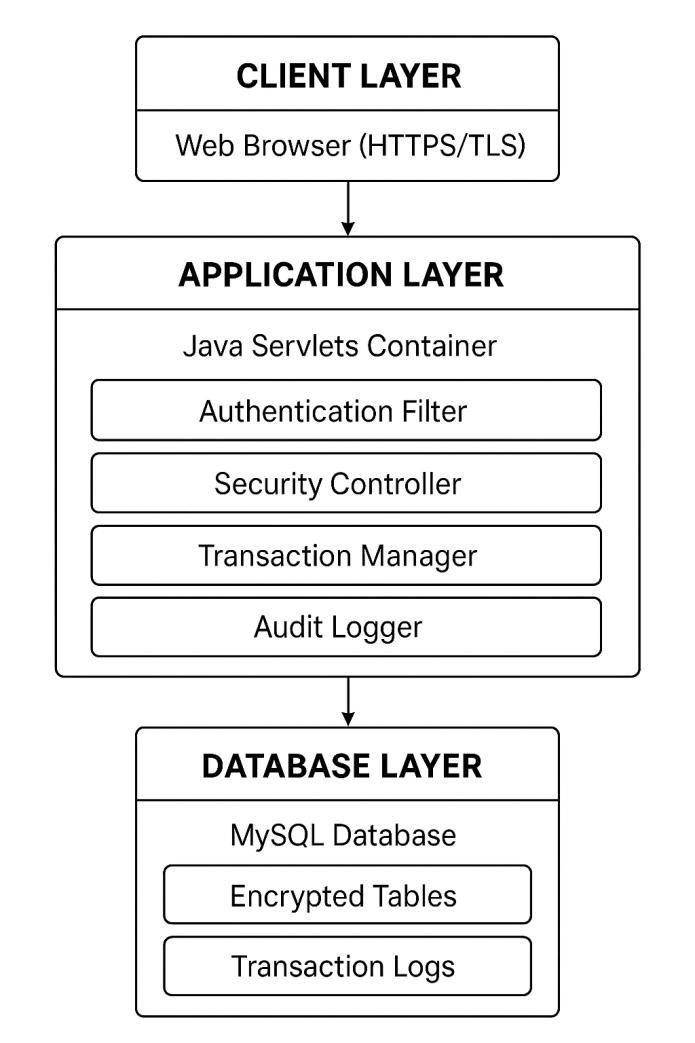
The system is structured on a proven three-tier model to ensure separation of concerns and enhanced security management. The Adaptive RBA framework is embedded withintheApplicationLayer.
PresentationLayer: ComprisesdynamicJSPpageswith HTML/CSS/JavaScript,responsiblefortheuserinterface andclient-sideinputvalidation.
Application Layer: Thecorebusinesslogicishandled by Java Servlets, which act as controllers. This layer manages user authentication, transaction processing, and orchestrates all interactions with the database. It hosts theAdaptive RBA Engineand other dedicated security modules: an Authentication Manager for credential verification, a Transaction Validator for businessrulecompliance,anEncryptionEnginefordata protection,andanAuditLogger.
Database Layer: MySQL server stores all persistent data, including user credentials, account details, transactionledgers,andaudittrails.
User Authentication Module: Manages secure access throughusername/password,withpasswordshashedusing bcrypt.IncorporatesCAPTCHAtodeterautomatedattacks andmanagesusersessionswithstricttimeouts.Thismodule interacts with the RBA framework for step-up authentication.
Account Management Module: Allowscustomerstoview accountbalances,updatepersonalcontactinformation,and reviewsystem-generatednotifications.
Funds Transfer Module: Handles all transaction types internaltransfers,billpayments,anddeposits/withdrawals. ThismoduleisdirectlyintegratedwiththeRBAframework; everytransactionrequestisfirstevaluatedforrisk before processing.
Administrative Module: Providesbankstaffwithtoolsto manageuseraccounts,monitorsystemlogsforsuspicious
International Research Journal of Engineering and Technology (IRJET) e-ISSN: 2395-0056
Volume:13Issue: 03| Mar 2026 www.irjet.net p-ISSN:2395-0072
patterns,approveorblocktransactionsflaggedbytheRBA, andgeneratefinancialreports.
SecurityCoreModule: Acentralizedcomponentenforcing input sanitization, coordinating the use of JDBC Prepared Statements,managingencryptionroutines,andmaintaining comprehensive system logs. The RBA framework is a key componentofthismodule.
Data Protection: A strategic distinction is made between hashing and encryption. Passwords are irreversibly hashed with bcrypt. Highly sensitive data likeaccountnumbersareencryptedusingAES-256.All client-servercommunicationissecuredwithTLS.
Injection Attack Mitigation: SQL Injection is systematically prevented by exclusively using JDBC PreparedStatements,ensuringuserinputistreatedas data,notexecutablecode.
Access Control: A Role-Based Access Control (RBAC) modelisenforced,grantingpermissionsbasedonuser roles (e.g., 'Customer', 'Admin'). The RBA framework providesadynamic,context-awarelayeroverthisstatic RBAC.
Session Integrity: User sessions are tracked with unique, random tokens. Sessions are configured to expire after a period of inactivity, and cookies are flagged as HttpOnly and Secure to thwart client-side scriptaccessandensureencryptedtransmission.
Auditing and Monitoring: All significant events logins,transactions,RBAdecisions,profilechanges are recorded in an immutable audit log. This allows for monitoring, forensic analysis, and regulatory compliance.
The schema is normalized for integrity and performance. Coreentitiesinclude:
users(user_id,name,email,password_hash,role, is_active)
accounts (account_id, user_id, account_number_encrypted,balance,created_on)
transactions (transaction_id, from_account, to_account,amount,type,timestamp,status)
audit_logs (log_id, user_id, action, risk_score, ip_address,timestamp)
Database-level integrity is maintained using foreign key constraints.Triggersareemployedforautomatedtasks,such
as logging balance updates. The InnoDB storage engine is utilizedtoguaranteeACID-complianttransactionprocessing.
Theimplementationusesa stack ofJava Servlets,JSP,and the JDBC API, deployed on an Apache Tomcat server. The JDBC driver facilitates all database interactions. A key practiceistheuseofPre-paredStatementforeverydatabase query involving user input, completely neutralizing SQL injection threats. Financial operations are wrapped in database transactions, managed viaconnection. Set Auto Commit(false),commit(),androllback(),toensureallsteps inatransactioncompletesuccessfullyornonedo,preserving data consistency. The RBA engine is implemented as a central Java service class invoked by Servlets before authorizingsensitiveactions.
Thesystemunderwentrigoroustesting.Securitypenetration testsusing toolslikeOWASPZAPconfirmeditsresilience, successfullyblockingallcommonSQLinjectionandcrosssitescripting(XSS)attackvectors.TheRBAframeworkwas validated to correctly trigger step-up authentication challenges for simulated high-risk scenarios (e.g., large transfers to new beneficiaries from unfamiliar locations). Performance benchmarks under simulated user loads showedsub-secondresponsetimesforstandardoperations, withthedeliberatecomputationalcostofbcrypthashingand RBAanalysisaddingaminimalandjustifiableoverhead.The transactionmanagementsystemflawlesslymaintaineddata atomicity and consistency, even during simulated system failuresmid-transaction.
Thisprojecthassuccessfullydemonstratedtheengineering ofasecure,scalable,andefficientonlinebankingplatformby leveraging the robustness of the Java EE ecosystem, the reliabilityofJDBC,andthetransactionalintegrityofMySQL. Theproposedmulti-layeredsecurityarchitectureprovidesa formidabledefense-in-depthstrategyagainstprevalentweb applicationvulnerabilities.Akeyinnovationofthisworkis the integration of an Adaptive Risk-Based Authentication (RBA) framework, which moves beyond static security modelsbydynamicallyassessingriskandapplyingcontextawareauthenticationchallenges.Theresultsfromrigorous penetrationtestingandperformancebenchmarkingconfirm that the system effectively upholds the core principles of data confidentiality, integrity, and availability. By systematicallyimplementingsecuritycontrolssuchasbcrypt hashing, AES-256 encryption, JDBC prepared statements, and robust session management, the platform mitigates critical risks like injection attacks, credential theft, and session hijacking, thereby providing a trustworthy frameworkforremotefinancialoperations.
International Research Journal of Engineering and Technology (IRJET) e-ISSN: 2395-0056
Volume:13Issue: 03| Mar 2026 www.irjet.net p-ISSN:2395-0072
While the current system establishes a strong security foundation,severalavenuesexistforfurtherenhancement andresearch:
1. Advanced Fraud Detection with Machine Learning: The current rule-based Risk Analysis Engine could be replaced or augmented with a machinelearningmodel(e.g.,anAnomalyDetection algorithm or a Deep Learning network). Such a model could be trained on historical transaction datatoidentifycomplex,non-linearfraudpatterns thataredifficulttocapturewithstaticrules,thereby improvingtheaccuracyandpredictivepowerofthe RBAframework.
2. Integration of Biometric Authentication: To further strengthen the authentication chain and improveuserconvenience,futureiterationscould integrate biometric methods. The "Security Enforcement"modulecouldbeexpandedtosupport fingerprint scanners, facial recognition, or voice authentication as a factor for step-up authentication, particularly for high-value transactions.
3. Blockchain for Immutable Transaction Ledgers: Exploring the use of a private or permissioned blockchain to record transaction settlements could provide an additional layer of security and transparency. Once a transaction is confirmedinthecorebankingsystem,ahashofit could be written to a blockchain, creating an immutableandindependentlyverifiableaudittrail.
4. Real-Time Behavioral Analytics: Enhancing the RBA's context collection to include real-time behavioralbiometrics,suchaskeystrokedynamics and mouse movement patterns, could provide a continuous and transparent authentication mechanism, further securing sessions against hijacking.
5. API Security for Open Banking: As the industry moves towards open banking, future work could focus on developing and securing RESTful APIs usingstandardslikeOAuth2.0andOpenIDConnect, allowing secure third-party integration while maintainingstrictcontroloverdataaccess.
References
[1] Oracle Corporation. (2023).Java Platform, Enterprise Edition(JavaEE)Specification,Version8.OraclePress.
[2] OWASP Foundation. (2021).OWASP Top Ten Web Application Security Risks. OWASP. Retrieved from https://owasp.org/www-project-top-ten/
[3] Oracle Corporation. (2023).MySQL 8.0 Reference Manual. Oracle Corporation. Retrieved from https://dev.mysql.com/doc/refman/8.0/en/
[4]Stallings,W.(2017).CryptographyandNetworkSecurity: PrinciplesandPractice(7thed.).PearsonEducation.
[5]Viega,J.,&McGraw,G.(2001).BuildingSecureSoftware: How to Avoid Security Problems the Right Way. AddisonWesleyProfessional.
[6] Tanenbaum, A. S., & Van Steen, M. (2017).Distributed Systems: Principles and Paradigms(3rd ed.). Pearson Education.
[7] Halfond, W. G., Viegas, J., & Orso, A. (2006). A Classification of SQL Injection Attacks and Countermeasures.Proceedings of the IEEE International SymposiumonSecureSoftwareEngineering,1-10.