
International Research Journal of Engineering and Technology (IRJET) e-ISSN: 2395-0056 p-ISSN: 2395-0072

Volume: 12 Issue: 05 | May 2025 www.irjet.net

International Research Journal of Engineering and Technology (IRJET) e-ISSN: 2395-0056 p-ISSN: 2395-0072
Volume: 12 Issue: 05 | May 2025 www.irjet.net
M.Manikandan1 , N.Subhashini2 , S.Sanjitha Fathima3 , S.Sri Sruthi4 , M.Sasmitha Shree5
1 Assistant Professor, Dept. of ECE, SSMIET, Tamilnadu, India
2,3,4,5UG Student, Dept. of ECE, SSMIET, Tamilnadu, India
Abstract - This article presents the design and analysis of square split ringresonator(SRR)using fabric basedsubstrates for biomedical sensing applications. This flexible materials polyester, polyethelene and polyamide were selected due to theirstabilityforwearabletechnologiesandsafeinteraction withhumanskin.simulationswerecarriedoutbyfocusingon thefrequencyrangeof12to 14Ghz.Theresonatorshoweda return loss of -42.39dB at 13.9Ghz for polyester,-49.52dB at 13.9 Ghz for polyethene and -53.06dB at 12.1Ghz for polyamide . Among three polyamide exhibited the best performance with the highest return loss and better impedencematching.Theantennadesignwasanalyzed with experimentalresultsaligningcloselywiththesimulationdata. Thecompact design, withstructuraldimensions intherange ofmillimeters, makes itsuitablefor wearable and conformal RF applications. Notably, this SRR configuration shows promising potential for non-invasive health monitoring systems, where flexible, lightweight, and fabric-compatible sensorsareessential.
Key Words: SRR,Flexibleantenna,Returnloss.
1.INTRODUCTION
In recent years, wearable electronics have gained a lot of attention,especiallyinthehealthcarefieldwherethere’sa growing demand for non-invasive and continuous monitoring systems. One of the promising technologies making this possible is the use of metamaterials, particularlySplitRingResonators(SRRs).Thesestructures are small, highly sensitive to changes in surrounding materials, and can be designed to work across specific frequency ranges making them great for things like biosensing and wireless communication in wearable devices[1],[3].
Most SRR designs that we see in the literature are based onrigidsubstrateslikeFR4orDuroid.Thesematerialsare reliable in terms of performance but are not ideal for wearables since they’re hard, inflexible, and uncomfortable to wear on the body. To overcome this, researchershavebeenlookingintomoreflexiblematerials like PDMS, Kapton, and different fabrics. These alternatives offer the flexibility needed to bend and stretch with the body’s movements while still maintaining good electrical performance, making them a betterfitforwearabletechnology[5],[9].Moreover, these

fabricsaremuchsaferforprolongedskincontact,whichis akeyconsiderationinreal-worldapplications[6],[8].
Several studies have looked into textile-based antennas, particularly using materials like polyester, polyethylene, and polyamide three fabrics that are both flexible and biocompatible, which makes them popular choices for wearable devices [2], [7].For instance investigated bodyworntextileantennas[3],using100%polyesterat2.4GHz, demonstrating the potential of textiles in wireless applications. Another study explored low-profile textile antennasfor5G-enablede-textiles,highlightingthegrowing importance of textile-based designs in next-generation communicationsystems[2].
However, many previous studies have tested only one substrate material,often withouta faircomparison across multiple textile options under consistent design and simulation settings This gap is notable, as the choice of substrate can significantly affect the performance of the antenna. Many existing works examine a single material without considering how others might perform in similar conditions[4].
That’s what this work aims to address. This project addresses that gap by designing and testing a square SRR on three flexible textile materials polyester, polyethylene, and polyamide all of which are safe for skin contact and common in wearable products. The study utilizes a dualring SRR configuration to improve resonance quality and sensitivity, building on previous research in the field of textile-basedantennas[5],[6].Thedualringconfiguration was selected to enhance the resonance quality and improve sensitivity . We simulated the designs at a frequencyrangeof13.5ghzandanalyzed return loss and impedance matching. Thepolyamide-based design stood out, showing the highest return loss of -53.06dB at 12.1Ghz while polyester and polyethylene had lower performance of -42.39dB at13.9Ghzand49.52dBat13.9 Ghz,respectively.
Basedontheoverallperformance,polyamideappearstobe themostpromisingmaterialoutofthethreeofferingboth flexibilityandstrongsignalcharacteristics.Thisworkhelps in understanding how fabric based substrates behave in realworldsensordesigns,andhopefullyservesasauseful reference for future wearable biomedical systems,

Volume: 12 Issue: 05 | May 2025 www.irjet.net
International Research Journal of Engineering and Technology (IRJET) e-ISSN: 2395-0056 p-ISSN: 2395-0072
furnishes required information to wearable antenna developers. The content in this article is organized as follows; Section 3 presents the proposed antenna structure. section 4 presents the Non conductive material as textile substrate and each substrate were compared through previous literature survey. In section 5,The parameters of the proposed square SRR are discussed. In section 6 and 7 the polyamide as optimal substrate is updated with different values in width, gap size and thickness.Finalsection8isendedupwiththeconclusion.
The design methodology of the proposed antenna is shown in Fig. 2.1,illustrates a square split ring resonator andhasapartialgroundplane.Thisstructureisutilizedto realizearesonancefrequencyof12to14Ghz.Thisresonant frequencyiscalculatedby
fr=1.8412×c 2πS√εr

Fig 2.1

Fig 2.2
Here,εristhedielectricconstant,c isthespeedoflight. SimulationsareperformedusingAnsysHFSSV.14.0EM softwarepackage.
Tocalculatewidth,length:
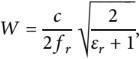
c is the speed of light in vacuum (approximately 3×1083 \times10^83×108m/s),fristheresonantfrequency,εris the relative permittivity (dielectric constant) of the substrate.
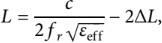
cisthespeedoflightinvacuum(≈3×10⁸\approx3 \times10^8≈3×10⁸m/s),
fr is the resonant frequency (Hz),eff is the effective dielectric constant of the substrate, which accounts for boththesubstratematerialandtheairaboveit.
The substrate material is a critical component in the design and performance of wearable metamaterial and antenna structures. In textile based technologies, the substrate not only supports the physical construction of the device but also plays a fundamental role in determining its electromagnetic behavior, mechanical flexibility, breathability, and overall user comfort. The integration of textile substrates with electronic functionality is particularly essential for applications involving body-worn devices, where both electrical performance and wearability must be optimized [12]. Among the various materials explored, polyester, polyethylene, and polyamide have emerged as leading candidates due to their favorable combinations of electrical,mechanical,andenvironmentalproperties.
3.1)
Polyester, a synthetic polymer derived from polyethylene terephthalate (PET), is extensively utilized in wearable electronics due to its mechanical strength, dimensional stability, and low manufacturing cost [12]. From an electromagnetic perspective, polyester exhibits a moderate dielectric constant typically ranging from 3.2to 3.5, along with relatively low dielectric loss, which contributes to consistent signal propagation and stable resonant frequencies in antennas and metamaterial designs [3]. Its hydrophobic nature ensures resistance to moisture absorption, which is crucial for maintaining performanceinhumidorsweat-proneenvironments[8].
Volume: 12 Issue: 05 | May 2025 www.irjet.net
International Research Journal of Engineering and Technology (IRJET) e-ISSN: 2395-0056 p-ISSN: 2395-0072
Several studies have highlighted polyester’s viability as a substrate for body-worn antennas, particularly operating around 2.4 GHz, where maintaining efficiency and flexibility is paramount [3]. Furthermore, polyester textiles can easily accommodate various fabrication techniques such as screen printing, inkjet printing, and embroidery, allowing for scalable production of flexible electronic devices. Its mechanical robustness ensures durability during repeated bending, stretching, and washing, making it suitable for long-term deployment in wearable applications [8]. Consequently, polyester continues to be a preferred substrate in the development ofwirelessbodyareanetworks(WBANs)and telemedicine systems[8].
3.2) Polythelene as substrate:
Polyethylene, particularly in its low-density (LDPE) or nonwoven textile forms, is recognized for its excellent dielectric properties, including a low dielectric constant (approximately2.2to2.5)andextremelylowdielectricloss [5]. These characteristics enable efficient radiation performance with reduced signal attenuation, making polyethylene an attractive choice for high- frequency antenna applications, including millimeter- wave and 5G communications[5].
In addition to its favorable electrical behavior, polyethylene exhibits exceptional chemical inertness, water resistance, and mechanical flexibility, enabling it to withstand harsh operating environments while maintaining user comfort [5]. Recent advancements have demonstrated the feasibility of employing additively manufactured polyethylene terephthalate (PET)-based substrates for flexible, high-gain multiband antennas, targeting mobile and wearable applications [5]. The lightweight nature of polyethylene alsocontributes to the overallreductionofdeviceweight,whichisacriticalfactor in the design of wearable metamaterials intended for extendeduse.
Furthermore, polyethylene’s compatibility with emerging fabricationtechniques,suchasinkjetprintingandadditive manufacturing, supports the creation of complex, highly flexible RF devices that are necessary for the next generation of smart textiles and body-centric wireless networks[5].
3.3) Polyamide as substrate:
Polyamide, widely known under the trade name "nylon," combinesexcellentmechanicalstrength,highelasticity,and good thermal stability, making it an ideal candidate for wearable applications [4], [10]. From a dielectric standpoint, polyamide typically exhibits a dielectric constant in the range of 3.4 to 3.8, providing a balance between size reduction and sufficient bandwidth for antennaandmetamaterialstructures[4].
The inherent flexibility of polyamide fabrics enables close conformity to the contours of the human body, ensuring minimal impedance mismatch caused by body movement [10]. Its moisture-wicking properties and resistance to environmental degradation further enhance its suitability for medical monitoring systems and continuous-wear devices [11]. Additionally, polyamide maintains its structural integrity and dielectricperformanceoverawide temperature range, which is beneficial for applications involvingvariableenvironmentalconditions[11].
In the context of smart fabrics and wearable communications, polyamide substrates have been successfully integrated into textile antennas and bodycentric systems, showing promising results in terms of durability,performancestability,andusercomfort[4],[10], [11]. polyamide. based fabrics in supporting advanced RF functionalitiesincompactandflexibleformats[10],[11].
4.
Operating frequency:12to14Ghz

Volume: 12 Issue: 05 | May 2025 www.irjet.net
International Research Journal of Engineering and Technology (IRJET) e-ISSN: 2395-0056 p-ISSN: 2395-0072
Figure 4.1 shows the top view and back view of a square Split Ring Resonator (SRR), a key structure in metamaterials. The top view typically reveals the square ring with a gap, essential for creating resonant electromagnetic behavior. The back view may show a continuous metal plane or mirrored pattern depending on the design. This configuration is commonly used to manipulate permittivity and permeability at specific frequencies.

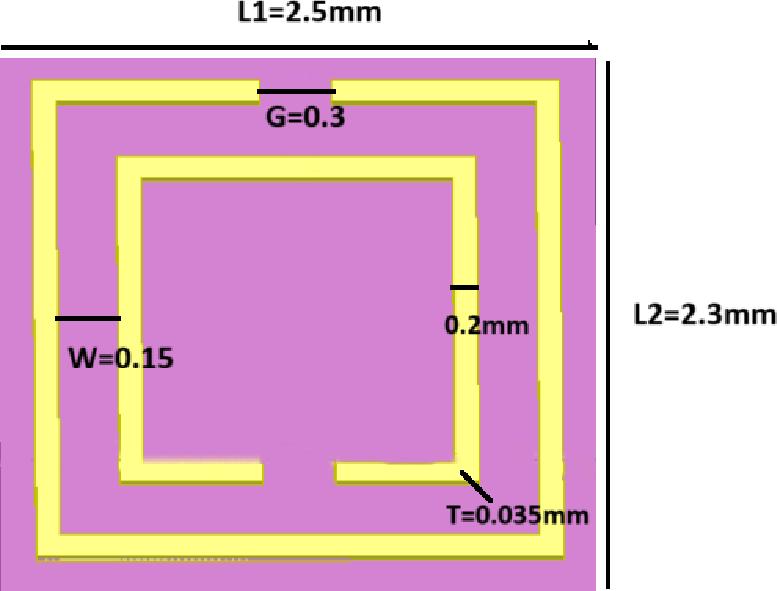
Table 4.1.Geometrical parameters of the squareshaped Split Ring Resonator (SRR) designed for operation at 10 GHz.
ThegeometricconfigurationoftheSplitRingResonator (SRR)isdefinedbyseveralkeyparameters,
L1-Outer side length of the square split ring resonator(SRR)
L2-Inner side length of the square ring placed withintheouterring.
G-Gap size at the split of the ring, crucial for controllingresonance.
W-Width of the metallic strip forming the SRR rings.
T-Thickness of the substrate material used beneaththeSRR
S-Spacing betweentheinnerandouter square ringsoftheSRR
A-Periodicity or lattice constant distance betweenadjacentunitcells
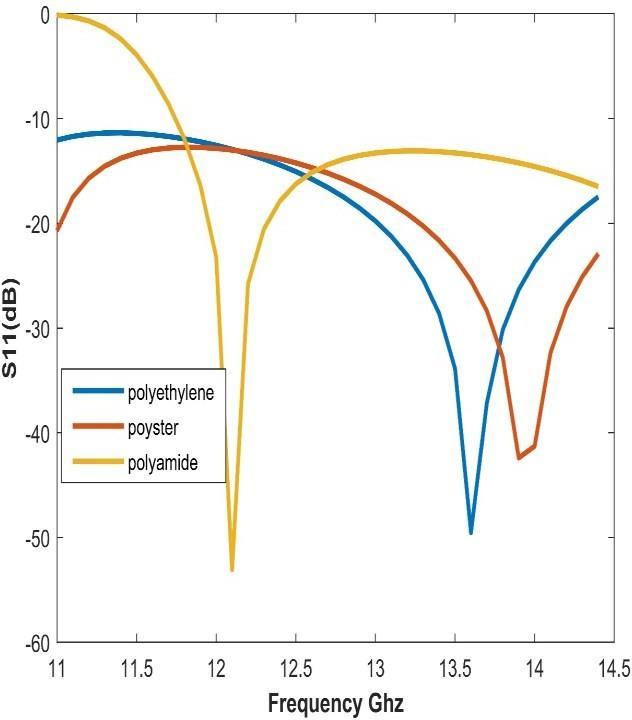
Figure 4.2.Simulated S11 (dB) response of a square SRR design on three different textile substrates
Thisfigure4.2illustratestheresonantbehavioroftheSRR structurewhen implementedon threetextilesubstrates: polyethylene, polyester, and polyamide. The S11 (reflection coefficient) values were plotted across a frequencysweepfrom10GHzto20GHz
From the graph, the approximate resonant frequencies andreturnlossesare:
Polyster 13.9ghz -42.39dB polythelene 136ghz -4952dB polyamide 121Ghz -5306dB
Among the three, polyamide clearly shows the strongest resonance, with the deepest S11 dip of approximately53.06 dB. This indicates better impedance matching and minimal signal reflection, meaning the SRR structure radiates or absorbs energy most efficiently when polyamideisusedasthesubstrate.
Thus, based on its lower return loss and sharper resonance,polyamidewaschosenasthebest-performing substrateforfurtherdesignoptimization.
Volume: 12 Issue: 05 | May 2025 www.irjet.net
International Research Journal of Engineering and Technology (IRJET) e-ISSN: 2395-0056 p-ISSN: 2395-0072
5. SELECTION OF POLYAMIDE AS OPTIMAL SUBSTRATE
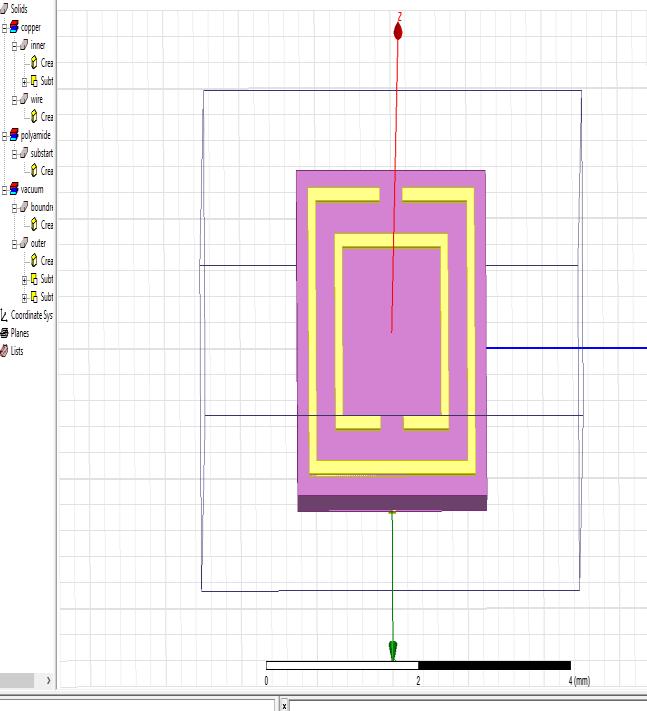
Figure 5.1: TopviewoftheSRR-basedmetamaterialunit celldesignedonapolyamidesubstrateinHFSS.
In this work, Polyamide has been selected as the most suitable substrate based on its balanced electrical and mechanical properties. Compared to Polyester and Polyethylene, Polyamide exhibits a moderate dielectric constant, low loss tangent, and excellent flexibility, all of which are critical for wearable antenna designs. Additionally, antennas fabricated with Polyamide showed better return loss performance and higher radiation efficiency, confirming its ability to support stable and efficient signal transmission. These advantages make Polyamide a reliable choice for future wearable and biomedicalantennaapplications.
The figure(5.1) illustrates the layout of the proposed metamaterial unit cell featuring a split ring resonator (SRR) structure. The design is implemented on a polyamide substrate, chosen for its flexibility and stable dielectric performanceathighfrequencies.Twocopperringsareetched with a precise gap between them, forming the core resonant geometry. The pink base represents the polyamide material, whiletheyellowpartsindicatethecopperrings.Themodelis enclosed in a vacuum box to mimic real-world electromagneticpropagation,andaxisindicators(X,Y,Z)assist inunderstanding the orientationoftheunit cell in 3D space. This structure was used to evaluate the resonance behavior andreturnlossperformance,especiallyforapplicationsinthe millimeter-waveandterahertzrange.
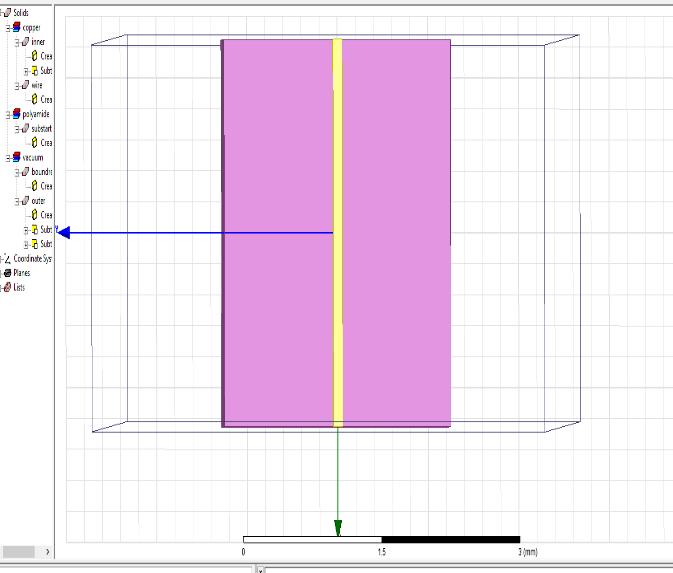
Figure 5.2: Backviewofthemetamaterialunitcell
structureshowingthepolyamidesubstrateandcopper groundlayer.
The Figure(5.2) shows the back side of the metamaterial unit cell structure. From this angle, It shows the continuous copper layer that supports the split ring resonator on the front side. This view is crucial for verifyingthegrounddesign,whichplaysanessentialrolein resonanceandoverallelectromagneticperformance.
6.EFFECT OF STRUCTURAL PARAMETERS ON S11 RESPONSE USING POLYAMIDE SUBSTRATE
This section discusses the influence of three critical geometric parameters gap size, thickness, and strip width onthereflectioncoefficient(S11)oftheSRRunitcellusinga polyamide substrate. Simulations were performed by varying one parameter at a time while keeping others constant.
Theimpactofconductorwidthontheresonantresponseof theSRRstructurewasanalyzedusingthreewidths:0.1mm, 0.2 mm, and 0.3 mm. Figure 1.3 shows that the configuration with 0.2 mm width achieves the deepest returnloss(below-40dB)around30GHzand50GHz,while the other widths show less pronounced or shifted resonancebehavior.
This indicates that 0.2 mm width provides the best impedance matching, possibly due to optimal balance between inductance and capacitance in the SRR loop. Too narrow or too wide a conductor alters the current distribution and resonance. The results are shown in Fig. 6.1andsummarizedinTable6.1.
Volume: 12 Issue: 05 | May 2025 www.irjet.net
International Research Journal of Engineering and Technology (IRJET) e-ISSN: 2395-0056 p-ISSN: 2395-0072
Table 6.1 ResonantFrequencyandS11forwidth
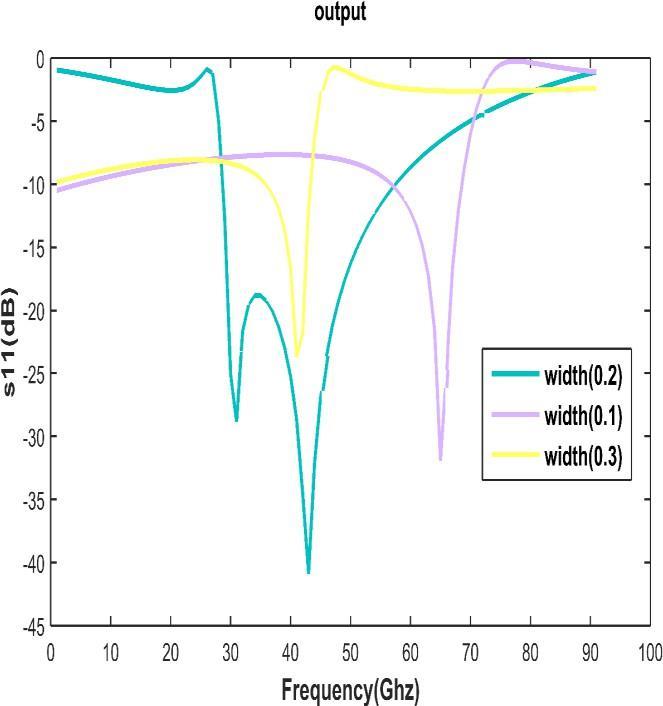
Fig.6.1.SimulatedS11vsFrequencyfordifferentwidthusing polyamidesubstrate.
6.2 Effect of Gap sizes
To evaluate the influence of gap size on the resonant characteristics of the SRR (Split Ring Resonator), simulations were carried out using three different gap dimensions: 0.2 mm, 0.3 mm, and 0.4 mm, all using a polyamidesubstrate.AsshowninFigure1.4,theresonant dips shift noticeably with the variation in gap size. The configuration with a 0.3 mm gap demonstrated the deepest resonance, reaching a return loss of approximately-40dBaround87GHz.
ThisbehaviorhighlightshowevensmallchangesintheSRR gap can significantly impact the reflection coefficient (S11). The gap controls the capacitance of the resonator circuit smaller gaps increase capacitance and typically lower the resonant frequency, while larger gaps reduce capacitance, shifting the resonance higher. Optimal gap sizing enhances energy confinement and improves resonancedepth.Resultsareshownintable6.2.
Table 6.2.ResonantFrequencyandS11forGapsizes
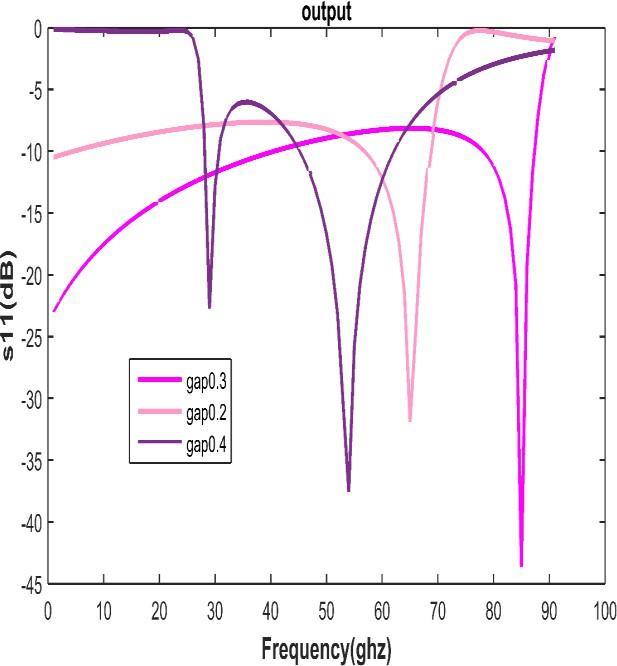
Fig.6.2.SimulatedS11vsFrequencyfordifferentgapsizes usingpolyamidesubstrate.
To evaluate the influence of substrate thickness on the resonantcharacteristicsoftheSRR(SplitRingResonator), simulations were conducted using three different thicknessesofpolyamide:0.033mm,0.035mm,and0.036 mm.AsshowninFigure1.5,allthreeconfigurationsexhibit adistinctresonancedipbetween9 GHz and 10.5 GHz, with the0.035mmthicknessachievingthedeepestreturnlossof approximately-32dBataround9.8GHz.
This indicates that minor changes in substrate thickness can significantly affect the reflection coefficient (S11), as thickness influences the effective dielectric loading and impedancematchingoftheresonator.Increasingthickness generally lowers the resonant frequency slightly due to increased electrical length, but too much thickness can also reduce resonance depth. Results are shown in table 6.3.
International Research Journal of Engineering and Technology (IRJET) e-ISSN: 2395-0056 p-ISSN: 2395-0072
Volume: 12 Issue: 05 | May 2025 www.irjet.net
Thickness(mm) Resonant frequency(ghz)
Minimum s11(db)
0033 93 -28db
0.035 9.8 -32db
0036 94 -27db
Table 6.3 ResonantFrequencyandS11forThickness
These parameters significantly influence the resonant frequencyandperformanceoftheSRR.Increasingthegap size generally raises the resonant frequency due to reduced capacitance, while increasing the ring width lowersthefrequencybyincreasinginductance.
Substrate thickness affects both bandwidth and loss; a thicker substrate can enhance bandwidth but may increase dielectric losses. Therefore, careful optimization of these dimensions is crucial for achieving desired electromagneticresponseinmetamaterialapplications
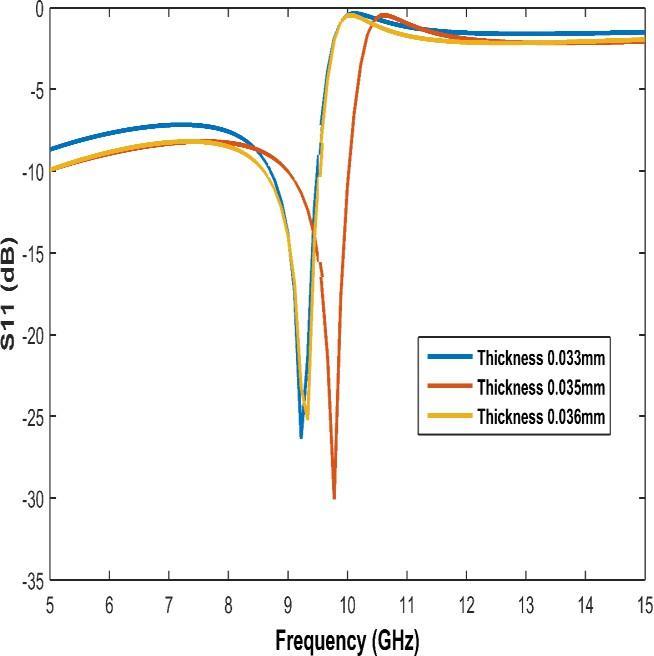
Fig.6.3.SimulatedS11vsFrequencyfordifferent Thicknessusingpolyamidesubstrate.
7.CONCLUSION
In this study, a square split ring resonator (SRR) was designed andanalyzed usingthree differenttextile- based substrates: polyamide, polyethylene, and polyester. Amongthese,polyamidedemonstratedthemostfavorable performance, exhibiting the deepest return loss and a clear, stable resonance response in the desired frequency range.
TofurtheroptimizetheSRRwiththepolyamidesubstrate, we systematically varied three key physical parameters gap size, ring width, and substrate thickness across three different values each, resulting in a total of nine different simulation combinations. Through this detailed parametric
analysis, weobserved how small adjustments in geometry significantly influenced the resonant behavior and return losscharacteristics.
Overall, polyamide emerged as the most efficient and reliable substrate in terms of electromagnetic performance. The findings of this work highlight the importance of material selection and dimensional finetuning in metamaterial and wearable antenna designs. These results can serve as a reference for future research inflexible,textile-basedresonatorapplications.
[1] A.H.Elnaggar,A.S.A.El-Hameed,M.A.Yakout,and N. F. F. Areed, “Development and comprehensive evaluation of a dual-port textile UWB MIMO antenna for biomedical use,” Optical and Quantum Electronics, vol. 56, no. 7, May 2024, doi: 10.1007/s11082-024-06982-8.
[2] M.Wagih,G.S.Hilton,A.S.Weddell,and S.Beeby,“5GEnabled E-Textiles Based on a Low-Profile MillimeterWaveTextileAntenna,” Vol.15,No.1,P.13, 2023., p. 13, Mar. 2022, doi: 10.3390/engproc2022015013.
[3] S.K. Noor, N.Ramli,N.N.Zaini,and N.H.A. Rahman, “Design and performance analysis of body worn textile antenna using 100% polyester at 2.4 GHz for wireless applications,”in Lecturenotesinelectricalengineering,2021, pp.333–343.doi:10.1007/978-981-33-4597-3_31.
[4] T.Govindan,S.K.Palaniswamy,M.Kanagasabai,andS. Kumar, “Design and analysis of UWB MIMO antenna for smart fabric communications,” International Journal of Antennas and Propagation, vol. 2022, pp. 1–14, Dec. 2022, doi: 10.1155/2022/5307430.
[5] A. Hassan, A. Saeed, S. Ali, H. M. Cheema, and A. Bermak, “Additively manufactured polyethylene terephthalate-based high-gain multiband-flexible antenna for wireless mobile applications,” Journal of Materials ScienceMaterials inElectronics,vol.36,no.3,Jan.2025,doi: 10.1007/s10854-024-14194-9.
[6] F.A.A.AbdullaandA.Demirkol,“Anoveltextile-based UWB patch antenna for breast cancer imaging,” Physical and Engineering Sciences in Medicine, Mar. 2024, doi: 10.1007/s13246-024-01409-w.
[7] Y. Dong et al., “Development of polyphenylene oxide-based microwave composite substrate and its application in microstrip antenna,” Journal of Materials Science Materials in Electronics, vol. 33, no. 3, pp. 1183–1191,Nov.2021,doi:10.1007/s10854-021-07407-y.
2025, IRJET | Impact Factor value: 8.315 | ISO 9001:2008 Certified Journal | Page1853
Volume: 12 Issue: 05 | May 2025 www.irjet.net
International Research Journal of Engineering and Technology (IRJET) e-ISSN: 2395-0056 p-ISSN: 2395-0072
[8] A.Yadav,V.K.Singh,A.K.Bhoi,G.Marques,B. GarciaZapirain, and I. De La Torre Díez, “Wireless body area networks:UWB wearabletextileantenna for telemedicine and mobile health systems,” Micromachines, vol. 11, no. 6, p.558,May2020,doi:10.3390/mi11060558.
[9]D. H. T. Sediq, J. Nourinia, C. Ghobadi, and B. Mohammadi, “A novel shaped ultrawideband fractal antenna for medical purposes,” Biomedical Signal Processing and Control, vol. 80, p. 104363, Nov. 2022, doi: 10.1016/j.bspc.2022.104363.
[10] D. Mikulić, E. Šopp, D. Bonefačić, J. Bartolić, and Z. Šipuš, “Design and realization of wearable textile slotted waveguideantennas,” Sensors,vol.23,no.17,p. 7509, Aug. 2023,doi:10.3390/s23177509.
[11] M. E. Atrash, M. A. Abdalla, and H. M. Elhennawy, “A fully-textile wideband AMC-backed antenna for wristband WiMAXandmedicalapplications,” International Journal of MicrowaveandWireless Technologies,vol.13,no.6,pp.624–633,Oct.2020,doi:10.1017/s1759078720001397.
[12] B. Almohammed, A. Ismail, and A. Sali, “Electrotextilewearableantennasinwirelessbodyareanetworks: materials, antenna design, manufacturing techniques, and human body consideration—a review,” Textile Research Journal, vol. 91, no. 5–6, pp. 646–663, Jul. 2020, doi: 10.1177/0040517520932230.