
International Research Journal of Engineering and Technology (IRJET) e-ISSN: 2395-0056
Volume: 13 Issue: 03 | Mar 2026 www.irjet.net p-ISSN: 2395-0072
International Research Journal of Engineering and Technology (IRJET) e-ISSN: 2395-0056
Volume: 13 Issue: 03 | Mar 2026 www.irjet.net p-ISSN: 2395-0072
Dhruv patel1 , Prof. Ankita Parikh2
1ME CIVIL (Infrastructure Engineering) Civil Engineering Department LDRP – Institute of Technology & Research, Gandhinagar, Gujarat, India
2Civil Engineering Department LDRP – Institute of Technology & Research, Gandhinagar, Gujarat, India. ***
Abstract - Intermittentwatersupplysystemsarecommonly used in developing regions, but they suffer from major operational challenges such as pressure fluctuations, uneven water distribution, and higher risks of contamination. This study develops a systematic methodology for converting an existingintermittentwatersupplynetworkintoacontinuous (24×7) system using hydraulic modeling. A distribution network with a total pipeline length of 26 km and 533 junctions was analyzed using Water GEMS. The proposed methodologyincludesmodifyingdemandpatterns,optimizing pump operation, and balancing storage through Extended Period Simulation (EPS). Results indicate that a continuous supply can be achieved primarily through operational improvements, without requiring major infrastructure upgrades.
Key Words: Continuous Water Supply, Intermittent Supply, Hydraulic Modelling, Water GEMS, Pump Control, EPS
Water supply systems in many urban areas continue to operate under intermittent conditions due to historical infrastructure limitations and constraints related to availableresources.Althoughsuchsystemsareabletomeet basic water demand, they experience several technical shortcomings,includingwidepressurevariations,unreliable delivery during peak periods, and overall operational inefficiencies. Continuous water supply offers a more efficient and reliable alternative by maintaining steady pressure and promoting equitable distribution across the network.However,convertinganintermittentsystemintoa continuous one requires careful planning and hydraulic assessment to avoid system imbalance or unintended pressure impacts. This study focuses on developing a structuredandpracticalmethodologyfortransitioningfrom intermittent supply to continuous (24×7) operation using simulation‑based hydraulic modeling. The proposed approach aims to improve system performance while minimizingmajorphysicalinfrastructuremodifications.
Many urban areas still rely on intermittent water supply becauseofoldinfrastructureandlimitedresources.Although thissystemprovideswaterforbasicneeds,itcausesseveral issues such as pressure drops, uneven distribution, and operationalinefficiencies.Continuouswatersupply(24×7) offersbetterpressurestability,improvedreliability,andsafer waterquality.
However, shifting an existing intermittent system to continuous supply requires proper planning, hydraulic analysis, and performance checks to avoid over pressure, shortages,ornetwork imbalance.Astructuredandmodelbased approach is therefore needed to guide utilities in evaluatingtheircurrentsystemanddesigningtherequired operationalimprovements.Thisstudyfocusesondeveloping suchamethodologyusinghydraulicmodelingtosupporta smooth and efficient transition from intermittent to continuouswatersupply.
Thisstudyfollowsastructured,simulation-basedapproach for developing a workable methodology to convert an IntermittentWaterSupply(IWS)systemintoaContinuous Water Supply (CWS) system. The methodology combines field data, hydraulic modeling, demand adjustments, and operational optimization. To make the process easier to understand, important screenshots and charts generated fromWaterGEMSareincludedthroughoutthischapter.
Thefirststepinvolvescollectingallavailableinformation ontheexistingdistributionsystem:
Pipediameters,lengths,andmaterials
Junctionelevationsandconsumerdemand
Pumpcharacteristicsandcurrentoperating schedule
ESRgeometryandstoragelevels
Present8‑hoursupplypatternusedinthe IWSsystem
International Research Journal of Engineering and Technology (IRJET) e-ISSN: 2395-0056
Volume: 13 Issue: 03 | Mar 2026 www.irjet.net p-ISSN: 2395-0072
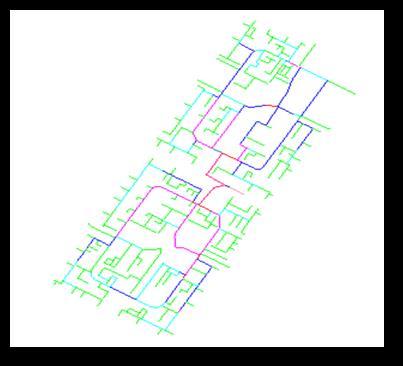
1 WaterGEMSnetworklayoutshowingpipes, nodes,ESR,andpump.
3.2. Development of the IWS Hydraulic Model
Oncethedataiscompiled,theexistingIWSsystemis modelledinBentleyWaterGEMS. Keyconfigurations:
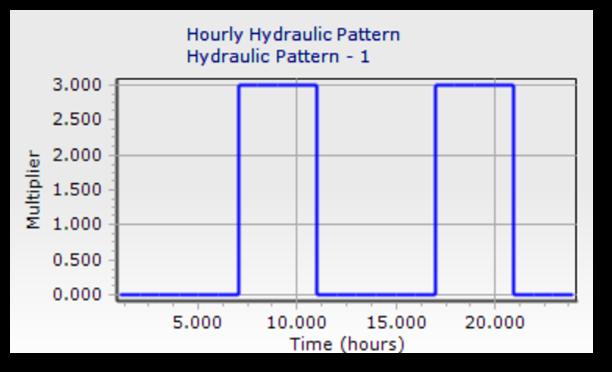
Intermittent8-hoursupplyisrepresentedusinga Three-peak demand multiplier pattern.
Duringoff-hours,demanddropsnearzeroto simulatenosupply.
Pumpoperationsarealignedwiththesupply windows.
A24-hourExtendedPeriodSimulation(EPS)is executed.
3.3. Development of the IWS Hydraulic Model
To simulate continuous (24×7) supply, a second scenario was created using the same network. In this scenario, the intermittent 8‑hour demand pattern was replaced with a 24‑hour diurnal demand curve, representing typical daily water consumption behavior in Indian urban areas. This
includesamorningpeak(07:00–09:00),amoderatemid‑day period,aneveningpeak(18:00–20:00),andlownight‑time demand.
ItisimportanttonotethatCPHEEOdoesnotprescribeany standard 24‑hour demand pattern. Therefore, the diurnal curveusedinthisstudyfollowsgeneralpracticecommonly adoptedinhydraulicmodeling,basedontypicalhousehold usagetrendsratherthanregulatoryguidelines.
Since the network distributes water through an Elevated Service Reservoir (ESR), basic ESR‑based pump controls wereappliedtomaintainstableoperationundercontinuous supply. These controls ensure that the reservoir neither overflows nor empties during the 24‑hour cycle. For modelingpurposes:
ThePumpONlevelwassetwhentheESRwater leveldropstoapproximately95.5m,
ThePumpOFFlevelwassetwhentheESRlevel reachesapproximately99.5m.
TheseON/OFFlevelsmaintainthestoragebetweenrealistic working limits and allow the CWS system to operate smoothly without short‑cycling. When combined with the 24‑hourdemandpattern,thissetuphelpsevaluatewhether the existing infrastructure can support continuous flow using mostly operational adjustments rather than major upgrades.
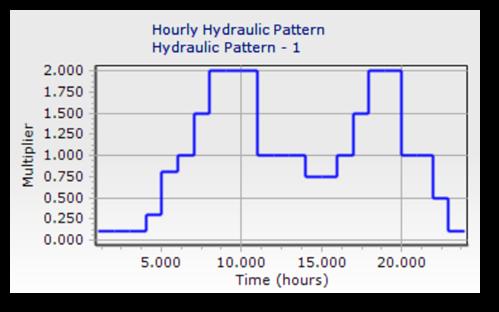
3 Diurnal demand pattern for 24×7 operation (general practice not as per CPHEEO).
3.4. Extended Period Simulation (EPS) Setup
Tocomparetheperformanceofthesystemunderboth intermittent (IWS) and continuous (CWS) supply, a 24-hourExtendedPeriodSimulation(EPS)wascarried outforeachscenariousingthesamemodellingsettings. Keeping the simulation conditions identical ensures that any differences in results come only from the changeinsupplypattern,notfrommodelconfiguration.
International Research Journal of Engineering and Technology (IRJET) e-ISSN: 2395-0056
Volume: 13 Issue: 03 | Mar 2026 www.irjet.net p-ISSN: 2395-0072
In both scenarios, the EPS was run with:
SimulationDuration:24hours
HydraulicTimeStep:1Hour
ReportingTimeStep:1Hour
DemandApplication:
IWSuseson/offsupplypattern
CWS uses a smooth diurnal pattern (general practice)
Solver Settings: Same numerical tolerances and convergencecriteria,ensuringfaircomparison
These settings allow the model to capture time varying changesinpressure,flow,andtanklevelsthroughouttheday, which are essential for assessing whether the system can maintainstabilityduringcontinuousoperation.
Tomaintainstablewaterlevelsundercontinuoussupply,the Elevated Service Reservoir (ESR) must operate within a defined working range. In the hydraulic model, ESR behaviour is controlled using level-based pump ON/OFF conditions.Thesecontrolsensurethatthereservoirneither runsemptynoroverflowsduring24-houroperation.
SinceCPHEEOdoesnotdefineanymandatoryESRcontrol settings for continuous supply, the following operational limitswereadoptedbasedoncommonengineeringpractice andsystemsafety:
Pump ON level: ThepumpstartswhentheESR waterlevel(hydraulicgrade)dropsto approximately 95.5 m.
Pump OFF level: ThepumpstopswhentheESR waterlevelreachesapproximately 99.5 m.
Theselimitsprovidesufficientstoragebuffer,allow smoothrefillcycles,andpreventshort-cyclingofthe pump.ThecontrollogicensuresthattheESRsupportsthe systemduringdemandpeaksandrefillsduring low-demandhours,whichisessentialforachievingstable 24×7supply.

Figure 4 PumpcontrolsetupshowingON/OFFtriggers linkedtoESRlevels.
Thefollowingchecksmustbeperformed:
✔ Pipe Velocities - Ensurevelocitiesstaywithin recommendedrange(0.3–2.0m/s).
✔ Pressure Availability - Checkifcontinuoussupply reduceslow-pressureareas.
✔ ESR Cycling -VerifytheESRlevelcyclessmoothly underthenewpumpcontrols.
Thisstepensuresthemodelisstableandoperationalin CWSmode.
This study presents a clear and practical methodology for converting an existing Intermittent Water Supply (IWS) modelintoaContinuousWaterSupply(CWS)modelusing WaterGEMS.Theframeworkfocusesontheoperationaland modellingchangesrequiredtosupport24×7supplyrather thanonmajorinfrastructureexpansion. Themethodologyefficientlydemonstratesthatthetransition tocontinuoussupplyprimarilyrequiresmodificationssuch as:
ReplacementoftheintermittentON/OFFdemand patternwithacontinuous24-hourdiurnalcurve
IntroductionofESRbasedautomaticpump controls
Correctionofbasedemandsforrealistic24hour distribution
Continuousavailabilityofhydraulicsources
Verificationofhydraulicstabilitythrough ExtendedPeriodSimulation
Byapplyingthesestructuredadjustments,theWaterGEMS modelcansuccessfullyrepresentcontinuousflowbehaviour, stable pressures, and balanced storage operation. The approach serves as a practical guide for engineers and utilities planning to shift from intermittent to continuous supply using simulation-based analysis. The methodology ensuresthatsystemperformanceisevaluatedandoptimized whileminimizingtheneedforcostlyphysicalupgrades.
[1] Nnaji,C.C.,Ekwule,O.R.,&Nnaji,C.(2024).Anextended period modeling of water supply systems using hydraulic simulators. Environment, Development and Sustainability.
International Research Journal of Engineering and Technology (IRJET) e-ISSN: 2395-0056
Volume: 13 Issue: 03 | Mar 2026 www.irjet.net p-ISSN: 2395-0072
[2] Leinæs, A., Simukonda, K., & Farmani, R. (2024). Calibration of intermittent water supply systems hydraulic models under data scarcity. Water Supply, IWAPublishing.
[3] Kassahun, Y., & Dargie, T. (2024). Performance EvaluationandOptimizationofExistingWaterSupply DistributionSystemUsingWaterGEMS:CaseofSekota Town. Journal of Earth & Environmental Waste Management.
2026, IRJET | Impact Factor value: 8.315 | ISO 9001:2008