
Volume:12Issue:11|Nov2025 www.irjet.net
International Research Journal of Engineering and Technology (IRJET) e-ISSN:2395-0056 p-ISSN:2395-0072

Volume:12Issue:11|Nov2025 www.irjet.net
International Research Journal of Engineering and Technology (IRJET) e-ISSN:2395-0056 p-ISSN:2395-0072

Gaurav Gaikwad1 , Deepak Panchal2 , Omprasad Deshmukh3 , Sonali Patil4
*1,2,3 Department of Computer Science & Engineering, Yadrav (Ichalkaranji) Maharashtra, India.
*4 Assistant Professor, Department of Computer Science & Engineering, Yadrav (Ichalkaranji) Maharashtra, India
Abstract - The proliferation of Natural Language Processing (NLP) technologies has revolutionized human- computer interaction, yet linguistic diversity remainsunderserved,particularlyforregionallanguages and their dialects. This project addresses this gap by developing localized NLP tools tailored for Marathi dialects, aiming to bridge the digital divide and promote equitable access to language technologies for Marathi speakers. Marathi, an Indo-Aryan language spoken by over 83 million people in India, exhibits significant dialectalvariationacrossregionssuchasDeshi,Varhadi, Konkani, and Ahirani. These dialects differ phonologically,lexically,andsyntacticallyfromStandard Marathi, rendering generic NLP models ineffective for dialect-specific tasks. This project focuses on creating robust, inclusive tools that account for these variations, enabling accurate dialect identification, machine translation, sentiment analysis, and speech recognition forunderrepresentedMarathi-speakingcommunities.
Key Words: Marathi Dialects, Konkani Translation, Standard Marathi, NLP, RAG Model, LLM, Gemini API, Embeddings, FAISS, Sentence Transformers, LangChain, Streamlit,VectorDatabase,DocumentChunking.
Indiaisacountryrichinlinguisticdiversity,andMarathi is one of its major languages spoken across regions like Konkan, Vidarbha, Marathwada and Western Maharashtra. Each region has its own dialect, creating variations in pronunciation, vocabulary and grammar. These dialectal differences make it difficult for standard NLP systems to correctlyunderstandorprocessuserqueries.
WiththegrowthofNaturalLanguageProcessing(NLP)and LargeLanguageModels(LLMs),intelligentsystemscannow understand human language better but most of these modelsaretrainedonlyonstandardformsoflanguages.As aresult,theystrugglewhenusersspeakinregionaldialects suchasKonkani(Devanagari)orotherMarathivariants.
Toaddressthischallenge,thisprojectdevelopsaRetrievalAugmentedGeneration(RAG)-basedsystemthattranslates Marathi dialects into standard Marathi and provides accurate answers using AI. The system translates dialectal input, retrieves relevant information from uploaded documents,andgeneratescontext-awareresponsesinclear Marathi. This approach helps bridge the linguistic gap for

rural and regional Marathi-speaking communities, making knowledgeaccesseasierandmoreinclusive.
Marathi has many regional dialects such as Konkani (Devanagari), Varhadi, Ahirani, and Deshi, which differ significantlyfromStandardMarathiinvocabulary,grammar, and pronunciation. Existing NLP and AI models are trained mostly on standard language forms and therefore fail to understand or translate these dialects accurately. This creates barriers for users who speak in local dialects, especially in rural areas, when interacting with digital systems.
Toaddressthisissue,thereisaneedforasystemthatcan:
accurately translate Marathi dialects into Standard Marathi,
retrieve relevant information from a knowledge base,and
generatecorrect,context-awareresponsesusingAI.
Theproblemisto developanintegrated,dialect-awareRAG system that bridges the linguistic gap and enables smooth communication between Marathi dialect speakers and AIbasedplatforms.
Themainobjectivesofthisprojectare:
1. To develop a dialect-to-Marathi translation system that accurately converts Konkani (Devanagari) and other Marathi dialect inputs into StandardMarathi.
2. To integrate a Retrieval-Augmented Generation (RAG)model forprovidingcontext-based,accurate answersfromuploadeddocuments.
3. TousetheGeminiAPI for high-qualitytranslation andAI-generatedresponsesinMarathi.
4. To preprocess and vectorize textual data using SentenceTransformersandstoreitefficientlyusing FAISSforfastandrelevantinformationretrieval.
5. Todesignauser-friendlyStreamlitinterface that supports document upload, dialect translation, contextual search, and answer generation in Marathi.

Volume:12Issue:11|Nov2025 www.irjet.net
Research in Natural Language Processing (NLP) has advanced rapidly with the development of transformerbased models such as BERT and multilingual systems. However, studies show that low-resource Indian languages like Marathi still lack sufficient datasets and tools, especially for dialect processing. Marathi has rich dialectal diversity Varhadi, Ahirani, Konkani, Deshi creatingsignificantlinguisticvariationsthatstandardNLP models struggle to understand.Initiatives like L3CubeMahaNLP and MahaBERT have contributed Marathispecific datasets and transformer models, improving performance in sentiment analysis, translation, and text classification. Prior work on Marathi transliteration and dialecttranslationhighlightsthechallengesofambiguous words, phonological differences, and inconsistent grammar across regions.The emergence of RetrievalAugmentedGeneration(RAG) hasfurtherstrengthened NLP systems by combining external document retrieval with powerful LLMs. Research by Lewis et al. shows that RAGsignificantlyimprovesfactualaccuracyinknowledgeintensivetasks.SurveysalsosuggestthatRAGisbeneficial for low-resource languages when combined with embedding-based retrieval using vector stores like FAISS.Frameworks such as LangChain, HuggingFace Transformers,andvectordatabases havemadeit easier to build custom pipelines for multilingual NLP. However, literature reveals minimal work on applying RAG to Marathi dialects, indicating a research gap that this projectaimstoaddress.
Theprojectfollowsastructuredmethodologytobuild a system capable of translating Marathi dialects (such as Konkani in Devanagari) into Standard Marathi and generatingaccurateanswersusingaRAGframework.
Themajorstepsare:
1. DocumentUploadandPreprocessing
1. A Streamlitinterface isdevelopedtoallowusers touploadPDFortextdocuments.
2. Theuploadedfilesarereadusing PyMuPDF(fitz) whichextractsalltextcontent.
3. Theextractedtextisdividedinto smallerchunks toensure:
a. Betterhandlingoflongdocuments
b. Improvedretrievalaccuracy
4. Chunking prevents loss of context and enables fastersearchduringqueryprocessing.
2. TextEmbeddingandVectorStorage
1. Each chunk of text is processed using Sentence Transformers (all-MiniLM-L6-v2) to generate semanticembeddings.
2. These embeddings convert text into numerical vectorsthatcapturemeaning.
3. A FAISS (Facebook AI Similarity Search) vector indexiscreatedtostorethesevectors.
4. FAISSenables:
a. High-speedsimilaritysearch
b. Efficient retrieval of the most relevant chunksduringquestionanswering
3.DialectTranslationUsingGeminiAPI
1. The user enters a query in Konkani (Devanagari) oranyMarathidialect.
2. Acustomtranslationfunctionsendstheinputtothe GeminiAPI.
3. Acarefullydesignedpromptensures:
a. Dialectsensitivity
b. Preservationofmeaning
c. Conversion to grammatically correct StandardMarathi
4. This step is essential because proper retrieval requiresnormalizedMarathilanguage.
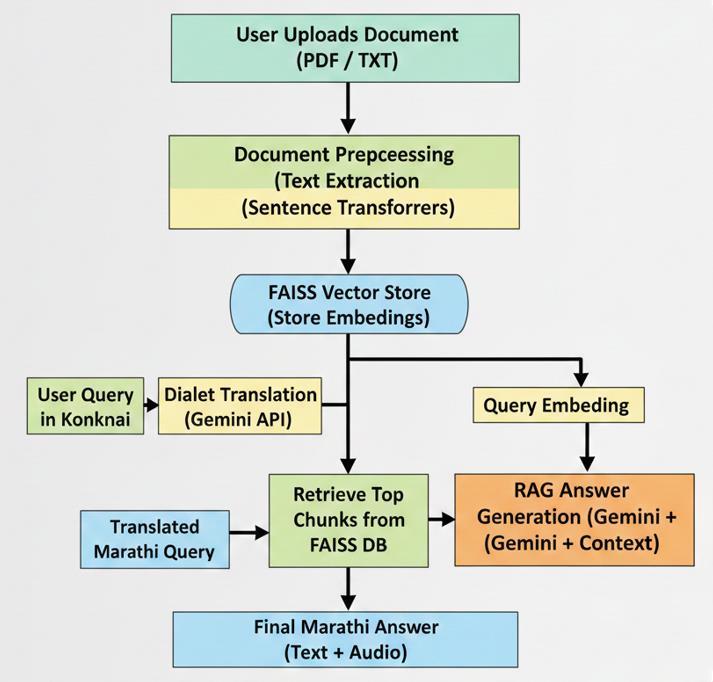
Figure-1:FlowChart
4.Retrieval-AugmentedGeneration(RAG)Pipeline
1. The translated Marathi query is again converted intoembeddings.
2. FAISSsearchesfortheclosestmatchingtextchunks fromtheuploadeddocument.
International Research Journal of Engineering and Technology (IRJET) e-ISSN:2395-0056 p-ISSN:2395-0072
Volume:12Issue:11|Nov2025 www.irjet.net
3. Theseretrievedchunksprovide:
a. Context
b. Backgroundknowledge
c. Informationrequiredtoanswertheuser’s questionaccurately
5.AnswerGenerationUsingGemini
1. Both the translated query and retrieved context aresenttogethertotheGeminimodel.
2. Gemini generates a detailed, accurate, and context-awareanswerinpureMarathi.
3. Thisensurestheresponseisnotonlylinguistically correctbutalsofactuallyrelevant.
6.UserInterfaceOutput
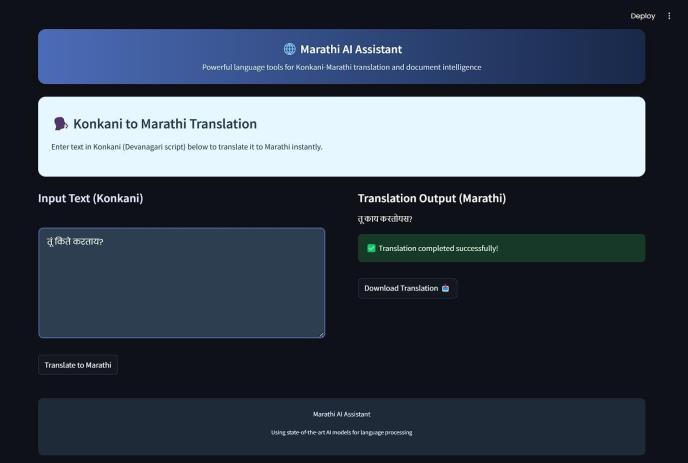
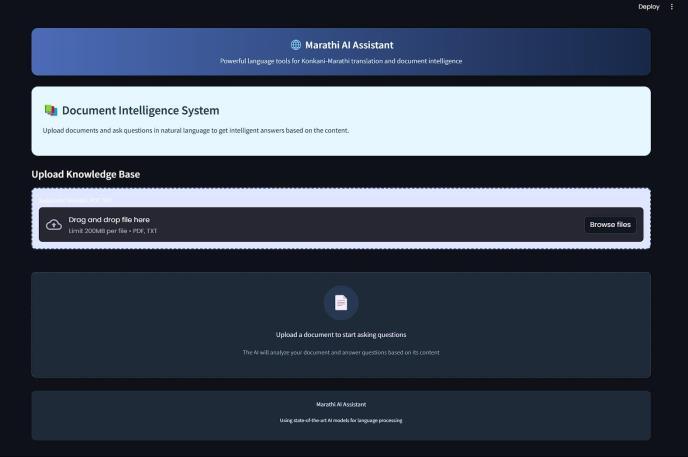
TheStreamlitUIdisplaysthefollowingclearly:
1. TranslatedMarathitext
2. RelevantdocumentcontextretrievedfromFAISS
3. FinalAI-generatedanswer
4. Optionally,the system also providesaudiooutput ofthegeneratedanswerforaccessibility.
7.TestingandRefinement
1. The system was tested using multiple dialectbasedqueries.
2. Promptengineeringandchunkingstrategieswere repeatedlyrefinedtoimprove:
a. Translationaccuracy
b. Retrievalrelevance
c. Responsequality
3. Feedbackloopsensuredimprovementin processingdialect-heavyinputs
3. RESULTS AND DISCUSSION
The developed system successfully integrates Marathi dialecttranslationwithaRetrieval-AugmentedGeneration (RAG) framework to provide accurate and context-aware outputs. The results demonstrate the effectiveness of combining translation, semantic retrieval, and LLM-based generation.
1.TranslationAccuracy
The Gemini-based translation module effectively converted Konkani (Devanagari) inputs into clear,grammaticallycorrect StandardMarathi.
Dialect-specific variations were handled well, preservingtheoriginalmeaning.
Example:
o Input(Konkani):
o Output(Marathi):
This accuracy confirms that the translation prompt and Gemini model perform reliably for dialect-heavyqueries.
2.RetrievalPerformance
Using Sentence Transformers embeddings and FAISS, the system retrieved relevant document chunkswithhighprecision.
In most test scenarios, the top 2–3 retrieved chunks contained sufficient context to answer thequery.
Semantic similarity search worked effectively even when the input was translated from dialects, showingrobustnessinretrieval.
3.AIResponseGeneration
Gemini generated coherent, natural-sounding, and context-basedanswersinMarathi.
The responses were not only linguistically correct but also factually aligned with the uploaded documentcontent.
For domain-specific queries (e.g., health, education, technical topics), the system provided accurate summaries and explanations drawn from the retrievaloutput.
4. UserInterfaceEvaluation
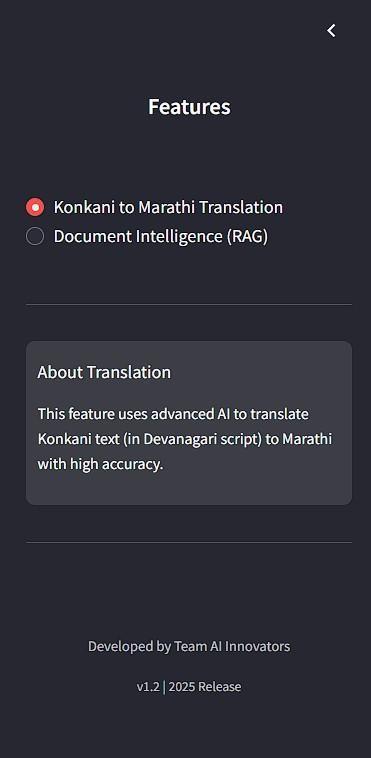
The Streamlit interface provided smooth interactionandsimpleworkflow.
Userscouldeasily:
o Uploaddocuments
o Enterdialectqueries
o Viewtranslatedtext
o Seeretrievedcontext
o Read or listen to the final AI-generated answer
The UI was intuitive, making the system accessible eventonon-technicalMarathi-speakingusers.
5. SystemLimitations
Although effective, the system presented certain limitations:
Overly informal or ambiguous dialect inputs sometimescausedtranslationinaccuracies.
Thetranslationqualitydependsontheperformance ofthe Geminimodel.
Retrievalaccuracymaydropwhen:
o ThePDFisverylarge
o Textispoorlystructured
o Documentchunkingisuneven
FAISS retrieval is sensitive to embedding quality, meaning low-quality text chunks may reduce precision.
The combined performance of dialect-aware translation, FAISS-based retrieval, and Gemini-based generation proves that a RAG pipeline can effectively support low-resource languages likeMarathi. Thesystembridges thelinguistic gap between regional dialects and standardized language, enabling rural and dialect-speaking communities to access informationmoreeasily.
The project demonstrates that RAG + Translation is a powerful approach for multilingual and dialect-rich environments. With further improvements such as better datasets, refined chunking strategies, and additional dialect support the system can be scaled to handle more Indian languagesandlinguisticvariations.
This project successfully demonstrates a complete dialect-aware system that translates Konkani (Devanagari) and other Marathi dialect inputs into Standard Marathi while providing accurate, context-based answers using a RAG model. By integrating translation, semantic retrieval, and AI-based response generation, the system bridges an important linguistic gap for Marathi-speaking communities, especiallyinruralanddialect-richregions.
The use of Sentence Transformers and FAISS enabled efficientretrievalofrelevantdocumentchunks,whereasthe Gemini API ensured high-quality translation and natural Marathi response generation. The Streamlit interface made the system accessible, easy to use, and suitable for nontechnicalusers.Testingconfirmedthatthesystemperforms well across various dialect queries, offering reliable translationandcontext-awareoutput.
Overall,theprojectdemonstratesthatcombining NLP+ Dialect Translation + RAG is a powerful solution for improving information access in low-resource languages. Withfurtherexpansiontomoredialects,largerdatasets,and improvedretrievalmechanisms,thissystemcanevolve into a robust multilingual assistant for Indian language communities.
1. Devlin, J., Chang, M.-W., Lee, K., & Toutanova, K. (2019).
BERT: Pre-training of Deep Bidirectional Transformers for Language Understanding. Proceedings of NAACL-HLT 2019, 4171–4186. https://doi.org/10.48550/arXiv.1810.04805
2. Lewis, P., Perez, E., Piktus, A., Petroni, F., Karpukhin, V., Goyal, N., et al. (2020). Retrieval-AugmentedGenerationforKnowledgeIntensive NLP Tasks.
Volume:12Issue:11|Nov2025 www.irjet.net
International Research Journal of Engineering and Technology (IRJET) e-ISSN:2395-0056 p-ISSN:2395-0072
NeurIPS 2020, 33, 9459–9474. https://doi.org/10.48550/arXiv.2005.11401
3. Joshi, P., Santy, S., Budhiraja, A., Bali, K., & Choudhury, M. (2020). TheStateandFateofLinguisticDiversityand Inclusion in the NLP World. Proceedings of ACL 2020, 6282–6293. https://doi.org/10.48550/arXiv.2004.09095
4. Conneau, A., Khandelwal, K., Goyal, N., Chaudhary, V., Wenzek, G., Guzmán, F., et al. (2020). Unsupervised Cross-lingual Representation Learning at Scale. ACL 2020, 8440–8451. https://doi.org/10.48550/arXiv.1911.02116
5. Kakwani,D.,Galhotra,S.,Oommen,B.,Holla,A., Sitaram, S., et al. (2020). IndicCorp:AMultilingualCorpusforIndian Languages. arXiv preprint, arXiv:2005.00085. https://doi.org/10.48550/arXiv.2005.00085
© 2025, IRJET | Impact Factor value: 8.315 | ISO