
International Research Journal of Engineering and Technology (IRJET) e-ISSN:2395-0056
Volume: 12 Issue: 04 | Apr 2025 www.irjet.net p-ISSN:2395-0072
International Research Journal of Engineering and Technology (IRJET) e-ISSN:2395-0056
Volume: 12 Issue: 04 | Apr 2025 www.irjet.net p-ISSN:2395-0072
Ayuti Khedekar1 , Prof. Ganesh Manerkar2
1Student, Department of Information Technology and Engineering, Goa College of Engineering, Farmagudi, Goa, India
2AssistantProfessor, Department of Information Technology and Engineering, Goa College of Engineering, Farmagudi, Goa, India ***
Abstract - The rapid adoption of Unified Payments Interface (UPI) has revolutionized digital payments in India, offering seamless and instant transactions. However, with increased usage, fraudulent activities like phishing,vishing,fakepayments,andQRcodescamshave surged. Traditional rule-based fraud detection systems struggle to addressthesesophisticated tactics.Thispaper proposes a machine learning-based solution that integrates advanced models, including Random Forest, XGBoost, LSTM, and CNN, to detect and classify various fraud types in real-time, enhancing UPI transaction security.
The system combines a hybrid approach that processes transaction data, QR code images, and audio from vishing attempts to identify fraud patterns. It is trained on a diversedataset oflabeledUPItransactions,QRcodes,and voice data, enabling it to detect evolving fraud behaviors. The model’s real-time alert system ensures timely detection, with promising results in accuracy. This approach provides a scalable solution to improve the security of digital payments, with future enhancements aimed at refining detection capabilities and adapting to newfraudtactics
Key Words: UPI, Fraud Detection, Machine Learning, Convolutional Neural Networks (CNN), Long ShortTerm Memory (LSTM)
The Unified Payments Interface(UPI) hasquicklybecome a key element of India’s digital payment ecosystem, offering users fast, secure, and affordable ways to make financial transactions. As UPI's popularity has surged, it has revolutionized how individuals and businesses manage daily payments. However, this growth has also attracted fraudsters, leading to an increase in fraudulent activities such as phishing, vishing, fake payment confirmations, and QR code scams. These evolving fraud tactics pose significant challenges to the security and reliability of UPI, affecting both users and financial institutions.
This project seeks to address the growing issue of UPI fraud by implementing a machine learning-based fraud detection system. The system integrates multiple models,
including Random Forest, XGBoost, Long Short-Term Memory (LSTM), and Convolutional Neural Networks (CNN),todetectandclassifydifferenttypesoffraudinUPI transactions. By analyzing factors like transaction amounts,timestamps,userbehavior,QRcodeimages,and audiodatafromvishingattempts,thesystemcanadaptto emergingfraudpatternsforsuspiciousactivities.
The primary aim is to enhance the security of digital payments and foster trust by offering a fast, automated solutionthataccuratelydetectsfraudwithminimalhuman involvement. Traditional rule-based systems often fail to keepupwiththeconstantlychangingtacticsoffraudsters, missingsubtleanomaliesintransactionpatterns.
The main goal of this project is to create an intelligent fraud detection system for UPI transactions that uses machine learning techniques to automatically detect and categorize different types of fraudulent activities. These include vishing (voice phishing), fake payments, impersonation, and counterfeit QR codes. The system is designed to provide real-time fraud detection and classification,ensuringthatanysuspicioustransactionsare quickly flagged for further investigation. By utilizing machine learning algorithms such as Random Forest, XGBoost, Long Short-Term Memory (LSTM), and Convolutional Neural Networks (CNN), the system will analyze transaction data, QR code images, and audio recordingstoidentifyfraudwithahighlevelofaccuracy.
Anotherimportantobjectiveofthisprojectistodevelopa scalable and adaptive fraud detection framework that can keep up with the ever-changing nature of fraudulent activities. As new fraud patterns emerge, the system will integrate incremental learning, enabling it to continuously update itself with new data without needing to be retrained from scratch. This flexibility ensures that the modelremainseffectiveindetectingevolvingfraudtactics. Ultimately, the project aims to strengthen the security of UPI transactions, provide valuable insights to financial institutions,andsupporteffortstomaintaintrustindigital paymentplatforms
Volume: 12 Issue: 04 | Apr 2025 www.irjet.net p-ISSN:2395-0072
The methodology for detecting UPI fraud in this project utilizes a machine learning framework that processes various data sources to identify fraudulent activities such asfakepayments,vishing,andQRcodescams.Thesystem is designed to handle different fraud types through a combination of specialized machine learning models, integrated into a unified structure that ensures real-time, accurate detection. Data for the fraud detection system is collected from diverse sources, including transaction records, audio data (for vishing detection), and QR code images. The raw data undergoes preprocessing to ensure consistency and quality, including cleaning, feature extraction, and normalization. This step ensures that the data is in the right format for model training, helping the systemlearneffectively.
Feature engineering plays a key role in identifying relevant patterns associated with fraudulent activities. By carefully selecting features that highlight specific characteristics of each fraud type, the system is able to enhance its ability to detect anomalies in transaction patterns, audio signals, and visual data from QR codes. Thesefeaturesarecrucialinenablingthemachinelearning models to distinguish between legitimate and fraudulent activitieswithhighprecision.
A variety of machine learning algorithms are employed, eachchosenbasedonthetypeofdataitwillprocess.These models are trained using historical datasets that include both fraudulent and legitimate data. The training process involves fine-tuning the models to identify complex fraud patterns in the input data. To optimize performance, hyperparameter tuning is conducted, adjusting key parameterssuchaslearningrateandbatchsizetoimprove the accuracy of the predictions. Regularization techniques areappliedtopreventoverfitting,ensuringthatthemodels generalizewelltonew,unseendata.
Once the models are trained, they are integrated into a cohesive system that can dynamically select the appropriate model based on the type of input data. This system is capable of processing data in real-time, immediately detecting fraud and providing alerts. Postprocessing techniques are employed to refine model predictions, further reducing false positives and improving the system'saccuracy.Additionally,thesystem incorporatesincrementallearning,allowingthemodelsto adapt to new data and emerging fraud tactics, ensuring continuousimprovementandrelevanceovertime.
Thedatasetusedinthisprojectisadiversecollectionthat captures various aspects of fraud detection in digital payment systems. It includes multiple data types such as transaction records, images, audio recordings, and text-
based communication, each providing crucial insights into specific fraud activities. These diverse data sources work together to identify fraudulent behaviors across the paymentecosystem.
Atthecoreofthedatasetistransactiondata,containing key features like transaction amounts, timestamps, user and recipient details, location, and merchant information. These features help identify financial and behavioural patterns, making it possible to detect anomalies that suggest fraudulent activity. To handle the imbalance betweenfraudulentandlegitimatetransactions,techniques such as data augmentation and resampling are used, ensuringthemodellearnseffectivelyfrombothcategories.
Inadditiontotransactiondata,thedatasetincorporates images, audio, and text to detect fraud elements like tampered payment codes, fake identities, or communication-based fraud such as vishing. The combination of these various data sources enables the systemtocaptureacomprehensiveviewoffraudactivities, ensuring it remains adaptable and effective in real-world applications. As new fraud patterns emerge, the dataset is regularly updated, keeping the system relevant and enhancing its ability to detect complex, evolving fraud tactics.
In this project, we developed a fraud detection system for UPI transactions by combining multiple data sources, includingaudio(forvishing),text(forimpersonation),QR codeimages(forfakeQRcodes),andtransactiondata(for fake payments). Models were trained for each type of fraud,withalgorithmstailoredtoprocessthespecificdata. The goal was to accurately classify fraudulent activities, usinglabeleddatasetsandevaluatingthemodelsbasedon key metrics such as accuracy, precision, recall, and F1 score.
The system utilizes several machine learning models: Random Forest Classifiers for vishing detection, Long Short-Term Memory (LSTM) networks, XGBoost for identifying fake payments, and Convolutional Neural Networks(CNN)fordetectingfakeQRcodes.
Eachmodelwasassessedonitsrespectivetestdata,with performance measured through standard classification metrics. In this section, we compare the models based on theiraccuracy,precision,recall,andF1score,highlighting theireffectivenessindetectingdifferentfraudtypes.
The Vishing Model, created with the Random Forest Classifier, achieved an impressive accuracy of 97.88%, indicating its ability to reliably identify fraudulent and non-fraudulentcalls.Withaprecisionof96.43%andrecall of99.39%,themodel effectivelyminimizesfalsepositives while accurately detecting fraud. The F1 score of 97.89% International Research Journal of Engineering and Technology (IRJET) e-ISSN:2395-0056
International Research Journal of Engineering and Technology (IRJET) e-ISSN:2395-0056
Volume: 12 Issue: 04 | Apr 2025 www.irjet.net p-ISSN:2395-0072
ensuresabalancedtrade-offbetweenprecisionandrecall, further confirming its robust performance in distinguishingfraudulentcalls.
These results show that the Random Forest Classifier is highly effective in detecting vishing within UPI fraud detection systems. The high precision and recall values suggestthatthemodelisunlikelytomisclassifylegitimate calls as fraudulent, or vice versa, making it a reliable tool foridentifyingfraudulentcalls.
The Impersonation Detection Model, built using LSTM, showcases outstanding performance, as reflected in both theaccuracyandlossplots.
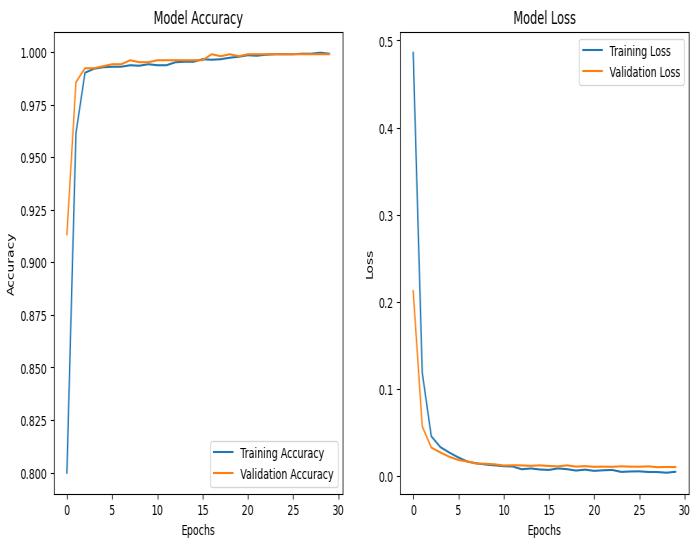
-2: PlotAnalysisforImpersonationDetection
Table-1: ClassificationReportofRandomForest
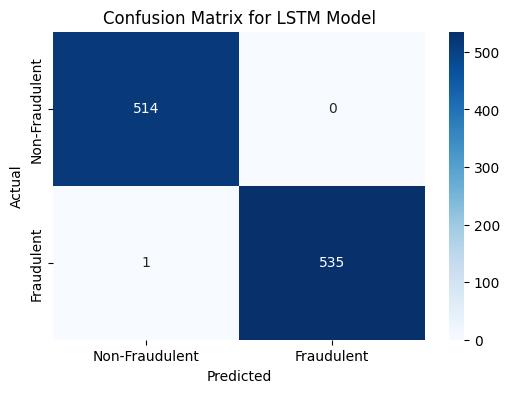
The Impersonation Detection Model was developed using a Long Short-Term Memory (LSTM) architecture, which is ideal for handling sequential data like text. After trainingtheLSTMmodel,weachievedoutstandingresults, with the model showing exceptional performance across key metrics such as accuracy, precision, recall, and F1 score.
PerformanceMetrics:
Accuracy:0.9990
Precision:1.0000
Recall:0.9981
F1Score:0.9991
The alignment of both training and validation accuracy curvesindicateseffectivelearningandgeneralization.The quickreductioninloss,followedbystabilizationnearzero, confirms minimal error and efficient learning, with no overfitting, showcasing the model’s robustness. The Fake Payment Detection Model using XGBoost achieved an accuracy of 87.83% and an ROC AUC score of 0.9422, highlighting its strong performance in distinguishing fraudulentfromlegitimatetransactions.
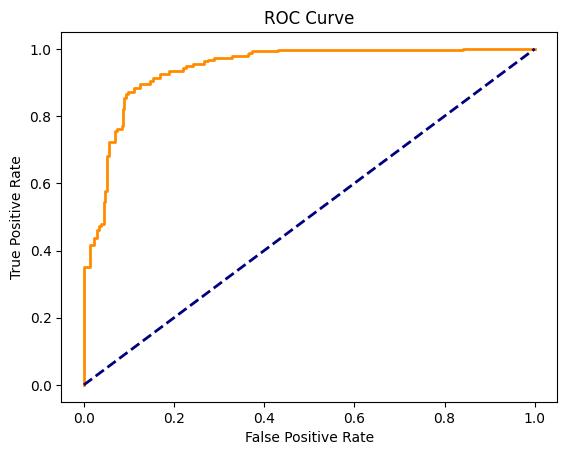
Fig-3: ROCcurveforFakePaymentDetection
The ROC curve demonstrates the model's strong performance, showing high true positive rates and low false positive rates, confirming its effectiveness. The confusion matrixfurthersupportsthis,indicatingthat the model correctly classified most transactions, with only a fewfalsepositivesandnegatives.
For Fake QR Code Detection, the CNN model showed significant improvement, steadily increasing accuracy throughout training and achieving near-perfect scores for both the training and validation sets, ensuring minimal overfitting.
International Research Journal of Engineering and Technology (IRJET) e-ISSN:2395-0056
Volume: 12 Issue: 04 | Apr 2025 www.irjet.net p-ISSN:2395-0072
The user-friendly UPI Fraud Detection System interface allows users to easily input transaction data and images for real-time fraud detection. It features an intuitive layout, enabling users to select parameters like language and location, and provides immediate fraud predictions basedonthetrainedmodels.
The UPI Fraud Detection System, developed using machine learning approaches, offers an effective solution todetectingandaddressing fraudulentactivitiesindigital payment platforms. By integrating diverse data types suchastransactiondetails, audiodata,text, and images the system is equipped to handle a wide variety of fraud scenarios, including vishing, impersonation, fake payments, and QR code scams. The integration of models likeRandomForest,LSTM,XGBoost,andCNNhasresulted in a robust and precise system capable of accurately identifyingdifferentfraudtypes.
Thesystem’sperformance,highlightedbyhighaccuracy, solid ROC AUC scores, and minimal misclassification, underscoresitseffectivenessandreliability.Eachmodelis tailored to process specific data types, enhancing the system's ability to handle complex fraud detection tasks. To ensure robust performance in real-world applications, techniques such as data augmentation and regularization havebeenapplied,preventingoverfittingandensuringthe models generalize well. The system also features an intuitive interface, allowing users and financial institutions to easily input data and receive real-time fraud predictions, making it accessible and practical for a widerangeofusers.
In the future, the system can be expanded with additional data sources, like biometric authentication and behavioural analytics, to improve accuracy and adaptability. As fraud tactics continue to evolve, ongoing updates and model improvements will ensure the system remains effective in combating emerging threats and securingdigitalpaymentecosystems.
[1] M. Naga Raju, Yarramreddy Chandrasena Reddy, Polavarapu Nagendra Babu, Venkata Sai Pavan Ravipati, Velpula Chaitanya. (2024). Detection of Fraudulent Activities in Unified Payments Interface using Machine Learning - LSTM Networks. 7th International Conference on Circuit Power and ComputingTechnologies(ICCPCT)
[2] N. Karthick, G. Leema Roselin, M. Tamilarasan, K. Kalaiselvi, J. Jayanthi (2024). Unified Payment Interface Imposture and Scam Detection Using Deep Learning and ANN. International Journal of Artificial Intelligence and Applications. Third International
Conference on Smart Technologies and Systems for Next Generation Computing (ICSTSN) | 979-8-35039156 5/24/$31.00 ©2024 IEEE | DOI: 10.1109/ICSTSN61422.2024.10671346
[3] Gangisetty Raj Charan, Dr.K Deepa Thilak (2023). Detection of Phishing Link and QR Code of UPI Transaction using Machine Learning. rd International Conference on Innovative Mechanisms for Industry Applications (ICIMIA) | 979-8-3503-43632/23/$31.00 ©2023 IEEE | DOI: 10.1109/ICIMIA60377.2023.10426613
[4] Rishu, Amanveer Singh, Sarvesh Tanwar (2024). Revolutionizing Online Transaction Safety with CNN and GAN-Based Fraud Detection Strategies. Asia Pacific Conference on Innovation in Technology (APCIT) | 979-8350361537/24/$31.0010.1109/APCIT62007.2024.10 673599
[5] J. Kavitha, G. Indira, A. Anil kumar, A. Shrinita, D. Bappan (2024). Fraud Detection in UPI Transactions Using ML 2024 EPRA International Journal of ResearchandDevelopment(IJRD)Volume:9|Issue:4 |April2024JournalDOI:10.36713/epra2016.
[6] B. Franklin Edburg1, K. Umadevi2, M. Vidya3 ,P. M. Ramesh Kumar(2022) Role of UPI Application Usage and Mitigation of Payment Transaction Frauds: An EmpiricalStudyMDIMJournalofManagementReview and Practice 2(1) 7 –22, 2024© The Author(s) 2024DOI: 10.1177/mjmrp.231222347 mbr.mjmrp.mdim.ac.inhttps://doi.org/10.1177/mjmr p.231222347
[7] Deshpande, K., & Dam, L. B. (2021). Unified Payment Interface (UPI) platform: Conniving tool for Social Engineering Attack. Pacific Business Review International, 14(3), September 2021. Available at: https://www.researchgate.net/publication/3578377 25
[8] Muhammad Liman Gambo, Anazida Zainal, Mohamad Nizam Kassim “A Convolutional Neural Network Model for Credit Card Fraud Detection, “2022 International Conference on Data Science and Its Applications (ICoDSA) | 978-1-6654-86651/22/$31.00 ©2022 IEEE | DOI: 10.1109/ICoDSA55874.2022.9862930.
[9] Mohammad Ziad Mizher, Ali Bou Nassif ‘‘Deep CNN approachforUnbalancedCreditCardFraudDetection Data,’’ 2023 Advances in Science and Engineering TechnologyInternationalConferences(ASET)|978-1665454742/23/$31.0010.1109/ASET56582.2023.10 180615
International Research Journal of Engineering and Technology (IRJET) e-ISSN:2395-0056
Volume: 12 Issue: 04 | Apr 2025 www.irjet.net p-ISSN:2395-0072
[10] S. K. Lokesh Naik, Ajmeera Kiran, Vadapally Praveen Kumar,ShanmukhMannam,YesarapuKalyani,Manda Silparaj ,‘‘Fraud Fighters - How AI and ML are Revolutionizing UPI Security,’’ 2024 International Conference on Science Technology Engineering and Management (ICSTEM) | 979-8-3503-76913/24/$31.00©2024IEEE|DOI:10.1109/ICSTEM61137 .2024.10560740
© 2025, IRJET | Impact Factor value: 8.315 | ISO 9001:2008 Certified Journal | Page1824