
International Research Journal of Engineering and Technology (IRJET) e-ISSN: 2395-0056
Volume: 12 Issue: 05 | May 2025 www.irjet.net p-ISSN: 2395-0072
International Research Journal of Engineering and Technology (IRJET) e-ISSN: 2395-0056
Volume: 12 Issue: 05 | May 2025 www.irjet.net p-ISSN: 2395-0072
P.S. Mayura Veena1 , L. Hymavathi2 , A. Tarun Teja2 , N. Jahnavi2 , K. Sateesh2
1Assistant Professor, Department of ECE, Anil Neerukonda Institute of Technology and Sciences, Andhra Pradesh, India
2UG student, Department of ECE, Anil Neerukonda Institute of Technology and Sciences, Andhra Pradesh, India ***
Abstract—Lung cancer remains one of the deadliest cancers in the world, mostly because it is challenging to detect earlier. This project proposes an approach for detecting lung cancer in a hybrid manner involving both classification and object detection methods. The classification model utilises the Xception model to differentiate the cancer cells and has an accuracy of 94.4%.
A YOLOv5 object detection framework is proposed to detect lung nodules inCT images.Withtrainingonthe dataset,this model achieved 99% accuracy, showing its performance in detectingandboundinglungnoduleswithhighaccuracy.
Keywords-convolutional neural networks, Xception model,yolov5,lungCTscans,lungcancer
1.INTRODUCTION
Lung cancer remains one of the most prevalent and fatal forms of cancer across the world, taking up a significant share of total cancer centers. Its early diagnosis plays a very vital role in improving patient survival rates; nevertheless, detection of lung nodules in their initial stagesisparticularlychallengingduetotheirminimalsize, contrast and intricate look in CT images. The classical diagnostic procedure on the basis of radiologists evaluating large volumes of thoracic CT scans manually is time-consuming, labour-intensive and susceptible to errors in diagnosis owing to fatigue and personal subjectiveinterpretation.[1]
RecentdevelopmentsinAIhaverevolutionizedthefieldof medical imaging by allowing for fully automated, highly accurate diagnostic tools. Of the many deep learning methods, Convolutional Neural Networks (CNNs) have proventobeatthestate-of-the-artforimageclassification, segmentation and object detection tasks [2]. Building on thesedevelopments,thisresearchintroducesadual-model framework to tackle two important facets of lung cancer diagnosis: the diagnosis of cancerous conditions and the localizationofpulmonarynodulesinCTscans.
The first step of the proposed system is the implementation of a deep learning classification model using the Xception architecture. As an extension of the Inception architecture, François Chollet created the deep convolutional neural network called "Xception," or
"Extreme Inception." It is based on the assumption that cross-channel correlations and spatial correlations in convolutional neural networks are completely separable. To this purpose, Xception substitutes standard convolutional layers with depthwise separable convolutions, which decompose a typical convolution into a depthwise spatial convolution followed by a pointwise (1×1) convolution. This structure drastically lowers the number of parameters and computational overhead while preservingorevenimprovingthemodel'srepresentational capabilities. This system trains the Xception model to classify slices of lung CT scans into four groups: normal, adenocarcinoma, large cell carcinoma, and squamous cell carcinoma.Xceptionisuniquelysuitedtoidentifythefinegrained textural and structural patterns characteristic of various lung diseases due to its architectural depth and parameterefficiency.Furthermore,themodelisrefinedon a carefully selected dataset using transfer learning techniques, which enables the system to have high diagnosticaccuracywithimprovedgeneralization.[3]
Paralleltothis,thesystemincorporatesanobjectdetection model inrealtimewithYOLOv5(YouOnlyLookOncev5), ahighlysuccessfularchitectureforfastandaccurateobject detectionin a variety of applications.YOLOv5 operates on afullimageinasinglepassandgeneratesboundingboxes and class predictions for objects that are detected. The suggested approach utilizes YOLOv5 for detection of lung nodules inCTscansand providesspatial context, together with visual interpretability to the classification outcome [4]. The model gets trained on the NCCD dataset available in Kaggle platform, with annotated CT scans appropriate forbothdetectionandclassificationtasks.
International Research Journal of Engineering and Technology (IRJET) e-ISSN: 2395-0056
Volume: 12 Issue: 05 | May 2025 www.irjet.net p-ISSN: 2395-0072
InputCTscan image


Image Preprocessing


Feature Extraction& classification Benignor Malignant
Tumour Detection



Normalization Resizing Xception

Fig1:Workflowoftheproject
2.1. DataCollection
The dataset is collected from NCCD (NATIONAL CENTER FOR CANCER DISEASES) in Kaggle site and it consists of lungCTscanimages.
Thedatasetisdividedintothreeparts:training,validation and test sets. The training portion is used to train the model, the validation set is used for hyperparameter tuning, and the test set is used to evaluate final performance.
2.2. Data Preprocessing
To make the model stronger, the images go through multiplepreprocessingoperations.
Initially, resizing of all the images takes place so that they allhavethesamedimensions.
Next, the normalization of pixel intensities takes place to fall between 0 and 1, which really helps the model learn moreeffectively.
2.3. Feature Extraction & Classification
The Xception is a deep CNN architecture designed to give thehighperformanceinclassificationtasks.
In this project the xception architecture is used for both feature extraction and classification. As the input image passesthroughthesuccessivelayersofthexceptionmodel, it identifies and learn features form low-level details like edgesandtexturestohighlevelpatternssuchasstructure of lung tumours. These learned features are utilized to classify the image into different cancerous and noncancerouscells.[5][6]
Entry flow:

Input CT scan image

Resize and normalize

Pass through the xception model

Global Average Pooling Classification


Predicted cancer type
Fig 2:Flowchart for Xception model
Toprocesstheinputimagethexceptionmodelbeginswith afewstandardconvolutions.
Then the xception model uses depth wise convolutions withmaxpoolingtoreducethespatialdimensions.
Inthisthemodelcapturesthebasicfeatureslikeedgesand simpletexturesandinputimagesizegetsreduced.[7]
Middle flow:
Themiddleflowcontainsnumberofidenticalmodules. each module has three depthwise convolution layers with residual connections middle flow allows learning of
International Research Journal of Engineering and Technology (IRJET) e-ISSN: 2395-0056
Volume: 12 Issue: 05 | May 2025 www.irjet.net p-ISSN: 2395-0072
complex patterns without increasing the computational cost.[7]
Exitflow:
In this further processing of features takes place using separable convolutions. It is followed by global average pooling and fully connected layers for final classification. [7]
2.3.1 Xception Model Performance
The Xception model achieves an accuracy of 94.4% across fourdistantclasses
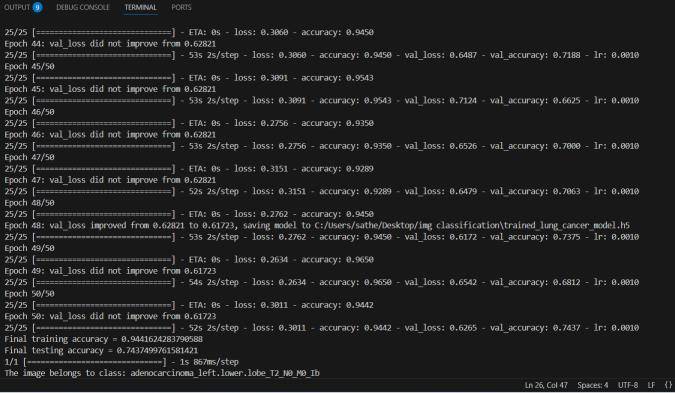
Fig 3: Outputshowingtheaccuracyofclassification using50epochs
2.3.2 Confusionmatrix for classification model
In this project xception model is for classification of lung nodules.
In order to know whether the model is giving accurate resultsornotconfusionmatrixisusedastheperformance tool.theconfusionmatrixisinthesquaretableformatand it is the visual representation of how well the model is performing by comparing actual labels with the labels predictedbythemodel.[8]
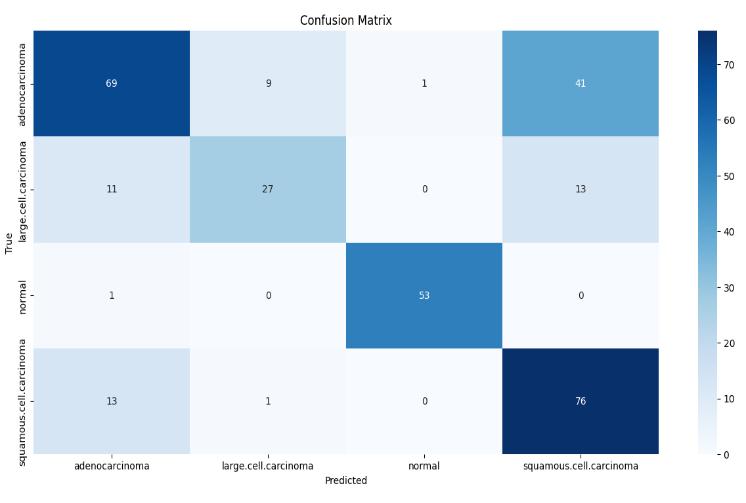
Thematrixisdividedintofourkeycomponents.
True positive - In this case the Xception model accurately predictsapositiveclass
True Negative -Here the model correctly predicts a negativeclass
False Positive -here the model incorrectly predicts a positiveclass.
False Negative -In this case the model incorrectly predicts anegativeclass
Also, there are certain evaluation metrices to evaluate the performanceofthemodel.[8][9]
Accuracy: Itisameasureofhowoftenapredictionmodel makesthecorrectprediction,theformulais
Precision: It is the measure of how many of the positives predictedbythemodelareactuallycorrect,theformulais
Recall: Itmeasureshowmanyoftheactualpositiveswere correctlyidentifiedbythemodel.
F1-score: ItisthemeasureofharmonicmeanofPrecision andrecall
2.3.3Classification output images:
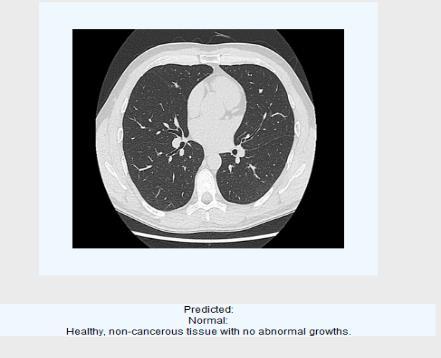
Fig5: Predictedasnormalhealthynon-canceroustissue
International Research Journal of Engineering and Technology (IRJET) e-ISSN: 2395-0056
Volume: 12 Issue: 05 | May 2025 www.irjet.net
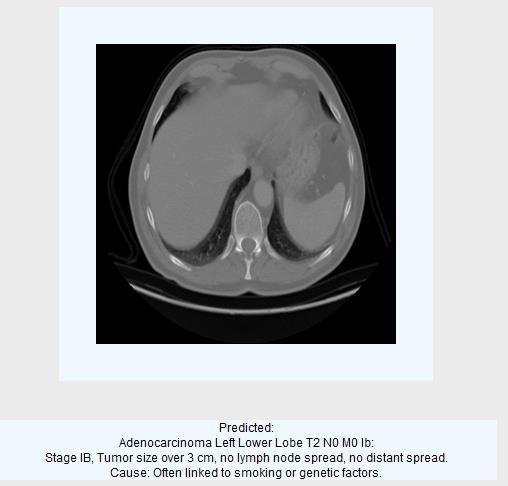
Predictedascancercell-adenocarcinoma
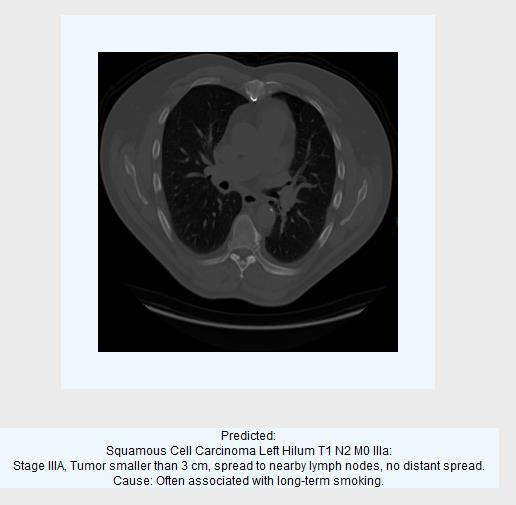
Fig7: Predictedascancercell-SquamousCellCarcinoma
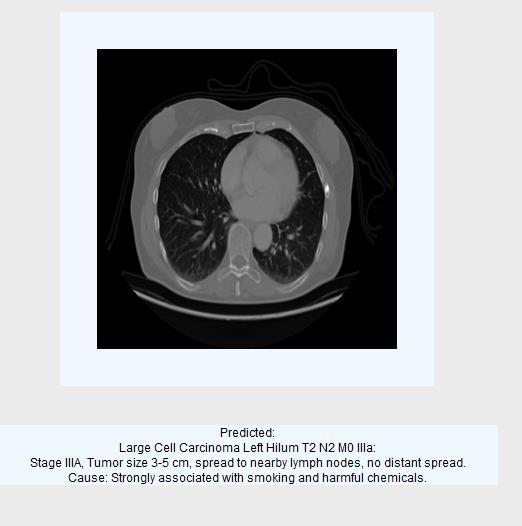
Fig8: Predictedascancercell-LargeCellCarcinoma
2395-0072
Table 1: ClassificationReport
2.4 Lung Nodule detection using yolov5 architecture
The evolution of object detection models has experienced some incredible advances in computer-aided diagnostic (CAD) systems for medical imaging in the past few years. Among these, the YOLO (You Only Look Once) series of models has become a prominent model class for real-time object detection. The fifth iteration in the YOLO series, YOLOv5, has shown unprecedented advances in detection performance, computation speed, and deployment efficiency. These characteristics make it particularly wellsuited for advanced medical tasks such as the localization andclassificationoflungnodulesincomputedtomography (CT)images [10]
Yolov5isaonestageobjectdetectorsothatitdetectsand classifiestheobjectsliketumoursinonepass,thismeansit predicts bounding boxes and class probabilities simultaneously.soherethereisaminimallossinaccuracy. Previous models like faster R-CNN first identify the object locations(proposals) and then classify these proposals. Thus, Yolov5 minimizes the processing delay and optimizestheperformance.
Yolov5 architecture has three main parts: the backbone, theneckandthehead.[11]
Backbone:
The function of this backbone is to extract features from theinputimage.Itbeginswithafocusmodule,whichslices the input into patches and concatenates them so that spatialinformationisretainedandsizealsogetreduced.
This is followed by CSP (Cross Stage Partial) bottle neck splits feature maps into two parts and later merges them. Itallowsreductionofthecomputationalcost.
The backbone also uses C3 modules, which are variant of CSP blocks and applies SiLU (Sigmoid-weighted Linear Unit)activationforbetternon-lineartransformations.[11]
Neck:
International Research Journal of Engineering and Technology (IRJET) e-ISSN: 2395-0056
Volume: 12 Issue: 05 | May 2025 www.irjet.net p-ISSN: 2395-0072
Thefunctionofthis neckpartistoaggregateandcombine features at different scales by using a combination of Feature
Pyramid Network (FPN) and Path Aggregation Network (PAN). FPN and PAN ensures information flows efficiently inbothtop-downandbottom-updirections.
Head:
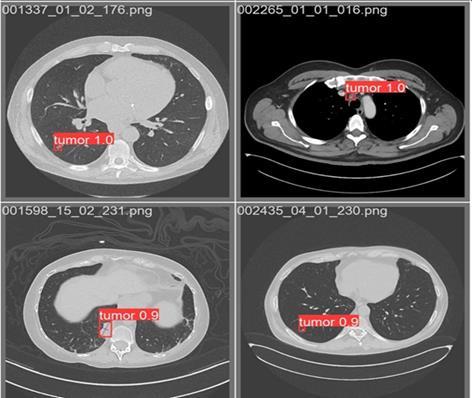
The head predicts the bounding boxes, objectness scores andclassprobabilitiesfromthefeatures.
Thefinaloutputconsistsofboundingboxesandconfidence scoresfordetectedlungnodules.[11][12]
The YOLOv5 model is trained in a supervised learning fashion, where detection and classification error are minimizedforalllabeledimageslices.
The model takes input images and ground-truth labels as input and learns to output bounding boxes and class probabilities. The configuration of the architecture involves choosing a suitable YOLOv5 based on hardware capability and performance compromises. The model is initialized from pretrained weights to borrow domain knowledgeandspeedupconvergence.[13]
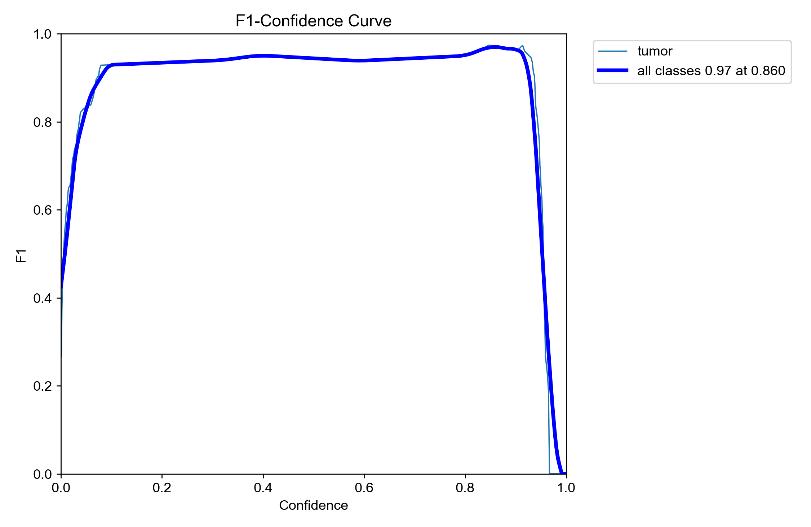
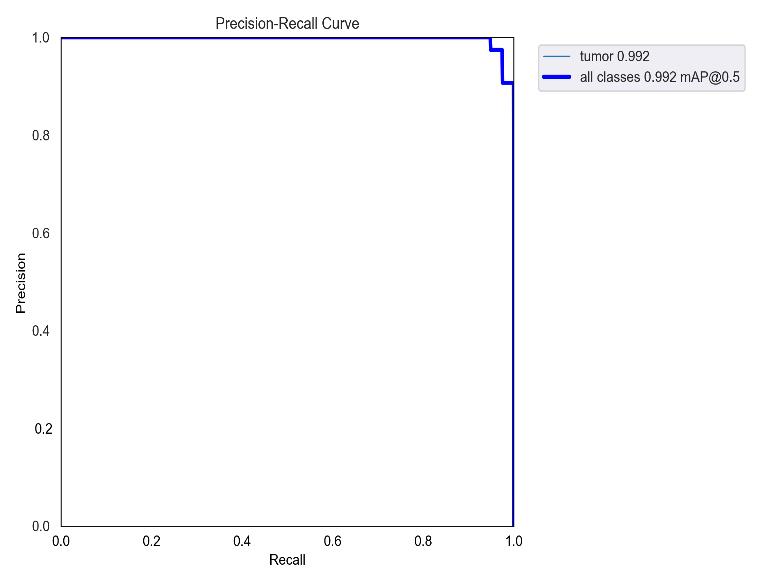
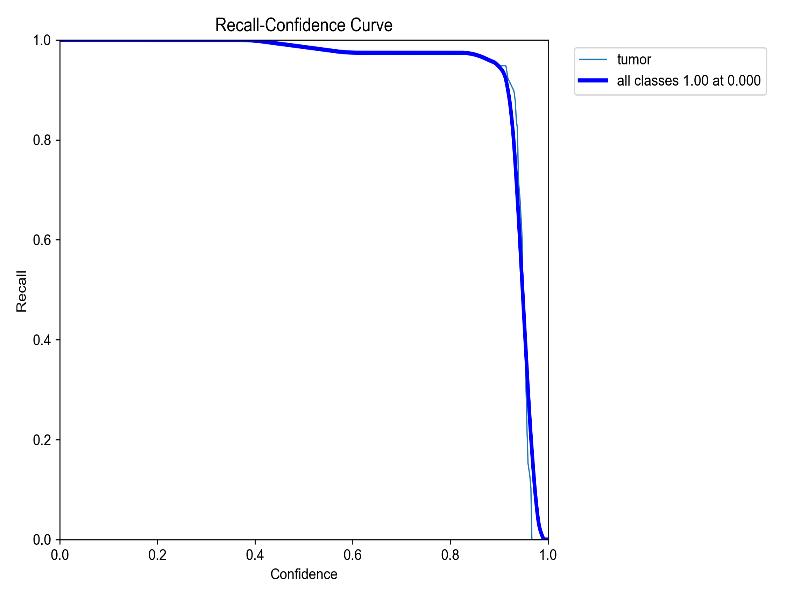
Here the following Evaluation metrics were used to analyzetheperformanceofthedetectionmethod.
Evaluation metricescurves:

Input image

Preprocessing
backbone


Yolov5 neck

Predicted bounding boxes for tumour
2.4.1 Training and validationperformance:
Trainingand validationdatasetaremeticulouslyprepared to have a variety of image slices that reflect real clinical situations, such as nodules of different sizes, shapes, density, and anatomical locations. The images are preprocessed to standardize pixel intensities, regulate contrast, and rescale to a standard input resolution compatiblewiththeYOLOv5architecture.
The information is separated into training and validation sets, wherein the training subset is applied to optimize parameters of the model and the validation set is used to assessgeneralizationandavoidoverfitting.
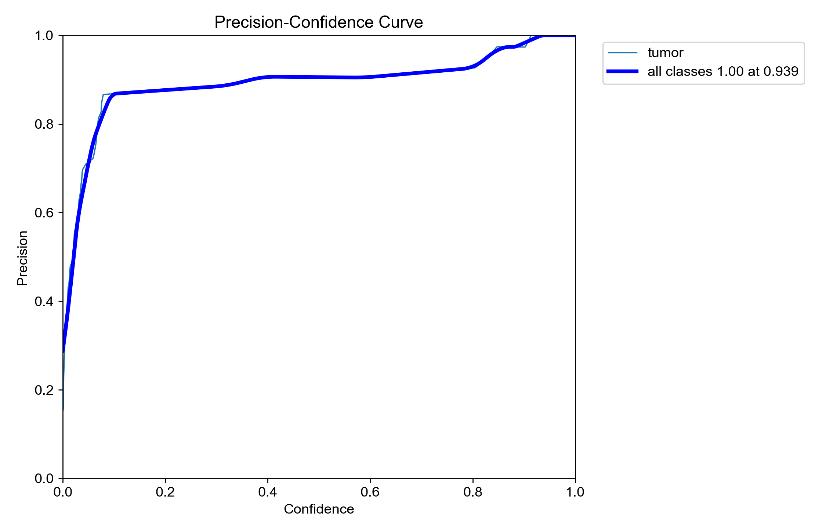
Precisioncurve
International Research Journal of Engineering and Technology (IRJET) e-ISSN: 2395-0056
Volume: 12 Issue: 05 | May 2025 www.irjet.net p-ISSN: 2395-0072
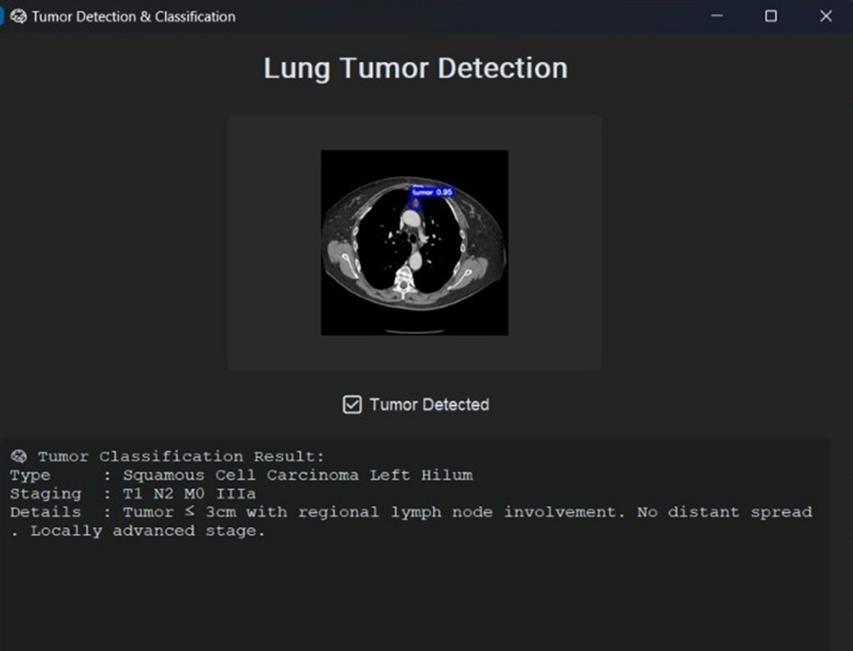
3.RESULTS
4.CONCLUSION & FUTURE SCOPE
The Xception model which was used for the classification achieved 94.4% accuracy in distinguishing between varioustypes oflungcancer cells.Theyolov5 architecture which was used for detection achieved 99% accuracy for lung nodule localization which also minimizes the false positives. These two models make finding and correctly diagnosinglungcancermorereliableandaccurate.
Following the good results obtained applying Xception in classificationandYOLOv5indetection,futureresearchcan investigate various improvements. A direction is constructing an end-to-end hybrid network that combines classificationanddetectionasasingleprocess,minimizing theprocessingtimeandmaximizingsystemresources.
Another area to consider is semi-supervised and selfsupervised learning, which would minimize the dependence on large labeled datasets, a typical shortcoming in medical imaging. Adding attention mechanismstoexistingarchitectureswillalsoenhancethe network's ability to pay attention to diagnostically important areas, more enhancing accuracy as well as interpretability.
Besides, thesystem would bescalabletosupportreal-time diagnostics in clinical settings with optimized deploymentmethodssuchasmodel quantization and edge inferenceforlow-resourceenvironments.
[1] T. Mahmmod, N. Ayesha, M. Mujahid and A. Rehman, "Customized Deep Learning Framework with Advanced Sampling Techniques for Lung Cancer Detection using CT Scans," 2024 Seventh International Women in Data Science
International Research Journal of Engineering and Technology (IRJET) e-ISSN: 2395-0056
Conference at Prince Sultan University (WiDS PSU), Riyadh, Saudi Arabia, 2024, pp. 110-115, doi: 10.1109/WiDSPSU61003.2024.00035.
[2] Geetha, G., et al. “Image Captioning Using Deep Convolutional Neural Networks (CNNs).” Journal of Physics: Conference Series, vol. 1712, no. 1, Dec. 2020, p. 012015. DOI.org (Crossref), https://doi.org/10.1088/1742-6596/1712/1/012015
[3] T.T. Al-Shouka and K. M. A. Alheeti, "A Transfer Learning for Intelligent Prediction of Lung Cancer Detection," 2023 Al-Sadiq International Conference on Communication and Information Technology (AICCIT), AlMuthana, Iraq, 2023, pp. 54-59, doi: 10.1109/AICCIT57614.2023.10217967
[4] Kumar, N. Komal, et al. “Detection and Recognition of Objects in Image Caption Generator System: A Deep LearningApproach.”20195thInternationalConferenceon AdvancedComputing&CommunicationSystems(ICACCS), IEEE, 2019, pp. 107–09. DOI.org (Crossref), https://doi.org/10.1109/ICACCS.2019.8728516.
[5] M. A. Javad Zadeh Barzaki et al., "Using Deep Learning for Classification of Lung Cancer on CT Images in Ardabil Province: Classification of Lung Cancer using Xception," 2023 13th International Conference onComputer andKnowledgeEngineering(ICCKE),Mashhad,Iran,Islamic Republic of, 2023, pp. 375-382, doi: 10.1109/ICCKE60553.2023.10326262.
[6] P. M. Bruntha et al., "Lung Nodule Classification using Shallow CNNs and Deep Transfer Learning CNNs," 2021 7thInternational ConferenceonAdvancedComputing and Communication Systems (ICACCS), Coimbatore, India, 2021, pp. 1474-1478, doi: 10.1109/ICACCS51430.2021.9441702.
[7] N. Valarmathi, S. B, S. V, S. F. J and S. M, "Pneumonia Disease Classification Using Xception CNN Model," 2024 2nd International Conference on Artificial Intelligence and Machine Learning Applications Theme: Healthcare and InternetofThings(AIMLA), Namakkal, India, 2024, pp. 1-6, doi:10.1109/AIMLA59606.2024.10531453.
[8] Aishwarya Maroju et al. “Image Caption Generating Deep Learning Model”. 2021 International Journal of Engineering Research & Technology (IJERT). ISSN: 22780181,vol10,issue09,sep2021.
[9]R.V.M.d.Nóbrega,S.A.Peixoto,S.P.P.daSilvaandP. P. R. Filho, "Lung Nodule Classification via Deep Transfer Learning in CT Lung Images," 2018IEEE31stInternational Symposium on Computer-Based Medical Systems (CBMS), Karlstad, Sweden, 2018, pp. 244-249, doi: 10.1109/CBMS.2018.00050.
Volume: 12 Issue: 05 | May 2025 www.irjet.net p-ISSN: 2395-0072 © 2025, IRJET | Impact Factor value: 8.315 | ISO
[10] A. M. Harale, V. K. Bairagi, E. Boonchieng and M. R. Bachute, "Nodules Detection in Lungs CT Images Using Improved YOLOV5 and Classification of Types of Nodules by CNN-SVM," in IEEE Access, vol. 12, pp. 140456-140471, 2024,doi:10.1109/ACCESS.2024.3466292
[11] X. Dong, N. Xu, L. Zhang and Z. Jiang, "An improved YOLOv5 network for lung nodule detection," 2021 International Conference on Electronic Information Engineering and Computer Science (EIECS), Changchun, China, 2021, pp. 733-736, doi: 10.1109/EIECS53707.2021.9588065.
[12]M.A.Muqeet,H.K.Gill,M.A.N.Hasnain,A.Fatima,A. Mohammed andM. K. Saifullah,"Detection of LungCancer using Deep Learning based Convolution Neural Network Models," 2023 IEEE Fifth International Conference on Advances in Electronics, Computers and Communications (ICAECC), Bengaluru, India, 2023, pp. 1-5, doi: 10.1109/ICAECC59324.2023.10560318.
[13] Vishal, S. Mehta and A. Rathour, "Optimizing Hybrid CNN-SVM Architectures for Enhanced Detection of Subsolid Lung Nodules: A Comparative Study with Traditional Methods," 2024 5th IEEE Global Conference for AdvancementinTechnology(GCAT),Bangalore,India,2024, pp.1-5,doi:10.1109/GCAT62922.2024.10923969.