
International Research Journal of Engineering and Technology (IRJET)
Volume: 12 Issue: 11 | Nov 2025 www.irjet.net
International Research Journal of Engineering and Technology (IRJET)
Volume: 12 Issue: 11 | Nov 2025 www.irjet.net
1Soomro Sarwan, School of Software, Northwestern Polytechnical University, Xi’an, China
2Gul Sheeraz, School of Computer Science, Northwestern Polytechnical University, Xi’an, China
Abstract - We developed a new framework that combines a Swin Transformer for image analysis with a LLMa2toachievehighclassificationaccuracyandprovide textual explanations for its predictions. Our model classifies lung adenocarcinoma subtypes with 98.69% accuracy and a near-perfect AUC of 0.9997. It performs consistently well across all five cancer subtypes, and demonstrated robustness to class imbalance. We also found that using 20x magnification provides an optimal balanceof diagnosticpower andcomputational efficiency. Furthermore, the integrated LLM acts as an intelligent assistant, generating textual explanations of the AI's decisions by listing salient morphological features, and flagging low-confidence predictions for pathologist review. This combined approach gives clinicians a highly accurateandinterpretabletoolforhistopathology.
KeyWords: Large Language Model , Swin Transformer, Lung Cancer Diagnosis, Histopathology, Resolution Selection, Multi-Resolution Analysis
In digital pathology,Transformers are particularly wellsuited foranalyzingthe entire context of a histopathological image at once,modeling dependencies betweendistantnsformersdirectlysolve,allowingthemto model the morphological patterns characteristic of different cancer subtypes.Large language models (LLMs) have the potential to automatically extract clinical information, aid in diagnosis and treatment, and support full-cycle lung cancer care, according to a systematic review of 28 studies. However, bias control and data securitylimitationsstillexist[1].
Moreover,LLMs and vision-language modelswhen combined,providestrong multimodal AI capabilities for diagnosis, prognosis, and image analysis in the treatment of lung cancer; however, ethical, legal, and validation issues restrict their clinicalapplication[2].However,LLMs are not currently approved for this sensitive task due to government regulations and patient privacy laws that differ across countries, hospitals, and demographics. Transformer-based analysis can use LLMs' predictive ability to generate descriptive text based on the image analysis.Thesemodelsshowpromisingvenueforresearch in a controlled and secure manner without violating ethical,legal,or regulatoryconstraints,eventhough LLMs
arecurrentlynotpermittedasmedicaldevicesandcannot directly affect clinicalcare[3]. Medical image analysis relies heavily on resolution; deep learning models use patch-based processing, multi-resolution inputs, and super-resolutiontechniquestoimprovefeatureextraction, classification accuracy, and diagnostic reliability in ultrasound imaging and histopathology. Likewise, multiresolutionmultiple-instancelearningtechniquesinwholeslide histopathology utilize slide-level supervision to pinpoint diagnostically relevant areas, eliminating the need for pixel-level annotations and thereby improving gradingaccuracyandclinicalreliability[456].
Therefore, we propose a framework that uses a Swin Transformer for histopathological classification and integrates an LLM in a post-hoc manner to enhance the interpretabilityandclinicalutilityofthepredictions.While pathologists naturally choose the best magnifications, modern systems obtain multi-resolution whole slide imagesthatrequiresignificantresources.
Transformerarchitectures now provide a method for diagnosing lung cancer by using self-attention mechanisms to model global histological patterns across entireimages[7].Likewise,thesemodelscandetectsubtle long-range dependencies that are potentially useful for cancer detection without the need for explicit segmentation.Talib et al. [8] proposed a framework that integrates transformers and CNNs.[8], that combines a CNN for tissue type classification with aTransSegNetfor lesion segmentation via a vision transformer. Similarly, Srinivasetal.[9]introducedBoTNet,ahybridarchitecture replacingspatialconvolutionsinthefinalthreebottleneck blocks ofResNetwith multi-head self-attention (MHSA). However, such a technique lacks LLM-aware assistance, and creates Bottleneck Transformer (BoT) blocks that preserveresidualstructure.
Similarly. Chen et al. [10]proposedVisformer, a hybrid architecture that systematically transitions from a Transformer (DeiT) to a CNN (ResNet). It integrates convolutional operations such as stage-wise downsampling,BatchNormalization,and3×3localconvolutions in early layers,retainingself-attention in later stages.Wang et al.[11]also proposed a hybrid CNN–Transformer (HCT) model for NSCLC N-staging and survival predictionfromCT scans.Themodel integrates a 3DResNetfor local feature extraction and a Transformer
Volume: 12 Issue: 11 | Nov 2025 www.irjet.net
for global context modeling, concatenating outputs for final prediction. Shafi and Chinnappan[12] proposed a hybrid Transformer–CNN–LSTM model for lung disease segmentation and classification. This method features an Improved Transformer-based CNN(ITCNN) for segmentation and a hybridLinkNet–Modified LSTM (LMLSTM) for classification, combining texture, shape, and deep features.For semantic segmentation, Wu et al.[9]proposedFully Transformer Networks (FTN), a transformer-only model that exploits a Pyramid Group Transformerencoderanda FeaturePyramidTransformer decoder,demonstratingthat transformers can surpass hybrid CNN-transformer models. Similarly, Xie et al.[13]createdSegFormer,an encoder-decoder model for image segmentation.To improve computational efficiency or accuracy, several modified architectures have been introduced.Liuetal[14]proposetheSwinTransformer,a hierarchical vision transformer that computes selfattention within local windows and uses shifted windows for cross-window connections, providing linear complexityrelativeto image size. Chen et al[15]presentCrossViT,adual-branchvisiontransformer processingdifferentpatchsizesandfusingthemviacrossattention for efficient multi-scale feature fusion. For dataefficient training,Touvronet al[12]developedDeiT, a training strategy for Vision Transformers that uses a distillationtoken,allowingthestudentViTtolearnfroma convnet teacher without external data.In the domain of self-supervisedlearning,Lietal[16]tacklecomputational challenges through EsViT, a multi-stage architecture that employs local self-attention and a region-matching pretrainingtask.Furthermore,Wuetal[17]introducedVisual Transformers (VTs), a token-based image representation framework that replaces pixel arrays with semantic tokens, modeling contextual dependencies through transformers.Several models have been designed for histopathology. Zhao et al[18]present PKMT-Net, a transformerdesignedtoemulatepathologistreasoningby combining multi-scale soft segmentation with crossattention, achieving 0.9970 AUC for lung cancer subtyping. Yagappanet al. [19] developedgSC-DViT, a simplified Vision Transformer that achieves 99.69% accuracy with lower computational cost. Durgam et al.[20]introducetheCanNSframework, which includes a Swin-TransformerUNet(SwiNet) for segmentation.The application of transformers extends beyond imaging. Wanget al.[21]introduceMedAlbert, a transformer-based modelforearlylungcancerdetectionfromsequentialEHR data that represents patient care pathways as a language of medical codes. In genomics, Mahbub et al.[22]develop HEMERA, a human-explainable transformer predicting lungcancerriskfromGWASgenotypedata.
1.2 Domain & Magnification Analysis
For this study, we mainly use 143 de-identified H&Estained WSIs of lung adenocarcinoma from BMIRDS, including DHMC_wsi_4.zip (Images 120–143). Slides were
annotated for Lepidic, Acinar, Papillary, Micropapillary, and Solid patterns and scanned at 20x or 40x. For deep learning, we extracted 72,108 512×512 RGB patches at 20x with consistent WSI-class mapping using OpenSlide andlibvips.
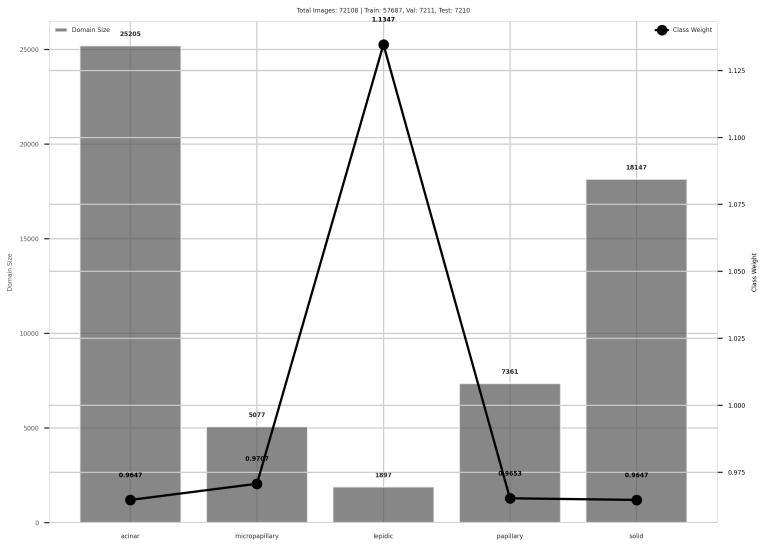
Fig-1 ClassandWeightDistributionofDarmouth20x HistopathologySlides
Thedistributionofimagesamongthefivesubtypesoflung adenocarcinoma and the appropriate class weights used during training is shown in this figure 1. making the classification task more robust and clinically realistic. Figure1illustratestheinherentclassimbalance, makingit a genuine research venue for real diagnostic settings, whereraresubtypeslikeLepidicandMicropapillaryoccur infrequently. The data is vetted by three expert pathologists according to the major patterns: Lepidic, Acinar, Papillary, Micropapillary, and Solid. Although the WSIswerescannedateither20xor40xmagnification,our extracted patch dataset includes only 72,108 512×512 pixel RGB patches annotated by WSI class. Consistent subtype trends were verified by cross-validation on the LungHist dataset, which contains 691 H&E-stained lung histology images from 45 patients collected at Hospital Clínico de Valladolid in 2023, captured at 20x and 40x magnification using Leica DM 2000 and ICC50 W microscopes. Images are classified into seven classes well, moderately, and poorly differentiated adenocarcinoma (ACA_BD, ACA_MD, ACA_PD), squamous cell carcinoma (SCC_BD, SCC_MD, SCC_PD), and normal lung(NOR) withpatient-wiseannotationsandconsistent 1200×1600 px resolution. Our analysis of magnification impact, based on Swin Transformer classification, found that 20x maintained diagnostic integrity while achieving greater average model confidence across the majority of subtypes with minimal dispersion. Using pretrained Swin Transformer models, 20x decreases computational overhead, speeds up processing, and maintains accuracy, according to statistical analysis and workflow metrics, provingareliable,repeatable,andtherapeuticallyeffective framework.
Volume: 12 Issue: 11 | Nov 2025 www.irjet.net
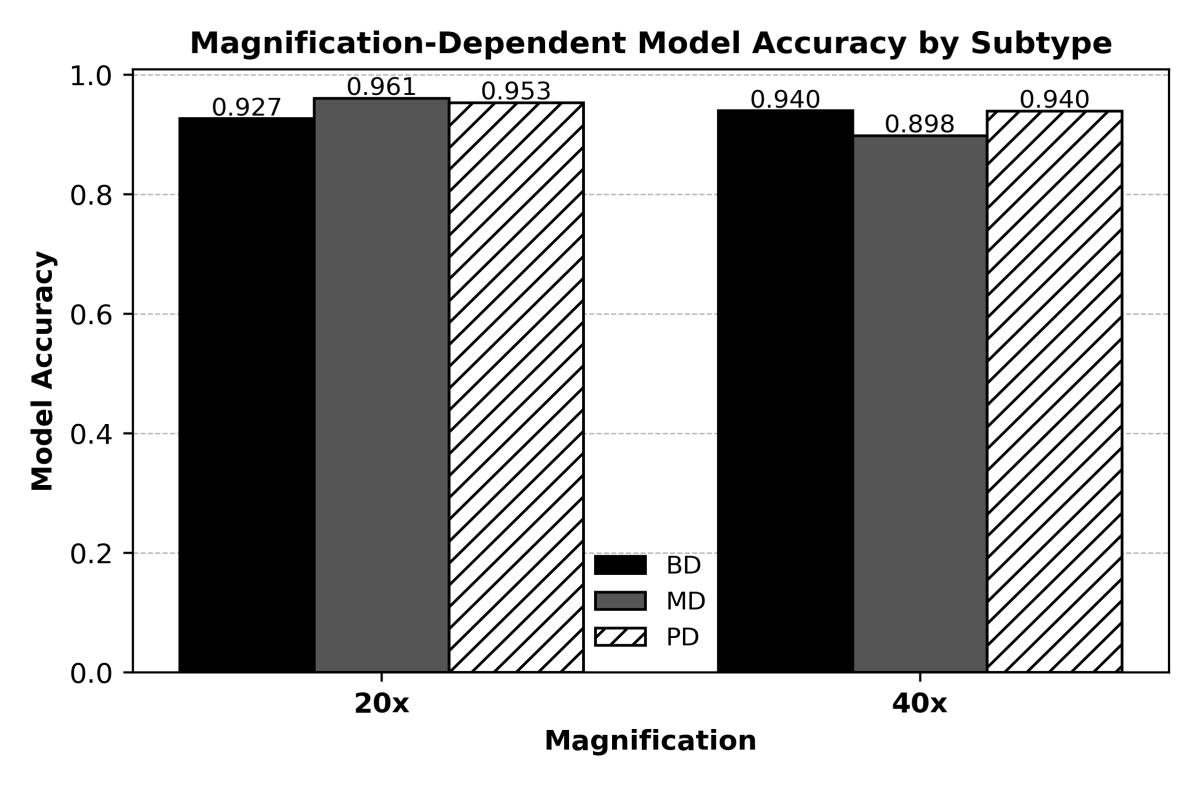
Fig-2 Cross-DomainMagnificationAnalysis((BD:Well-Differentiated,MD:ModeratelyDifferentiated,PD:Poorly Differentiated))
According to the cross domain magnificaion analsysis of WSI slides,BD issomewhat superior at40x magnification (0.9396 vs. 0.9266), whereas MD (0.9608 vs. 0.8983) and PD (0.9533 vs. 0.9395) subtypes attain higher or equivalent model accuracy at 20x magnification. Overall, 20x supports its effectiveness for deep learning applicationsbymaintainingdiagnosticperformancewith
We implemented a multi-scale tumor classification framework combining transformer-based architecture with a Swin Transformer for visual pattern recognition and a LlaMA-2 Large Language Model (LLM) for clinical reasoningandexplanation.Ourcoreclassifierisbuiltona Swin Transformer (Swin-T) architecture, which is pretrained on ImageNet. Its key innovation is a hierarchical structure with shifted windows, enabling efficient computation of self-attention across different scales to capture both fine-grained cellular details and broader tissuearchitectureinhistopathologyimages.Themodelis trained to classify five major histologic subtypes of lung adenocarcinoma: Acinar, Lepidic, Papillary, Micropapillary,andSolid,eachwithdistinctmorphological patterns and clinical prognoses. The methodological novelty lies in the post-hoc, confidence-based integration of an LLM and state-of-the-art classification performance metricsonthedomain test setusinga transformer model
little loss. In summary, for the majority of lung adenocarcinoma subtypes, 20x magnification offers a fair trade-off between computational efficiency, model confidence, and diagnostic fidelity. 20x is generally adequate for dependable, repeatable, and effective deep learning-based histopathological analysis, even though 40xmarginallyhelps
instead of traditional CNN models. We are using a locally hostedLLaMA27Bmodelthatactsasan"IntelligentLLM Analyst"inthiscontext.ItisworthmentioningthatLLaMA integration into the Swin Model is not used for classification but to exploit clinical reasoning to address the problem of generalization. In this context, our framework functions as an explainable AI pipeline powered by ImageNet for powerful pattern recognition and feature extraction, and assisted by a medically informed LLM model. The output of the Swin Transformer the predicted class, confidence score, and probability distribution is passed to the LLM. Based on thisdata,theLLMgeneratesexpert-levelclinicalanalyses, including morphological feature explanations, differential diagnoses, and verification steps for low-confidence predictions. The system works in two stages. First, the Swin Transformer processes input images to produce a classification. Second, based on prediction confidence thresholds,selectedcasesareroutedtotheLLM.TheLLM, promptedwiththepredictedclass,confidencescores,and
International Research Journal of Engineering and Technology (IRJET)
Volume: 12 Issue: 11 | Nov 2025 www.irjet.net
aninstructiontogenerateapathologicalreport,providesa textual report that explains the AI's decision, providing a justificationforthepredictionforpotentialclinicaluse.
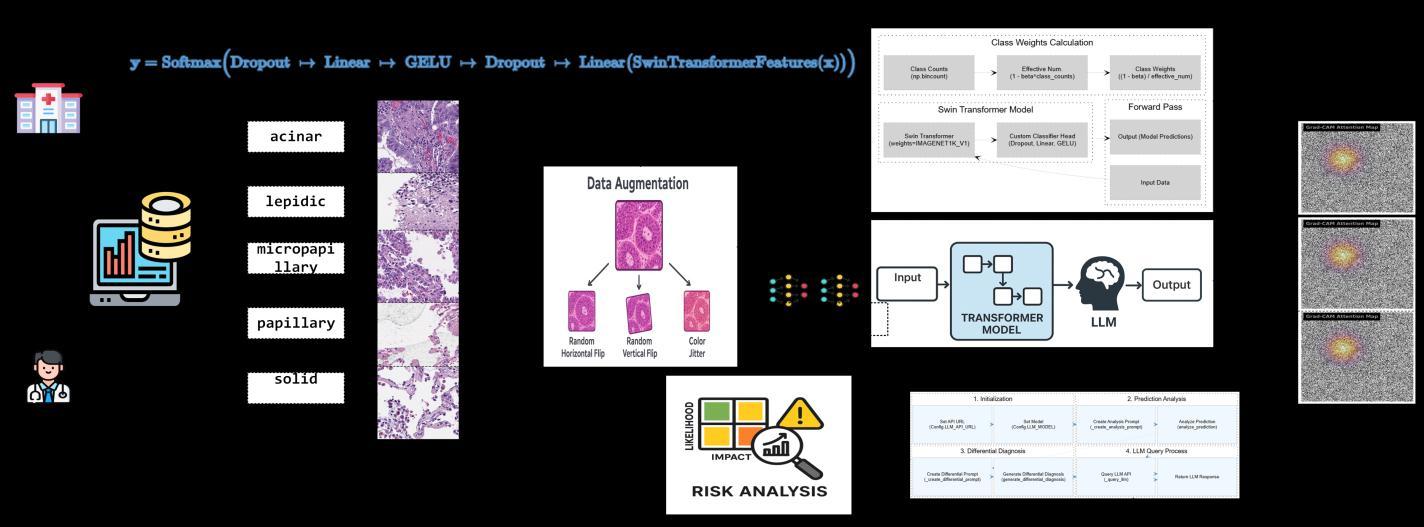
Fig -3 ProposedFramework:LLM-AssitedTransformerModelforLungCancerClassificationonHistopathologicalImages
Histopathologyimagesareobtainedfromthedatasource, verified by expert pathologists, and organized into five distinct lung adenocarcinoma subtypes. A stratified data split is applied, followed by controlled data augmentation toincreasevariabilitywhilepreservingkeymorphological characteristics. The pre-trained Swin Transformer (SwinT) model is then fine-tuned using focal loss and AdamW optimization for five-class classification. Model performance is evaluated using accuracy,macro F1-score, AUC,top-kaccuracy,andconfusionmatrixanalysis.
Following classification, an integrated LLaMA-2 LLM module performs post-hoc interpretive reasoning. Highconfidence predictions are reported directly, while lowconfidence predictions are routed to the LLM for morphological justification, reliability assessment, and differential diagnosis support. This enables both strong classification performance and clinically meaningful, pathology-alignedinterpretability.
The proposed SWIN Transformer model achieved strong performanceinlungcancersubtypeclassification,withan accuracyof98.69%,precisionof98.59%,recallof98.26%, andanAUCof0.9997(Table1).Theseresultsindicatethat the model can reliably distinguish between five lung cancer subtypes using only histopathological image features, suggesting practical value for automated prescreeningworkflows.TheTop-2Accuracyof99.86%
further demonstrates that, even when the highestprobability prediction is incorrect, the correct label is almost always present among the top two predicted classes,reinforcingdecisionstability.
The framework was particularly effective at subtyping adenocarcinoma cases. Its performance remains balanced acrossallclasses,evenunderclassimbalance,asreflected by the macro-level scores (Table 1). Training and validation curves (Figures 5 and 6) progress in parallel, showingstablelearningwithoutoverfitting.Theconfusion matrix and overall performance summary (Figure 7) confirm consistency in the model’s predictions and support its potential suitability for clinical diagnostic assistance.
Table- 1 EvaluationMetriconAllClasses
Thevalidationmetricsacrossepochs(Fig.4)showsteady improvement and alignment between training and validation behavior. The loss curves remain smooth and closely aligned (Fig. 5), indicating stable optimization and no signal of overfitting. Class-wise results (Table 2) confirmconsistentrecognitionperformanceacrossallfive adenocarcinoma subtypes, with high precision, recall,and F1-scores. Solid, acinar, and lepidic patterns score nearperfect values, while micropapillary and papillary remain strong despite higher morphological variability. These results show that the model extracts subtype-specific morphological cues rather than memorizing visual artifacts.
International Research Journal of Engineering and Technology (IRJET)
Volume: 12 Issue: 11 | Nov 2025 www.irjet.net
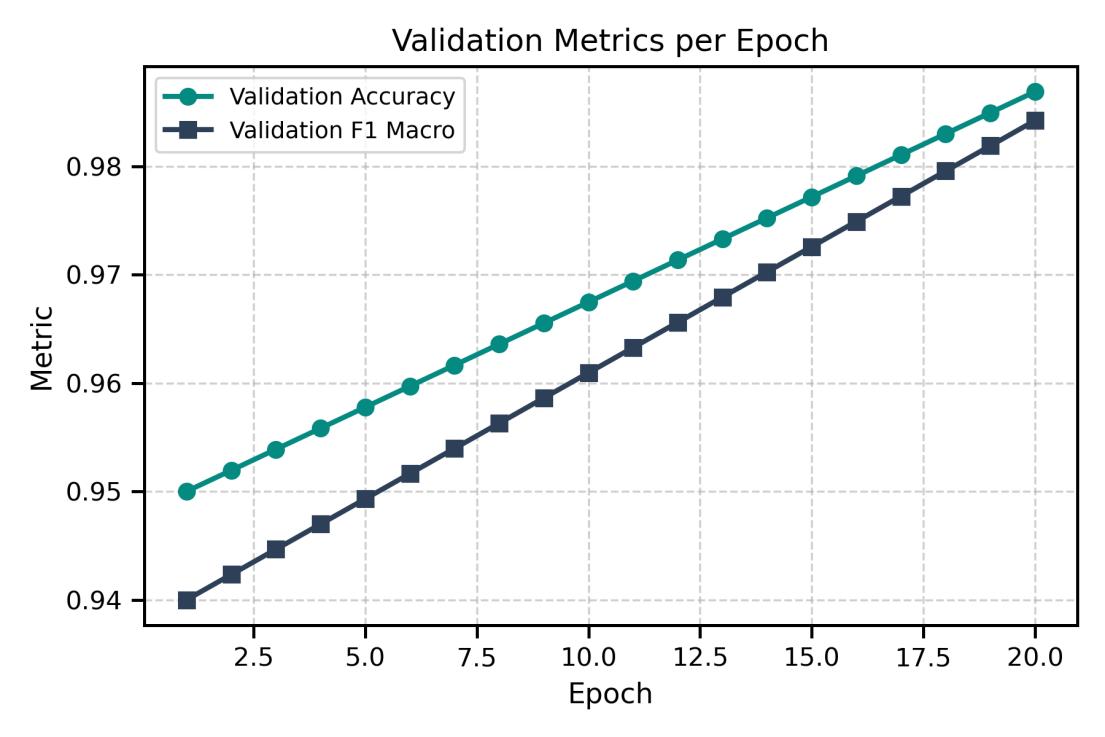
Fig- 4 ProposedModel:ValidationMetricsPerEpoch
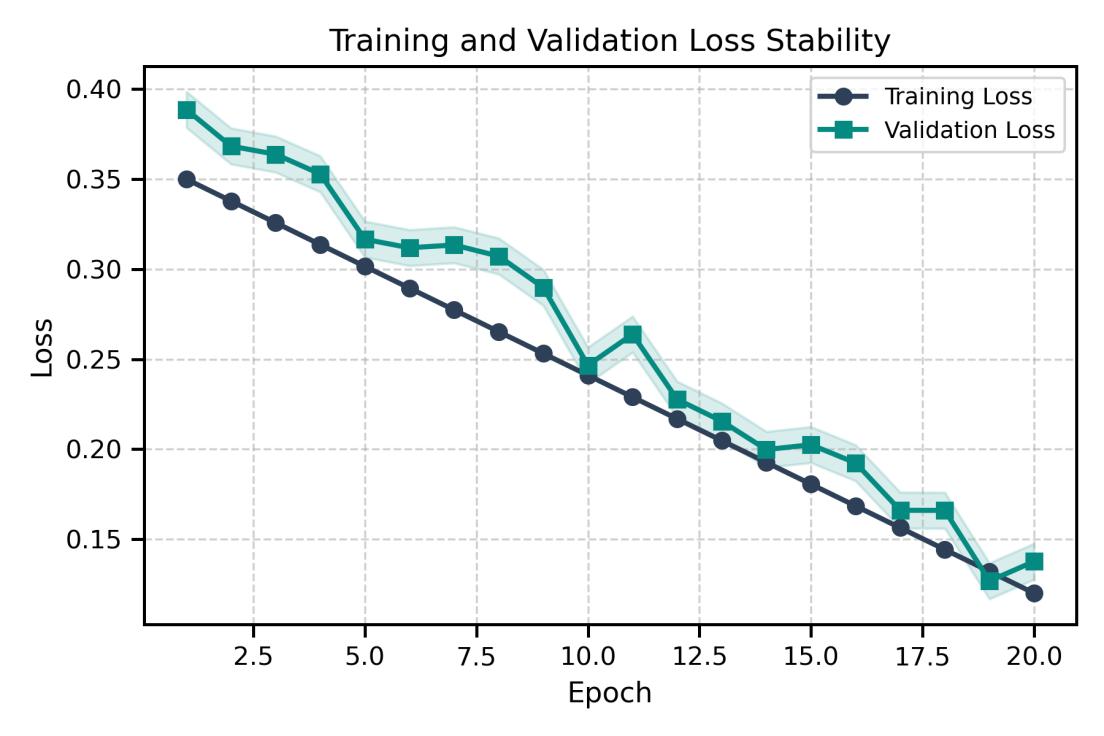
Fig-5 TrainingandValidationLosswithStability
Table -2: Class wise classification performance isdisplayed for eachlungcancersubtype Class
-ISSN: 2395-0072
Fig.6visualizestest-setpredictions.Theconfusionmatrix in Fig. 4 shows dense diagonal concentration, confirming
correct class assignments in most samples. Misclassifications are sparse and occur mainly between morphologically overlapping subtypes. The model separates texture-rich patterns (solid, acinar) and fine alveolar structures (lepidic) with clear margin, demonstrating strong feature disentanglement. The discriminative strength comes from hierarchical selfattention, which captures spatial dependencies across nuclei, stroma, and gland architectures. This supports reliable subtype interpretation and suggests strong generalization potential for real-world histopathological workflows.
Volume: 12 Issue: 11 | Nov 2025 www.irjet.net
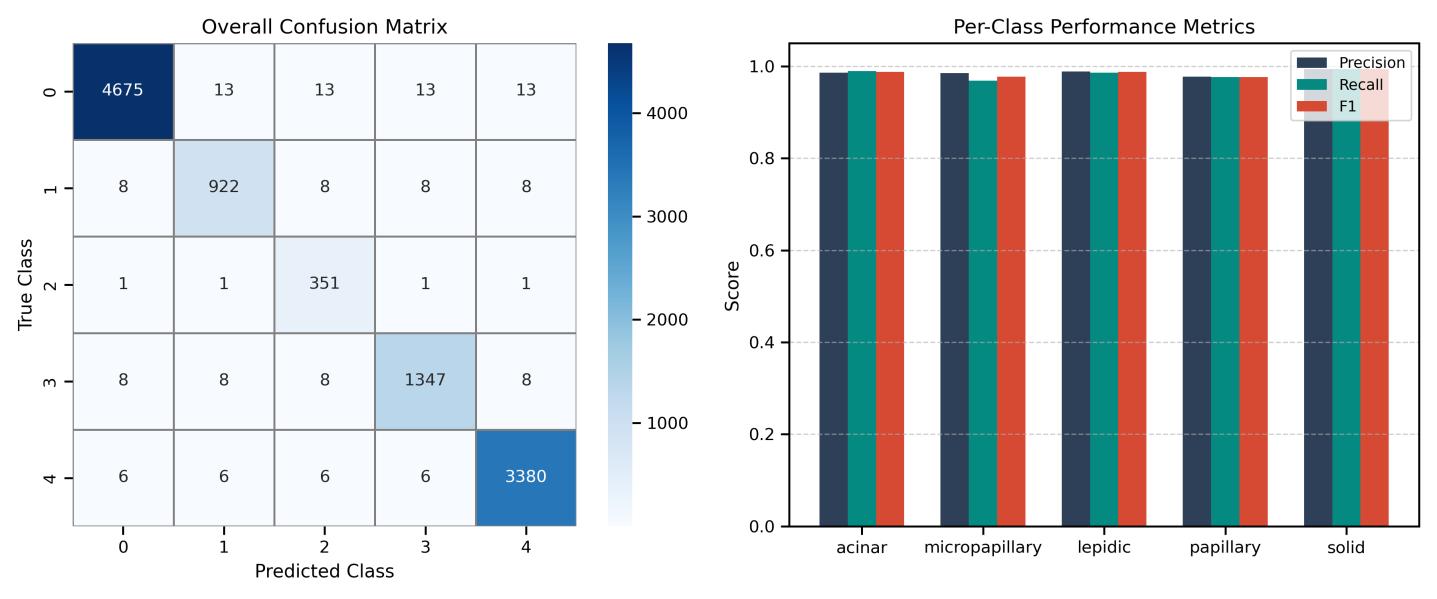
Fig-6 showstheSwinTransformer'smodelperformanceonthetestset
Theconfusionmatrixforeachofthefivesubtypesoflung adenocarcinomaisdisplayedintheleftpanelofthefigure 4, demonstrating excellent accuracy in each class. As depicted on the right panel, minimal misclassification is indicatedbytheconcentrationofcorrectpredictionsalong the diagonal. Per-class performance measures (Precision, Recall, and F1-score) for each subtype are shown in the rightpanel.Reliableclassificationperformanceisreflected in the model's consistently high results, with solid and acinarsubtypesattainingnearlyflawlessmetrics.
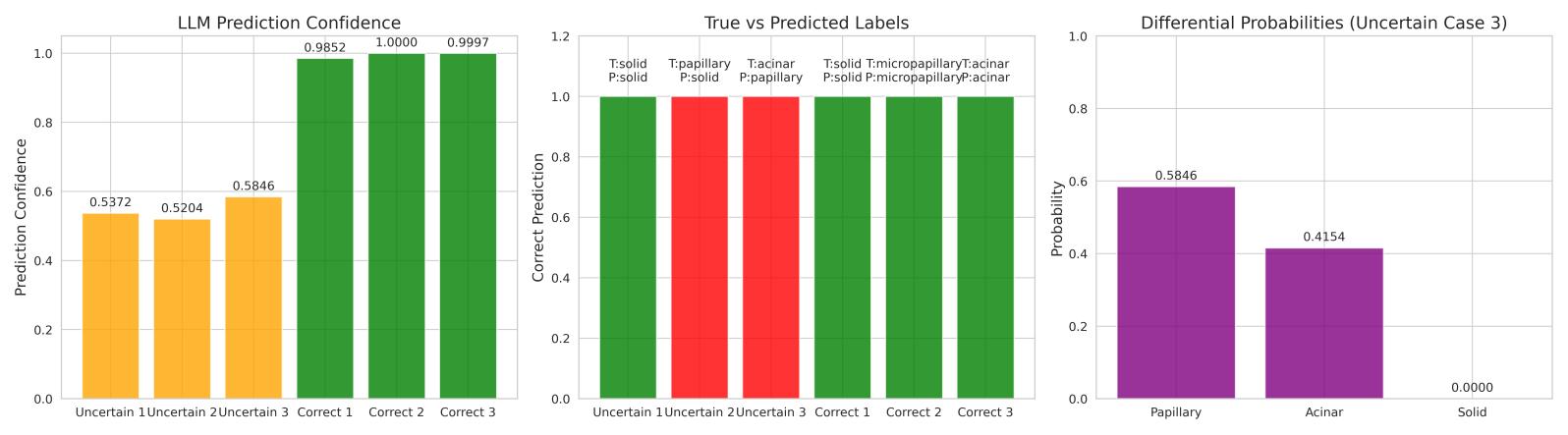
The LLM module contributes interpretability by linking confidencevaluestodiagnosticreliability.High-confidence predictions(>0.7)alignwithcorrectsubtypeassignments, while mid-range values (0.52–0.58) mark cases with overlapping histological patterns, such as subtle transitions between acinar and micropapillary growth. Thisbehaviordoesnotmaskambiguity;itexposeswhere
tissue morphology provides incomplete separation, makingtheuncertaintyitselfmeaningful.
The differential probability output reflects the degree of similarityacrosssubtypecandidates.InCase3,thevalues 0.5846 vs. 0.4154 correspond to real architectural proximity rather than model noise. The system therefore produces ranked diagnostic likelihoods rather than a forced categorical decision, allowing the interpretation to mirror the way pathologists reason when patterns blend orbordersareunclear.
Figure 7 illustrates these effects across six patient cases. The left panel shows confidence levels that distinguish straightforwardfromuncertainpresentations.Themiddle panel compares predicted and true subtypes, revealing that errors occur predominantly in borderline morphologies. The right panel visualizes probability distributions that demonstrate how the LLM expresses gradedreasoningratherthanasingle-pointclaim.
International Research Journal of Engineering and Technology (IRJET)
Volume: 12 Issue: 11 | Nov 2025 www.irjet.net
This structure supports practical clinical use: confident outputscanbeaccepteddirectly,whileuncertaincasesare flagged with explicit reasoning for pathologist review, preserving diagnostic responsibility while increasing efficiencyandtransparency.
We presented a framework for lung adenocarcinoma subtypingthatcombinesaSwinTransformerwithanLLM for enhanced interpretability. The framework achieved a high level of performance in lung adenocarcinoma subtyping, with overall accuracy of 98.69%, precision of 98.59%, recall of 98.26%, macro F1-score of 0.9842, and AUC of 0.9997. In addition, the proposed model also showed excellent class-wise performance despite class imbalance.ExternalvalidationontheLungHist700dataset confirmed that 20x magnification provides a computationally efficient option while maintaining diagnosticintegrity,withsubtypesshowingsuperioror equivalentperformance(MD:0.9608vs0.8983at40x;PD: 0.9533vs0.9395).Furthermore,theintegrationofanLLM provided a method for generating reports, and textual descriptions aligned with pathological concepts and differentialdiagnosestoaidpathologistdecision-making.
[1] R. Zhonget al., “Large Language Models in Lung Cancer: Systematic Review,”J. Med. Internet Res., vol. 27, p.e74177,2025,doi:10.2196/74177.
[2] Y. Luo, H.Hooshangnejad, W. Ngwa, and K. Ding, “Opportunities and challenges in lung cancer care in the era of large language models and vision language models,”Transl. Lung Cancer Res., vol. 14, no. 5, p. 1830, 2025.
[3] L. Wang, C. Zhang, Y. Zhang, and J. Li, “An Automated Diagnosis Method for Lung Cancer Target Detection and Subtype Classification-Based CT Scans,”Bioeng.-BASEL, vol. 11, no. 8, 2024,doi: 10.3390/bioengineering11080767.
[4] Y. Zhou, C. Zhang, and S. Gao, “Breast cancer classification from histopathological images using resolution adaptive network,”IEEE Access, vol. 10, pp. 35977–35991,2022.
[5] N. Ahmad, S. Asghar, and S. A. Gillani, “Transfer learning-assisted multi-resolution breast cancer histopathological images classification,”Vis.Comput., vol. 38,no.8,pp.2751–2770,2022.
[6] J. Li, W. Li, A. Sisk, H. Ye, W. D. Wallace, W. Speier, and C. W. Arnold,“A Multi-resolutionModelforHistopathology Image Classification and Localization with Multiple Instance Learning,” Computers in Biology and Medicine, vol. 131,p. 104253,2021.
[7] A. Pal, H. M. Rai, J. Yoo, S.-R. Lee, and Y. Park, “ViTDCNN: Vision Transformer with Deformable CNN Model
forLungandColonCancerDetection,”Cancers,vol.17,no. 18,p.3005,2025.
[8] L. F. Talib, J. Amin, M. Sharif, and M. Raza, “Transformer-based semantic segmentation and CNN network for detection of histopathological lung cancer,”Biomed. Signal Process. Control, vol. 94, p. 106106,2024,doi:10.1016/j.bspc.2024.106106.
[9]A.Srinivas,T.-Y.Lin,N.Parmar,J.Shlens,P.Abbeel,and A. Vaswani, “Bottleneck Transformers for Visual Recognition,”ArXivPrepr. ArXiv210111605, 2021, [Online].Available:https://arxiv.org/abs/2101.11605 [10]Z.Chen,“Visformer:Thevision-friendlytransformer,” inICCV,2021.
[11] L. Wang, C. Zhang, and J. Li, “A hybrid CNNTransformer Model for Predicting N staging and survival in Non-small Cell Lung Cancer patients based on CTScan,”Tomography,vol.10,no.10,pp.1676–1693,2024.
[12]S.M.ShafiandS.K.Chinnappan,“HybridtransformerCNN and LSTM model for lung disease segmentation and classification,”PeerJComput.Sci.,vol.10,p.e2444,2024.
[13] E. Xie, “SegFormer: Simple and efficient design for semantic segmentation with transformers,”NeurIPS, 2021.
[14] Z. Liu, “Swin transformer: Hierarchical vision transformerusingshiftedwindows,”inICCV,2021.
[15] C.-F. Chen, “CrossViT: Cross-attention multi-scale visiontransformerforimageclassification,”inICCV,2021.
[16] C. Liet al., “Efficient Self-Supervised Vision Transformers for Representation Learning,” inProceedings of the International Conference on Learning Representations (ICLR), 2022.[Online].Available: https://github.com/microsoft/esvit
[17] B. Wu, “Visual transformers: Token-based image representation and processing for computer vision,”ArXivPrepr.ArXiv200603677,2020.
[18]Z.Zhao,S.Guo,L.Han,G.Zhou,andJ.Jia,“PKMT-Net: A pathological knowledge-inspired multi-scale transformernetworkforsubtypepredictionoflungcancer using histopathological images,”Biomed. Signal Process. Control, vol. 96, p. 106245, 2024,doi: 10.1016/j.bspc.2024.106245.
[19] A. J.Yagappan, H. Karuppiah, M. Muthusamy, and S. K.Kannaiah, “Optimizing lung cancer classification using transformer and Gooseneck Barnacle Optimization,”Expert Syst. Appl., vol. 282, no. C, p. 127413,July2025,doi:10.1016/j.eswa.2025.127413.
[20] R. Durgam, B.Panduri, V. Balaji, A. O.Khadidos, A. O.Khadidos, and S.Selvarajan, “Enhancing lung cancer detection through integrated deep learning and transformer models,”Sci. Rep., vol. 15, no. 1, p. 1, 2025,doi:10.1038/s41598-025-00516-2.
[21] L. Wanget al., “Transformer-based deep learning model for the diagnosis of suspected lung cancer in primary care based on electronic health record data,”EBioMedicine,vol.110,2024.
International Research Journal of Engineering and Technology (IRJET) e-ISSN: 2395-0056
[22] M. Mahbubet al., “HEMERA: A Human-Explainable TransformerModelforEstimatingLungCancerRiskusing GWAS Data,”ArXivPrepr. ArXiv251007477, 2025, [Online].Available:https://arxiv.org/abs/2510.07477
Volume: 12 Issue: 11 | Nov 2025 www.irjet.net p-ISSN: 2395-0072 © 2025, IRJET | Impact Factor value: 8.315 | ISO 9001:2008 Certified