International Research Journal of Engineering and Technology (IRJET) e-ISSN: 2395-0056

Volume: 09 Issue: 09 | Sep 2022 www.irjet.net p-ISSN: 2395-0072

International Research Journal of Engineering and Technology (IRJET) e-ISSN: 2395-0056
Volume: 09 Issue: 09 | Sep 2022 www.irjet.net p-ISSN: 2395-0072
 Swetha Vura1,2
,
Yamuna Devi C.R31Assistant Professor, Dept. of ECE, School of Engineering and Technology, CMR University, Bengaluru, India 2Research Scholar, VTU, Belagavi, India 3Associate Professor & HOD, Dept. of ETE, Dr. Ambedkar Institute of Technology, Bengaluru, India ***
Abstract - Images are one of the most important visual representations used almost in every field. They require memory for their storage which necessitates a lot of space. Image compression plays a pivotal role in reducing the size of an image so that more images can be stored and thereby increasing the transmission speed. Many coding algorithms are written to compress images and reduce redundancy. This paper analyses and compares Huffman and Arithmeticcoding algorithms with reference to image compression.
Key Words: Image compression, Huffman coding, Arithmeticcoding,compressionratio,compressiontime
Imageisrepresentedasa 2Dmatrixintermsofrowsand columns.Theintersectionofaparticularrowandcolumnis called a pixel. To store these images, lot of memory and storage space is required. This gives rise to the need for image compression where the image size is reduced to accommodatemoreimages.Astheresourcesarefinite,the techniques used in image compression have to effectively employthestoragespaceandthebandwidth[1].Imagesfind theirapplicationinalmosteverypossiblefieldlikesatellites [2-5], medical [6,7], artificial intelligence (AI), machine learning,IOT,robotics,computervision,patternrecognition etc. The real challenge is to decrease the size without deteriorating the quality of the image. Joint Photographic Experts Group (JPEG) is a standard for compression [8] which comprises of steps including transformation, quantizationandcodingprocesses.Themajorclassification of image compression is lossy and lossless compression techniques[9].Inlossytechnique,wehavedatalossbutin lossless,thedecompressedandoriginalimageareidentical [10,11].Someofthelosslesscompressionmethods[12,13] are Shannon Fano Coding, Run-length Encoding, Huffman Coding, Arithmetic Coding, Lempel Ziv Coding etc. The codingalgorithmsareassessed[14]onvariousaspectslike compressionratio,compressiontime,Peaksignal-to-noise Ratio(PSNR)etc.
Huffman coding is a type of entropy encoding algorithm whichfindstheimprovedmethodofencodingstringsofdata
dependingontheirrespectivefrequency.Onthebasisofthe assigned frequency, the minutest variable length code is designated to each character based on its frequency of occurrenceinthedata.Thiscodingincorporatesadistinct method for selecting the representation for each symbol, which results in a prefix-free code [15] where the more recurrentlyusedcharactersareallottedsmallercodesand less recurrently used characters are allotted larger codes. Huffman algorithm builds an expanded binary tree of minimalweightedpathlengthfromaseriesofweights.This list consists of probabilities of symbol occurrences. This Huffman tree is used to define variable sized representations.
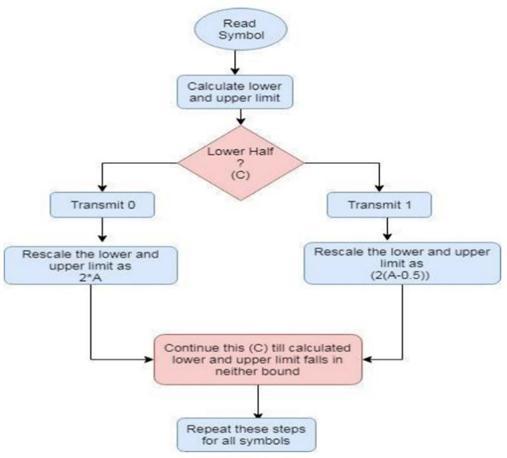
Arithmeticcodingcircumventsthethoughtofsubstitutingan inputsymbolwithadistinctcode.Thelessfrequentlyused symbolsarerepresentedwithmorebitsandmorefrequently used symbols are represented with less bits [16]. The channelofinputsymbolsissubstitutedwithasinglepoint floating number which lies between 0 and 1. This unique number can be decoded to construct the exact channel of symbolsthatwentintoitsdesign(Fig.1). Fig -1:BlockDiagramofArithmeticCodingAlgorithm
International Research Journal of Engineering and Technology (IRJET) e-ISSN: 2395-0056
TheefficiencyofAdaptiveHuffmanandArithmeticcodingis comparedfordifferentsetsofimagesin[17].Anapplication named CMedia Compressor is proposed where analysis is performedonaquantitativebasis.Thesampleimageswhich wereselectedfortheprocessofcompressionareofnature and architecture and taken from the public domain. The proposedapplicationprovidestheoptiontoselecteitherthe Adaptive Huffman Coding or Arithmetic Coding. The parameters calculated are compression time and spacesavingstodeterminetheefficiencyofthecodingalgorithms. ThesimulationresultsconcludethatArithmeticcodinghas less compression time for all the sample images and high space-savingsparameterformostofthecases.Fortextfiles, Adaptive Huffman coding performed better compared to Arithmeticcoding.
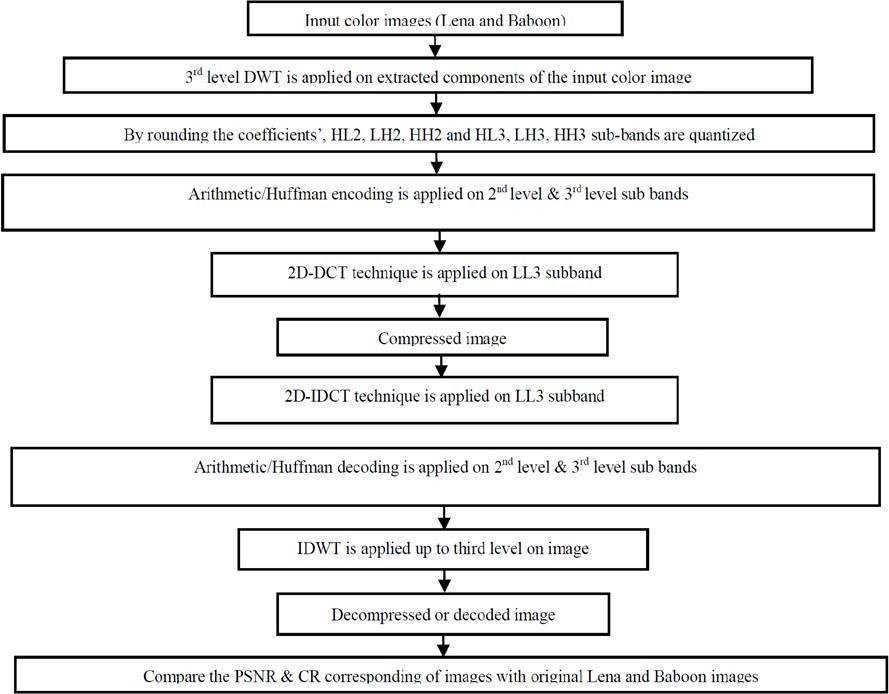
AhybridcombinationofDWTandDCTisusedtoanalysethe performanceofHuffmanandArithmeticCodingin[18].The colorimagesofLenaandBaboonareusedfortheprocessof compressionasdepictedinFig.2.TheoriginalimageisLevel 3 decomposed by Discrete Wavelet Transform and the quantized sub bands are encoded with Huffman and Arithmeticcodingtechniques.Thenthe2DDCTisappliedto get the compressed image. This compressed image has to undergo inverse transformation using IDCT and decoded alongwithinverseDWTtoobtainthedecompressedimage.
On calculating PSNR and Compression Ratio (CR), it is inferredthatHuffmancodinghashigherPSNRincomparison toArithmeticcodingbuthaslessCR.
andstereoscopiccompressionusingHuffmancoding(SCHC).
In the SCAC method, the left and right images are initially read to extract the RGB components. After quantization, Arithmeticcodingisappliedtoboththeimages.TheCR is first calculated. The PSNR value is obtained when the decoding and retrieving process is completed. The same procedureissimilarlycarriedoutforSCAC.Boththecoding approaches are analysed for lossy as well as lossless techniques.Thetime taken for executionof SCHCismuch morethanSCAC.ItcanalsobenoticedthatLossySCACgives moreCRandLosslessSCACproducesmorePSNR.
The images captured by the satellite in the raw format occupy enormous amount of memory and are complex in nature. The images used for remote sensing are generally multispectral images which are large in size and hence require a lot of space for storage. In [20], a hybrid methodology is proposed which consists of Lempel-ZivWelch (LZW) Coding and Arithmetic Coding to compress suchimages.Thesimulationresultsfortheproposedhybrid method are analysed in comparison with other lossless methodslikeRunLengthCoding,Huffmancodingetc.The multispectralimageisfirstappliedwithLZWencoding.On the resultant encoded image, Arithmetic encoding is employed.Oncethebitstreamiscompressed,itisdecoded with Arithmetic and LZW methods. The deconstructed images(Fig.3)areevaluatedwithparameterslikeCR,PSNR, BitsperPixel(BPP)andStructuralSimilarityIndex(SSIM). The results indicate that the adopted hybrid method performs better compared to traditional compression methods. Higher compression ratio and less BPP are achievedintheproposedhybridmethodology.
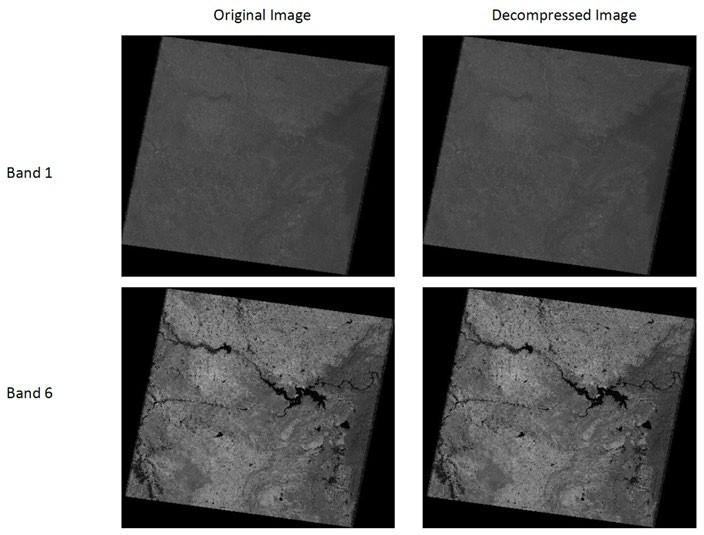
Fig -2:Flowchartoftheprocessofcompressionand decompression[18]
Stereoscopicimagestakenin3Dhavemoredepthandneed more storage space in contrast to normal images. Compressionofsuchimagesbecomesaherculeantask.The proposed method in [19] compares the results of stereoscopic compression using Arithmetic coding (SCAC)
Hospitals generate enormous data daily and therefore necessitatealotofstoragespace.Thesemedicalimageshave to be compressed so that more number of images can be stored. Lossless image compression algorithms like Runlength encoding, LZW, Shannon-Fano, Huffman and
Volume: 09 Issue: 09 | Sep 2022 www.irjet.net p-ISSN: 2395-0072 © 2022, IRJET | Impact Factor value: 7.529 | ISO 9001:2008 Certified Journal | Page17
Fig -3:Resultantmultispectralimagesofhybrid methodology[20]International Research Journal of Engineering and Technology (IRJET) e-ISSN: 2395-0056
Volume: 09 Issue: 09 | Sep 2022 www.irjet.net p-ISSN: 2395-0072
Arithmeticcodingareanalysedin[21].RLEperformswell only if the image has long runs of similar data. LZW is a lossless compression algorithm but is complex and consumes a lot of time. In Shannon-Fano coding, the generatedoutputcodemayvaryeachtime.Thereisahuge lossofdatawhichisnotacceptable.Huffmancodingadoptsa bottom-up approach where an optimal prefix-free code is generated (Fig. 4). The major disadvantage is that even if thereisasmallchangeinthecode,theentiremessageislost. AfixednumberofbitsareusedinArithmeticcodingwhich gives better compression ratio but increases the compression time. It is concluded that Huffman coding surpassesotheralgorithmsforrealtimeapplications.
eitherbetruncatedorwrittendirectly,avoidingrepetitionof data.Anincreasedcompressionratioof15.30%wasattained whencomparedtoHuffmancodingalgorithm.Thisproposed algorithm was less complex and produced greater compression ratios than Huffman coding with the same compressiontime.
Fig -4:EncodingofHuffmantree[21]

Digital Image Processing has a plethora of applications which include remote sensing, medical, robotics, machine learning,artificialintelligence,patternrecognitionetc.The algorithmsandtechniquesrequiredforimagecompression areanalysedin[22].JPEGcompressioninputsanimageto subdivide it as n x n images. These sub-images are transformedusingalgorithmslikeDCT,DWTetc.Theyare thenquantizedwherethereisaparticularlossofdata.The quantized output is encoded using techniques like Runlength,Huffman,Arithmeticcoding etc.Itisobservedthat Huffman coding [23] has a faster compression rate while Arithmeticcodinggiveshighercompressionratio[24,25]. HuffmancodingandArithmeticcodingareextensivelyused in the field of image compression. As both the coding techniques have their own limitations, an effective and alternate algorithm is proposed in [26] which is based on Huffman coding. Initially Huffman coding algorithm is employedtothedata(Fig.5)andthentheresultantdatais readwhetheritislongorshort.Theshortbitsareignored andifthedatahasmorenumberofbits,furthercompression takesplace.Dependingonwhetherthecurrentandthenext characterareinthesameleaf,theflagbits“1”and“0”are added.Theadditionoftheflagbitsensurethatthebitscan
Fig -5:Flowdiagramofproposedalgorithm[26]
Withthegrowingdataandinformationinimagesinevery field,imagecompressionisinevitable.Huffmancodingand Arithmeticcodinghavebeenappliedandtestedonadiverse set of images from satellite, multispectral, medical, architectural, stereoscopy etc. It has been observed that Arithmetic coding has higher compression ratio but increased compression time in comparison to Huffman coding.Intermsofperformance,Huffmancodingsurpasses Arithmetic coding with higher PSNR. Some of the hybrid methodologieshavealsobeendiscussedinthispaperwhich showbetterperformancethantraditionalmethods.
[1] Uthayakumar, J., T. Vengattaraman, and P. Dhavachelvan. "A survey on data compression techniques:Fromtheperspectiveofdataquality,coding schemes, data type and applications." Journal of King Saud University-Computer and Information Sciences (2018).

[2] GunasheelaK.S.,PrasanthaH.S.(2018)SatelliteImage Compression-Detailed Survey of the Algorithms. In: Guru D., Vasudev T., Chethan H., Kumar Y. (eds) Proceedings of International Conference on Cognition and Recognition. Lecture Notes in Networks and Systems, vol 14. Springer, Singapore. https://doi.org/10.1007/978-981-10-5146-3_18.
[3] Shihab,H.S.,Shafie,S.,Ramli,A.R.etal.Enhancementof SatelliteImageCompressionUsingaHybrid(DWT–DCT)
2022, IRJET | Impact Factor value: 7.529 | ISO 9001:2008 Certified Journal
International Research Journal of Engineering and Technology (IRJET) e-ISSN: 2395-0056
Volume: 09 Issue: 09 | Sep 2022 www.irjet.net p-ISSN: 2395-0072
Algorithm. Sens Imaging 18, 30 (2017). https://doi.org/10.1007/s11220-017-0183-6.
[4] Telles J., Kemper G. (2021) A Multispectral Image Compression Algorithm for Small Satellites Based on WaveletSubbandCoding.In:IanoY.,ArthurR.,Saotome O.,KemperG.,PadilhaFrançaR.(eds)Proceedingsofthe 5th Brazilian Technology Symposium. BTSym 2019. SmartInnovation,SystemsandTechnologies,vol 201. Springer, Cham. https://doi.org/10.1007/978-3-03057548-9_17.
[5] M. Olaru and M. Craus, "Lossless multispectral and hyperspectral image compression on multicore systems,"201721stInternationalConferenceonSystem Theory,ControlandComputing(ICSTCC),2017,pp.175179,doi:10.1109/ICSTCC.2017.8107030.
[6] Liu,F.;Hernandez-Cabronero,M.;Sanchez,V.;Marcellin, M.W.;Bilgin,A.TheCurrentRoleofImageCompression StandardsinMedicalImaging.Information2017,8,131. https://doi.org/10.3390/info8040131.
[7] Pardeep Kumar,AshishParmar,Versatile Approaches for Medical Image Compression: A Review, Procedia ComputerScience,Volume167,2020,Pages1380-1389, ISSN 1877-0509, https://doi.org/10.1016/j.procs.2020.03.349.
[8] Shuyun Yuan, Jianbo Hu, Research on image compression technology based on Huffman coding, Journal of Visual Communication and Image Representation, Volume 59, 2019, Pages 33-38, ISSN 1047-3203, https://doi.org/10.1016/j.jvcir.2018.12.043.
[9] Khandwani, Fouzia I., and P. E. Ajmire. "A survey of losslessimagecompressiontechniques."International Journal of Electrical Electronics & Computer Science Engineering5.1(2018):39-42.
[10] A.J. Hussain, Ali Al-Fayadh, Naeem Radi , Image Compression Techniques: A Survey in Lossless and Lossy algorithms., Neurocomputing (2018), doi: 10.1016/j.neucom.2018.02.094.
[11] Arora, Sunny, and Gaurav Kumar. "Review of Image Compression Techniques." International Journal of RecentResearchAspects5(2018):185-188.
[12] Mander,Kuldeep,andHimanshuJindal."Animproved image compression-decompression technique using blocktruncationandwavelets."Internationaljournalof image,graphicsandsignalprocessing9.8(2017):17.
[13] Raghavendra,C.,Sivasubramanian, S. & Kumaravel,A. Improved image compression using effective lossless compressiontechnique.ClusterComput22,3911–3916 (2019).https://doi.org/10.1007/s10586-018-2508-1.
[14] Wahba, Walaa Z., and Ashraf YA Maghari. "Lossless image compression techniques comparative study." International Research Journal of Engineering and Technology(IRJET),e-ISSN2395-00563.2(2016).
[15] Alistair Moffat. 2019. Huffman Coding. ACM Comput. Surv. 52, 4, Article 85 (July 2020), 35 pages. DOI:https://doi.org/10.1145/3342555.
[16] Harika Devi Kotha et al 2019 J. Phys.: Conf. Ser. 1228 012007
[17] P.MbeweandS.D.Asare,"Analysisandcomparisonof adaptive huffman coding and arithmetic coding algorithms," 2017 13th International Conference on Natural Computation, Fuzzy Systems and Knowledge Discovery (ICNC-FSKD), 2017, pp. 178-185, doi: 10.1109/FSKD.2017.8393036.
[18] Kumar, Gaurav & Kumar, Rajeev. (2021). Analysis of Arithmetic and Huffman Compression Techniques by Using DWT-DCT. International Journal of Image, Graphics and Signal Processing. 13. 63-70. 10.5815/ijigsp.2021.04.05.
[19] T. K. Poolakkachalil and S. Chandran, "Analysis of Stereoscopic Image Compression Using Arithmetic Coding and Huffman Coding," 2018 International Conference on Inventive Research in Computing Applications (ICIRCA), 2018, pp. 214-220, doi: 10.1109/ICIRCA.2018.8597216.
[20] S. Boopathiraja & Palanisamy, Kalavathi & Chokkalingam, S. (2018). A Hybrid Lossless Encoding Method for Compressing Multispectral Images using LZWandArithmeticCoding.INTERNATIONALJOURNAL OFCOMPUTERSCIENCESANDENGINEERING.06.
[21] Rahman,M.A.;Hamada,M.LosslessImageCompression Techniques:AState-of-the-ArtSurvey.Symmetry2019, 11,1274.https://doi.org/10.3390/sym11101274
[22] P. T. Chiou, Y. Sun and G. S. Young, "A complexity analysis of the JPEG image compression algorithm," 20179thComputerScienceandElectronicEngineering (CEEC), 2017, pp. 65-70, doi: 10.1109/CEEC.2017.8101601.
[23] Liu,X.,An,P.,Chen,Y.etal.Animprovedlosslessimage compression algorithm based on Huffman coding. Multimed Tools Appl (2021). https://doi.org/10.1007/s11042-021-11017-5.
[24] Salman,NassirH."Compare ArithmeticCodingto The Wavelet Approaches for Medical Image Compression" Journal of Engineering Science and Technology 16.1 (2021):737-749.
© 2022, IRJET | Impact Factor value: 7.529 | ISO 9001:2008 Certified Journal | Page19
International Research Journal of Engineering and Technology (IRJET) e-ISSN: 2395-0056
Volume: 09 Issue: 09 | Sep 2022 www.irjet.net p-ISSN: 2395-0072
[25] T.Koya,S.ChandranandK.Vijayalakshmi,"Analysisof application of arithmetic coding on dct and dct-dwt hybrid transforms of images for compression," 2017 International Conference on Networks & Advances in ComputationalTechnologies(NetACT),2017,pp.288293,doi:10.1109/NETACT.2017.8076782.
[26] Erdal, E.; Ergüzen, A. An Efficient Encoding Algorithm Using Local Path on Huffman Encoding Algorithm for Compression. Appl. Sci. 2019, 9, 782. https://doi.org/10.3390/app9040782
2022, IRJET | Impact Factor value: 7.529 | ISO 9001:2008 Certified Journal |