International Research Journal of Engineering and Technology (IRJET) e-ISSN:2395-0056

International Research Journal of Engineering and Technology (IRJET) e-ISSN:2395-0056
1Department of Civil Engineering, Anna University Regional Campus, Madurai, Tamil Nadu, India.
2Department of Civil Engineering, University College of Engineering, Dindigul, Tamil Nadu, India. ***
Abstract - Concrete is an extensively utilised construction material in many parts of the world, and its qualities are changing as technology advances. High performance concrete is a recent advancement in concrete technology that is meant to allow for the use of materials, exposure circumstances, and cost requirements while also providing higher service life and durability. The addition of mineral admixture and chemical admixture to concrete in place of cement improves its strength and durability. Fibers are mixed into high-performance concrete to improve its strength and ductility. Polyolefin fibres are man-made synthetic fibres. Polypropylene and polyethylene fibres are the most common polyolefin fibres. Polyolefin fibres can be employed both structurally and non-structurally. A polyolefin fibre is resistant to corrosion and abrasion. M50 grade concrete will be used for testing. Fiber reinforced concrete is completed with a water cement proportion of 0.34 for different levels of polyolefin fiber addition of 0.1%, 0.3%, 0.5% of materials were blended using M50 grade of concrete. Silica fume and metakaolin are used as mineral admixture and super plasticizer are used as chemical admixture.
Key Words: Polypropylenefibre,cement,M-sand,Coarse aggregate,Admixture,Silicafume,metakaolin.
Concrete is used extensively in the construction of numerousconstructions.Concrete,afterwater,isthemost widelyutilisedsubstanceontheplanet.Concreteisbrittle, and its tensile strength is very low. It is, however, a delicate material that breaks quickly due to a variety of factors including autogenously shrinkage, freeze-thaw reactions, and mechanical compressive and tensile stresses. Micro cracks do not influence the strength of concrete,buttheydoallowmorefluidpenetration,suchas water and other chemical solutions (chlorides, sulphates, and acids), causing cement matrix deterioration and, as a result, corrosion of embedded steel reinforcing bars. The presence of cracks not only reduces the material's mechanical strength and durability, but it also compromises the structure's safety. To reduce shrinkage cracks and improve strength, fracture toughness, and ductility, it is becoming increasingly common to reinforce concrete with small and randomly distributed artificial or
natural fibres in more extensive applications. To improve the performance of concrete, mineral and chemical admixtures have been used to partially replace cement in recent years. Mineral admixtures such as fly ash, GGBS, metakaolin,andsilicafumedensitytheconcrete,makingit stronger, safer, and more lasting. Because of the limited permeability,waterandotheracidswillnotpenetratethe structure,increasingitsstrengthandserviceability.
Volume: 09 Issue: 08 | Aug 2022 www.irjet.net p-ISSN:2395-0072 © 2022, IRJET | Impact Factor value: 7.529 | ISO 9001:2008 Certified Journal | Page 114
According to the American Concrete Institute, high performance concrete is defined as having excellent durability, strength, and workability. Concrete with specified properties generated for a specific use and environment exposure is referred to as high performance concrete. The type of cement, partial replacement of cement with mineral admixtures (fly ash, GGBS, silica fume, metakaolin, and other industrial wastes, for example), type of super plasticizer, and mine omposition of fine and coarse aggregate have all contributed to the development of high performance concrete. Highperformance concrete is stronger and easier to maintain thanregularconcrete.Theadditionofpozzolansandalow water content results in a thick microstructure with high strength and low permeability in high-performance concrete. The use of high-strength, low-water-cementratio concrete has resulted in improved durability. There are two methods for preventing the transit of hostile ions like chlorides: decreasing the capillary pore system and generating chemically active binding materials. When compared to regular strength concrete, HPC is typically more brittle. Applying a confining pressure to highperformanceconcretecanimproveductility.Itcanalsobe improvedbyaddingfibrestothedesignmixtochangethe composition. Fibers are made from a variety of materials, including steel, glass, polyester, aramid, polyolefin, and natural fibres, and come in a variety of sizes and shapes. Themajorityoffibresareemployedinbothstructuraland non-structural applications. Fibers have the advantage of reducing shrinkage cracks, saving cement, and increasing concrete'stensileandcompressivestrength.Theoptimum flexural strength and toughness performance is achieved by combining high ductility with high strength fibre reinforcement. Fiber reinforced concrete is gaining popularityasahigh-potentialmodernstructuralmaterial.
International Research Journal of Engineering and Technology (IRJET) e-ISSN:2395-0056
Volume: 09 Issue: 08 | Aug 2022 www.irjet.net p-ISSN:2395-0072
Polyolefin fibres are man-made synthetic fibres manufactured by polymerizing unsaturated hydrocarbons intolinearsaturatedhydrocarbonsusingasyntheticlinear polymer. Polypropylene (CH2 = CH – CH3) and polyethylene (CH2-CH2) are two forms of polyolefin polymersusedtocreatesyntheticfibres.Polypropyleneor polyethylene is the most common polyolefin fibres. Then there are the polyolefin’s that are most widely used. Melting and spinning are used to create polyolefin fibres. The granules of polymer are fed into the extruder, which melts the material. After that, the filaments are cooled in anairstreambeforebeingcollectedincans.
Polyolefin fibres are made from olefin polymers that comprise 85 percent ethylene, propylene, or other olefins and are generated via chain polymerization. At normal temperature, polyolefin fibres have a specific gravity of less than one, are unaffected by solvents, and are only swelled by aromatic and chlorinated at elevated temperatures. Abrasion resistance is high in a fibre. Polyolefin fibres have a number of advantages, including corrosionresistanceandhighstraincapacity.Itissuitable for use in a harsh environment to protect structures against corrosion due to its corrosion resistance. Polyolefin fibres enable long-term fracture control and goodbondinginthecementmatrix. Polymerresearchand engineering advancements have enhanced the use of polyolefin in everyday applications. Polypropylene and polyethylene are the fastest-growing polymeric families duetotheirlowproductioncostswhencomparedtoother fibres and materials. They encouraged use because of the inexpensive cost, superior chemical resistance, high strength, and toughness. Polyolefin fibres have good tensile strength, abrasion resistance, and chemical resistance in general. Polyolefin fibres are gaining popularity as a replacement for corrosive steel solutions. Micro and macro polyolefin fibres are two varieties of polyolefin fibres available on the market, each serving a particular purpose. Polypropylene, one of the polyolefin fibres, is used in cementitious composites to improve the structure's strength, durability, and crack resistance. The addition of fibre to concrete, as well as the creation of polyolefin-based synthetic macro fibres, increased mechanical qualities and reduced shrinkage cracking. The use of macro synthetic fibres as an alternative to steel fibre in fibre reinforced concrete has grown popular. Polypropylene is reported to have a crystalline that is halfway between low density polyethylene (LDPE) and high density polyethylene (HDPE). Polypropylene, on the other hand, has a higher operating temperature and tensilestrengththanpolyethylene.
The first stereo regular polymer to attain industrial significance was polypropylene. Polypropylene fibres were first introduced to the textile industry in the 1970s, and they quickly established themselves as an importantcomponentofthefastexpandingsyntheticfibre family. Polypropylene is currently ranked fourth among the "big three" fibre classifications, which include polyester, nylon, and acrylic. However, in comparison to other commodity fibres, its use in garments and domestic textiles has been restricted, with the majority of the fibre produced going to industrial uses. It's a linear structure that'sheldtogetherbythemonomerCnH2n.Itisproduced using propylene gas and a catalyst such as titanium chloride. Aside from that, polypropylene could be a by product of oil refinery. In contrast to amorphous thermoplastics such as polystyrene, PVC, polyamide, and others, which have random placement of radicals, most polypropyleneiscrystallineandgeometricallyregular.
A Binder or substance that hardens and sets and may bind other materials together in construction is cement.thefundamentaljustificationforselectingOPC53 grade is that it has the right strength, surface area and finenessforthehydrationprocess.Cementhaspassedthe primarymaterialtesting.
Table-1: PropertiesofCement
Fine aggregate is that material that passes through a 4.75mm screen and is inert to chemically inactive. By bridging the gaps between the coarse particles, the fine aggregate in concrete strengthens the concrete paste and decreases its porosity. For both fine andcoarseaggregatethebasicmaterialstestinghavebeen finished.
International Research Journal of Engineering and Technology (IRJET) e-ISSN:2395-0056
Volume: 09 Issue: 08 | Aug 2022 www.irjet.net p-ISSN:2395-0072
Table-2: Propertiesoffineaggregate
Properties Results
Gradingofsand ZoneII
Specificgravity 2.63 Finenessmodulus 2.47 Waterabsorption 1.5%
Construction aggregate, a broad category of coarse particle materials used in construction, comprised sand,gravelcrushedstone,slag,andrecycledconcrete.We utilised coarse gravel that was maintained in a 12.5mm filter after passing through a 20mm sieve. Concrete with high performance has to be strong. If coarse aggregates are utilised, shrinkage will be decreased. For fine and coarse aggregate, the basic material testing has been finished.
Table-3: Propertiesofcoarseaggregate
Properties Results
Specificgravity 2.70 Waterabsorption 2%
Finenessmodulus 6.2
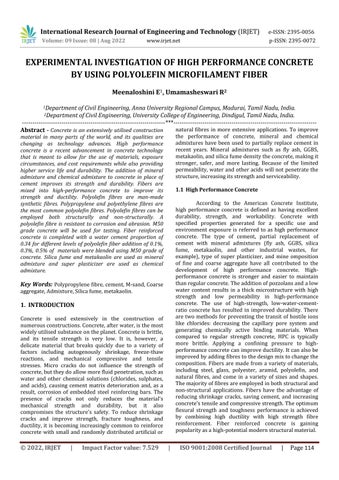
In order to create polyolefin fibers, synthetic linear polymers are used to polymerize unsaturated hydrocarbons into saturated linear hydrocarbons. Whirling and melting used make the fibres of polyolefin fibers, which are manufactured from olefin polymers that include 85% ethylene, propylene, or other olefins. There aretwodifferenttypesofpolyolefinonthemarket:macro and micro. Each has a specific use. The ultimate load is increased by a polyolefin microfilament fiber, which also hashightensilestrength,abrasionresistanceandchemical resistance.
Length (mm) 12
Appearance White
Specific gravity 0.91
Melting Point (oc) 160
Acid and alkali proof High
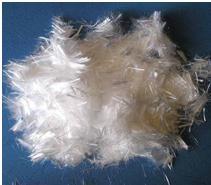
By definition, silica fume is very fine noncrystalling silica generated in electric arc furnace as a by product of the manufacture of elemental silicon or silicon alloys,accordingtotheAmericanConcreteInstitute(ACI). Silica fume is also known is micro silica, condensed silica fume, volatized silica,andsilica dust.Typicallyitisa grey powder that resembles fly ashes or Portland cement. It possesses pozzolanic and cementitious properties. Concretes durability is increased by adding silica fume, whichalsoshieldstheembeddedsteelformcorrosion.The pastes finely dispersed pozzolana particles produce a lot of nucleation sites where the hydration products can precipitate. This process causes the paste to thicken and become more homogeneous in terms of fine pore distribution.Thisisbroughtonbyaninteractionbetween the amorphous silica found in pozzolanic materials and the calcium hydroxide created during cement hydration processes. Several by products of silica fume include concrete uses due of its chemical and physical characteristics;itisapozzalanathatisextremelyreactive. Silica fume may make concrete incredibly durable androbust.
Properties
Results
Physicalform Powder
Color White
Specificgravity 2.20 Sizeofparticles 0.1
ChlorideContent Nill
Fig-2: SilicaFume
International Research Journal of Engineering and Technology (IRJET) e-ISSN:2395-0056
Volume: 09 Issue: 08 | Aug 2022 www.irjet.net p-ISSN:2395-0072
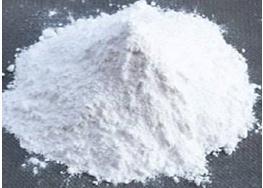
Numerous studies have been conducted on natural pozzolans, particularly kaolintic clay and thermally activated common caly. These impure substances are reffered to as metakolin. Despite having some pozzolanic characteristics, they are not extremely reactive.Purelyreactivepozzolanisproducedwhenwater processing eliminates non-reactive. Purely reactive pozzolan is produced when water processing eliminating nan-reactivecontaminantsformhighlyreactivemetakolin. High reactivated metakolin that is white or cream in colour(HRM).Highreactivemetakolindisplayssignificant pozzolanicreactivityandadecreaseinCa(OH)2 asearlyas one day. Silica fume can be competed with by the highly reactive metakolin. Instead than being a by product like otherpozzolaniccompounds,metakolinisanintentionally createdsubstancewithspecifiedproperties.
Table-6: PropertiesofMetakolin
Properties Results
Physicalform Powder Color White Specificgravity 2.50 Finenessmodulus 800m2/kg Specificsurface 11m2/g
Fig-3: Metakolin
Waterproofing compound for concrete, mortar, andplasterinliquidform.Foruseinconcrete,mortarand plaster,aspecificallyformulatedunique,pinkcolourliquid integrated water proofing compound has been created using Sika’s technology of particular selective polymers, surfaceactiveagentsandadditives.
Table-7: Propertiesofsikacimpink
Appearance Pinkcolourhazyliquid Density 1.21at25oC pH value >6
Themeasuringofspecimens0.3minheight,0.2m in base diameter and 0.1m in top diameter. The damping rodhasa0.0016mdiameterand0.6mlength.
Table-8: SlumpConeTestResult
Replacement of polyolefin fiber(%)
Trial No Slump Value (mm)
Average Slump value(mm)
Type of slump 0 1 105 100 True or High Slump
2 95 0.1 1 110 108 2 105 0.3 1 105 110 2 115 0.5 1 110 115 2 120
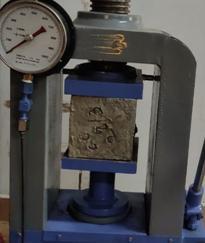
Onacompressivetestingmachinewithacapacity of 2000kN, a cube with standard dimensions of 0.15m X 0.15m X 0.15m is subjected to compressive strength test whilebeingloadedatarateof4kN/s.Attheageof7and 28 days, the test was conducted. Concretes compressive strength with and without fibers, with and without substitutesformetakaolin(10%)andflyash(15%).Below table is displays the concretes compressive strength values.
Table-9: CompressiveStrengthTestResult
Replacement of polyolefin fiber (%)
Average Compressive Strength of concrete at 7 Days(N/mm2)
Average Compressive Strength of concrete at 28 Days(N/mm2)
0 34.44 51.33 0.1 34.75 53.51 0.3 36.43 56.21 0.5 35.69 55.67
International Research Journal of Engineering and Technology (IRJET) e-ISSN:2395-0056
Volume: 09 Issue: 08 | Aug 2022 www.irjet.net p-ISSN:2395-0072
Table-10: SplitTensileStrengthTestResult
Average Compressive Strength of concrete at 7 Days (N/mm2)
Replacement of polyolefin fiber(%)
Average Split Tensile Strength of concrete at 7 Days(N/mm2)
Average Split Tensile Strength of concrete at 28 Days(N/mm2)
Chart-1: CompressiveStrengthTestResult
Compressive strength at 28 days in HPC (56.21 N/mm2)at 0.3% ofpolyolefinfibersismorethan thatofordinaryconcrete.
Average Compressive Strength of concrete at 28 Days (N/mm2) 0 1 2 3 4 5 6 7 0 0.1 0.3 0.5
0 3.28 5.50 0.1 3.32 5.28 0.3 3.74 5.90 0.5 3.43 5.47
Average Split Tensile Strength of concrete at 7 Days (N/mm2)
Average Split Tensile Strength of concrete at 28 Days (N/mm2)
Chart-2: SplitTensileStrengthTestResult
The Split tensile strength at 28 days in HPC (5.90 N/mm2)at 0.3% ofpolyolefinfibersismorethan thatofordinaryconcrete.
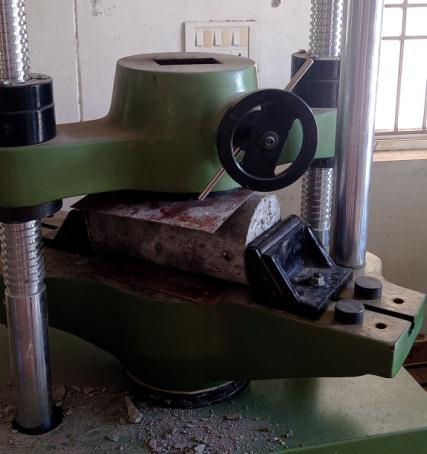
A cylindrical structure with standard diameter of 0.15m and a height of 0.3m was used for the split tensile strength test. In line with IS 5816:1998, the load was gradually raised to produce split tensile stress. Test specimensweregatheredwhentheanimalswere28and7 days old. The spilt tensile strength of concrete with and withoutfibers,withareplacementof10%metakaolinand 15% fly ash the concretes split tensile strength findings aredisplayedinthetable.
Fig-5: SplitTensileStrengthTest
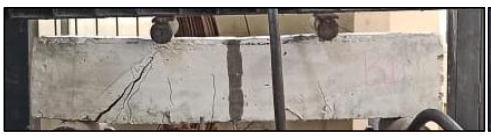
Thespecimensbeamlengthis0.75m.Eitherthree point load test may be used to guide the flexural test on concrete. the concretes flexural strength data are displayedinatable,
International Research Journal of Engineering and Technology (IRJET) e-ISSN:2395-0056
Volume: 09 Issue: 08 | Aug 2022 www.irjet.net p-ISSN:2395-0072
Table-11: FlexuralStrengthTestResult
Replacement of polyolefin fiber (%)
Flexural Strength of concrete at 7 Days (N/mm2)
Flexural Strength of concrete at 28 Days(N/mm2) 0 4.40 6.23 0.3 4.98 7.35
Flexural Strength of concrete at 7 Days (N/mm2)
Flexural Strength of concrete at 28 Days (N/mm2)
Chart-3:FlexuralStrengthTestResult
The highest split tensile strength measured in HPC at 28 days (5.90 N/mm2) at 0.3% polyolefin fibers is higherthanthatofregularconcrete.
The highest flexural strength measured in HPC at 28 days (7.35 N/mm2) at 0.3% polyolefin fibers is higher thanthatofregularconcrete.
When fiber content is added to traditional concrete, the compressive strength, split tensile strength, andflexuralstrengthallraise.
The addition of polyolefin fibers to concrete can solvetheissueofthelowtensilestrengthofconcrete.
Their research makes it clear that reinforced concrete beams builtusing silica fumeand metakolinasa cementsubstitutematerialmayperformmorestructurally well.
Beamshaveshownanincreaseindeflectionvalue asaresultoftheadmixturesductilebehaviour.
Duetotheircapacitytostopmacrofracturesform growing out of micro fissures, fibers can aid to decrease waterpermeability.
The flexural strength at 28 days in HPC (7.35 N/mm2)at 0.3% ofpolyolefinfibersismorethan thatofordinaryconcrete
Fig-6: FlexuralStrengthTest
The best results were achieved in high performance concrete at 0.3% polyolefin fiber with 10% silicafumeand10%metakaolinasfractionaltrade forthe fineaggregate.
When compared to ordinary concrete, HPCs strengthisrelativelyhighreplacementforsilica fumeand metakaolinasfineaggregate.
The highest compressive strength measured in HPCat28days(56.21N/mm2)at0.3%polyolefinfibersis higherthanthatofregularconcrete.
[1]. Alberti.M.G, Enfedaque. A, Galvez.J.C (2017), “Fiber reinforced concrete with a combination of polyolefin and steel hooked fibers”, Elsevier, CompositeStructures,Vol171,Pp:317–325.
[2]. Alberti.M.G, Enfedaque. A, Galvez.J.C (2014), “Study on the mechanical properties and fracture behaviour of polyolefin fiber reinforced self compacting concrete”, Elsevier, Construction and BuildingMaterials,Vol55,Pp:274–288.
[3]. Amin Noushini, Max Hastings, Arnaud Castel, Farhad Aslani (2018), “Mechanical and flexural performance of synthetic fiber reinforced geopolymer concrete”, Elsevier, Construction and buildingMateirals,Vol186,Pp:454–475.
[4]. Anas Alkhatib, Mohammed Maslehuddin, Salah Uthman Al-Dulaijan (2020), “Development of high performance concrete using industrial waste materials and nano-silica”, Elsevier, Journal of Materials Research and Technology, Vol 9, Part 3, Pp:6636–6711.
[5]. Deng, Zongcai Shi, Feng, Yin Shi, Tuladhar and Rabin (2016), “characterisation of macro polylefin fiber reinforcement in concrete through round determinatepaneltest”,NaturalSciencefoundation
International Research Journal of Engineering and Technology (IRJET) e-ISSN:2395-0056
Volume: 09 Issue: 08 | Aug 2022 www.irjet.net p-ISSN:2395-0072
ofchina(NSFC),ISSN:0950-0618,Vol121,Pp229335.
[6]. Filipe R.G., De Sa Flavio De A. Silva, Deniel C.T. Cardoso (2020), “Tensile and flexural performance of concrete members reinforced with polypropylene fibers and GFRP bars”, Elsevier, CompositeStructuresVol253,Pp112–784.
[7]. Hong samkim, Sang Ho lee, Han – Young Moon (2007), “Strength Properties and durability aspects ofhighstrengthconcreteusingKoreanMetakaolin”, Elsevier, Construction and Building Materials, Vol 21,Pp:1129–1237.
[8]. Jianzhuang Xiaoa andH.Falknerb (2006),“Study on residual strength of high performance concrete with and without polypropylene fibers at elevated temperature”,Elsevier,FireSafeJournal,Vol41,Pp: 115–121.
[9]. Jun – Mo Yang, Kung – Hwan Min, Hyun – oh shin, Young – Soo Yoon (2012), “Effect of steel and synthetic fibers on flexural behaviour of high strengthconcretebeamsreinforcedwithFRPbars”, Elsevier,Composites,Vol43,PartB,Pp:1077-1086.
[10]. Krzyszt of Ostrowskia, Mateusz Dudekb, Lukasz Sadowski (2019), “Compressive behaviour of concrete filled carbon fiber – reinforced polymer steel composite tube columns made of high performance concrete”, Elsevier, composites structures,Vol234,Pp:111–668.
[11]. Maruthachalam, I. Padmanaban, and B.G. Vishnuram (2013), “Influence of polyolefin macromonofilament fiber on mechanical properties of high performance concrete”, KSCE Journal of Civil Engineering,Vol17,Part7,Pp:1682–1689.
[12]. P. Magudeswaran, R.Sasipriya, E. Ezhilarasai, A. Thangadurai (2017), “An Experimental study on flexural behaviour of damaged reinforced HPC Beams strengthened with CFRP wrapping”, International Journal of Civil Engineering and technology(IJCIET),Vol8,Issue3.
[13]. Magdalena Rucka, Erwin Wojtczak, Magdalena Knak,MarzenaKurpinska(2021),“Characterization of fracture process in polyolefin fibre reinforced concrete using ultrasonic waves and digital image correlation”, Elsevier, Construction and Building MaterialsVol280,Pp:122–522.
[14]. M.Z. Mehdi Dehestani, Amirali Badiee Bahnamiri (2019), “Effect of polypropylene fibers on bond performance of reinforcing bars in high strength
concrete”, Elsevier, Construction and Building Materials,Vol215,Part1,Pp:401–409.
[15]. Mohamed Said, T.S. Mustafa Ali S. Shanour, and Mostafa M. Khalil (2020), “Experimental and analytical investigation of high performance concrete beams reinforced with hybrid bars and polyvinylalcoholfibers”,Elsevier,Constructionand buildingMaterials,Vol259(2020)120395.
[16]. Moradi .M.J, Khaleghi.M, Salimi.J, Farhangi.V, Ramezanianpour.A.M (2021), “Predicting the compressive strength of concrete containing metakaolin with different properties using ANN”, Elsevier,Measurement,Vol183,Pp:109790.
[17]. Ortiz Navas.F, Juan Navarro Gregori, Leiva Herdocia.G, Serna.P, Cuenca.E (2018), “An Experimental study on the shear behavior of reinforced concrete beams with macro-synthetic fibers”, Elsevier, Construction and Building Materials,Vol169,Pp:888–899.
[18]. Sattainathan Sharma.A(2019),“Ductility behaviour of steel fibers reinforced concrete beam strengthened with GFRP laminates”, Elsevier, Construction and Building Materials, Vol 06, No 03, Pp:6530–6539.
[19]. Tomasz Drzymala, Wioletta Jackiewicz – Rekb, Mariusz Tomaszewski, artur kusb, Jerzy Galaja, Ritodas Sukysc (2017), “Effect of high temperature on the perperties of High performance concrete (HPC)”,Elsevier,ProcediaEngineering,Vol172,Pp: 256–263.
[20]. VahidAfroughsabetandtogayozbakkaloglu(2015), “Mechanical and durability properties of high strength concrete containing steel and polypropylene fiber”, Elsevier, Construction and BuildingMaterials,Vol94,Pp:73-82.
© 2022, IRJET | Impact Factor value: 7.529 | ISO 9001:2008 Certified Journal | Page 120