International Research Journal of Engineering and Technology (IRJET) e-ISSN: 2395-0056

Volume: 09 Issue: 08 | Aug 2022 www.irjet.net p-ISSN: 2395-0072
International Research Journal of Engineering and Technology (IRJET) e-ISSN: 2395-0056
Volume: 09 Issue: 08 | Aug 2022 www.irjet.net p-ISSN: 2395-0072
1Department of Physics, Salem Sowdeswari College, Salem - 636010, India
2 Research Department of Physics, Namakkal Kavignar Ramalingam Government Arts College for Women, Namakkal - 637001, India
3 Periyar University, Palkalai Nagar, Salem – 636011, India ***
Abstract - Potassium Sulphate Formate (PSF) was prepared for equal molar ratio of Potassium Sulphate and Formic acid slow evaporation technique using water as solvent. The unit cell proportions were gained by both single crystal and powder X - ray diffraction analysis. The structural refinement of PSF shows that it crystallizes in the orthorhombic system with non –centro symmetric space group Pna21. The single crystal XRD analysis reveals the extended framework architecture of PSF through self - assembly process, involving short range and directional bonds among many other different interactions. Presence of functional groups and modes of vibrations for PSF was interpreted using Fourier transform infrared spectrum. The UV- visible and fluorescence spectral calculate were carried out and to find the optical quality and transmission range of grown crystal The TG – DTA studies were performed in order to evaluate the thermal stability. The emission of green light on passing the Nd: YAG laser light confirmed the second harmonic generation property of the crystals and the SHG efficiency of the crystals was found to be higher than that of KDP.
Keywords: Semi organic, Slow evaporation, Powder XRD, FTIR Spectrum, TGA, SHG
Nonlinearoptical(NLO)applicationsdemandgoodqualitysinglecrystals,whichinheritlargeNLOcoefficient[1], coupledwithimprovedphysicalparametersonepotentiallyattractivesystem,wherethereisapotentialforrealizingvery large second order nonlinear coefficient based on organic crystals. Organic materials have been of particular interest becausethenonlinearopticalresponsesinthisbroadclassofmaterialsismicroscopicinorigin,offeringanopportunityto use theoretical modeling coupled with synthetic flexibility to design and produce novel materials. In parallel to discover thenewNLOmaterials[2],itisalsoveryimportanttomodifythephysical,optical,andelectrical,mechanicalpropertiesof these materialseither byaddingfunctional groups or byincorporationofdopantsfortailor madeapplications. TheSemi organiccrystalcouldbedevelopedfromtheaqueoussolutionwithimprovedthermalstabilityandthehardnessenablethe crystalforeasycuttingandpolishingrespectively.[2]Efficientmoleculesneedtobeselectedfortheprocess,whichshould possessthefollowingfeatures,the electronicorganizationofthemoleculeefficientlypaired with electricfield andbetter resonance must be utilized for response magnification and the chosen molecule must be concentric and symmetrically effective. Assessing the growth of the crystal, it possesses knowledge in the field of mathematics, chemistry, physics and crystallography. Crystal growth comprises mass and heat transfer phenomenon along with the conventional properties [2].Theconcentration field andtheconcernedtemperaturepossessa predominantimpacton crystal quality. Thegrown crystalsandpowderX-rayanalysisandUVspectralanalysis,thermalanalysis, SHGmeasurementsresultsofthesestudies havebeendiscussedinthispaperdetail.[3]
Potassium Sulphate Formate (PSF) were synthesised using slow evaporation solution technique at a room temperatureandtheshortprocedureispresentedtable1.TheestimatedamountsofPotassiumSulphate,Formicacidwere takeninequimolarratioandstirredbyaconstantmagneticstirrertoensurehomogeneousmixingofsolutions.Thestirred reactionmixtureisheatedupto400Cfor3hrs. afterwhichthetemperatureisslowlyreducedtoroomtemperature. The preparedclearsolutionwaspouredintoabeakerandcovered.After15days,thesolventwasevaporatedandgoodquality transparentcrystalsareobtained.ThePSFgrowncrystalisshowninFig.1.
International Research Journal of Engineering and Technology (IRJET) e-ISSN: 2395-0056
Volume: 09 Issue: 08 | Aug 2022 www.irjet.net p-ISSN: 2395-0072
Single crystal X – ray diffraction analysis was performed on the as grown PSF crystal using ENRAFNONIUSCAD–4 X–raydiffractionanalysiswascarriedusingthegoodqualitysinglecrystalofPSFinorder torevealtheunitcellparameters,spacegroupandcrystalsystem.ItisrevealedfromtheanalysisthatthePSF crystalbelongstoorthorhombiccrystalsystemwithPna21 non–centrosymmetricspacegroup.Theunitcell parametersarefoundtobea=20.41Å,b=7.05Å,c=6.28Å,V=904Å3 andisfoundtobeingoodagreement withthereporteddata.
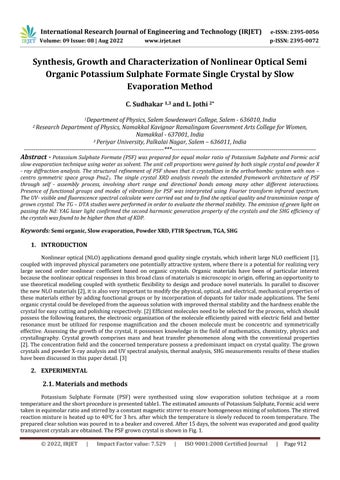
ThepowderX–Raydiffractionanalysiswerecarriedouttoconfirmthecrystallinityandalsothepurityof thegrowncrystalusingaBrukerD8AdvancediffractometerwithCuKα(1.5406Å)radiation.FromthepowderXray data, the various planes of reflections were indexed using POWDERX program. The indexed powder X-ray diffractionpatternforPSFcrystalisshowninFig.2.Theappearanceofsharpandstrongpeaksgoodcrystallinity ofthegrownPSFcrystal.PowderXRDpatternwasrecordedbyscanningthesampleovertherange0-900atscan speed of 10/min. The good crystalline nature was confirmed from the sharp peaks. The slight shift in the sharp peakpositionstowardstoloweranglesidemaybeduetotheadditionof PSFcrystalanditisalsoconfirmedbya slightvariationobservedinthelatticeparametersofthegrowncrystal.[5,6]

International Research Journal of Engineering and Technology (IRJET) e-ISSN: 2395-0056
Volume: 09 Issue: 08 | Aug 2022 www.irjet.net p-ISSN: 2395-0072
Fig – 2: The XRD data of the grown PSF crystal
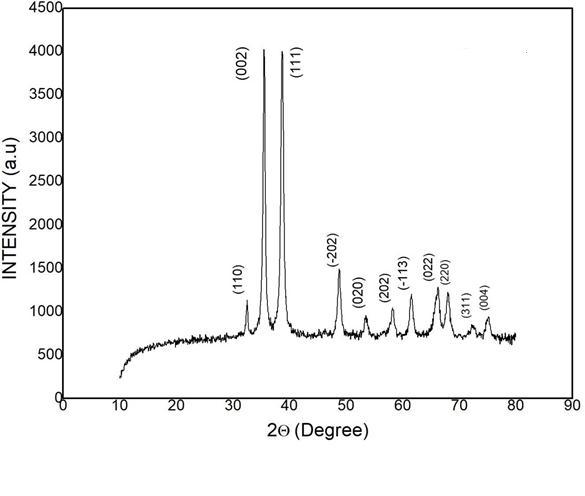
The FT – IR spectroscopy was used to identify the presence of functional groups in the grown crystal using PERKIN ELMER Fourier transform infra – red Spectrometer. Using KBr pellet technique in the wavelength rangebetween500–4000cm-1 carriedouttheFTIRanalysisofPSF.TherecordedFTIRspectrumofPSFisshown in Fig. 3. The broad band at 3398 cm-1 and the band at 1624 cm-1 are due to C=O stretching vibrations. S=O stretchingvibrationsarefoundat1384cm-1.Thebandat1285cm-1 isduetoS-Oplanebending.Theasymmetric stretchingvibrationofSO4giverisetoabandintheregionof1107cm-1[7].
International Research Journal of Engineering and Technology (IRJET) e-ISSN: 2395-0056
Volume: 09 Issue: 08 | Aug 2022 www.irjet.net p-ISSN: 2395-0072
Fig – 3: FT – IR spectrum of the grown PSF crystal
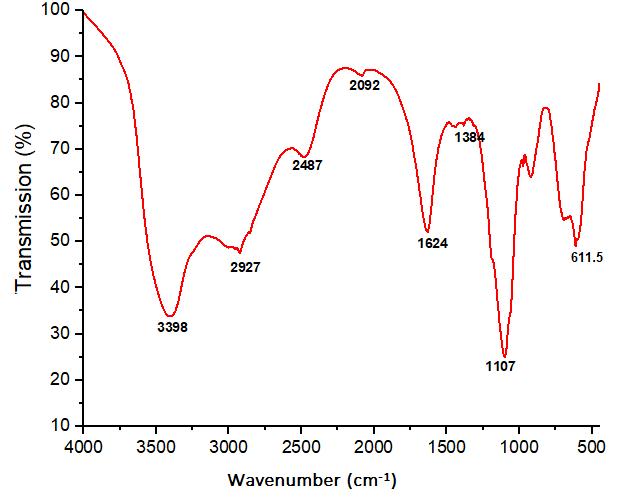
An optically polished crystal of 1 mm thickness was used for recording the optical absorption and transmission spectrumofPotassiumSulphateFormate(PSF)singlecrystalintherangeof100nmto1200nm,isshowninFig.5andFig. 6 Theopticalabsorptioncoefficient(α)wasusedtofind,
ExtinctioncoefficientK= and BandgapenergyEg = (eV)
Where isthelowercut–offwavelengthofthesampleandwherehisPlank’sconstant.Bandgapenergywasthe difference in energy between the valence band and the conduction band of a solid material it is simply the energy of forbidden electrons movement in the material it is simply the energy was governed by the structural disorder, an imperfectioninstoichiometricandpassivationatthesurfaceandthedisorderofphononstates.Itisinverselyproportional to the bandgap energy. From the UV – VIS spectrum, lower cut - off wavelength was observed at 218 nm this is due to interbond electronic transitions. Using the lower cut – off wavelength bandgap energy value was calculated as 5.6 eV which is shown in Fig. 6. The high transmission of the grown crystal in the entire visible region with a wide bandgap indicates the low defect concentration in the grown material [8]. It is seen from the spectrum that the crystal is transparentintheentirerangewithoutanyabsorptionpeak,whichisanessentialparameterfortheNLOcrystals.

International Research Journal of Engineering and Technology (IRJET) e-ISSN: 2395-0056
Volume: 09 Issue: 08 | Aug 2022 www.irjet.net p-ISSN: 2395-0072
Fig – 4: UV – vis Absorbance of the grown PSF crystal

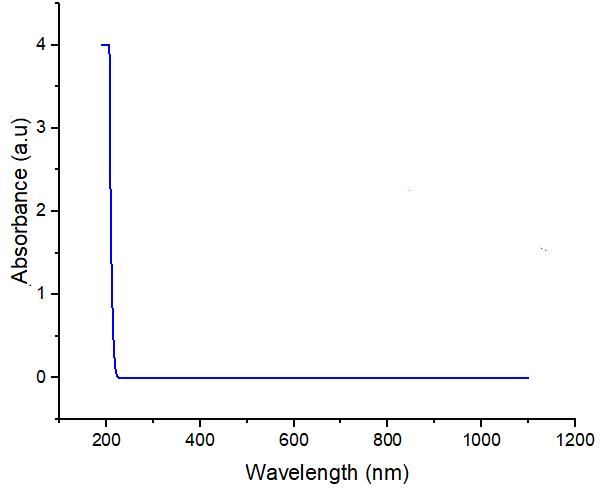
The PSF crystal is transparent in the entire UV – visible region. A better transmittance with lower cut – off wavelengthinthevisibleregiongives4.98eV.Opticallypolishedsinglecrystalsofthickness3mmwereusedforthisstudy Fig.5showsthattheabsorptionspectrumofthegrowncrystalsandthepresenceoflowercutoffwavelengthrangeofthe materialspossessingNLOactivity.
Fig – 5: UV – vis Transmission spectrum of the grown PSF crystal
International Research Journal of Engineering and Technology (IRJET) e-ISSN: 2395-0056
Volume: 09 Issue: 08 | Aug 2022 www.irjet.net p-ISSN: 2395-0072
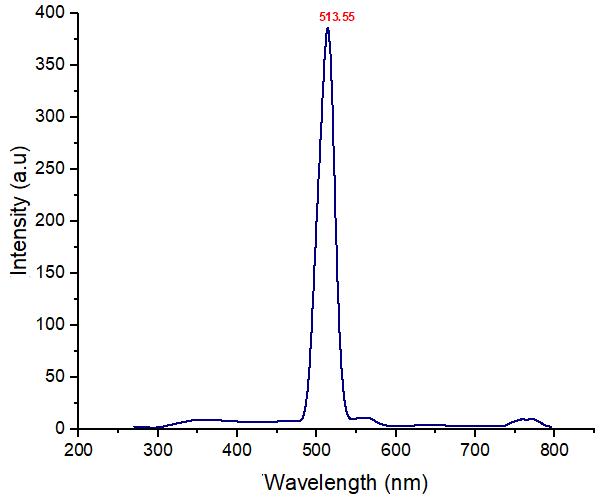
Fluorescence is the emission of light by a substance that has absorbed light or other electromagnetic radiations. The most striking examples of fluorescence occur when the absorbed radiation is in the UV region of the spectrum and thusinvisibletothehumaneyeandtheemittedlightisinthevisibleregion.Fluorescencegenerallyfoundincompounds containing aromatic functional groups with low energy π - π* transition levels. Compounds containing aliphatic and alicycliccarbonylstructuresorhighlyconjugateddouble –bondstructureexhibitfluorescence.Theemissionspectrumof PSF in the range 200 – 800 nm. The spectrum is given in Fig. 7 Which shows a peak at about 513 nm indicates that PSF crystalhasabluefluorescenceemission.
Fig – 6: Fluorescence spectrum of the grown PSF crystal
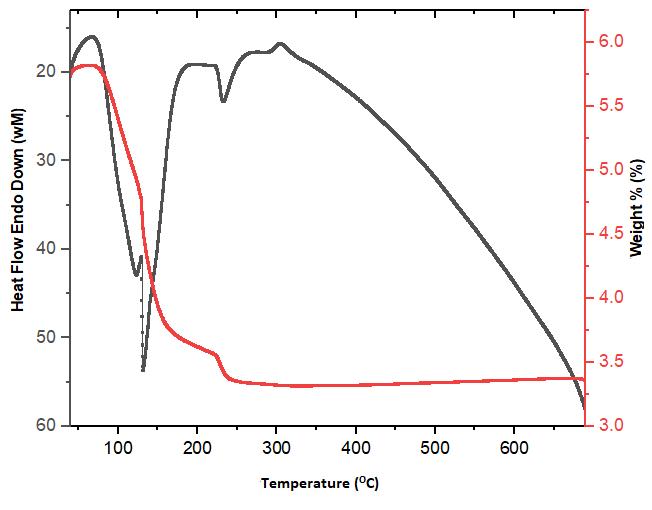
The grown PSF crystal was subjected to Thermo Gravimetric Analysis (TGA) and Differential Thermal Analysis (DTA)andthespectraareshowninFig.8.TheywerecarriedoutusingPerkinElmerDiaTG/DTAinstrumentinanitrogen atmosphereforatemperaturerangefrom400Cto6800Cataheatingrateof200C/min Thedecompositionswitchesnearly from1200Cto2100Canda majorweightlossof99%obtainedat 2050C.Theweightloss directedthatthedecomposition natureofthesampleandNLOapplicationsSPFwasusedbelow1200C[24].However,thereisnoweightlosswasdetected below1000CwhichshowsthereisnowatermoleculeinSPF. Asharpexothermicpeakat 1210CwasobtainedintheDTA spectrumofSPFwhichindicatesthemeltingpointofthegrownsample.Theweightlosswasspottedat1210Cfromthisthe decompositionstartsbeforemelting.Theacuityofthepeaksindicatesagooddegreeofcrystallinityofthesample.
International Research Journal of Engineering and Technology (IRJET) e-ISSN: 2395-0056
Volume: 09 Issue: 08 | Aug 2022 www.irjet.net p-ISSN: 2395-0072
Fig – 7: TG - DTA curve for PSF crystal
The second harmonic generation was studied by analysing the efficiency in terms of sample output and KDP value withthehelpofcommonpowdermethodologyasKurtz–Perrypowdertechnique[2].Q–switchedNd:YAGlaserwiththe fundamentalbeam1064nm,repetitionrateof10Hzandpulsewidth10nswasusedtomeasuretheSHGefficiencyofPSF. The standard reference material Potassium dihydrogen phosphate (KDP) was used to compare the SHG efficiency. The opticalsignalincidentonaphotomultipliertubewasconvertedintovoltageoutput. TheSHGisconfirmedbytheemission of green radiation at 518 nm and the SHG efficiency is found to be 2.76 times greater than that of standard reference materialKDP.
PotassiumSulphateFormate(PSF) crystalsaregrownbyslowevaporationtechnique.Thecrystallinenatureand purityofgrowncrystal isconfirmedbypowerXRDtechnique.Wehaveobtainedthosecrystalspossessanorthorhombic arrangementstructure.TherecordedFTIRspectrumofthegrowncrystal PSFconfirmsthepresenceoffunctionalgroups inthecompound.UV-VIS-NIRspectrumofPSFshowsnon-linearopticalpropertywhichistheessentialrequirementsfor any non-linear optical material. The thermal studies of the samples suggest that the thermal stability is better for doped crystals. The fluorescence of the grown sample is confirmed by nonlinear optical property. The SHG efficiency of PSF crystal is nearly 2.76 times that of standard KDP material. From the overall analysis, it is clear that the synthesized PSF possesshigherefficiencythanKDPandcanbeeffectivelyappliedintheoptoelectronicfield.
Oneoftheauthors(LJ)thanksSophisticatedInstrumentationcentre,IndianInstituteofTechnology,Chennaiand CentralInstrumentationcentreMKUniversityforthesupportinPowderXRD,Fluorescence,FT-IR,DSCandTG/DTAdata collection. LJ also, thanks to Prof. P.K. Das, Institute of Science, Bangalore for having protracted laser facilities for SHG measurements.
International Research Journal of Engineering and Technology (IRJET) e-ISSN: 2395-0056
Volume: 09 Issue: 08 | Aug 2022 www.irjet.net p-ISSN: 2395-0072
[1] E. Vinoth, S. Vetrivel, S. Gopinath & J. Suresh, Journal of Taibah University for Science, Vol.13, Issue 1979 –992,Sep.2019.
[2]D PremAnand,S.Selvakumar,K.Ambujam,K.Rajarajan,IndianJournalofPure&AppliedPhysics,Vol.43, Issue2,863–868,November2005.
[3]P.Saritha,S.Barathan,ElixirCrystalResearch,Volume6,Issue3,42503–42505,2016
[4]EzilVizhi,VijayanNarayanasamy,N.Sivakumar,Optik123(5),409-413,2012.
[5]N.Indumathi,K.DeepaandS.Senthil,Int.J.Eng.Devel.Reser.Vol.5,Issue1,2321-9939,2017
[6]S.Sivasakthi,M.Haridas,G.Pasupathi,Int.J.Innov.Reser.Mult.Fie.Vol.3,Issue6,2455 0620,2017.
[7]AlbertIrudayaraj,A.DhayalRaj,S.Karthick,R.Vinayagamoorthy,G.Jayakumar,Int.J.Rece.Sci.Reser.Vol.6, Issue2,2732–2736,2015.
[8]R.Sakunthaladevi,L.Jothi,J.Mol.Struc.Vol.1233,0022–2860,2021.K.Uma,R.Manimekalai,G.
[9]Pasupathi,Int.J.Che.Mater.Reser.Vol.3,Issue4,91-99,2015.
[10]S.Arulmani,K.Deepa,S.Senthil,Int.J.Sci.Reser.Sci.Tech.Vol.4.Issue5,184-189,2018.
2021.
[12]N.Nithya,R.MahalakshmiandS.Sagadevan,Int.J.Med.Sci.Edu.Vol.13,Issue1,50–57,2016
[13]CynthiaSundararaj,SureshSagadevan,Mater.Reser.Vol.21,Issue1,5373-5379,2016.
[14]P.Sakthi,R.Rajasekaran,A.Arun,J.mate.Sci.polandDOI:10.2478/MSP-2019-0033.
[15]K.Suguna,G.Suhanya,Int.J.Adv.Reser.Sci.Eng.Tech.Vol.5,Issue12,7690-7696,2018.
[16]S.AlfredDevaprasadandJ.Madhavan,Arch.AppL.Sci.Reser.2010,2(4):26-32.
[17]R.Anitha,S.Athimoolam,M.Gunasekaran,K.Anitha,J.Mol.Struc.Vol.1076,115-125,2014.
[18]Koteeswari,PanduranganandSagadevanSuresh,J.Mater. Vol.6,Issue1,1453-1460,2014.
[19] A. Sarbudeen, I. Md. Zahid, G. Foize Ahmad, M. Gulam Mohamed, Int. J. Eng. Reser. Tech. Vol. 5, Issue 3,
[11] T. Kalaiarasi, M. Senthilkumar, S. Shanmugam, Bull. Mater. Sci. Vol. 13, Issue 1, 12034 – 021- 02421– 6, 2395–0072,2018.
[20]K.Selvaraju,K.Kirubavathi,S.Kumararaman,J.Mine.&Mate.Charac.Eng.Vol.11,Issue 3,303310,2012
[21]C.Sudhakar,L.Jothi,Int.J.Reser.Rev. Vol.6,Issue1,2349–5138,2019
[22]L.Jothi,G.Vasuki,R.RameshBabu,K.Ramamurthi,Optik125(2013)2017-2021
[23]P.Yasotha,R.Thiyagarajan,P.Sagunthala,JournalofNon–OxideGlasses,Vol.8,Issue1,29–36,2016
[24] P.Girija,S.Kumaravel,C.VidyaandP.M.Anbarasan,Int.J.Adv.Sci.Eng.Vol.3No.3373–3378,2017
[25]P.V.Radhika,K.Jayakumari,C.K.Mahadevan,Int.J.Eng.Reser.andAppl.Vol.3,Issue6,1841–1849,2013.