International Research Journal of Engineering and Technology (IRJET)

e-ISSN: 2395-0056
Volume: 09 Issue: 07 | July 2022 www.irjet.net p-ISSN: 2395-0072
e-ISSN: 2395-0056
Volume: 09 Issue: 07 | July 2022 www.irjet.net p-ISSN: 2395-0072
Anshumaan Phukan 1 , Varad Vinayak Godse 2
1 ,2Dept. of Computer Science Engineering, Bennett University, Greater Noida, Uttar Pradesh, India ***
Abstract Global warming has become a growing concern in recent times. The root cause of the problem directs toward carbon emissions in the form of greenhouse gas. The increasing human activities intervene in the earth's natural carbon absorbing capacity. It leads to unwanted situations like the melting of ice caps, increasing sea levels, extreme weather conditions, and many others. The contributors to carbon emissions vary across industries ranging from electricity and heat production, transportation, agriculture, forestry, fossil fuel, and many more.
The idea behind our project is to run a prediction, analysis, and forecasting system over datasets related to carbon emissions. We will focus on certain core factors causing carbon emissions. It would include trends over the years, maximum and minimum contributors, etc. The analysis can be a foundation for predicting the future trends of these contributors.
The distribution of carbon emissions across sectors has different aspects and consequences. It is essential to concentrate on the existing numbers and statistics to understandthescaleoftheissue.
According to the article from World Resources Institute, agriculture has become the second largest emitter by releasing6billiontonsofgreenhousegases.Theemissions increased by 8 percent from 1990 to 2010, with a projectionofa15percentrisetill2030.Thesourcesrange from fuel use on farms, fertilizers, manure management, urea,fieldburningofcropresidue.
A logical approach for diagnosing such abnormalities is to conduct an MRI (Magnetic Resonance Imaging) of the patient'sbrainfollowedbyashort sightedexamination of these MRI/X ray. Unfortunately, such a procedure can oftenbetediousandinefficient. Asperstandardprotocols, the neurologist has to pace through multiple scans of a singlebrain to accurately determine the root cause and occurrence of abnormalities in most cases. Thus, such an approach can lead to inaccuracy, latency, and false positives.
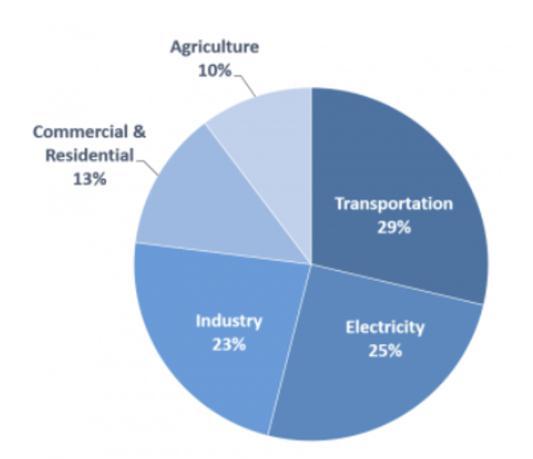
Transportation has become a large scale contributor as well. The data from Oxford Martin School account for transportationforaroundone fifthofcarbondioxide(CO2) emissions. A majority of it comes from passenger vehicles like cars, and buses about 45.1%. The entire transportation sector involving road, air, and rail travel contributes to 21% of total carbon emissions. The use of gasoline (fossil fuel) engines across vehicles has become therootcause.
Electricity is a widely used resource across industries and daily life. Its production from primary energy sources like coal, uranium, and natural gas contributes to emissions. According to a report from Planete Energy, electricity forms42.5%ofCO2emissions.Fromthistheamount,41% is produced from coal, 16% from hydropower, 22% from gas, 11% from nuclear power, and 10% percent from oil and renewables. The growing population and technology have triggered an exponential need for electricity. It has causedgrowingconcerns.
The carbon emissions from commercial and residential construction materials have become prominent as well. A report from nature communications sees a rapid emission increase of 750 Mt(22% globally) in 2020. It predicts the range of emissions to be 3.5 to 4.6 Gt in the upcoming 30 years.
Thestatisticalnumbersofthecontributorsaresignificantly large.Thecurrentscenariohintsatthegrowingconcernsof the future. The idea behind our effort will be to use the latesttechnologyfordevelopingananalysisandprediction model that provides concrete insights over different contributors.
International Research Journal of Engineering and Technology (IRJET) e-ISSN: 2395-0056
Volume: 09 Issue: 07 | July 2022 www.irjet.net p ISSN: 2395 0072
Thetrendsincarbonemissionsdependoncertainbaseline corefactorsthatcauselargerimpacts.
Thecorefactorsvaryasbelow
1)CoalSector(CO2Emissions)
2)NaturalGasSectorCO2Emissions
3)Distillate Fuel, Including Kerosene Type Jet Fuel, Oil SectorCO2Emissions
4)PetroleumCoke SectorCO2Emissions
5)ResidualFuelOilSectorCO2Emissions
Asseeninthescantotheright,thepatienthasabnormal tissue in the brain, which can be spotted as a white highlight towards the center of the scan. Unique patterns such as these can be used to detect any malignant in the brain, further helping us classify whether the brain is abnormal.
CO2 emissions is a big problem all around the planet. There are numerous studies begin conducted to reduce the CO2 emissions. There is an urgent need for a system that can estimate CO2 emissions and allow us to take appropriate actions to minimise the CO2 emissions. IN ordertosolvethisproblemmachinelearningcanbeused. The process of creating algorithms which can improve through experience is known as machine learning. For example, training a model which could automatically recognise fraud mails. Some models for prediction of CO2 emissionshavebeencreatedemployingmachinelearning.
In 2015 Researcher Chairul Saleh created a model which predictedtheCO2emissionsthatmakeuseoftheSupport Vector Machine algorithm in machine learning. Coal combustion and electrical energy were the input parametersforthemodel,bothofwhichplayamajorrole inCO2emissions.Inordertoevaluateandtrainthemodel, thedatafromtheAlcoholindustrywasobtained.InMayof 2017,anotherteamofresearchersdevelopedamodelthat described the quantity of CO2 released during the manufacturing of raw milk. Data from various milk manufacturing processes such as dairy processing and packaging waste disposal were provided to the model for predictionsofCO2 emissions.Accordingtothefindings of the research, 1120 g CO2 is released per litre in manufacturingofrawmilkproducts.
6)PetroleumSectorCO2Emissions
7)GeothermalEnergySectorCO2Emissions
8)Non BiomassWasteSectorCO2Emissions
9)TotalEnergySectorCO2Emissions
The use of coal across various industries grew to 45 % globally between 2001 and 2010. The burning of coal to generate steams to run turbines for electricity, as a raw material for agricultural fertilizers, as core material for cement production in constructions, as a combustion sourceinrailwayandwatertransportmadeitaprominent sourceofcarbonemissions.
It is responsible for 46% of global carbon emissions and 72%oftotalGreenHouseGas(GHG)emissions.
The emissions from natural gas are comparatively low but account for around half of what is caused by coal. A widescale use for generating electricity(steam generation units), fuel for transport (Compressed Natural Gas CNG), heat for buildings, household use(refrigerator cooling), agricultureinputs(Pesticides,fertilizers,irrigation cheaper than electricity) has caused a 43 percent increase since 2005. Although it contributes less compared to coal, it requiressignificantattention.
Distillatefuelsarefractionsofpetroleumformedasaresult of distillation subdues. It includes diesel fuels, jet fuel, and fuel oil(marine fuel, furnace oil, heavy oil). In 2021, the sector emitted 81.92 metric tons of carbon. It causes emissions almost four times that of petroleum. The recent days witnessedlimiteduse ofdiesel vehicles(notincluding heavy vehicles) and purer alternatives for jet and marine fuels.
Petroleum coke is a carbon rich by product of crude oil refining. Its use in the aluminum industry, graphite
International Research Journal of Engineering and Technology (IRJET) e-ISSN: 2395-0056
Volume: 09 Issue: 07 | July 2022 www.irjet.net p ISSN: 2395 0072
electrodesforthesteelindustry,andfuelforcementkilns has caused growing concerns. It emits more greenhouse gases and air pollutants than raw coal. China initiated the early use, with an 18.9 percent rise between 2010 and 2016.Theeconomicadvantagesofpetroleumcokebenefit manyindustriesacrosstheglobe.
Petroleumisawidelyusedresourceacrossindustriesand daily lives. A largescale application as fuel for vehicles extends to ammonia for fertilizers, heating furnaces, petrochemical industry, and Lubricants. It also produces many harmful by products. The sector emitted 1.22 million metric tons of carbon dioxide in 2013. In 2020, a 6.3 percent decline in emissions marked the growth rate overthedecade.
Geothermal energy uses heat from the earth's core by producing minimal waste products. It emits 38 grams of Carbon dioxide per kilowatt of electricity produced. The
We plan to achieve our goal by using a combination of machine learning and neural networks to forecast carbon emissionsbasedonmeaningfuldata.
Hypothesis testing would play a prominent role in our data analysis section. Hypothesis testing is a type of statistical method of drawing conclusions about a probability distribution or population parameter using data from a designated sample. It would be useful for our scenario because it allows us to evaluate 2 mutual exclusive statements, create an assumption and perform statistical analysis to reject or accept the hypothesis. In ourusecase,testssuchastheChi Squaretest,T Test,and AnnovaTestwillbeused.Thenullhypothesis,abbreviated as H0, would be our assumption. If statistical testing rejects our null hypothesis, we will define an alternate hypothesis. As a result, we can clearly deduce the relationships between individual carbon emission variables and total emission levels using these methodologies.
After understanding our data, the necessary feature engineering and selection procedures would be followed to ensure our model can predict carbon emissions with maximum accuracy. Techniques like mutual info index, correlation matrix, and variance threshold would play a huge role in selecting features that affect our prediction the most. Taking too many useful features can also result in a dimensionality curse. Feature extraction techniques like principal component analysis could help us in
minimal emissions from the sector introduce the need to monitortoavoidoverexploitation.
Non biomass sectors like nuclear energy produce zero carbon emissions, butthe production processes(extraction andtransportofuranium,nuclearwastegeneration)cause harmfuleffects.
The data is from the US Energy Information Administration,anditisatimeseriesdatathatspansfrom January1973toJuly2016.Itisacomprehensivecollection of carbon emission values spanning several years and involvesvariousenergysectorssuchasgeothermalenergy, naturalgas,petroleumcoke,andsoon.Withtheuseofsuch data throughout constant time intervals, we may run carbon emission forecasting models like ARIMA. It would beusefulincaseswhenvitaldecisionsmustbemadebased onpredictedemissionvalues.
reducing dimensions by creating eigenvalues and eigenvectors. After acquiring the preprocessed data, numerous statistical models and neural networks will be trainedonit. Thisstudy will employmodelssuchaslinear regression, polynomial regression, locally weighted regression, KNN, naive Bayes, SVM with different kernels, ensemble approaches with different base learners, and ANN. The base machine learning models like regression will be our introductory approach, which would be followed by theimplementationofadvanced techniques.If the scatter plot portrays clear subdivisions among our dataset, models like KNN and SVM would be our first priority. Bagging and boosting ensemble techniques like decision tree, AdaBoost, gradient boost, and xgboost will help us combine several base models to produce one optimal predictive model. These techniques are also called as free lunch model as no single model wins. The aim of ensemblemodelsistobuildstronglearningbasedonweak learners.
The final model would be the custom neural network with differentexperimentaloptimizers,activationfunctions,and weight initialization techniques. Finally, we will perform a detailedinvestigationofourfindingsanddiscoveriesusing visualizationsandhyperparametertuningtodeterminethe parameters and model combinations that will provide the bestforecast.
The dataset consists of time series data points collected atconstanttimeintervals.Thetime dependentordynamic natureoftheproblemrequirestime seriesmodeling.Itisa powerfultoolforextractingcurrentdataandmakingfuture predictionsandforecasting.
International Research Journal of Engineering and Technology (IRJET) e-ISSN: 2395-0056
Volume: 09 Issue: 07 | July 2022 www.irjet.net p ISSN: 2395 0072
Theoverviewofthestepsforthefinaloutputinvolvesthe retrievaloftheCSVtime seriesdata,transformingorpre processing of the data for suitable input, visualizing the data, applying different methods for testing whether it is stationary, transforming time series data to stationary, finding optimal parameters to build SARIMA model, diagnosing,andvalidatingthepredictionsandforecasting.
The read_csv function of pandas extracts the data in the form of a data frame. The info() function provides specifications describing 5096 observations with six columns.Thedatatypeoffourcolumnsisanobject,while two have an integer. The current data frame does not represent a time series. The read_csv function needs specializedargumentstobringthedataintheformoftime series.Theargumentsgoasfollows
parse_dates: Identifies the key for the date time column. The initial dates come in string format. Forexample'YYYYMM'
index_col: Shifts DateTime column into index column.
date_parser: Converts an input string into a DateTimevariable.
Further pre processing involves dropping null rows and null values in the index column using functions like notNull() and dropNa(). The coerce property with setting errors converts columns to float and fills problematic entries with Null(NaN). The to_numeric function converts theemissionvaluecolumnfromobjecttonumeric.
The dataset is analyzed to observe any trends and seasonality. The presence makes it nonstationary data. The removal of nonstationary elements converts the dataset into stationary. The residuals from the process formthebaseforfurtheranalysis.
Stationary Process Astationaryprocesshasa probability distribution that remains unchanged with time. The parameters like mean and variance do not change over time.
The most common violation of stationarity comes from trendsinmean.Ifthecauseofnon stationarityistheunit root, then it is not mean reverting. If it is a deterministic trend,itcantransformtostationarity.
The analysis occurs with a single category of Natural gas CO2emissions.Thesamestepscanrepeatforothers.
The group by function creates data frames with columns corresponding to the categories and having emission values.Theindexcolumnhasdate timeentries.
The plot method from MatPlotlib generates a graph. It has emissionvaluesonthey axisandDateTime(in years)data onthex axis.Thestructureandtrendsoftheplotcanhelp toobservestationarity.
The test considers a null hypothesis. In this case, the null hypothesis is that the time series is nonstationary. A Test statistic gets compared with critical values at different confidencevalues.IfthecriticalvalueexceedstheStatistic, the null hypothesis gets rejected. The time series is stationary.
The opposite case accepts the null hypothesis keeping the time seriesdatanon stationary.
The Adler function from python takes the data and lag parameters. A lag describes the delay time between two sets of observations. Methods like Akaike Information Criterion(AIC) determine the optimal number of lags. The autolagparameterssetthenumberoflagstominimizethe AIC.
The test provides a p value which gets compared to the user providedcutoff.
It also gives a test statistic that compares critical values at differentconfidencelevels.
The technique focuses on taking the mean of a set of consecutivevalues.
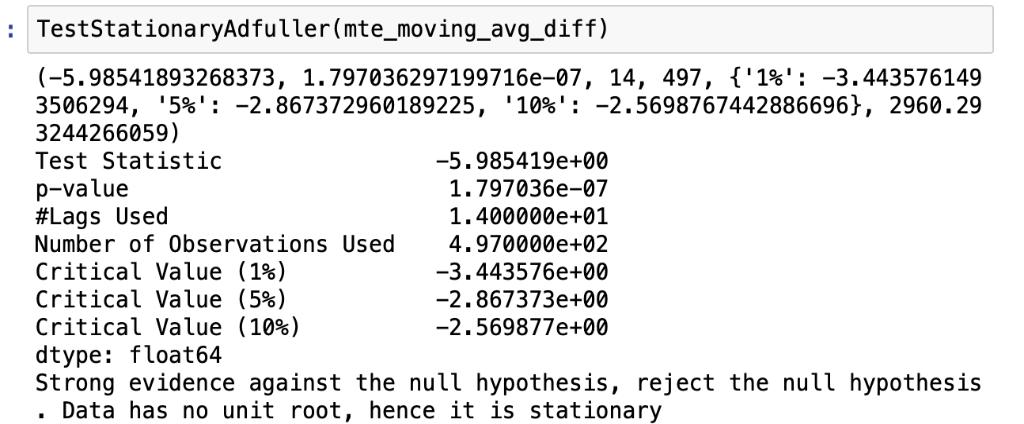
We target a yearly trend that requires an average of 12 consecutive values or months. The value in each entry in thecolumnisthemeanoftheprevious12values.Thefirst 11 values remain null as they do not have a sufficient number of values prior(12). The original data gets subtractedfromthenewdataofthemovingaverage.Itgets tested through the dicky fuller test that tells whether the conversiontostationarityissuccessful.
Thetechniqueusestherollingmethodfrompython.
International Research Journal of Engineering and Technology (IRJET) e-ISSN: 2395-0056
Volume: 09 Issue: 07 | July 2022 www.irjet.net p ISSN: 2395 0072
Adding seasonal terms to an ARIMA model results in a model called SARIMA. This model is characterized by 3 terms:
P:orderoftheautoregressiveterm
Q:orderofmovingaverageterm
D: number of differencing required to convert non stationarytimeseriesdatato stationary.
WhenaseasonalARIMAmodelneedstobefitted,ourgoal should be to determine the parameters that are responsible for optimizing the metric of interest. While implementing seasonal ARIMA, we considered two possiblescenarios.Firstonebeingastationarytimeseries data with no dependence. In this case, residuals were modeled as white noise. The second case would involve a time series data with noticeable dependence among values. We specifically needed to implement statistical modellikeARIMAinthesecondscenario.
For forecasting stationary time series data, the ARIMA model,whichisalinearfunctionakintolinearregression, iscommonlyutilized.
For finding optimal parameters, we implemented two major techniques: Plotting of ACF and PACF curve. Autocorrelation Function and Partial Autocorrelation Function are both responsible for measuring correlation betweents(timeseries)withalaggedversionofitself.But in the case of PACF, elimination of variations are already explained beforehand by intervening comparisons. As a result, these two graphs will be used to determine the model'stuningparameters(pandq).
Second method involves Grid Search for optimizing parameters. This method was included as it a more systematic approach compared to the previous one. It is an iterative technique of exploring all possible combination of parameters of our forecasting model. Seasonal ARIMA model will be fitted all combinations. After exploration, parameters that yield the best performance will be opted. A function called SARIMAX() was used in our case to perform hyperparameter optimization.
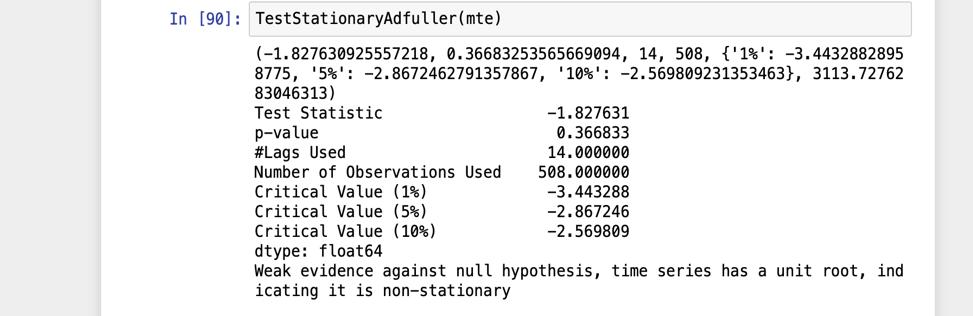
Theresultofthefirstadderfullertestyieldedagreaterval ueof 1.827631forTestStaticcomparedtothecriticalval ues at different confidence levels. The initial critical value wassetat0.01.Theconfidencelevelsweresetat95,90%,
99%.Itmeans5%( 2.867303),10%( 2.569840)and1%( 3.443418)ofthecriticalvalue.
Themovingaveragemethodresultsinteststatic( 5.98541 9e+00)lesserthancriticalvalues10%( 2.569840),1%( 3. 443418)and5%( 2.867303)
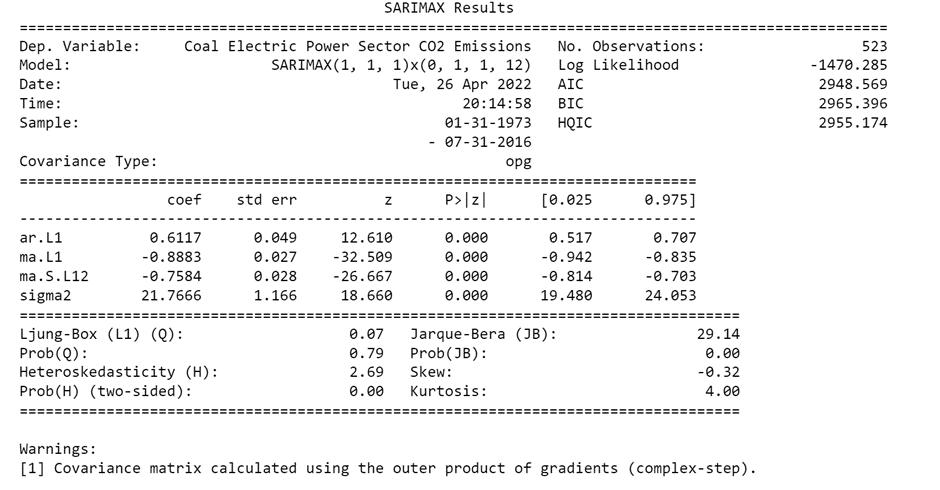
For performing evaluation, we first plotted the Autocorrelation Function (ACF) and Partial Autocorrelation Function (PACF) curve for our seasonal ARIMAmodel.Asfindingtheoptimalparametersmanually graphs is time consuming, we opted for grid search method. Using this method, we explored each and every possible combination of parameters possible. When analyzing and comparing statistical models with various parameters, each can be rated against the others based on how well they fit the data or their ability to properly forecast future data points. A statistical value called AIC was used for the scenario. For this example, weare taking emission values only for Coal Electric Power Sector. The Akaike Information Criterion value measures how well a model fits our training data. It is calculated using the number of independent variables, and the maximum likelihoodestimateofthemodel.AICvaluesareonlyuseful incomparisonscenarios.AlowerscoreofAICindicatesour model is performing well. After performing hyperparameter tuning through grid search, the SARIMAX (1, 1, 1)x(0, 1, 1, 12) yielded the lowest AIC score of 2003.553. Hence, we considered these conditions for our proposedmodel.Nextstepwewentforin depthanalysisof themodelwiththeabove mentionedparameters.
International Research Journal of Engineering and Technology (IRJET) e-ISSN: 2395-0056
Volume: 09 Issue: 07 | July 2022 www.irjet.net p ISSN: 2395 0072
TheredKDElineinthetoprightplotcloselyresemblesthe N(0,1) line. This indicates the residual residuals are normally distributed. However, we can observe some deviations in the straight line, indicating the normal distribution is not perfect for the distribution of errors in the forecast, but it is defiantly acceptable. The qq plot at the bottom left again indicated our residuals are normally distributed.
Fig:State spacemodelresultforCoalElectricPower Sector
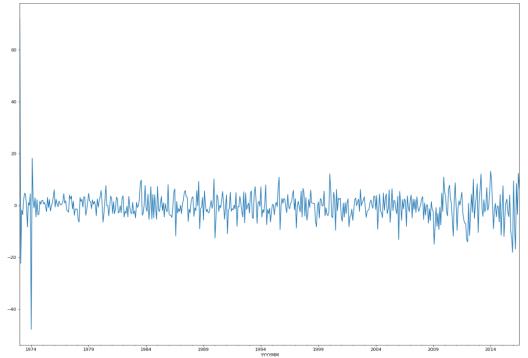
The next analysis would plot the residual errors for our seasonalARIMAmodel.
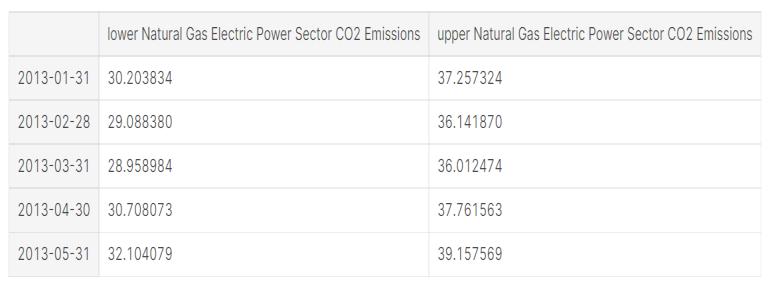
Afterweobtainedourmodelfortimeseriesforecasting,we startedcomparingthepredictedandrealvaluesofthedata. We got the values and accompanying confidence intervals for time series forecasts using the get prediction() and conf_int()properties.
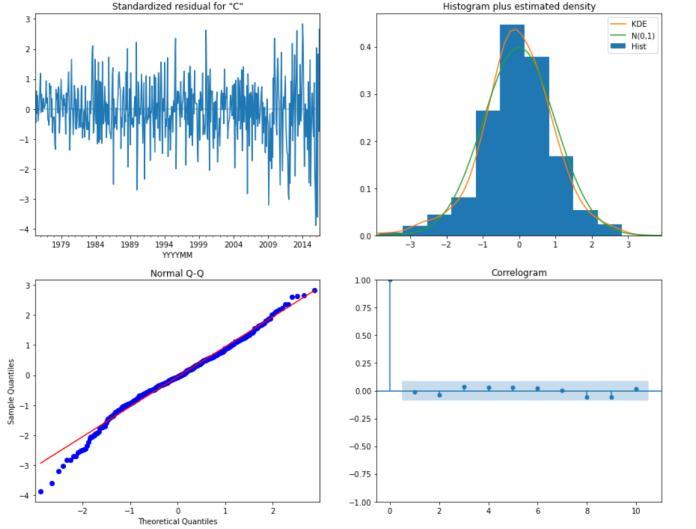
Theresidualerrordistributionisdepictedinthediagram. Itshowsthatthepredictionisalittleskewed.
The table above portrays one step forecasts at each point usingtheentirehistoricaldatauntilthecurrentpoint.
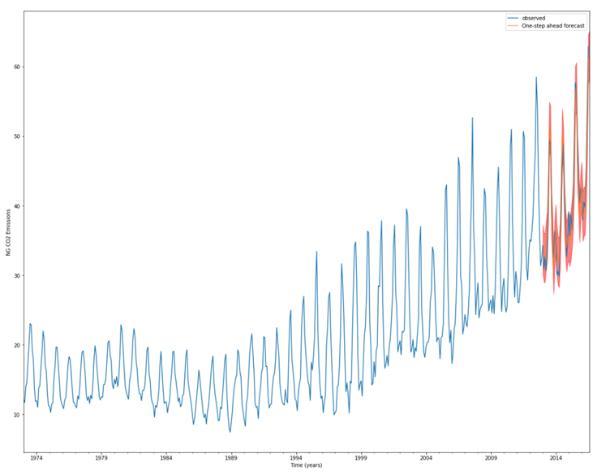
Overall, our forecasts closely match the true numbers, indicatingasimilarpatternofbehavior.
Themodel webuiltgaveus anMSEscoreof 14.39andan RMSEscoreof 3.7936, which isfairly low.The model's purpose was to achieve high-quality predictive power throughdynamicforecasting.
International Research Journal of Engineering and Technology (IRJET) e-ISSN: 2395-0056
Volume: 09 Issue: 07 | July 2022 www.irjet.net p ISSN: 2395 0072
Theget_forecastmethodundertakesthetotal numberof steps to forecast. The conf_init() method provides confidence intervals . A confidence interval has a set of valueswithinwhichtheparametercanlie.
Thedatafromtheabovefunctionisusedtodrawtheplots todisplaytheforecastfordifferentcategories.
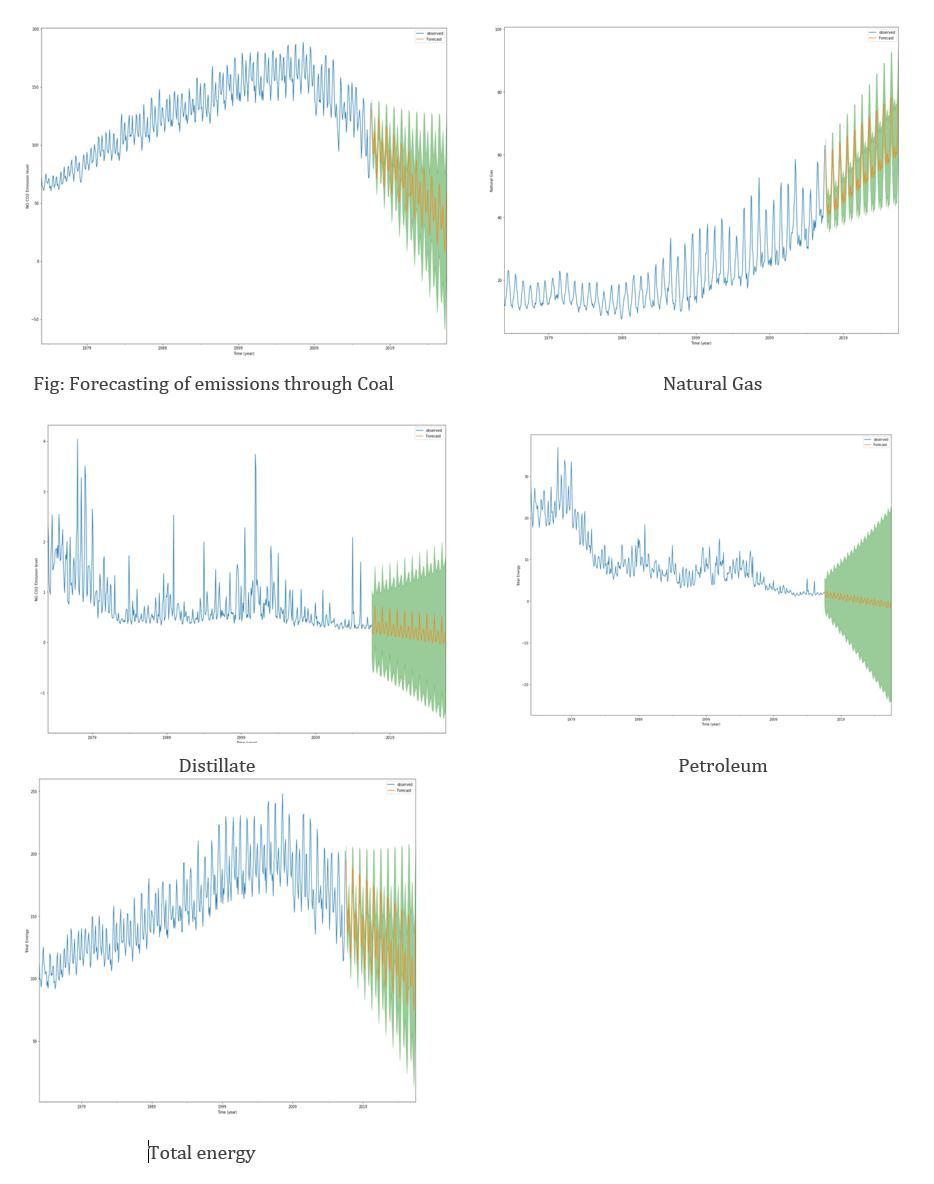
Thehighlightedareaingreencolor represents the other possible variations in the forecasted values. The forecastingmodelperformsbetterwhenitisless.
Thenaturalgasforecastshowsanupward trendforthe nexttenyears.Thegreenarearemainsshorterasaresult ofagoodprediction.
Thecoalforecastshows adownward trend highlighting thedecreaseduseofcoalinthefuture.Theshortergreen areacorrespondstoagoodprediction.
Thedistillatefuelcategorywitnessesaslightlydecreasing butalmostconstanttrend. Thelargergreenarea suggests morevariationsintheforecastedline.
Thepetroleum category witnesses a slightlydecreasing trend.
Itconsistsofvariationsintheforecastedline.
Thetotal energy plot combining every sector showsa downwardtrendwithnegligiblevariations.
Thecategorieslikenaturalgas and coal areused widely and have led to environmental consequences . The growingtrendinnaturalgasisalarming,butadecreasing trendincoalhighlightsanimprovedscenario.
Other categories like petroleum and distillate have constantgrowth.
The patterns and trends forecasted by the model prove essential as it helps to understand the future. The global aimofachievingnetcarbonemissiontozeroby2050need continuous analysis and predictions over the current scenarios.Thecurrentemissiontrendmightseemconstant ordecreasing,butthesituationwilldeterioratebecausethe present emissions have effects in the far future. Hypothetically, if we reduce the net emissions to zero at once, the impact of recent emissions will trigger the problemagain.
Theuseof technologytoanalyze datasetsfor generating insights plays a significant role. The various machine learningtechniques extended by python libraries help run efficientandusefulpredictionsandforecasts.
Wefocussedonthetechniquestogenerateaforecastingan alysis that is useful to environmentalists, researchers, and othersworkingtowardsthecause.
https://www.wri.org/insights/4-chartsexplain-greenhouse-gas-emissions-countriesand-sectors
http://www.annualreviews.org/doi/abs/10.1 146/annurev-environ-032310-112100
https://www.planeteenergies.com/en/medias/close/electricitygeneration-and-related-co2-emissions
International Research Journal of Engineering and Technology (IRJET) e-ISSN: 2395-0056
Volume: 09 Issue: 07 | July 2022 www.irjet.net p ISSN: 2395 0072
https://machinelearningmastery.com/arima for time series forecasting with python/
https://www.machinelearningplus.com/time series/augmented dickey fuller test/
https://machinelearningmastery.com/moving average smoothing for time series forecasting python/
https://neptune.ai/blog/select model for time series prediction task
https://towardsdatascience.com/identifying ar and ma terms using acf and pacf plots in time series forecasting ccb9fd073db8?gi=e940575f86f8
https://www.yourdatateacher.com/2021/05/ 19/hyperparameter tuning grid search and random search/
https://robert alvarez.github.io/2018 06 04 diagnostic_plots/
https://pandas.pydata.org/docs/reference/api /pandas.read_csv.html