The Use of Recycled Concrete Aggregate in Structural Concrete
Professor, Department of Civil Engineering, Guru Nanak Institute of Technology, Nagpur, Maharashtra, India

Department of Civil Engineering, Guru Nanak Institute of Technology, Nagpur, Maharashtra, India
Abstract Properties Of The Reused Totals And The Appropriateness Of The Equivalent In Primary Cement Were Contemplated And Contrasted Them And Normal Totals. The Outcomes Showed That The Molecule Size Appropriation Of Reused Totals Is Viable With Those Of Normal Totals. The Reused Totals Had Rough And Effect Upsides Of 48.7% And 27.10%, Separately While Those Of The Normal Totals Were 29.5% And 11.45, Individually. Mass Thickness Of Reused Totals Was 1065 Kg/M3 With Contrasted With 1296 Kg/M3 Of Natural Totals And The Water Assimilation Was 2.82% With Contrasted With 1.22 Of Natural Totals. The Blend Configuration Proposed For Concrete Was Grade 30. Properties Of Cement Made Under Three Blending Situations Of Regular Total To Reuse Total Extents, For Example, Half Half, 25% 75%, And 0% 100 Percent Were Contrasted And Those Of 100 Percent Normal Totals. With Expanding Level Of Reused Total Substance, Compressive Strength, Flexural Strength, Pliable Parting Strength And Usefulness Were Fundamentally Diminished. As Per The Outcomes, Grade 30 Substantial Properties Could Be Accomplished With Blend Extents Of Half Normal Total And Half Reused Total, Without Essentially Influencing The Substantial Properties, Demonstrating A Half Saving Of Regular Totals Hence Lessening Ecological Effects And Improving Supportability.
M. Etxeberria Æ A. R. Marı' Æ E. Va'zquez (2007). Substantial rubble could be changed into valuable reused total utilized in substantial creation with properties reasonable for most primary substantial applications in Egypt. Hardly any properties of RCA, for example, ingestion and scraped area opposition were lower than those expected by Egyptian substantial code of training despitethefactthatitagreeswithotherglobalcodes.RAC withsubstitutionproportionupto100 percentof NAand 400 kg/m3 concrete substance delivered underlying cement with 33 MPa trademark strength which is reasonable for most primary substantial applications in Egypt,AshrafM.Wagihetal.(2013).
1. INTRODUCTION
The advancement of concrete, which was basic for the structure utilization of bends, made a speedy and finally durable interest for improvement sums. Improvement aggregates,orbasicallyknownas"sums",isa wideextent of coarse particulate material used being developed. The absolute fills in as help to add fortitude to the overall composite material. Toward the day's end aggregates are used for each piece of advancement. The impact of the utilization of reused total on the pillars' shear strength relies upon the level of coarse total subbed, extraordinarily for radiates without cross over support. For low rates of replacement (under 25%) one might say that this impact is for all intents and purposes irrelevant,
TheimpactsofRCAuseonsubstantialmaterialproperties, and the enormous scope effect of RCA on primary individuals. Total properties are most impacted by the leftoverstuckmortaronRCA.Alongtheselines,RCAisless thick, more permeable, and has a higher water ingestion limitthanNA.WhileRCAandNAhavecomparabledegree, RCA particles are more adjusted in shape and have more fines severed in L.A. scraped spot and squashing tests. Supplanting NA in concrete with RCA diminishes the compressive strength, however yields same or unrivaled parting elasticity, Katrina McNeil et al. (2013). Appropriatelydifferentsubstantialwastemightbeutilized in the development of primary cement. Their size and content can have various results on short and long haul mechanical properties, but an incorporated examination ready to consider microstructure boundaries, too as perceptible elements, can be a helpful device for planning improved blends in with exhibitions comparable to those generally displayed when regular totals are utilized. Also, the current examination demonstrated the plausibility of presenting fine and coarse reused totals together inside another substantial without adversely influencing the mechanical exhibitions, both in the short and long haul S. Manzi,C.Mazzotti,M.C.Bignozzi(2013).
1.1 Background/Problem Statement
Aggregate is one of the most fundamentally significant materials being used for substantial creation as it significantlyimpactssubstantialpropertiesandexecution. As to utilization in concrete, a safe approximation is that
Key Words Mix design, Compressive strength, Tensile parting strength, Flexural strength
nolessthan4.5billiontonsofsubstantialtotalseachyear areconsumedaroundtheworld.Thisfigureisexpectedto address absolute total creation, remembering utilization for cement and street base. Total use in concrete comprises maybe somewhere in the range of 25 and 35 percentoftheabsolutetotalcreation.
The sheer majority of worldwide total utilization is faltering. The above unavoidably impacts on the climate because of the extraordinary colossal amount of general and development squander materials or from building destruction locales created in created nations. The exploration led for the Industry Commission Report demonstratedthataround3milliontonsofwastetotalhas been made in the Australia alone. The removal of this waste has turned into a brutal social and natural issue. This is an enormous weight on the world's regular assets and an inexorably costly issue for strong waste administration. Accordingly, a potential elective total technique to conquer this issue might be utilizing reused substantialtotalsratherthanregulartotalindevelopment errands. This arrangement not exclusively can assist with preservingand broaden regularassetsyetinaddition can decrease the expense of waste treatment and the interest onlandfilllocalesforarrangingthewaste
1.2 Understanding the application of Recycled Aggregates
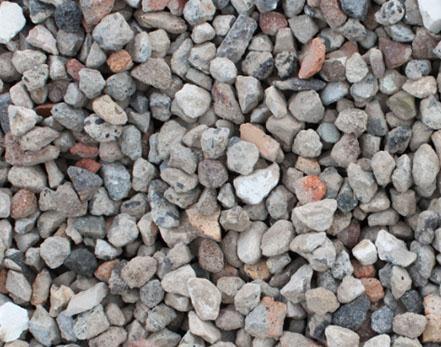
The reused substantial aggregate displayed in can be characterizedassquashedconcretemadeoutofaggregate partscoveredwithconcreteglueorconcretemortarfrom thedestructionoftheolddesignsorasphaltsthathasbeen handled to deliver aggregates reasonable for use in new concrete. The handling, likewise with numerous regular aggregates, by and large includes pulverizing, evaluating and washing. This eliminates pollutant materials, for example,buildingupsteel,leftoversofformwork,gypsum board, and other unfamiliar materials. The subsequent coarse aggregate is then reasonable for use in concrete. Thefineaggregate,inanycase,forthemostpartcontains alotofoldconcreteglueandmortar.
Thiswillingeneralexpandthedryingshrinkageandcreep properties of the new concrete, as well as prompting issues with unfeasible blend and strength. Subsequently, numerous transportation divisions have tracked down that utilizing 100 percent coarse reused aggregate however with simply around 10% to 20% reused fines functionsadmirably.Astoconsequencesofthemajorityof the past examination that has been done as such far, the utilization of recycled aggregate is generally as of now in bad quality/strength concrete, for instance, asphalt base andpiece insteadof utilized inprimarycement. The most well known utilization of recycled concrete aggregate is the utilization in substantial sub base in street development,bankassurance,commotionboundariesand
dikesmanykindsofgeneralmassfillsandfillmaterialsfor seepagestructures
1.3 Objective
Theaimofthisprojectistodecidethetrademarkstrength and solidness properties of 100 percent reused total utilizedinprimarycement,contrastedandnormaltotal,as well as to track down the most efficient arrangement and nature of the reused substantial total to diminish the ecologicaleffect.
2. AGGREGATE PROPERTIES
This part talks about the properties of RCA when contrasted with NAs. A comprehension of how the total changesafterpreviouslybeingutilizedincementcanwork on the capacity to depict why RCA might perform contrastingly when utilized in new cement than NA. The vitally total properties that are introduced are the thickness, porosity, and water ingestion of the total, the shape and degree of the total, and the total protection frompoundingandscrapedarea.
Fig 1: Recycled Aggregates
2.1 Basic Properties of Concrete with Recycled Concrete Aggregate
In view of accessible exploratory proof, the main properties of reused substantial total (RCA) and concrete madewithreusedtotal(RAC)aremomentarilyintroduced in this section. Suggestions for creation of RAC are additionallyintroduced.
At the point when annihilated concrete is squashed, a specificmeasureofmortarandconcretegluefromthefirst substantialremainingpartsappendedtostoneparticlesin reused total. This connected mortar is the principle justification for the lower nature of RCA contrasted with regulartotal(NA).
3. METHODOLOGY
Mytechniqueistofigureoutthegenuinecostofdelivering reused total including cost of transportation, research facility testing and to contrast them and normal total. I additionally attempted to demonstrate what level of the nature of the reused total including the tidiness and strength. For that reason the main issue is the manner by whichIcanaccomplishthestrengthofthenewconcreteby utilizingreusedtotal.
To begin with, I will test the reused total given by the neighborhood reusing organization. For instance, Particle Size Distribution of Aggregate, Particle Density and Water Absorption, Particle shape/Proportional Caliper, Wet/Dry StrengthVariation,LosAngelesAbrasion,SodiumSulphate Soundness, and Organic debasements other than sugar; to figure out what is the blend plan of preliminary example. Then,atthatpoint,Iwillattempttomakeafewchambers to testthe trademark strength upto 50MPa toaccomplish theobjective.
3.1 Aggregate
Three kinds of totals were utilized in this study which incorporate normal sand as fine total (NFA), coarse totals with evaluating of 4.75 20 mm were dolomite as regular (NCA)andthesquashedsubstantialrubbleas(RCA)which were gathered from fifteen distinct wellsprings of destroyed structures and landfill areas then, at that point, squashedutilizingaHartlePC 160portableeffectsmasher displayed then, at that point, sieved to the expected evaluating. Testing of the total was done according to Egyptiancodeoftraining(ECP203 2008,vol.3).
3.2 Concrete
CEM I 42.5 N was utilized. Testing of concrete was done according to the Egyptian Standard Specifications ESS 2421/2007. The pre owned concrete conformed to the furthestreachesofESS4756 1/2009
3.3 Water
Consumable regular water was utilized for substantial blendingallthroughthereview.
3.4 Admixtures
Twosortsofadmixtureswereutilized:
(I)Chemical admixture was Modified Naphthalene FormaldehydeSulphateSuperplasticizeragreeingwith the ASTMC494TypeAnandF.
(II) Mineral admixture was silica smoulder following the ASTMC1240 11
3.5 Concrete mixes
Fiftysubstantialblendsframingeightgatheringshavebeen intendedtocontrastthepropertiesofRACandNAC.Bunch (1) was intended to concentrate on the impact of RCA quality.Blendsofthegatheringweremadeof100percent RCAgatheredfrom15uniquedestructionandlandfillareas around Cairo. All blends of the Group (1) have steady superplasticizer content of 1.3% and the complete water contentwasacclimatedtogetconcretehavinga rutworth of 10 ± 2 cm, generally utilized in most underlying substantial applications in Egypt. Gatherings (2 8) were intended to concentrate on the impact of RCA content, concrete dose, utilizing of superplasticizer and silica seethe.
Various sums of supplanting of NA with RCA (0%, 25%, half, 75% and 100 percent) were tried keeping the coarse/fine total proportion steady. Superplasticizer content of 0% and 1.3% was utilized with variable water content to acquire concrete having a rut esteem of 10 ± 2 cm.
Concrete items were 350, 400 and 450 kg/m3 . Silica seethewasaddedto10%ofconcretesubstanceforGroups (4 and 7). The outright volume technique was taken on to plantheblendextentofthesubstantialorganizations.
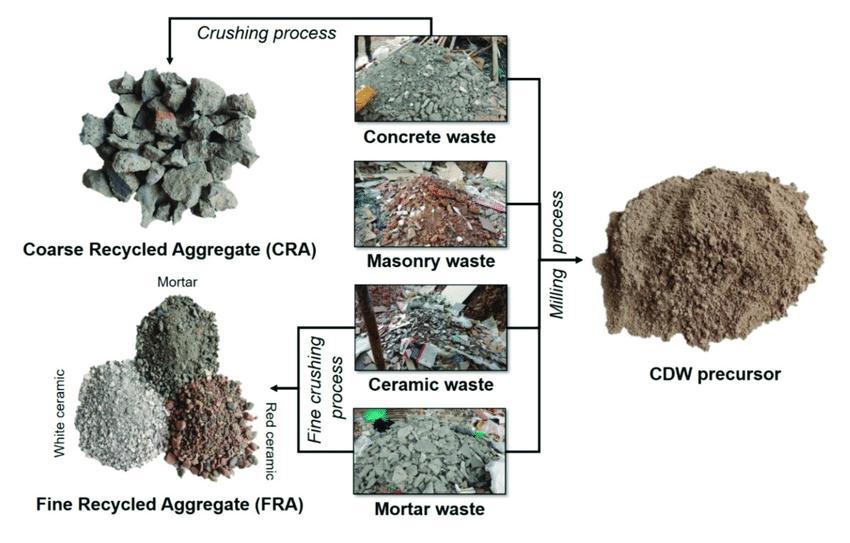
4. THE PROCESS OF CREATING RECYCLED AGGREGATE
4.1 Pre sorting of source material
Theprimarystageuponlandinginthereusingplantisthe pre arrangingofthematerial.Alldestructionmaterialswill go through an essential arranging framework to initially isolatesteel,wood,Gyprock,chipboard,fiberboard,paper, light mass, concrete and weighty fines. All messy cement wouldbetipofftruckandgoesthroughtheErinScreen.
4.2 Primary Crushing Plant
The material will then enter the essential pounding plant. TheprimaryphaseofthisisthePulveriserExcavator.This machine will pound the substantial into half meter round pieces.ThePulveriserExcavatorisasortofaffectedfactory smasher. The dirt is then further 'scalped' away. Scalping happenswitha25mmscalpingscreentoeliminatesoiland dirt balls fromthe messedup concrete. The material then, at that point, enters the essential smasher which will separate it to 100mm to150mm measured total. This smasheristypicallyajawsmasher.
4.3 Secondary Crushing Plant
Asthecrushedmaterialleavestheprimarycrushingplant, the material will pass through a picker station. Personnel standingherewillattempttoremoveanyremainingwood,
International Research Journal of Engineering and Technology (IRJET)
Volume: 09 Issue: 04 | Apr 2022 www.irjet.net
reinforced steel, plastics and other large objects. The material will then pass through magnets. This electromagnetic separation removes any remaining reinforcedsteelandothermetallicscrap.
Therearetwodifferentstrategiesforscreeningorisolating the material to make clean total. They are Dry Separation and Wet Separation. Wet division includes the material going through a water engine, where low thickness unfamiliar materials are taken out by water jets and the utilization of a float/sink tank. This delivers an exceptionally perfect total. Dry Separation includes the utilizationofblowingairtoeliminatelighterparticlesfrom the heavier substantial material. Reused total is for the most part 'blown' something like two times and typically multipletimes.
The cleaned material then enters the optional smashing plant.ThisisacentersmasherattheRecyclingQueensland plant. The smasher can be set to a specific size and the squashedmaterialisthengonethroughscreens.Thereare different screens whichsortthe total into numeroussizes. Total, which is excessively enormous, would return to the electromagneticdivisionandcyclesthroughtheAirKnives andbackintotheauxiliarysmasher.
5. COMPARISON OF RECYCLED AGGREGATE AND NATURAL AGGREGATE
It is critical to know about the contrast between reused aggregateandnormalaggregate.Thiswaythedistinctions can be considered and conceivably moderated while involvingreusedaggregateinsubstantialblends.
5.1 Particle surface texture
Reused aggregate will in general be harsher. Reused aggregate has an enormous surface region. Normal aggregate will in general be smoother and more adjusted. This significantly influences the nature of the concrete. Regular aggregates can smaller all the more intently;
ISSN: 2395 0056
ISSN: 2395 0072
comingaboutismoregroundedcompressivestrengthand lowerwaterretention.
Reusedaggregatesharshershapeimpliesthattheparticles don't fit as minimalistic ally. There are more voids, which brings about more prominent water retention and cause more vulnerable between the holdings. The molecule surface can likewise influence water content and blend waternecessitiesinablend.Thuslyaffectsthefunctionality intheblend.
5.2 Quality
The nature of reused aggregate can be exceptionally conflictingonthegroundsthatitwillrelyuponthesource material's physical and substance properties. Regular aggregate is considerably more reliable because of its uniformsource.
This variable quality element can make reused aggregate hard to work with. Indeed, even in the survey writing, numerous analysts found unfathomably various outcomes from what ought to have been comparative blends. This mightactuallymakeblendplaninatroublesomecycle.The other huge concern level of chloride content of reused aggregatesintheeventthatthematerialwillbeutilizedin supported concrete. Accordingly, there is a chloride content of reused concrete in the 56 day age example whichhasbeendoneinthiscontemplated.
5.3 Particle density
The thickness of recycled aggregate is around 17% lower than regular aggregate in the trials directed as a component of this task. This is because of the moderately permeablenatureoflingeringmortarandconcreteglueor particles sticking to the outer layer of unique normal aggregate to diminish the thickness because of the less thick nature of the mortar. Molecule thickness impacts substantial thickness in both the plastic and solidified states.
5.4 Aggregate strength
Thestrengthofaggregateisseldomtriedandforthemost part doesn't impact the strength of customary concrete however much the strength of the glue and the glue aggregate bond. Notwithstanding, aggregate strength becomes significant in high strength concrete. Concrete created with 100 percent reused aggregate has 80% to 90% of the strength tantamount with regular aggregate cement.Whiletheregularaggregateheldinsidethereused aggregate will in any case have its unique strength, the mortarwillobviouslynot,influencingthegeneralstrength ofthereusedaggregate.Moreover,themortarappendedto the aggregate molecule can diminish the general glue aggregatestrengthoftheendresult.Regularly,thestrength of the aggregate not set in stone by utilizing the wet/dry
© 2022, IRJET | Impact Factor value: 7.529 | ISO 9001:2008 Certified Journal | Page2988
Fig.1: Process Of Creating Recycled Aggregate
International
Volume:
Engineering and Technology (IRJET)
strength variety technique. The trial had shown that strength of reused aggregate is lower than normal aggregate. This might prompt an adverse consequence on the last compressive strength of cement delivered with reusedaggregate.
6. RESULT AND ANALYSIS
The grading of the recycled aggregate had been shown in Tablewasachievedthegradingrequirementsandlimitsof deviation according to the AS2758.1 1998. Therefore, the concretetrialmixcanbedesignedtoachievetherequired compressivestrength
TABLE 1: Particle Size Distribution
A.S Test Sieve (mm) 20mm SA
ISSN: 2395
ISSN: 2395
7. CONCLUSIONS
Though a couple of unfriendly results were displayed whiletestingtheabsolutepropertiesofreusedaggregates, there were no such opposing defects in the significant being delivered utilizing reused aggregates. Due to the lightweightofconcreteandlowermassthickness,itmight beengagedwithslightregionsinraisedstructure.
10 mm SA
20 mm RA
14 mm RA
5 mm RA C/DUST 26.5 100 100 19 92.6 88 100 13.2 36 100 24 33
9.5 2.2 88.3 2.4 1.1 100 4.75 1.6 22.5 1 0.6 61 100 2.36 0 0.7 0 0.5 18 82
1.18 0.6 0.4 2.4 62 0.6 0.1 1.9 46 0.425 0.1 1.7 32 0.3 0 1.4 21 0.15 0.5 1.1 17 0.075 0.4 0.7 0 Pan 0 0
The usefulness decreased with RA, it should be reminded that there are such innumerable admixtures keeping watch to overcome this issue. Finally, it might be reason that something like portion of ordinary aggregates can be really replaced with reused aggregates in concrete, without out and out impacting the significant properties, exhibiting a half saving of typical aggregates therefore lessening regular impacts and further developing reasonability.
REFERENCES
1. M.EtxeberriaÆA.R.Marı´ÆE.Va´zquez(2007) Recycled aggregate concrete as structural material Materials and Structures (2007) 40:529 541DOI10.1617/s11527 006 9161 5.
2. Ashraf M. Wagih, Hossam Z. El Karmoty, Magda Ebid & Samir H. Okba (2013) Recycled construction and demolition concrete waste as aggregate for structural concrete, HBRC Journal, 9:3,193 200,DOI:10.1016/j.hbrcj.2013.08.007.
3. Katrina McNeil, and Thomas H. K. Kang (2013) Recycled Concrete Aggregates: A Review International Journal of Concrete Structures and Materials Vol.7, No.1, pp.61 69, March 2013 DOI 10.1007/s40069 013 0032 5 ISSN 1976 0485 / eISSN2234 1315
4. S.Manzi,C.Mazzotti,M.C.Bignozzi(2013) Short and long term behavior of structural concrete with recycled concrete aggregate http://dx.doi.org/10.1016/j.cemconcomp.2013.0 1.003.
5. Mirjana Malešev , Vlastimir Radonjanin and Snežana Marinković(2010) Recycled Concrete as Aggregate for Structural Concrete Production Sustainability 2010, 2, 1204 1225; doi:10.3390/su2051204