Design and Analysis to Improve Buckling Strength of Light Vehicle Connecting Rod
Depending on the number of cylinders in the engine, any vehicle that use an internal combustion engine requires at least one connecting rod. It is subjected to intense cyclic stresses. These loads might range fromhighcompressiveloads caused by combustion to high tensile loads caused by inertia. As a result, the component's long term durability is crucial. As a result of these considerations, the connecting rod has been the subject of research in a variety of areas, including production, materials, performance simulation, and so on. In this study, several materials such as aluminium, titanium, and C70 steel, as well as high strength carbon fibre, are compared to existing materials. The primary goal of this project is to find new materials that can be used to replace existing materialswhilealsoincreasingbucklingstrength with reducing weight.
Key Words: Buckling strength, Connecting rod, Four wheeler (light vehicle).
1. INTRODUCTION
Duetothedemandfordownsizedengines,greaterspecific power and increased mechanical efficiency, reciprocating powercylindercomponentsareexpectedtoexertlessforce on the cylinder walls to more efficiently transfer the combustionforceinthecylindertoareciprocatingmotion bythecrankshaft,mainlybymeansoflighterweight.Atthe sametime,theselightercylindercomponentsareexpected tomaintainsufficientstrengthandsafety even asinternal combustion engines have significantly increased both specificpowerandmaximumspeedduringthelastdecade. Onecriticalcylindercomponentistheconnectingrod,which transfers the oscillating movement of the piston into the rotating movement of the crankshaft. The connecting rod must not only provide the stiffness and the strength to withstand the cylinder pressure and inertia forces of the engine,butmustalsobeofminimalmass.Additionally,the hydrodynamic performance of the small end and big end mustbeconsideredandoptimizedinordertoimprovewear and friction properties and to meet tougher NVH requirements.
This included Visual observation, metallurgical testing, magnetic particle testing, fractography analysis by stereo
andscanningelectronmicroscopy,residualstressanalysis, dimensionalinspection,chemicalanalysis,Brinellhardness testing, tensile testing, inclusion analysis, microstructure analysisandgrainflowanalysis.ConnectingRodisoneofthe most important components of reciprocating internal combustion engine. It acts as a link between piston and crankshafttoconvertthe traverse motion of the piston to rotationalmotionofthecrankshaft.Itconsistsofsmallend (pistonside),bigend(Crankside)andI section.Smallend andbigendaremachinedtoensureproperfittingofbush(at small end) and Bearings (at Big end). The small end is connected to piston through piston pin. The small end exhibitsreciprocatingmotionwhiletheBigendwhichissplit in two parts for clamping it on the crankshaft exhibits rotational motion. Due to its operational nature, complex state of stresses which includes compression stresses associatedtothepressureexertedbythecombustiongases, andtensilestressesrelatedtotheinertiaofthecomponents inmotion,eitheralternativeorrotational.Increasingtrend of higher power density engine and harsh emission regulationtendstoincreasethemeaneffectivepressureand thepeakfiringpressure.Thereareallfourcriticalareasof theconnectingrodthesmallendorpinend,theshankorI beam, the crankshaft or big end and the bolted joint. A solutionforanoptimizedcomponentlayoutwillbeprovided that combines excellent strength and improved durability with reduced mass. This optimized solution will enable automakerstodesignengineswithhigherfuelefficiencyand greater reliability in order to meet the challenges of the future.
2. LITERATURE REVIEWS

[1] “Connecting Rod Buckling Analysis Using Eigenvalue and Explicit Methods” by Arden Anderson, Mercury Marine; Masahiro Yukioka, Mercury Racin.
Inthisresearchitpresentsthedesigningaconnectingrod. Thebucklingstrengthisheavilyaffectedbythebeamsection, and Johnson's buckling equation is used to estimate the bucklingstrengthofagivenbeamsection.Thisapproachis acceptableifthebeamsectiongeometryisconstantfromthe small end to the big end. But, recent expectations for light weight,lowNVH,andlowfuelconsumptionenginesrequire
the connecting rod section geometries
progressively changing from the small end
big end. FiniteElementAnalysis(FEA)
the bucklingstrengthofa
used
complex
in
[2] “Optimization Methods Applied to Automotive Connecting Rod Mechanical Design” by Rafael Augusto De Lima E Silva, Marco LúcioBittencourt
In this journal it concludes that the mechanical design of automotiveconnectingrodsisessentiallyguidedbyanalytic calculations followed by numeric methods to assess the stresses, displacements, contact pressures, fatigue and buckling.Inthisworkitappliesanalternativemethodology basedonthemethodoftopologyoptimizationtodesignthe connectingrodaimingmassreduction.Twoconnectingrods designsweredevelopedusingtwodifferentmethodologies, which the methodology considering the topology optimizationgenerateda3%lighterconnectingrodandwith improvedlubricationperformancewhencomparedwiththe conventional design obtained from the current design methodology.
[3]“Fatigue Failure Analysis of Diesel Engine ConnectingRod”byMdTauseefAlam,AnilThakur, Venkatesh Kumar PS, and SatayaGhadei
Inthesearticleitsuggeststhattheconnectingrodofahigh performancereciprocatinginternalcombustionengineisone ofthecriticalcomponentsexhibitingcomplexmotion.Thisis subjectedtobothcompressiveloadduetocombustionforce as well as tensile load due to inertia of the moving components. These loadings are cyclic in nature and the componentishighlypronetofatiguefailureifnotdeignedor manufactured carefully. Therefore, connecting rods are designedandmanufacturedwithhighdegreeofprecisionfor infiniteloadingcycle.Butfailuresinconnectingrodisoften reported which is associated to either fatigue, bending, bearingfailureorassemblyfaults.
[4] “Advanced Connecting Rod Design for Mass Optimization”byMichaelT.Lapp,RogerA.Krause, Christopher C. Hall, Dan H. Dinu and Alex AntocIn this paper it is discussed that an effort to optimize the connecting rod of an internal combustion engine for both massandreliability,anall newforgedsteeldesignhasbeen developed that is 37% lighter than the lightweight productiondesign.Theconnectingrodhasbeenoptimized using3DModeling,FEA,advancednumericalsimulationsuch asPIMO3D,andavarietyofmechanicaltestingandlessons learned. The four critical areas of the connecting rod are definedanddiscussedindetail,andanoptimizationsolution foreachareaispresented.Finally,theoptimizedconnecting rodincorporatingalloftheknowledgeandinformationfrom theprevioussectionsispresented.
[5] “Optimized Power Cell Unit in IC Engine Design for Light Weight and High Strength Piston and Connecting Rod” by Dan Dinu and Michael T. Lapp MAHLE
In this article it concluded that the optimization of the connectingrodcoversmaterialanddesignfeaturesinorder toreduceweightandimprovefunction.Materialselectionfor connecting rods has to consider functional and manufacturing aspects. Function The basic criterion for optimumfunctionofthecomponentisthefatiguestrengthof thematerial.Highfatiguestrengthallowsareductioninthe crosssectionandthiscontributestooverallweightreduction ofthecomponent.
[6] “Connecting Rod Optimization for Weight and Cost Reduction” by Pravardhan S. Shenoy and Ali Fatemi the University of Toledo
In this journal it presentsan optimizationstudy ona steel forgedconnectingrodwithaconsiderationforimprovement in weight and production cost. Since the weight of the connectingrodhaslittleinfluenceonitstotalproductioncost, thecostandtheweightweredealtwithseparately.Reduction inmachiningoperations,achievedbychangeinmaterial,was a significant factor in manufacturing cost reduction. Literaturesurvey suggests cyclic loads comprised of static tensileandcompressiveloadsareoftenusedfordesignand optimizationofconnectingrods.
[7] “Development and Application of Buckling Estimation Method in Engine Connecting Rod” byHeewook Moon, Sungwon Shin, Kyungwoo Lee, Hoon Chang and DaejoonYeom
In these research it presents the studies of automobile engineering on developing the high performance and high fuelefficiencyengine.Particularlymostengineershavetried toreducetheweightsofmovingcomponentsoftheenginefor achievinghighfuelefficiency.However,theconnectingroad (hereafter referred as connecting rod) tends to be overdesigned for the reliability since it is one of the main movingpartstransferringthehugeignitionpressuretothe crankshaft. The connecting rod consists of a small end transferringtheignitionpressurethroughthepiston,abig endgrippingthecrankshaft,andfinallyashanklinkingsmall end and big end. The reduction of cross section of shank bringsalightconnectingrodbutincreasesthepossibilityof bucklingfailureaswellthereforethebucklinganalysisinthe earlydesignphasehastobecarriedout.
2.1. OBJECTIVES
wheeler
new material
can replace
RESEARCH METHODOLOGY:
Flow chart 01 Organization of the Project (Methodology Detail)
[1]. I started the work of this project with literature survey.Igatheredmanyresearchpaperswhichare relevant to this topic. After going through these papers, we learnt about buckling strength of 4 wheelerconnectingrod.
[2]. Afterthatthecomponents whicharerequiredfor our project are decided. after finalizing the component, we can also find out the different material which we are use in this Project like aluminum,Highstrengthcarbonfiber,titanium,C 70steeletc.
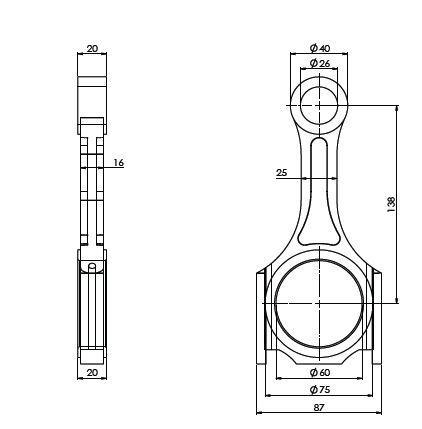
[3]. Afterdecidingthecomponents,the3DModelwillbe donewiththehelpofSolidworkssoftware.
[4]. TheAnalysisofthecomponentswillbedonewith thehelpofANSYSusingFEA.
[5]. IntheanalysisweareperformingStaticstructure analysis for connecting rod in buckling with differentmaterial
[6]. ComparativeanalysisbetweentheExistingmaterial & analysis result of other material which we are consider.
3. DESIGN AND ANALYSIS:
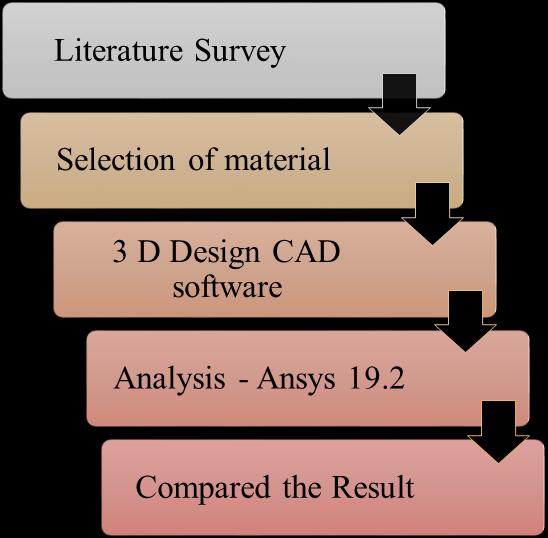
Intheprojectwearecreating3DCADModelDrawnin theSOLIDWORKSsoftwareshowinthefigure1
Fig.1:ConnectingRodModelinSolidworks
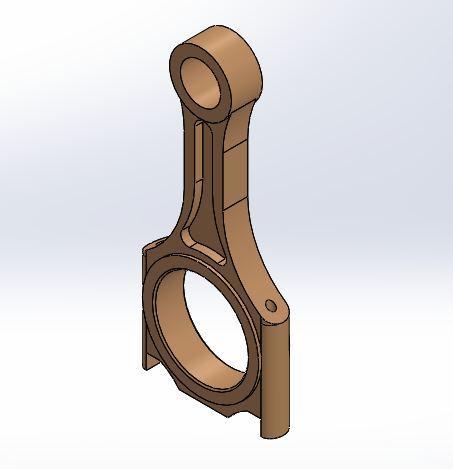
Thefigure1.showthat3DCADmodelofConnecting rodaftercompletingthe3Dmodelwemovedforthedrafting ofthecomponent.
Thedraftingofthecomponentisshowinthefigure2 andprovidingthedimensionofthecomponent.
Fig.2:ConnectingRodDraftinSolidworks 3.1. Calculations
Borediameter 75mm
Strokelength 95mm BorexStroke(mm)=75×95
Displacement 3.14/2x(Borediameter)2xStrokelength
Displacement=419.4CC
MaximumPower=60PS@4500rpm
MaximumTorque=105Nm@2500rpm
CompressionRatio=9/1
DensityofPetrolC8H18=737.22kg/m3 =737.22E 9kg/mm3

Temperature=600F=288.8550K
MolecularWeightofPetrol 114.228g/mole
FromGasEquation, PV=mRspecificT
P=Pressure,V=Volume,m=Mass,T=Idealroom temperatureandRspecific=Specificgasconstant
Mass=Density×Volume =737.22E 9x419.4XE3 =0.309kg
Rspecific=R/M =8.314/0.309=26.88J/kgK
Maximumpressureexertedonthesurfaceofsmallpistonend
P=(0.30×26.88×288.85)/4.19X�� 4 P=5.5MPa.
4. MESH
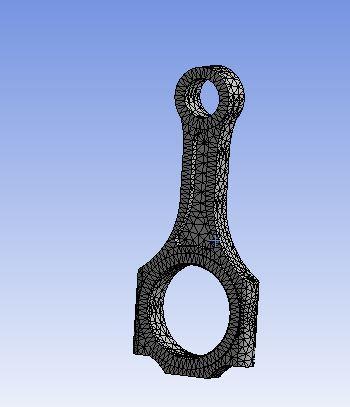
ANSYSMeshingisageneral purpose,intelligent,automated high performanceproduct.Itproducesthemostappropriate meshforaccurate,efficientMultiphysicssolutions.Amesh well suited for a specific analysis can be generated with a singlemouseclickforallpartsinamodel.Fullcontrolsover theoptionsusedtogeneratethemeshareavailableforthe expertuserwhowantstofine tuneit.Thepowerofparallel processingisautomaticallyusedtoreducethetimeyouhave towaitformeshgeneration.Creatingthemostappropriate mesh is the foundation of engineering simulations. ANSYS Meshingisawareofthetypeofsolutionsthatwillbeusedin theprojectandhastheappropriatecriteriatocreatethebest suitedmesh.ANSYSMeshingisautomaticallyintegratedwith eachsolverwithintheANSYSWorkbenchenvironment.Fora quickanalysisorforthenewandinfrequentuser,ausable mesh can be created with one click of the mouse. ANSYS Meshingchoosesthemostappropriateoptionsbasedonthe analysis type and the geometry of the model. Especially convenientistheabilityofANSYSMeshingtoautomatically takeadvantageoftheavailablecoresinthecomputertouse parallelprocessingandthussignificantlyreducethetimeto create a mesh. Parallel meshing is available without any additionalcostorlicenserequirements.
Fig.3:Meshingofsteelmaterial
Fig.4:MeshingDetailsofstainless steelmaterial
4.1. Boundary Condition
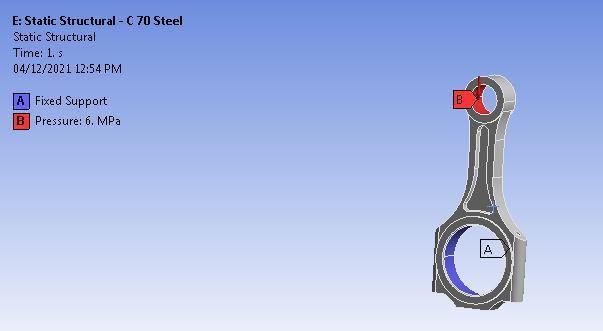
Aboundaryconditionforthemodelis thatthesettingofa well knownvalueforadisplacementoranassociatedload. Foraspecificnodeyou'llbeabletoseteithertheloadorthe displacement but not each. The main kinds of loading obtainableinFEAincludeforce,pressureandtemperature. Thesemaybeappliedtopoints,surfaces,edges,nodesand componentsorremotelyoffsetfromafeature.
Fig.5:Boundarycondition
FEA Result of Steel
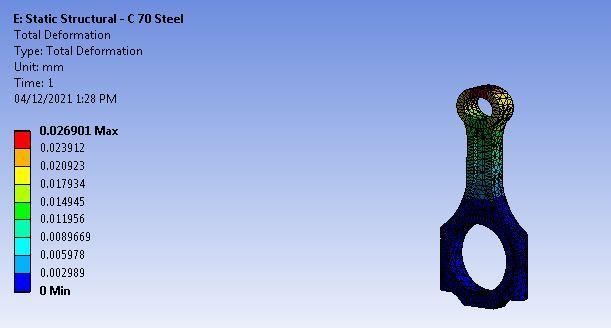
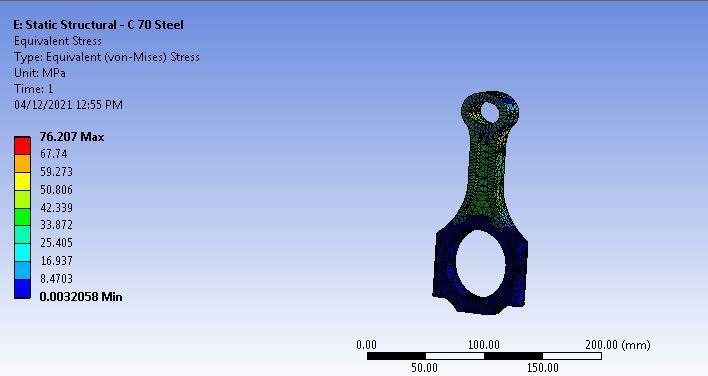
stress
6:DetailsofEquivalentStressof
steel material
boundaryconditionofthesteel
component of 6 Bar.
rod
Fig.7:DetailsofDeformationinSteelmaterial
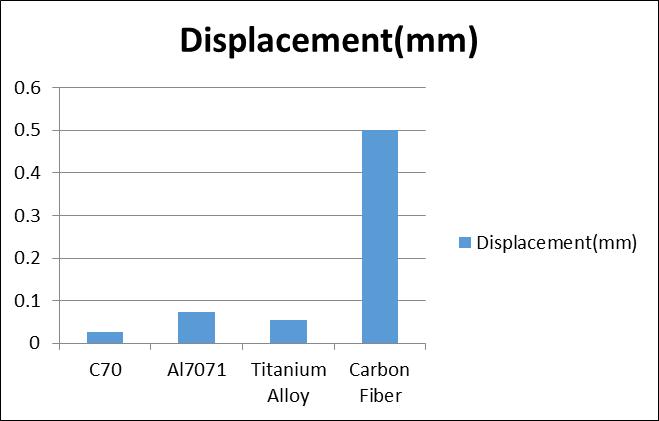
IntheboundaryconditionofthesteelwegivethePressureto thecomponentof6Bar,sothatdeformationinconnecting rodare0.026mm.
Strain energy
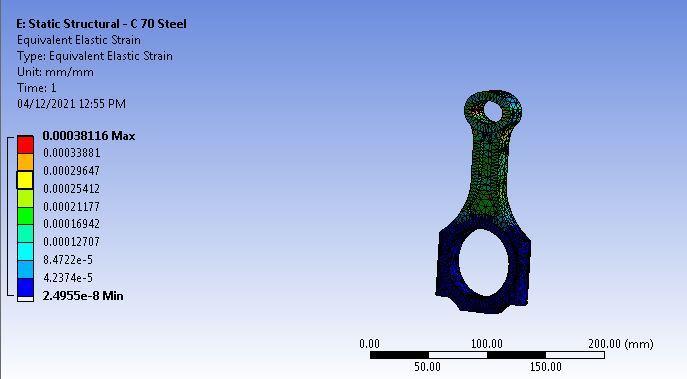
Fig.8:Strainenergyresultsofstainless steelmaterial
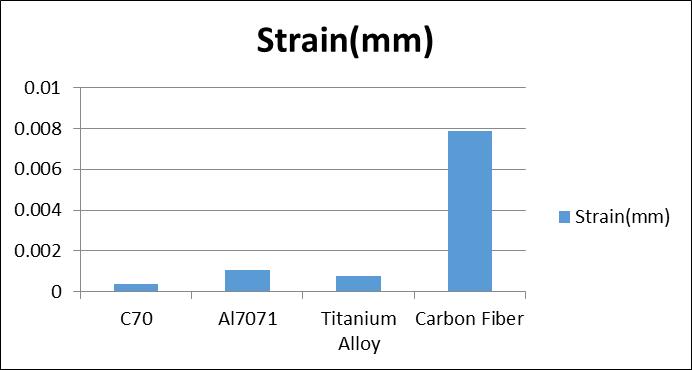
IntheboundaryconditionofthesteelwegivethePressureto thecomponentof6Bar,sothatstraininconnectingrodare 0.0003Mpa.
FEA Result of Al7075
Equivalent stress
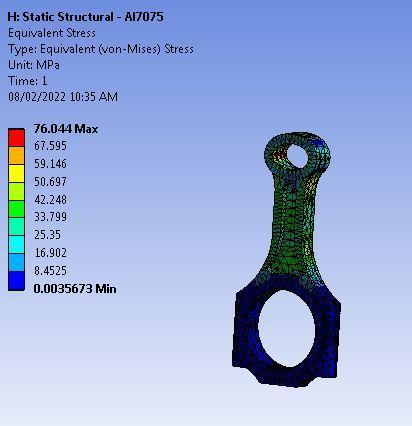
Fig.9:DetailsofEquivalentStressofAL7075 Material
IntheboundaryconditionoftheAl7075wegivethePressure tothecomponentof6Bar.SothattheEquivalentstressin connectingrodare76.04MPA.
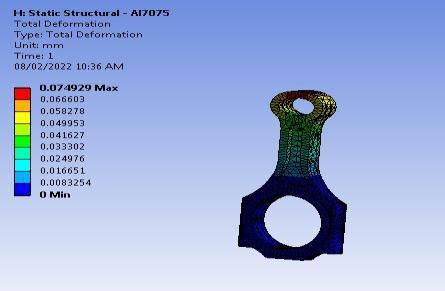
Deformation
Fig.10:DetailsofDeformationinAl7075material
IntheboundaryconditionoftheAl7075wegivethePressure tothecomponentof6Bar,sothatdeformationinconnecting rodare0.074mm.
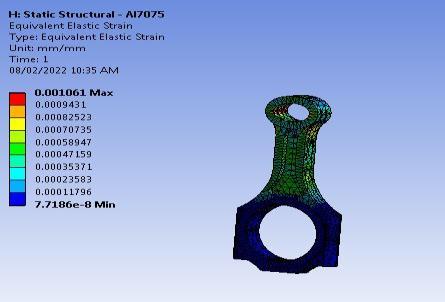
Strain energy
Fig.11:StrainenergyresultsofAl7075material
IntheboundaryconditionoftheAl7075wegivethePressure tothecomponentof6Bar,sothatstraininconnectingrod are0.00010mm.
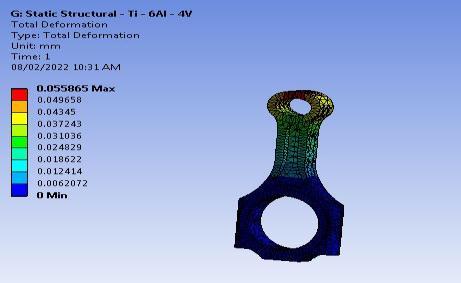
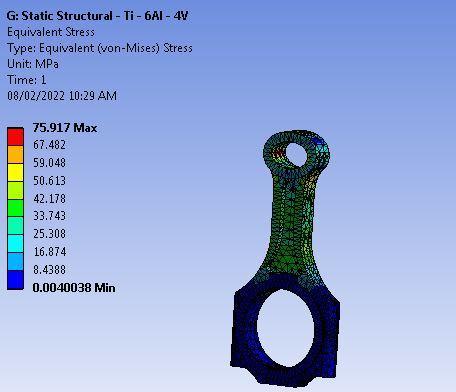
FEA Result of Titanium Alloy
stress
12:DetailsofEquivalentStressofTitaniumAlloy material
theboundaryconditionoftheTitaniumAlloy
tothecomponent
Bar.
Fig.13:DetailsofDeformationinTitaniumAlloymaterial
IntheboundaryconditionoftheTitaniumAlloywegivethe Pressuretothecomponentof6Bar,sothatdeformationin connectingrodare0.055mm.
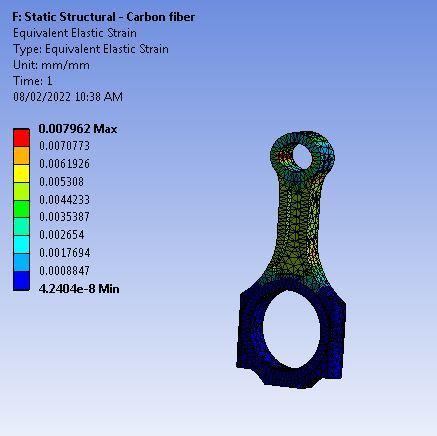
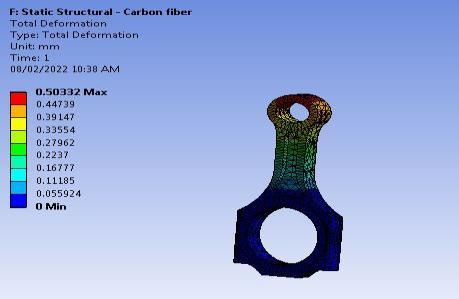
FEA Result of Carbon Fiber
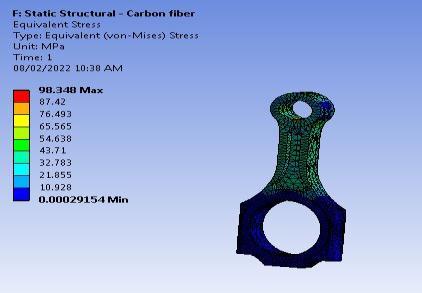
stress
Fig.14:DetailsofEquivalentStressofCarbonFibermaterial
IntheboundaryconditionoftheCarbonFiberwegivethe Pressuretothecomponentof6Bar.SothattheEquivalent stressinconnectingrodare98.34MPA.
Fig.15:DetailsofDeformationinCarbonFibermaterial
Intheboundary conditionoftheCarbonFiber wegivethe Pressuretothecomponentof6Bar,sothatdeformationin connectingrodare0.5mm.
Strain energy
Fig.16:StrainenergyresultsofCarbonFibermaterial
IntheboundaryconditionoftheCarbonFiberwegivethe Pressure to the component of 6 Bar, so that strain in connectingrodare0.0079mm.
4.2. RESULT & DISCUSSION:
In this project of connecting rod we can analyzed the differentmaterialwithstress,StrainandDisplacement.
Graph1:StressinMaterial
InthisGraphshowthatTitaniumAlloyhastheLessStress generatecomparedtotheSteel&AluminumMaterial
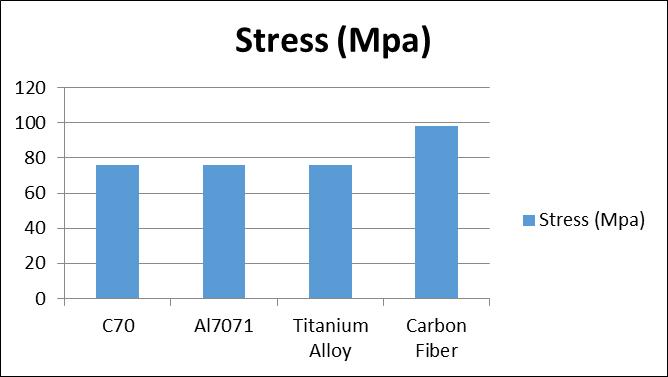
thatwecanhereimprovingthestrengthofour connectingrodwecanreinforcedtheTitaniumalloy withCarbonfiber.
Inthecarbonfibereachlayerstresscaringcapacity isaround6Mpa(98Mpa/16WidthTHK).
Hence by applying the Carbon fiber layer on the titaniumalloywecanincreasethestrengthofthe Connectingrodwithnegligibleincreaseinweight.
Graph2:StraininMaterial
thisGraphshowthatTitaniumAlloy
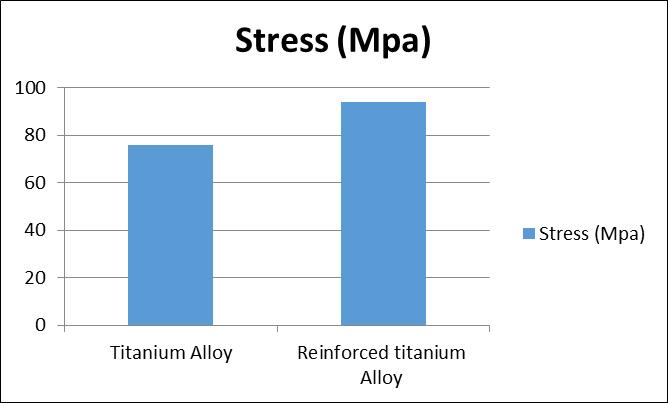
Graph5:ReinforcedmaterialStressComparison
Strengthoftitaniumalloyisincreasebyapplyingthe3layer ofcarbonfiberwithnegligibleincreaseinweight
Graph3:DisplacementinMaterial
In this Graph show that Titanium Alloy has the Less DisplacementcomparedtotheSteel&AluminumMaterial
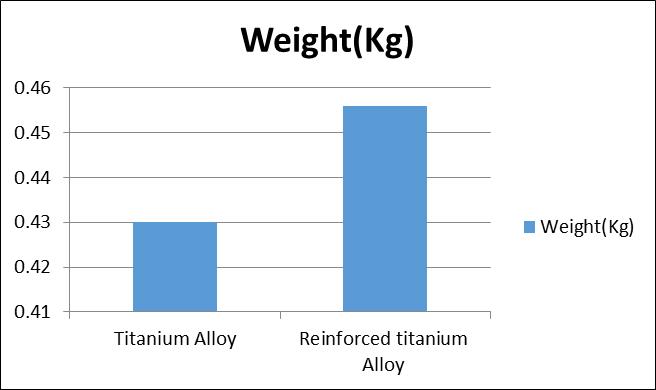
Graph4:WeightComparisonofMaterial
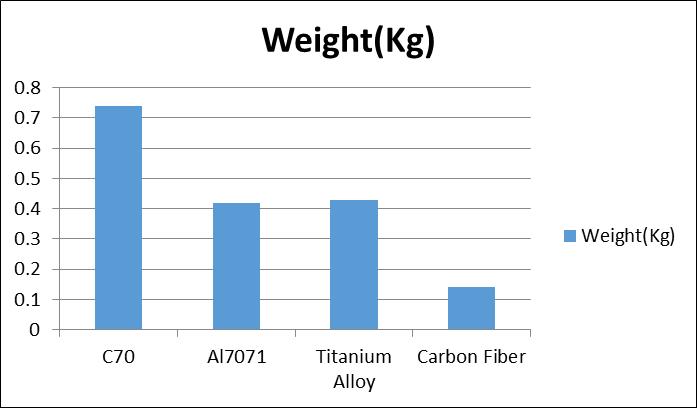
Titaniumalloyandcarbonfiberhasthelessweightcompared totheothermaterial
InthegraphresultwecanseethatTitaniumalloy has been generating less stress and displacement comparedtotheothermaterial(Existingmaterial)
Graph6:ReinforcedmaterialWeightComparison
HenceforimprovingtheStrengthwecanapplyingtheCarbon fiberonTitaniumAlloythenwegottheresultImprovingthe strengthof13%ComparedtotheExistingmaterialC70and Simultaneouslyreducedtheweight23%
4.3. CONCLUSIONS
In present investigation with existing material analysis with determine stress, strain energy and displacement
isobservedfromanalysisthatstressproducedin theconnectingrodwithTitaniumalloyislessthan Al7071&C70Material.
improvingtheStrength
canapplying
wegotthe result
CarbonfiberonTitaniumAlloy
thestrengthof13%
Characterization, Materials Today: Proceedings 2 (2015)2094 2103
Existing material
Simultaneously reducedtheweight
Successfully
the
5. REFERENCES
[1]“ConnectingRodBucklingAnalysisUsingEigenvalue and Explicit Methods” by Arden Anderson, Mercury Marine;MasahiroYukioka,MercuryRacin0148 7191, e ISSN:2688 3627
[2] “Fatigue Failure Analysis of Diesel Engine Connecting Rod” by Md Tauseef Alam, Anil Thakur, Venkatesh Kumar PS, and SatayaGhadei Mahindra & MahindraLtd0148 7191,e ISSN:2688 3627
[10]SV.Uma,MaheswaraRao,T.V.HanumantaRao,K. SatyaNarayana,B.Nagaraju“FatigueAnalysisofSundry I.C Engine Connecting Rods” ELSEVIER, Materials Today:Proceedings5(2018)4958 4964,2017
[11]K.Bari,A.Rolfe,A.Christofi,C.MazzucaandK.V. Sudhakar,“ForensicInvestigationofaFailedConnecting RodfromaMotorcycleEngine”,ELSEVIER,PII:S2213 2902(17)30011 1,May2017
[12] Malkan, S. R.,Ko, F. K. “Three Dimensionally Braided Preform for a Composite Connecting Rod: Concept Development and Demonstration” Journal of Reinforced Plastics and Composites, 10.1177/073168449101000205, March,1991
[
3] “Advanced Connecting Rod Design for Mass Optimization” by Michael T. Lapp, Roger A. Krause, ChristopherC.Hall,DanH.DinuandAlexAntocMAHLE IndustriesInc0148 7191,e ISSN:2688 3627
[4]“ConnectingRodOptimizationforWeightandCost Reduction”byPravardhanS.ShenoyandAliFatemi;The UniversityofToledo2005 01 0987
[5] “Development and Application of Buckling Estimation Method in Engine Connecting Rod” by Heewook Moon, Sungwon Shin, Kyungwoo Lee, Hoon Chang and DaejoonYeom Hyundai Engine Company 0148 7191,e ISSN:2688 3627
[6]D.Gopinath,Ch.V.Sushma“DesignandOptimization ofFourWheelerConnectingRodUsingFiniteElement Analysis” 4th International Conference on Materials Processing and Characterization ( 2015), pp 2291 2299
[7]XiaoleiZhu,JingXu,YangLiu,BoCen,XiaoFengLu, ZhuoZeng“Failureanalysisofafailedconnectingrod cap and connecting bolts of a reciprocating compressor”,ELSEVIER,PII:S1350 6307(16)30748 8, Jan2017.
[8] J. Chao “Fretting fatigue induced failure of a connecting rod” ELSEVIER, Centro Nacional de Investigaciones Metalúrgicas (CENIM CSIC), Avda. GregoriodelAmo8,28040Madrid,Spain,October2018.
[9] Mohammed Mohsin Ali Ha, Mohamed Haneef “Analysis of Fatigue Stresses on Connecting Rod Subjected to Concentrated Loads at The Big End” 4th InternationalConferenceonMaterialsProcessingand
[13] F. Folgar, J. E. Widrig and J. W. Hunt “Design, FabricationandPerformanceofFiberFP/MetalMatrix CompositeConnectingRods”,SAETransactionsVol.96, Section2(1987),pp.155 163
[14] I CRIVELLI VISCONTI, A. LANGELLA, L. NELE, G. DELLA VALLE “IMPROVEMENT ON COMPOSITE CONNECTING·ROD DESIGN”, University of Naples Piazza Ie Tecchio 80125 Naples Italy ©Elsevier SciencePublishersLtd1990