A Study of Disaster Management & Geotechnical Investigation of Landslides: A Review
Rohit Mahajan¹ Purva Nandgaonkar² Sneha Vibhute³ Sidharth Mandlik4 P. S. MoteDepartment of Civil Engineering, JSPM’s ICOER Wagholi, Pune.
Department of Civil Engineering, JSPM’s ICOER Wagholi, Pune.
This paper deals with several aspects of the assessment of hazard and risk of land sliding. In recent years the interest in this topic has increased greatly and there are many technical papers dealing with this subject in the literature. Landslide is the phenomena of sliding of upper loose soil surface over another soil surface. Landslide study includes geological and Geotechnical properties of soil before and after landslide. Slope failures are common geo hazards in the near Panhala fort region during monsoon period. Mainly excess rainfall triggered the land slide, which directly affected on geotechnical properties of soil. The paper discusses the geological, geotechnical investigation of the area. The area is still failure prone and may fail as number potential failure surfaces exist in the site. The Geo technical analysis of the slopes was carried out to identify the type of failure happened on the slope and to examine whether the chances of the profile to failure still exists in the site. The results showed that the hill slope was unstable with factor of safety less than one and which is prone to failure. This study provides a technically viable solution method to avoid such disaster in same topographical features. Angle of internal friction (Ø), plastic limit, liquid limit and plasticity index of the samples were determined in the Geo technical laboratory
Key Words: Landslide, Geotechnical analysis, Geomorphology,NaturalHazards,RainfallInterference.
1. INTRODUCTION
Human settlements and their subsequent developmental activities, especially in the urban and Semi Urban areas, are drastically changing the landforms and thereby disturbing the original drainage pattern. The changed drainagepatterncouldbetheprimarycauseforthefailure of the soil masses located beneath the natural soil slopes. The result generally is called ‘land slide’. Landslide is a common natural disaster often in hilly terrain, which causeshugelossofnaturalresourcesandhuman life.Itis mainly attributed by natural factors, such as earthquakes and rainfall occurred on these regions. A sudden downwardmovementofthe consolidated,unconsolidated soils, and rock matter from a geomorphic feature due to natural and man made activities leads to landslide. Such movementcanoccurinmanyways,itcanbeafall,topple, slide, spread, or flow. The hypothesis for land slide was
rainwater infiltration decreases metrics suction (i.e., negativeporewaterpressure)inthesoil,whichresultsin decrease of shear strength and trigger the landslide phenomenon in hilly terrain. Slope stability analysis is essentially a problem of optimization namely the determination of the slip surface that yields minimum factorofsafety.
2. LITERATURE REVIEW

[1] Chetan R. Shah, Sandip S. Sathe (2021): The authors didtheirworkonLandslidecatastrophehappenon30July 2014 has buried almost 140 peoples under a loose soil mass in Malingaon village of Pune district, Maharashtra, India.Soilsamplesfromahillslopesectionwerecollected (viz.bottom,middle,andtop)fordeterminationofthesoil properties and slope stability. Mainly excess rainfall triggered the land slide, which directly affected on geotechnical properties of soil. The results showed that the hill slope was unstable with factor of safety less than one and which is prone to failure. The land use and land cover map (viz. before and after of land slide) analysis have inferred that the hill slope was unstable. The unscientific way of agriculture practices method and conversionofnon agriculturallandintoagriculturalusage was the major cause for land slide in the study area. This study provides a technically viable solution method to avoidsuchdisasterinsametopographicalfeatures.
[2] Mr. Jayesh B. Patil & Dr. A. B. Landage (2021): In this papertheauthorsconcludedthattheLandslidesareoneof the most dangerous natural hazards in hilly terrain. The region around a previous landslide in Patan, Satara district, Maharashtra, has been chosen as the research location. Landsat8, Google Earth, Google Maps, and other satellite images, as well as Survey of India (SOI) topographicalsheets,serveasthefoundationforobtaining baseline information on different metrics such as NDVI slope, relative relief, drainage density, and geology/lithology. The purpose of this research is to understand the importance of mapping geological ligamentsandlandscapecharacteristicsincludingstreams, slope, and aspect. Rainfall is one of the primary causes of landslides.Anycorrectiveactionmustincludeoneorboth of the following characteristics. Thus, landslide hotspots are identified using GIS and remote sensing. Landslide
Hazard Zonation (LHZ) scenario map of the study area, Results from recent study focused on identification of critical LHZ in the Patan and surroundings area, Satara dist. This also highlights the importance of multidisciplinarystudiesof landslideshazards,combining subjectsasdiverseasgeologyandgeomorphology,RSand GIS. Following specific conclusions are drawn from the study: 1. The area is classified into four parts a. Low b. medium c. High d. Very high 2. Most of the identified hotspot are on the steep slope at hilly Regions. 3.The analysis done on the satellite image LANDSAT 8 dated in February 2021 and analysis done in the month of June 2021 we got the information about the various landslides occurred in Patan taluka inmonth of August 2021 so that we visited the Landslide location, the location of spots identified, and actual location of landslide are matched. 4.Thusinthispresentworkwecanidentifytheprobability locationsofthelandslideswiththeuseofvariousmapsin theArc GISsoftware.
[3] Sachin Verma & Vidya S Khanduri (2019): This paper concludes that the State of Himachal Pradesh in India suffer from various natural and manmade hazard. Although there are many hazards consists of earthquake, snow, storm, dam failure but landslide is one of main hazard in state which occur mostly at monsoon season. Aim of current study is to understanding current state of knowledge in term of managing landslide hazard at Himachal Pradesh. State has well establish policy of managing the disaster of landslide in the state. It is observed that various use of GIS in preparing landslide susceptibility zonation map is main prevention technique whereas geotechnical investigation of soil to help in understand mechanism of failure it also helps to deciding possible mitigation technique possible failure slope. Use software like plaxis 2d is found highly effective to analysingslopsandeffectivityofsolution.
[4]PaolaReichenbach&MauroRossiaetal.(2018):Inthis paper, they do a critical review of statistical methods for landslide susceptibility modelling and associated terrain zonation’s. Landslide susceptibility is the likelihood of a landslide occurring in an area depending on local terrain conditions, estimating “where” landslides are likely to occur. Since the first attempts to assess landslide susceptibility in the mid 1970s, hundreds of papers have beenpublishedusingavarietyofapproachesandmethods in different geological and climatic settings. Here, they critically review the statistically based landslide susceptibility assessment literature by systematically searchingforandthencompilinganextensivedatabaseof 565peer reviewarticlesfrom1983to2016.Theypresent graphical visualisations and discussions of commonalities and differences found as a function of region and time, revealing a significant heterogeneity of thematic data types and scales, modelling approaches, and model
evaluation criteria. They found that the range of thematic data types used for susceptibility assessment has not changed significantly with time, and that for several studies the geomorphological significance of the thematic datausedispoorlyjustified.Theyalsofoundthatthemost common statistical methods for landslide susceptibility modelling include logistic regression, neural network analysis,data overlay,index basedandweightofevidence analyses, with an increasing preference towards machine learning methods in the recent years. Adopting a Susceptibility Quality Level index, they found that the quality of published models has improved over the years, buttop qualityassessmentsremainrare.Theyidentifieda clear geographical bias in susceptibility study locations, with many studies in China, India, Italy, and Turkey, and onlyafewinAfrica,SouthAmerica,andOceania.Basedon previous literature reviews, the analysis of the information collected in the literature database, and our own experience on the subject, we provide recommendationsforthepreparation,evaluation,anduse of landslide susceptibility models and associated terrain zonation’s.
[5] Dattatraya J. Khamkar, Sumedh Y. Mhaske, Pandurang D. Sabale (2018): The authors described the problem of the landslide is severe in Western ghat of Maharashtra mostly due to the topography, human interference, heavy rainfall etc. Upland region of Deccan Volcanic Provinces (DVP) is considered as a most vulnerable region for landslides activity in the Maharashtra state of India. The areashowsthickflowsoftheDeccanTrapbasaltofUpper CretaceoustoEoceneage.StateHighway 70isthelifeline of the Pune District and Raigarh District of Konkan. The part of the highway between Bhor and Mahad is highly landslide prone and frequently blocked during the rainy season. A detailed exploration was carried out along the roadsectionstarted fromBhorcity,and itextendedup to the Mahad, in Konkan region. Paper discusses the geological, geotechnical investigation of the area. The remedialmeasuresaresuggestedtominimizetheseverity oflandslide.Thetotaltopographyoftheslopeissuchthat the drain flowing almost through the middle of the slope can carry considerable debris. However, the overall condition of the slope is such that it may not fail unless there is some major triggering factor. The highway has deep cut along its route with mostly untreated, unsafe slopes and presence extreme climatic conditions. Another importantisthatalotofconstructionactivitiesdaytoday are going on in the hilly terrain, which is partially responsible to cause the jerk in the rock along the road cutting section. Such activities help for the movements of loosematerialtowardsthesloppyarea.Fortheprevention of such mass movements, there is need of ground improvementtechniquesforthestabilityofslopes.Asitis a highly vulnerable region especially in a rainy season as per as the mass movements are concerned. The slope
material has considerable silts, and the permeability was foundtobeoftheorderof10 6cm/sec.Asaresult,dueto heavy rain continued for a couple of days it is expected thatporepressureontheslopemayriseandcouldtrigger thelocalslip.Thematerialdislodgedduetolocalslipsmay get deposited into the drain making partially blockage of the flow. Under such condition the subsequent damage downstreamoftheslopewillbeevenlarger.
[6] Stefano Luigi Gariano & Fausto Guzzetti (2016): According to the 5th report of the Intergovernmental Panel on Climate Change (IPCC), “warming of the climate system is unequivocal”. The influence of climate changes (CC)onslopestabilityandlandslidesisalsoundisputable. Nevertheless, the quantitative evaluation of the impact of global warming, and the related changes in climate, on landslides remains a complex question to be solved. The evidence that climate and landslides act at only partially overlapping spatial and temporal scales complicates the evaluation. We analysed more than 100 papers dealing withtheeffectsandtheconsequencesofCCandlandslides published since 1983 (Gariano and Guzzetti, 2016). The study of the impacts of CC on landslides is attempted adopting modelling, empirical, or combined approaches. Twogroupsofempirical approachescanbesingledout. A first empirical approach (namely historical analysis) compares catalogues of historical landslide occurrences with climatic records, chiefly rainfall, and temperature, covering a few to many decades, typically in the last two centuries. A second empirical approach exploits paleo environmental data to reconstruct records of ancient landslides and to analyse periods of increased/decreased landslideactive.
[7] G. Shanmugam (2015): In this journal the author explained that the synonymous use of the general term “landslide”, with a built in reference to a sliding motion, for all varieties of mass transport deposits (MTD), which include slides, slumps, debrites, topples, creeps, debris avalanches etc. in subaerial, sub lacustrine, submarine, and extra terrestrial environments have created a multitude of conceptual and nomenclatural problems. In addition, concepts of triggers and long runout mechanisms of mass movements are loosely applied without rigor. These problems have enormous implications for studies in process sedimentology, sequence stratigraphy, palaeogeography, petroleum geology,andengineeringgeology.Therefore,theobjective of this critical review is to identify key problems and to provide conceptual clarity and possible solutions. This profligateperiod of“kicking thecan down the road” must end now. Only slides, slumps, and debrites can be meaningfully interpreted in the sedimentary record. Therefore,theterm“landslide”shouldberestrictedsolely to MTD in which a sliding motion can be empirically determined. A precise interpretation of a depositional facies (e.g., sandy slide vs. sandy debrite) is vital not only for maintaining conceptual clarity but also for characterizing petroleum reservoirs. Clarity matters in science.
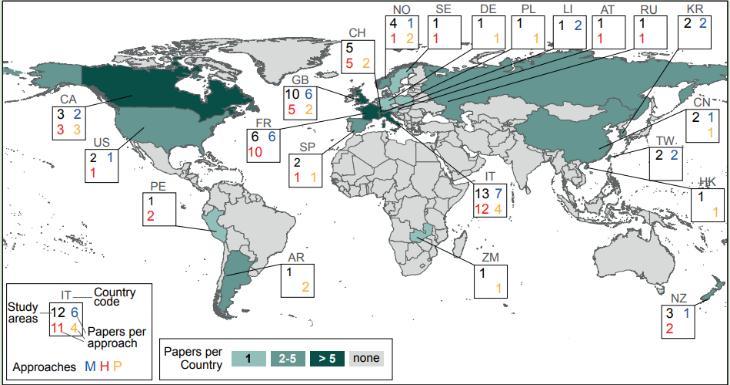
Geographical distributionof landslide climatestudies.For each country, the number of study areas and the number of papers for three different approaches are given. Approaches:M,modellingapproach;H,historicalanalysis; P,analysisofpaleolandslideevidence.Fivecontinentsare represented, with many studies in Europe (69), followed by North America (10), Asia (7), South America (4), Oceania (3), and Africa (1). The Alps are the most investigatedphysiographicarea.
[8] Shrikant Karlekar (2012): The author introduces the identification, mapping and monitoring of land sliding susceptible zones helps in the mitigation of landslides as well as in rehabilitation of affected people. This paper aims at preparing a landslide susceptibility zonation map of the Raigad district of Maharashtra using multivariate analysis. The morphology of slope failure clearly reflects theprocessesandcausativefactorsbehindtheoccurrence of landslides. Thus, various hillslope form attributes such as total ground length covered by the landslide, surface irregularityandcrest curvatureof the landslidescar have been estimated for all the landslides reported from western ghat and Konkan region of Raigad. These attributes subsequently were used to derive landslide form attributes such as dilation index, tenuity index, displacement index etc. Finally, a landslide susceptibility zone map has been prepared based on the estimated susceptibility index. It can be seen from the map that the western ghat foot hill spurs and hilltops in the south eastern part of the district are prone to landslides. The coastal lateritic areas to the south are relatively more susceptible than northern coastal areas covered by basalt flows of aa type. The northern and north eastern hilly regions of the district covered by pahoehoe flows also show more than 52% susceptibility to landslides. The landslides in Raigad district of Maharashtra are the result of instability of slopes created by deforestation, road cutting and increase in the water content of weathered rocks and decrease in lateral support. The landslides in
coastalareasshowslightlymoredilationthanthoseinthe Sahyadri’s. The displacement index is however more in caseoflandslidesintheSahyadri’s.
[9] Highland & Bobrowsky et al. (2008): They stated that the downward movement of slope forming materials undertheinfluenceofgravitywhichcanbeconsidered as ahighnegativelyimpactinggeologicalhazardonthesocio economic conditions (Baum & Godt, 2010; Petley, 2012). Rainfall is the most common triggering mechanism of landslides(Song,Chae,&Lee,2016;Tu,Kwong,Dai,Tham, & Min, 2009), hence it is of prime importance to develop real time warning systems to manage risk and minimize theimpactoflandslidestriggeredbyrainfall.However,the state of knowledge and resources available to issue real timewarningsofrain inducedlandslidesvariesacrossthe globe. Existing warning systems against rainfall induced landslides are based on rainfall threshold for an area or deformationofaslope,inwhichonlythelatterisbasedon the characteristics of a slope such as geometry, rainfall infiltration characteristics, and mechanical characteristics oftheslope(Sasahara,2017),whichvariesmorespatially. Therefore, this study set out to investigate the usefulness of such physical parameters in producing a real time warningforrain inducedindividuallandslides.
[10]KellerandBlodgett(2004):TheyexplainedthatStudy the physical variables as slope and hydrology network is important to understand the landslides effects in the landscape and a comparison between areas with landslides and without landslides could be significant to explain the consequences of this geomorphological element.Therefore,thisresearchisfocusedinexplainthe landslidesprocessesinTenerifeandElHierrostudyingthe characteristics,effectsandconsequencesinthelandscape, and determinate if landslides are the predominant geomorphologicalelementinthelandscape.Inconclusion, landslides by themselves cannot be considered the main factorinthegeomorphologyoftheTenerifeandElHierro, but this geomorphological element combinedwith land movements (uplift and subsidence) and volcanic activity, are the three factors that are shaping the landscape in both islands, considering the volcanism the main agent in the origin of the landslides and in the post landslide’s events.
[11]OliverKorup(2002):Thisreviewtakesacriticallook at recent trends and developments in international and New Zealand based research on landslide dams. Temporary or permanent stream blockages by mass movements commonly occur in steep terrain, and gradually receive more attention and awareness with increasing population and land use pressure in upland regions.Thisreviewofrecentliteratureonlandslidedams isanattempttoappreciatethecurrentstateofknowledge and to elucidate several directions of future research
potential. Since much of the previous work is scattered in local case studies, organizational means to overcome this shortcoming have seen increasing integration of information into large high quality databases. This is an essential step towards future conclusions and interpretations. Hopefully it will overcome the difficulties presented by the wealth of existing, mostly descriptive data. Current research problems are basically inherent in the often transient and event type character of landslide dam formation occurring over geo(morpho)logical timescales, a characteristic that, for instance, seriously restricts process based studies of dam failures. A major uncertainty in this regard is the lack of both theoretical andempiricaldataonthelongevityorlocalresidencetime oflandslidedamsandtheirassociatedlandforms.Thefew existing morpho chronological models of stream impoundments by mass movements are but a starting point for assessing the long term impact of these phenomena regarding concepts such as those of channel hillslopecoupling orlandscapesensitivity(e.g., Brunsden, 2001). With a view to clarifying or navigating the many black and grey boxes in present knowledge by devising new and creative methodologies, the following possible researchdirectionsdeservespecialattentioninthefuture.
[12] P. Aleotti& R. Chowdhury (1999): This paper deals with several aspects of the assessment of hazard and risk oflandsliding.Inrecentyearstheinterestinthistopichas increased greatly and there are many technical papers dealing with this subject in the literature. This article presents a summary review and a classification of the main approaches that have been developed world wide. The first step is the subdivision between qualitative and quantitative methods. The first group is mainly based on the site specific experience of experts with the susceptibility/hazard determined directly in the field or bycombiningdifferentindexmaps.Theapproachesofthe second group are formally more rigorous. It is possible to distinguish between statistical analyses (bivariate or multivariate) and deterministic methods that involve the analysis of specific sites or slopes based on geo engineeringmodels.Suchanalysescanbedeterministicor probabilistic. Among the quantitative methods discussed is the Neural Networks approach which has only recently been applied to engineering geology problems. Finally, several considerations concerning the concept of acceptableriskandriskmanagementarepresented.
3. CONCLUSIONS
This paper is done to understand and manage landslide hazard at Panhala region. Following conclusions are drawn:
*Hill slopemonitoringisessential toavoidsuchlandslide nearhabitants’area.
* Soil erosion is also the causative factor;
can be reduced by increasing the vegetative
* The main cause for hill slope failure was an improper drainage system at the top and middle part of the hill, which have created a more pore water pressure in
* Mitigatory measures to be adopted are drainage correction, proper land use, reforestation, and creation of awarenessamonglocalpeople.
REFERENCES
[1] Chetan R. Shah, Sandip S. Sathe (2021): GEOLOGY, ECOLOGY,ANDLANDSCAPES2021,VOL.5,NO.1,1 6 doi.org/10.1080/24749508.2019.1695714.
[2] Mr.JayeshB.Patil&Dr.A.B.Landage(2021):Volume: 08 Issue: 10 | Oct 2021 e ISSN: 2395 0056 p ISSN: 2395 0072.
[3] SachinVerma&VidyaSagarKhanduri(2019):Review on Landslide Hazard Management at Himachal Pradesh. (E ISSN 2348 1269, P ISSN 2349 5138) Volume6,Issue1.
[4] Paola Reichenbach & Mauro Rossia (2018): 0012 8252/©2018TheAuthors.PublishedbyElsevierB.V. ThisisanopenaccessarticleundertheCCBY NC ND license (creativecommons.org/licenses/BY NC ND/4.0/).
[5] DattatrayaJ.Khamkar,SumedhY.Mhaske,Pandurang D.Sabale(2018):InternationalJournalofEngineering &Technology,7(3.29)(2018)524 528.
[6] Stefano Luigi Gariano & Fausto Guzzetti: Session NH9.1/CL2.26,AbstractID:EGU2017 503.
[7] G. Shanmugam (2015): Journal of Paleogeography 2015,4(2):109 166.
[8] Shrikant Karlekar (2012): Journal of Indian Geomorphology Volume 1, 2012 / ISSN 2320 0731 (IGI).
[9] Highland&Bobrowskyetal.(2008):Thecontribution of landslides to landscape evolution in Europe. Geomorphology.15,p191 211.
[10] KellerandBlodgett(2004):DissertationinGeography, University of Plymouth, 2014. Journal of Geotechnical andGeo environmentalEngineering,139(3),507 510. doi:10.1061/(ASCE)GT.1943 5606.0000786.
[11] Oliver Korup (2002) NZ Progress in Physical Geography 26,2 pp. 206 235 Sr. No. 10.1191/0309133302pp333ra.
[12] P. Aleotti& R. Chowdhury. (1999): Bull Eng Geol Env (1999)58:21 447QSpringer Verlag.