
POTHOLE DETECTION SYSTEM USING YOLO v4 ALGORITHM
of Information Technology, Atharva College of Engineering, Maharashtra,
of Information Technology,

There are many potholes present on the road. This can lead to major accidents. Every year around 3597 people die due to these potholes. To tackle and detect such potholes we have come with this project. The goal of this project was to create a pothole detection system that is specifically designed to detect potholes. This model was developed using the YOLO (You Only Look Once) algorithm for real time object detection. It is a pretrained model which detects the pothole using YOLO v4. Previously sequential CNN (Convolution Neural Network) Algorithm was used but later we figured out after a comparative analysis that YOLO gave better results in real time. A GUI (Graphical User Interface) was added to the model so that we can simulate the model using the start and stop button. This system consists of a camera that, when activated, extracts images from live camera recording in order to detect potholes. It will display potholes in real time, and the pothole will be highlighted with boxes, as seen in real time object detection systems. This system provides us with an accuracy of 80 85%.
Key Words: You Only Look Once Algorithm, Convolutional Neural Network, real time detection, GraphicalUserInterface,potholedetection,accuracy
1. INTRODUCTION
Obstacle detection has been the subject of extensive research in the past, with different methods for avoiding various types of impediments in diverse environments being tested. However, the focus has been mostly on autonomous agents avoiding impediments, which has been confined to extruding obstacles. As a result, the detection mechanism became exceedingly system specific and unsuitable for widespread use. Road transportation hasbeenverysimpleandcost effective,albeitthecomfort oftherideisdeterminedbythestateoftheroad.Potholes onroadwaysareabigsourceoffrustrationforpeoplewho travelbycar.Accidentsandlossofhumanlivesarecaused bypotholesgeneratedbysevererainfallandheavyvehicle activity.[1]Asaresult,potholesarebecomingasignificant concern to drivers, who risk accidents and car damage. Unexpected humps and ditches on the road could lead to more collisions. As a result, the potholes must be filled to maketheridemorecomfortableandtoeliminatepotential hazards. As a result, the suggested system employs the YOLO (You Only Look Once) v4 Algorithm to detect
College of Engineering,
potholes. We utilized the following ways to test this model:
● Building a model that will detect the potholes in its path.
● Highlightingthepotholessothatthepersonisalerted.
Fig 1:Conditionsofroadswithpotholes.
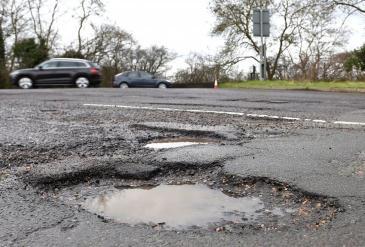
Manually examining and evaluating visual pavement data is a time consuming and costly process, and the findings areheavilyimpactedbythesubjectivityandexperienceof evaluations.[5] The primary objective of this system is to detect the potholes present on the road through deep learning approach which helps automate the task of detectingpotholesandhelpsonetoeasilyunderstandthat they are heading towards a pothole present on the road. Thefollowingisdiscussedintherestofthepaper:Section 2 discusses some of the related projects or literature review. Section 3 provides the methodologies used. The technical components used is presented in Section 4. Section 5 presents the implementation and Section 6 presents the comparative analysis between CNN (Convolutional Neural Networks) and YOLO v4 of the proposed system and Section 7 describes the conclusion andfurtherresearchwork.
2. LITERATURE REVIEW
(1) In a paper titled ‘Deep Learning Based Pothole Detection and reporting System (IEEE 2020)’, they have used accelerometer and ultrasonic sensor, mounted it in
the bottom of a car, and driven the car at 25 km/hr and also used a GPS to identify the location. The micro controllerdetectsthepotholeandgivesthelocationtothe control room. The microcontroller (ATmega328) initializes the GPS and provides us the Coordinates. The methodology used was Comparative study between CNN, KNN(k NearestNeighbors),Kirchoff’sTheoryMethod.(2) Inthepaper,‘AModernPotholeDetectiontechniqueusing DeepLearning(IEEE2020)’,theyhavemountedacamera onthecarandthendetectedthepotholesandmarkedthe locationusingtheappthatisdevelopedbythemsothecar which does not have the camera can get the information aboutthepotholeusingtheapplicationandgivethedriver the required alerts. They have not mentioned about the accuracy of their project. The methodology used was F RCNN(fasterregionbasedConvolutionalneuralnetwork). (3) In the paper ‘Development and Analysis of Pothole detectionandAlertbasedonNodeMCU(IEEE2020)’,one candepictthedepthanddangeraccompaniedwithit.The location is shared using GPS module and IFTTT (if this, then that) server to the mails of the maintenance authorities who can take the necessary actions. The methodology used was a model created using node MCU, GPS module, Ultrasonic sensor, IFTTT Webhooks. (4) In the paper ‘Smart Detection and Reporting of Potholes via Image Processing using Raspberry Pi Microcontroller (IEEE 2018)’, The whole system was successfully implemented using the Raspberry Pi microcomputer with a 100% reporting success rate. The methodology from a moving car, it was able to locate and report potholes, the system used image processing, the integration of which wasusedtoproduceanalgorithmusingPythonLanguage from the OpenCV library to detect and report potholes automatically. The reported image of the pothole and its location was stored and viewed through the Internet, Dropbox, and the webserver. (5) In the paper titled ‘Deep learning algorithm based on YOLO Neural Network for detecting potholes in asphalt pavement. (International Seminar on Intelligent Technology and Its Applications (ISITIA) 2019)’, the model with Yolo neural network succeeded in detecting potholes for asphalt pavement images. It shows a satisfactory detection accuracy of the applied architecture, Yolo v3, Yolo v3 Tiny, Yolo v3 SPP. Which present the mAP of 83.43%, 79.33%, and 88.93% respectively, and the area measurement accuracy of 64.45%, 53.26%, and 72.10% respectively. Also, it needs an average detection time of 0.04 seconds per image. Therefore, it has a high opportunity to be developed and implemented.TheyusedtheYoloV3Algorithm.
3. METHODOLOGY
Fig 2: SystemBlockDiagram
The system block diagram is shown in Fig 2 The proposedsystemworkswiththehelpofaverysimpleand user friendly GUI which provides you with two options, “Start” and “Stop”, and helps you achieve real time potholesdetectionusingYOLOv4algorithm.
When one selects the “Start” Option, the Camera switches on and live detection of potholes takes place. Now the camera keeps on recording while the YOLO v4 algorithm works in the back end simultaneously. The required information necessary for detecting the potholes is captured.
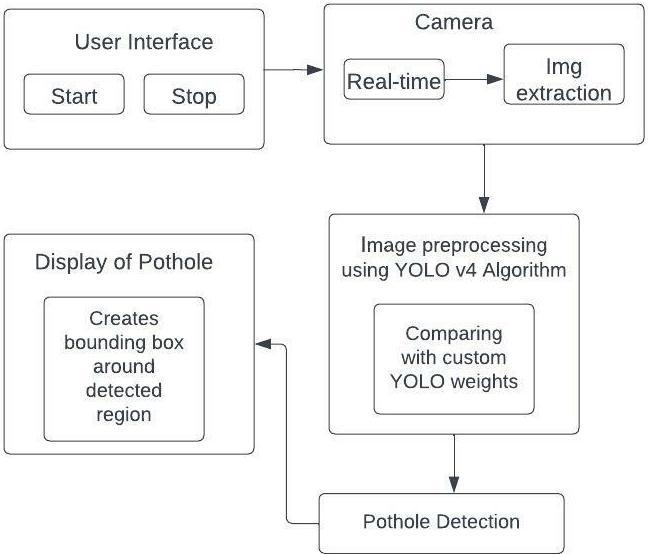
The images are extracted throughout the live recording and accordingly a detection process is carried out. The YOLO v4 algorithm takes these images one by one and processes it. It compares the information recorded from the images with the yolo weights. When a pothole is detected, it predicts a bounding box around it. The bounding box consists of a Box Label and Predicted AccuracyPercentagewhereAccuracyPercentagerefersto the percent of how accurately a pothole is detected. Whatever number of potholes are detected in each image getsreflectedontheconsoleoutput.
As you select the “Stop” option, the system exits the GUI andthusthedetectionprocessstops.
4. TECHNICAL COMPONENTS OF PROPOSED SYSTEM
i. HARDWARE REQUIREMENTS
a. LaptoporPC:
A good laptop with Nvidia 1660 GPU and 8 GB RAM was goodenoughforthissystemasYOLOrequiresagoodGPU tomakeitefficient.
Camera:
SOFTWARE REQUIREMENTS
VisualStudio:
Microsoft Visual Studio is a Microsoft integrated development environment. It's used to make websites, web apps, web services, and mobile apps, among other things. Wehavedonethecodingpartofthissystemusing VisualStudio.
5. IMPLEMENTATION
Improving the safety of traffic is an important issue in Indian telecom services (ITC). This proposed model is a pothole detection system based on machine learning and image processing using the YOLO Algorithm. This system will help to detect the potholes present on the road and give a warning to the driver. The motivation here is to servehumanitybetterwiththehelpoftechnology.
5.1 Pre processing of Data
Data preprocessing is a crucial phase in the data miningprocessthatinvolvesmanipulatingorremovingor adding data before it is utilized to ensure or improve performance. In data mining and machine learning initiatives, the phrase "garbage in, trash out" is especially apt. Since our YOLO v4 Model is pretrained we had to input a few images or videos as our data while now, with real time detection system, images are automatically extractedfromliverecordingthrough thecamera andare furtherprocessedusingtheYOLOv4Algorithm.
5.2 Deep Learning Approach
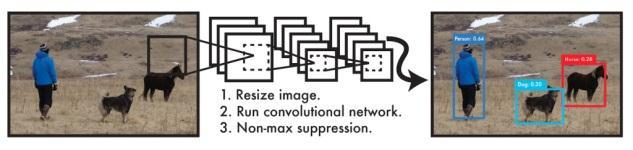
The YOLO V4 algorithm is used in the suggested system. "You Only Look Once" is the acronym meaning "You Only Look Once." It is a state of the art, real time object identification system developed by Joseph Redmon that can distinguish several items in a single frame. YOLO takes a completely different technique to detection than earlier technologies. It uses a single neural network to processtheentireimage.Theimageisdividedintoregions by this network, which predicts bounding boxes and probabilities for each region. The projected probabilities areusedtoweighttheseboundingboxes.
YOLOv4 is well with its AP and FPS improvements. On a single CPU, YOLOv4 optimizes real time object detection andtraining.OntheCOCOdataset,YOLOv4achievedstate of the artperformancewith43.5percentspeed(AP)at65 framespersecond(FPS)onaTeslaV100.
The basic concept of YOLO is illustrated in the diagrams below.YOLOdividestheinputimageintoaSxSgrid,with each grid cell anticipating the object that is centered in thatgridcell.
Fig 3. S x S Grid
Boundingboxesandconfidencescoresforthoseboxesare predicted in each grid cell. These confidence scores represent the model's belief that the box contains an object as well as the accuracy with which it believes the boxitforecastsis.
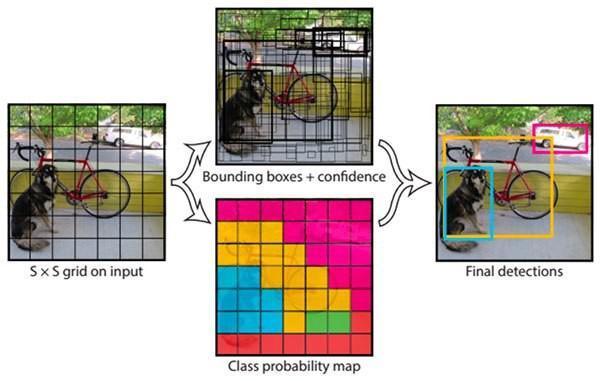
Fig 4: YOLOConcept
5.3 GUI for simulation
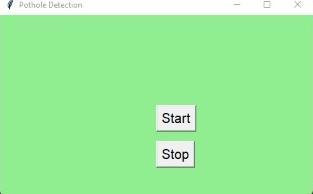
A simple GUI (Graphical User Interface) using Tkinter wasmadesothatwecanturnonandoffthesimulationof the detection of potholes. When you turn on the system, the camera starts capturing and you can detect the pothole. You will see if the pothole is detected or not and then can turn off the simulation by clicking on the stop button.TheGUIisdisplayedinfig5below.
Fig
5.4 SYSTEM FLOW
modelworks
6: Flowchartofthemodel
In this model first we had to upload the image/ video in the code to get the desired output. So, for the improvement and to make it usable we connected our model to a live camera to get a real time detection of the potholes.
Thesystemflowisasfollows:
When the system starts, the camera is switched on and real time detection of potholes using Yolo V4 algorithm takes place. The images are extracted from live video and processed in order to detect potholes. The detected potholes are displayed in bounding boxes and as a result real timepotholesdetectionisachieved.
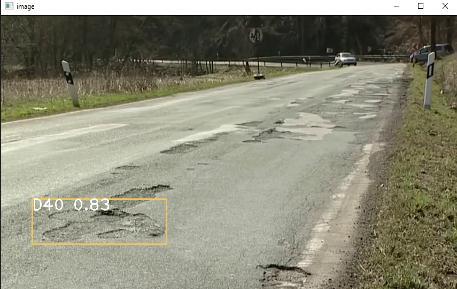
Hereareafewimagesofourresults:
Fig 8: ResultimageofDetectedpothole(2) ClassLabel:D40,Accuracyachieved:83%
6. COMPARATIVE ANALYSIS AND EXPERIMENTAL RESULTS
A comparative analysis of two Algorithms was done. CNN and YOLOv4 were tested and the table 1 below, explains theresults.
Table 1: ComparativeanalysisofDifferentAlgorithms
Algorithm Used Description Accuracy
CNNModel
The previous tested system used CNN module to train and test the model and created a confusion matrix as an output to show whether the image belonged to the normal category or the pothole category. It wasnotagreatoptionto go ahead with this as it was not able to perform wellinrealtime.
We achieved a good accuracy of about 80 82% but this model took much longer time to detect the pothole
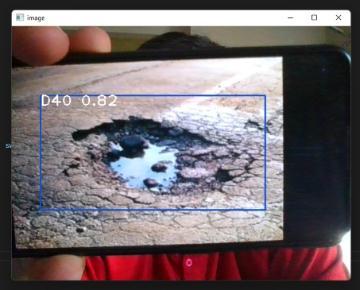
Fig 7: ResultimageofDetectedpothole(1)
82%
YOLOv4Model
We used the Yolo v4 image classification algorithm for detecting the potholes. In this proposed system the potholes are detected in real time instead of uploading some image/video in the code. It was a pretrained model and could easily detect potholes in real time as compared to CNN.
This model easily achieved a great accuracy of 85% 90% on average in real time pothole detection system.
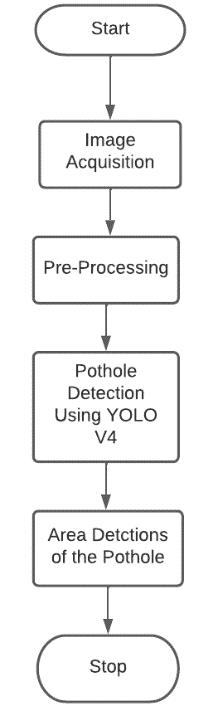
Fig 9: PotholeAccuracyof69%and63%
Above Fig 9 shows the detected pothole in bounding boxes.Twopotholesarepresentandbotharesuccessfully detected with 69% accuracy and 63% accuracy with D40 asclasslabels.
Note: Intheaboveimages, ‘D40’and‘D20’areclasslabels. Thefollowingtable2can bereferredto knowitsdetailed information:
Table 2: RoadDamageTypes
Damage Type Detail Information Class Label
Longitudinal Wheel markedpart D00
Transverse EqualInterval D10
Crack
Alligator Partial/Overall pavement D20
Other Damage Pothole D40
7. CONCLUSIONS
In this paper we have discussed the pothole detection systemusingYOLOV4Algorithm.
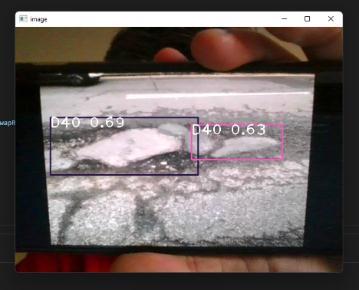
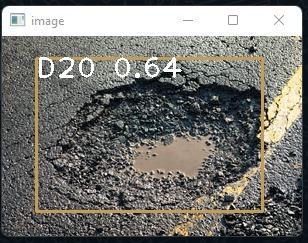
Fig -10: PotholeAccuracyof64%
Above Fig 10 shows the detected pothole in a bounding box. One pothole is present and is detected with 64% accuracywithD20asclasslabel.
Decision of using YOLO V4 was great because the biggest advantage of using YOLO is its superb speed it’s incredibly fast and can process 45 frames per second. YOLOalsounderstandsgeneralizedobjectrepresentation. It is one of the best object detection algorithms, with a performance that is comparable to that of the R CNN algorithms. The system provides several benefits and can operate with less manpower. Hence, we have successfully completed the training and testing of our model using YOLO V4. The system successfully detects the potholes withagoodaccuracyofapprox 85%.
REFERENCES
1) E.J.Reddy,P.N.Reddy,G.Maithreyi,M.B.C.Balaji,S. K. Dash and K. A. Kumari, "Development and Analysis of Pothole detection and Alert based on NodeMCU," 2020InternationalConferenceonEmergingTrendsin Information Technology and Engineering (icETITE), 2020, pp. 1 5, doi: 10.1109/icETITE47903.2020.347M. Young, The Technical Writer’s Handbook. Mill Valley, CA: UniversityScience,1989.
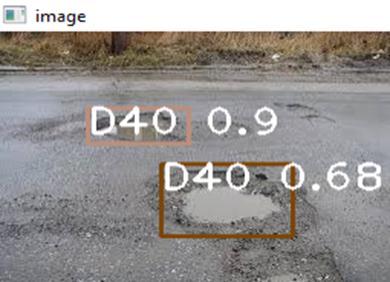
Fig 11: PotholeAccuracyof90%and68%
Above Fig 11 shows the detected pothole in bounding boxes.Twopotholesarepresentandbotharesuccessfully detected with 90% accuracy and 68% accuracy with D40 asclasslabels.
2) S. Hegde, H. V. Mekali and G. Varaprasad, "Pothole detection and inter vehicular communication," 2014 IEEE International Conference on Vehicular Electronics and Safety, 2014, pp. 84 87, doi: 10.1109/ICVES.2014.7063729.
3) G.Singal,A.Goswami,S.Gupta,Tchoudhury“PITFREE: Potholes Detection on Indian Roads Using Mobile sensors” IEEE 8th International Advance Computing Conference(IACC),14th 15thdec.2018.
S.Barnwal“VehicleBehavioranalysisforunevenroad surfacedetection”IEEE18thInternationalConference on Intelligent Transportation Systems, 15th 18 Sep 2015.
5) Ch. Koch, I. K. Brilakis, “Improving Pothole Recognition through Vision Tracking for Automated Pavement Assessment”, In Proc.of EGICE Workshop, pp.1 8,2011.
6) A.Mednis G. Strazdins, R. Zviedris, G. Kanonirs, L. Selavo, “Real time pothole detection using Android Smartphones with Accelerometers”, In Proc.of InternationalConferenceonDistributedComputingin SensorSystemsandWorkshops,pp.1 6,2011,2011.
7) P. Mohan, V. N. Padmanabhan, and R. Ramjee, “Nericell: using Mobile Smartphones for Rich MonitoringofRoadandTrafficConditions,”InProc.of ACM Conference on Embedded Network Sensor Systems,pp.357 358,2008