¹
International Research Journal of Engineering and Technology (IRJET) e-ISSN: 2395-0056

Volume: 09 Issue: 12 | Dec 2022 www.irjet.net p-ISSN: 2395-0072
¹
International Research Journal of Engineering and Technology (IRJET) e-ISSN: 2395-0056
Volume: 09 Issue: 12 | Dec 2022 www.irjet.net p-ISSN: 2395-0072
- Frist Author, PG Student, M.E Transportation Engineering and Management, Dr. Rajendra Gode Institute of Technology and Research, (SGBAU) Amravati
2- Second Author, Professor and Head, Civil Engineering Department, Dr. Rajendra Gode Institute of Technology and Research, (SGBAU) Amravati
3 – Third Author, Assistant Professor, Civil Engineering Department, Dr. Rajendra Gode Institute of Technology and Research, (SGBAU) Amravati ***
Abstract - As the population grows and their mobility needs become more intricate, transportation systems must evolve to address advanced mobility issues. Furthermore, there are various instances in which traditional methods are useless, such as when processing large amounts of data provided by in-vehicle sensors and network devices. To solve these issues, several Artificial Intelligence-based solutions have been deployed to various areas of the transportation environment. In this study, the traffic system of Amravati city mainly in Rajkamal Square is studies as it is the most busy area in the city. The traffic density passing from the square in one hour by the conventional traffic signaling system is calculated. Then the probable outcomes from the proposed traffic signal controlling system created using artificial intelligence by scratch pygame python programming and algorithm was compared with the conventional one and results were drawn. It was seen than the proposed system is more effective and efficient than the current system since is can pass more vehicles in an hour than the current one reducing congestion occurs at traffic signal hence reducing fuel consumption and environmental pollution. The proposed traffic signaling system can be used all over the country for reducing problems like congestion and pollution occurs due to traffic jams at signal junction.
Technology has previously benefited organizations in resolving challenges; some of these solutions have revolutionized the way businesses run by lowering operating costs and increasing efficiency. The transportation industry is one of the nextindustriestosuccessfullyadoptnewtechnology,asitfaceshurdlessuchastrafficcongestion,unexpecteddelays,and routingissues,allofwhichresultinfinanciallossesforthecompany.Trafficcongestion,airandnoisepollution,andtraffic accidents are all serious concerns in metropolitan areas as the number of private automobiles on the road increases. Urban traffic congestion is becoming one of the most significant concerns. Smarter transportation networks, specifically intelligent/smart transportation, is one of the key smart city visions. Artificial intelligence (AI) has been instrumental in realizing the goal of a smart city. The former offers a scalable and dependable data collection and transmission infrastructure.Machinesforintelligenttransportationapplicationsbenefitfromthelatter'screativeanduniquequalities.
Artificial intelligence (AI) has emerged as a prominent area of research to address most of the present environmental sustainabilitydifficultiesasaresultofglobalenvironmentalchallengesinthetwenty-firstcentury.Adetailedgraspofthe links between AI and data on the one hand, and transportation system characteristics and elements on the other, is requiredforsuccessfulAIimplementation.It'salsohopedthattransportationofficialswillfigureouthowtoemploythese technologytoimprovetrafficcongestionandtraveltimes.(Abduljabbaretal.,2019)
In this project, artificial intelligence is used to deploy a smart traffic light control system in Amravati to address issues such as traffic delays, environmental pollution, and carbon emissions caused by excessive fuel burning during traffic congestion, and large red time delays. Amravati was chosen for the proposed project since it is one of Maharashtra's fastest growing cities. By implementing a system that aims to reduce such problems by automatically computing the optimalgreensignaltimebasedonthecurrenttrafficconditionatthesignal,wecanensurethatthe directionwithmore traffic is allotted a green signal for a longer period of time as compared to the direction with less traffic, jams at traffic signalsandmorefuelconsumption.
Artificial intelligence (AI) is a vast field of computer science that aims to make machines behave like humans. AI is sometimes defined as a machine's ability to conduct human-like cognitive processes. Processing the data using powerful
International Research Journal of Engineering and Technology (IRJET) e-ISSN: 2395-0056
Volume: 09 Issue: 12 | Dec 2022 www.irjet.net p-ISSN: 2395-0072
algorithmshasprovidedsignificant benefits togovernmentsandcorporationsinrecent years.Initscurrent state,AIcan handle challenges in real-time transportation, such as controlling the design, operation, timetable, and administration of logistical systems and freight transportation. The research focuses on specific areas of concern in the transportation industry, as well as difficulties that can be addressed with AI. Traffic Management, Public Transportation, Safety Management,Manufacturing,andLogisticsaresomeofthesub-systemsconsideredinIntelligentTransportationSystems whereAIbenefitsareputtouse(Iyer,2021). Overtheyears,AItechnologieshavebeendeployed,andthispaperexplains how they might be useful to transportation applications. The most important AI application areas include system identification and function approximation, nonlinear prediction, design, planning, optimization, decision making, clustering, and pattern recognition (Kyamakya,2006) Artificial intelligence technologiesenablethecreation of roadand highwayecosystemsviatheInternetanddigitalplatforms.Theseecosystemsenablethecollectingandanalysisofdataon vehicles and road infrastructure to solve a wide range of problems related to transportation management. The use of "smart" control systems for federal roads and highways that are synced with the transportation control systems of significant cities and other territories allows for increased cargo turnover and passenger flow while maintaining traffic safety(Okrepilovetal.,2022).
Transportation is not overlooked by intelligent technologies that are infiltrating various aspects of human life. These technologies are designed to improve people or products mobility while also improving road safety and transportation comfort, reducing transportation collisions, and reducing environmental impacts. AI approaches enable apps to manage the complete transportation system - vehicles, drivers, infrastructure, and how these components dynamically supply transportation services (Šusteková D & Knutelská M, 2015). The use of artificial intelligence in transportation aims to addressthedifficultiesofrisingtraveldemand,CO2emissions,safetyconcerns,andenvironmentaldegradation.Whenthe systemandusers'behaviouraretoodifficulttomodelandpredict,transportationdifficultiesbecomeahurdle.Asaresult, AI is seen as a good fit for transportation systems to address issues such as rising travel demand, CO2 emissions, safety problems, and environmental degradation (Abduljabbar et al., 2019) Artificial Intelligence (AI) has the potential to provideavehiclefortransformationinatimewhentheneedtoshifttoamoresustainabletechno-socialparadigmismore pressing than ever before to avoid the negative consequences of a resource-intensive and unthinkingly opportunistic liveability philosophythatdoesnotlookfarinthefuture. AIisdescribedasasystem'sabilitytoaccuratelyreadexternal input, learn from it, and apply that learning to accomplish specific goals and activities through flexible adaptation. By eliminatingtheneedforhumanlabourandgreatlyenhancingourscientificandtechnicaladvancement,AIhasthepromise of making us healthier, wealthier, and happier (Nikitas et al., 2020). The evolution of transportation systems to tackle advanced mobility problems has become required as the population grows and their mobility needs become more sophisticated(Machinetal.,2018).
The research was carried out in Amravati city. Population wise it is the 2nd highest populated city after Nagpur in the Maharashtra’s Vidarbh region with population 7,78,087. Rajkamal Square is the most busy square and most populated area in Amravati so it is selected for the study. Rajkamal is moving from developing to developed area, resulting in urbanizationandvehiculartrafficasitamainandcentralareaconnectingGandhichowk,Jawahargate,Jayastambh,Main marketline,Rajapeth,BusstandandRailwaystation.
The analysis was conducted using a simple framework for evaluating the existing traffic signal network present at RajkamalSquare.Readingsofvehiculartrafficforcalculatingthetrafficdensityweretakenforthreetimesforthedifferent timingofadayi.e.inmorning,afternoonandateveningfor1houreachandtheresultobtainedfromconventionaltraffic signalsystemwerecomparedtoproposedtrafficsignalsystemandconclusionwasdrawn. Thedatawascollectedbythe videostakenatthetrafficjunctionandfieldsupervisionbyphysicalattendance.
In this study, Microsoft Excel was used for statistical analysis. Firstly the vehicular density of 1 hour is divided into 12 groupsof5minutesforallthethreetimingineachfourlaneandthedata wastabulated.Thentotalnumberofvehicleson four lane passed in 5 minutes was calculated and then all the vehicles passing through traffic junction in 1 hour from all the four lanes was calculated. Results obtained by calculating the traffic density passing in 1 hour both by conventional andproposedsystemwerecomparedandfurtherconclusionwasdrawn.
International Research Journal of Engineering and Technology (IRJET) e-ISSN: 2395-0056
Volume: 09 Issue: 12 | Dec 2022 www.irjet.net p-ISSN: 2395-0072
Fig. 1 Flowchart of the Stimulation
The traffic flow has no specific pattern that is followed, and the static signal timers pose a huge problem to the already critical problem of congestion. Therefore implementing a system which aims to reduce chances of such scenarios by automaticallycomputingtheoptimalgreensignaltimebasedonthecurrenttrafficconditionatthe signalwillensurethat thedirectionwithmoretrafficisallottedagreensignalforalongerdurationoftimeascomparedtothedirectionoflessor traffic.Thissystemcanoverridetheoldersystemofhardcodedlightswhichcauseunwanteddelays,reducingcongestion and waiting time which will reduce the number of accidents and fuel consumption which in turn will help in controlling theairpollution.
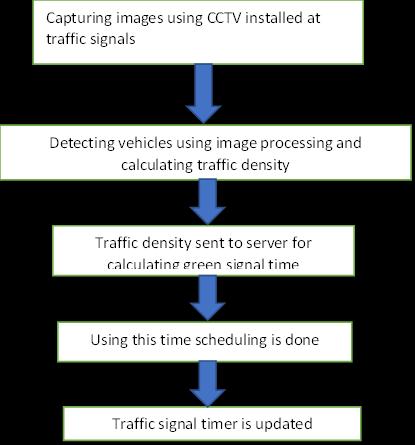
The main objective of this project is to design a traffic light controller based on Computer Vision that can adapt to the currenttrafficsituation.TheproposedsystemaimstouselivevideofeedfromtheCCTVcamerasatthetrafficjunctionsfor therealtimetrafficdensitycalculationbydetectingthevehicleatthesignalandsetthegreensignaltimeaccordingly.The vehiclesareclassifiedasbike,car,bus/truckandrikshawtoobtainamoreaccurateestimateofgreensignaltime.
Realtimetrafficlightswitchingaccordingtothecurrenttrafficdensity
Virtuallynonewhardwaretobeinstalled
Lessexpensivethansensors
Autonomous:Noneedofmanpower
Proposed system will pass a snapshot from the CCTV cameras at traffic junctions for real time traffic density calculationusingimageprocessingandcomputervision.
ThisprojectusedcustomizedYOLO(youlookonlyonce)modelforobjectdetectioninordertodetectvehicles.
2022, IRJET | Impact Factor value: 7.529 | ISO 9001:2008 Certified Journal |
International Research Journal of Engineering and Technology (IRJET) e-ISSN: 2395-0056
Volume: 09 Issue: 12 | Dec 2022 www.irjet.net p-ISSN: 2395-0072
The scheduling algorithm will use this traffic density and appropriately set the optimal green signal time for each signal,andupdatetheredsignaltimesoftheothersignals.
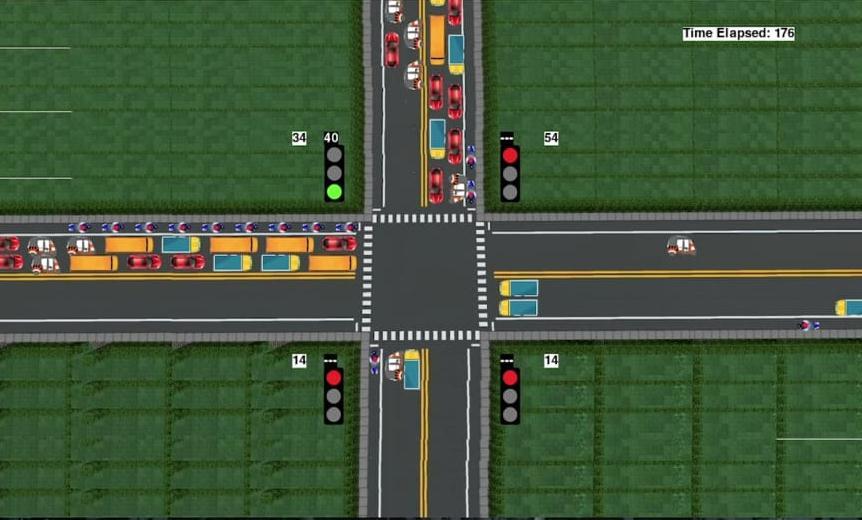
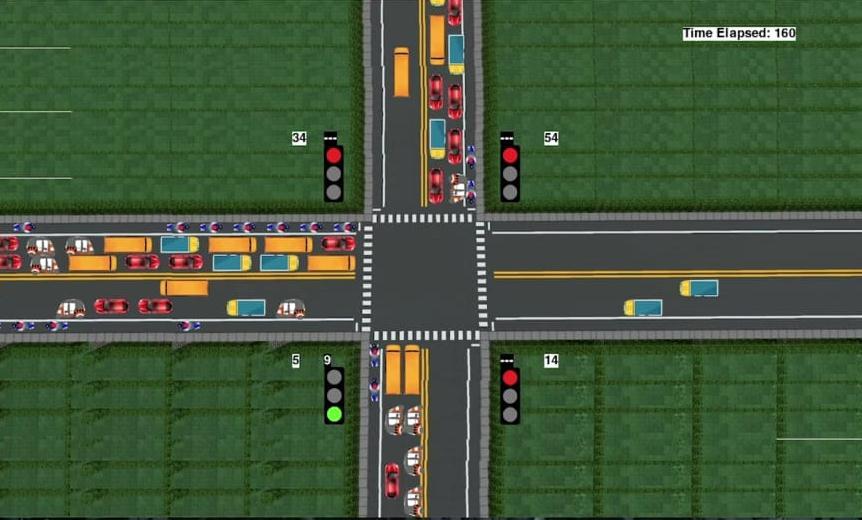
Someofthefactorsconsideredinsignalswitchingalgorithm:
o Theprocessingtimeofthealgorithmtocalculatetrafficdensity
o Theno.oflanes
o Lageachvehiclesuffersduringstart-up
o Thenon-linearincreaseinlagsufferedbythevehicleswhichareattheback
o Themaximumandminimumgreensignal timethatcanbeset – Thisisdonetopreventstarvationofthelane with lesstraffic
Fig.2Lowerthegreentimeasno.ofvehiclesareless
Fig.3Greatergreentimesetsasno.ofvehiclesaremore
International Research Journal of Engineering and Technology (IRJET) e-ISSN: 2395-0056
Volume: 09 Issue: 12 | Dec 2022 www.irjet.net p-ISSN: 2395-0072
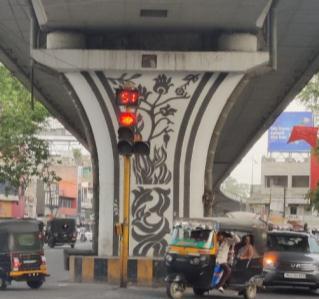
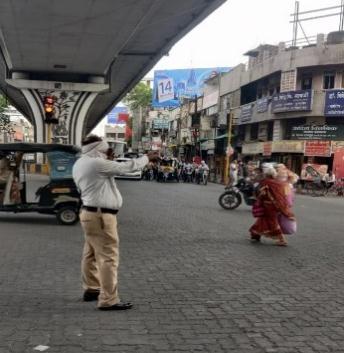
Fig.4 Due to inferior traffic signaling system, manpower is required to control the traffic
Comparedthetotalnumberofvehiclesthatcrosstheintersectionoveraperiodof5minutesinthecurrentsystemandthe proposedadaptivesystemwiththesamedistributionoftraffic,overatotaltimeof1hourwith12simulationsof5minutes eachanddifferentdistributionsoftraffic.
Theresultsobtainedaretabulatedintheformofnumberofvehicleslane-wiseandthetotalnumberofvehiclespassed.
Table1.Vehicularcountatmorningaspercurrentsystem
CurrentSystem
SimulationNo Lane1 Lane2 Lane3 Lane4 Total 1 57 64 49 21 191 2 68 63 42 23 196 3 70 59 33 29 191 4 66 61 39 32 198 5 67 56 42 27 192 6 64 62 35 19 180 7 55 58 29 26 168 8 56 52 33 28 169 9 49 73 37 30 189 10 52 60 41 24 177 11 43 59 39 28 169 12 56 60 28 34 178 Total 2198
Table2.VehicularCountatMorningaccordingtoproposedsystem
ProposedAdaptiveSystem
SimulationNo Lane1 Lane2 Lane3 Lane4 Total 1 103 76 46 34 259 2 96 73 38 29 236 3 90 86 36 23 235 4 86 65 51 28 230 5 83 79 43 31 236 6 67 87 35 22 211 7 69 71 38 30 208 8 61 82 43 32 218 9 75 88 48 39 250 10 69 81 36 27 213
International Research Journal of Engineering and Technology (IRJET) e-ISSN: 2395-0056
11 101 95 26 26 248 12 68 77 43 43 231 Total 2775
Table3.Vehicularcountatafternoonaspercurrentsystem
CurrentSystem
SimulationNo Lane1 Lane2 Lane3 Lane4 Total
1 49 54 47 36 186 2 51 43 39 34 167 3 47 49 36 41 173 4 41 51 41 39 172 5 56 46 32 34 168 6 46 52 47 28 173 7 33 48 51 36 168 8 47 52 44 33 176 9 52 63 39 29 183 10 55 59 46 29 189 11 39 49 28 44 160 12 44 51 41 41 177 Total 2092
Table4.Vehicularcountatafternoonaccordingtoproposedsystem
ProposedAdaptiveSystem
SimulationNo Lane1 Lane2 Lane3 Lane4 Total
1 55 59 64 37 215 2 60 51 43 49 203 3 61 47 49 46 203 4 47 59 55 44 205 5 68 56 46 42 212 6 59 66 59 37 221 7 47 53 48 51 199 8 66 57 56 49 228 9 69 72 52 41 234 10 59 55 59 46 219 11 51 59 49 48 207 12 54 64 48 49 215 Total 2561
Table5.Vehicularcountateveningaspercurrentsystem
CurrentSystem
SimulationNo Lane1 Lane2 Lane3 Lane4 Total
1 67 64 51 32 214 2 68 63 47 29 207 3 62 62 33 31 188 4 76 71 41 43 231
Volume: 09 Issue: 12 | Dec 2022 www.irjet.net p-ISSN: 2395-0072 © 2022, IRJET | Impact Factor value: 7.529 | ISO 9001:2008 Certified Journal | Page1313
International Research Journal of Engineering and Technology (IRJET) e-ISSN: 2395-0056
5 67 56 34 27 184 6 74 52 39 38 203 7 65 67 51 39 222 8 60 68 48 28 204 9 49 73 39 35 196 10 47 60 42 31 180 11 57 66 47 29 199 12 43 69 39 23 174 Total 2402
Table6.Vehicularcountatafternoonaccordingtoproposedsystem
Simulation No Lane1 Lane2 Lane3 Lane4 Total
1 71 69 55 41 236 2 78 73 42 36 229 3 70 72 39 42 223 4 66 79 49 52 246 5 67 56 52 37 212 6 79 81 55 49 264 7 55 58 59 46 218 8 71 72 61 28 232 9 56 89 37 42 224 10 52 76 49 36 213 11 61 74 51 28 214 12 59 72 41 34 206 Total 2717
Aswecansee,withallconditionsalike,theadaptivesystemwasabletopass2775vehiclesatmorning,2591vehiclesat afternoonand2717vehicleateveningatRajkamalsquarewhilethecurrentstaticsystemcouldpassonly2198vehiclesat morning,2052vehiclesatafternoonand2462vehicleateveningrespectivelyinonehour,whichmeans577,481,315 morevehiclespassedthroughRajkamalsquareatmorning,afternoonandeveningrespectively.
V R =457.66 458………………(1) (2) ………………..(3)
Thustheproposedadaptivesystemcanimprovestheperformancebyover21%inanaverage.
The adaptive system on an average allows 458 more vehicles every hour and 39 more vehicles to pass every 5 mins as comparedtothestaticsystem.Thisimpliesreductioningreensignaltimeaswellaswaitingtimeofthevehicles.
Volume: 09 Issue: 12 | Dec 2022 www.irjet.net p-ISSN: 2395-0072 © 2022, IRJET | Impact Factor value: 7.529 | ISO 9001:2008 Certified Journal | Page1314
International Research Journal of Engineering and Technology (IRJET) e-ISSN: 2395-0056
Volume: 09 Issue: 12 | Dec 2022 www.irjet.net p-ISSN: 2395-0072
Thustheproposedsystemsetsthegreensignaltimeadaptivelyaccordingtotrafficdensityatthesignalandensuresthat the direction with more traffic is allotted a green signal for longer duration of time as compared to the direction with lessertraffic.Thiswill lowertheunwanteddelays andreducecongestionandwaitingtime whichwill turninreduce the fuelconsumptionandpollution.
According to the simulation results, the system shows about 21% improvement over the current system in terms of number of vehicles crossing the intersection which is a significant improvement. This system can be integrated with the CCTVcamerasinmajorcitiesinordertofacilitatebettermanagementoftraffic.
1. Abduljabbar,R.,Dia,H.,Liyanage,S.,&Bagloee,S.A.(2019).Applicationsofartificialintelligenceintransport:An overview. Sustainability (Switzerland), 11(1).https://doi.org/10.3390/su11010189
2. Iyer, L. S. (2021). AI enabled applications towards intelligent transportation. Transportation Engineering, 5, 100083.https://doi.org/10.1016/j.treng.2021.100083
3. Kyamakya, K. (2006). Artificial intelligence in Transportation Telematics. OGAI Journal (Oesterreichische Gesellschaft Fuer Artificial Intelligence), 25(3),2–4.
4. Machin, M., Sanguesa, J. A., Garrido, P., & Martinez, F. J. (2018). On the use of artificial intelligence techniques in intelligent transportation systems. 2018 IEEE Wireless Communications and Networking Conference Workshops, WCNCW 2018, January 2020,332–337.https://doi.org/10.1109/WCNCW.2018.8369029
5. Nikitas,A.,Michalakopoulou,K.,Njoya,E.T.,&Karampatzakis,D.(2020).Artificialintelligence,transportandthe smart city: Definitions and dimensions of a new mobility era. Sustainability (Switzerland), 12(7), 1–19. https://doi.org/10.3390/su12072789
6. Nti,E.K.,Cobbina,S.J.,Attafuah,E.E.,Opoku,E.,&Gyan,M.A.(2022).Environmentalsustainabilitytechnologies in biodiversity, energy, transportation and water management using artificial intelligence: A systematic review. Sustainable Futures, 4(February),100068.https://doi.org/10.1016/j.sftr.2022.100068
7. Okrepilov, V. V., Kovalenko, B. B., Getmanova, G. V., & Turovskaj, M. S. (2022). Modern Trends in Artificial Intelligence in the Transport System. Transportation Research Procedia, 61, 229–233. https://doi.org/10.1016/j.trpro.2022.01.038
8. Rafiyan,E.(2013). ACCEPTABILITY OF INTELLIGENT TRANSPORTATION SYSTEMS ( ITS ) TO VARIOUS GROUPS OF DRIVERS Master of Science Thesis in Software Engineering and Management. May.
9. Ravish, R., & Swamy, S. R. (2021). Intelligent Traffic Management: A Review of Challenges, Solutions, and Future Perspectives. Transport and Telecommunication, 22(2),163–182.https://doi.org/10.2478/ttj-2021-0013
10. Šusteková D, & Knutelská M. (2015). How Is the rtificial Intelligence Used in pplications for Traffic Management. Machines. Technologies. Materials., 9(10), 49–52. https://stumejournals.com/journals/mtm/2015/10/49