A COMPARATIVE STUDY USING ETABS SOFTWARE ON THE WIND ANALYSIS OF G+10 AND G+15 REGULAR AND IRREGULAR VERTICAL HIGH-RISE STRUCTURES SUBJECT TO DIFFERENT WIND GUSTS
K. RAJA SEKHAR1 , Assoc. prof Sri. G. GOWRI SANKARA RAO21M. TECH structure student, Aditya institute of technology and management, Andhra Pradesh 2Associate professor, civil, Aditya institute of technology and management tekkali, Andhra Pradesh ***
Abstract - To compete in the ever-expanding competent market, a structural engineer must save time. Etabs software was developed in order to assess and build vertical high-rise structures in front of this. Extended Three-dimensional Analysis of Building Software is known asETABS.Skyscrapers, concrete and steel structures, as well as low- and high-rise buildings, are commonly analyzed using ETABS. The present project deals with a comparative study using etabs software on the wind analysis of g+10 and g+15 regular and irregular vertical high-rise structures subject to different wind gusts. In this study total, ETABS V20 is used to develop and analyses of 24 building models for wind loads. The wind analysis is performed at different heights, such as 35.2 m and 51.2 m, with velocities of 33, 39, 44, 47, 50, and 55 m/s. The comparison of the plan configuration also shows how measures like storey displacement, storey drift, storey shear, and overturning moment response interact. Identifying the most economic regular andirregularstructureinapronezone is the aim of this research.
Key Words: regular structure, irregular structure, wind gusts,displacement,drift,storeyshear,overturningmoment, Etabsv20.
1 INTRODUCTION
Indiaiscomingtounderstandthevalueofwindengineering astheneedforbigger,moreefficientstructuresdevelops.In metropolitanregionsinparticular,horizontaldevelopment isnolongera practical solution due topopulation growth andthescarcityofland.Extremelymassivestructurescanbe builtbecauseofmoderntechnology,althoughweinIndiaare stillnotasefficientatutilizingitasotherareasoftheworld are.Duetothescarcityoflandavailable,constructinghighrise structures is becoming a necessity. The traditional methodofmanualhigh-risebuildingdesigninvolvesalotof time and runs the risk of human error. Therefore, using computer-based software that speeds up the process and produces more precise results is important. Today's structuralengineersutilizeETABSsoftware,whichcansolve commonissueslikestaticanalysisandwindanalysiswhile usingvariousloadingcombinationstoverifydifferentcodes.
InIndia,windengineeringiscommonlymistakenforwind energy. However, wind engineering is a special branch of

engineeringwheretheeffectsofwindonbuildingsandtheir surroundings are researched. Wind loads on structural framesmustbetakenintoaccountwhendesigningbeams, columns,lateralbracing,andfoundations,whilewindloads on claddings must be taken into account when selecting claddingsystemsforstructures.Whenastructureexceeds 150 meters in height, wind often influences the design. However, lateral forces generated by earthquakes are the otherforcethathasanimpactonthemajorityofhigh-rise structures.Buildingsmigrateawayfromthehigh-frequency earthquakewavesastheygethigherandmoreflexible. In different wind pressure areas of the Indian subcontinent, thisstudygiveswindanalysesofhigh-risestructures.G+10 and G+15 regular and irregular story reinforced concrete framedstructuresareusedfortheinvestigation.IS875(Part 3)-2015,anIndiancode,isusedtoassesswindloads.
1.1 Need of research
Indevelopingcountries,likeIndia,thereisalotofdemandto developthecitiesbecausemorepeoplearemovingtowards citiesduetoemployment.Duetothegrowingpopulationand scarcity of land, tall buildings are required with different requirements. In tall buildings, different forces are acting. Wemustanalyzealloftheforcesactingonthebuildingto ensureitsstability
1.2
objective of this study
herewehaveconsidered24 modelsofhigh-risebuildings i.e.,g+15,g+10regularandirregularbuildingswithdifferent wind speed 33,39,44,47,50,55 m\s. the compare to the structures' wind analysis results by using the cladding method.
TostudythestructuralperformanceofRChighrise multistoreybuildings.
to use the ETABS V20 software to analyses both regularandirregularbuildingsinaccordancewith IS875Part-3whileconsideringwindspeedsof33, 39,44,47,50,and55m/s.
Toevaluatetheeffectofwindforceonanumberof building-related parameters, such as maximum
International Research Journal of Engineering and Technology (IRJET) e-ISSN: 2395-0056
Volume: 09 Issue: 12 | Dec 2022 www.irjet.net p-ISSN: 2395-0072
displacements,maximumstoreydrift,shearforce, andabendingmoment.
To study the comparison of different heights and different shapes of the building based on their result.
2 Literature review
Holmes, john (et.al) thearticlecomparesthreecomponents of the Asia-pacific regions wind load estimations using variouswindloadingstandardsandregulation.Heanalyzed thelow,medium,andhigh-risestructures.Thehugamount of resonant dynamic response to wind present in the structuresmakesitmorechallengingtodetectbaseshear, bending moments, and acceleration at the top of the tall building.Thecoefficientsofvariationforthealong-windand crosswindresponses,whichvariedfrom14%to18%,were bothrelativelylow.
Pavan p s, seyiekrunuo kire (et.al) when the system beings to move in one direction, a noticeable natural air movement known as wind occurs. This paper presents a comparativestudyofwindstudies.Loadsthatdeterminea multistoreybuildingsdesignload.Accordingtois875(part III):1987, two model are analyzed using the E TABS programme with varying wind speeds. For both high-rise and low-rise structures, a comparison of maximum displacements and story shear has been done. After a thorough investigation, it has been shown that high rise structuresaremorevulnerabletowindforcesthanlowrise building.
Suma devi (et.al) hascompletedtheresearchforthisthesis. Theprovisionsthatmayreducetheeffectsofpounding,like the separation distance, addition of shear wall, lateral bracings,andvariationinstoreyheightofthebuilding,have beentakenintoconsiderationforanalysis.Inthisstudy,ETABS of 15 and 10 stories. And conclusion is derived bye taking into account both fixed-base and base-isolated situations.
Kishore Chandra Biswal floating columns are a basic designelementinmodernstructuresinmetropolitanIndia. Thisstudylightonthesignificanceofthefloatingcolumns presenceinthebuildinganalysis.Alternativemeasures,such as stiffness balancing of the first and second storey, are suggestedtoreducetheirregularitycausedbythefloating columns. Fem codes are created for 2D multi-store frame withandwithoutfloatingcolumnsinordertoanalyseshow the structure responds to various earthquake excitations with varying frequency contents while maintaining a constantpageandtimedurationfactor.Usingetabs,thetime period of floor displacement, drift, base shear, and overturning moment are calculated for frames with and withoutfloatingcolumn.
3 METHODOLOGY AND ANALYSIS
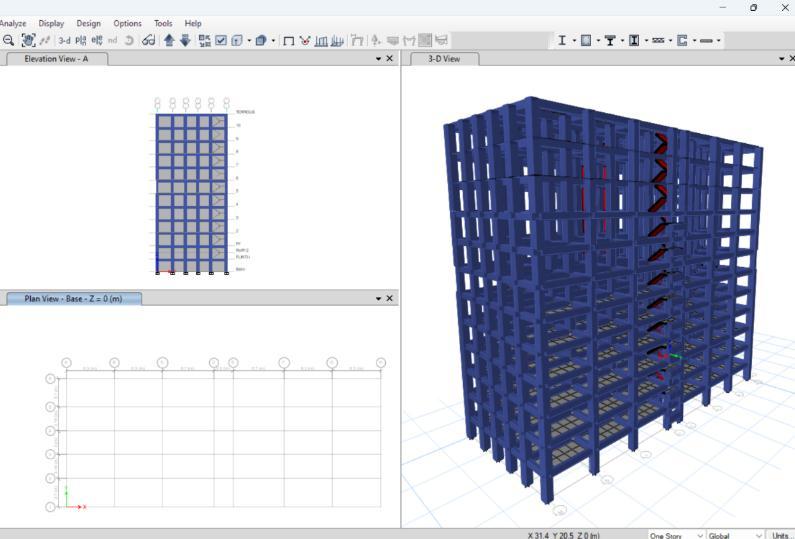
Thecurrentstudyconsidersthatsupportconditionsfortheir G+10 and G+15 models of structures with a foundation depth of 3 m are fixed at the bottom of the supports and footings.Thebuildingsare41.1meterslong,16.75meters wide, and 35.2 and 51.2 meters high. M30-grade concrete and Fe415-reinforced steel bars with and without irregularities are evaluated as material qualities for the constructions that were simulated using the ETABS V20 programme.Windspeedsof33,39,44,47,50,and55m/s arealsotakenintoconsideration.Theelevationsandfloor plansoftheconstructionareshowninthefiguresbelow.
Model1:regularstructurewithG+10consideringwindgusts of33,39,44,47,50,and55m/s
Model 2: irregular structure with G+10 considering wind gustsof33,39,44,47,50,and55m/s
Model3:regularstructurewithG+15consideringwindgusts of33,39,44,47,50,and55m/s
Figure 1 planandelevationand3Dmodel
Model 4: irregular structure with G+15 considering wind gustsof33,39,44,47,50,and55m/s
3.1 DESIGN PARAMETERS
International Research Journal of Engineering and Technology (IRJET) e-ISSN: 2395-0056
Volume: 09 Issue: 12 | Dec 2022 www.irjet.net p-ISSN: 2395-0072
3.2 DESIGN DATA
ASPERIS875(PART-III)2015
Typeofbuilding:RCCbuildingwithterraincategory1atG +10andG+15.
Height=38.2,width=16.5andlength=41.6. 33,39,44,47,50,and55m/sarethestandardwind speeds (VB).
VZ = (VB * K1 * K2 * K3 )Designwindspeed K1istheriskcoefficientforsignificantstructuresor towers.
K2standsfortheheightandsizecomponentsofthe terrain.
K3=TopographyFactor(upwindslope3O) PZ = 0.6 Vz2 isthedesignwindpressure. Theleewardwindspeedis0.5andthewindwardwind speedis0.8.
WALL LOAD CALCULATIONS
Thicknessofwall*heightofwall*densityofbrick masonry=0.23*2.6*20=11.73kn/m3
Live load
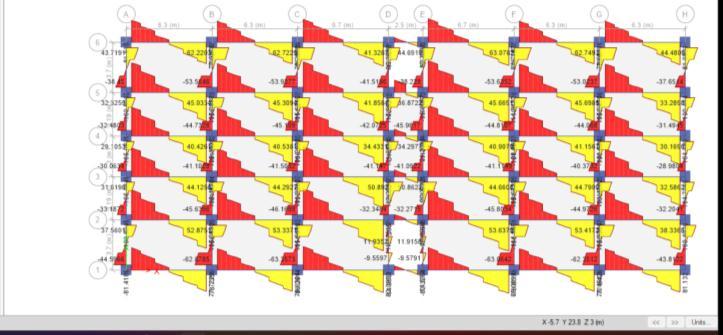
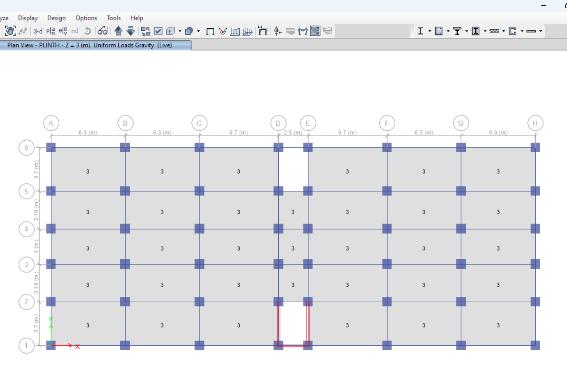
aliveloadof-3Kn/misconsidered.AccordingtoIS875 Part2,liveloadsarecalculated.
Figure 2 assigning of live load and dead load
4 RESULT AND DISCUSSION
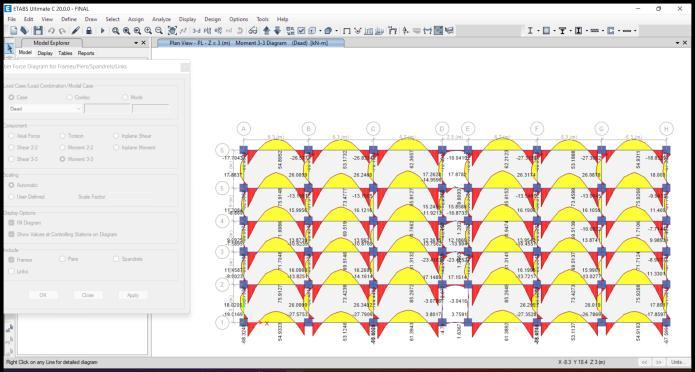
A graphical representation is generated to display these forcesandisusedtostudybycomparingthelateralforces, storeydisplacement,storeyshear,overturningmoment.
Figure 3 displacementofthestructure
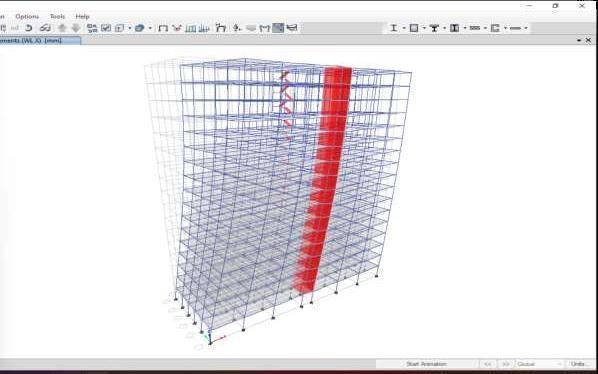
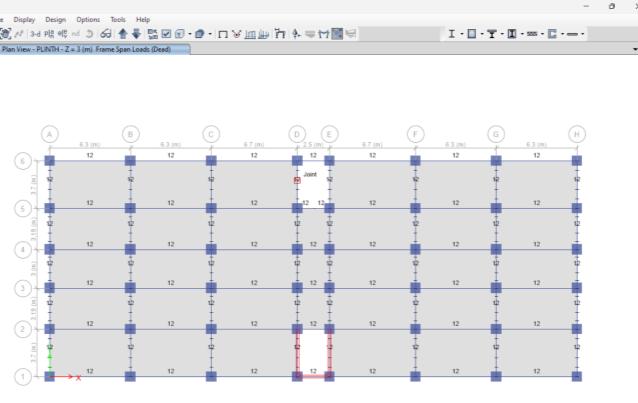
Figure 4 shearforceofthestructure
International Research Journal of Engineering and Technology (IRJET) e-ISSN: 2395-0056
Volume: 09 Issue: 12 | Dec 2022 www.irjet.net p-ISSN: 2395-0072
44 0.000031 0.000058 0.000032 0.000058 47 0.000033 0.000066 0.000038 0.000066 50 0.000043 0.000075 0.000059 0.000075 55 0.000052 0.000091 0.000066 0.00009
Figure 5 bendingmomentofthestructure
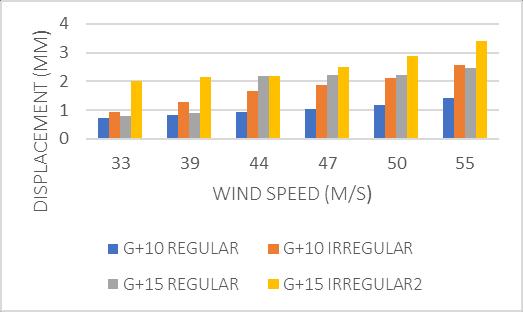
Table 2 :maximumdisplacementforregularirregular StructureswithG+10andG+15
WIND SPEEDS G+10 G+15 (m/s) REGULAR IRREGULAR REGULAR IRREGULAR 33 0.721 0.928 0.787 2.012 39 0.829 1.296 0.907 2.167 44 0.917 1.65 2.183 2.183 47 1.047 1.883 2.222 2.491 50 1.185 2.131 2.238 2.891 55 1.433 2.578 2.452 3.411
Chart 2: ComparisonofthemaximumDriftforregular irregularstructurewithG+10andG+15
Table4:maximumstoreyshearforregularirregular structurewithG+10andG+15
WIND SPEEDS G+10 G+15 (m/s) REGULAR IRREGULAR REGULAR IRREGULAR 33 313.0704 45.1298 372.38 83.75 39 358.0819 63.0325 512.209 116.97 44 398.4907 80.2307 651.964 292.2985 47 454.4907 91.5442 743.899 307.56 50 514.5799 103.6037 841.894 348.085 55 622.6417 125.3604 1018.695 375.6422
Chart 1: Comparisonofthemaximumdisplacementfor regularirregularstructurewithG+10andG+15.
Table 3:maximumdriftforregularirregularstructure withG+10andG+15
WIND SPEEDS G+10 G+15 (m/s) REGULAR IRREGULAR REGULAR IRREGULAR 33 0.000026 0.000033 0.000028 0.000029 39 0.00003 0.000046 0.00003 0.000034
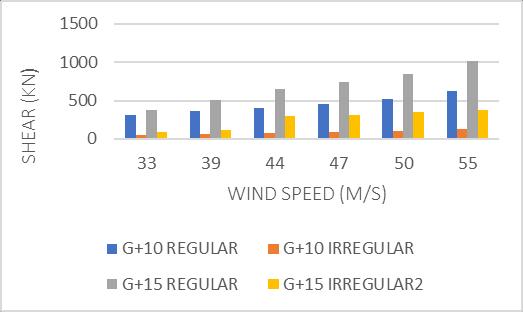
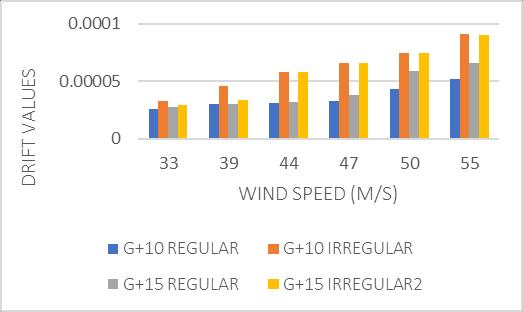
Chart 3:Comparisonofthemaximumstoreyshearfor regularirregularstructurewithG+10andG+15
International Research Journal of Engineering and Technology (IRJET) e-ISSN: 2395-0056
Volume: 09 Issue: 12 | Dec 2022 www.irjet.net p-ISSN: 2395-0072
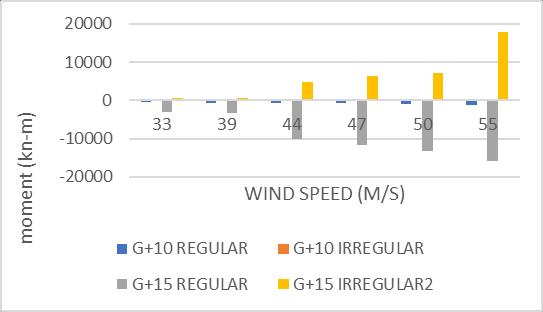
Table 5:maximumstoreymomentforregularirregular structureswithg+10andg+15
SPEEDS G+10 G+15 (m/s) REGULAR IRREGULAR REGULAR IRREGULAR 33 -555.047 87.923 -3179.51 519.9635 39 -638.34 122.8024 -3317.76 726.23 44 -706.17 156.308 -10250.1 4691.089 47 -806.87 178.35 -11695.4 6375.089 50 -912.29 201.84 -13236.1 7214.903 55 -1104.02 244.232 -16015.7 17854.21
Chart 4 :Comparisonofthemaximumstoreymomentfor regularirregularstructureswithg+10andg+15
5 Conclusion
Themultistoreybuildingsexposedtodifferentwindforces areexaminedinthisstudythroughmodellingandanalysisof thesebuilding,andthefollowingconclusionisdrawn:
Windspeed(55,50,47,44,39,33m/s)istheobserved orderoftheeffectswhenlateralforcesareappliedtoa high-risestructure
Asthewindspeedincreases,thedisplacementincreases. The wind’s influence increases when it has a larger impactonhigh-risebuilding.
It observes that storey drift increases irregular structureswhencomparedtoregularstructures.
Thestoreyshearismoreinregularstructurescompared toirregularstructures.
The storey moment decreases in regular structures whencomparedtoirregularstructures.
Ithasbeenobservedthataswindspeedhasincreased, the lateral forces generated on the structures are becomingmoresevere.
Also, it can be concluded that, compared to a regular structure, an irregular structure is more severely affectedbywindforce.
Aconclusionthatcanbedrawnfromthisisthathighrise buildings are more exposed to wind forces than low-risebuildings.
Windspeed(55,50,47,44,39,33m/s)istheobserved orderoftheeffectswhenlateralforcesareappliedtoa high-risestructure
5.1 SCOPE FOR FUTURE WORK
Tocomparethestudybyprovidingshearwallanalysis atadifferentlocation.
Comparativestudyingbyprovidingbracingsandbase isolationanddynamicanalysis.
Nonlineartimehistoryanalysiscanbeperformedonthe high-risestructures
6 REFERENCES
1. Ajitha and M.Naveen Naik, "The Wind and Seismic AnalysisonDifferentHeightsofBuildingUsingETABS," ISSN2249-6203.TheResearchPublication,Vol.5,No.2, 2016,pp.19–26.
2. AZZAZHUSSAIN,AMRUTHK."AComparativeStudyon theEffectofWindVelocityonTallBuildingsinDifferent TerrainCategories"ISSN:2320-2882|Volume6,Issue 2,April2018|ISSN:2320-2882
3. IS:875:1987(Part3),"IndianStandardCodeofPractice for Design Wind Loads," Bureau of Indian Standards, NewDelhi.
4. KundanKulbhushan,SwatantraKumarRao,"Designand Analysis of Residential Multistorey Building (G+5) by UsingETABS,"IJSRD:InternationalJournalforScientific Research&Development,2019,VOL.7,Issue03.
5. MohammedAsimAhmed,ModiAmir,SavitaKomur,and Vaijainath Halhalli "effect of laod on tall buildings in differentterraincategories"ijret:InternationalJournal ofResearchinEngineeringandTechnologyeISSN:23191163|pISSN:2321-7308.
6. PAWAN R. THAKARE, "Analysis of G+15 High Rise BuildingsbyUsingEtabsforVariousFrameSectionsin ZoneII,"May2022,IJIRT,Volume8Issue12,ISSN23496002,
International Research Journal of Engineering and Technology (IRJET) e-ISSN: 2395-0056
Volume: 09 Issue: 12 | Dec 2022 www.irjet.net p-ISSN: 2395-0072
7. RanjithaK.P.,KhalidNayazKhan,etal.,"EffectofWind Pressure on R.C. Tall Buildings Using Gust Factor Method,"InternationalJournalofEngineeringResearch &Technology(IJERT),ISSN:2278-0181,www.ijert.org, Vol.3Issue7,July-August2014.
8. ShaikhMuffassir,L.G.Kalurkar "ComparativeStudyon Wind Analysis of Multi-storey RCC and Composite Structure for Different Plan Configurations,", IOSR Journal of Mechanical and Civil Engineering (IOSRJMCE),volume13,issue4,ver.VII(july-august2016), pp.42–49.
9. Sneha Kawale, Prof. Nandkishor Sinha "multi storied irregularstructuressubjectedtowindforce:areview" e-ISSN: 2582-5208 International Research Journal of ModernizationinEngineeringTechnologyandScience (Peer-Reviewed, Open Access, Fully Refereed InternationalJournal)Volume:04/Issue:06/June-2022.
10. WakaleYogeshNamdev,MoonManishYewnath,etal.eISSN: 2582-5208 International Research Journal of ModernizationinEngineering,Technology,andScience Volume:04/Issue:05/May-2022