International Research Journal of Engineering and Technology (IRJET) e-ISSN: 2395-0056

Volume: 09 Issue: 12 | Dec 2022 www.irjet.net p-ISSN: 2395-0072
Clone of an organization
Miss Vidhi Gupta, Mr. Anand Tiwari, Mrs. Diksha Tiwari1 Undergraduate student, Krishna Institute of Technology, Uttar Pradesh, India
2 Asst. professors, Krishna Institute of Technology, Uttar Pradesh, India
3 Asst. professors, Krishna Institute of Technology, Uttar Pradesh, India ***
Abstract – This work present the clone of any organization which helps to manipulate the designing or features of an organizations and testing process so that original site did not get disturb by any of them
This will helps people in testing of any site or will do many tasks by the help of clone.
Clone is a concept where we can make an exact copy of a thing and clone will do all the works same as original but if it get any interruption of or any damage then it will not able to do any work.
Key Words: Clone, database clone, domain clone, software testing, hacking, software reverse engineering, software development life cycle.
1. INTRODUCTION
Cloning istheprocessofgeneratingageneticallyidentical copy of acellor an organism.Cloninghappens often in nature forexample,whenacellreplicatesitselfasexually withoutanygeneticalterationorrecombination
Prokaryoticorganisms (organisms lackinga cellnucleus) such asbacteriacreate genetically identical duplicates of themselves usingbinary fissionorbudding Ineukaryoticorganisms (organisms possessing a cell nucleus)suchashumans,allthecellsthatundergomitosis, suchasskincellsandcellsliningthegastrointestinaltract, areclones; the only exceptions aregametes(eggsandsperm),whichundergomeiosisand genetic recombination. This is all base on the concept of medicalscience,whenwecometoknowthatinthefieldof technologyandengineering,sothecloningistheprocess whenthecreationofreplicaofanysoftware,technology,or anorganization.
1.1 Different things we can built as a clone
Frontend design
Wecanbuildawebsitelooklikesimilarto anyotherwebsite.
Wecanimplementsamedesignfontsetc. Frontend would be easy to maintain as a purposeofclone.
Backend design
Sometimeitwouldbedifficulttomaintaina side as in working but if we have great knowledgeofdatastructureandalgorithm then it is easy to work as like same or originalsite.
Backendcloneiseasytomaintainwiththe highdataconfiguration.
Database clone
There are a multiple of ways you could create a database clone. Standard Backup andrestoreisonemethod.Export/Import is another. Third party tools are also availableforsettingupDatabaseCloning.
Nowwecancreatedatabaseclonealsowith thehelpofORACLE,MySQL.
Domain
Domainisnotpossibletocreateaclone because domain will be taken by the servers which are not possible to manage2siteswiththesamedomain.
1.2 Software testing
Softwaretestingisaprocesswheredeveloperchecksthe requirementoftheclientthatsoftwareisactually work or look like according to the client requirements. Software is defect free. The purpose of software testing is identifying errors, gaps or missing requirements in contrast to actual requirement. Finally, complete content and organizational editingbeforeformatting.Pleasetakenoteofthefollowing itemswhenproofreadingspellingandgrammar:
1.2 Benefits of software testing
Cost-Effective: It is one of the important advantages of software testing. Testing any IT projectontimehelpsyouto saveyour moneyfor the long term. In case if the bugs caught in the earlierstageofsoftwaretesting,itcostslesstofix.
International Research Journal of Engineering and Technology (IRJET) e-ISSN: 2395-0056
Volume: 09 Issue: 12 | Dec 2022 www.irjet.net p-ISSN: 2395-0072
Security: It is the most vulnerable and sensitive benefitofsoftwaretesting. Peoplearelookingfor trusted products. It helps in removing risks and problemsearlier.
Product quality: Itisanessentialrequirementof any software product. Testing ensures a quality productisdeliveredtocustomers.
Customer Satisfaction: The main aim of any product is to give satisfaction to their customers. UI/UXTestingensuresthebestuserexperience.
2. Table of types of Software testing
Categories of testing Types of testing
Review. Information extraction refers to the practice of gathering all relevant information for performing the operation.Modelingreferstothepracticeofcombiningthe gatheredinformationintoanabstractmodel,whichcanbe used as a guide for designing the new object or system. Review refers to the testing of the model to ensure the validity of the chosen abstract.Reverse engineering is applicableinthefieldsofcomputerengineering,mechanical engineering,design,electronic engineering,software engineering,chemicalengineering,andsystemsbiology
SoftwareReverseEngineeringisaprocessofrecovering thedesign,requirementspecificationsandfunctionsofa productfromananalysisofitscode.Itbuilds aprogram databaseandgeneratesinformationfromthis.
The purpose of reverse engineering is to facilitate the maintenanceworkbyimprovingtheunderstandabilityof a systemandtoproduce thenecessarydocumentsfor a legacysystem.
ReverseEngineeringGoals:
CopewithComplexity.
Recoverlostinformation.
Detectsideeffects.
Synthesizehigherabstraction.
FacilitateReuse.
3. Software development life cycle
Testing strategies in software engineering
3. Software reverse engineering
Reverse engineering (also known as backwards engineering or back engineering)isaprocessormethod through which one attempts to understand throughdeductivereasoninghowapreviouslymadedevice, process, system, or piece ofsoftwareaccomplishes a task withverylittle(ifany)insightintoexactlyhowitdoesso.It is essentially the process of opening up or dissecting a systemtoseehowitworks,inordertoduplicateorenhance it. Depending on the system under consideration and the technologies employed, the knowledge gained during reverse engineering can help with repurposing obsolete objects,doingsecurityanalysis,orlearninghowsomething works.
Althoughtheprocessisspecifictotheobjectonwhichitis beingperformed,allreverseengineeringprocessesconsist ofthreebasicsteps:Informationextraction,Modeling,and
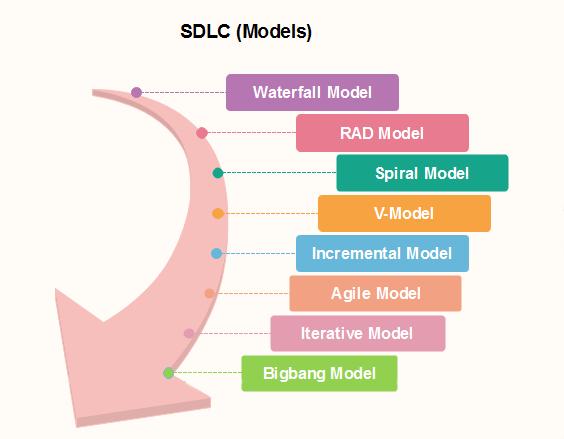
SoftwareDevelopmentlifecycle(SDLC)isaspiritualmodel usedinprojectmanagementthatdefinesthestagesinclude in an information system development project, from an initialfeasibilitystudytothemaintenanceofthecompleted application.
Therearedifferentsoftwaredevelopmentlifecyclemodels specifyanddesign,whicharefollowedduringthesoftware developmentphase.Thesemodelsarealsocalled"Software Development Process Models."
Waterfallmodel
RADmodel
Spiralmodel
Hybridmodel
Prototypemodel
V-model
Incrementalmodel
Agilemodel
Iterativemodel
Big-bangmodel
Prototypemodel
International Research Journal of Engineering and Technology (IRJET) e-ISSN: 2395-0056
Volume: 09 Issue: 12 | Dec 2022 www.irjet.net p-ISSN: 2395-0072
3) Spiral Model
Thespiralmodelisa risk-driven process model.ThisSDLC model helps the group to adopt elements of one or more processmodelslikeawaterfall,incremental,waterfall,etc. Thespiraltechniqueisacombinationofrapidprototyping andconcurrencyindesignanddevelopmentactivities.
Each cycle in the spiral begins with the identification of objectivesforthatcycle,thedifferentalternativesthatare possible for achieving the goals, and the constraints that exist. This is the first quadrant of the cycle (upper-left quadrant).
The next step in the cycle is to evaluate these different alternatives based on the objectives and constraints. The focus of evaluation in this step is based on the risk perceptionfortheproject.
Figure -1:softwaredevelopmentlifecycle
1) Waterfall Model
ThewaterfallisauniversallyacceptedSDLCmodel.Inthis method, the whole process of software development is dividedintovariousphases.
Thewaterfallmodelisacontinuoussoftwaredevelopment model in which development is seen as flowing steadily downwards (like a waterfall) through the steps of requirements analysis, design, implementation, testing (validation),integration,andmaintenance.
Linear ordering of activities has some significant consequences.First,toidentifytheendofaphaseandthe beginningofthenext,somecertificationtechniqueshaveto beemployedattheendofeachstep.Someverificationand validation usually do this mean that will ensure that the outputofthestageisconsistentwithitsinput(whichisthe outputofthepreviousstep),andthattheoutputofthestage isconsistentwiththeoverallrequirementsofthesystem.
2) RAD Model
RAD or Rapid Application Development process is an adoption of the waterfall model; it targets developing softwareinashortperiod.TheRADmodelisbasedonthe conceptthatabettersystemcanbedevelopedinlessertime byusingfocusgroupstogathersystemrequirements.
o BusinessModelling
o DataModelling
o ProcessModelling
o ApplicationGeneration
o TestingandTurnover
Thenextstepistodevelopstrategiesthatsolveuncertainties and risks. This step may involve activities such as benchmarking,simulation,andprototyping.
4) V-Model
InthistypeofSDLCmodeltestingandthedevelopment,the stepisplannedinparallel.So,thereareverificationphases on the side and the validation phase on the other side. VModeljoinsbyCodingphase.
5) Incremental Model
The incremental model is not a separate model. It is necessarilyaseriesofwaterfallcycles.Therequirementsare divided into groups at the start of the project. For each group,theSDLCmodelisfollowedtodevelopsoftware.The SDLC process is repeated, with each release adding more functionalityuntilallrequirementsaremet.Inthismethod, each cycle act as the maintenance phase for the previous software release. Modification to the incremental model allowsdevelopmentcyclestooverlap.Afterthatsubsequent cyclemaybeginbeforethepreviouscycleiscomplete.
6) Agile Model
Agilemethodologyisapracticewhichpromotescontinues interaction of development and testing during the SDLC processofanyproject.IntheAgilemethod,theentireproject isdividedintosmallincrementalbuilds.Allofthesebuilds areprovidediniterations,andeachiterationlastsfromone tothreeweeks.
Anyagilesoftwarephaseischaracterizedinamannerthat addresses several key assumptions about the bulk of softwareprojects:
International Research Journal of Engineering and Technology (IRJET) e-ISSN: 2395-0056
Volume: 09 Issue: 12 | Dec 2022 www.irjet.net p-ISSN: 2395-0072
1. It is difficult to think in advance which software requirementswillpersistandwhichwillchange.It isequallydifficulttopredicthowuserprioritieswill changeastheprojectproceeds.
2. For many types of software, design and developmentareinterleaved.Thatis,bothactivities should be performed in tandem so that design modelsareprovenastheyarecreated.Itisdifficult tothinkabouthowmuchdesignisnecessarybefore constructionisusedtotesttheconfiguration.
3. Analysis,design,development,andtestingarenot aspredictable(fromaplanningpointofview)aswe mightlike.
7) Iterative Model
Itisaparticularimplementationofasoftwaredevelopment life cycle that focuses on an initial, simplified implementation, which then progressively gains more complexityandabroaderfeaturesetuntilthefinalsystemis complete. In short, iterative development is a way of breaking down the software development of a large applicationintosmallerpieces.
8) Big bang model
Big bang model is focusing on all types of resources in software development and coding, with no or very little planning. The requirements are understood and implementedwhentheycome.
Thismodelworksbestforsmallprojectswithsmallersize development team which are working together. It is also usefulforacademicsoftwaredevelopmentprojects.Itisan idealmodelwhererequirementsareeitherunknownorfinal releasedateisnotgiven.
9) Prototype Model
The prototyping model starts with the requirements gathering.Thedeveloperandtheusermeetanddefinethe purposeofthesoftware,identifytheneeds,etc.
A 'quick design' is then created. This design focuses on thoseaspectsofthesoftwarethatwillbevisibletotheuser. It then leads to the development of a prototype. The customerthencheckstheprototype,andanymodifications orchangesthatareneededaremadetotheprototype.
Loopingtakesplaceinthisstep,andbetterversionsofthe prototypearecreated.Thesearecontinuouslyshowntothe user so that any new changes can be updated in the prototype. This process continues until the customer is satisfied with the system. Once a user is satisfied, the prototype is converted to the actual system with all considerationsforqualityandsecurity.
3. CONCLUSIONS
Conclusionofthiscloningistobedifferentiatingorcreate anotherwaysoftestingwithoutinterrupttheoriginalsite
There are lot of data stored in an organizations some are running their own business through an organization, so if hackersorprogrammerswanttolearnandcompletetheir needs of testing and manipulating new features on any organizationsotheyarefreetoimplementtheirtestonthis cloneandallthedatawillberecordedandthisdatawillbe secured.Theirpracticeswouldnotgetwasteandpeoplecan abletolearnlotthings.
REFERENCES
[1] https://www.ibm.com/in-en/topics/software-testing.
[2] https://www.javatpoint.com/software-engineeringsdlc-models
[3] https://www.geeksforgeeks.org/software-engineeringreverse-engineering/
BIOGRAPHIES
MissVidhiGupta
UnderGraduatestudentofB.Tech, Computerscienceengineering OfKrishnainstituteoftechnology, Kanpur,UttarPradesh,India
Mrs.DikshaTiwari
Asst.professorinKrishnaInstitute Of technology, Kanpur, Uttar Pradesh,India.
Mr.AnandTiwari
Asst.professorinKrishnaInstitute Of technology, Kanpur, Uttar Pradesh,India.