International Research Journal of Engineering and Technology (IRJET) e-ISSN: 2395-0056

Volume: 09 Issue: 12 | Dec 2022 www.irjet.net p-ISSN: 2395-0072
International Research Journal of Engineering and Technology (IRJET) e-ISSN: 2395-0056
Volume: 09 Issue: 12 | Dec 2022 www.irjet.net p-ISSN: 2395-0072
1M. Tech Scholar, Civil Engineering Department, SAGE University, Bhopal, Madhya Pradesh, India 2H.O.S., SOET, SAGE University, Bhopal, Madhya Pradesh, India ***
Abstract - In this paper P-delta analysis of building structuresisperformed,themethodsreviewedincludethe amplificationfactormethod,thedirectmethod,theiterative method, the negative property member method, and the second-ordercomputerprogrammethod.Theinfluenceof asymmetryofbuildingontheP-deltaeffectinelasticranges ofbehaviourisevaluated.Theresultindicatedthattheeffect oftheP-deltaisquitesensitivetocharacteristicsofground motionsuchasthefrequencycontentofearthquakes.Under theP-Deltaeffect,displacementvariesexponentiallywithan increaseinheightorincrementinstories.Theaxialforces also vary with the height of the structure. Because of the wide variation in displacement with an increase in slenderness,P-Deltaanalysisisrequiredforstructurestaller than 7 stories. the P-Delta effect will be substantial when lateralforcesexistonthestructureandthisincreaseswith anincreaseinthenumberofstories.TheP-Deltaeffectisnot predominantinbuildingsuptosevenstoriesanditisvery negligiblewhenonlygravityloadingexistsonthestructure.
Key Words: P-DeltaAnalysis,ElasticRanges,L-shaped building,Axialforce,GravityLoading,LateralForces
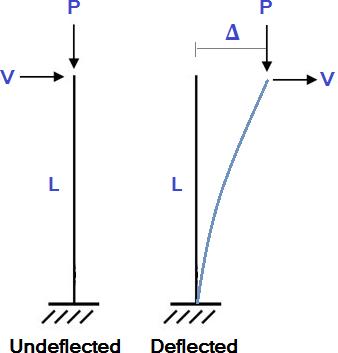
Theterm"P-Δanalysis"itselfexplainsthemeaning,whena structuralmemberisloaded,thenitsshapechanges,anddue to this additional forces & moments are induced. It is a second-orderanalysis.P-DeltaAnalysisisatypeofanalysis thatisparticularlyimportantforlaterallydisplacingmultistorybuildingstructuresexperiencingagravityload.
When subjected to lateral displacements, the building structurewilldeformwhichinturnproducessecond-order over-turningmomentsandusually,thesearenottakeninto considerationinthecaseofdynamicandstaticanalysis.
P-Delta effects usuallybecome prevalent in tall structures thatareexperiencinggravityloadsandlateraldisplacement due to wind or other forces. If the lateral displacement and/or the vertical axial loads through the structure are significant, a P-Delta Analysis should be performed to accountforthenon-linearities.Inmanycases,alinearstatic analysiscanseverelyunderestimatedisplacement(among other results) in comparison with a P- Delta (Non-Linear) Analysis.
Sometimestheplotareaishavinganirregularshape.Inthat situation,thereisaneedtoconstructabuildingaccordingto theshapeoftheplotarea.IftheplotareaisinL-shape,soto makecompleteuseoftheplotareawehaveconstructedan L-shapebuilding.Recently,moststructuresofarchitectural importancehavebeenhighlyunfeasibletoplanwithregular shapes.Withsuchcomplexconfigurationirregularities,the structural design and the prediction of the potential structuralcollapseofirregularbuildingsunderearthquakes becomeverychallenging.Moreover,torsionaleffectscould significantly amplify the seismic response of buildings. Lshaped buildings have the potential of re-entrant corners and torsional irregularities, which causes stress concentration.
International Research Journal of Engineering and Technology (IRJET) e-ISSN: 2395-0056
Volume: 09 Issue: 12 | Dec 2022 www.irjet.net p-ISSN: 2395-0072
Seismic analysis is a tool for the estimation of structural response in theprocess ofdesigning earthquake-resistant structuresand/orretrofittingvulnerableexistingstructures. Inprinciple,theproblemisdifficultbecausethestructural responsetostrongearthquakesisdynamic,nonlinear,and random.Allthreecharacteristicsareunusualinstructural engineering,wherethegreatmajorityofproblemsare(orat leastcanbeadequatelyapproximatedas)static,linearand deterministic. Consequently, special skills and data are neededforseismicdesign,whichanaveragedesignerdoes notnecessarilyhave.
For the purpose of understanding the significance of the various design parameters and efficacy of this study, it is necessarytoreviewtheliteratureofpastresearch.
Bharat and Hemchandra (2020) aimed to compare the seismicresponsedemandsofthedifferentL-shapedbuildings withthereferenceregularmodelbyvaryingtheseismicangle ofincidence.Thesecondpartistodeterminetheresponseof thedifferentmodelswhensubjectedtothevaryingangleof theinputresponsespectrum.Henceitcanbeconcludedthat code-defined load combination rules are insufficient to achievetheresponsefortheirregularstructures.[1]
Shehata et. Al.(2018) investigated structural seismic response demands for the class of L-shaped buildings by evaluatingtheplanconfigurationirregularityofre-entrant corners and lateral–torsion coupling effects on measured seismicresponsedemands.Themeasuredresponsesinclude story drift, inter-story drift, story shear force, overturning moment, torsion moment at the base and over-building height,andtorsionalirregularityratio.[2]
Vijayalakshmi et. Al. (2017) consideredtheeffectoflateral loadonthestructuralsystemfortheP-Deltaeffect.Thedrift ratio is found for both, earthquake and wind loading, consideringwithandwithouttheP-Deltaeffectforadifferent number of stories such as G+10, G+20, G+30, and G+40 stories.[3]
Raheem et. Al. (2016) graspedtheseismicbehaviorofthe buildings with an irregular plan of L-shape floor plans throughtheevaluationoftheconfigurationirregularityofreentrant corners effects on measured seismic response demands.Themeasuredresponsesincludeinter-storydrift; storyshearforce;overturningmoment;torsionmomentat the base and along the building height; top floor displacement;andtorsionalIrregularityRatio.[4]
Kabir et. Al. (2015) assessedtheseismicvulnerabilityand response of regular and irregularly shaped multi-story buildings of identical weight in the context of Bangladesh. Bothstatic and dynamic (responsespectrum) analysis has
been performed to study the influence of the shape of a buildingonitsresponsetovariousloading.[5]
Mallikarjunaand Ranjith(2014) describedseismicanalysis foran18-storysteel-framedstructureusingSTAADProV8i software.AcomparisonofP-Deltaanalysiswithlinearstatic analysishasbeenattempted.[6]
Dinar and Rahi (2013) evaluatedthedeflectionofhigh-rise steel structures under the P- Delta effect. Linear static analysis was done to observe the severity of the P-Delta phenomenon.TheanalysiswasdonebyusingSTAADProv8i software.Theyfoundthatbecauseofthewidevariationin displacement with an increase in slenderness, P-Delta analysisisrequiredforstructurestallerthan7stories.[7]
Mahdi and Gharaie (2011) evaluatedtheseismicbehavior of three intermediate moment-resisting concrete space frames with an asymmetrical plan in five, seven, and ten storiesbyusingpushoveranalysis.Ineachoftheseframes, bothprojectionsofthestructurebeyondareentrantcorner are greater than 33 percent of the plan dimension of the structureinthegivendirection.[8]
Sood and Naveen (2010) outlinedandcomparedthethree methods,anddiscusstheminthecontextoftraditionalforcebasedseismic designand earlier designapproaches which contained some elements of performance-based design. Factors defining different performance states will be discussed, including the need, not yet achieved, to include residualdisplacementasakeyperformancelimit.[9]
Federal EmergencyManagementAgency(2005)proposed the evaluation and improvement of the nonlinear static procedures (NSPs) contained in the Pre-standard and CommentaryfortheSeismicRehabilitationofBuildings,and theCapacitySpectrumMethod,asdetailedareintheATC-40 Report, Seismic Evaluation, and Retrofit of Concrete Buildings.[10]
Theobjectivesofthisstudyare:
ToanalyzetheseismicperformanceofL-shapedbuildings withandwithoutP-Deltaanalysis.
Tocomparetheresultsobtainedfromlinearanalysisand P-Deltaanalysis.
Thedifferentparameterssuchasforces,storydisplacement, timeperiod,frequency,torsionmomentresponses,andstory drift in different seismic zones in different models are comparedtoachievetheaboveobjectives.
PreparetheplanforL-shapedBuilding.
International Research Journal of Engineering and Technology (IRJET) e-ISSN: 2395-0056
Volume: 09 Issue: 12 | Dec 2022 www.irjet.net p-ISSN: 2395-0072
Linearanalysisof10,20,30,40&50storiesofL-Shaped buildingsforvariousparametersusingSTAADProV8i.
P-Deltaanalysisof10,20,30,40&50L-Shapedbuildings forvariousparametersusingSTAADProV8i.
Comparetheresultoflinearanalysis&P-Deltaanalysis.
Itwasconcludedthatduetothenon-linearrelationship betweendeflectionandthegravityloads,itisnecessary that loads corresponding to the failure state under considerationbeusedinP-Deltaanalysis.
Thecharacteristicsofalateralload-resistingsystemhave farmoreimportantcomparedwiththenumberofstories inthebuilding.
BothlinearstaticandP-Deltaanalysesarenecessaryfor tallRCstructures.
The building response values on P-Delta analysis were twice that on static analysis. The X bracing in the continuousbracingpatternisproventobemoreeffective underbothstaticandP-Deltaanalyses.
Because of the wide variation in displacement with an increaseinslenderness,P-Deltaanalysisisrequiredfor structurestallerthan7stories.
TheP-Deltaeffectwillbesubstantialwhenlateralforces existonthestructureandthisincreaseswithanincrease in the number of stories. The P-Delta effect is not predominantinbuildingsuptosevenstoriesanditisvery negligible when only gravity loading exists on the structure.
The effect of P-Delta increases as the height of the buildingincreases,anditcanbereduceduptoacertain extentbytheconstructionofshearwalls.
Thestructureswithirregularityconfigurationsare40% morepronetodestabilizingstressesi.e.,1.4timesmore when compared to conventional rectangular nonirregularitystructuresanddynamicstressesare1.7times morethanthelinearstaticmethodofwindanalysis.
The impacts of P-Delta are quite sensitive to ground movement,forexample,thefrequencycontentofquakes. Theaffectabilityisstillvitalbutnotexactlythedynamic cases. All in all, the affectability to ground motion increases,astheeccentricityincreases.Theimpactof"PDelta"analysesisdiscoveredhigherinstaticanddynamic analyses and the impact of "P-Delta" analyses is much
higherwhentheplanofthebuildingisasymmetricwith respecttoasymmetricbuilding.
[1] BharatK.,andHemchandra C.(2020),“Seismic elastic performanceofL-shapedbuildingframesthroughplan Irregularities”,publishedbyElsevierLtd;Structures27 (2020)22–36.
[2] ShehataE.,RaheemA.,MomenM.,AhmedM.,Mohamed M.,Ahmed,AlyG.A.,andShafyA.(2018),“Evaluationof plan configuration irregularity effects on seismic response demands of L-shaped MRF buildings”, Bull Earthquake Engineering (2018), 16:3845–3869, SpringerScience+BusinessMediaB.V.,partofSpringer Nature.
[3] Vijayalakshmi R., Bindu N.B. and Vahini M. (2017), “Effects of P-delta On High Rise Buildings Located in Seismic Zones”, International Research Journal of EngineeringandTechnology,Volume:04Issue:08.
[4] MomenM.M.,ShehataA.E.,RaheemA.,MohammedM. A.,AlyG.A.,andShafyA.(2016),“IrregularityEffectson the Seismic Performance of L-Shaped Multi-Story Buildings”, Journal of Engineering Sciences, Assiut University,FacultyofEngineering,Vol.44,No.5,PP.513 –536.
[5] KabirM.R.,SenD.,andIslamM.(2015),“Responseof multi-storeyregularandirregularbuildingsofidentical weightunderstaticanddynamicloadingincontextof Bangladesh”,IJCASE,Volume5,No3.
[6] Mallikarjuna B. N. and Ranjith A. (2014), “Stability analysis of Steel frame structures: P-Delta analysis”, International of Research in Engineering and Technology,Vol.3,Issue8.
[7] DinarY.,andRahiN.U.(2013),“VariationofDeflection of Steel High-rise Structures due to P-Delta effect Considering Global Slenderness Ratio”. International Journal of Emerging Technology and Advanced Engineering,Volume3,Issue12.
[8] Mahdi T., and Gharaie V. S. (2011), “Plan irregular RC framesComparisonofPushoverwithNonlineardynamic analysis”, Asian journal of civil engineering (building andhousing)Volume12,No6.
[9] SudhanshuS.,andDr.NaveenK.(2010),“Performancebasedseismicdesignofbuilding”.
[10] Federal Emergency Management Agency (2005), “Improvement of nonlinear static seismic analysis procedures”,FEMA-440.