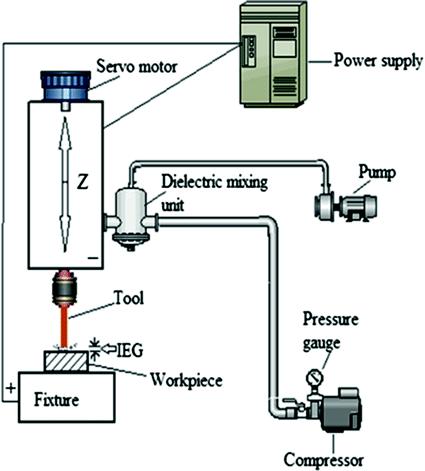
The important aspect is that they satisfy the demandsoftoday’sindustry,butthemajorproblem is that it is very difficult to machine the newly developed materials. So, in order to manipulate them, newer machining methods have been developed • These methods are more efficient than the conventional ones. Electric discharge machining (EDM) is one of the most widely used methods among the new techniques. EDM has been employed to effect/change the surface properties suchasroughnessandhardnessofthematerialBy VaryingtheEDMprocesssuchasconventionalEDM, dry EDM, and PMEDM Research in the process of PMEDMisgoingonsincelast20yearsbutstillthe process is in laboratories, it is not being used for commercialapplications. Secondly major application of EDM is for manufacturing dies. In dies surface quality is the mostimportantfactorasitreducesthemachining allowances to be kept on the components manufacturingusin9gthatdie.
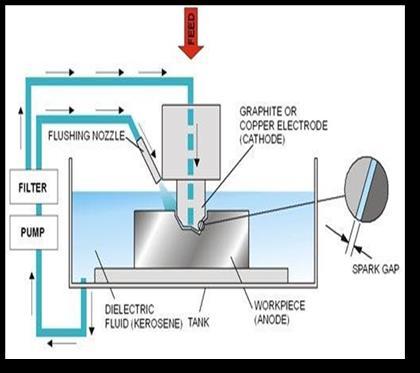
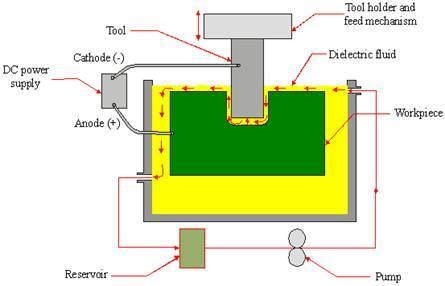
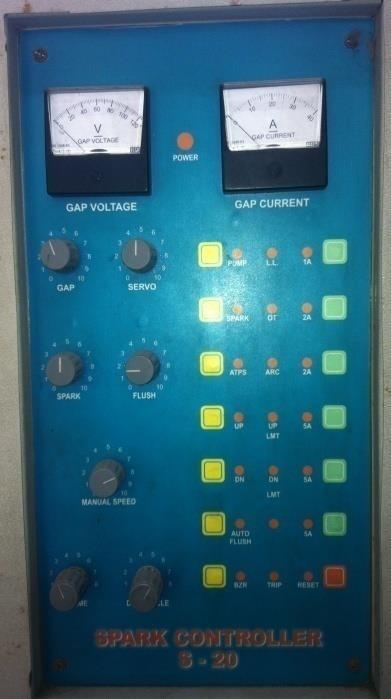
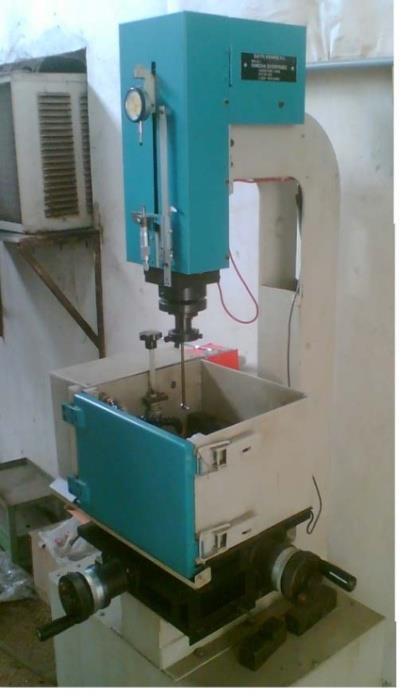
Fig: Electric Discharge Machine
•
International Research Journal of Engineering and Technology (IRJET) e ISSN: 2395 0056 Volume: 09 Issue: 01 | Jan 2022 www.irjet.net p ISSN: 2395 0072 © 2022, IRJET | Impact Factor value: 7.529 | ISO 9001:2008 Certified Journal | Page1006 EXPERIMENTAL STUDY AND THERMAL MODEL DEVELOPMENT OF DRY PROCESS Mr. Shreyas Satish Vathare1 1Student, Bachelor of Engineering (Mechanical Engineering), Dr. J.J. Magdum College of Engineering, Jaysingpur 416 101 (Maharashtra) (India) *** Abstract - TheprincipleofdryandneardryEDMprocess anditsapplicationsisdiscussedbrieflyinprecedingcontent. Inthiscontent,makingofexperimentalsetupisdiscussed broadly since it required to make extra attachment to the conventional EDM for DEDM and NDEDM process. Each attachmentanditsfunctionarediscussedbrieflysincewhich effects on performance of EDM and it reflects during measurementofresponsevariable. Key Words: DryProcess,EDM,Manufacturing,Electrodes, ControlUnit,Lubrication. 1.INTRODUCTION •

International Research Journal of Engineering and Technology (IRJET) e ISSN: 2395 0056 Volume: 09 Issue: 01 | Jan 2022 www.irjet.net p ISSN: 2395 0072 © 2022, IRJET | Impact Factor value: 7.529 | ISO 9001:2008 Certified Journal | Page1007 MediumProperties ConductivityThermal Specific capacityheat StrengthDielectric ViscosityDynamic Density W/m K J/g K (MV/m) g/m s g/L Kerosene 0.149 2.16 14 22 1.64 0.82 Deionized water 0.606 4.19 13 0.92 1 Air 0.026 1.04 3 0.019 1.2 Oxygen gas 0.026 0.92 0.019 1.429

Selection of the response variables
Theenvironmentinwhichexperimentsareperformedisthe main external source of variation of performance of EDM process.Someexamplesoftheenvironmentalnoisefactors aretemperature,vibrationsandhumanerrorinoperating theprocess.
A brief statement of the problem under investigation is “Experimental investigation of dry and near dry EDM process”
Identification of the noise factors
variation,whileadjusting(orkeeping)theprocessontarget. Whenthefactorsaffectingvariationhavebeendetermined, itcouldbeusedtofindsettingsforcontrollablefactorsthat willeitherreducethevariation,maketheproductinsensitive to changes in uncontrollable (noise) factors, or both. It is widely recognized in many fields particularly in development of new products and processes in quality Taguchicontrol.
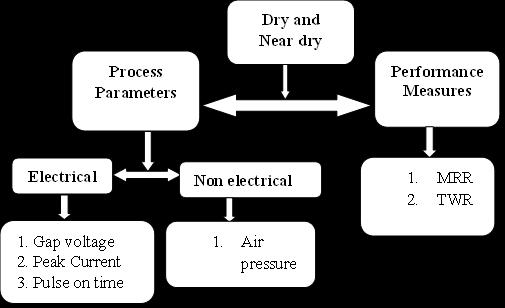
Figure: Process Parameters and Performance Measures
Definition of the problem
International Research Journal of Engineering and Technology (IRJET) e ISSN: 2395 0056 Volume: 09 Issue: 01 | Jan 2022 www.irjet.net p ISSN: 2395 0072 © 2022, IRJET | Impact Factor value: 7.529 | ISO 9001:2008 Certified Journal | Page1008
Taguchi Method Based Design of Experiments
method based design of experiments involved followingsteps.
Inanyprocess,theresponsevariablesneedtobechosenso thattheyprovideusefulinformationabouttheperformance oftheprocessunderstudy.Theresponsevariableschosen for study are SR, heat affected zone, Micro hardness and metalrecastlayerbyvisualinspection. Selection of the process parameters and their levels
In order to solve the problem, Taguchi’s method was developed based on the concept of the orthogonal arrays (OA), which can significantly reduce the number of trials requiredinanoptimization procedure.Itistheoneofthe mostpowerfulDoEmethodsforanalyzingofexperiments.It isregardedastheforemostproponentofrobustparameter design, which is an engineering method for product or processdesignthatfocusesonminimizingvariationand/or sensitivity to noise. When used properly, Taguchi designs provide a powerful and efficient method for designing products that operate consistently and optimally over a variety of conditions. In robust parameter design, the primarygoalistofindfactorsettingsthatminimizeresponse
Onesimpleandwell knownmethodforoptimizationistrial anderrorapproach.Thismethodhasasimpleconceptbutis notpracticalforthecomplexsystemswithmanyparameters.
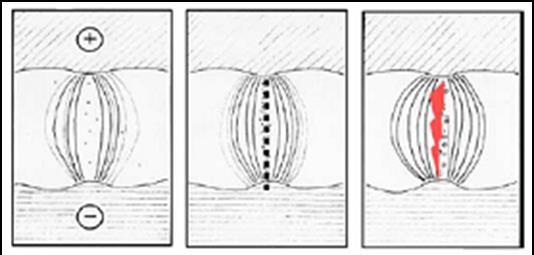
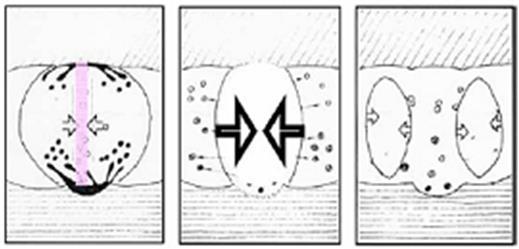
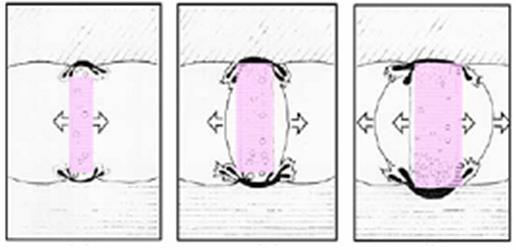
Phases of a Discharge during EDM: Preparation Phase
Theprocessparameterscanbedividedintotwocategories i.e., electrical andnon electrical parameters{referfigure}. Major electrical parameters are gap voltage, peak current andpulseontime.NonelectricalEDMprocessparameteris airpressure.
Phases of Discharge during EDM: Interval Phase Phases of Discharge during EDM: Discharge Phase
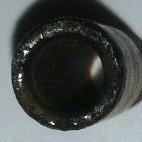
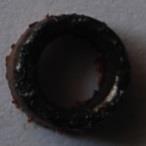
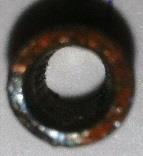
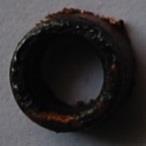
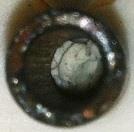
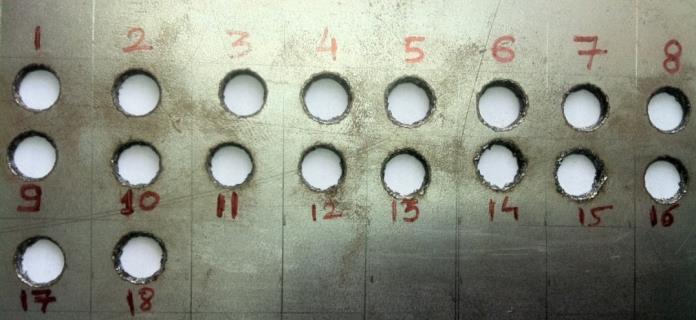
International Research Journal of Engineering and Technology (IRJET) e ISSN: 2395 0056 Volume: 09 Issue: 01 | Jan 2022 www.irjet.net p ISSN: 2395 0072 © 2022, IRJET | Impact Factor value: 7.529 | ISO 9001:2008 Certified Journal | Page1009 Collection of Electrodes after Dry EDM Process. Figure: Dry EDM Machined Plate Figure: Near dry EDM Machined Plat I = 15 A, POT = 200 µs, P = 1.5 bar I = 15 A, POT = 200 µs, P = 2 bar I = 16 A, POT = 50 µs, P = 1.5 bar I = 16 A, POT = 50 µs, P = 1 bar
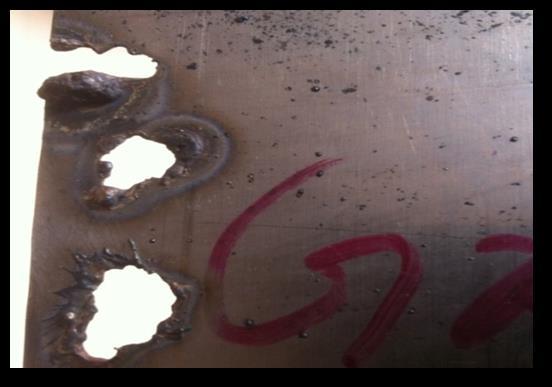
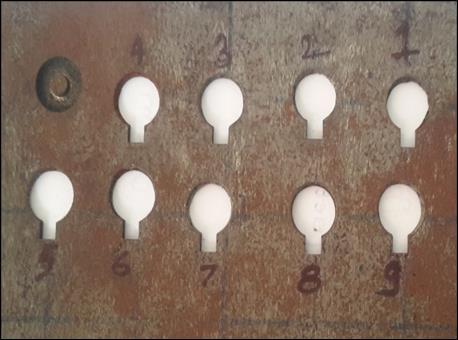
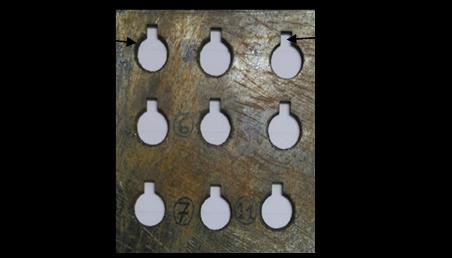
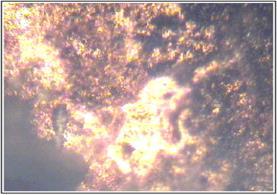
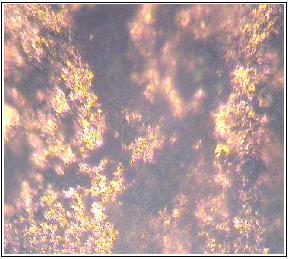
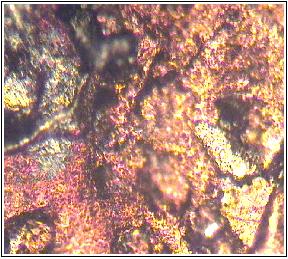
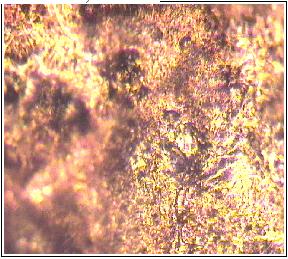
International Research Journal of Engineering and Technology (IRJET) e ISSN: 2395 0056 Volume: 09 Issue: 01 | Jan 2022 www.irjet.net p ISSN: 2395 0072 © 2022, IRJET | Impact Factor value: 7.529 | ISO 9001:2008 Certified Journal | Page1010 Drills as per L18 orthogonal array by Dry EDM. Table: Experimental L18 Orthogonal Array for Final Experiments. Expt.no. Current POT(µs) Pressure(bar) MRR(gm/min) TWR(gm/min) SRµmRa 1 15 50 1 0.0392 0.0000 3.2 2 15 50 1.5 0.0205 0.0000 4.2 3 15 50 2 0.0270 0.0000 3.6 4 15 100 1 0.0588 0.0000 4.6 5 15 100 1.5 0.0632 0.0000 4 6 15 100 2 0.0698 0.0000 3.6 7 15 200 1 0.0542 0.0005 4.6 8 15 200 1.5 0.0623 0.0011 3.6 9 15 200 2 0.0231 0.0017 3.8 10 16 50 1 0.0484 0.0012 4.6 11 16 50 1.5 0.0335 0.0011 4.8 12 16 50 2 0.0718 0.0012 5.2 13 16 100 1 0.0757 0.0013 3.8 14 16 100 1.5 0.1080 0.0022 4.4 15 16 100 2 0.1092 0.0022 4.6 16 16 200 1 0.0249 0.0000 4.2 17 16 200 1.5 0.0209 0.0000 4.4 18 16 200 2 0.0408 0.0000 4.4 materialWorkpiece : Mild Steel. Tool type :Electrode(Copper). Dielectric :Oxygengas. Design Experimentsof :Taguchimethod.
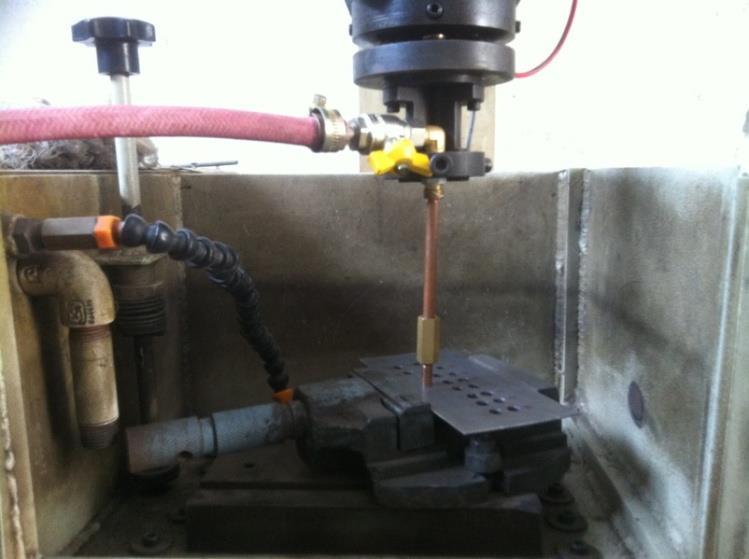
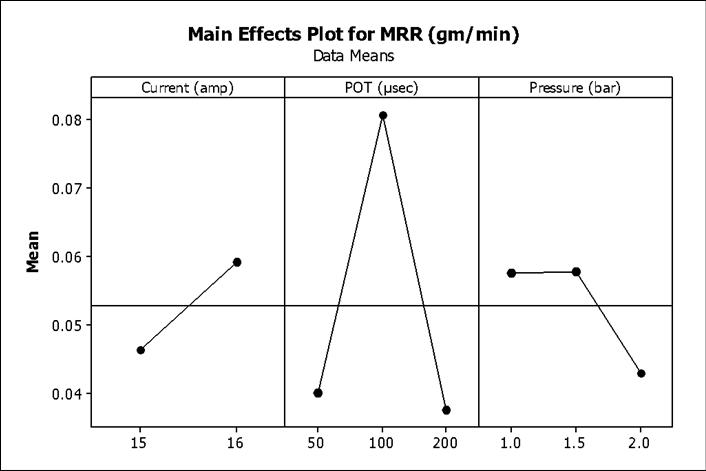
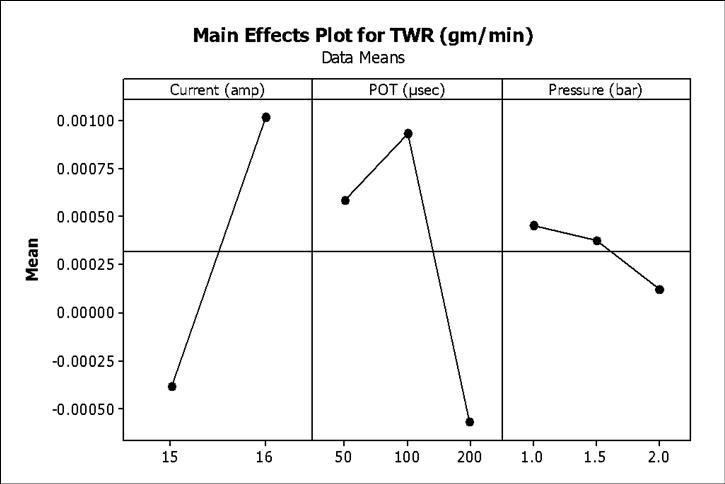
International Research Journal of Engineering and Technology (IRJET) e ISSN: 2395 0056 Volume: 09 Issue: 01 | Jan 2022 www.irjet.net p ISSN: 2395 0072 © 2022, IRJET | Impact Factor value: 7.529 | ISO 9001:2008 Certified Journal | Page1011 ANOVA for Material Removal Rate (MRR): ANOVA(AnalysisofVariance)forMRRhasgiveninTable From ANOVA table we found that, pulse on time is most significantparameterforthehighermaterialremovalrateat 99% confidence level. We can say that current also a significant parameter for higher material removal rate at 80%confidencelevel.Theremainingparameter,dielectric pressure(oxygengaspressure)isnon significantparameter formaterialremovalrate. S=0.0184919 R Sq=67.80% R Sq(adj)=54.38% ANOVA for MRR ANOVA for Tool Wear Rate (TWR): ANOVAforTWRisgiveninTable.Fromtheresultswefoundthat,currentandpulseontimearemostsignificant parameterforTWRbutremainingparameterdielectricpressureisnon significantparameterforTWR S=0.000343329 R Sq=92.10% R Sq(adj)=88.81% ANOVA for TWR TheexperimentationisperformedfordryEDMprocess usingcompressedairasdielectricmedium.Theexperimental workingphaseisshown.TheexperimentationforDEDMis carriedouttodrillholesonspringsteelmaterial.TheDoEof process parameters are shown. In case of dry EDM only compressedairispassedthroughthehollowelectrodewitha pressureof0.5,1and1.5bar. Source DF SS MS ratioF valueP nibutioContr(%) Current 1 73610.000 73610.000 2.15 0.168 5.77 POT(µsec) 2 04050.007 52030.003 10.29 0.002 55.24 )Pressure(bar 2 86320.000 43160.000 1.26 0.318 6.77 Error 12 10340.004 34190.000 32.20 Total 17 74330.012 Source DF SS MS oratiF evaluP nbutioContri(%) Current 1 870000.00 870000.00 074.0 00.00 48.60 (µsec)POT 2 740000.00 370000.00 531.4 00.00 41.34 bar)Pressure( 2 040000.00 020000.00 1.52 70.25 2.23 Error 12 140000.00 010000.00 7.82 Total 17 790010.00
I. To study the effect of the surface properties with respecttodryEDM. II. To study the effect of dry EDM onMRR as well as TWR.
III. Simulationofexperimentalresult.
In order to fulfill the objectives, following methodology is adopted: Phase I: DatacollectionregardingtothedryEDM. Phase II: ThecurrentworkaimstodevelopdryEDMsetup. Phase III: The parametric analysis will be taken place by conducting a set of experiments using oxygen gas as a dielectric. Phase IV: DesignofexperimentsusingTaguchimethod.
POSSIBLE OUTCOMES:
1. It satisfactory shows the improvement in surface roughness(SR).
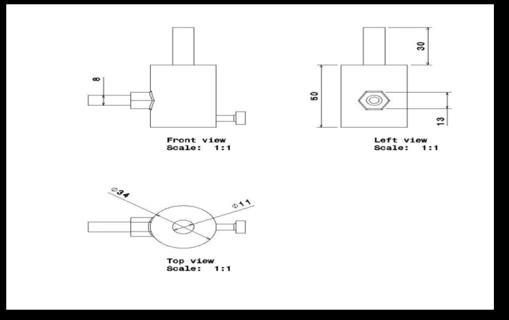
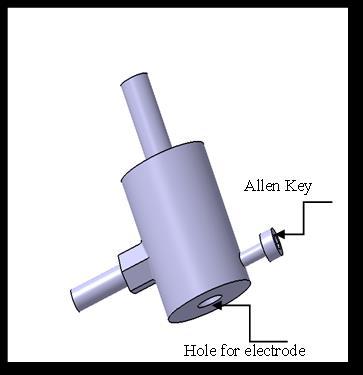
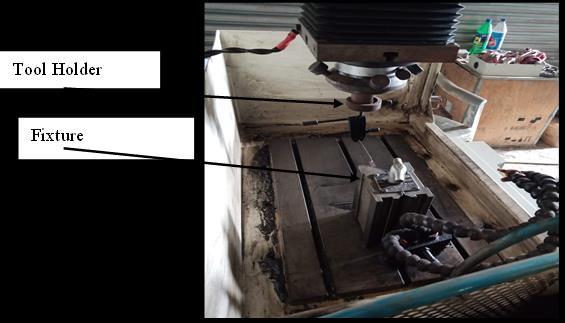
Toholdthetoolandprovidetheleakfreeentryofmist flowandgasfromMQLtoworkpieceisafunctionofthetool holder. It is an important part of external attachments of machine.Thetoolholderisahollowcylindricalpartanditis fitted in collet chuck of spindle. To fit the electrode, tool holderhasinternalthreadsandthetoolasexternalthreads sotheyaretightwitheachother.
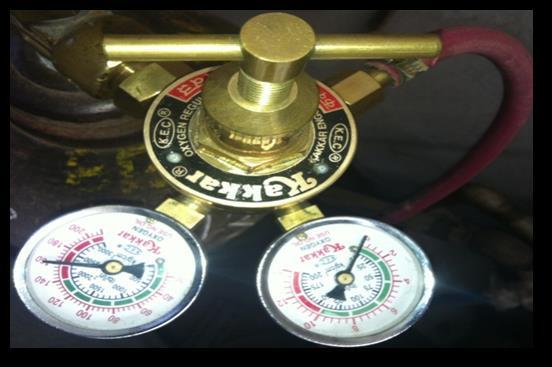
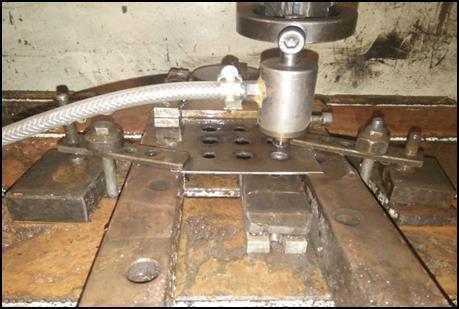
Working tank with work holding device: Theworkingtankandfixtureforholdingtheworkpieceis shown in fig.All thedistilledwater iskeptinthe working tankandwhichisusedtosupplythefluidduringtheprocess ofmachining.Theminimum quantitylubrication(MQL) is connectedwithtankwhichmakesthemistflowofdielectric foruseofneardryEDMprocess.Thefixtureisalsoshown which holds the workpiece properly. The working tank is mounted ontable whichreciprocates in X Ydirectionthis movementisprovidedmanually.
2. It shows the lower tool wear rate (TWR) in machiningprocesses
1. DevelopmentofdryEDMsetup.
Figure: Tank and fixture Tool holder modelling & details
International Research Journal of Engineering and Technology (IRJET) e ISSN: 2395 0056 Volume: 09 Issue: 01 | Jan 2022 www.irjet.net p ISSN: 2395 0072 © 2022, IRJET | Impact Factor value: 7.529 | ISO 9001:2008 Certified Journal | Page1012
3. Analysis of response variables using Minitab software.
Phase V: AnalysisofresponsevariablesAndOptimizationof multipleresponsevariablesusingGRA.
OBJECTIVE:
Figure: (a) Modelling of Tool Holder and (b) Drawing of Tool Holder
Figure: Working phase
METHODOLOGY:
4. Optimizationofmultipleresponsevariablesusing Greyrelationalanalysis.
3. ImprovementinMRRandOptimizedTWR.
4. Improvementinsurfacequalityandtopography.
2. Identification of response variables such as tool wearrate(TWR)materialremovalrate(MRR).
5. ImprovementinProductionRate.
PROPOSED WORK: Incurrentresearchworkfollowingaretheobjectives:
(a) (b)
CONCLUSIONS AND FUTURE SCOPE:
Present dissertation work has performed for drilling operation by dry EDM process. The experiments were performedusingTaguchimethodofdesignofexperiments. AnalysiswascarriedoutusingMinitab16software.Thefinal experiments were performed on bright mild steel work material,forthreeresponsevariablessuchasMRR,TWRand SR.Threeprocessparameterswereselectedsuchascurrent, pulseontimeanddielectricpressure. In this work, experimental evaluation of dry electrical dischargedrillingwascarriedout.Thisstudyhasrevealed variouscharacteristicsofdryEDMprocessbymeasurement ofMRR,TWRandSR.
BIOGRAPHIES: Mr. Shreyas Satish Vathare. (BachelorofMechanicalEngineering, Dr. J.J. Magdum College of Engineering, Jaysingpur(416 Location: Sangli
101),MH,India)
International Research Journal of Engineering and Technology (IRJET) e ISSN: 2395 0056 Volume: 09 Issue: 01 | Jan 2022 www.irjet.net p ISSN: 2395 0072 © 2022, IRJET | Impact Factor value: 7.529 | ISO 9001:2008 Certified Journal | Page1013
(416416),MH,India