
COMPENSATION OF REACTIVE POWER AND ENERGY SAVING USING CAPACITOR BANKS

Page 1

International Research Journal of Engineering and Technology (IRJET)

e-ISSN: 2395-0056

Volume: 09 Issue: 01 | Jan 2022

p-ISSN: 2395-0072

www.irjet.net

COMPENSATION OF REACTIVE POWER AND ENERGY SAVING USING CAPACITOR BANKS Dr. S Mani Kuchibhatla1, V V Sai Likhitha2, Suruvu Vinay3, Avula Narendar4 1-4Department of Electrical and Electronics Engineering, Jawaharlal Nehru Technological University, Hyderabad, Telengana Department of Electrical and Electronics Engineering, ACE Engineering College, Ghatkesar, Telengana ---------------------------------------------------------------------***----------------------------------------------------------------------

Abstract- Reactive power management is a critical problem when commerce with the planning and operation of power systems with high wind energy infiltration. This paper is envisioned to present a synchronized reactive power planning approach using capacitor banks. According to this approach instead of using the reactive power limit as it is customarily done, the reactive power inoculation from static var compensator (SVC) is related to the standing physical limits of the control variables. The capacitor banks shall comprise a series of single-phase capacitor units suitably planned for the essential total amount of reactive power for the specified frequency and voltage. The guaranteed minimum values of losses of the capacitor units shall include losses due to discharge resistors which shall be mounted inside each unit to discharge each unit from peak voltage to maximum 75 V in less than 10 minutes. Internal fuses shall be provided in order to limit possible failure to a single capacitor element only. By reactive power compensation using capacitor banks can regulate the energy and diminish the consumption of electricity. This work is implemented using MATLAB.

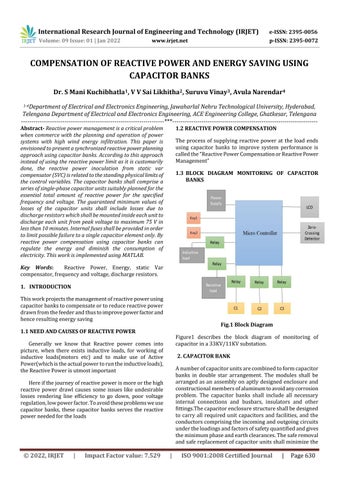
1.2 REACTIVE POWER COMPENSATION The process of supplying reactive power at the load ends using capacitor banks to improve system performance is called the “Reactive Power Compensation or Reactive Power Management” 1.3 BLOCK DIAGRAM MONITORING OF CAPACITOR BANKS

Key Words: Reactive Power, Energy, static Var compensator, frequency and voltage, discharge resistors. 1. INTRODUCTION This work projects the management of reactive power using capacitor banks to compensate or to reduce reactive power drawn from the feeder and thus to improve power factor and hence resulting energy saving

Fig.1 Block Diagram

1.1 NEED AND CAUSES OF REACTIVE POWER

Figure1 describes the block diagram of monitoring of capacitor in a 33KV/11KV substation.

Generally we know that Reactive power comes into picture, when there exists inductive loads, for working of inductive loads(motors etc) and to make use of Active Power(which is the actual power to run the inductive loads), the Reactive Power is utmost important

2. CAPACITOR BANK A number of capacitor units are combined to form capacitor banks in double star arrangement. The modules shall be arranged as an assembly on aptly designed enclosure and constructional members of aluminum to avoid any corrosion problem. The capacitor banks shall include all necessary internal connections and busbars, insulators and other fittings.The capacitor enclosure structure shall be designed to carry all required unit capacitors and facilities, and the conductors comprising the incoming and outgoing circuits under the loadings and factors of safety quantified and gives the minimum phase and earth clearances. The safe removal and safe replacement of capacitor units shall minimize the

Here if the journey of reactive power is more or the high reactive power drawl causes some issues like undesirable losses rendering line efficiency to go down, poor voltage regulation, low power factor. To avoid these problems we use capacitor banks, these capacitor banks serves the reactive power needed for the loads

© 2022, IRJET

|

Impact Factor value: 7.529

|

ISO 9001:2008 Certified Journal

|

Page 630


Turn static files into dynamic content formats.
Create a flipbook