International Research Journal of Engineering and Technology (IRJET)
e-ISSN: 2395-0056
Volume: 08 Issue: 01 | Jan 2021
p-ISSN: 2395-0072
www.irjet.net
WIRELESS SENSOR NETWORKS: A SURVEY ON RECENT ALGORITHMS AND TECHNIQUES Prof. Atul Pawar1, Sharvari Gaikawad2, Saurabh Ghewande3, Uday Kale4 , Rushikesh Sumbe5 1Professor,
Department of Computer Science and Engineering, PCCOE, Pune, India Department of Computer Science and Engineering, PCCOE, Pune, India ---------------------------------------------------------------------***---------------------------------------------------------------------2,3,4,5Student,
Abstract - It's captivating how Wireless Sensor Networks (WSNs) play a major role in revolutionizing the world by its sensing technology.
The research interest in WSNs has increased as a result of the potential for their widespread use in many different arenas. Those which include right from home automation, security and environmental monitoring to confidential sectors like military surveillance and many more. Despite the successes gained, the widespread adoption of WSN’s particularly in remote-inaccessible places where their use is most beneficial is hampered for various reasons. The major challenge being the "inefficiency in energy consumption"! This paper, introduces different aspects to improvise the lifetime network and efficiency of the network. Insights are given to various other energy management schemes and approaches that include variations in clustering and routing of data. It also provides a brief and simulated study of different techniques and algorithms in the field of WSNs. This paper contributes in a fashion about introducing the WSNs in different sectors of its operation and reflecting its significance.
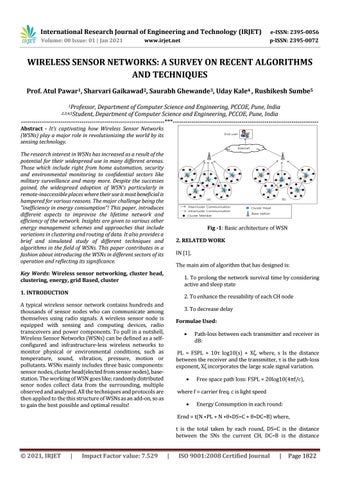
Fig -1: Basic architecture of WSN 2. RELATED WORK IN [1], The main aim of algorithm that has designed is:
Key Words: Wireless sensor networking, cluster head, clustering, energy, grid Based, cluster
1. To prolong the network survival time by considering active and sleep state
1. INTRODUCTION
2. To enhance the reusability of each CH node
A typical wireless sensor network contains hundreds and thousands of sensor nodes who can communicate among themselves using radio signals. A wireless sensor node is equipped with sensing and computing devices, radio transceivers and power components. To pull in a nutshell, Wireless Sensor Networks (WSNs) can be defined as a selfconfigured and infrastructure-less wireless networks to monitor physical or environmental conditions, such as temperature, sound, vibration, pressure, motion or pollutants. WSNs mainly includes three basic components: sensor nodes, cluster head(elected from sensor nodes), basestation. The working of WSN goes like; randomly distributed senor nodes collect data from the surrounding, multiple observed and analyzed. All the techniques and protocols are then applied to the this structure of WSNs as an add-on, so as to gain the best possible and optimal results!
3. To decrease delay Formulae Used:
Path-loss between each transmitter and receiver in dB:
PL = FSPL + 10τ log10(s) + Xζ, where, s Is the distance between the receiver and the transmitter, τ is the path-loss exponent, Xζ incorporates the large scale signal variation.
Free space path loss: FSPL = 20log10(4πf/c),
where f = carrier freq. c is light speed
Energy Consumption in each round:
Ernd = t(N ∗PL + N ∗θ∗DS−C + θ∗DC−B) where, t is the total taken by each round, DS−C is the distance between the SNs the current CH, DC−B is the distance
© 2021, IRJET
|
Impact Factor value: 7.529
|
ISO 9001:2008 Certified Journal
|
Page 1822