IRJET- A Comparative Study on Convolutional Neural Network and Viola-Jones Algrithm for Faster Face

Page 1

International Research Journal of Engineering and Technology (IRJET)

e-ISSN: 2395-0056

Volume: 07 Issue: 07 | July 2020

p-ISSN: 2395-0072

www.irjet.net

A comparative study on Convolutional Neural Network and Viola-Jones Algrithm for faster Face Recognition Rubeena M M1, Dr.Manish T I2 M.Tech scholar, Dept. Of Computer Science and Engineering, Adi Shankara Institute of Engineering and Technology, Kalady, Kerala, India 2Professor, Dept. Of Computer Science and Engineering, Adi Shankara Institute of Engineering and Technology, Kalady, Kerala, India ---------------------------------------------------------------------***---------------------------------------------------------------------1

the face recognition system further more robust and easy to design face, besides serving because the pre-processing for face recognition, face detection will be used for regionof-hobby detection, re-targeting, video and image.

Abstract - Facial recognition system is a technique to

verify or identify a face from digital image or video. This research field has wide applications from the need of Automatic recognition's, Surveillance systems, Design of human-computer interface etc. These researches implicate knowledge and researchers from areas such as Pattern recognition, Neuroscience, Computer vision, machine learning, Psychology, and Image processing, etc. There are various computer algorithms that are relevant in the discipline of face recognition, but this paper focus on two of the most popular methods: Convolutional Neural Networks and the Viola-Jones algorithm. In this paper, we’ll go through general ideas and structures of face recognition, important issues and finally give a comparison of algorithms.

1.2 Feature Extraction The human-face patches are extracted after the face is detected from images. There are some disadvantages for using these patches directly, first, each patch contains over 1000 pixels, which are too enormous to build a strong recognition system. Second, the face patches may taken from different camera alignments, in distinct illuminations, with various facial expressions or pose and may cause occlusion and clutter of face. To overcome these, feature extraction is done for information packing, dimension reduction, salience extraction, and noise cleaning. Then a face patch is transformed into a vector with fixed dimension or a set of reliable points and their corresponding locations.

Key Words: Face Recognition, Viola-Jones, Convolutional Neural Network (CNN).

1. INTRODUCTION

1.3 Face Recognition

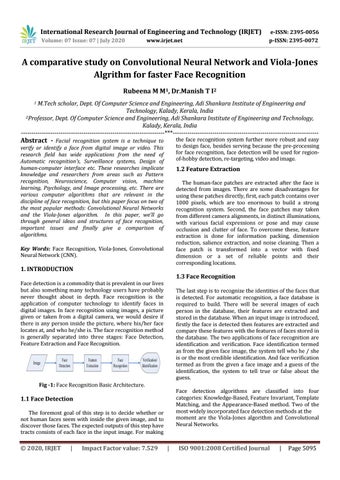
Face detection is a commodity that is prevalent in our lives but also something many technology users have probably never thought about in depth. Face recognition is the application of computer technology to identify faces in digital images. In face recognition using images, a picture given or taken from a digital camera, we would desire if there is any person inside the picture, where his/her face locates at, and who he/she is. The face recognition method is generally separated into three stages: Face Detection, Feature Extraction and Face Recognition.

The last step is to recognize the identities of the faces that is detected. For automatic recognition, a face database is required to build. There will be several images of each person in the database, their features are extracted and stored in the database. When an input image is introduced, firstly the face is detected then features are extracted and compare these features with the features of faces stored in the database. The two applications of face recognition are identification and verification. Face identification termed as from the given face image, the system tell who he / she is or the most credible identification. And face verification termed as from the given a face image and a guess of the identification, the system to tell true or false about the guess.

Fig -1: Face Recognition Basic Architecture.

Face detection algorithms are classified into four categories: Knowledge-Based, Feature Invariant, Template Matching, and the Appearance-Based method. Two of the most widely incorporated face detection methods at the moment are the Viola-Jones algorithm and Convolutional Neural Networks.

1.1 Face Detection The foremost goal of this step is to decide whether or not human faces seem with inside the given image, and to discover those faces. The expected outputs of this step have tracts consists of each face in the input image. For making

Š 2020, IRJET

|

Impact Factor value: 7.529

|

ISO 9001:2008 Certified Journal

|

Page 5095


Turn static files into dynamic content formats.
Create a flipbook
Issuu converts static files into: digital portfolios, online yearbooks, online catalogs, digital photo albums and more. Sign up and create your flipbook.
IRJET- A Comparative Study on Convolutional Neural Network and Viola-Jones Algrithm for Faster Face by IRJET Journal - Issuu