
IRJET- Effect of Soil Structure Interaction on Seismic Performance of Step Back Building Resting on

Page 1

International Research Journal of Engineering and Technology (IRJET)

e-ISSN: 2395-0056

Volume: 07 Issue: 07 | July 2020

p-ISSN: 2395-0072

www.irjet.net

Effect of Soil Structure Interaction on Seismic Performance of Step Back Building Resting on Sloping Ground Sanjaykumar D. Rachcha1, Dr. Jigar K. Sevalia2 1P.G.

student, Sarvajanik College of Engineering and Technology, Surat, Gujarat, India Sarvajanik college of Engineering and Technology, Surat, Gujarat, India ---------------------------------------------------------------------***---------------------------------------------------------------------2Professor,

Abstract - On sloping ground, construction of framed

structure is adopted either step back or step back and set back configuration. Due to varying in height of column towards slope and also these buildings are unsymmetrical in nature, hence attract large amount of forces like shear forces, Bending moments, torsional moments and unequal distribution. Over the years, it has been extensively established that the practice of assuming structure being fixed at the base which may leads to errors in evaluation during dynamic loading. These errors are mainly depend on type of soil at the base. To capture the real behaviour of R.C.C framed building resting on slope, in this paper Response spectrum analysis has been carried out to study the effect of soil structure interaction (SSI) on seismic performance of R.C.C framed building of G+5(step back system) with under laying soil types (Hard, Medium and soft soil) and variation in angle of slope from 100 to 400 by using ETABS software. The Building shall be also analyzed with shear wall with respect to various slope of ground and soil type. The results shall be analyzed in the form of base shear, bending moment, torsional moment, time period, storey displacement and storey drift.

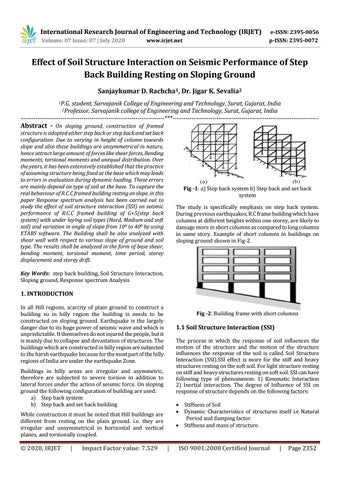
Fig -1: a) Step back system b) Step back and set back system The study is specifically emphasis on step back system. During previous earthquakes, R.C frame building which have columns at different heights within one storey, are likely to damage more in short columns as compared to long columns in same story. Example of short columns in buildings on sloping ground shown in Fig-2.

Key Words: step back building, Soil Structure Interaction, Sloping ground, Response spectrum Analysis

1. INTRODUCTION In all Hill regions, scarcity of plain ground to construct a building so in hilly region the building is needs to be constructed on sloping ground. Earthquake is the largely danger due to its huge power of seismic wave and which is unpredictable. It themselves do not injured the people, but it is mainly due to collapse and devastation of structures. The buildings which are constructed in hilly region are subjected to the harsh earthquake because for the most part of the hilly regions of India are under the earthquake Zone.

Fig -2: Building frame with short columns

1.1 Soil Structure Interaction (SSI) The process in which the response of soil influences the motion of the structure and the motion of the structure influences the response of the soil is called Soil Structure Interaction (SSI).SSI effect is more for the stiff and heavy structures resting on the soft soil. For light structure resting on stiff and heavy structures resting on soft soil. SSI can have following type of phenomenon: 1) Kinematic Interaction 2) Inertial interaction. The degree of Influence of SSI on response of structure depends on the following factors:

Buildings in hilly areas are irregular and asymmetric, therefore are subjected to severe torsion in addition to lateral forces under the action of seismic force. On sloping ground the following configuration of building are used: a) Step back system b) Step back and set back building

 Stiffness of Soil  Dynamic Characteristics of structures itself i.e Natural Period and damping factor.  Stiffness and mass of structure.

While construction it must be noted that Hill buildings are different from resting on the plain ground. i.e. they are irregular and unsymmetrical in horizontal and vertical planes, and torsionally coupled.

© 2020, IRJET

|

Impact Factor value: 7.529

|

ISO 9001:2008 Certified Journal

|

Page 2352


Turn static files into dynamic content formats.
Create a flipbook